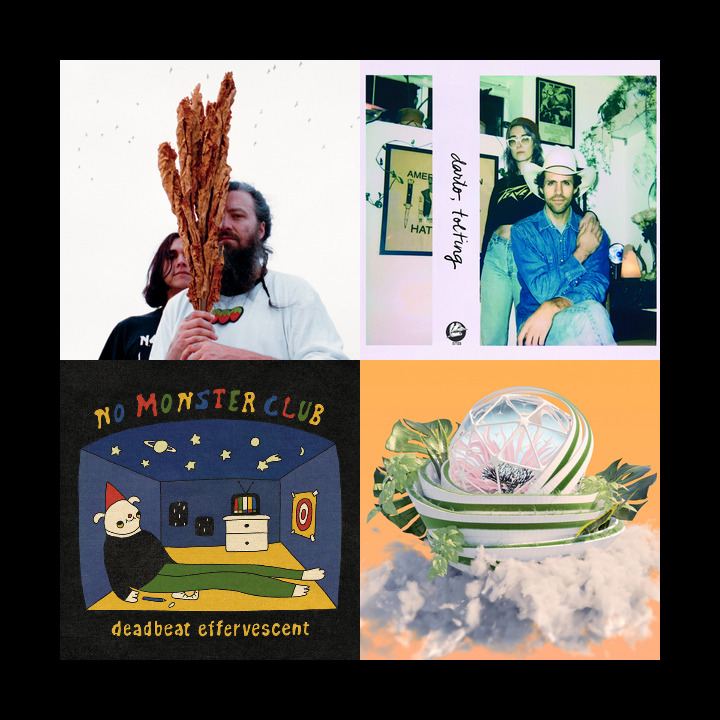
More new music? Yes. This Pressing Concerns covers new albums from OMBIIGIZI and No Monster Club, the debut EP from Tomato Flower, and the recent Darto compilation. Rosy Overdrive’s January 2022 playlist also went up this week, so things are pretty busy ’round here.
Release date: February 10th Record label: Arts & Crafts Genre: Indie rock, “Moccasin-gaze” Formats: Vinyl, digital Pull track: Ookwemin
OMBIIGIZI is a collaboration between Adam Sturgeon of Status / Non Status and Daniel Monkman of Zoon, two Anishnabee artists who already sound in tune to one another on their debut record as a duo, Sewn Back Together. The album covers a lot of ground, from psychedelia to post-rock to dream pop and shoegaze. They cite some relatively off-the-beaten-path indie rock groups like The Sea and Cake and Eric’s Trip offshoot Elevator as inspiration, both of which I hear in the refreshing noise Sturgeon and Monkman make together. As sonically interesting as Sewn Back Together is, the record still feels lyrics-forward (or, at least, message-forward); some of the songs repeat a line or two hypnotically to drive things home, and some of the record’s wordier tracks necessitate (and are granted) breaks in the clouds.
Sewn Back Together opens with two songs that cover each of these aforementioned tactics—opening track “Ookwemin” is a meditative, dreamy entrance into the record, reminding me of “Find a Home” from the most recent Status / Non Status record, hovering on a few words and images in a tribute to Monkman’s late father, before the straightforward “Residential Military” lets its evocative lyrics ride up front. What follows are a few tracks that either fall into the vein of the record’s opening track (such as “Yaweh”) or its second one (like “Spirit in Me”), but with some left turns, like the vocal effects in “The Once Child” and in the closing of exhale “Zaagitoon”.
Sewn Back Together’s penultimate track, “Birch Bark Paper Trails”, is one of the most fascinating songs on the album. The climax of the record, it revisits the clear-eyed loud rock of “Residential Military” with more urgency, building up its tension with stop-starting guitar blasts. Veering between sinewy, almost-mathy rock and dreamier interludes, the song ends with a lengthy spoken word passage by Sturgeon that makes explicit and hammers home the familial bonds that show up in several of the record’s songs (“Ookwemin”, “Ogiin”, and “Spirit in Me”, most prominently). The words of “Birch Bark Paper Trails” find Sturgeon searching the Internet, registries, and archives for details on the past, the past of family, forefathers, his past—it is not the song from which the title Sewn Back Together is taken, but it’s perhaps the clearest instance of what OMBIIGIZI mean by it on the record. (Bandcamp link)
No Monster Club – Deadbeat Effervescent
Release date: February 11th Record label: Emotional Response/Popical Island Genre: Pop rock, twee, jangle pop Formats: Vinyl, digital Pull track: Save the Circus
Pulling a few indie rock subgenres together probably tells you less about what Dublin’s No Monster Club sound like than simply mentioning that they’re led by somebody who calls himself Sir Bobby Jukebox. I could say that their latest record, Deadbeat Effervescent, is “fully committed to taking the listener on a big, colorful pop-rock journey” or something, or just point out that its lead single is called “Save the Circus” and lives up to its title. Or that the song that succeeds it, “Black & White”, confidently deploys steel drums and chugging power chords in equal measure—and it’s just the first song of several to prominently utilize that arresting choice in percussion.
No Monster Club ends up reminding me more than anything of unsung indie pop hero Nick Thornburn of Islands and The Unicorns, alike both in their devotion to lighthearted and fun posturing (something underrepresented in modern indie rock, to be sure) and in the way that their influences remind me that any music they make is technically “island music” (Vancouver Island for Thorburn, Ireland for No Monster Club). Deadbeat Effervescent is a record with plenty of bells and whistles—aside from the aforementioned steel drums, we also get the bugle that introduces (of course) “A Bugle Call”, the brass marching of “The Trundling Path”, and the kiddie music tones and literal whistle on “Spaceman’s Gold”.
None of these choices end up excessive, though—or maybe they are excessive, in a good way. Whichever it is, there’s plenty going on beneath the surface sheen of these songs—“Save the Circus” is one dagger of a pop song from pretty much every angle, and the skittering surf-pop tune that follows the intro of “A Bugle Call” is another. Mr. Jukebox and company can’t resist combining effectively all of their tricks at the end of Deadbeat Effervescent; album closer “Walk the Plank” trots out a call-and-response hook, a steady, restrained power pop guitar line, siren synths, and several Stephin Merritt-worthy instrumental pop flourishes. All that, and it’s still genuinely surprising to me that it’s six minutes long. There must be some kind of Bermuda Triangle time warp going on there. (Bandcamp link)
Darto – Tolting
Release date: February 4th Record label: Slow Thrive Genre: Noise rock, post-punk Formats: Cassette, digital Pull track: Bottom Floor
The Snoqualmie Valley, Washington-originating duo of Darto have been making music together under that name since 2009—and the half-siblings who comprise the band, Candace Harter and Nicholas Merz, have played together for even longer than that. Their Pacific Northwest origins, frequently noisy and insular music, and the monotone male/female vocal interplay between Harter and Mertz all make Unwound comparisons fairly obvious. Darto dive a little further than that, though, as evidenced by the career-spanning cassette Tolting. The compilation’s sixteen songs come from various singles and non-album tracks spanning across the first decade of Darto’s existence (2009-2019).
Tolting opens with the dark, pounding “Bottom Floor”. It’s noise rock at its screechy best—only to be counterbalanced one track later by the minimalist psychedelia of “Fundamental and Slyme”. The mood effectively set, Tolting then begins its substantial survey of the music of Darto. A few of the tape’s tracks jump out immediately as highlights: the all-too-brief Harter-led noise pop of “World’s Worth”, the whispery slowcore of “Bay Area Man”, the slinking indie rock of “Pontius Pilot”, and a wall-of-sound epic in “Rite” that’s hidden towards the end. Repeated listening starts to reveal the merit of some of the “odder” tracks—like the way “Aging” marries a friendly synthpunk instrumental to one of Merz’s more unhinged deliveries, or the odd calm at the center of the droning “Apostate”. Tolting is a maze to get lost in. (Bandcamp link)
Tomato Flower – Gold Arc
Release date: February 11th Record label: Ramp Local Genre: Indie pop, psych pop, avant pop Formats: Digital Pull track: Red Machine
The psychedelic pop rock of Tomato Flower covers a lot of ground on their debut EP Gold Arc—one minute it’s lighter than air, moments later they’re pulling together something layered and busy. I probably could’ve guessed they’re from Baltimore. The group (a trio at the time of recording, now already a four-piece band) comes off a little more grounded in rock than more electronica-based groups from their base city, but more synth-friendly than most of their other forebearers—namely the more polished side of Elephant Six, and clear-eyed, harmony-heavy 2000s indie rock.
Gold Arc opens with about as friendly an entry point as one could hope for in the delicate, melody-driven “Red Machine”, and the stop-start “World to Come” isn’t far behind it in that department. The sub-90-second “Stone” is the other track that captures this side of Tomato Flower, further streamlining their take on indie rock down to swirling, spidery guitar work. They do this very well, and these songs are probably the EP’s clear highlights, but the songs that push a bit—the surprisingly amped-up psych-rock blast of “Truth Lounge” and the odyssey of closing track “Shying”, which turns Gold Arc’s core sound on its head—are what help the EP feel longer than its brief 13 minutes. (Bandcamp link)
Rosy Overdrive’s January overview is going up a week into February, but that’s pretty par for the course, and one can’t rush perfection. Or playlists. There are fewer songs on this one, mostly because two of them push ten minutes, and the December/January playlists are always a little weird, but there’s no dip in quality here.
Artsick is the only band with more than one track on the playlist this time around (they’ve got two), but there are three different Silkworm-related songs on here spread across three separate projects.
You can hear the entire thing on Spotify here, and I’ve also added other options for the first time, in light of recent events: BNDCMPR, and Tidal. Neither of these are perfect, as they are each missing a couple of songs (noted in their respective descriptions), but it’s a start. Be sure to check out previous playlist posts if you’ve enjoyed this one.
“You Gave Me the Key”, Julie Doiron From I Thought of You (2021, You’ve Changed)
There are only so many hours in the day. I know a lot of people love Julie Doiron’s music, and I expect I would/will like it when I get around to listening to more of it. I Thought of You is a good album, so I suppose I’m already on my way. “You Gave Me the Key” kicks it off, and it’s a great song. It’s under the three minute mark and somehow feels even shorter, like Doiron distilled the country-rock side of her music to its barest parts but without losing anything. I hear some Daniel Romano (who plays several instruments on the record and is her You’ve Changed labelmate) in the music, and Doiron’s lyrics here could work just as well on a sparse folk tune as this one’s bouncy retro feel. How Canadian of them.
“When Can I See You Again?”, Kids on a Crime Spree From Fall in Love Not in Line (2022, Slumberland)
Bay Area noise pop trio Kids on a Crime Spree open their debut LP with a bang with the chiming march of “Karl Kardel Building”, and then kick it into high gear with the runaway train of “When Can I See You Again?” Like the best moments of Fall in Love Not in Line, the brisk song balances the delicate lead vocals of songwriter Mario Hernandez with the rest of the group’s tuneful squall. Read more about Fall in Love Not in Line here.
“Hangover Game”, MJ Lenderman From Boat Songs (2022, Dear Life)
Another couple of months, another step forward for Jake Lenderman. Last year brought the glorious lo-fi country mess of Ghost of Your Guitar Solo, and then the rounding-into-shape Knockin’ EP not much long after. The lead single from Lenderman’s next record, April’s Boat Songs, follows the line. “Hangover Game” feels as fleshed-out as any of Knockin’s five songs, but even slicker and harder-rocking. The instrumental that roars in the lyrical breaks and the surprising ascending-chord thing going on in the refrain feels like Lenderman taking a page from his other band, Wednesday, but the core is vintage MJ Lenderman. “Hangover Game” is about (what else) the alleged Michael Jordan Flu Game, which I’m surprised it took Lenderman this long to tackle in song form. Yeah, I like drinking too. Read more about Boat Songs here.
“Getting Warmer”, Party’z From Party’z (2022)
An offshoot of the ace Chicago emo band Kittyhawk, the debut EP from Party’z is, somewhat surprisingly, an electric record of amp-cranked, fuzzy power pop. Opening track “Getting Warmer” kicks Party’z off with the sound of a guitar plugging in and subsequently sprays the listener with feedback, before a soaring instrumental marked by heavy reverb, Delia Hornik’s melodic keyboard, and Mark Jaeschke’s earnest vocals takes shape. Read more about Party’z here.
“Five Hearts Breaking”, Alejandro Escovedo From Gravity (1992, Watermelon)
Gravity is such a great debut album, isn’t it? Of course, Alejandro Escovedo had been making music for quite some time before he began his solo career, so I’m sure that helped. “Paradise” is on a playlist I made a few years ago that I might get to on this website eventually, but upon revisiting it for the first time in awhile, “Five Hearts Breaking” is the one that really stuck out to me. It’s as sharp a tune as any Escovedo has written, and one of the ones that reminds you of how singular a talent he is. It’s a good example of why his music been called “punk” and “country” over his career, even though this particular song sounds like neither.
“I Feel Fine”, Reptaliens From Multiverse (2022, Captured Tracks)
For their third record, Portland, Oregon’s Reptaliens upped the guitar intake of their casually futuristic lounge-pop, as the steady downstroked electric guitar and shuffling drumbeat that confidently announce album opener “I Feel Fine” exemplify. It’s a dose of six-string clarity, with singer Bambi Browning’s sung-spoken melody grounding the song as much as does the music. Read more about Multiverse here.
“The Brain”, Silkworm From Italian Platinum (2002, Touch and Go)
“The Brain” is one of those subtle masterpiece Silkworm songs. It’s not as immediately attention-grabbing as, say, “I Hope U Don’t Survive” from the same record, but the more one listens to it, the greater it sounds. Tim Midyett’s songs in particular are likely to fall into this camp. Midyett is a vocal fan of Jamaican music, and I can hear its influence especially in “The Brain”’s choppy main guitar part. Aided in large part by Matt Kadane’s keyboard, this is one of Silkworm’s more “new wavey” moments. But mostly, it’s just another great Silkworm song. Read more about Silkworm here.
“Milk Crates”, Pigeon Pit From Feather River Canyon Blues (2022, Reach-Around)
“Milk Crates” and, indeed, Feather River Canyon Blues as a whole, takes me back. It’s an album made in the spirit of early Against Me! and the Mountain Goats, and reminds me of getting rocked by the actually good folk punk groups like Defiance Ohio and Nana Grizol (although Nana Grizol is still around and still good). Pigeon Pit’s Lomes Oleander leads, with the exception of an endearing false start, a nonstop, extremely potent survival singalong anthem that’s already more than won me over by the time she gets to the ending refrain that gives the song its name. “No fucked up world to drown out,” indeed.
“She’s Evil”, Guv’ner From The Hunt (1996, Merge)
Guv’ner were 90s indie players. They were a New York band with connections to Sonic Youth and Pussy Galore (without sounding particularly like either) and released a couple records on Merge before dissolving completely. One of the singers was named Pumpkin Wentzel, and she had a line of maternity clothes sometime after the band’s demise. None of this really has anything to do with “She’s Evil”, an instantly-great indie pop song that still deserves to be heard in 2022, even if it takes the pushing of people like me who spend their free time searching stuff like this out. Listen to that chorus harmony!
“Freon Dumb”, Zinskē From Murder Mart (2022)
The upcoming debut record from Philadelphia’s Zinskē takes the infinitely familiar (to me) tools of 90s indie rock and builds something thorny and intricate out of them. The latest single from Murder Mart, “Freon Dumb”, is a pretty good example—it starts with some tough, catchy downstroked power chords and rolls out some restrained but sharp alt-rock underneath of lead singer Chris Lipczynski’s dark sung-spoken vocals. Read more about Murder Mart here.
“The Spaces in Between”, 40 Watt Sun From Perfect Light (2022, Cappio/Svart)
Yes, I put this ten-minute song right in the middle of this playlist. You’re not going to avoid it that easily. Trust me, you want to hear this one. I was partially drawn to 40 Watt Sun’s Perfect Light because the album artwork and group name reminded me of Mark Eitzel’s 60 Watt Silver Lining, and, well—the record doesn’t disappoint on this front. Patrick Walker, the mind behind 40 Watt Sun, apparently has a doom metal past, but Perfect Light is all gorgeously ornate, heartbreaking slowcore. Most of the record’s eight songs stretch beyond eight minutes long; “The Spaces in Between” isn’t even the longest one. It just might be the best one, though—Walker’s vocals are strong but vulnerable, the piano and guitar quiet but insistent.
“Oh, No”, Russel the Leaf From My Street (2022, Records from Russ)
“Something’s been wrong with my mind for a long, long time,” Russel the Leaf’s Evan Marré announces loudly at the beginning of “Oh, No”, a highlight from January’s My Street. Marré doesn’t let up from there: what follows is a go-for-broke starry-eyed power pop song about how everything is going wrong (“Haven’t you seen me today—I’m the mess of the week”, goes another memorable line) that’s both catchy and cathartic. Read more about My Street here.
“Ain’t That Easy”, D’Angelo From Black Messiah (2014, RCA)
From what I recall, I think D’Angelo’s Black Messiah got a little bit a critical acclaim. Something about slowly becoming one of the most longed-for and vainly-anticipated records of the century so far and then meeting or even surpassing those expectations. Maybe. Truthfully, “Ain’t That Easy” is just here because I like that one guitar part. Okay, it’s not just that, even though that would be on-brand for me. There’s also the matter of Pino Pallandino’s bass playing, which I obviously can’t ignore, and D’Angelo and Questlove’s weird mix of percussion, which I can ignore even less.
“Stress Bomb”, Artsick From Fingers Crossed (2022, Slumberland)
A rising figure in twee and indie pop/punk, Christina Riley’s latest project Artsick has melody and energy in no short supply. Fingers Crossed is a sharp record that nicely positions itself along the likes of Tiger Trap, Boyracer (of which Riley is also a member), and plenty of groups on their home of Slumberland Records. “Stress Bomb” threads sweetness (like the way Riley delivers the hook-bomb of the title) and darkness (like the droll way Riley requests “just shoot me” as the stress takes hold) with the best of them. Read more about Fingers Crossed here.
“Apology Accepted”, Joel R.L. Phelps and the Downer Trio From Inland Empires (2001, Moneyshot/12XU)
Joel R.L. Phelps’ mostly-covers release Inland Empires is one of his more difficult records, but it does contain something of a reprieve in his version of the Go-Betweens’ “Apology Accepted”. It’s probably the most upbeat that Phelps and his aptly-named backing band, The Downer Trio, ever sounded—acoustic guitar strums and what sounds like a light accordion backing warmly shade Phelps’ vocals, which are never going to sound joyful but can compromise with “wistful”. Read more about Joel R.L. Phelps here.
“Brushstrokes”, Maxwell Stern & Gordon M. Phillips From You Are With Me (2021, Alchemy Hours)
I missed Maxwell Stern and Gordon M. Phillips’ collaborative You Are with Me EP when it came out in November, and when I did become aware of it, I was too preoccupied with Phillips’ one-off single “The Hotel” to give it proper attention, but it’s worth circling back to now. Like “The Hotel”, it pulls Phillips away from the cinematic post-rocky emo of his band Downhaul to folk/country/”Americana”; the storytelling in “Brushstrokes” confirms this as a natural fit. One of the two Phillips-penned and sung songs on the EP (I need to check out Stern/his band Signals Midwest, his material is good here too), “Brushstrokes” features Phillips taking a backseat to the gold-toothed man with whom he shares a brief but song-worthy conversation. Like “The Hotel”, it’s a puzzle, but a less dire one—it seems unlikely the events in the song have changed the trajectory of anything one way or the other.
“Version of You”, Heart Shaped From No Contact (2022, Poison Moon/Unique Technique)
The latest release from Poison Moon Records is a single from the Belfast-based group Heart Shaped, led by Texas native Kendall Bousquet. I wrote about that label’s last offering, K. Campbell’s sharp power pop “Breaking Glass” single, a few month ago, and while Bousquet’s writing is no less catchy, it deals in different sonic terrain. Although copious reverb and Bousquet’s airy vocals mark “Version of You” as “dream pop”, Heart Shaped sound wide awake and in control throughout. Bouqsuet’s backing band gives the song a spirited reading, and the prominent melodic lead guitar truly makes the track.
“Self-Portrait in a Convex Mirror” (Radio Edit), Jeff Tobias From Recurring Dream (2022, Strategy of Tension)
Multi-instrumentalist Jeff Tobias has played in bands like Sunwatchers and Modern Nature; his debut “pop” album as a solo artist both takes advantage of and streamlines his various talents. Recurring Dream’s closing track, “Self-Portrait in a Convex Mirror”, is a great example; it builds to a chirping synthpop climax, but spends plenty of time gliding along a simple, mid-tempo propulsive groove that it feels like it could go on forever. Read more about Recurring Dream here.
“Memory Tone”, Anton Barbeau From Manbird (2020, Gare du Nord)
Anyone who follows Rosy Overdrive because of its namesake likely recognizes the name of Anton Barbeau thanks to his work with the late Scott Miller. If you (like me) haven’t been keeping fully abreast of Barbeau’s recent output, you should be pleased to learn that he’s been both prolific (he’s released three records since 2020) and ambitious—which brings us to Manbird. A double-album concept album inspired by Barbeau’s many “homes” of California, Berlin, and Oxford, Manbird stretches Barbeau’s shape-shifting power pop to impressive limits. My favorite track from it, “Memory Tone”, is a subtle but fascinating blend of classic guitar pop, glam, and piano rock, even getting a little Prince in the bridge.
“Sleeping/Daydreaming”, Onsloow From S/T (2022, How Is Annie/Friend Club)
Onsloow are a Norwegian power pop/pop punk group, and their eight-song debut record feels like it doesn’t waste a moment. I could’ve gone with the chugging “A Good Day to Forget” or the honey/darkness mixture of “Overthinking” for this playlist, but opening track “Sleeping/Daydreaming” just grabbed me too strongly to ignore. It’s hard not to compare them to fellow countrymen Spielbergs, who similarly trade in big, earnest choruses, but Onsloow follow their own path. Lead singer Johanne Rimul sounds not unlike Neko Case (a commanding vocal presence to which I do not compare her lightly), and combined with some showy melodic synths, updates the New Pornographers for the not not emo-influenced indie rock era.
“How It Seems”, treesreach From Time and Time (2022)
Marion, Iowa’s treereach play an earnest, songwriting-first Middle-America style of indie/rock/folk, and their latest single is a triumph in that particular field. It’s a pastoral, lilting instrumental that nevertheless features a soaring chorus led by singer Dillon Rairdin’s spirited vocals that comes out of nowhere. I don’t know if I would’ve figured out that “How It Seems” is about quitting a job without Rairdin explicitly saying so, but maybe it reflects positively on his pop songwriting chops that he can pen lyrics this pointed and confessional-sounding without giving up too much in the body. Midwestern through and through, Rairdin tempers the bold proclamation in the chorus with the title line: “at least that’s how it seems”.
“Teenage Sequencer”, Pedro the Lion From Havasu (2022, Polyvinyl)
The list of singer-songwriters who I will allow to transport me back in time to middle school is very short indeed. If David Bazan wasn’t on it before Havasu, he’s probably somewhere near the top of it now. His latest record with Pedro the Lion sketches the titular Arizona military town in which he lived for a small but pivotal time in his youth. Like 2019’s Phoenix, Pedro stick to an austere rock band sound to call up the desert, but one of my favorite tracks from it is one of the songs that pushes against the setup the most. The cleverly-titled “Teenage Sequencer”, while still keeping its feet planted in rock music, takes the shape of a Headphones/David Bazan-solo era beat-driven track, which somehow elevates Bazan’s distant but tender lyrics recalling a junior high relationship. Everything marches forward, whether the narrator is ready or not.
“Restless”, Artsick From Fingers Crossed (2022, Slumberland)
The opening track of Fingers Crossed presents something of Artsick’s main contradictory driving force—musically, it’s a triumphant gallop, with a steady stomping drumbeat and a great melodic bass undergirding the track, while Christina Riley’s lyrics find herself ennui-gripped and grasping at various methods of dulling the titular emotion over the celebratory instrumental. You can tell Riley is a pop lifer by the way she spins it all together. Read more about Fingers Crossed here.
“Slide Away”, The Dream Syndicate From Out of the Grey (1986, Big Time/Fire)
Recently reissued by Fire Records, 1986’s Out of the Grey found The Dream Syndicate regrouping with an altered lineup and embracing the sharp, classic-rock-indebted side of their music that had always been there. Smack dab in the middle of the album, “Slide Away” is one of the best pure pop moments the band ever put together, all giddy chord changes and melodies everywhere. It could almost pass for a more muscular mid-period R.E.M. song. Read more about Out of the Grey here.
“Rhinelander”, Bottomless Pit From Blood Under the Bridge (2010, Comedy Minus One)
“Rhinelander” is the subtlest track on a record that’s pretty much all subtlety. The underappreciated Blood Under the Bridge is the quiet calm after the pure emotional release of Hammer of the Gods, and the record’s second track is a micro-version of the same in a way, coming after the seven-minute “Winterwind”. The song has no percussion, which allows all of its other elements to cut a little deeper: Tim Midyett’s almost-to-himself vocals, the plodding bass guitar, and a guitar solo that’s far from the Silkworm-verse’s showiest, but still one of its best. Read more about Bottomless Pit here.
“Mary Marionette”, Dwaal Troupe From Lucky Dog (2021)
Dwaal Troupe are a Chicago band that I believe has some personnel overlap with Lifeguard, a group that’s shown up on Rosy Overdrive before. The Lifeguard single I wrote about was a brief jolt of Unwound-esque post-hardcore; Dwaal Troupe’s latest, Lucky Dog, is a sprawling collection of tuneful but lo-fi 90s-style indie rock. “Mary Marionette” is one of my favorite tracks from it; it’s got an almost Flying Nun-ish light psychedelic tinge to it, which is certainly helped by the complete shift the song pulls off deftly in the (I guess?) bridge, but the chorus is as strong and straightforward as could be.
“The Other End of the Telescope”, Elvis Costello & The Attractions From All This Useless Beauty (1996, Warner)
Post-Imperial Bedroom Elvis Costello is, I think, no less spotty for me than the average music writer (although he’s been on a bit of a roll lately). Nevertheless, I still listen to these mid-period records because I’ll find something as good as “The Other End of the Telescope”, the opener to All This Useless Beauty. Why I really like this despite not being able to find anything memorable in 1998’s Painted from Memory I couldn’t quite say, although it being an Aimee Mann co-write probably has something to do with it. In fact, apparently Mann’s band ‘Til Tuesday recorded “The Other End of the Telescope” years before Costello did, which I didn’t know when I selected it for this playlist, but I still think this is the superior version. It wanders more, but it never drifts away from its core.
“Fiscal Weeks”, Heaven’s Cameras From Shutters Firing (2022, Repeating Cloud)
Heaven’s Cameras is the solo project of Lemon Pitch’s Alex Merrill, and the lead single from his record Shutters Firing wastes no time in establishing a distinct sound. “Fiscal Weeks” opens with a classically clear jangle-pop intro before Merrill’s droll vocals come in to counterbalance the guitar. As the somewhat-rudimentary instrumental goes on, it rarely deviates from its initial sound, and the prominent bass guitar plodding underneath it becomes more noticeable. It ends up sounding something like Kurt Wagner or Stephin Merritt fronting one of the bands from Captured Tracks’ 2020 Strum & Thrum compilation, dipping in and out of the picture as he remembers something else he needed to get off of his chest.
“Fall Town”, Brock Winthrop From Pity on a Hill (2016)
Massachusetts’ “puritan pop” project Brock Winthrop takes unlikely inspiration from the deep and obscure religious history of their surrounding New England, as some of their songs’ lyrics and artwork suggest. Instead of the gothic doom-folk or prog-metal one would expect to be wrought from such sources, Pity on a Hill is a quite accessible jangle-pop EP, although songs like “Fall Town” certainly have a dark side. The track marries a squiggly, spooky synth shadow to more traditionally-shimmering guitar arpeggios, and would be remarkably unique even without Winthrop’s oddly specific lyrical concerns.
“Don’t Turn the Light On, Leave Me Alone”, CAN From Soundtracks (1970, Liberty/United Artists)
Like any good 90s indie rock fan, I’ve made a few halfhearted attempts to get into CAN over the years, because, like, you know, all your favorite bands are just stealing from them or whatever. This time I tried Soundtracks, which is seemingly well-regarded but never really spoken of as the pinnacle, and I’d recommend it for people in my position. It’s very digestible, and the one “out-there” track (“Mother Sky”) is a blast, but I’ll pull out “Don’t Turn the Light On, Leave Me Alone”. Apparently the band’s first recording with vocalist Damo Suzuki, it’s a sub-four-minute track that manages to be both jammy and melodic (both in terms of Suzuki’s singing and in the band’s playing).
“All We Wanted Was a Gem That Wouldn’t Fade”, Zaq Baker From This Time It’s Personal (2022)
Zaq Baker’s latest album is titled This Time It’s Personal, and he’s not kidding around. It’s an intimate listen both musically (most of the record’s eight songs find Baker alone with his piano) and lyrically (the introspective turns and interpersonal relationship analyses certainly don’t feel like they’re holding anything back). Baker takes a few self-critical turns on This Time It’s Personal, and “All We Wanted Was a Gem That Wouldn’t Fade” doesn’t necessarily contradict those, but it’s my favorite song from the record in part because it doesn’t view that as a dead end. It’s harder to present subtleties when one performs in Baker’s chosen musical theatre-inspired style, but “All We Wanted Was a Gem That Wouldn’t Fade” does it.
“Note to Self (To Say Goodbye)”, Patrick Brayer From Cabbage and Kings: An Inland Shrimpire Anthology (2022, Shrimper)
Cabbage and Kings is Shrimper Records’ attempt to rectify the surprisingly small number of physical Patrick Brayer records that have come out over the Claremont singer-songwriter’s half-century music career. The album’s seven expansive songs are the sound of a folk singer with nothing to prove but plenty of places left to explore and probe. “Note to Self (To Say Goodbye)” takes over nine of those minutes to complete its stare, but Brayer doesn’t blink the entire way through. Read more about Cabbage and Kings: An Inland Shrimpire Anthology here.
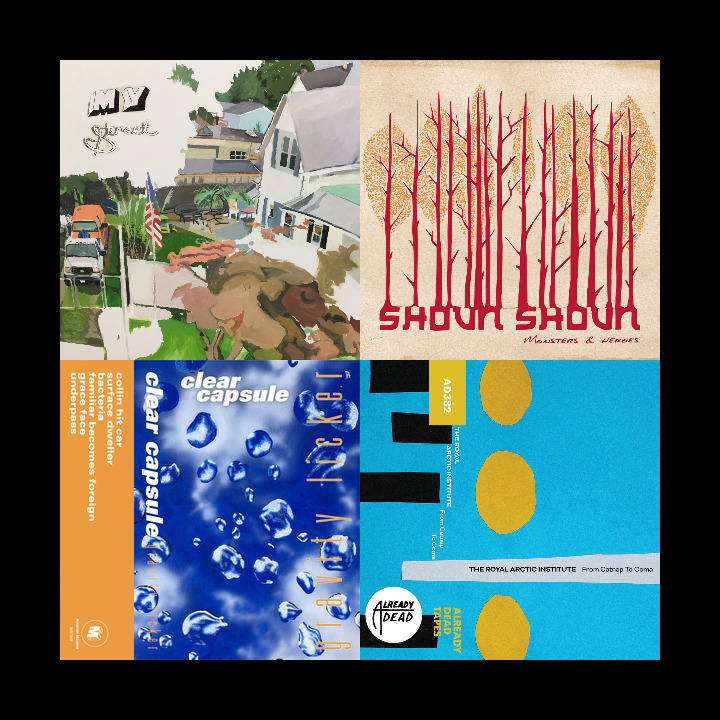
Third Pressing Concerns of 2022! This time around, it features new albums from Russel the Leaf and Shoun Shoun, and new EPs from Clear Capsule and The Royal Arctic Institute. Half of these bands released something in 2021 that appeared in Pressing Concerns as well. Half of them didn’t. All four are good, though. I’m working on the January playlist, which will be a little late–probably next Monday.
Release date: January 22nd Record label: Records from Russ Genre: Power pop, indie pop Formats: Cassette, digital Pull track: Oh, No
Russel the Leaf’s Evan Marré declared his intention to release five records in 2021, and while that didn’t end up happening, he’s been prolific by most other metrics. My Street comes less than a year after last February’s Then You’re Gunna Wanna, which was one of my favorite records of last year, and a few of these songs were previewed a few months ago on the Re-Mix “My Street” EP. The fuzzier, almost pop-punk sound of the EP was distinct from Then You’re Gunna Wanna’s Brian Wilson-esque studio pop while still being distinctly Russ, and My Street splits the difference between the two. The EP’s four songs all sound more casual and slowed-down in their versions on My Street, but the album on the whole feels like it’s in “rock band” mode more often than Marré’s last full-length—even though, as usual, the music is played mostly by Marré with a couple of featured contributors (here it’s his brother Josh and Connor Armbruster) .
That doesn’t mean the Beach Boys influence is any less felt on this record, though—album opener “Listen to Me” and the violin-aided “Little Italy, Again” are both piano-led baroque pop as clear-eyed as ever, and closing track “I’ll Go Away” is an ambitiously-built and -layered final statement. My Street is just as likely to bust out a bouncy acoustic, almost folk-pop song like the exquisite title track or the incredibly catchy “Catch the Spell”. Two such songs comprise the record’s peak: the ironically grinning “Oh, No” and the subtler sincerity of “How Long Does It Usually Take to Care?” The former is a go-for-broke starry-eyed song about how everything is going wrong (“Haven’t you seen me today—I’m the mess of the week”); the latter takes place long after any of the chaos-induced adrenaline has dissipated, leaving oddly quiet self-reflection. “I want to take it a little bit easier, even though I won’t,” Marré allows in a small step. A few tracks later, he’s unloading in a song called “Run Right Over Me”. It’s no less deft. (Bandcamp link)
Clear Capsule – Gravity Licker
Release date: February 1st Record label: Mutation Genre: Shoegaze, noise pop, psychedelia Formats: Cassette, digital Pull track: Grace Face
Clear Capsule like their rock music fuzzy and reverb-drenched. The Los Angeles five-piece band’s latest EP, Gravity Licker, starts from the reference point of landmark 90s shoegaze records (hell, Clear Capsule might not even know that albums don’t have to sound like that), but they’re not unwavering re-enactors. They fit very nicely into a newer wave of omnivorous, Swirlies-influenced loud-feedback rock groups that aren’t afraid to take a few detours—bands like The Spirit of the Beehive and Gaadge. Clear Capsule helpfully demonstrate their breadth within a few seconds of the opening track “Collin Hit Car”, which shifts from a lightly psychedelic intro into a stomping, wall-of-sound Smashing Pumpkins-esque rocker, and they then keep the good times rolling with the straightforward noise pop of “Surface Dweller”.
Not content to bash out a few more (quite worthy) Siamese Dream-era bangers, Gravity Licker then veers hard into the drum machine-driven slither of “Bacteria”, which is tempered by lead singer Bryce Pulaski’s voice appearing as central and melodic as ever. But the following “Familiar Becomes Foreign” dispatches with even that, leaving Clear Capsule with something that’s purely dreamy atmospheres and sounds closer to turn-of-the-century plunderphonics and trip-hop than anything that could’ve graced DGC Records. And then the heavy pop bliss returns with “Grace Face”…eventually. It sifts through plenty of noise to get there. Once it does, though…the second half of the track is probably my favorite spot on the record. Gravity Licker is a worthwhile trip. (Bandcamp link)
Shoun Shoun – Monsters & Heroes
Release date: January 28th Record label: Self-released Genre: Alt-rock, post-punk Formats: CD, digital Pull track: My Daughter
Monsters & Heroes is either a particularly dynamic garage rock record or a fairly economical art rock album, depending on your perspective. It’s the debut full-length from Bristol’s Shoun Shoun, and it’s rooted in meaty but austere alt-rock—bassist Ole Rudd and drummer Giuseppe La Rezze are both central to about all of Monsters & Heroes’ sound. Songs like “Stuck” are virtually nonstop rhythmic sprints, with everything else seeming incidental to the central loop—except for the vocals, that is. Monsters & Heroes, probably unsurprisingly for a record that’s got as sharp a rhythm section as it does, has a clear post-punk bent, but vocalist Annette Berlin is one of the biggest reasons why the album doesn’t fall into a sea of nameless British post-punk revival bands.
Berlin can drolly sing-speak with the best of them, sure—check out her motor-mouth delivery in “Much Sweeter”, for instance, let alone her muttering in “Stuck”—but that’s just one facet. Berlin has listened to a lot of Nico and Kim Gordon, and probably picks up an attitude from them as much as their specific styles. She offers up restraint in one of Monsters & Heroes’ least restrained songs, the 90s alt-rock opener “Did I Play Games”, and showiness in songs like the slow-burning “Sway with Me” and the tension feast of “Refresh & Replay”. Berlin can also fall in line with a sharp pop song, which Shoun Shoun surprisingly bring forward in the galloping “My Daughter”, hidden away in the second half of the record. Altogether, Berlin and the band offer more than enough to keep their debut intriguing throughout. (Bandcamp link)
The Royal Arctic Institute – From Catnap to Coma
Release date: February 4th Record label: Already Dead Tapes Genre: Jazz-rock, post-rock Formats: Cassette, digital Pull track: Fishing by Lantern
New York instrumental quintet The Royal Arctic Institute released the quite good Sodium Light EP in 2021, and they’ve already followed it up less than a year later with the equally-substantial From Catnap to Coma. Like their last EP, the new one lays out five tracks in over 20 minutes, and if their clear, guitar-lead-heavy version of cinematic jazz-rock intrigued you the last time around, From Catnap to Coma certainly doesn’t disappoint on that front either. Guitarists John Leon and Lynn Wright glide across the textures provided by keyboardist Carl Baggaley and the backdrop provided by rhythm section David Motamed and Lyle Hysen, ebbing and flowing to match the tides that a couple song titles conjure up.
There are differences between the two EPs, though. Sodium Light was the more upbeat, jauntier of the two, while Catnap, befitting of its name, is more languid and spends its time stretching out a little more. That’s not to say the songs are “simpler”—taking a visit to the busy second half of “Shore Leave on Pharagonesia” should disabuse one of that. The EP was recorded by James McNew of Yo La Tengo, and while I won’t lay too much credit for From Catnap to Coma at his feet, his own band is a reminder that subtlety takes its own skill to create in an interesting manner. The last two songs in particular drift off in a particularly unmoored fashion, with the last couples minutes of “Anosmia Suite” seeming to come from somewhere off in the distance. (Bandcamp link)
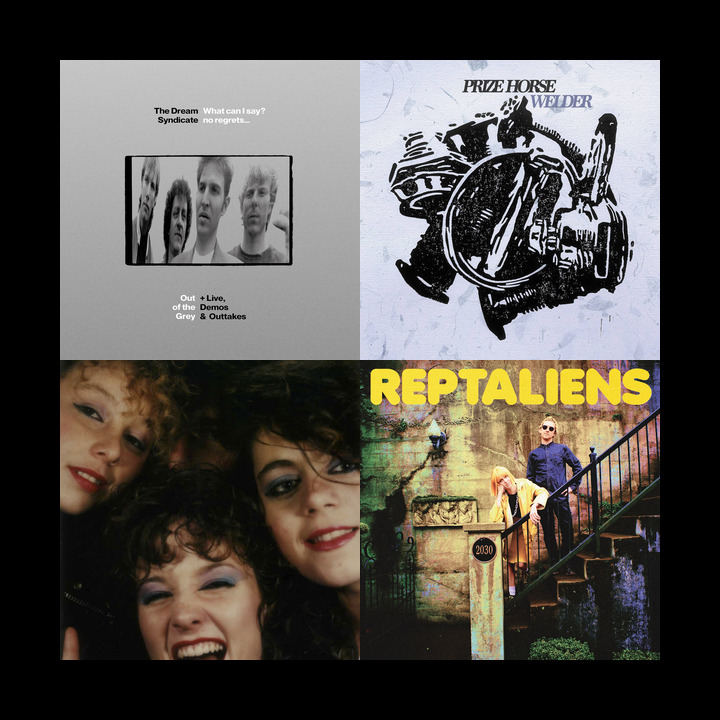
The second edition of Pressing Concerns of the new year highlights a large-scale reissue from The Dream Syndicate, new albums from Kids on a Crime Spree and Reptaliens, and the debut EP from Prize Horse. It’s a good year (musically, at least) already!
The Dream Syndicate – What Can I Say? No Regrets…Out of the Grey + Live, Demos, & Outtakes
Release date: January 14th Record label: Fire Genre: Alternative rock, psychedelic rock Formats: CD, digital Pull track: Slide Away
I’ve always respected The Dream Syndicate more than actively enjoyed them. I’m well aware of how important they are to several of my favorite bands, from Eleventh Dream Day to Silkworm to the one after which this website is named, sure. I’ve heard their consensus best record, The Days of Wine and Roses—the one that’s key to about a half-dozen subgenres of indie- and alt-rock—and I like it just fine, and their first “reunion” record, 2017’s How Did I Find Myself Here?is a very good album in its own right. As impressive as those two albums are, Out of the Grey is the Dream Syndicate record that’s hit me the hardest thus far, and is the closest to what I’ve imagined this band to be.
Originally released in 1986, Out of the Grey was the first Dream Syndicate record not to feature key members Kendra Smith and Karl Precoda, which is a big deal to some people from what I understand. I can certainly hear a difference between it and The Days of Wine and Roses—the latter album splits the difference between dreamy psychedelia and speedy desert rock and roll. Out of the Grey zeroes in on the latter, and instead of ping-ponging, finds a wide range within it to explore. The “rockers” no longer sound hurried and frantic; on the converse, The Dream Syndicate come off like a band with all the time in the world. Songs like the opening title track, “Boston”, and “Blood Money” all find the band hitting on something and just riding it for as long as they deem it necessary, which is generally the exact right amount.
The Dream Syndicate (at this point, the quartet of vocalist/guitarist Steve Wynn, guitarist Paul Cutler, bassist Mark Walton, and drummer Dennis Duck, all of which except Cutler are still in the band today) find time in Out of the Grey to put together some of the sharpest pop songs I’ve heard from the band; namely the giddy chord changes of “Slide Away” and the borderline-inappropriate bouncy sing-along melody of “Drinking Problem”. They still rocked, of course—even though you can actually dance to “Dancing Blind”, they see no need to minimize the blistering lead guitar in order to further this achievement. And the catharsis of closing track “Let It Rain” takes awhile to fully develop, but when it’s there, it’s unmistakable. One of the previously-released bonus tracks What Can I Say? No Regrets… offers up is a sharp, stomping version of “Cinnamon Girl”, which should be an “a-ha” moment if you hadn’t gotten there already.
On the heels of a long-overdue vinyl reissue of the original record last year, Fire Records has produced two discs’ worth of previously-unreleased bonus material to enhance the CD release of What Can I Say? No Regrets…. While I imagine someone who’s been a bigger fan of The Dream Syndicate would get more out of these extras, I found myself thoroughly enjoying the 1985 live set that comprises the second CD. The production and recording choices of Out of the Grey don’t bother me at all, but if your problem with the record is it’s not loud and jammy enough for you, head straight to the Live at Scorgies, NY section. The covers and demos of the third disc do little for me, true, but two different looks at one great collection of songs is more than enough for me to cosign What Can I Say? No Regrets…. (Bandcamp link)
Kids on a Crime Spree – Fall in Love Not in Line
Release date: January 21st Record label: Slumberland Genre: Noise pop Formats: Vinyl, CD, cassette, digital Pull track: When Can I See You Again?
Bay Area noise pop trio Kids on a Crime Spree have been kicking around for a decade or so, but it took until 2022 for a full-length record of theirs to emerge. Fall in Love Not in Line’s 25 minutes are an eternity in comparison to the rest of the band’s releases, the most substantial of which was previously 2011’s We Love You So Bad EP. They did release a few singles in the intermittent time period, though, and it doesn’t take long for Fall in Love Not in Line to remind the listener of the power of a single song. The record’s first two tracks are fuzzy power pop excellence from singer-songwriter Mario Hernandez, the chiming “Karl Kardel Building” wringing a hell of a lot out of an instrumental riff and the brisk “When Can I See You Again?” balancing Hernandez’s delicate vocals and lyrics pleasingly with the tuneful squall of the band.
Kids on a Crime Spree could’ve stopped there and added another no-fat single to their discography, but they dig a bit deeper on the rest of Fall in Love Not in Line and uncover more to enhance their repertoire. This includes a few reverb-y pop songs that rival the openers in the anxious undertones of “All Things Fade” and bouncy stomp of “Goods Get Got”, and it also features a couple of sonic expansions. “Vital Points” dials the distortion down just enough to let its 60s-cool melody shine a little brighter, and if “Overtaken by the Soil” is at times, ah, overtaken by noisiness, it isn’t enough to overwhelm the handclaps and stop-start guitar riff that put the track over the top. Whatever form these songs take, they all benefit from Hernandez’s hooky writing, as well as the ability of Hernandez and bandmates Becky Barron and Bill Evans to wring melody out of noisy sonic terrain. (Bandcamp link)
Prize Horse – Welder
Release date: January 19th Record label: New Morality Zine Genre: The heavy shoegaze/grunge/emo/post-hardcore spectrum Formats: Vinyl, digital Pull track: 3 Tiles
Welder may be the debut release from Minneapolis’ Prize Horse, but the trio have been playing together for several years now. The six-song EP was produced by Corey Coffmon of nü-shoegazers Gleemer and released through New Morality Zine, a reliable source for punk and heavy rock music as of late—if you’re familiar with either of those touchstones, you can probably guess approximately what Welder sounds like. That doesn’t make at any less strong of a debut release, though. Guitarist/vocalist Jake Beitel, bassist Liv Johnson, and drummer Jon Brenner play a blown-out brand of alt-rock that suggests they’ve spent several hours with classic space rock opuses like Fantastic Planet and Downward Is Heavenward, and Beitel’s unshakable monotone vocals are very 1990s as well.
While Beitel is too high in the mix for Prize Horse to come off as a straight shoegaze band, Welder certainly sound like they’re playing with a firmly-fixed downcast expression. Songs like “Emeryth” and the title track do get loud, but only in the service of creating dark, chilly listening experiences. Beitel’s downtuned guitar rakes across both these and the more traditionally “rocking” songs like “Far” and “Musket”, and the rhythm section (particularly Johnson’s concrete-solid bass playing) anchors these tracks in a workmanlike way, not unlike the profession to which the EP’s title alludes. It’s all very no-frills, but through sheer commitment Welder is able to suck you in completely in spite of—or maybe perhaps because of?—that. (Bandcamp link)
Reptaliens – Multiverse
Release date: January 21st Record label: Captured Tracks Genre: Indie pop, psych pop, dream pop Formats: Vinyl, CD, digital Pull track: I Feel Fine
Here we have a band that’s on the complete opposite end of the “space rock” spectrum from Prize Horse. Portland, Oregon’s Reptaliens have made a name for themselves over the past half-decade with their casually futuristic lounge-pop, and with their third record, they’ve put together a strong collection of songs by exploring deviations from this sound. Multiverse follows a reverse indie rock band trajectory, embracing guitars and reducing the synths in something of a insular turn by the band’s core duo of Cole and Bambi Browning. Reptaliens are good enough at churning out subtle, airy pop music with any toolset that Multiverse isn’t a jarring listen—still, the steady downstroked electric guitar and shuffling drumbeat that announce album opener “I Feel Fine” are, if nothing else, rather exciting.
Songs like “In Your Backyard” and “Take It” take the six-string clarity of “I Feel Fine” and crank up the reverb for some confident dream pop moments, and the latter even flirts with a feedback jam as it draws to a close. The distortion in “Do You Know Are Sleeping?” isn’t restricted to the last moment—it’s a formative part of the song. Bambi’s vocals don’t sound shaken by the music, retaining their half-to-herself sung-spoken melodies in all of Multiverse’s ten tracks. More than anything, it’s her voice that provides the throughline, performing much the same role in the brisk power pop of “Don’t Wait for Me” at the center of the record as in closing track “Jump”, which is effectively made out of another drum shuffle and some positively groovy guitar leads. It all hangs together, it feels natural, but most importantly it’s a fun listen. (Bandcamp link)
It’s late-stage January, so let’s get on with what music 2022’s had to offer so far already. The first Pressing Concerns of the new year hits on new records from Jeff Tobias (Sunwatchers, Modern Nature), Artsick (Burnt Palms, Lunchbox, Boyracer), and Patrick Brayer, and the debut EP from Party’z (Kittyhawk).
Release date: January 7th Record label: Strategy of Tension Genre: Experimental pop, post-punk, synthpop Formats: Vinyl, digital Pull track: We’re Here to Help
New York’s Jeff Tobias is a ringer of sorts—he’s played various instruments, most notably saxophone, for bands like Sunwatchers and Modern Nature—but his debut “pop” album as a solo artist is something new for him. Recurring Dream is an adventurous album—Tobias alone is credited with playing fourteen different instruments on the record—but it’s also a highly cohesive one. Tobias loosely settles into a synth-pop style across Recurring Dream, but that gives him a lot of room with which to work. Just in the first two songs, we get the blaring alarm sounds that twine with saxophones on the urgent chaos of “Our Very Recent Past” and the minimalist funk rhythms that help “We’re Here to Help” pull off something of a smooth swagger. Like all of Recurring Dream, these two songs are grounded by the steady presence of Tobias’ voice—it’s a subtle voice that sounds both fervent and intimate. The barely-there but certainly audible smirk in the titular line of “We’re Here to Help” (that is, help relieve the wealthy of the burden of their horded wealth) is why it works.
The nonprofit grifter and offshore tax cheat character studies in “We’re Here to Help” aren’t atypical here—Recurring Dream is a heady record with a lot on its mind, something of a synth-heavier version of the Personal Space record from last year, and the lyrics don’t always spell out their messages in the way that song’s does. But Tobias glides us confidently from scene to scene, pushing his voice in the soft rock lament of “Transparency” and throwing us into the thick of it with the dire opening of “Venezuela”. Even between Tobias’ bag of musical tricks and at-times intimidating lyrics, Recurring Dream commits fully to being a pop album—every song I’ve mentioned has something I’d consider a hook, and it ends with “Self-Portrait in a Convex Mirror”, a shimmering piece of synthpop propulsion that feels like it could go on forever. Recurring Dream has all the tools to confuse and overwhelm, and it does when it wants to, but it’s just as likely to artfully smooth out its own creases and ripples. (Bandcamp link)
Artsick – Fingers Crossed
Release date: January 21st Record label: Slumberland Genre: Twee, indie punk Formats: Vinyl, CD, cassette, digital Pull track: Stress Bomb
Christina Riley played guitar and sang in Burnt Palms for most of last decade, and more recently has been playing with long-running indie pop punk group Boyracer, featuring heavily on last year’s Assuaged. Boyracer isn’t the only 90s twee/indie pop connection that can be traced to Riley’s latest band, Artsick: both members of Lunchbox are involved in Fingers Crossed as well (Donna McKean plays bass on the record, Tim Brown recorded it). Not surprisingly, the Oakland-based trio (Riley, McKean, and drummer Mario Hernandez of Kids on a Crime Spree) sound right at home on indie pop royalty Slumberland Records: Riley’s frequently droll vocals prominently anchor the sound of a band bashing out loose but confident pop music. Like Boyracer, Artsick are on the louder end of the twee spectrum: Fingers Crossed isn’t afraid to rock. They cite Tiger Trap as an influence, and I certainly hear it.
Artstick balance the pop and the rock well: the crunchy fuzz of “Despise” also pulls out enthusiastic handclaps, and if “Ghost of Myself” is a workout, it’s because they’ve sped up a jangly pop rocker just a bit more than your average K Records band would (and one doesn’t get any more pop-reverent than that song’s intro, no?). As a vocalist, Riley delivers: she holds her own in the noisier numbers, but when the clouds part a bit, she takes full advantage of the clarity. The triumphant gallop of opening track “Restless” contrasts with an ennui-gripped Riley grasping at various methods of dulling the titular emotion, and then in “Stress Bomb”, she just as memorably mutters “just shoot me” at the lobber of the title. Only 28 minutes long, Fingers Crossed is a brief yet not ephemeral first look at the latest chapter of Christina Riley’s pop music career. (Bandcamp link)
Patrick Brayer – Cabbage and Kings: An Inland Shrimpire Anthology
Release date: January 21st Record label: Shrimper Genre: Folk, country Formats: CD, digital Pull track: Note to Self (To Say Goodbye)
Patrick Brayer is something of a contradiction, or at the very least a curious case. Major folk players like Alison Krauss and Dave Alvin have covered his songs, but here he is releasing an album on Shrimper Records, primarily known as an underground lo-fi cassette label from the 90s. He’s a prolific songwriter, as evidenced by scores of digital releases on his Bandcamp page, but there’s only ever been a small handful of official, physical Patrick Brayer releases. His first record came out in 1979—over forty years ago. So, what to make of Cabbage and Kings? Well, the record does keep one foot planted firmly in the underground—if there’s any question as to how Brayer fits in with the Shrimper world, these songs reveal traces of Refrigerator’s quieter side and Simon Joyner, and there’s a desert-folk ramble a la Howe Gelb of Giant Sand that’s not too far off either.
But at the same time, Cabbage and Kings places Brayer among more well-known company. If Leonard Cohen and Johnny Cash could make great records in the later years of their careers, well, so can he. Brayer sounds infinitely comfortable on Cabbage and Kings’ songs, which stretch out to hold everything Brayer has to give. “If you’ve had a life as rich as mine, I doubt it, but good for you,” he sings in “Empty Cage”, a tribute to Chris Darrow that, first-personal or not, is one of several songs that succeed in spanning a lifetime into a few minutes. “Note to Self (To Say Goodbye)” takes over nine of those minutes to complete its stare, but Brayer doesn’t blink the entire way through. These songs are incredibly captivating; it really does come off as the work of someone who’s spent decades mapping out a unique version of well-trodden songwriting hills. (Midheaven link)
Party’z – Party’z EP
Release date: January 14th Record label: Self-released Genre: Fuzz rock, noise pop Formats: Digital Pull track: Getting Warmer
One of my favorite compilations of last year was Mikey’s Favorite Songs by Kittyhawk, a collection of non-album material from the Chicago emo band. While Kittyhawk seems to be active again in some capacity, that hasn’t stopped a couple of its members from debuting as Party’z this month. It’s the project of Kittyhawk’s guitarist/vocalist Mark Jaeschke, with the band’s bassist Clare Teeling joining a lineup rounded out by keyboardist Delia Hornik and drummer Andy Hendricks. However, very little of the elder act’s Midwest emo sound is apparent in Party’z’s four-song debut EP, at least not on the surface. Jaeschke and the band have put together a record of amp-cranked, fuzzy power pop.
In the opening kick-off of “Getting Warmer” and (especially) the closing reverb-fest of “Follow the Sound”, Party’z flirt with being a straight-up end-of-the-2000s shitgaze band—they sound closer to Times New Viking than any of their “main” group’s fellow fourth-wave emo revivalists. Intentionally or otherwise, however, the Party’z EP argues for some common ground here: these are four earnest pop songs underneath the feedback. Hornik’s keyboard routinely pokes out, delivering hooky Rentals/Anniversary synths even as the guitar threatens to drown it out, and Jaeschke is as likely as not to use the distortion to emphasize the emotion in their vocals as to obscure them. Party’z already have plans for a follow-up full-length record, and what they’ve put down together so far suggests that one should keep an eye on the young band. (Bandcamp link)
If you chose to read this, you probably know who Silkworm were, but I’ll try to briefly go over it for anyone who doesn’t. Silkworm formed in the late 1980s in Missoula, featuring singer/guitarists Andrew Cohen and Joel Phelps and singer/bassist Tim Midyett, and then moved to Seattle and added Michael Dahlquist, the greatest drummer of all time. In the mid-90s Phelps left and started a solo career, the band continued on as a trio, and they ended up in Chicago. Silkworm ceased to exist in 2005 after Dahlquist’s death. Cohen and Midyett played in the band Bottomless Pit together in the aftermath of Silkworm’s demise, but that band is no longer active either. Midyett currently leads the band Mint Mile, while Cohen released a solo record in 2017 and was playing live shows up until the pandemic began. Phelps’ last record with his band, The Downer Trio, came out in 2013.
As the 2013 documentary Couldn’t You Wait: The Story of Silkworm emphasizes, this is a band with a small but fervent cult following. I’m not the first person to be inspired by their music enough to write 7,000-odd words about it, but I wanted to try to be comprehensive with my submission into this world. Silkworm doesn’t sound like anybody else. Spawning from Montana has something to do with that, sure, but it’s more than that. Cohen, Midyett, and Phelps are all extraordinary songwriters—and all three’s styles are fairly different from the others’. Even the “lesser” albums and EPs by them deserve looks. I’ve made a companion playlist to this piece that emphasizes this, pulling from almost every record included in this list (it’s ordered for flow, not to reflect the order of my list). If you aren’t familiar with Silkworm or any of their related groups, I hope you find something in here that speaks to you. If you are familiar with Silkworm—yes, I know Libertine is too low. You don’t have to yell at me about it.
Some notes to other people who also care deeply about Silkworm: This list does not include Silkworm’s early demo cassettes. I never liked the early Silkworm stuff I’ve heard enough to try too hard to track those down. It doesn’t include any of the bands that original drummer Ben Koostra ended up in, but I’m sure they’re perfectly fine. It doesn’t include the other bands by late-era keyboardist Matt Kadane, but I shouldn’t have to tell you that Bedhead and The New Year are quality groups. It doesn’t include any of the Sunn O))) albums that Tim Midyett played on, although there is a record in here with a different Sunn O))) connection. It doesn’t include the Silkworm live bootlegs that have shown up on Bandcamp in recent years, although I’m grateful those exist. It doesn’t include any of the one-off tracks from any of the members, eventhoughtherearemanygoodones.
36. Alison Chesley, Steve Albini, and Tim Midyett – Music from the Film Girl on the Third Floor (2020)
I’m betting a lot of you didn’t know this existed, and it’s probably up some of your alleys, so I’m happy to be including this for that purpose, at least. It’s not really up mine, though. It is notable for the novelty of hearing Tim Midyett make music with two great collaborators: Steve Albini (who engineered almost everything by Silkworm, but to my knowledge never played with them) and indie rock’s greatest cellist, Alison Chesley (aka Helen Money) of Verbow. If you like slow, mostly-instrumental, (literally) cinematic post-rock, then give Music from the Film Girl on the Third Floor a listen.
35. Dama/Libra – Claw (2014)
The most recent full-length record to feature any contributions from Joel Phelps, the Northern Spy-released Claw paired his vocals up with music from former Sunn O))) member, brother of Michael, and noted crow enthusiast G. Stuart Dalhquist. It is, like the previous record on this list, not really my bag—this is definitely the closest thing to a drone album here, sounding something like Sunn O))) songs shortened into “normal” track length and featuring admittedly great Phelps vocals. Plus it has “Been to the Water”, the record’s most tuneful song and a no-brainer entry into any Joel Phelps best-of collection.
34. Joel R.L. Phelps and the Downer Trio – Consulate EP (2017)
Consulate was recorded at the same time as 2013’s Gala, but didn’t surface until a little over three years later, making it Joel Phelps’ most recent release. It’s a short one, featuring two alternate version of tracks from Gala and two EP exclusives. The two revisits strip the songs down to parts, turning the ripping “Blinding Light” and the rhythm-section showcase “Goldentown” into a mid-tempo acoustic shuffle and piano ballad, respectively. The two “new” songs are even sparser, Phelps rising barely above a whisper above delicate instrumentation in “On the Side” and “Roll on Columbia”. Hardly a major release, but any new Joel Phelps is welcome at this point.
33. Silkworm – You Are Dignified EP (2003)
My favorite thing about Silkworm’s You Are Dignified covers EP is how great of a selection these songs are. When I was at my peak obsession with this band, this EP helped me either discover or strengthen my admiration for Robbie Fulks, Bedhead, Nina Nastasia, and Shellac. Even the Pavement selection (“And Then…”) is a well-chosen obscurity, an early version of “The Hexx” that was relegated to Brighten the Corners B-side status. As for the acoustic, mandolin-heavy versions themselves, they’re fun (particularly Michael’s version of “Prayer to God” and Tim and Andy’s “Let’s Kill Saturday Night”), if admittedly fairly inessential for most.
32. Ein Heit – The Lightning and the Sun (1997)
Well, something has to be the lowest-ranked “rock” album on this list. Ein Heit was the band that originally united Joel Phelps, Tim Midyett, and Andy Cohen in Missoula before they formed Silkworm and decamped to Seattle. They’ve always seemed fond of the band, and it’s commendable that they got back with Ein Heit members John Kappes and Tom Kipp to make a permanent record of the group, even reuniting with Joel Phelps after he somewhat acrimoniously left Silkworm. The Lightning and the Sun isn’t without its charms—the Phelps-sung “Lonesome Heart” is killer, and when I’m in the right mood, the seven-minute “Without Warning” sounds profound to me—but these are largely songs from a handful of musicians who hadn’t reached their best form yet. It’s an incredibly unique-sounding record, though, I have to give it that.
31. Silkworm – Marco Collins Sessions EP (1995)
Like You Are Dignified, the Marco Collins Sessions EP found Silkworm in stripped-down mode, but they’re playing their own songs here, which helps it rank a little higher. Marco Collins is a longtime Seattle DJ whose Wikipedia page claims he was “instrumental” in breaking Harvey Danger’s “Flagpole Sitta”, among other songs, so he should be commended both for that and facilitating this four-song EP. Another feather in the Marco Collin Sessions EP’s cap is that the acoustic version of “Couldn’t You Wait?” is actually better than the album version—credit that to Tim Midyett’s vocal performance, especially at the song’s climax. The whole EP was reissued as a bonus with Comedy Minus One’s 2013 reissue of Libertine.
30. Tim Midgett – It Goes Like This EP (2002)
It Goes Like This was initially part of a CD subscription series from Three Lobed Recordings, and then made more widely available a few years later by Comedy Minus One. Three out of the EP’s six songs would eventually wind up on Silkworm albums, so might be tempting to call this a demo dump, but there’s also a cover of The Zombies’ “Time of the Season” into which Midyett clearly put a good deal of effort. My favorite song here is the windswept “As Long…”, one of the two unreleased-elsewhere originals, and among the eventual Silkworm tracks, it’s a treat to hear “Something Hyper” without the (cool) weird stuff they did with it on It’ll Be Cool, as well as Italian Platinum highlight “Young” sung by Midyett instead of Kelly Hogan as it is on that record.
29. Joel R.L. Phelps and the Downer Trio – The Downer Trio EP (1997)
The Downer Trio isn’t the only Joel R.L. Phelps release to hover somewhere between EP and full-length—it nears the 30-minute mark thanks to a couple of covers, an alternate version, and a brief instrumental. None of the three original tracks would be on my shortlist for favorite Phelps tune, but the twitchy, rhythm-section-heavy opener “Razorback” probably merits an honorable mention, and the gliding alt-country of “At El Paso” connects the dots between the first two Phelps LPs nicely. Among the covers, The Clash’s “The Guns of Brixton” becomes a haunting piano ballad, but it’s Phelps’ surprisingly intense take on “Emerald City” by Dramarama that’s the most successful.
28. Mint Mile – In Season & Ripe EP (2015)
Mint Mile, Tim Midyett’s first band without Andy Cohen (without him as a creative partner, at first, and later without him at all) introduced themselves to the world rather quietly, with a trio of four-song EPs. In Season & Ripe feels low-key even among the other two, relying heavily (for Midyett) on acoustic guitar and kind of drifting through its four tracks. The lazy strut of “Mountain Lion” opens the EP with Mint Mile’s first classic song, sounding like vintage Midyett but also distinct from Silkworm and Bottomless Pit. The rest of In Season & Ripe doesn’t quite deliver on “Mountain Lion”’s promise, but if “Modern Day” and “Wound” can feel a little dizzying sometimes, it’s a unique moment in Midyett’s music career.
27. Joel R.L. Phelps and the Downer Trio – Gala (2013)
While Gala as a whole doesn’t reach the heights of Joel Phelps’ previous records, I am grateful that it exists at all; after a worsening battle with substance abuse resulted in nearly a decade without any new music from Phelps, the triumph that marks Gala’s strongest songs is completely earned. Phelps vows “I want to grace to put my bottle down” in opener “The Nashville Sound”, one of the greatest songs he’s ever written, and The Downer Trio sound as alive as ever on highlights “Blinding Light” and “Thank You and Goodnight”. While it looks increasingly likely with every passing year that Phelps’ sudden flurry of musical activity in the early 2010s was a blip on the radar rather than the beginning of a new era, the world is better for it to have happened.
26. Silkworm – Even a Blind Chicken Finds a Kernel of Corn Now and Then (1998)
Even a Blind Chicken Finds a Kernel of Corn Now and Then is a two-CD compilation that compiled some of Silkworm’s harder-to-find releases: their 1992 debut record, L’ajre, 1993’s His Absence Is a Blessing EP, and various non-album singles. I decided to include the compilation instead of breaking the LP and the EP out separately to highlight a couple non-album tunes: namely “Slipstream”, the first great song Silkworm made together, but “Violet” and “Around a Light” (originally released together) are strong, too. Of the two major releases here, L’ajre is definitely the weaker of the two (ranking probably ahead of Consulate, if you’re curious)—all of “Homoactivity” is awesome, and parts of several other songs are too, but it’s the sound of a band still yet to figure out how to restrain themselves enough to make great records. In my opinion, His Absence Is a Blessing is a little overrated—it’s not until In the West that they truly ascend, to me—but it does contain “Scruffy Tumor”, the First Great Silkworm Song (which is distinct from the first great song made by Silkworm, it should be noted). Rank it between Inland Empires and Tradition, if you must.
25. The Crust Brothers – Marquee Mark (1998)
The Crust Brothers are likely 90s indie rock’s greatest supergroup, slotting ahead of The Halo Benders and that time Johnny Marr was in Modest Mouse. The Brothers were the three members of Silkworm at the time (Midyett, Cohen, Dahlquist) and Stephen Malkmus of Pavement, and Marquee Mark captures one of the group’s few live performances. The Crust Brothers gleefully make Silkworm’s (and, I guess, Pavement’s) classic rock undertones explicit; almost all of these tracks are covers of songs that could be generally described as “classic rock”. It’s a really fun album, and maybe should be higher—Malkmus leads the band through a ripping version of “Feel a Whole Lot Better”, all of them sing together on “You Ain’t Goin’ Nowhere”, and Midyett’s scorching take on “Heard It Through the Grapevine” is the definitive version of the song (not that I’m biased or anything). Oh, and they get Malkmus to sing a Silkworm song—his “Never Met a Man I Didn’t Like” is charming.
24. Joel R.L. Phelps and the Downer Trio – Inland Empires (2000)
There’s only one original song on Inland Empires, but it’s a doozy. “Now You Are Found (1962-1999)” is a beautiful, heartbreaking tribute to Joel Phelps’ sister, who’d died of a drug overdose in what was the very, very recent past at the time. It’s a bit of a tough listen, as incredible as it is—possibly why the song finds itself the centerpiece of a curious, seven-song, mostly-covers record that straddles the line between LP and EP instead of one of many originals on a “normal” album. Not that the other songs on Inland Empires are relief, exactly, but they’re emotional in different ways. Phelps gives Steve Earle’s “Someday” a slow, bittersweet reading that gazes into the past deliberately, and his version of Iris Dement’s “My Life”, coming right after “Now You Are Found” as it does, is silence-inducing. Inland Empires more than earns “Apology Accepted”, a Go-Betweens cover that’s probably the most upbeat the Downer Trio have ever sounded.
23. Joel R.L. Phelps and the Downer Trio – Tradition EP (2004)
Tradition was originally a bonus CD that came with 2004’s Custom, and it’s more of a piece with that record than with anything else in Joel Phelps’ discography. Like Inland Empires, it’s mostly covers (three of them, plus two originals), but the Downer Trio announce from the opening notes of “What Are You Doing Here Cowboy?” that they’re not trying to recreate that album’s sparse, pin-drop intimacy. That song, as well as an intense, six-minute version of Joy Division’s “24 Hours” finds Phelps, William Herzog, and Robert Mercer with amps cranked up, and when they slow to a crawl in “Right Now”, it’s a full-band, bass-and-drums-led one. The one exception is a hushed take on Townes Van Zandt’s “Flying Shoes”, which I believe might be an Inland Empire outtake (they went with “Our Mother the Mountain” instead).
22. Bottomless Pit – Lottery 2005-2012 EP (2012)
The physical edition of Lottery 2005-2012 was a Japan-only two-CD compilation of everything Bottomless Pit had released up until that point, plus a couple of exclusive bonus tracks. That’s not the version I’m ranking here; this is for the digital version, which made the three previously-unreleased songs available to everybody else. This is a small release, sure, and maybe shouldn’t even count, but these three tracks are all very good to great and stack up against any of the “proper” Bottomless Pit records. Like the Developer bonus tracks, “State I’m In” and “The Colchis Eagles” show that Midyett and Cohen prune songs off their albums due to how well they “fit in” with the record’s mood, rather than the individual tracks’ quality. The “fast” version of “Winterwind”, the third and final song, is better than the album version, and is maybe Bottomless Pit’s greatest achievement as a single recording, but the “slow” version fits Blood Under the Bridge better, so off to Japan this one went.
21. Joel R.L. Phelps – Warm Springs Night (1995)
After Joel Phelps was either fired from or quit the band he co-led and helped found, he struck out on his own with a fiery, rickety record of shambling country/garage rock that doesn’t sound quite like any of the following albums, even as it set up the path the Downer Trio would follow. Even though it’s not billed as “Joel R.L. Phelps and the Downer Trio”, the other two members of the trio—William Herzog and Robert Mercer—play on Warm Springs Night, and the rockers sound like a rough version of what they’d make together. Phelps never tried to recreate the post-hardcore squall of Silkworm with The Downer Trio, and while he probably comes closest on Warm Springs Night—the loose anger of “Counsel”, the noise-punk “God Bless the Little Pigs”—there are plenty of subtle moments to mark the beginning of his second act. The western slowcore of the title track and “OK Reno” as well as more electric lonesome tracks like “The Graze and the Graves” and “All We Want” both ended up being fruitful paths for the singer-songwriter to follow.
20. Mint Mile – The Bliss Point EP (2016)
The Bliss Point saw the return of the electric guitar to prominence in Tim Midyett’s music, and thus Mint Mile sounds a bit more like his previous bands here—at least on the surface. Opener “City of Speed Traps” is maybe the most Silkworm-y Mint Mile song, keeping things surprisingly straightforward with a nice pop song chord progression and a chiming guitar riff. It’s a classic. As is “Park”, a song that doesn’t particularly sound like Silkworm. That song chimes as well; I’m not enough of a gearhead to be sure who or which of the various stringed instruments on The Bliss Point is responsible for it, but it’s a fun touch all over the appropriately-titled EP. The extended, drum-less instrumental intro and oddly groovy choruses of “Park” make it stand out like a sore thumb, but it works. The two other tracks are more slippery, although “Bellflower” in particular is an intriguing combination of the “new” Mint Mile sound and that of In Season & Ripe’s.
19. Mint Mile – Heartroller EP (2018)
The final entry in Mint Mile’s introductory trio of EPs is the most consistent one, and it also has what’s probably the band’s best song so far in “Disappearing Music”. Especially in its first three songs, Heartroller settles on a rolling country-rock sound that it feels like Midyett and crew had been working towards since the beginning of Mint Mile. By this point, Mint Mile had solidified into a set lineup (Midyett, drummer Jeff Panall, guitarist Justin Brown, bassist Matthew Barnhart), and it definitely shows. “Fight It All the Way” stretches to seven minutes, but every second of it is full of drive and determination, and the balladry of “Golden to the Point of Being Common” rises and falls appropriately. The drum machines and keyboards that mark closer “Disappearing Music” make it the EP’s black sheep, but the song’s hypnotic march would be out of place anywhere, I suspect, and it’s too damn good to leave off of anything. Apparently the song took fifteen years for Midyett to finish, and needed Mint Miler collaborator Howard Draper to help complete it. They nailed it.
18. Silkworm – Blueblood (1998)
Other than L’ajre, which doesn’t really count, Blueblood is the lowest proper Silkworm album on here. It’s always had an air of “last by default” to it (the Couldn’t You Wait documentary skips over it entirely, for instance), and I’m not really here to challenge that perception of Blueblood. Maybe it was fatigue from releasing three records in as many years, or maybe it was a necessary transition before Silkworm entered their most fertile period in the early 2000s, but it’s a noticeable step down from the records that came both before and after it. But even a below-average Silkworm album is still a very above average normal album. Blueblood gifts us with “I Must Prepare (Tablecloth Tint)”, a low-key Midyett number that’s the record’s one true short-lister, and several other Silkworm classics—among them, Cohen’s absurd opening track “Eff”, and Midyett’s two-song closing punch of “Pearly Gates” and “Clean’d Me Out”. And my complaints—“Redeye” feels like a lesser version of “The Lure of Beauty” from Firewater, “Empty Elevator Shaft” feels like a dry run for better Michael Dahlquist lead vocal songs, and I can never remember how “Tonight We’re Meat” and “Ritz Dance” go—are relatively minor in the end, and I still like all of those songs. Besides, this way I can be pleasantly surprised by the “Tonight We’re Meat” riff every time I hear it.
17. Joel R.L. Phelps and the Downer Trio – 3 (1998)
There are some words that keep coming up when I talk about Joel R.L. Phelps’ music. Stark. Quiet. Intense. Insular. “Difficult”. Listening to “The Way Down” once probably illustrates what I’m getting at better than any of my words could. Phelps sings accompanied only by the plucking of an upright bass, and occasional stabs of horns. Phelps’ voice is a whisper at first, until rising to a strained holler by the song’s end. And this is how he chose to start 1998’s 3. The rest of the record isn’t so difficult—unless you’re a typical Silkworm fan. That is to say, there’s very little alt-rock on 3; if it’s alt- anything, it’s country. And it’s very good at it, too—the steel guitar-driven “Rev. Robert Irving” is one of Phelps’ best songs, and “Always Glide” lilts in the same right ways. And there are plenty more long, lonesome ballads—“Hope’s Hit” and “Fifty” both scratch that itch, Phelps sounding no less passionate over music more subdued than over either Silkworm or most of The Downer Trio’s faire. Phelps’ next two proper records rocked more than 3, and I like them more than 3, but I wouldn’t change 3 from what it is, not at all.
16. Andrew Cohen and Light Coma – Unreality (2017)
Andrew Cohen was the last songwriting member of Silkworm to make a record on his own (although Midyett’s bands had made only EPs at this point). Cohen contemplated retiring from music after Bottomless Pit ended and he found the role of sideman in Mint Mile unfulfilling. Instead, he fell in with Light Coma, a Chicago band that’s released two records on their own and is led by Bottomless Pit bassist Brian Orchard. Unreality answers the question of whether an album made up of just Andy’s songs would work on its own with a resounding “yeah, duh”. It’s a classically-sequenced record, with a surprisingly shiny and inviting side one paired with a thornier, headier second side. “Your Biography” and “Repack” are just about the brightest Cohen has ever sounded, but there is a darkness to Unreality; in addition to the loss of Dahlquist, the death of acquaintance Jason Molina hangs over several songs here too, notably “Midwest DTs” and “Midwest Delirium” (the same song, but done both acoustic and electric).
15. Mint Mile – Ambertron (2020)
Around about here is where the rankings get very difficult. Ambertron has already risen a lot from where I would’ve put it at the time of its release; I suspect that a few years from now, it’ll be even higher on my personal list. Even though Tim Midyett always felt like the most prolific songwriter in Silkworm, it took the longest time for him to make a full-length record of entirely his own songs, but the hour-and-change Ambertron is more than worth the wait. Midyett seizes on the country-rock sound Mint Mile hit on with Heartroller and uses it to expand these songs. And just from a writing perspective, Ambertron feels like a high water mark moment for Midyett—the cores of “Shy”, “Riding On and Off Peak”, and “Giving Love” could’ve come from any point in his music career, but the details and the performances all sound only like Mint Mile. Kelly Hogan, who sang one of Silkworm’s best songs on Italian Platinum, returns to make “Sang” even more intriguing. All of the aforementioned songs (as well as the inviting opener “Tobacco Coffee Wintergreen”) could be the best one, but my favorite track from Ambertron I think has to be “Fallen Rock”. The loping, slow-trotting song unhurriedly unfolds its highway drama over seven minutes; it doesn’t sound like anything else on Ambertron, but it isAmbertron as much as any of the other songs are.
14. Silkworm – Libertine (1994)
Yes, yes. As I alluded to in the intro, I know Libertine is ranked too low. Sorry. I love it dearly; I just love a dozen of these albums more. Like I said, this is where it gets difficult. It’s a lot of people’s number one favorite Silkworm record, and I can see why—it’s still got the noisy post-punk sound of In the West, but it cleans it up and polishes it just enough for the classic rock-indebted sound of their future to slightly peek through. I will also say that Libertine, the last album to feature contributions from Joel Phelps, is also his strongest moment as a member of Silkworm: the central trio of “Yen + Janet Together”, “Oh How We Laughed”, and “The Cigarette Lighters” showcase three different but equally compelling sides to his songwriting, and is the defining aspect of Libertine. Or maybe it’s Midyett’s “Couldn’t You Wait”, which—even though I admitted I prefer the Marco Collins version, is breathtaking and captivating in any context. Or maybe it’s “Grotto of Miracles”—it isn’t as straightforward as, say, “Into the Woods” or “Dust My Broom”, yet it established Andy Cohen as a singular musical force in every way: lyricist, vocalist, guitarist, composer.
13. Bottomless Pit – Hammer of the Gods (2007)
There was no question of whether Silkworm would continue to exist after Michael Dahlquist’s death in 2005 (it wouldn’t), but there was almost as little question as to whether or not Tim Midyett and Andy Cohen would continue to make music together (they would). Thus begat Bottomless Pit, a band that was as strong and powerful as Silkworm in its own way. Joined by Seam’s Chris Manfrin on drums and .22 and Light Coma’s Brian Orchard on bass (Midyett moved to baritone guitar, which he’d been playing more often than not in Silkworm anyway), Hammer of the Gods isn’t the only post-Silkworm album colored by Dahlquist’s death, but it’s probably the one most defined by it. Nearly every song seems either directly or indirectly about it, from Midyett’s fairly straightforward eulogy “Human Out of Me” and swelling opener “The Cardinal Movements” to Cohen’s dark, brooding songs like “Dead Man’s Blues” and “Greenery”. Hammer of the Gods is smooth and refined in a way that Silkworm never were—I wouldn’t have guessed Cohen could ever lead a song as delicate as “Dogtag”, for instance.
12. Joel R.L. Phelps and the Downer Trio – Customs (2004)
For a while it seemed like Customs was going to be the final statement of Joel R.L. Phelps and the Downer Trio, and while thankfully that didn’t turn out be the case, it would’ve been a strong note on which to go out. In some ways, it’s the most streamlined Downer Trio record—it continues the roaring alt-rock that Blackbird hit upon, but sharpens down that record’s vast expanses to knife-edge power chords in the opening one-two of “From Up Here” and “Be First!”. It’s the best opening to a Phelps record—the former featuring the strongest use of steel drums in indie rock, and the latter “merely” being possibly the fieriest thing the band ever put to tape. Although the big Joel Phelps ballads eventually show up on Customs, particularly in the second half, there’s also a middle ground—songs like “What the Sgt. Said” and “Kelly Grand Forks”, mid-tempo power chord chuggers that strike a balance between Phelps’ hushed subtlety and the unbridled release of the record’s first two songs. My only real complaint with the record is sequencing: too many loud songs in front and quiet songs in the back, causing the four track after “Shame” too blend together a bit too much, even though they’re all strong on their own (especially the hulking “The Lie for the Day”).
11. Bottomless Pit – Congress EP (2008)
Congress is four songs and nineteen minutes of Bottomless Pit coalescing into a fine-tuned band. If they’d held these tracks back and made a full album, they might’ve capitalized on the moderate buzz Hammer of the Gods had gotten and maybe Bottomless Pit could’ve rivaled the popularity of Cohen and Midyett’s previous band. But like Silkworm, they did things their own way, for the better—Congress isn’t a compendium to either Hammer or 2010’s Blood Under the Bridge. It’s its own thing. Midyett’s two songs, “Red Pen” and “Pitch”, are both long, propulsive, rhythm-emphasizing tracks that aren’t as leisurely as “Winterwind”, nor as urgent as “The Cardinal Movements”. The transfixing “Red Pen” sounds like something off of Shade Perennial that’s been unwound and spread out a bit. Cohen’s two songs are shorter and are closer to, if still removed from, the heart of Hammer of the Gods. In particular, the two-minute-thirty “Fish Eyes” (which was once covered by Waxahatchee; it’s worth digging for that) feels a lot more “bittersweet” than “hopelessly despairing”. The way Cohen sings the title (“Fish uh-eyes”) is equal parts brilliant and silly.
10. Joel R.L. Phelps and the Downer Trio – Blackbird (1999)
After the quiet alt-country of 3 just one year previously, one might’ve thought Joel Phelps was going to fade (or grow, depending on your perspective) into an acoustic, lonesome folk singer-songwriter. Then he and the Downer Trio made Blackbird, the strongest record Phelps ever released after he left Silkworm. The electricity that marked a good deal of Warm Springs Night was back, as opening rocker “Then Slowly Turn” announced triumphantly, but he, William Herzog, and Robert Mercer sound more focused here, tighter as a trio than ever before. Like Customs, it starts with a hell of a one-two punch, with “I’ve Got a Live One” coming off as “Be First!” if it were too anxious to fully commit to its anger. Unlike the following record, however, the most powerful moments on Blackbird aren’t necessarily its loudest ones: third track “Unless You’re Tired of Living” rocks but in a sprawling, delirious fashion, and the centerpiece of the album, a six-minute cover of the Comsat Angels’ “Lost Continent”, is a masterpiece of restraint. Phelps has always been able to wring out unthinkable emotion from relative simplicity (think “Pilot” and especially “Dremate” from In the West) and Blackbird features his two best songs in this fashion: the cavernous “Invited” and the closing “Landslide”.
9. Bottomless Pit – Blood Under the Bridge (2010)
Blood Under the Bridge, the most underappreciated and misunderstood Bottomless Pit album, doesn’t really rock. Other than the rare instrumental “Dixon” and the steam-blow-off closing track “38 Souls”, it’s a deliberate and slow-paced record that doesn’t go out of its way to grab your attention. It’s an inward turn—if it’s not exactly “acceptance” to Hammer of the Gods’ “grief”, it’s at least more considering of the possibility. Like Congress, Blood Under the Bridge opens with a seven-minute Tim Midyett song, but the steady, gorgeous plod of “Winterwind” feels less like a complete journey than an excerpt of something even larger. And that’s one of Midyett’s louder numbers on the record—we also get the floating, percussionless “Rhinelander” and the last-thoughts-before-falling-asleep “Q.E.D.”. Then again, there’s also the upbeat, new wavey “Late”, which features probably the best usage of “fuckers” anywhere on this list. Blood Under the Bridge is the strongest “Midyett” album of Bottomless Pit’s three, although “Summerwind” feels like a major work in the oeuvre of Andy Cohen (even if it’s more of the “impenetrable obelisk” and less of the “great American novel” variety).
8. Silkworm – It’ll Be Cool (2004)
A Pitchfork writer once claimed that toward the end of their career, Silkworm “made few missteps but brought fewer surprises”. While the first part is accurate, to the second, I would submit that the author must not have really listened to It’ll Be Cool, a deeply weird and surprising album that ended up being an unexpected yet fittingly odd final statement. The opening six-and-a-half minute “Don’t Look Back” is basically krautrock Silkworm, and looked toward Bottomless Pit more than anything else in their discography. And that’s one of the more “normal” ones. “Penalty Box” is almost a typical Andy Cohen rocker, except for the squeaky riff (I believe it’s a sped-up guitar) sprinkled liberally throughout, and even without the slowed-down vocal effect harmonizing with Tim Midyett throughout “Something Hyper”, that song would still be one of the most unique tracks Silkworm ever recorded. And that’s not even getting into “Xian Undertaker”, which turns Midyett’s mandolin flirtations and new-ish member Matt Kadane’s ringing piano into a rousing, barroom singalong that certainly doesn’t sound like anything else on It’ll Be Cool (and, other than maybe “Bourbon Beard”, anything else by Silkworm). The underappreciated “The Operative” is one of Silkworm’s sweetest and most straightforward moments, and (along with instrumental “His Mark Replies”) it’s an incredible note on which to end Silkworm’s final album.
7. Silkworm – In the West (1994)
I’ve made it clear that I like a lot of earlier Silkworm recordings, but in earnest, there wasn’t much among them to suggest that they were just around the corner from making a record like In the West, the peak of the band’s four-piece years. If it were all they’d managed to accomplish together, they’d still be a fascinating case. Silkworm was still a “noise rock” band at this point, but beginning to show why that label could never accurately hold them. First track “Garden City Blues”, their best album opener, sets up several tenets of Silkworm perfectly: delicate and subtle despite its most notable feature being Dahlquist’s pounding drums, unbridled guitars that nevertheless can and do hold back when necessary, and a generally unpredictable but smooth structure. Andy Cohen steals the show on In the West between “Into the Woods” and “Dust My Broom”, which both showcase Silkworm at full might, but all three songwriters take a step forward on the record. Between the album opener and “Punch Drunk Five” (which benefited greatly from Comedy Minus One’s recent remastered reissue of the record), Tim Midyett is more than holding his own, and all three Joel Phelps songs on the album are absolute scorchers (I’ve always been fond of the post-punk closer “Pilot”, which seems to get the least love of the three).
6. Silkworm – Developer (1997)
A lot of what I said about Blood Under the Bridge also applies to the equally-underappreciated Developer, but on a larger scale. 1996’s Firewater was not a breakout, but Silkworm were as popular as they’d ever be, and instead of capitalizing, they made an aggressively un-commercial follow-up to it. Tim Midyett in particular seemed to be chasing something on Developer—between the glacial, Dahlquist-showcase opener “Give Me Some Skin”, the murmuring “The City Glows”, and the watch-glancing “Waiting on a Train”, this is the closest Silkworm ever came to being a slowcore band. But they didn’t even commit to that fully: Andy Cohen’s first three songs—the joyous “Never Met a Man I Didn’t Like”, the pummeling title track, and the anxious fever dream of “Ice Station Zebra”—all rock in decidedly different ways, but they all rock. Despite all this, Developer is a deeply rewarding album that all hangs together incredibly—they left some good songs off of this record, namely “Ogilvie”, but I wouldn’t change Developer a bit. The last few tracks in particular took me ages to fully come around to, but “Sheep Wait for Wolf” and “Goodnight Mr. Maugham” contain some of Cohen’s best and most interesting writing, even if it was the stretch from “Never Met a Man I Didn’t Like” to “Ice Station Zebra” that led me back to Developer enough times to actually see it.
5. Silkworm – Firewater (1996)
Firewater is the big one. The mid-90s double album that fans of their era of indie rock are most likely to remember. The Matador debut. The concept record. The one where Andy Cohen goes absolutely wild on every single one of his songs. Cohen’s lyrics and images are the most immediate memory stickers on Firewater—“the crowd’s a rapacious beast”, “Friday night is sacred, it’s not time to be wasted”, his friend Jean-Luc on the subway, and nearly every word of “Nerves”. It’s a fascinating surface, but there’s so much more going on below just a few one-liners—such is the nature of a 60-minute album where every song is worthwhile, and most are superb. It’s reputation as an “alcohol album” is earned—there’s “Drunk”, for one, and “Severance Pay” and “Slow Hands” are explicit about it as well—but that’s not the entire picture. Several of these songs are about the rough circumstances behind Joel Phelps’ departure from the band; Midyett has said as much about “Swings” (“Now I know that I made a big mistake on you”) and “Caricature of a Joke” (guess to whom the title refers). But Firewater can’t be boiled down to that either; there’s just too much here. There’s the “he’s still going?” endless guitar solo in “Killing My Ass”, the equally-absurd one in the otherwise-acoustic tour tale “Miracle Mile”, Cohen’s most-divorced-man-ever character in “Don’t Make Plans This Friday”. Not only were Silkworm going to be fine after the departure of Phelps, but they were going to get better. And better.
4. Silkworm – Chokes! EP (2006)
Michael Dahlquist, Douglas Meis, and John Glick were killed in Skokie, Illinois, in 2005 while driving from their workplace together to get lunch. One of the least important results of this senseless loss of life was that the greatest band in the world would immediately cease to exist. The instrumentals that would become the four original songs on Chokes! had been recorded weeks before Dahlquist’s death—after an understandable amount of time had passed, Cohen, Midyett, and Kadane finished the tracks and added two previously-recorded covers. Since Touch and Go had dropped Silkworm (presumably to sign fifty more dance-punk bands), 12XU issued it initially. If the band had gotten to finish Chokes!, it could’ve been their best album—the four songs are just that good. The thundering call-and-response of “Internat’l Harbor of Grace” is a massive achievement for Midyett, only slightly overshadowing his triumphant and, in these circumstances, quite moving “Bar Ice”. This time around, Andy Cohen gets to be the subtler one—neither “Low Blow” nor “Lily White & Cherry Red” qualifies as an “anthem”, but both of them are sharp reminders of everything this band did well. I almost don’t need the two extra covers—not that I would get rid of them, no. Especially not “Spanish Harlem Incident”, a live-recorded Crust Brothers version of the Bob Dylan song sung by Dahlquist that closes the record.
3. Bottomless Pit – Shade Perennial (2013)
Bottomless Pit couldn’t have made Firewater, but Silkworm couldn’t have made Shade Perennial. Like the death of Silkworm, the probably permanent “indefinite hiatus” of Bottomless Pit makes me sad, but it’s a different kind of sadness. Silkworm’s end was cruel and random, but Bottomless Pit bowed out after reaching the group’s logical endpoint; that is, Shade Perennial. To try to expound on earlier Pit analysis—Hammer of the Gods was raw grief, Blood Under the Bridge was the uneasy acceptance that the passing of time brings, and Shade Perennial is…ascension? Otherworldliness? Bottomless Pit were already a tight band, but here everything sounds nearly completely as one. It’s a 30 minute out-of-body experience. Opening track “Fleece” is a mountain with thunderclouds surrounding it, every note and moment perfectly arranged in a seemingly-impossible manner. “Incurable Feeling” is much the same way except that, improbably, you can also dance to it. The storm parts to reveal the clung-to happiness of “Bare Feet”, strengthens again in the deluge of “Sacred Trench”. The intentness of “Full of Life” gives way to perhaps the record’s most grounded song, Cohen’s nevertheless towering “Horse Trading”, and the whole thing ends improbably (again!) with a six-minute sprint called “Felt a Little Left” that starts in the most incredible way possible and strongly resists ending.
2. Silkworm – Italian Platinum (2002)
Italian Platinum is Silkworm’s best collection of songs. It’s a lost greatest hits record from a 1970s classic rock band that should’ve treated AOR as its personal playground. Or maybe it’s from an adventurous 1980s post-punk band that would inspire a legion of British music-mag-hyped imitators decades later. Or a 90s alt-rock group that united the underground and the mainstream and provided a respite from Red Hot Chili Peppers on modern rock radio. Every song’s got its own world here: Andy Cohen both opens and closes the record with monster riffs and maximum absurdity (“A Cockfight of Feelings” is probably Silkworm’s best song title, if not best album closer), and lands an emotional bullseye right in the middle of it with “LR72”, a song that wasn’t written about Michael Dahlquist but is now inseparable from his death to me. In between, Tim Midyett weaves in and out of brilliant pop songs, from the cloudy new wave of “The Brain” to the cheery stop-start of “Is She a Sign” to the propulsive post-punk of “The Third”. Midyett and Cohen firing off perfect songs too boring for you? Well, here’s Kelly Hogan singing Midyett’s stunning ballad “Young” (holy shit, wow, Kelly Hogan!). And there’s Midyett and Dalhlquist dueting on “Bourbon Beard”, a stunningly sad singalong that’s the latter’s peak as a vocalist. And did I mention that this album is Matt Kadane’s crowning achievement with Silkworm? Probably not, because there’s just too much else going on in Italian Platinum.
1. Silkworm – Lifestyle (2000)
When people joke about how they only listen to the same five artists, albums, playlists, or what-have-you, I never feel more alienated. Anyone who reads Rosy Overdrive knows that I much, much prefer to (in some way need to) keep finding new-to-me music. This means I don’t look back too much, at least not in the way most people do. I don’t have big, insurmountable Favorites of much of anything. I talk about Guided by Voices more than any other band, but a lot of that is because they always have something new. That being said, Lifestyle is my favorite album from any band, from any year, ever. The story behind it is laughably simple: Silkworm stopped trying to “make it” as a touring band, all its members got permanent day jobs, and they put together an album of music that they wanted to make for themselves. It’s perfect. Lifestyle has half a dozen pop songs that, I think, require no particular fondness for “indie rock” to immediately love—so, of course, the record starts with “Contempt”, the album’s weirdest song. “Slave Wages” and “Treat the New Guy Right” veer to the other end of the spectrum—the third and fourth best songs on Lifestyle, they’d be the two best songs in the discography of nearly any other band. The sub-two-minute “Raging Bull” is a mini-epic that absolutely goes on a journey, and the gleeful “YR Web” happily stays right where it is to no less great an effect. Lifestyle doesn’t run out of steam, either—the frantic “Dead Air” is my favorite song Tim Midyett ever wrote, which means it is one of the greatest songs ever, and the acoustic closing track “The Bones” comes just shy of eclipsing it. Lifestyle deserves more than just a long paragraph (somebody wrote an extremely long piece on it I deliberately avoided rereading before doing this), and I’m sure I will want to come back to it eventually despite all this writing I’ve just done about Silkworm. I could write the length of this post over just on “Plain” and still feel the same way, I’m sure. I can’t say that about any other band or album.
2021 may be long dead by now, but there’s plenty of music from that year that I’d rather not leave behind in 2022. Some of these songs were chosen for the playlist while I was finalizing Rosy Overdrive’s year-end lists, some I stole from other blogs’ lists, and there are more songs from 1996 on here again. Right now we’re in a (mostly) dead zone of new music, so there’s no excuse for you not to find something to listen to in here.
Artists with multiple tracks this time around: Delay (3), They Might Be Giants (2). Andrew Taylor and the Harmonizers (2).
“Moonbeam Rays”, They Might Be Giants From BOOK (2021, Idlewild)
There are a lot of They Might Be Giants songs and albums that I haven’t heard, which is odd, because what I have listened to, I like a good deal. I almost skipped over BOOK, but one listen to “Moonbeam Rays” put an end to that—they are still nailing these pop rock tunes, and this is one of their catchiest ones ever, with no qualifiers at all. As triumphant as the Johns sound on “Moonbeam Rays”, it sounds like the song is some kind of severance, the narrator fleeing across state lines away from a relationship that was unsatisfactory in their eyes. Still sounds like they care about how the addressee of the song reacts to it, though.
“For This to Pass”, Andrew Taylor and the Harmonizers From Andrew Taylor and the Harmonizers (2021, Bobo Integral)
The end-of-December playlist usually has a couple of these: albums that should’ve been on my year-end list but I didn’t hear them in time. Andrew Taylor is one-half of The Boys with the Perpetual Nervousness, which made my one of favorite albums of 2021, and has also made music as Dropkick. This is the first album under his own name, culled from songs written during the pandemic for which Taylor didn’t have another outlet, and it’s a front-to-back sublime collection of wistful jangle pop. “For This to Pass” embraces the synths with which the most recent Boys with the Perpetual Nervousness album slightly flirted, but the bleeps only enhance the melodic guitar leads rather than try to replace them in any way.
“Roman Candle, Both Hands”, Delay From Songs for Money (2021, Salinas)
Delay is some band from Ohio that’s apparently been going since the late 90s. Kind of surprising that I didn’t know about them yet, because Songs for Money is very much my shit. Opening track “Roman Candle, Both Hands” is a pretty good indicator of what you’re going to get from this album, which—say it with me now—Would Have Made The Year End List If I’d Heard It Earlier. It’s some shambolic but incredibly confident indie-pop-punk, with the band pumping out 90 seconds of gleeful basement-dance-party rock music like it’s nobody’s business.
“Across the Room”, Ok Cowgirl From Not My First Rodeo (2021)
Ok Cowgirl is a Brooklyn “dream rock” band that just dropped a promising debut EP, Not My First Rodeo. Singer Leah Lavigne is a wistful pop songwriter, which is apparent even in “Across the Room”, the one song from the EP that’s unquestionably a rocker. Lavigne puts forth frantic and wide-eyed lyrics, which describe a bolt of emotion brought on by seeing a former partner “in passing” and the subsequent flooding back of an entire lifetime. The rest of the band propels the song forward alongside her. Read more about Not My First Rodeo here.
“Instant Night”, Beauty Pill From Instant Night (2021, Northern Spy)
The title track to December’s Instant Night EP appeared as a standalone single in October 2020, right before the last presidential election, but one doesn’t need this context to understand the political climate at the dark heart of the song. The percussionless “Instant Night” floats along ominously in a way befitting its title, as singer Erin Nelson’s clear vocals breathlessly catalog the shadow overhead: “Look around, it was day, it was day…now it’s night,” she reports, wide-eyed. Read more about Instant Night here.
“The Hotel”, Gordon M. Phillips (2021)
There are myriad problems with the streaming service model of music listening, but probably the worst one is that Spotify Wrapped isn’t going to take into account the approximately sixty times that I listened to “The Hotel” by Gordon M. Phillips between Christmas and New Years this year. Now, I’m on record as having loved PROOF, the album Mr. Phillips’ band Downhaul released in the first half of 2021, but “The Hotel” doesn’t really sound like that cinematic emo-rock album. It’s a country song, I guess—Maxwell Stern, who also recently did a collaborative EP with Phillips, plays lap steel on it, and Phillips’ storytelling is captivating in a way that I don’t even know how he’s doing it. And it’s maybe my favorite vocal performance by anybody in 2021: the way Gordon kicks into “We gotta go! We gotta there!”, the quavering when he pronounces “I can tell there’s something wrong”, and the incredibly unexpected falsetto he shoots into with “It’s all over the ground now”…just listen to the damn song.
“Earth to Mike”, Spiritual Cramp From Here Comes More Bad News (2021, Industry Standard)
Here Comes More Bad News is an incredibly short four-song ride from San Francisco’s Spiritual Cramp, a blast of punk rock that’s influenced by garage rock, post-punk, and/or hardcore (whichever of the three you prefer, choose your own adventure). “Earth to Mike” is the best song, although it’s only by a hair. It’s 90 seconds long, so it wastes no time establishing what Spiritual Cramp does best: a careening instrumental and motormouth vocals from singer Michael Bingham, who is quite good at what he does even if it’s not “technically good singing”.
“Zero”, Thanks for Coming From #1 Flake in North America (2021)
It took me a couple months to get to September’s #1 Flake in North America, which of course means that Thanks for Coming’s Rachel Brown has already announced their next record, which might be out already by the time this goes live. Well, this last album is still worth a look, particularly “Zero”, a breezy acoustic-strummer of a song. It’s produced by Brown’s Water from Your Eyes bandmate Nate Amos, and it does has a This Is Lorelei-ish simple catchiness to it, although there’s actually quite a lot going on musically in the song underneath Brown’s acoustic guitar. “I’m thinking how nice it is to be consumed / How nice it is to be confused”—now there’s a good Rachel Brown lyric.
“Frozen Santa”, Death Hags From Frozen Santa (2021, Big Grey Sun)
A Christmas song, why not? I highlighted a song from Death Hags’ last release, Big Grey Sun #3, back in May, and I’m happy to let the group—the project of Los Angeles’ Lola G.—soundtrack my holidays, too. The title track to Death Hags’ new seasonal album just happens to be about old Saint Nick, but otherwise it sounds pretty similar to Lola G.’s best moments: a dreamy, surf-rock instrumental, some backing “Whoo-ooh”s, and a great lazy West Coast pop melody. Nearly as good on Frozen Santa is “Xmas on Your Own”, which ups both the “dream pop” and “girl group” influence proportions, and there’s also about 18 minutes of ambient winter tundra between “Titan Icy World” and “North Pole Chaos” if sunny 60s music isn’t your idea of Christmas.
“Song of the Seasons”, Neil Young and Crazy Horse From Barn (2021, Reprise)
Barn is a late-period Neil Young album, which is to say it’s got a few duds on it. But I will say this: the highlights are some of Neil’s strongest songs in recent memory. The eight-minute, chilly “Welcome Back” is transfixing, and “Heading West” is a classic shambolic Crazy Horse rocker. Best of all though is opening track “Song of the Seasons”—its probably-too-long-runtime points toward the post-LP era of Neil Young, sure, but the song itself is “Out on the Weekend”-level porch-sitting folk rock, and the harmonica and (especially) accordion are both nice touches.
“In the Shade”, Noun From In the Shade (2021, State Champion)
Screaming Females’ Marrisa Paternoster had a busy 2021, despite the lack of a full-length from her main band. December saw the release of Peace Meter, the first album under her own name, and in July she released a three-song EP as Noun, which was one of Rosy Overdrive’s Favorite EPs of 2021. The title track to In the Shade is Paternoster in classic “alt-rock banger” form, riding a mid-tempo power pop instrumental and a vocal hook that’s as good as that of any of Screaming Females’ singles.
“Shit Creek”, Delay From Songs for Money (2021, Salinas)
Second verse, same as the first. Sort of, at least. Like “Roman Candle, Both Hands”, the second song on Delay’s Songs for Money is an effortlessly catchy, fairly short piece of barebones pop punk, but the stakes feel a little higher in “Shit Creek”, believe it or not. The singer (who I think is Austin Eilbeck, but it might be his twin brother Ryan) is in some dire straits, but he’s “stubborn as fuck” and not going to let shitty jobs and cartoon villains take him down a peg: “The world’s got me down on my knees, but you don’t even gotta keep asking me / ‘Cause I don’t really wanna be anywhere else”.
“Bleeding Out”, Uncle Bengine and the Restraining Orders From Write Home (2021, Funny / Not Funny)
A tuneful mess of traditional country instrumentation and garage rock sensibilities, Write Home is a casual country-punk record, and its somewhat anxious undercurrents all come to a head midway through the album on “Bleeding Out”. The raving speak-singing of Uncle Bengine—Harrisonburg, Virginia’s Ben Schlabach— reminds me a bit of Micah Schnabel from Two Cow Garage, as he cracks that “someone told me ‘at least punk would be good again’” about these tumultuous times, before elaborating with some trouble ruminations on “civilizational decay” and Green Day. All over the band letting loose with a controlled rock-and-roll demolition of an instrumental. Read more about Write Home here.
“Lolo 13”, Laura Jane Grace From At War with the Silverfish (2021, Polyvinyl)
It took me awhile to get into At War with the Silverfish, but at least I did get into it. Last year’s LJG album, Stay Alive, was comprised of songs that were supposed to be recorded with Against Me! but ended up recorded by Grace alone because of the pandemic—and to me, they never shook the “unfinished demos” musk I got from them. Perhaps I should revisit it now, since Grace’s At War with the Silverfish EP is proof that she can still knock out some great stripped-down songs like the early days. “Lolo 13” is a delicate folk-pop tune that’s casual enough to sneak up on you but firm enough not to let go once it’s got you.
“Endless Summer”, Superchunk From Wild Loneliness (2022, Merge)
Oh good, Superchunk are back. And they’re brining their friends along, too: the credits for February’s Wild Loneliness list Rosy Overdrive favorites Mike Mills, Franklin Bruno, and none other than Teenage Fanclub’s Norman Blake and Raymond McGinley right here on “Endless Summer”. In terms of post-hiatus Superchunk, the laid-back pop rock of Wild Loneliness’ lead single isn’t the pissed-off punk of 2018’s What a Time to Be Alive, nor is it the fizzy power pop of 2010’s Majesty Shredding. It’s closest to a cut off of 2013’s I Hate Music, or even a slightly beefier Portastatic/Mac McCaughan solo track (but not like anything on last year’s The Sound of Yourself, as good as it was). But most importantly: it’s great, and I will continue to be grateful for Superchunk in 2022.
“The Romantic Egotist”, In a Daydream From This Side of Purgatory (2021)
Detroit “emo art rock band” In a Daydream released their first record in December, featuring a single that aggressively lives up to their genre billing. “The Romantic Egotist” is Beach Boys emo (let’s see if we can turn this descriptor into a movement in 2022, shall we), a multi-part indie rock movement that twists from shimmery soft rock to a swinging pop-punk showtune, and then spends its second half toggling between the two modes. Unlike a lot of prog-emo, Brian Porter’s vocals are actually good—not that they have to be, but the Brian Wilson influence certainly pops better if you hit all the right notes, like “The Romantic Egotist” does.
“Beat You to It”, Babe the Blue Ox From People (1996, RCA)
The first of a few “hey, look at this band I found!” entries on this list, Babe the Blue Ox is a weird one. They were (still are, I think) a Brooklyn band that were on Homestead at one point, and were just as likely to throw up a mess of jazz-and-math-rock as they were to deliver tuneful 90s college rock anthems that sound kind of like the Poster Children, if you remember them. “Beat You to It” is shimmery, mid-tempo indie rock, one of several shiny highlights on 1996’s People. At least, I think it was on People—their discography is available now only as a single compilation where all of the songs are ordered alphabetically (Jesus Christ).
“Ihop”, Pee From Now, More Charm and More Tender (1996, March)
So, this band is literally called “Pee”. I don’t know what’s up with that—in fact, I know very little about this band. They’re from San Francisco, their drummer also drummed in A Minor Forest, and they released Now, More Charm and More Tender—a chaotic 1990s time capsule of a record that darts between noisy, mathy rock and catchy, almost-twee indie pop rock. “Ihop” is in the latter camp, a great vocal-duet song featuring singer/guitarists Jim Stanley and Kelly Green swapping out over two minutes. The chorus is solid, but this is the rare “verses are the best part” pop song.
“Pelican Pete”, Supermilk From Four by Three (2021, Specialist Subject)
I was going to say that whoever “Pelican Pete” is, it sounds like some British bullshit, but apparently it’s a tourist gimmick in Minnesota, assuming that “Pelican Pete” is actually about a real thing. “Pelican Pete” is also a great song by Supermilk, which is the project of Doe’s Jake Popyura. Four by Three came out back in July, and Good Morning America thinks it’s the second best album of 2021—I’ve just now gotten to it, and it’s certainly a uniquely spirited mix of big shiny alt-rock, lean post-punk, and some quieter moments. “Pelican Pete” is a mid-tempo number, carried primarily by an emotional and melodic vocal from Popyura, but that between-verses riff is certainly pretty catchy too.
“Firetruck”, Floating Room From Shima (2021, Famous Class)
It took me a little while to get into Shima, the latest EP from Portland, Oregon’s Floating Room, but I’m fully on board now. While there are plenty of Rosy Overdrive favorites connected to Floating Room—Mo Troper on the record, Keegan Bradford of Camp Trash in the live band—it’s singer/songwriter Maya Stoner’s project, and she’s why Shima succeeds. These four songs manage to be both punky and ephemeral not unlike Alien Boy, another Portland band, and Stoner’s voice is a force that’s just at home helming the delicate indie rock of “Firetruck” as it is doing…what it’s doing in the last half of “Shimanchu”. Of course I chose the pretty arpeggios in “Firetruck” for the playlist, but I do also really like the song that makes me go “Ah, that’s why they’re touring with Citizen and Drug Church”.
“The Light Will Stay On”, The Walkabouts From Devil’s Road (1996, Virgin)
Now, here’s some fancy-pants rock music. The Walkabouts are “an alt-country band from Seattle”, and I imagine that’s mostly true throughout their surprisingly vast discography that I haven’t yet heard because I didn’t know this band existed until like a month ago. After hopping around from PopLlama to Sub Pop, Devil’s Road found them on a major label, and “The Light Will Stay On” at least sounds like they took advantage of it. It’s all lush and orchestral Americana, to be sure, with the strings and twangy riffs deployed in equal measure. It’s a little dark—not like 16 Horsepower or Handsome Family gothic country, exactly, but the bassline is pretty hypnotic, and Carla Torgerson’s vocals are stately, but at a distance.
“Brontosaurus”, They Might Be Giants From BOOK (2021, Idlewild)
Oh yes, this is classic They Might Be Giants. There’s the piano-and-horns propulsion, the “is this one of their kid songs?” title, the simple simple simple sing-song melody, some self-referential lines—oh, and that really deep, completely unexplainable undercurrent of sadness that I get every time I listen to “Brontosaurus”. Here are some of the rhymes with the title: “I joined the circus”, “They found it easy to ignore us”, and finally “Who would have believed skin could be so porous?” If you’re wondering about the last one, just listen to the song’s sucker-punch of a bridge for more context.
“Sakura”, Joncro From Richmond Station (2021)
Mississauga, Ontario’s Joncro claim an interesting mix of Jamaican music/reggae and noise rock/post-hardcore as influences. If that description intrigues you, I’d recommend listening to Richmond Station, as there are several songs, particularly in the record’s back half, that actually do back it up. “Sakura” doesn’t neatly fit among either of the two; it’s not nearly as Shellac-esque as opening track “Passa Passa”, for one, but it does sound heavy in a noise pop/shoegaze way, and Daniel G. Wilson’s vocals are hypnotic and catchy. Like “Passa Passa”, “Sakura” stretches out with a long instrumental outro, allowing the rest of the band (bassist Kieran Christie, drummer Matthew Mikuljan) to claim “no slouch” status as well.
“Heights”, Thank You Thank You From Next to Nothing (2021, Oof)
I think I’ve already referenced the Beach Boys a couple times so far in this post; one more can’t hurt, right? Tyler Bussey used to play in The World Is a Beautiful Place & I Am No Longer Afraid to Die and currently plays in Strange Ranger, both bands that have appeared on Rosy Overdrive before, and last January he released his first music as Thank You Thank You, a five-song EP. Next to Nothing is a nice debut from the Philadelphia-based Bussey, which reminds me of other Philly-based/Philly-connected acts like Another Michael, Russel the Leaf, and Jodi (not coincidentally, members from all of these acts appear on the EP, which I didn’t even know before writing that line down). In particular, the soft rock of “Heights” revels in 60s studio-pop influences, such as…you guessed it…
“You’ve Become a Habit”, Leo Nocentelli From Another Side (2021, Light in the Attic)
“You’ve Become a Habit” is a characteristic highlight from Another Side, the recently-unearthed folk record from Leo Nocentelli that made Rosy Overdrive’s Best Reissues of 2021 list. The record was recorded in New Orleans in 1971, and is very much in line with soul/funk-influenced singer-songwriters like Bill Withers that were popular concurrently. The soulfully sparse, acoustic “You’ve Become a Habit” finds the Meters guitarist inhabiting a narrator who “falls for a sex worker named Fancey”, and he tells the tale tenderly but without giving up his primary role as storyteller.
“Switter Beat”, Delay From Songs for Money (2021, Salinas)
Third verse, same as the first and the second—again, sort of. The third track on Songs for Money is, like the two before it, incredibly catchy power-pop-punk in under two minutes, and like “Shit Creek”, there’s a sense of urgency—in fact, “Switter Beat” probably has more urgency musically than “Shit Creek”, which mostly relied on its lyrics. The vocal melody for “Switter Beat”, particularly in the verses, sounds familiar in a good way—like Delay found some forgotten sixties pop song, revved it up, and used it for their crude, offensive Ohio lo-fi indie rock purposes.
“I Fire Myself”, Mary Timony From Mountains (2000, Matador)
Mary Timony’s Mountains is a weird record, especially for a solo debut. More talented writers than myself ruminated on this last January, when Matador released a 20th anniversary “please reconsider” edition of the album. I’m still not sure how much I like it—it probably could’ve been more than an honorable mention on my 2021 reissues list had I spent more time with it, but I didn’t—but “I Fire Myself” is one of the crystal-clearest “oh, I see what she’s going for” moments on Mountains, and it makes me want to hop fully on board. It’s certainly one of the best “piano and handclaps” songs I can think of, and if Timony’s vocals still sound like the 90s “slack-rocker” she was, maybe “I Fire Myself” suggests that that term might’ve been too dismissive then and now.
“Hope You’re Happy”, Gaunt From Kryptonite (1996, Thrill Jockey)
Gaunt is another Ohio band I didn’t know about until recently, but unlike Delay, they haven’t been active in a long time. They sort of broke up at the end of the 90s, lead singer/guitarist Jerry Wick was killed in a hit-and-run a few years later, and that was basically it for Columbus’ Gaunt. Still, they did quite a bit before then, releasing five records of high-energy garage-punk on Thrill Jockey, Amphetamine Reptile, and Warner Bros. Records in the 90s. Kryptonite is apparently their “mature” album because it has a couple slower songs, but “Hope You’re Happy” is all rush to my ears, a classic 90s underground pop-punk anthem that unfortunately wasn’t a career rocket launcher, though it was plenty good enough to be.
“Dust”, Varnaline From Man of Sin (1996, Zero Hour)
What is Varnaline? Well, Varnaline was Anders Parker, especially on Man of Sin, the then-Portland-based project’s debut. See, Parker (who still makes music under his own name today, and even released a record in 2021) wrote and played everything on this album, which is a must-listen for any fan of dusty, rickety alt-country. There are a few great fuzz-rockers like “No Decision No Disciple” and “The Hammer Goes Down”, but it’s the curious, almost interlude-esque quiet song “Dust” that caught my attention the most. The sub-two minute song is: Parker sounding lonesome but tuneful, simple acoustic guitar strumming, a lot of whirring in the background, and…what is that, a melodica? It sounds good, whatever it is.
“The Gin Mills”, The Sonora Pine From The Sonora Pine (1996, Quarterstick)
For a lot of people, Tara Jane O’Neil is best known as the bassist of cult Louisville post-hardcore band Rodan, but she didn’t go anyway after that group broke up in 1995. She’s still musically active, having released an ambient album and contributed to a tribute record for fellow Louisville musician Wink O’Bannon in 2021. But in the immediate aftermath of Rodan, there was The Sonora Pine, which released two records in the late 90s for Touch and Go imprint Quarterstick. Noisy, experimental, and frequently beautiful, the first of those two records features “The Gin Mills”, a slow-building, delicate trudge of a song that’s enhanced by Samara Lubelski’s violin.
“Apart of You”, Pile of Love From Pile of Love (2021)
Pile of Love is a power pop band made up of members of Drug Church, State Champs, and The Story So Far—all punk bands that I’ve definitely heard of before. So, yes, this does loosely fall into my “noisy punk/hardcore dudes making music inspired by Guided by Voices” microgenre of interest, but singer Morgan Foster sounds more like Chris Collingwood of Fountains of Wayne than anyone else, and the revved-up backing band sounds almost Swervedriver-esque. “Apart of You” is pure, happy, hooky alt-rock that could’ve come from a late 90s one-hit wonder, one of the ones that still have cult followings today.
“Strong”, Thalia Zedek From Been Here and Gone (2001, Thrill Jockey)
The 20th anniversary edition of Thalia Zedek’s 2001’s record Been Here and Gone (which was one of Rosy Overdrive’s favorite reissues of 2021) provided a welcome look back to the Massachusetts singer-songwriter’s first album on her own, the one that more or less set the tone for a rewarding solo career to follow. Album highlight “Strong” exemplifies much of what makes the record work: Zedek’s ragged but confident vocals, languid guitar playing that’s not exactly “slowcore” but it’s in the realm, and prominent featuring of David Michael Curry’s cello that lends the song (and album) a stately, towering feel.
“Still Playing Out”, Andrew Taylor and the Harmonizers From Andrew Taylor and the Harmonizers (2021, Bobo Integral)
“For This to Pass” is the chiming pop rock anthem from Andrew Taylor and the Harmonizers; with “Still Playing Out”, we get our ballad. Although the primary note many (myself included) seemed to get from Songs from Another Life was “wow, this band sounds a lot like Teenage Fanclub”, Taylor has developed his own distinct style of songwriting for those who care to look for it: a mix of bittersweet melodies delivered in his Scottish-accented vocals, a surprisingly liberal application of pedal steel flourishes, and lyrics that go back again and again to the well of time passing, examining how several different perspectives on this phenomena all lead to the same simple acceptance.
“Blackest Crow”, The Body and BIG|BRAVE From Leaving None But Small Birds (2021, Thrill Jockey)
The opening track to Leaving None But Small Birds, the collaborative album between experimental heavy bands The Body and BIG|BRAVE, sets the tone for the record—a surprising tone, but one that ultimately makes some sense. The nearly eight-minute “Blackest Crow” is a bleak but spirited piece of traditional folk-inspired music, and the two acts handle it quite well. It reminds me of The Ex incorporating Eastern European sounds into their noise punk, or what Lingua Ignota’s been doing lately, or even how the sparest Songs: Ohia records find a certain heaviness in the starkness. Robin Wattie’s vocals and lyrics commit fully to evoking their influences, and the violin accomplishes this to no less a degree.
“The Night Has No Eyes”, Chris Brokaw From Puritan (2021, 12XU)
Puritan came out on January 15th; nearly a year will have passed by the time this goes live. I highlighted “The Heart of Human Trafficking” back when the record came out, but I’ve kept coming back to its closing track again and again as the months have passed. Originally written by the late Karl Hendricks and recorded by Brokaw for a tribute album on his behalf in 2017, the latter’s weary reading of the song suits that of a songwriter who could find profundity in our shitty human experiences. “The night has no eyes / You could see anything in me that you want to see”—how’s that for a new year’s resolution? Time to stumble into 2022 in the dark, I suppose.
To wrap up 2021, Rosy Overdrive is looking back at some of its favorite reissues, compilations, and archival releases of the year. I’ve chosen sixteen to highlight here (as well as a few honorable mentions at the end); a few entries cover several albums’ worth of music. Because of the wide variety among these selections, this list (unlike 2021’s albums and EP lists) is unranked.
2nd Grade – Wish You Were Here Tour Revisited
Release date: June 25th Record label: Double Double Whammy Genre: Power pop Formats: Vinyl, cassette, digital
The majority of Wish You Were Here Tour Revisited was originally released in 2018, so I’m counting it under the “reissue” category for year-end purposes. Three years ago, when the original fourteen-song version of Wish You Were Here Tour came out, 2nd Grade was essentially just Peter Gill. Now a five-piece band, …Revisited beefs up eight of these songs, with tracks like “Favorite Song” and the title track growing from quiet guitar-and-vocals tunes to power pop stompers. The new versions are a treat, but the originals (Wish You Were Here Tour from 2018 is here in its entirety) have plenty to commend them as well, and some of the record’s strongest songs (“There’s Something I Should Tell You”, “Bad Idea”) only appear as Gill solo recordings.
The Antelopes (and The Class of ’76) – Breaking News
Release date: November 5th Record label: Floating Mill Genre: Post-punk, dance punk Formats: Cassette, CD, vinyl (single only), digital
London’s The Antelopes originally lasted for a single six-song recording session in 1981, and only two of those songs initially saw release. November’s Breaking News collects all the band’s recorded material, as well as a few bonus tracks from an Antelopes offshoot called The Class of ‘76. While their lone single painted the band as practitioners of dark, moody post-punk, the previously unreleased songs dabble in psychedelia, country, and groove-rock, and the inclusion of three songs from the Funkadelic-inspired rhythmic agitprop of The Class of ’76 is even further out of left field. Whether they sound more like Joy Division or Chic, though, The Antelopes and The Class of ’76 remain compelling. (Read more)
Dazy – MAXIMUMBLASTSUPERLOUD: The First 24 Songs
Release date: August 20th Record label: Convulse Genre: Power pop, fuzz rock Formats: Cassette, digital
Dazy is the solo project of Richmond musician James Goodson, which regularly transmitted singles and EPs of short, sweet, revved up power pop songs underneath a healthy amount of distortion from late 2020 to the first half of 2021. The two most substantial of those releases, The Crowded Mind and Revolving Door, caught Rosy Overdrive’s attention in April—they’re included in MAXIMUMBLASTSUPERLOUD, as well as all the other singles and some previously unreleased tunes. Nearly every one of these songs has a killer hook, and Goodson stakes out a familiar yet unique sound that’s a combination of Britpop and lo-fi, or somewhere between Green Day and Madchester.
Willie Dunn – Creation Never Sleeps, Creation Never Dies: The Willie Dunn Anthology
Release date: March 19th Record label: Light in the Attic Genre: Folk, singer-songwriter Formats: Vinyl, digital
Light in the Attic Records is no stranger to bringing Indigenous Canadian music to the spotlight, having reissued Willie Thrasher’s superb Spirit Child in 2015. Their work this year in making the work of the late Mi’kmaq folk singer Willie Dunn more accessible has been particularly rewarding. Several of his records became available digitally for the first time in 2021, and the crown jewel was the career-spanning Creation Never Sleeps, Creation Never Dies compilation. The intense, ten-minute “The Ballad of Crowfoot” that opens the anthology is one of the finest folk songs ever conceived, and the rest of the record only further proves that Dunn’s songbook rivals that of folk’s household names.
Kittyhawk – Mikey’s Favorite Songs (2012-2016)
Release date: February 26th Record label: Count Your Lucky Stars Genre: Indie emo rock Formats: Cassette, digital
Chicago’s Kittyhawk amassed a collection of songs over their initial four-year ride that rivals that of their proper LP output, and the Mikey’s Favorite Songs cassette helpfully compiles all of these in one place. Kittyhawk features members of several notable bands, but the compilation reveals a group with its own unique footprint, anchored by the voice of lead singer Kate Grube and an interest in classic pop songcraft. The five songs from their 2012 debut EP hangs together well, and the non-album tracks find the group stretching out a bit more to rewarding results. (Read more)
Leo Nocentelli – Another Side
Release date: November 19th Record label: Light in the Attic Genre: Folk, soul Formats: Vinyl, cassette, CD, digital
Another Side has a cinematic history. Recorded by Leo Nocentelli, he of the genre-defining funk act The Meters, in New Orleans in 1971, shelved for years and believed destroyed in Hurricane Katrina, rediscovered by chance and finally seeing release a half-century later. That’s all well and good, but what’s more remarkable is how fresh and great these ten songs sound, long-lost or no. It’s a folk record from a funk guitarist, and probably succeeds more because of this than in spite of it; the groove of “Riverfront” and the soulfulness of “You’ve Become a Habit to Me” add even more dimension to the album. It reminds me above anything else of those two big Bill Withers records (recorded at the virtually the same time as this album), and I don’t see why Another Side couldn’t have taken a place alongside those.
Pere Ubu – Pennsylvania / St. Arkansas
Release date: September 10th Record label: Fire Genre: Post-punk, art rock Formats: Vinyl, CD, digital
The “Dark Americana” period of Pere Ubu is the band’s most underappreciated era, and the eternal all-night diners and endless highway expanses of Pennsylvania and St. Arkansas that emerged around the turn of the century are as good as anything else David Thomas and crew have cooked up over their long careers. These two records (along with the just-as-excellent Raygun Suitcase and some bonus material) were reissued as part of the Drive, He Said box set not too long ago, and I can’t necessarily recommend these over that package, but the new remixes and remasters do change things up, and are worth a listen even if you already know these songs well. St. Arkansas in particular ups the bass and the vocals, resulting in a claustrophobic, up-close listening experience.
R.E.M. – New Adventures in Hi-Fi (25th Anniversary Edition)
Release date: October 29th Record label: Craft Genre: Alternative rock Formats: Vinyl, CD, digital
R.E.M.’s best album should come from the early 1980s—that is, after all, when they were the most consistently great. But they had to go and make a massive, bloated masterpiece that looms over everything else in the second half of the 90s. New Adventures in Hi-Fi does everything, blowing the band up to levels not previously attained but still seeming quiet and intimate when it wants to be. The bonus content was always destined to be a little disappointing compared to past R.E.M. reissues—since it was recorded during the Monster tour, there weren’t going to be many record-specific shows or B-sides from which to pull, but their cover of Richard and Linda Thompson’s “Wall of Death” and the creepy carnival organ live version of “Binky the Doormat” are worth it on their own.
Seam – Headsparks
Release date: September 24th Record label: Numero Group Genre: Shoegaze, slowcore Formats: Vinyl, digital
The debut record from Chapel Hill, North Carolina’s Seam might be the group’s noisiest album, but there’s still plenty of traces of the band that would go on to make some of the most beautiful Loud Indie Rock of the 1990s. Guitarist/vocalist Sooyoung Park may have still been shaking off his work with his previous band, the unfortunately-named Bitch Magnet, and soon-to-depart drummer Mac McCaughan (yes, that one) recalls his contributions derisively, but the trio (also featuring bassist Lexi Mitchell) put together some undeniable songs, such as the takeoff of “Pins & Needles”, confident mid-tempo numbers like “Decatur” and “King Rice”, and “New Year’s”, which their friends in Codeine have made something of an indie rock standard.
Snowhore – Everything Tastes Bad
Release date: March 29th Record label: Devil Town Tapes Genre: lo-fi indie rock, bedroom indie folk Formats: Cassette, digital
Everything Tastes Bad, the debut EP from Philadelphia’s Snowhore, initially received a limited, Bandcamp-only release in 2018, but a cassette reissue from Devil Town Tapes earlier this year saw these songs reach a wider platform. Most of these tracks are blink-and-you’ll-miss it, two-minute-or-less snapshots of singer-songwriter and bandleader Veronica Isley’s writing style, but are no less effective because of this. The reissue’s two sparse, acoustic bonus tracks are appealing in an American Weekend-era Waxahatchee way, but the rest of Everything Tastes Bad shows Snowhore can similarly translate their weight to full-band settings. (Read more)
The Stick Figures – Archeology
Release date: September 3rd Record label: Floating Mill Genre: Post-punk Formats: Vinyl, CD, cassette, digital
The aptly-titled Archeology is an expanded reissue of Tampa, Florida’s The Stick Figures only official release, a self-titled 1981 EP. All four of those songs are here, as well as unreleased studio and live recordings that combine to create a record’s worth of solid, inspired American first-wave post-punk. The Stick Figures incorporate the Pylon/B-52’s-esque dance-punk that was happening one state away in Athens, Georgia, as well as a straight-up funk rock influence as well, and run the gamut from clean college rock to scuzzy noise-punk. (Read more)
Tar – Jackson
Release date: September 1st Record label: Chunklet Genre: Noise rock, post-hardcore Formats: Vinyl (as part of box set and separately), digital
Chicago’s Tar were essential noise rockers of the genre’s explosive era—from 1989 to 1995, they put out six records (four LPs, two EPs) on Touch and Go and Amphetamine Reptile Records, arguably the two most important noise rock labels. Their Touch and Go albums have been available (at least digitally), but a box set for Chunklet Industries has made Tar’s first two albums and debut EP (as well as a bonus live album) available both physically and on streaming. Among these is 1991’s Jackson, the group’s sophomore album and quite possibly their career peak: their lean, punky version of noisy indie rock sounds incredible and energetic across all its eleven tracks.
Various – Cameroon Garage Funk
Release date: September 3rd Record label: Analog Africa Genre: Funk rock, Afrobeat, Afro-funk Formats: Vinyl, CD, digital
Analog Africa’s most recent compilation is presented as a document of the vibrant 1970s music scene around the city of Yaoundé, the capital of the central-Atlantic African country of Cameroon. Most of Cameroon Garage Funk was supposedly recorded by one engineer using one microphone in a local church—however it was made, it sounds great for a fifty-year-old archival release from any country. There is, unsurprisingly, plenty of variety on Cameroon Garage Funk, but there are a few hallmarks of most of these songs: Afrobeat horns, rock and blues-y guitar solos, spirited vocals falling anywhere between “a smooth croon” and “delightfully ragged”, and above anything else, completely locked-in rhythm sections.
Winterhawk – Electric Warriors
Release date: October 22nd Record label: Don Giovanni Genre: Hard rock, heavy metal, rock and roll Formats: CD, digital
Some four decades or so later, reissues from Don Giovanni Records put a spotlight on the two albums from Native American rock group Winterhawk, 1979’s Electric Warriors and 1980’s Dog Soldier. They’re both worth a listen, but it’s the former that lands Winterhawk on this list and hopefully takes its place among the other canonical hard rock/heavy metal albums of its original era. Smooth tracks like “Dark Skin Lady” and “Restaurant” rival nearly anything of the sort Thin Lizzy put to tape, while “Black Whiskey” and “Prayer” display powerful emotional centers. Best of all is “Custer’s Dyin’”, a stomping number worth the price of admission alone.
Neil Young – Archives Vol. II (1972-1976)
Release date: March 5th Record label: Reprise Genre: Folk rock, country rock Formats: CD, digital
It’d be a fool’s errand to try to adequately explain Archives II in a couple of sentences. The 10-CD box set, which was technically released in a limited fashion at the end of 2020 but made available to the rest of us earlier this year, encompasses the four years that many (myself included) view as Neil Young’s most successful period. These recordings come from the aftermath of Harvest, when Young made his (in)famous Ditch Trilogy, the underrated Zuma, and the recently-unearthed Homegrown. If you’re streaming it, I recommend having the tracklist pulled up to see where one disc ends and another begins—buried in here are more full-album statements than most will make in a lifetime.
Thalia Zedek – Been Here and Gone
Release date: March 20th Record label: Thrill Jockey Genre: Indie rock, slowcore Formats: Vinyl, digital
Repressed and remastered for its 20th anniversary, 2001’s Been Here and Gone is a key point in Thalia Zedek’s music career. The ragged rock group she co-led for most of the 90s, Come (who also just reissued their second album, Don’t Ask Don’t Tell) had come to an end, and the singer-songwriter and ace guitarist responded by putting together a singular record that nevertheless ended up guiding what was to come in her future recordings. Been Here and Gone is a dense record, but a stately one as well, with the prominent use of David Michael Curry’s cello helping these songs roar and flow dramatically.
Rosy Overdrive’s last Pressing Concerns of 2021 looks at the new EP from Massage, as well as December full-length releases from Uncle Bengine & The Restraining Orders, Piel, and Joe Peppercorn.
If you’re looking for more new music, you can browse previous editions of Pressing Concerns or visit the site directory. Rosy Overdrive is in the midst of year-end list season, having done albums and EPs already, and hoping to have a reissue/compilation list up eventually. Even so, there’s a good chance this is the last post to go up in 2021, so thanks for reading and we’ll be back in 2022.
Massage – Lane Lines
Release date: December 10th Record label: Mt.St.Mtn. Genre: Jangle pop, post-punk Formats: Vinyl, digital Pull track: In Gray & Blue (Haçienda Verison)
The four-song (six on the vinyl edition) Lane Lines EP is Massage’s second release of 2021, following June’s Still Life. That album’s release on Mt.St.Mtn. and Bobo Integral Records as well as the band’s West Coast headquarters placed Massage squarely among severalother modern jangle/guitar pop groups, although they claim a distinct subsection of the genre for themselves. Massage—led by guitarist/vocalists Alex Naidus and Andrew Romano— are on the more subdued, rainy side, calling to mind The Clientele and the more guitar-heavy side of 80s British post-punk. The four completed tracks on Lane Lines—one alternate version of a Still Life tune, two originals that “fell through the cracks” or otherwise didn’t make it onto a record, and a cover—reaffirm all this in fifteen minutes.
The “Haçienda Version” of “In Gray & Blue” that opens the EP earns the New Order-referencing descriptor, with unmistakably Peter Hook-influenced melodic bass running prominently throughout and a great New Romantic vocal. Although it isn’t as obvious, the new wave influence also runs through the best of the two exclusive-to-this-EP songs, the title track. “Lane Lines” is a builder, pacing forward confidently until letting loose with some of the EP’s purest pop in its final minute. Massage claim The Feelies quite a bit as an influence, and that one’s where I hear it the most. The last non-vinyl exclusive song is a cover of poet/folk singer Ivon Cutler’s 1967 song “I’m Going in a Field”, and the band slips into the requisite “pastoral” and “sunburnt psychedelia” mode deftly. One of the two demos on the vinyl edition of Lane Lines (“Without Your Love”) is slated to appear on Massage’s next record, but what’s here in completed form—to say nothing of the full-length record they released six months ago—will be more than sufficient for the time being. (Bandcamp link)
Uncle Bengine and the Restraining Orders – Write Home
Release date: December 17th Record label: Funny / Not Funny Genre: Alt-country, country rock Formats: Vinyl, digital Pull track: Bleeding Out
The first full-length record from Uncle Bengine and the Restraining Orders in around a decade was recorded in various locations and with various musicians over the last seven years, the one constant being Uncle Bengine himself—Harrisonburg, Virginia’s Ben Schlabach. Schlabach anchors the ten tracks of Write Home, an unhurried, casual alt-country record that’s no less deep because of it. The Restraining Orders’ loose mix of more traditional instrumentation (upright bass, violin, and pedal steel) with their garage rock sensibilities places the album in the “country punk” sphere of bands like State Champion and Lucero (as well as Tucker Riggleman & The Cheap Dates, another group with a Harrisonburg connection). The woozy “Walk Home” introduces Write Home with relatively little fanfare, sporting an acoustic-guitar/pedal-steel shuffle instrumental and the voice of Uncle Bengine, an everyman with an ever-so-slight Appalachian twang.
Write Home then goes into two of its strongest tracks: the harried travelogue of “Trucks”, whose isolated, pill-popping trucker main character belies its upbeat, propulsive music, and “King Bed”, an anxious spiraling ballad brought on by the narrator’s mystery illness. The second half of Write Home kicks off with “Bleeding Out”, where Schlabach’s raving speak-singing reminds me a bit of Micah Schnabel from Two Cow Garage—it’s the tightest moment on the record, a controlled rock-and-roll demolition triggered from Schlabach’s troubled ruminations. Most of the songs aren’t quite as openly dire, at least not musically—just a couple songs later, “Black Smoke” succeeds mostly resting on violin and vocal harmonies for the track to work. The other exception to this is closing track “Ghost Woods”, which cranks the amps high, but not high enough to distort Uncle Bengine’s parting message: “I hope I die in the trees”. Even without Schlabach’s declaration, the fiddle triumphantly breaking through the fuzz-rock guitar at the same time delivers much the same message. (Bandcamp link)
Piel – A.K.A. Ma
Release date: December 10th Record label: Birs Genre: Shoegaze, psychedelia Formats: Vinyl, CD, digital Pull track: Custodian
The latest record from Los Angeles’ Piel is 24 minutes and six songs long, but the five-piece band views A.K.A. Ma as an album rather than an EP. There’s certainly more than enough going on in these songs to where it feels like a full experience—what appears to be the group’s first album in a decade is a dense, busy record where sounds form layer on layer over singer Tiki Lewis’ vocals. The title of the record also comes from Lewis: it’s a tribute to her mother, who passed away in 2019 shortly before these songs were written; the band (Lewis, plus drummer Kenny Ramirez, bassist/guitarist Jonathan Burkes, and mult-instrumentalists Yegor Mytrofanov and Cisco DeLuna) handle the songs of A.K.A. Ma with an appropriate delicateness to match.
A.K.A. Ma opens with “Custodian”, a shimmery dance-rock tune that also might feature the record’s most profound lyric from Lewis, in which she embraces the responsibility and caretaking at the heart of its title (“I take what I need without greed”, she vows over the swirling instrumental). The driving “The New” is the other clear upbeat track on A.K.A. Ma, coming after two songs (“Lost in Translation” and “Reach for Me”) in which Piel reach for a slightly less overwhelming industrial throb, and the synth-hypnosis of “Easy As It Feels”. The latter is the closest Piel get to “dream pop” on A.K.A. Ma, especially when Lewis’ breathy spoke-sung vocals take the spotlight. Like the best moments of the record, it’s straightforward despite all the textures Piel have layered on top of its core. (Bandcamp link)
Joe Peppercorn – Darkening Stars
Release date: December 8th Record label: Anyway Genre: Pop rock, psychedelic pop Formats: Digital Pull track: Walked on the Moon
Joe Peppercorn has made three records (most recently 2012’s Somber Honey) as part of the Columbus, Ohio indie/folk rock band The Whiles, and more recently has gained some notoriety through something called “Sgt. Peppercorn’s Marathon”, a concert in which he and some other Columbus musicians play every Beatles song ever in one 14-hour sitting. Rosy Overdrive is no stranger to elaborate Beatles tributes, but today I want to talk about Peppercorn’s original music. Darkening Stars is Peppercorn’s proper solo debut, and it’s an earnest collection of guitar pop songs clearly made by an artist with “Beatlesque” influences, but one who aims beyond imitation as well.
Darkening Stars is, musically, a lush orchestral album with harpsichord and psychedelic flourishes that recall Peppercorn’s love of 60s and 70s pop, as well as certain strains of the 2000s—Elliott Smith is explicitly cited, and I hear plenty of Jon Brion-esque studio pop here too. Unlike a lot of similarly-minded music, there’s not so much “power” in this pop; Peppercorn prefers to float through these fifteen songs, which is appropriate for Darkening Stars’ dreamy, airy world of moons, ghosts, and, yes, a sky full of stars. The bittersweet triumph of opener “Walked on the Moon” is one of the only really upbeat songs on the record, but it’s far from the only track that finds beauty in both the familiar and the unknown, in both the well-trodden and the remote. (Bandcamp link)
2021 was a great EP year, by my estimation. Maybe it’s because the pandemic made EPs more practical vis-à-vis full-lengths to release than normal, maybe because I’m more in touch with smaller (and thus more likely to release EPs) bands than normal this year, but I liked a lot of EPs this year. I chose nine for the 2020 year-end list; I could’ve done fifty this time without running out of ones that I liked. I stuck with 25 because I don’t want to do another big big scope list after Rosy Overdrive’s 100 favorite albums of 2021 took so long, and the descriptions here are shorter than that list too. I wrote about the majority of these earlier in the year, anyway, so you can read more about them if you want.
I’d like to do one more new music round-up before the end of the year, and there will also be a “Best reissues/compilations of 2021” list at…some point. Maybe not ‘til January, but it’ll go up eventually.
25. Oscar Bait – Everything Louder Than Everything Else
Release date: October 1st Record label: Little Elephant Genre: Melodic hardcore, post-hardcore Formats: Vinyl, digital
Everything Louder Than Everything Else is just about everything one could want from a melodic post-hardcore record in 2021. For one, the EP rips through six catchy bursts of energy in less than ten minutes; for another, its tough exterior is backed with an introspective underneath, with lead singer Jim Howes pulling inspiration everywhere from professional sports to David Foster Wallace. Rippers like “Blitzer” and “This Is Water” are plenty enjoyable even without taking the microscope to Howes’ lyrics, but there is enough going on there to warrant a closer reading. (Read more)
24. Beauty Pill – Instant Night
Release date: December 3rd Record label: Northern Spy Genre: Electronic, experimental indie rock Formats: Vinyl, CD, digital
Although Beauty Pill’s latest EP only contains two “full” songs, an instrumental, and a remix, it’s far from a throwaway release. The title track to Instant Night showed up as a standalone single right before the 2020 election last year, and it floats along just as ominously here as it did a year ago. The synth-funk of “You Need a Better Mind” is a world away from “Instant Night” musically, but Clark’s lyrics are not so much, perhaps a more personal take on the isolation and loneliness of the title track. (Read more)
23. My Idea – That’s My Idea
Release date: July 30th Record label: Hardly Art Genre: Indie pop, pop rock, synthpop Formats: Digital
Lily Konigsberg and Nate Amos have appeared on Rosy Overdrive plenty of times, and not infrequently together—Konigsberg has guested on Amos’ This Is Lorelei project several times, and Amos produced Konigsberg’s debut solo album—so it’s not surprising that My Idea, a new act formed by the two of them together, made the cut. That’s My Idea confidently cycles through the hallmarks of both of their output: jangly guitar pop in “I Can’t Dance” and “That’s My Idea”, spunky punk-pop in “Stay Away Still”, minimalist synthpop on “Birthday”. It’s a debut release in band name only.
22. J. Marinelli – Fjorden & Fjellet
Release date: June 4th Record label: Self-released Genre: Lo-fi pop rock Formats: Digital
The four song Fjordan & Fjellet EP is a sort of musical evolution for the Norway-based, West Virginia-originating J. Marinelli—the long-time live-to-tape “one-man punk band” recorded his instruments separately this time around, giving Marinelli freedom to add in more fleshed-out drum parts, some bass guitar, and plenty of handclaps. Nevertheless, these songs still sport Marinelli’s familiar Appalachian spin on Robert Pollard-esque lo-fi pop rock, with “Worker and Parasite” and “Where They’d Have Us” in particular coming off as pleasing yet curiously-written. (Read more)
21. Snow Ellet – Suburban Indie Rock Star
Release date: March 19th/August 13th Record label: Self-released/Wax Bodega Genre: Emo pop, power pop Formats: Cassette, digital
Snow Ellet and Suburban Indie Rock Star are definitely worthy of the very specific but very real hype they’ve gotten. The debut EP from the Chicagoland solo project plants its flag in the middle of indie rock and emo, and songs like the Oso-Oso-via-Madchester opener “To Some I’m Genius” or the starry-eyed bummer pop of reissued bonus track “Wine on the Carpet” are just executed incredibly. Along with the just-as-good non-album single “Cannonball”, Snow Ellet is an undeniable rising (suburban indie) pop rock star.
20. Noun – In the Shade
Release date: July 13th Record label: State Champion Genre: Indie rock, indie punk Formats: Vinyl, digital
Earlier this month, Screaming Females’ Marissa Paternoster released her solo debut Peace Meter—it’s an intriguing departure from her band, and perhaps I will talk about it more on Rosy Overdrive. In July, though, she released the three-song In the Shade EP as Noun, which hews much closer in sound to Screaming Females—and is just as good as her main group. The title track is Paternoster in classic “alt-rock banger” form, and the other two songs nail “dramatic tension” (“Heather”) and “hypnotic light-grooving” (“Speak to Me”).
19. Camp Trash – Downtiming
Release date: January 22nd Record label: Count Your Lucky Stars Genre: Emo power pop Formats: Vinyl, digital
Florida’s Camp Trash debuted in January with a four-song tour-de-force of bright Sunshine State emo. Downtiming confidently and casually positions itself among the long lineage of commercial “alternative rock”, evoking everything from Bleed American to the Clone High soundtrack to the effortless cool of the Gallagher brothers to The Get-Up Kids covering Superchunk to PureVolume pop punk to “Hey Jealousy” to Jade Lilitri and other “fifth wave emo” guitar pop bands. Did I forget anything? (Read more)
18. Molly O’Malley – Goodwill Toy
Release date: October 21st Record label: Mollywhop Record Shop Genre: Synthpop, dream pop Formats: Digital
Goodwill Toy dives fully into Molly O’Malley’s specific blend of synthpop production and reverb-guitar tones, journal entry-evoking lyrics delivered in a wistful voice, and an ambitious presentation that goes far beyond what one might expect for a four-song EP, and either you’re up for it or you aren’t. O’Malley’s emotional, front-and-center voice helms pop anthems (“Princess Mia (Ybsntcht)” and bittersweet, subtler dramas (“Tangible”) alike, and though short, Goodwill Toy’s four songs hang together thematically and completely. (Read more)
17. Cub Scout Bowling Pins – Heaven Beats Iowa
Release date: January 22nd Record label: GBV, Inc. Genre: Lo-fi indie rock, power pop Formats: Vinyl, CD, digital
Robert Pollard has seemingly finally found stability in the last half decade, focusing on his current iteration of Guided by Voices over his myriad side projects. Cub Scout Bowling Pins only goes further to prove Pollard’s happiness with his current group of collaborators—Heaven Beats Iowa is a collaboration between Pollard and the rest of the GBV lineup, resulting in a muddy, informal feel that buries Pollard’s (strong as ever) hooks lower in the mix, but never so low that they’re less effective. (Read more)
16. Sour Widows – Crossing Over
Release date: April 23rd Record label: Exploding in Sound Genre: Slowcore, folk rock Formats: Vinyl, digital
The latest EP from the Bay Area’s Sour Widows is a solid collection of four casually beautiful indie rock songs that push the record past twenty minutes without overstaying its welcome. Shades of folk rock, slowcore, and dream pop turn up throughout Crossing Over, though not slotting neatly into any one of those categories. One thing they do commit to is the harmonies between co-lead-singers Susanna Thomson and Maia Sinaiko, one of the most obvious reasons why these songs sound as great as they do.
15. Oblivz – Uplifts
Release date: April 5th Record label: Self-released Genre: Synthpop Formats: Cassette,digital
Oblivz’s Charlie Wilmoth and Andrew Slater are more well-known (to me at least) for their guitar pop band Fox Japan, but their new project veers headfirst into electronic territory. Slater’s guitar still interjects along Uplifts’ four tracks, but its neighbors are drum machines and synths this time. Fox Japan’s dark humor still marks these songs, particularly in “Only the Weak Survive” and “Two Is Impossible”, and the treadmill pop of “Time Cop” is proof that Wilmoth and Slater are as good at nailing synthpop hooks as they are power pop. (Read more)
14. Enumclaw – Jimbo Demo
Release date: April 30th Record label: Suite A/Youth Riot Genre: Alt-rock, shoegaze Formats: CD, cassette, digital
The one release from Tacoma, Washington’s Enumclaw thus far is a captivating record of ever-so-slightly-crooked Pacific Northwest indie rock that both hints at the band’s full potential and works quite well on its own. The five songs on Jimbo Demo are all incredibly catchy (particularly opening track “Cents” and single “Fast N All”), and there’s depth underneath: lead singer Aramis Johnson’s vocals give these songs melancholy, sometimes even dark sides, and Nathan Cornell’s prominent bass pops throughout.
13. Mt. Oriander – This Is Not the Way I Wanted You to Find Out
Release date: October 8th Record label: Count Your Lucky Stars Genre: Midwest emo Formats: Cassette, CD, digital
Empire! Empire! (I Was a Lonely Estate) and Parting’s Keith Latinen seems to try to lower the stakes of his new solo project Mt. Oriander’s debut EP with its title (referencing that he wanted to release a full-length record before today’s craziness got in the way), but This Is Not the Way I Wanted You to Find Out needs no such shunting. These five songs place Latinen’s clean, melodic vocals even more front-and-center than his past bands, sounding like a mix between palpably heavy full-band slowcore and Latinen’s Midwest emo background. It’s a subtle record from him, but a career highlight nevertheless. (Read more)
12. Dan Wriggins – Still Is: Dan Wriggins Sings Utah Phillips
Release date: May 7th Record label: Orindal Genre: Folk Formats: Digital
Friendship’s Dan Wriggins recorded (most of) Still Is at the same time as his debut solo EP, Mr. Chill, though at the time he wasn’t sure if these songs—all covers of folk singer and labor activist Utah Phillips—would ever see the light of day, until they surfaced as a digital Bandcamp-only release. One doesn’t have to be familiar with Utah Phillips’ work to appreciate Still Is—that’s a testament both to Phillips’ original songs and how Wriggins performs them. Some of these songs are bluntly, blisteringly political, and others are just as affecting on the personal level—as the title of the EP suggests, Phillips’ songs are no less powerful or relevant today. (Read more)
11. This Is Lorelei – Bad Forever
Release date: April 2nd Record label: Wharf Cat Genre: Pop punk Formats: Digital
Amidst the torrent of Nate Amos’ prolific 2021, Bad Forever stands out in particular. The nine-song release finds Amos with the guitars cranked up, in full pop punk mode—it is (yet another) left turn for This Is Lorelei, but it’s not a world away from the hooky guitar pop Amos typically makes. Bad Forever is sloppier and, in a sense, trashier than the (relatively) more restrained, measured previous work of This Is Lorelei, and Amos (with the help of the Greek chorus of Palberta) sounds like he’s teetering on the edge of something throughout the album’s frenetic pace. (Read more)
10. Mannequin Pussy – Perfect
Release date: May 21st Record label: Epitaph Genre: Punk rock, indie rock, hardcore punk Formats: Vinyl, digital
I’ve been a casual Mannequin Pussy fan for awhile now, appreciating if not “getting” their rather fervent following, but I’m fully on board with the Philadelphia band’s latest. Perfect is more or less exactly what I’ve wanted from this band: it’s a nearly 50/50 mix of exciting hardcore-influenced tracks and stately, capital E-emotional indie rock, both of which are executed about as well as one could hope. Based on the rest of this list, it’s unsurprising that the latter are more up my alley (see: “Control”, “To Lose You”), but the more, ah, confrontational Colins “Bear” Regisford-sung “Pigs Is Pigs” is just as good.
9. (T-T)b – Suporma
Release date: April 16th Record label: Acrobat Unstable Genre: Pop punk, emo, 90s indie rock Formats: Cassette, digital
(T-T)b is a chiptune and video game soundtrack instrumentation-incorporating “bitpunk” band named after an emoji who make music on the emo label Acrobat Unstable. Whatever you expected them to sound like after that description, you’re probably wrong—Suporma is, I think, a slacker-rock record more than anything else. From the triumphant chorus of opening track “I Don’t Wanna Die” and the chugging, “When I Come Around”-esque guitar chords on “Daisy”, (T-T)b utilize their bleeps the way another band might use “traditional” synths or even horns, and it works on Suporma just as well as any of those embellishments might.
8. Meat Wave – Volcano Park
Release date: June 11th Record label: Many Hats/Big Scary Monsters Genre: Post-hardcore, noise rock, punk rock Formats: Vinyl, digital
The first multi-song release from Meat Wave in four years is a heartening sign that the Chicago band are alive, well, and making some of the best music of their career. Volcano Park is surprisingly musically dynamic, while at the same time being an incredibly thematically cohesive set of songs—the rage of their past work is still there, but the mask slips to reveal a frantic, existential core over these six songs. Threads of individual commodification and wear and tear run through Volcano Park, before closing track “Fire Dreams” burns it all down. (Read more)
7. Snakeskin – Heart Orb Bone
Release date: July 13th Record label: State Champion Genre: Indie rock Formats: Vinyl, digital
The first new music from New Jersey’s Snakeskin since 2018 is a three-song, 12-minute picture disc in which the band sounds as polished and clear-eyed as ever. “T.V.” and the title track are irresistible widescreen, grand-scale indie rock, deploying chopper-takeoff power chords and sparkly melodic guitar leads as well as dramatic, nostalgia-tinged lyrics from lead singer Shanna Polley. Although overshadowed by the other two songs, acoustic closer “Happening” succeeds well at something else entirely.
6. Options – On the Draw
Release date: June 11th Record label: Self-released Genre: Bedroom pop, pop punk, indie rock Formats: Digital
Options’ Seth Engel has probably engineered a record by your favorite Chicago band, but he’s also found time to build a robust discography of his own. The nine-song, 18-minute “mixtape” On the Draw (which is an EP because I said so) is a pretty sharp departure the chilly, slowcore-and-emo-indie-rock of the last two Options records, 2020’s Window’s Open and Wind’s Gonna Blow. Recorded at home instead of Engel’s studio domain, On the Draw embraces a lo-fi pop sound that speeds through a fun selection of brief auto-tuned melodies and zippy power chords, particularly nailing the sub-two minute closing tracks “Hoper” and “Run Wild”.
5. Canandaigua – Slight Return
Release date: August 6th Record label: Baja Dracula Genre: Folk rock, alt-country Formats: Digital
Slight Return is the most substantial release yet from Raul Zahir De Leon’s Canandaigua solo project. The EP’s six tracks show off De Leon’s compelling, off-kilter interpretation of Americana that jumps from ragged electric rock to more traditional folk/country sounds—it’s ramshackle, but intentionally so. SlightReturn’s elemental lyrics describe love, sadness, toil, and friendship in a way that declines to date these songs, even as modern anxieties and struggles creep in around the edges. De Leon tackles some weighty topics, like confronting difficult societal truths and the fallibility of the Americana canon over sharp, swelling country-rock instrumentals. (Read more)
4. MJ Lenderman – Knockin’
Release date: August 20th Record label: Dear Life Genre: Lo-fi folk, alt-country Formats: Digital
Knockin’, the third release under the MJ Lenderman name in 2021, is the sound of the Asheville musician getting comfortable with his distinct style of alt-country—no bells and whistles, just five full-fleshed out Lenderman songs. Instead of losing the spontaneous magic of March’s Ghost of Your Guitar Solo, tracks like the country groove of “TV Dinners”, the tender wrestling rumination “TLC Cage Match”, and the Daniel Johnston-esque “Happiness” only serve to affirm that Lenderman can write a hell of a song. Few in music had a 2021 that even approached that of MJ Lenderman. (Read more)
3. Cashmere Washington – The Shape of Things to Come
Release date: September 17th Record label: Fish People Birds/Black Ram Genre: Emo-indie-rock, R&B Formats: Cassette, digital
The formal debut from Midland, Michigan’s Thomas Dunn II is an EP that’s been accurately called “post emo” (by their tape label) and “bedroom punk/hip-hop” (by Dunn). The Shape of Things to Come isn’t the first release to meld emo-adjacent rock and rap, but it distinguishes itself by committing to a lo-fi, fuzzy sound anchored by Dunn’s guitar playing, even in songs like “Last Year” where the hip-hop influence is particularly felt. If Cashmere Washington’s next releases (more EPs are forthcoming, per Dunn) live up to the promise that The Shape of Things to Come demonstrates, then perhaps it’ll just be the beginning. (Read more)
2. Olivia’s World – Tuff 2B Tender
Release date: April 23rd Record label: Lost Sound Tapes Genre: Twee pop Formats: Cassette, digital
Olivia’s World bandleader Alice Rezende’s songwriting is bursting with big ideas, and the group goes big musically to back them up. The Queensland-based four-piece paints Tuff 2B Tender with a layered, full-band sound that does justice to both ends of the EP’s title. Opening track “Debutante” gradually turns into a wall of sound featuring ringing piano and cascading guitars, “Hell-Bent” is a romp that features Rezende’s best stream of consciousness lyrics, and the pastoral fantasy of “Grassland” ends Tuff 2B Tender by finding comfort and strength in discovering and inventing new worlds—appropriate for a “twee” act that doesn’t just stick to that genre’s signature guileless indie pop. (Read more)
1. Dan Wriggins – Mr. Chill
Release date: March 12th Record label: Orindal Genre: Alt-country Formats: Cassette, digital
Stripping down the “ambient country” of his main band Friendship even further, Mr. Chill is comprised of five sparse tracks that feature only Dan Wriggins’ acoustic guitar, occasional organ and piano stabs, and fellow Friendship member Michael Cormier’s steady drumming. Wriggins’ distinctive warble and strong songwriting shines on Mr. Chill just as much as it does on his work with the underrated Friendship—the title track and “Lucinda on June Bug” are some of the fullest, sharpest songs Wriggins has penned to date, and the less immediate ones (particularly the dark “Season”) reveal themselves just as confidently with time. (Read more)