This is a good blog post! Okay, we’ve gotten that out of the way–now that you’re fully on board, we can start discussing new albums from Coventry, The Garment District, Soft Screams, and Guest Directors. Although only one of these acts (Soft Screams) has appeared in Pressing Concerns before, you’ll find plenty of friendly faces throughout this post.
If you’re looking for more new music, you can visit the site directory to see what else we’ve written about lately. If you’d like to support Rosy Overdrive, you can share this (or another) post, or donate here.
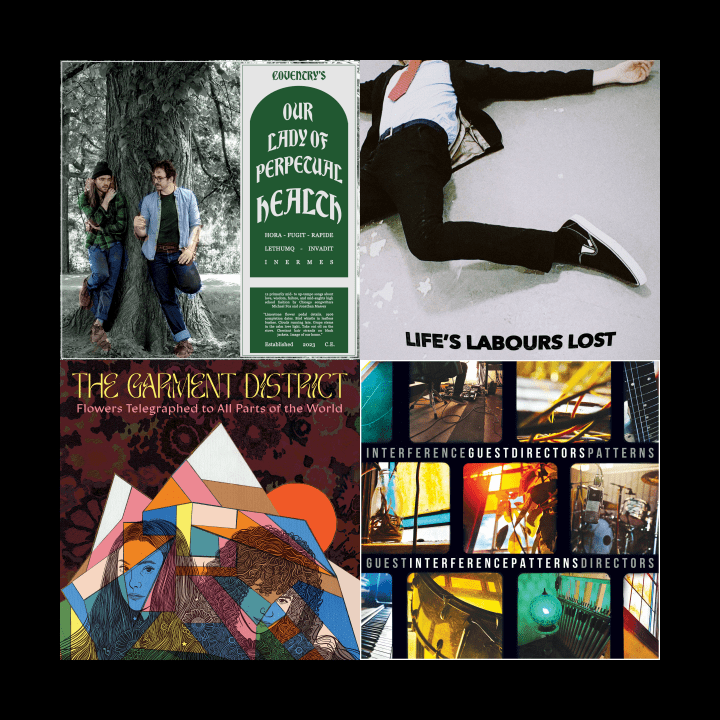
Coventry – Our Lady of Perpetual Health
Release date: September 19th Record label: Septic Jukebox Genre: Folk rock Formats: CD, digital Pull Track: Chain Wallet
Chicago’s Coventry is a brand new collaboration between two singer-songwriters who’ve bounced around several Windy City bands: Jon Massey (who I knew from Silo’s Choice and has also played in Animal Mother and Upstairs) and Mike Fox (from Arthhur and Flesh of the Stars). The duo’s other bands range from art punk to doom metal, but with Coventry, they seem to have landed on something closest to a more ornery version of Silo’s Choice’s folk rock. Their debut CD, Our Lady of Perpetual Health, is an accessible but decidedly offbeat collection of excellently-penned pop songs. Massey and Fox certainly have spent plenty of time with classic folk rock and “studio pop” from the 1960s and 70s, but it’s also a very Chicago record, channeling the spirit of both Drag City iconoclastic troubadours and Thrill Jockey jazz-fusion scientists.
The duo (who play everything on the record themselves) sound inspired and energetic for the entirety of Our Lady of Perpetual Health–Coventry seem to feel the pull of mellow soft rock, but Massey and Fox are too busy building their songs up to piano belters, soaring indie rock, or synth-populated jungles to completely heed it. One aspect of Our Lady of Perpetual Health I find myself appreciating is how often Massey and Fox sing on the same song. They have fairly distinct voices from one another, so when Massey’s Dan Bejar-ish lounge-voice switches to Fox’s deeper, startled-Bill-Callahan tones, it’s just another exciting turn in the music. Take something like “Chain Wallet”, the most immediate standout pop song on the album. Bright, mid-tempo acoustic pop rock marks the majority of the song (“Had a bitter fight over Shugo Tokumaru / You lost your temper and took the aux cord from me” receives a shockingly beautiful delivery from Fox), and then Massey takes the bridges and they both launch into guitar heroics overdrive for a huge showy finish.
The sub-two-minute, zippy “Coach House” is a piece of lo-fi fuzzy pop that gives that final part of “Chain Wallet” a run for its money, while plenty of the record’s mid-tempo moments (the relaxed strumming of “Seneca”, the pensive piano pop of “Large Portable Shrine”) acquit themselves just as sharply. Other parts of Our Lady of Perpetual Health take center stage on repeat listens, from the sleepy opening track “Middlebrow” to the majority of the record’s back end–on this particular listen, it’s the final track, “Sprouts”, which begins with some nice Charlie Gillingham organ-keys and an all-timer from Fox: “If I was a dog, then you were a fish / Because you’re cold and slipped through my fingers”. That song’s friendly neighborhood jazz-pop feels like an appropriate send-off for Our Lady of Perpetual Health, with the eager-to-please music thriving alongside both of Coventry’s members offering up quality-over-quantity lyrics. (Bandcamp link)
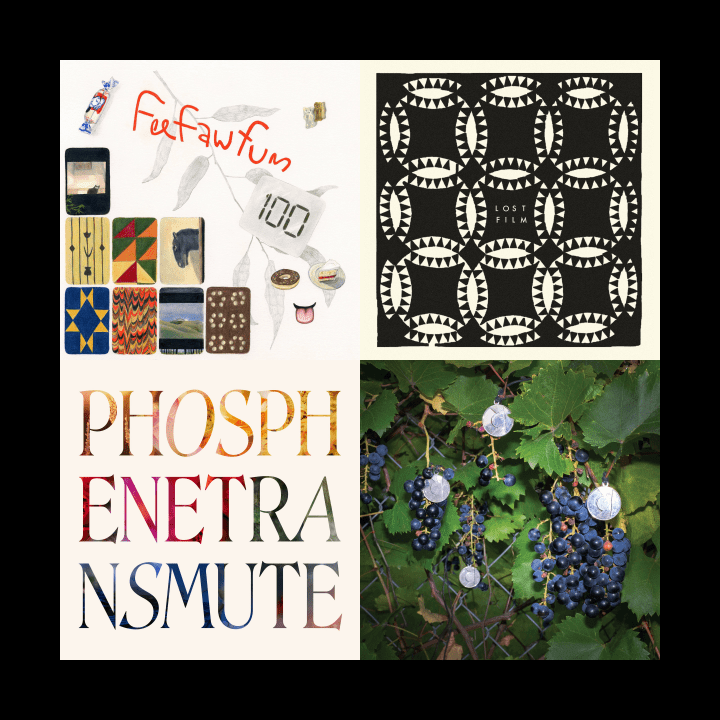
The Garment District – Flowers Telegraphed to All Parts of the World
Release date: September 22nd Record label: HHBTM Genre: Psychedelic pop, psychedelic rock, synthpop Formats: Vinyl, digital Pull Track: Left on Coast
Jennifer Baron was a founding member of The Ladybug Transistor, the Brooklyn indie pop group associated with the Elephant 6 collective–joining as a bassist in the mid-90s, she eventually became a songwriting force within the group. Since 2011, however, Baron has led another outlet for her music–The Garment District, in which she gathers up a host of collaborators and contributors to make her busy brand of pop music. The Garment District put out three full-length albums between 2011 and 2016, although the project had been quiet as of late. However, their fourth album (and second, after 2016’s If You Take Your Magic Slow, to be released on vinyl) is certainly a fully-formed return–Flowers Telegraphed to All Parts of the World is a stuffed, expertly-crafted pop album with all kinds of fascinating twists, details, and musical decisions.
On Flowers Telegraphed to All Parts of the World, Baron once again hands off the bulk of lead vocal duties to her cousin, Lucy Blehar, although guitarist Dan Koshute also sings a couple of songs and Alex Korshin sings one (and in the case of “Seldom Seen Arch” and “Cooling Station”, Baron is content to leave them purely instrumental). The majority of the songs on the album are over five minutes long, and The Garment District make every effort to develop each one of them into its own little odd, self-contained world. The first half of the album kicks off with the organ-sweet “Left on Coast”, a busy retro-pop tune that’s perhaps the most “Elephant 6” song here–although it’s the analog synth touches that set the tone for the bizarre dance-rock of “A Street Called Finland” immediately after.
Koshute’s vocals on “The Starfish Song” remind me of Joseph D’Agostino from Cymbals Eat Guitars, and the music takes a hard left turn towards big-picture guitar-forward indie rock to the point I had to make sure I was still listening to the same band (if I’d just waited until the band veer into weird organ-pop in the song’s second half, I would’ve known). The second half of Flowers Telegraphed to All Parts of the World is just as compelling–it contains the weirdest moment on the record with the dub-influenced “Cooling Station”, a beautiful conventional pastoral guitar pop conclusion in “The Instrument That Plays Itself”, and “Moon Pale and Moon Gold”, which balances the two ends of The Garment District quite nicely. As Flowers Telegraphed to All Parts of the World hits the 45 minute mark and floats off into a psychedelic outro, one is left sitting, impressed, at the other end of the large amount of ground the group has traversed. (Bandcamp link)
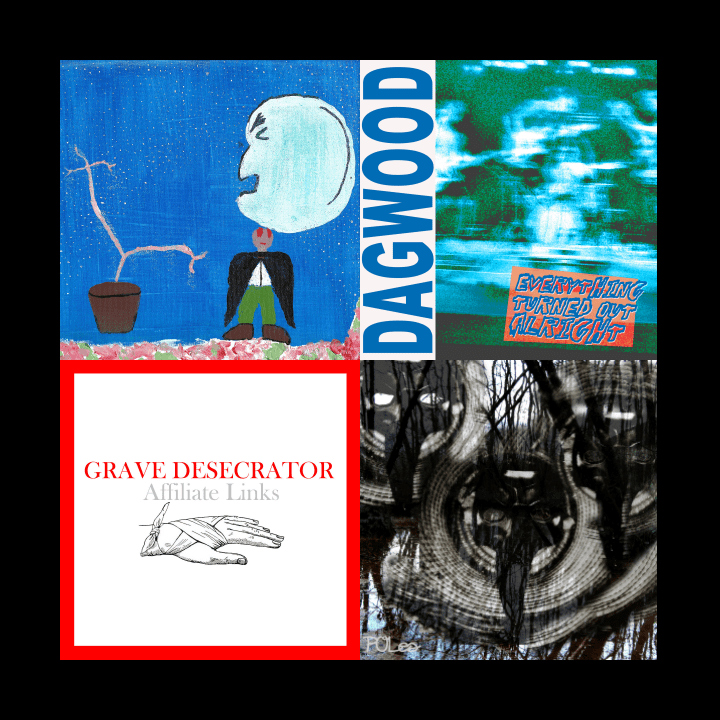
Soft Screams – Life’s Labours Lost
Release date: September 22nd Record label: Corrupted TV Genre: Lo-fi power pop Formats: Digital Pull Track: Carry on Young Cadavers
Perhaps more than anything else, I’ve been impressed with the ambition of Connor Mac. I’ve observed them putting copious amounts of worldbuilding into the realms of both their band Galactic Static and their solo project Soft Screams, and I’ve also heard plenty of music (Friendly Universe from the former, Diet Daydream from the latter) good enough to back up this sprawling presentation. Mac is a lo-fi power pop devotee in the vein of plenty of Rosy Overdrive mainstays, although they’ve developed a distinct style of it–too conflicted to embrace the sugaryness of Matt Addison’s Mythical Motors, not quite noisy enough to match the darkness of Ben Spizuco’s Hello Whirled, but containing shades of both–particularly on the newest Soft Screams album, Life’s Labours Lost. From its Shakesphere-inspired title to the musings on capitalism and work culture contained therein, it’s perhaps Mac’s most thematically heavy record yet–although, thankfully, it’s also one of their best as a pop songwriter.
“Anything I Want” kicks off the album with a Soft Screams pop anthem, and Mac’s love of chunky riffs helps build “Carry On, Young Cadavers” into one of the best pop moments on the album–the chorus of “Carry on, you young cadavers / Got caught up in a dead man’s game” is one of the record’s best-sounding rebukes. More than a bit of Life’s Labours Lost matches Mac’s thoughts with musical shifts, like the cloudy, worried-sounding “Hell in My Hands”, or the pissed-off drum-machine-punk of “AGITATOR”. Life’s Labours Lost reaches something of a climax in its second half, as Mac offers up two songs that pretty clearly grapple with the capitalist rot at heart of the album; “Sad @ the System” finds Mac “just worn out, sad at the system, spirit’s torn out,” unable to muster up energy for anger, but in the next one, “Fucked Up Forever”, Mac starkly stares down the fear that they’ve wasted their entire life laboring under capital, and emerges from the other side defiant and revolutionary. Mac sounds downright cheery at the end of “Fucked Up Forever”, but the record closes with “The Great Decimator”, a Hulk-smash piece of fuzz rock aggression that lets out a laborer’s life’s worth of tension in three minutes, and rightfully (and righteously) so. (Bandcamp link)
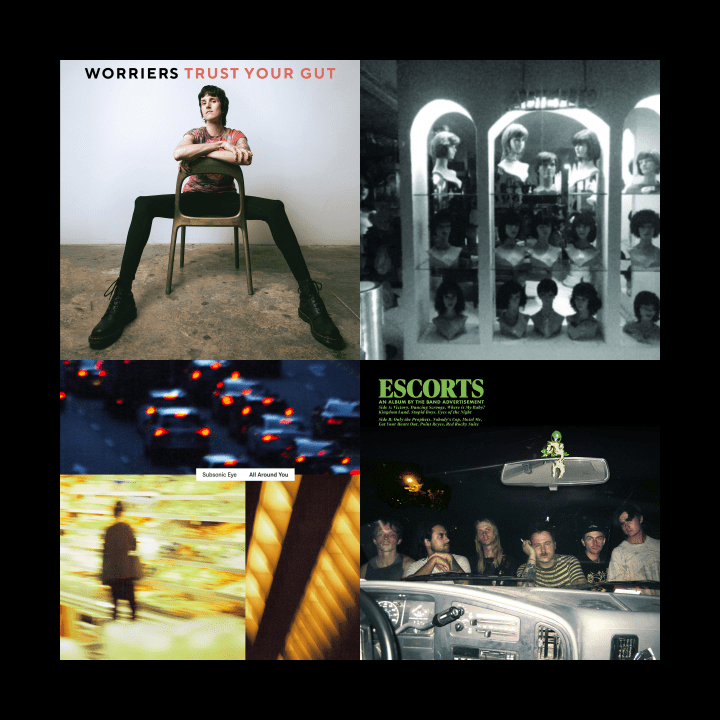
Guest Directors – Interference Patterns
Release date: September 22nd Record label: Topsy/Snappy Little Numbers Genre: Shoegaze Formats: Vinyl, CD, digital Pull Track: Nico
This may be Guest Directors’ first album, but that hardly means that the Seattle quartet is new to indie rock. For one, the band have already put out five EPs dating from 2016 up to last year, and for another, the band’s two singer/guitarists have a musical history dating even further back–Julie D. played guitar in the San Diego 90s math rock band Chinchilla, and Gary Thorstensen is none other than the founding guitarist of TAD. This helps explain the noise that the quartet (also featuring bassist Charlie Russo and drummer Rian Turner) are able to whip up on Interference Patterns, their debut full-length. Rather than trading in punk or math rock, the first Guest Directors album leans hard into stately, dense, shoegaze-influenced indie rock–it doesn’t quite let the noise overtake the vocals enough to be “pure” shoegaze, instead letting Julie D. and Thorstensen confidently ride alongside the distortion (it reminds me kind of the Phosphene album from last week, but with more emphasis placed on guitars vis à vis synths).
The thundering “From This Distance” opens Interference Patterns with a big, fuzzed-out shoegaze anthem, and while the dramatic, swirling “Perfect Picture” continues the distorted rock, the song’s nimbleness and less blunt nature indicates that Guest Directors aren’t going to just keep repeating themselves. The band go a step further by offering up a dream-y power ballad in “Raise a Glass”, and the mid-tempo “Blackout Dream Blues” has a probing, meandering sound. The electricity-charged “Skinless’ kicks off Interference Patterns’ flipside with a heavy shoegaze energy that matches the other half’s opener, but the B-side also contains “Nico”, which feels like the most openly “pop” moment on the record. The album closes things out with a pair of songs in “Stare It Down” and “You’ll Never Know” that still contain plenty of guitar heroics and walls of sound, but they both build their way slowly and deliberately towards these conclusions. Although Interference Patterns is certainly made by a rock band, it’s also the work of one that can pull back just enough when the music calls for it. (Bandcamp link)
This Thursday on Pressing Concerns, we’re looking at four albums that are coming out tomorrow, September 22nd: new ones from Slaughter Beach, Dog, Patio, Flat Worms, and Anton Barbeau. I’ve been a fan of all four of these acts for several years, predating the founding of Rosy Overdrive, and it’s a highlight of the blog’s lifespan that I’m writing about these albums here, together, in 2023. It’s been a busy week on the blog, with posts going up both on Monday (featuring Feefawfum, Phosphene, Lost Film, and American Cream Band) and on Tuesday (featuring Hearts of Animals, Affiliate Links, Dagwood, and POLes). Check both of those posts out if you haven’t yet; that’s a dozen records to take with you into the weekend!
If you’re looking for more new music, you can visit the site directory to see what else we’ve written about lately. If you’d like to support Rosy Overdrive, you can share this (or another) post, or donate here.
Slaughter Beach, Dog – Crying, Laughing, Waving, Smiling
Release date: September 22nd Record label: Lame-O Genre: Singer-songwriter, alt-country, folk rock Formats: Vinyl, CD, digital Pull Track: Float Away
For the majority of the 2010s, Jake Ewald co-fronted a band whose appeal escaped me at the time, but I have enjoyed his other project, Slaughter Beach, Dog, effectively from the moment I heard the rickety indie rock of “Mallrat Semi-Annual” back in 2016. Ewald has grown quite a bit as a writer over the past few years–like a lot of emo-originating songwriters, he clearly learned a lot from Johns Darnielle and K. Samson, but he’s always come off as “informed by” rather than imitating others. The folk-indebted, earnest, and distinctly hand-drawn style that Ewald’s cultivated has been a treat to witness take shape across career highlights like the underappreciated Motorcycle.jpg EP and the relatively cold, engrossing opus Safe and Also No Fear. The fifth Slaughter Beach, Dog album is called Crying, Laughing, Waving, Smiling, and Ewald is once again both in motion and in his element. It follows up on the more-laid back moments of 2020’s At the Moonbase–it’s a record made by someone who’s always had a knack for songwriting but feels like he’s getting more comfortable and trusting in his work.
Part of this comfort is reflected by the nature of Crying, Laughing, Waving, Smiling’s recording sessions–it’s Slaughter Beach, Dog’s most band-centric album yet. Not only was it recorded by a solid five-piece lineup–it was also a collaborative effort, with the rest of the musicians playing “what they were hearing” for the song based off of Ewald’s skeletal versions. The band–which I simply must point out includes Rozwell Kid’s Adam Meisterhans on guitar, as well as Superheaven’s Zack Robbins on drums, longtime collaborator Ian Farmer on bass, and Logan Roth on piano and synths–don’t turn Crying, Laughing, Waving, Smiling into an out-of-character rock-and-roll album, rather working more subtly in lockstep to dress Ewald’s songs with a bit more refinement. Of course, Ewald has always put more than enough into his music to let it stand without too many bells and whistles, and even when Slaughter Beach, Dog kicks things up a little bit, the core of the album is vintage Ewald.
The first half of Crying, Laughing, Waving, Smiling is, understandably, the more showy side, with the band slipping into something of a folk rock groove on “Strange Weather”, “Float Away”, and “My Sister in Jesus Christ”. The starry guitar pop of “Float Away” is one of the most instantly infectious moments I’ve heard on a Slaughter Beach, Dog album, while “My Sister in Jesus Christ” pulls off marrying a particularly potent set of Ewald lyrics to raucous (well, for Slaughter Beach, Dog, at least) country rock. Still, the record opens with the fairly meditative “Surfin’ New Jersey”, which melts into dreamy, psychedelic folk rock in a less obvious but perhaps even more impressive display of the band’s power. The nine-minute “Engine” picks up this thread in the middle of the record’s second side, with the band stretching out just enough to guide Ewald, at the center, home. Almost reflecting on the success of “Engine”, the last two songs on the record dial things back a bit, but that doesn’t mean they’re relegated to afterthoughts; I’ve been turning the lyrics to “Easter” over in my mind for quite a bit now. I wouldn’t expect any less of a riddle than “In my ice cream stand, there’s french fries too” to close a Slaughter Beach, Dog album. (Bandcamp link)
Patio – Collection
Release date: September 22nd Record label: Fire Talk Genre: Post-punk, art punk Formats: Vinyl, CD, digital Pull Track: Either Way
As far as I’m concerned, Patio’s second album has something for everyone (assuming everyone likes modern post-punk, which I choose to believe). Musically, Collection is a collection of quite aurally pleasing indie rock and art-punk (dealing in both garage-y bluntness and more restrained melodicism); approachable but not too “simple”, there’s plenty of unexpected and exciting moments. Lyrically, Collection is attention-grabbing too–not every moment on the album is straightforward (certainly not!), but plenty of moments are, and even when the lyricist (either bassist Loren DiBlasi or Lindsey-Paige McCloy, who trade off lead vocals) is a bit cagey, it’s not hard to, with a little bit of close listening and tone reading, latch onto what’s going on here to some degree. I do remember quite enjoying Patio’s 2019 debut, Essentials, and would’ve been happy to take in “more of the same” without too much thought, but I do appreciate Patio creating a record that prompts me to listen a bit more actively.
I admittedly have a terrible track record at predicting these things, but if you told me that Collection was going to launch Patio into the stratosphere, I’d believe you wholeheartedly. Just listening to something like “Either Way”, an album track that offers up increasingly affecting vocals, welcome pockets of earnest rolling indie rock and whoa-nelly, jerk-stop moments, and writing that reflects said push and pull (“I don’t need to know everything you’ve thought” on one end, “How can I do this right? How can I take your side?” on the other)–what’s not to like? Or the way that “Sixpence” balances its “oh shit” bone-dry chorus by sliding into offbeat pop-weird mode for the rest of the song? I appreciate every time that McCloy unexpectedly revvs their guitar into a brief ringing, and I think it’s cool how the album opens with a slow-builder (“The Sun”) and then launches into a song that starts at 100% before pulling the curtain back and then opening it again (“Relics”). I like how “Performance” will drop a crystal clear line like “I am not a cloak to be worn on particular days” in the middle of everything else going on in it. There’s a lot to like on Collection; it’s a pop album that’s also a grower. (Bandcamp link)
Flat Worms – Witness Marks
Release date: September 22nd Record label: GOD?/Drag City Genre: Garage rock, post-punk, fuzz rock Formats: Vinyl, CD, cassette, digital Pull Track: Sigalert
True, there have been a lot of bands trying to nail the midpoint between post-punk and garage rock over the past decade or so, but there’s something about Los Angeles’ Flat Worms that makes them particularly compelling practitioners of the art. Call it a back-against-the-wall edginess, or a no-nonsense, song-first, “workmanlike” attitude–they’ve got that dog in them, so to speak. I recognized it on 2019’s Into the Iris EP, and the band (Will Ivy, Justin Sullivan, and Tim Hellman) only continued their run into 2020’s Antarctica (one of my favorite records from that year). For a band that put out two albums and two EPs in a four-year period, going over three years between albums is a pretty notable gap, but Witness Marks sounds like a group that hasn’t lost a step. Even for a band that excels at making music like this, the album particularly has a “back in the saddle” feeling, even more laser-focused on rolling through sharp garage rock as a single, in-lockstep unit.
Opening track “Sigalert” is Flat Worms’ version of a raveup–careening guitars, fuzzed-out bass guitar, and barked but subtly malleable vocals all combine to what I’d consider to be an excellent two-point-five minute pop song. “Orion’s Belt” and “Time Warp in Exile” continue the sharp garage punk excellence in the record’s first-half, and even slightly restrained tracks like the stomping “SSRT” and the prowling “Suburban Swans” still cut. While its surface remains unreadable, there’s grief at the heart of Witness Marks, the lyrics of which were written in the aftermath of Ivy and his wife losing their unborn child. Ivy’s writing largely deals with this in the form of powerful but fairly opaque imagery, like the “helicopter in the burning sky” in “Wolves in Phase”, although “16 Days” throws metaphor out the window and the closing title track has a couple of gut-punch lines. Musically, Flat Worms don’t soften their blows as they take on Ivy’s writing. They sharpen the tools they know how to use best, lock themselves in, and proceed forward together. (Bandcamp link)
Anton Barbeau – Morgenmusik/Nachtschlager
Release date: September 22nd Record label: Think Like a Key/Gare du Nord Genre: Psychedelic pop, power pop Formats: CD, digital Pull Track: Waiting on the Radio
Gather ‘round, children–Anton Barbeau has a thirty-one song double album to impart upon all of us. Barbeau–who was splitting his time between his native California and more recent home of Berlin during the recording of Morgenmusik/Nachtschlager–has been a scourge on the genre of offbeat pop rock for over three decades now, and if anything, he’s only ramped up his output in recent years. The 77-minute Morgenmusik/Nachtschlager (which follows last year’s Power Pop!!! and Stranger, 2021’s Oh the Joys We Live For, 2020’s Manbird and Kenny Vs. Thrust…) is both a victory lap and a statement that Barbeau still has a lot left to sculpt. It’s full of contributions from guest musicians that prove Barbeau has successfully worked his way into the stratosphere of his influences–XTC’s Colin Moulding, The Soft Boys’ Andy Metcalfe, the dB’s Chris Stamey, Elf Power’s Bryan Poole–but the amount of ground covered here suggests he’s not content to sit on his laurels now (and if he’s not now, he likely will never be).
Realistically, I’m not going to be able to capture everything about Morgenmusik / Nachtschlager in 300-400 words–I encourage you to immerse yourself in it and figure out which corners of Barbeau’s mind resonate with you the most. Barbeau makes getting into this album as easy as it could be, mind you–“Waiting on the Radio” is a gorgeous, nostalgic jangle pop opener, and the next few tracks may have odd moments but all are pop successes (the proggy “Bop”, the composed “Milksnake”, the synth-funk touches of “Mothership Projection”). The Morgenmusik side is probably the more immediate one (“Coming Clean” and “Demand a Dream” highlight the rest of this side), although Nachtschlager does contain “Come Back”, which finds Barbeau pulling out a song structure straight from the best of 60s girl group singles. “Crankin’ em out, I’m a wizard with a wand, yeah,” Barbeau sings with a wink on the record’s penultimate song, “…the scent of zeitgeist in the air”. The punchline to this is, perhaps, the record’s final track, “Help Yourself to a Biscuit”, a six-minute, multi-stage piece of fully-loaded psychedelic fuzz-pop that sounds, well, timeless. (Bandcamp link)
Surprise! It’s a Tuesday Pressing Concerns. As it turns out, I’ve gotten to hear a lot of great new music lately, more than I’d normally be able to cover. Thankfully, though, I had some down time last weekend, and now I’m able to present to you the second of three Pressing Concerns that’ll go up this week. This one features a new album from Hearts of Animals, new EPs from Affiliate Links and Dagwood, and a cassette reissue of an EP from POLes. This is all hot on the heels of yesterday’s post, which presented albums from Feefawfum, Phosphene, Lost Film, and American Cream Band, and I also recommend going back to that one if you missed it.
If you’re looking for more new music, you can visit the site directory to see what else we’ve written about lately. If you’d like to support Rosy Overdrive, you can share this (or another) post, or donate here.
Hearts of Animals – Imaginary Heartbreak
Release date: September 1st Record label: Self-released Genre: Folk, baroque folk Formats: Digital Pull Track: Imaginary Heartbreak
Mlee Marie has been recording music since at least the mid-2000s. The Houston-based multi-instrumentalist has contributed her talents to albums and/or live performances by everyone from Daniel Johnston to Alien Eyelid (the latter being the most recent, having played saxophone and sang on Bronze Star earlier this year). Concurrently, Marie has been putting out music on her own as Hearts of Animals for just as long–there are four full-length albums under the name, as well as a handful of EPs. As Hearts of Animals, Marie has made music ranging from southern garage rock to dreamy jangle pop, but her latest record, Imaginary Heartbreak, is a decidedly different affair. On her fifth album, Marie dives headfirst into baroque, orchestral folk music–Marie mentions that it’s her first album that “doesn’t have any drums”, and it instead fills this gap with woodwinds, strings, and even a harmonica that all shade her delicate, acoustic song foundations in a different manner.
The opening title track is one of the album’s most meditative (and best) moments, a slow-moving four-minute song in which Marie sings an understated vocal in the beginning, and a hypnotic sustained note marks the song’s second half. The poppiest songs on Imaginary Heartbreak occur in the first half–“Beautiful” features cello and bass (performed by Evan Leslie and Alien Eyelid’s Brett Taylor, respectively) alongside a nice acoustic guitar core and sweet vocals from Marie, and she sings alongside a fluttering flute in “Spell Song”. These two songs sandwich a calming, peaceful instrumental take of “Crepe Myrtle”, a song whose initial version I highlighted in a playlist earlier this year. The record’s subtler midsection might be its high point–from the deliberate pacing of “Chapter” to the deconstructed baroque pop of “Joey’s Bedroom” to the minimalist retro-pop of “Neap Tide”, Marie keeps us all engaged before sending us off with the 13-minute ambient piece “Pictures of Trees”. Hearts of Animals took a winding journey to end up in the midst of the odyssey of Imaginary Heartbreak’s final song, but listening to the record as a whole, it all makes sense. (Bandcamp link)
Affiliate Links – Grave Desecrator
Release date: August 22nd Record label: Self-released Genre: Indie pop, dream pop, alt-country, chamber pop Formats: Digital Pull Track: Grave Desecrator
Hamilton, Ontario’s Brad Davis is new to me, but it seems like he’s been at this for quite a while, playing in several bands over the years (Oval-Teen, Lake Holiday, Fresh Snow). His latest project is called Affiliate Links, a solo-ish endeavor which made its full-length debut last year with Enough Light on We Are Busy Bodies Records. Although there’s no Affiliate Links LP on the decks for 2023, Davis has something even more ambitious planned this year. After marking the first half of 2023 with a standalone cover of Guided by Voices’ “Optional Bases Opposed” (points for creativity in choosing that one), Davis plans to put out three EPs under the Affiliate Links banner before the end of the year. The first one, Grave Desecrator, was mastered by frequent Robert Pollard collaborator Todd Tobias, and it’s a compelling collection which falls on the lush, orchestrated end of bright guitar pop.
Although Davis is the sole songwriter and seemingly the only “permanent” member of Affiliate Links, Grave Desecrator features eight guest musicians contributing everything from trumpet to violin to pedal steel. The EP contains flourishes by these instruments throughout, but the core of the record is Davis’ pop songwriting. The opening title track is a breezy, laid-back piece of guitar pop that nevertheless has a chorus that grabs the listener. The dreamy haze of “Enough Light” is accentuated by pedal steel (provided by Jimmy Hayes and Hamilton McKay Belk), as is the brisk “Abdicate the Throne”, the song on the EP that hews closest to “alt-country”. The piano, organ, and vibraphone coloring “Scar Maps” push it into ornate chamber pop territory, and the whole thing ends with the seven-minute “Sky to Fall”, a steady, trudging piece of slow-building dream-folk. At 24 minutes, Grave Desecrator offers more across its six songs than a lot of bands do on their full-lengths; if Davis truly has two more of these up his sleeve, 2023 is going to be a fertile time for Affiliate Links. (Bandcamp link)
Dagwood – Everything Turned Out Alright
Release date: August 2nd Record label: Self-released Genre: Power pop, pop punk Formats: Digital Pull Track: Sheep on Mars
Although they’ve apparently been putting out music since 2011, New Haven power-pop-punk quartet Dagwood first showed up on my radar in July, when I heard their single “Sheep on Mars”– a song that I then proceeded to highlight on the blog and declare “one of my favorite singles in recent memory” (which I stand by, by the way). Containing a borderline greedy amount of hooks delivered with a blast of fuzzy 90s alt-rock energy, the band (guitarist/vocalist Grady Hearn, guitarist Mike Nagy, bassist Tim Casey, and drummer Kilian Appleby) were an easy addition to my (unofficial, in my head) list of “bands to watch”. Last month, Dagwood gathered up the three singles they’d released so far this year (including “Sheep on Mars”), tacked on three brand-new songs, and, viola, the Everything Turned Out Alright EP was born.
I’ve already made my position on “Sheep on Mars” clear, but the other two previously-released singles are no slouches either–both the fuzzed-out slacker anthem “I Am a Loser” and the choppy, gnarly “Worse for the Wear” are charming pop songs that earn their places buffeting “Sheep on Mars”. However, it’s the new songs that steal the show on Everything Turned Out Alright. The opening title track is Dagwood at their slickest and cleanest–it’s a bouncy, smooth piece of alt-power-pop in which Hearn tries an enjoyable falsetto on for size. On the other end of the spectrum is “Dagdream”, in which Hearn’s voice gets pushed to the background as the band explore swirling, almost shoegaze-y space rock (the chorus is no less catchy, though). And then, of course, there’s nothing more power pop than ending the album with “Every Time It Ends the Same”, a stomping piece of defeatist rock and roll. A dozen minutes, a half-dozen songs, energy and pop smarts everywhere–Everything Turned Out Alright, indeed. (Bandcamp link)
POLes – Pamplemoustique (Cassette Reissue)
Release date: September 3rd Record label: Tapes from the Crypt Genre: Math rock, noise rock, post-hardcore, post-rock Formats: Cassette, digital Pull Track: Puy des goîtres
POLes are an instrumental rock trio, formed in 2010 by then-library coworkers Bruno Kuchalski (guitar), Marc Lobjoit (drums), and Mickaël Gomes (guitar). The band was fairly active in the first half of the 2010s, putting out a handful of releases including 2012’s Marmyteran LP and the Pamplemoustique EP in 2014. The latter appears to still be the most recent POLes release, as the band went on hiatus shortly after. However, with the group (which is currently split between Paris and Lyons) “considering getting back to its aural nonsense” (per Kuchalski) soon, they’ve remastered their nearly-decade-old EP and partnered with Tales from the Crypt Recordings to give Pamplemoustique a cassette release. It’s a noisy, dissonant, and compelling collection of swirling, probing, and punishing guitars that doesn’t seem to have lost any of its bite over time.
Although Pamplemoustique only runs four songs long, one doesn’t feel shortchanged listening to it. For one, all the songs are fully-developed (all of them except for the three-minute “Les nains” are pushing five minutes), and for another, POLes are colliding their instruments together in a shower of sparks for pretty much its entire length. “Puy des goîtres” kicks things off with a nice, meaty noise rock/post-hardcore riff, one that continues boring into the listener’s skull for most of its length before POLes offer up a thrashing conclusion. The high-flying “Les nains” is the mathiest one, drum squalls stopping and starting over twisting guitars, while the wobbly but sturdy march of “Complainte d’Yvonne” is a tough piece of noise punk with which to close things out. Pamplemoustique is far from the “friendliest” record I’ve written about this year, but its strengths reveal themselves to those willing to let POLes take them underground. (Bandcamp link)
On this beautiful fall Monday, Pressing Concerns has arrived with the morning dew to present you with four new albums that we’re confident you will enjoy. Do you like post-punk? Math rock? Dream pop? Psych-jazz-funk-kraut? Well, all of that and more awaits you as we discuss new ones from Feefawfum, Phosphene, Lost Film, and American Cream Band.
If you’re looking for more new music, you can visit the site directory to see what else we’ve written about lately. If you’d like to support Rosy Overdrive, you can share this (or another) post, or donate here.
Feefawfum – 100
Release date: September 8th Record label: Self-released Genre: Math rock, art punk, post-punk, noise rock Formats: Vinyl, digital Pull Track: DKA
Over the past month or so, I’ve written about records from Curling–who branched off from their math rock roots to make an exploratory, progressive pop album–and Perennial–who are in the business of reviving early-2000s post-hardcore/dance-punk through sheer force of will. Somewhere in the middle of the two lies Feefawfum, a Montreal-originating, Oakland-based band led by drummer/vocalist Farley Miller. On their second full-length album, 100, Farley (who recorded the record largely on his own) reaches back into the world of early 2000’s jerky, frantic-sounding math rock/post-punk to color his songwriting (they cite Deerhoof as an influence, although that doesn’t quite capture their sound on its own…they’re too poppy to be compared to Melt-Banana, not exactly “sasscore” either…does anyone remember Ex-Models?). Feefawfum whips up a frenzy in nine songs and 30 minutes, sounding noisy and paranoid but at the same time remaining surprisingly pop-fluent.
Another record I could compare 100 to is Everything Is Broken, Maybe That’s O.K. by Alex Orange Drink, an album that discusses singer Alex Zarou Levine’s experiences living with homocystinuria, a serious, life-threatening, long-term metabolic genetic disorder. Although it’s easy to miss it in the instrumental barrage, 100 is a also concept album–about Miller’s everyday life as an adult diagnosed with type 1 diabetes. The clues are there once one knows to look for it–in the Brainiac-y freak punk of opening track “DKA”, Miller sings about needing to be able to afford insulin in order to live (“I hope I live to see a raise / So I can change my blood’s pH” goes the chorus, aided by backing vocals from Mellotron player Emma Greenbaum and bassist Kevin Sullivan).
“DKA” is short for diabetic ketoacidosis, and even the record’s title refers to the optimal blood sugar level for the human body (100 mg/dL). The rest of the album connects to this in some way–“Evergreen” and “Miles Away” take a dark big-picture view (“The protocols and flow charts / Know what’s the best for you” Miller sarcastically sings in the former, a Wolf Parade-y art punk tune about the completely legal ways pharmaceutical companies kill poor people), while “Should Have Known” supplements this with a straightforward account of a hypoglycemic episode and the uncaring world around him in the moment. 100 plows ahead musically regardless of where Miller is at in his lyrics–one doesn’t need to know the entire backstory to enjoy the taunting egg punk of “Brown”, or the punchy noise rock of “Pickled Ginger”. Truthfully, I didn’t really know much of this until I sat down to write about 100, but by that point it had already offered me more than enough to win me over. (Bandcamp link)
Phosphene – Transmute
Release date: September 15th Record label: Self-released Genre: Dream pop, post-punk, synthpop, shoegaze Formats: Digital Pull Track: Umbra
Phosphene are the Portland, Oregon-based duo of vocalist/guitarist Rachel Frankel and drummer Matt Hemmerich, who have been making music together for around a decade. Their third album, Transmute, is the work of two musicians inspired by the dream pop and post-punk of the 1980s, both directly and filtered through bands drawing from the same well (Frankel mentions Japanese Breakfast and Alvvays as touchpoints for their sound). Transmute is surprisingly muscular-sounding for a dream pop record–these eight songs are, more often than not, anchored by prominent, sharp guitar lines, propulsive drumming from Hemmerich, and Frankel’s front-and-center vocals. Phosphene recorded Transmute during the pandemic–as a result of the extra gestation time, they expanded their sonic palette to incorporate more synths and even digital strings. What Phosphene have ended up with is a record that shows how to allow these new touches in a way that adds to the music without overwhelming their core sound.
Phosphene hit the ground running on Transmute with the six-minute “Umbra”, a focused, advancing song that balances its no-nonsense rhythm section with synths and some decorative and even dance-friendly guitarplay from Frankel. “Black Sheep” and “Levitation” continue to fill Transmute’s first side with full-sounding post-punk exercises, before they offer up their first ballad in “Jigsaw”, a go-for-broke piece of wide-eyed dreamy synthpop. Transmute is a consistently solid listen, as Phosphene continue to balance their post-punk foundation with dreamy touches across its second half. “Wisp” builds confidently but never eases its grip on the jangly guitar line that’s shading it, the brisk “Everyone Is Gone” lets the synths deliver some of the most memorable melodies, and “Wandering” closes things out by taking a Sundays-esque, earnest piece of guitar-driven dream pop and adding a few more layers to it. It’s one last pleasing but hefty moment. (Bandcamp link)
Lost Film – Keep It Together
Release date: September 15th Record label: Relief Map Genre: Dream pop, post-punk, jangle pop, slowcore, bedroom pop Formats: Vinyl, digital Pull Track: Big Talk
Easthampton, Massachusetts’ Jim Hewitt has been making music for about a decade as Lost Film–for the past couple of years, he’s been doing it while also running the record label he founded, Relief Map (Old Moon, Kitner, Convinced Friend). The past few Lost Film records had been recorded by Hewitt alone at home, but for Keep It Together, his fourth album under the name, he had other plans–he recorded it (along with drummer Ben Husk and engineer Matt Freake) in a cabin in rural New Hampshire “in the midst of a blizzard”. The trio of longtime indie rockers approached Keep It Together with the intention of making a polished guitar-pop album, and what they’ve produced is their version of it–one indebted to both 1980s post-punk/indie pop and 2010s greyscale bedroom pop, but always hovering towards the “pop” side of these genres.
Hewitt is a subtle vocalist–he falls on the Alex G/Hovvdy spectrum of “getting out of the song’s way”, although he delivers his melodies in a warm and pleasing manner nonetheless. His singing contrasts nicely with the music of Keep It Together, which pushes against its limits for 25 minutes and nine songs. The wide-eyed indie rock of opening track “Little Things Forever” sounds both humble and sweeping, and then Lost Film outdo themselves on the next track, the shining “Big Talk”. The midsection of Keep It Together is more insular–”Exist” and “Stay” turn polished jangly rock inward, and while letting borderline-garish synths lead the mid-tempo, cavernous “Searching” is a particularly “DIY bedroom rock” move, it’s one that the band pull off. Second half highlights “Notion” and “Re:places” keep spirits high towards the end of the album–the latter ends with the swirling post-punk instrumental giving way to an excitable lead guitar part. It’s one big pop moment–after all, why wouldn’t some indie rockers in a cabin in New Hampshire reach the pinnacle of pop music? (Bandcamp link)
American Cream Band – Presents
Release date: September 15th Record label: Quindi Genre: Krautrock, post-punk, psychedelic rock, no wave, jazz-rock Formats: Vinyl, digital Pull Track: Taste What We Taste
American Cream Band is led by Nathan Nelson and a “rolling cast of collaborators”, emerging out of the Twin Cities about a decade ago and putting together several records of improvisational-originating, krautrock and psychedelic-inspired rock music. The bulk of their latest album, Presents, was recorded by Nelson and ten other musicians in December of 2021, and it’s an exciting and friendly big-band album that functions as a proof of concept that making and listening to “record collector rock” can be, in fact, extremely fun. Presents is led by Nelson’s ringleader bark, and it throws everything from punchy horns, a scorching rhythm section, and gripping, chanting backing vocals at the listener in under a half-hour.
Presents opens with “Sirens”, a synth-led, ambient-psych-ish soundscape–it’s something of a throat clearing before American Cream Band get down to business. “Dr. Doctor”, the first rock song on the album, is led by a brisk bassline and drumbeat, over top of which the band layers additional productions, synth and horn accents, and a call-and-response of the title from Nelson and his bandmates. The repetition of the title in “Banana” (or “Banana-nana”) certainly feels like it’s on the improvisational side of things, although the groove on this one is no less potent. The horn-funk of “Royal Tears” punctuates a sharp side A, while the flipside contains a couple more space-jazz explorations in “Birds Don’t Try” and closing track “Words Would Handcuff Us” (while nevertheless offering up the blaring funk rock of “Taste What We Taste” as well). Presents feels longer than its relatively brief runtime–not in a “it’s not over yet?” way, mind you, in a “I can’t believe we just went through all that in 28 minutes” kind of way. (Bandcamp link)
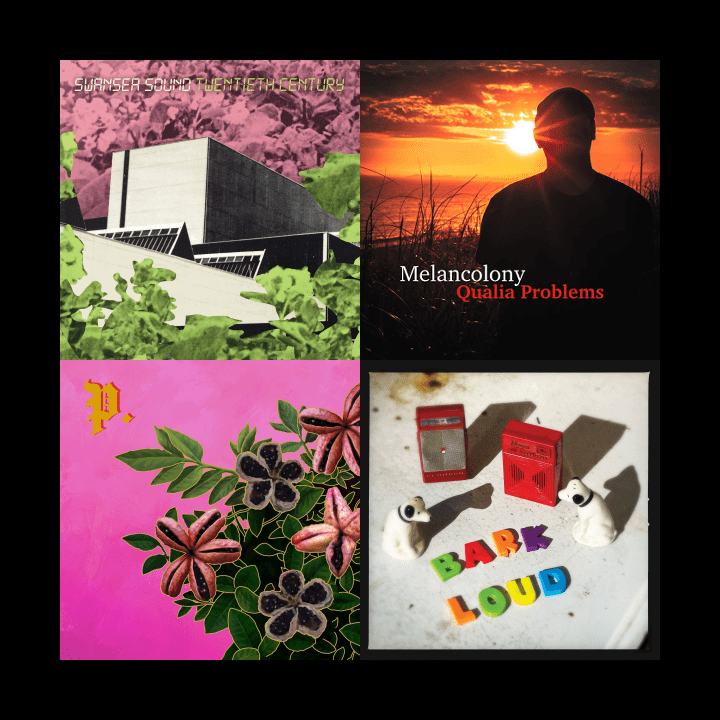
Welcome to a Thursday Pressing Concerns! Today, we’ve got four new albums to discuss: rippers from Worriers, Tony Jay, and Advertisement come out tomorrow, and Subsonic Eye‘s new album came out earlier this week. In my opinion, this post rules, and it contains exactly the kind of bands I wanted to write about on my blog when I started this whole thing. I would also recommend checking out Monday’s blog post (featuring Swansea Sound, Proper., Melancolony, and Bark) and the August playlist/round-up (which went up on Tuesday).
If you’re looking for more new music, you can visit the site directory to see what else we’ve written about lately. If you’d like to support Rosy Overdrive, you can share this (or another) post, or donate here.
Worriers – Trust Your Gut
Release date: September 15th Record label: Ernest Jenning Record Co. Genre: Power pop, pop punk Formats: Vinyl, digital Pull Track: Losing the Thread
The first half of 2023 saw the biggest curveball in the decade-plus history of Worriers. The Lauren Denitzio-led, Brooklyn-based group made their name with albums of sharp indie-pop-punk, releasing music on labels like Don Giovanni and SideOneDummy and collaborating with Laura Jane Grace, Mikey Erg, and members of Bad Moves–artists who doubled as sonic points of comparison for albums like 2017’s sublime Survival Pop. In April of this year, however, Denitzio (who had relocated to Los Angeles) put out Warm Blanket, which they had recorded entirely at home, resulting in a low-key, bedroom pop-adjacent Worriers album. There had perhaps been hints of this with 2020’s You or Someone You Know, but it still felt like a huge departure. It was an intriguing turn, but Worriers hadn’t abandoned their louder side, as Trust Your Gut proves mere months later. Aided by The Hold Steady’s Franz Nicolay and Against Me!’s Atom Willard, among others, Denitzio and crew hammer out a record of power pop and pop punk that unsurprisingly contains several layers under its surface.
Denitzio’s songwriting has always been the main draw of Worriers, rather than the clothes in which their songs are dressed, and Trust Your Gut is a reminder that their lyrics can resonate and echo just as effectively in a “polished” pop context as in “intimate” bedroom rock. That’s certainly not to say that Nicolay’s keyboard playing doesn’t add to songs like “Backyard Garden” and the title track, but it does so in a way such that Denitzio’s personality shines through just as easily. The subtler depths of Worriers are apparent in songs like “Cloudy and 55” and “Waste of Space”, and Denitzio’s decision to stick these songs in the first half of the record rather than bury them in side two is an indication that they’re growing comfortable merging the various “kinds” of Worriers songs on the same album. Some of the most classic Worriers-sounding songs come near the end, like the exhausted punk of “Charming”, and the entire world that Denitzio builds in under two minutes in “Losing the Thread” is soundtracked by surprisingly smooth pop rock. Truthfully, though, these distinctions feel as fuzzy as ever–when Denitzio is pouring this much of themself into every song on Trust Your Gut, it starts to feel like Worriers can encompass just about anything. (Bandcamp link)
Subsonic Eye – All Around You
Release date: September 13th Record label: Topshelf Genre: Dream pop, indie pop, fuzz pop Formats: Vinyl, CD, cassette, digital Pull Track: Circle
One of the first albums I ever wrote about in Pressing Concerns was Subsonic Eye’s Nature of Things, the third full-length from the Singaporean indie rock band. It was a compelling record of dreamy, jangly, perhaps even slightly emo-y East Asian rock music that got a good deal of buzz–that is to say, ripe to be picked up by Topshelf Records, who’ve brought bands like Elephant Gym and Sobs to the West in recent years. The all-too-brief Melt the Wax EP surfaced late last year as the quintet’s first release on the label, and now they’ve arrived with All Around You, the fourth Subsonic Eye full-length. The band (Nur Wahidah, Daniel Castro Borces, Jared Lim, Sam Venditti, and Lucas Tee) pick up where Nature of Things left off–it’s an album of wide-eyed, big-sky indie rock marked by Wahidah’s compelling, expressive vocals and hooks that work well with All Around You’s grandiose ambitions.
Although All Around You is only a couple minutes longer than their last album, it feels fuller and bigger, with the band packing a lot into a lot of these songs’ two-minute runtimes. It’s a natural progression for Subsonic Eye, and one that works for them. Although a lot of bands who dive headfirst into ornate and “pretty” “heartland rock” run the risk of smoothing out their sound to the point of homogeneity–blending in with countless other slick Americandie bands that receive glowing Uproxx write-ups–Subsonic Eye will never have that problem as long as Wahidah’s distinctive vocals remain at their helm. From the electric propulsion of the album’s first three songs to the laid-back, guitar-driven dream pop of second-half highlights like “Tender” and “Machine”, Subsonic Eye’s winning formula of putting Wahidah’s singing front-and-center ensures that their pop smarts don’t get swallowed up (and, in fact, the instrumentals only add to the catchiness). Wahidah is key in holding the multiple sides of Subsonic Eye together, although the band’s dexterity deserves acknowledgement as well–whether they’re trading in perked-up, amp-cranked fuzz-pop or wistful, wandering material, All Around You confidently presents it all as one. (Bandcamp link)
Tony Jay – Perfect Worlds
Release date: September 15th Record label: Slumberland Genre: Indie pop, dream pop, lo-fi pop Formats: Vinyl, cassette, digital Pull Track: Just My Charm
Rosy Overdrive readers got a healthy dose of Michael Ramos last year–that’s when Mt. St. Mtn. reissued his solo project Tony Jay’s Hey There Flower, as well as Half Yesterday, a record from Flowertown (the band he co-leads with Cindy’s Karina Gill). Those twin releases are enough to get a sense of Ramos’ style of music–he falls on the dreamy, quiet, and sparse end of his city of San Francisco’s guitar pop scene, with his winning melodies being delivered with either patience-requiring slowness (particularly with Flowertown), heavy deployment of open space (with Tony Jay), or both of the above. Tony Jay has jumped to Slumberland for a brand new full-length, Perfect Worlds, and it’s yet another collection of pleasing pop music helmed by Ramos. Unlike Hey There Flower, however, Perfect Worlds features some other musical contributions (Kelsey Faber on guitar, keys, and synth, Cameron Baker on percussion and glockenspiel), and it subsequently sounds a little cleaner–even though, yes, it was still recorded in Ramos’ bedroom.
Perfect Worlds is still a Tony Jay record, however, and enjoying it requires accepting Michael Ramos’ ideas of pop music. The album starts with the three minute noise piece of “Falling Sand”, for one–and while the first “proper” song”, “Isolated Visions” may have a steady drumbeat and a deliberate jangling guitar line, it still feels oh-so-fragile. Percussion drops in and out of these songs–side one highlight “Just My Charm” is just about as developed as Tony Jay has gotten, while tracks like “Conquered Certainty” and “Wonder Why” decline to dress themselves up and harken back to Hey There Flower. The title track offers up a piece of sparkling indie pop in the record’s second half, coming in the midst of a few songs (“Talking in My Sleep”, “Ice in the Jar”) that require a bit of a closer look in order to see their luster. There’s plenty to enjoy in Tony Jay’s less showy songs, however, and the fact that they’re interspersed with songs that take a step towards the listener makes coming back to them even more automatic. It’s never been easier–or more rewarding–to meet Tony Jay where he is. (Bandcamp link)
Advertisement – Escorts
Release date: September 15th Record label: Feel It Genre: Garage rock, psychedelic rock, post-punk, krautrock Formats: Vinyl, CD, cassette, digital Pull Track: Victory
As far as I know, all six members of Advertisement are fine, clean, upstanding members of society–and yet, their latest album, Escorts, just kind of feels dirty. Not in the loud gutter-punk way that some of their Feel It labelmates trade in, however–the band’s sophomore album has something more subtle but still quite potent going on. Advertisement–keyboardist/synth player Jesse Rosenthal, guitarist Ryan Mangione, drummer TJ Main, bassist Waylon Trim, and guitarist/vocalists Charlie Hoffman and Carl Marck–have spent the last half-decade cultivating a unique sound, a freewheeling, adventurous take on rock-and-roll that evokes everything from Lou Reed to Creedence Clearwater Revival to The Men to heavy psychedelia. Escorts is fairly uncategorizable–it’s a jammy album made by a band that doesn’t really sound like a “jam band”, it feels indebted to classic rock but is quite liberal with synths, and it frequently wanders but always feels on its way to somewhere.
The songs of Escorts were written remotely, as the sextet has become spread out over New York, Los Angeles, and their original hometown of Seattle, but they convened in southern California at Ty Segall’s home studio to record the album. Clearly, the band are locked in on Escorts–take any two random points on the album and one might say “is this the same band?”, but listening to it in order feels, somewhat improbably, like an incredibly smooth experience. Advertisement kick things off with the relatively straightforward garage-y “Victory”, but then they move into the six-minute groove of “Dancing Scrooge”–a swerve that nevertheless has nothing on their reinvention as a darkwave band on the next track, “Where Is My Baby?” Escorts moves toward the psychedelic and atmospheric as it progresses–there’s certainly some nice guitarplay on “Eat Your Heart Out”, and “Nobody’s Cop” is a deceptively pretty pop song, but the back end of Escorts kind of sounds like you’re watching the airport get smaller and smaller as the plane climbs higher. By the time closing track “Red Rocky Suite” comes roaring by, one might wonder if they even want to land. (Bandcamp link)
Coming slightly later than usual (Labor Day happened, I didn’t want to try to cram an extra long post in a short week, I’m busy sometimes, et cetera), here is the Rosy Overdrive August 2023 round-up and playlist. Almost everything here is from this year, and it’s all great music! Tell a friend about it! Listen to it on your way to work! Find the song of the summer!
Bands who get multiple songs on this playlist: Star 99, Ruler, Onesie, and Gaadge (good call on those four, me).
Here is where you can listen to the playlist on various streaming services: Spotify, Tidal, BNDCMPR (missing a song). Be sure to check out previous playlist posts if you’ve enjoyed this one, or visit the site directory. If you’d like to support Rosy Overdrive, you can share this (or another) post, or donate here.
“Shamble”, Curling From No Guitar (2023)
On their first album in five years, the trans-Pacific duo Curling offer up a record that reflects their love of vintage 60s-esque, heavily-tinkered-with studio pop rock, without straying too far from the more math rock-y sound of their previous music. From the beginning of No Guitar, Tokyo’s Jojo Brandel, San Francisco’s Bernie Gelman, and drummer Kynwyn Sterling all co-anchor a somewhat offbeat but still incredibly catchy power pop group. Once opening track “Shamble” kicks in, everyone is working in lockstep to land hooks–the delivery of “Holy shit, someone needs to kick my ass” is quite an achievement in particular. Read more about No Guitar here.
“Vegas”, Star 99 From Bitch Unlimited (2023, Lauren)
Bitch Unlimited, the debut album from San Jose’s Star 99, has that unmistakable sound of early 2010s indie-pop-punk–the quartet is comprised of Bay Area music veterans, which makes sense given this fact. Bitch Unlimited is ten songs and 26 minutes long, and just about every second of it is crammed with hooks–including up to the final buzzer with closing track “Vegas”. Co-frontperson Saoirse Alesandro offers up several memorable lines on the track (“Poured a glass of water out, it was calcium and lead / An opportunity to recognize that my brain’s a harbinger of death,” is how the track opens, and “They’re lying to us through maps / They’re lying to us through maps,” is just as key) as the band blast through a fizzy, medicated indie rock song. Read more about Bitch Unlimited here.
“Is It in My Head”, The Symptones From The Symptones (2023)
On their self-titled sophomore album, Minneapolis five-piece group The Symptones make an indie rock record with a party energy stretching beyond their relative obscurity. The band dig through power pop, soul, R&B, and Springsteenian heartland rock–not everything on The Symptones is “up my alley”, but when it hits–like on side two highlight “Is It in My Head”–it’s undeniable. On this song, The Symptones build a two-minute pop rocker that’s bursting with hooks from the beginning, Taylor Tuomie’s sincere vocals really selling things over a nice, big pop song chord progression.
“Have Nots”, Blues Lawyer From Sight Gags on the Radio (2023, Dark Entries)
It’s been an eventful 2023 for Blues Lawyer. They put out a full-length, All in Good Time, back in February (it’s one of my favorite albums of the year, by the way), and co-founder Rob I. Miller put out a solo record that’s just about as good a couple months later. Blues Lawyer are back again with a 7” EP that comes out at the end of September–and the first single from Sight Gags on the Radio is Blues Lawyer at their best. “Have Nots” finds the band on the fuzzy end of the indie pop spectrum, with distorted guitars punching up Miller and Elyse Schrock’s vocals. The song takes a detour towards the wild and noisy in its bridge, but the band guide it back to its pop beginnings effortlessly.
“Someday I’ll Go Surfing”, Diners From Domino (2023, Bar/None)
On Domino, her latest album, Diners’ Blue Broderick takes a turn for the louder, rockier, and full-band-embracing. Aided by producer Mo Troper and guitarist Brenden Ramirez, Broderick made “the rock record that [she] always wanted to make”, and songs like “Someday I’ll Go Surfing” are all the richer for it. Diners find a higher gear here–it’s a breezy track that’s power pop in its purest form, hooky and sturdy. Like countless other power pop classics, “Someday I’ll Go Surfing” has plenty going on under its hood, as its title line takes on a kind of meditative quality. Would recommend checking the song’s video out too. Read more about Domino here.
“Welcome”, Downhaul (2023)
“Welcome” is apparently the cap on Downhaul’s 2023. The slick “The Riverboat” came out in February, while May marked the release of the four-song (or “12-minute song with four suites”) Squall EP–“Welcome” is the final song from the same sessions that produced both previous releases (recorded with Chris Teti of The World Is a Beautiful Place & I Am No Longer Afraid to Die). It’s the most casual song that Downhaul have released this year (not that that’s saying much). It has a bit of the rootsiness that the band has stepped away from since 2021’s PROOF, fitting well with a lyric from Gordon M. Phillips that touches on family, climbing sumac trees as a kid, and, in the chorus, a simple but resonant piece of advice about navigating all of that as an adult.
“Anemone in Lemonade”, Onesie From Liminal Hiss (2023, Totally Real/Pillow Sail/Kool Kat Musik)
The third album from Brooklyn’s Onesie, Liminal Hiss, is a barrage of warped pop hooks that nevertheless comes through loud and clear. It’s an intriguing combination of 60s/70s studio-based pop rock and more freewheeling, 90s indie rock, all working together to make fireworks in the form of songs like “Anemone in Lemonade”. The song rises and falls, guitar heroics and melodies swirling in an incredibly pleasing torrent that kind of reminds me of the new Curling album that came out the week before Liminal Hiss. Read more about Liminal Hiss here.
“Nanty Glo”, Gaadge From Somewhere Down Below (2023, Crafted Sounds/Michi Tapes)
The latest from Pittsburgh’s Gaadge, Somewhere Down Below, is a varied-sounding record–it lobs lo-fi basement pop, heavy-duty shoegaze, and more electronic and experimental pop rock at the listener with varying frequency. “Nanty Glo” isn’t quite “MBV” or “GBV”–the first-half highlight is a quick piece of hard-hitting pop-punk that sounds surprisingly clean in both its instrumentation and in Mitch Delong’s vocals. Like many great Bob Pollard songs, however, “Nanty Glo” gets its hooks in and bows out in quick fashion–the song has already run its course by the time 90 seconds have elapsed. Read more about Somewhere Down Below here.
“I Want a New Me (girlghostboyghost)”, Madder Rose From No One Gets Hurt Ever (2023, Trome)
Billy Coté and Laura Cannell went through the pandemic differently–the latter “didn’t feel much music”, while the former wrote an album’s worth of songs. Luckily the Madder Rose co-leaders have each other–with Cannell on lead vocals, the two have made a great record of dreamy, lightly psych-y, lightly slowcore-y indie rock that sits well under the Madder Rose name. No One Gets Hurt Ever ends with“I Want a New Me (girlghostboyghost)”, a surprising piece of straightforward pop rock (“slightly more lighthearted than our usual gloomy bullshit,” Coté writes on Bandcamp). Its lyrics are simple but vaguely opaque, its music is bright, trying to find a middle ground between “upbeat” and “normal Madder Rose tempo”. It feels like a dream.
“You Don’t Have to Know Where to Go”, Helpful People From Brokenblossom Threats (2023, Tall Texan/Burundi Cloud)
Last month saw the debut full-length album from Helpful People, the duo of The Reds, Pinks & Purples’ Glenn Donaldson and Carly Putnam (of The Mantles and The Ollies). The record kicks off with “You Don’t Have to Know Where to Go”, rolling off the assembly line with a fuzzy melodic electric guitar line riding alongside a gentle acoustic strum. While I’m not too familiar with Putnam’s previous work, the instrumental has Glenn Donaldson written all over it, hitting the same mark as some of the more “electric” material on The Town That Cursed Your Name, his other band’s most recent album. Putnam’s matter-of-fact vocals serve the track well, landing the final blow for the hook. Read more about Brokenblossom Threats here.
“I Need a Friend”, House & Hawk From 4 (2023, Heavy River)
House & Hawk’s 4 is a fascinating pop album–everything from 80s sophisti-pop, turn-of-the-century indie rock, synthpop, psychedelia, and prog color these eleven songs. The Pittsburgh duo of Alexander Strung and Steve Ninehouser frequently hit the pop bullseye in the midst of the grandiose, and there’s nothing more straightforward on 4 than “I Need a Friend”. The song sends the band surprisingly into chugging mid-tempo indie rock territory, a low-key triumph whose sturdy foundation allows it to hold its own against some of the album’s more involved prog-pop fare. Read more about 4 here.
“Telephone”, Quinn Cicala From Gold (2023)
There aren’t many people that can write a song like Quinn Cicala. They’ve been putting out solid singles over the past couple of years (I’m partial to “I Wish Life Worked Like That” from the Arkansas EP), but “Telephone” has hit me harder than anything since their 2021 self-titled album. Cicala always gives themself fully into their performances, but “Telephone” pushes things even further, as they sing about a troubled friend who passed away way too early. Hidden tattoos, woolheaded wisdom, and camping trips populate Cicala’s reminiscences, and their recitation of a quote from the subject’s own mother (“A monster, a cheater, one ugly motherfucker”) is a good an indication as any that this song is a collection of thorny and deeply-wound emotions delivered in a roaring emo-country package.
“The Beginning”, Shamir From Homo Anxietatem (2023, Kill Rock Stars)
I could’ve laughed when I first heard “The Beginning”. Shamir’s spent the last decade making it perfectly clear that he can make any kind of music he wants (I quite enjoyed last year’s foray into cold industrial pop Heterosexuality, despite it not being my typical bag). On “The Beginning”, Shamir’s target is late-90s alt-pop, and he nails it perfectly. You could slot this in between Third Eye Blind and Smash Mouth on a modern rock block and it’d fit perfectly (well, it would if Shamir sang more like a frat boy, but I digress). It’s aided greatly by a rock-solid pop song subject (The kicker line: “We’re so caught up on having a happy ending / We forgot the beginning”).
“Fucking Up”, Ruler From Extra Blue and High (2023, Matt’s Gleaming)
Back in 2018, Barsuk put out Ruler’s Winning Star Champion–I’d never heard of the band or its leader, Matt Batey, but it quickly became one of my favorite power pop records of the past few years. A half-decade later, a second Ruler has emerged, flying somewhat under the radar–which is unfortunate, because Extra Blue and High’s best moments are as good as anything else I’ve heard from Batey. Ruler skip through highlight “Fucking Up”, chugging power chords giving way to a chorus that really finds a lot of dynamism in “fucking up”, “fucked it up”, et cetera.
“Boy You Got Me Good”, Annie Hart From The Weight of a Wave (2023, Uninhabitable Mansions)
With The Weight of a Wave, Au Revoir Simone’s Annie Hart lets everyone know that she can still put together one hell of a synthpop record. The album’s ten indie pop tunes sound sharply-written and -recorded, and Hart’s minimal presentation only enhances the album’s charms. The Weight of a Wave opens with a golden pop tune in “Boy You Got Me Good”, a beautiful, bass-driven display of 80s new wave/synthpop with a killer but still somewhat understated hook from Hart. It sounds like a triumph, and an earned one. Read more about The Weight of a Wave here.
“Raining Sour Grapes”, The Cowboys From Sultan of Squat (2023, Feel It)
Bloomington, Indiana garage punk stalwarts The Cowboys open up their sixth album–and first in three years–with plenty of power pop hooks. The opening title track to Sultan of Squat is nothing short of a power pop classic, and “Raining Sour Grapes” arguably bests it in the number two slot. It’s a rock and roll rave-up of a song brought over the finish line by a particularly showy performance from lead singer Keith Harman. There’s at least three different parts to this song that could’ve been the main hook, and there’s even a half-time grand finale finish. All in under two minutes, too. Read more about Sultan of Squat here.
“Marvel”, Sarah Shannon From Demo 98 (2023, Snappy Little Numbers)
Shortly after her 90s indie rock group Velocity Girl broke up, Sarah Shannon recorded Demo 98 with Geoff Turner of Gray Matter and Adam Wade of Jawbox and Shudder to Think. While five out of six of its songs made their way to 1999’s Estheraho EP, these recordings sat on the shelf for twenty-some years before being rediscovered by Turner and subsequently released on vinyl through Snappy Little Numbers. “Marvel” is an excellent barebones pop song, with just a bit of the D.C. edge punching up a track that Shannon has given what’s effectively a power pop core. Velocity Girl may have just reunited and begun going through their own archives, but this piece of Shannon’s solo career deserves a look as well.
“Go Ahead, Do Your Thing”, Krissanthemum From Go Ahead, Do Your Thing + Roundabout (2023)
Krissy Lassiter, aka Krissanthemum, is an adventurous purveyor of busy-sounding, multi-layered psychedelic pop music. She mentioned Elephant 6 when she sent me her latest single, and it does feel like the work of somebody who’s spent a lot of time with mid-career of Montreal records. The full-throated, bursting pop music of “Go Ahead, Do Your Thing” pulls from several other areas, however (for instance, the single’s B-side is a fascinating cover of Yes’ “Roundabout”, which should give you some indication of where Krissanthemum is at). There’s some nice guitar work on this song (featuring Sweet Dreams Nadine’s Julian Fader on drums, among others), and Lassiter’s vocals help the song stay grounded as it threatens to launch itself into the stratosphere.
“Pressure Socks”, Pretty in Pink From Pillows (2023, Hidden Bay/Subjangle/Little Lunch)
Melbourne/Hobart’s Pretty in Pink make charming, minimal edge-of-the-world guitar pop–they pull from everything from The Cat’s Miaow to Flying Nun to Young Marble Giants on Pillows, but at the same time they cultivate a distinct sound led by vocalist Claire McCarthy’s aching, bare lyrics and vocals left hanging out in the ether by sparse instrumentals. “Pressure Socks”, the song that opens up Pillows, is a particularly Colossal Youth-esque exercise in timing and sharply-deployed, minimal but quite catchy guitar leads–there’s relatively little going on in the song, but every note of it is essential. Read more about Pillows here.
“The Rough”, Outro From The Current (2023)
I don’t know all that much about Northampton, Massachusetts’ Outro. The difficult-to-Google band has put out a couple of EPs, but The Current appears to be their debut full-length album, and my favorite song on it is the final one. On “The Rough”, the quartet sound like a vintage college rock group, with maybe even a bit of Paisley Underground thrown in there (I want to list names like Eleventh Dream Day, Big Dipper, The Dream Syndicate…remember all those guys?). The song’s built around a pretty simple ascending three-chord progression, but the band really sell it, and singer-songwriter Josh Levy has kind of a charismatic everyman thing going on vocally. Solid band!
“Hippolyta!”, Perennial From The Leaves of Autumn Symmetry (2023)
New England art punks Perennial have chosen to follow up their breakout album (last year’s excellent In the Midnight Hour) with The Leaves of Autumn Symmetry, a five-song EP containing “reworkings” of select songs from their 2017 self-recorded debut, The Symmetry of Autumn Leaves. Perennial have clearly taken leaps forward since 2017, and it comes through on these spirited, full-steam-ahead readings (a revolution that is again aided by producer Chris Teti’s clear sound). The no-fat chant-punk of “Hippolyta!” would’ve been right at home on In the Midnight Hour, with the band leaving a trail of destruction in approximately one and a half minutes. Read more about The Leaves of Autumn Symmetry here.
“X-Games Mode”, Dim Wizard featuring Mike Krol and Ratboys (2023)
Pleased to report that the Dim Wizard factory has produced yet another star-studded hit single. Back in February, David Combs of Bad Moves released “Ride the Vibe” under the Dim Wizard moniker, an undeniable piece of slacker power pop that conscripted the talents of Jeff Rosenstock, Illuminati Hotties’ Sarah Tudzin, and The Sidekicks’ Steve Ciolek. That song created a high bar, and at first I wasn’t sure if “X-Games Mode” (featuring Mike Krol, Ratboys’ Julia Steiner, Tudzin again, and Illuminati Hotties drummer Tim Kmet) lived up to it. But, now that I’ve really listened to it–it does. This one rules too. The vaguely scummy sound that Tudzin and Combs hit on rules, the Steiner verse (Steinerverse?) rules, the synths rule, the guitars rule…maybe I need to give Illuminati Hotties another shot if Tudzin is working these kinds of wonders out here on Dim Wizard songs.
“Emily”, Sargasso From Further Away (2023, Dead Definition)
With its acoustic, folk-inspired instrumentation, hints of bossa nova, and pop structures, Further Away is a gentle-sounding record, but it’s never boring–Sargasso have far too many ideas and too much energy across its thirteen tracks to fall into any potential “easy listening” pitfalls. The extraordinarily friendly, almost campfire-ready folk rock of “Emily” kicks off the album–the New England quartet are a truly collaborative group, and songs like this one really benefit by feeling like they’re coming from a collective rather than just “some guy”. Read more about Further Away here.
“Didn’t Have to Try”, Hurry From Don’t Look Back (2023, Lame-O)
Perhaps appropriate given the record’s contradictory title (which violates its own command by being a Teenage Fanclub reference), Don’t Look Back is both a subtle record and an immediate one. On his fifth album as Hurry, Matt Scottoline doesn’t favor the louder, more distorted end of the power pop spectrum, instead trending towards intricate, deliberate song structure–but never at the expense of passing up an excellent chorus. Opening track “Didn’t Have to Try” is one of the “fizzier” moments of the album, a steady, chugging electric guitar lining Scottoline’s gorgeous chorus and verses. Read more about Don’t Look Back here.
“I Should Know Better, Whatever”, Lightweight From The Next One’s on You (2023, Glizzy Borden)
I miss Two Cow Garage. Those guys are doing different things now, and that’s fine, and I suspect that even if they did make another record, it wouldn’t have the ragged country-punk sound of their 2000s records. What we do have, however, is Sacramento’s Lightweight, whose latest EP hits the same spot for me. What The Next One’s on You lacks in Midwestern rootsiness it more than makes up for in its raspy, Micah Schnabel-esque punk belting. “I Should Know Better, Whatever”, my favorite song from the EP, takes the better part of a minute to launch into its pop punk anthem core, but once it does, it’s pretty much unstoppable.
“Hot Weather”, Florry From The Holey Bible (2023, Dear Life)
Florry’s The Holey Bible kind of feels like a patchwork quilt–some of these songs have been kicking around for a while, and they jump around a bit style-wise, but they fit together quite nicely and comfortably. “Hot Weather” sits in the album’s number three spot, and it comes after the Philadelphia seven-piece country band kick the record off on a welcoming, laid-back note with the first two songs. Francie Medosch and crew then tear into a roaring display of the band’s full power, with electric guitars and fiddles dueling for supremacy. Read more about The Holey Bible here.
“Penny Lids”, Sunshine Convention From The Sunshine Convention (2023, Cardinal Telephone)
Sunshine Convention is the project of Brooklyn-based singer-songwriter and Robert Pollard award-bestower Jake Whitener–perhaps unsurprisingly, Whitener favors music that’s fuzzy, lo-fi, loud, but above all massively pop-friendly. His debut album, The Sunshine Convention,opens with an undeniable noise-pop hit in “Penny Lids”. The track wears its Sparklehorse influences quite proudly, from the “pennies on his eyelids” title line to the similarities with “Rainmaker”, one of Mark Linkous’ most straightforward fuzz-rock songs. Forebearers aside, “Penny Lids” has an excitable energy and Whitener’s songwriting is enough to have this one stand on its own. Read more about The Sunshine Convention here.
“Girl”, Star 99 From Bitch Unlimited (2023, Lauren)
I’ll let Saoirse Alesandro, vocalist/guitarist of Star 99, explain this one a little bit: “Girl is about moving back home and getting older in the place you grew up in. It’s about looking up from horse-blinder early 20’s self-involvement after a decade and realizing some of your friends are still there and some aren’t.” Regardless of inspiration, Alesandro gets off several vivid images on the opening track to their debut album– “It’s small-town aristocracy / It’s abandoned malls and theater seats” is definitely the immediate attention-grabber, but the quip about “month-to-month lease fever dreams” and the entire last verse (ending with “I don’t care, I know you’re better than this / You’re guilty!”) both have stuck with me too. Read more about Bitch Unlimited here.
“Price Tag”, Ruler From Extra Blue and High (2023, Matt’s Gleaming)
What’s the best song on Extra Blue and High, “Fucking Up” or “Price Tag”? The former might win via sheer brute pop force, but there’s a wistfulness and down-in-the-dumps charm to “Price Tag” that nevertheless still produces a chorus to write home about. Matt Batey is somebody with nothing to his name in “Price Tag”, and it’s unclear if he’s bothered by it so much as wondering what it’ll cost him. “I want you to have a price tag, so I know how much I need / So I know that you won’t be ever taken away from me,” is how Batey starts the song; “The best things come when you’re done feeling sorry” does a lot of lifting in the last verse.
“She Needs Therapy”, The Radio Field featuring Mimi Welldirty From Don’ts and Dos (2023, Subjangle/Less)
Hey, is this song about me? Ha ha, I kid (I’m definitely already in therapy). Anyway, The Radio Field is led by Lars Schmidt, a longtime German indie popper–I wrote about “The Version” by them a couple months ago. “The Version” has ended up on the first Radio Field full-length, Don’ts and Dos, as has “She Needs Therapy”, another laser-focused piece of fuzzy, jangly guitar pop. I assume that the featured guest, Mimi Welldirty, is the second voice throughout the song–the decision to have Welldirty sing the title line is what puts this one over the top for me. Or maybe it’s the chiming guitars underneath that nice layer of distortion?
“X-Smoker”, Cool Dead Woman From Arrival (2023)
Stumbled onto Arrival, the debut EP from Brooklyn’s Cool Dead Woman, last month. It’s a pretty solid collection of lo-fi pop-punk tunes (there’s a nice cover of “Game of Pricks” on there), led by vocalist/guitarist Inna Mkrtycheva and featuring five other musicians (including Stove/Smile Machine’s Jordyn Blakely). “X-Smoker” is sugary indie pop that dips nearly into twee territory, just a bit of fuzzy guitars punching up the song’s two-and-a-half minute runtime. Mkrtycheva’s vocals are understated but more than enough to deliver the hooks, and both the synths and guitars have moments of excellent melodies as well.
“Memory Lane”, Taking Meds From Dial M for Meds (2023, Smartpunk)
New York’s Taking Meds have been Taking Off as of late, with their latest album, Dial M for Meds, garnering just about as much attention as a band that sounds like Archers of Loaf but more power pop could possibly receive. Although “Outside” (which I highlighted last month) is probably still my favorite track from it, “Memory Lane” is quickly rising up the Rosy Overdrive charts. It kicks the album off in inspired fashion, riding its simple-but-effective chorus for all it’s worth and (and this is the mark of a great pop band) offering up verse melodies that are just as catchy.
“Hardcare”, Exercise From Ipso Facto (2023, End of Times)
Exercise hail from Austin, Texas, and–well, let’s just cut to the chase here. They released what I’m pretty sure is there second proper album, Ipso Facto, earlier this summer, and it contains a song called “Hardcare” on it, of which I’m quite fond. It’s a bouncy piece of post-punk-y noise pop–it’s catchy in an off-center way, opening with a spiraling but melodic guitar riff and then kind of stacking other indie rock elements on top of it precariously. “Hardcare” never falls apart, though–it’s sprinting right up until it’s time to wrap the song up.
“Our Apartment 2”, American Poetry Club From Walking Song b/w Our Apartment 2 (2023, Heavenly Creature)
Nice to hear from American Poetry Club again. “Walking Song” and “Our Apartment 2” are the first new songs from the band since 2021’s Do You Believe in Your Heart?!, although bandleader Jordan C. Weinstock did release a solo album last year. I have to go with the B-side here–it’s just an excellent piece of post-emo bedroom pop. Connor Sbrocco’s trumpet adds a lot to this song, although it’s the core of Weinstock’s vocals (aided by Sbrocco, Marcelle Dabbah, and Kaley Macleod) that anchors “Our Apartment 2”. Also, shout out to Rosy Overdrive favorite Lily Mastrodimos of Long Neck, who has a guitar credit on the single.
“Permaspring”, Onesie From Liminal Hiss (2023, Totally Real/Pillow Sail/Kool Kat Musik)
Onesie open up their third album, Liminal Hiss, with one effective mission statement of a song. “Permaspring” contains both lethal doses of jangling guitars and stomping power pop (often in the same musical breath), and the swerving chord changes after the chorus reflect the oddball side of the band as well as anything. In typical Onesie fashion, it tilts toward grandiose, golden-era rock music while at the same time keeping things foundationally simple. Read more about Liminal Hiss here.
“Angelica”, Spirit Night From Bury the Dead (2023)
Coming in the second half of the excellent Bury the Dead is “Angelica”, an incredibly interesting-sounding piece of noisy catchiness with a smooth chorus. It’s Spirit Night’s version of the “song with a girl’s name as the title”, which of course means it’s a song about loving someone who’s in a relationship with someone else. Dylan Balliett begins the song “sick with anticipation / down at the train station”, and ends with the singer shrugging and saying “These things happen, all is fine / These things happen all the time”. Somewhere in between, Balliett delivers an epiphany about “just look[ing] at what is there” and appreciating his current relationship with the title character–if you’re looking for how this song connects with the rest of Bury the Dead, start there. Read more about Bury the Dead here.
“Summerslam”, Jobber (2023, Exploding in Sound)
Hey, remember Jobber? Last year, they put out their debut EP, Hell in a Cell, which ended up being one of my favorites of 2022. The first Jobber release since that five-song record is the standalone “Summerslam” single, and the band’s winning streak of scorching grunge-y power poppy riff-y wrestling-themed alt-rock (whew) remains intact. “Summerslam” was recorded by Jobber’s core duo of Kate Meizner and Mike Falcone (who also play together in Hellrazor), although it’s certainly got a full-band might to it. This actually might be the heaviest Jobber’s gotten yet–we’re trending toward, like, Hum territory in the verses (although the chorus is still sharp pop).
“Alison”, Strawberry Runners From Strawberry Runners (2023, Duper Moon)
Nothing to see here, just a lovely indie-folk-pop tune to get stuck in your head. Emi Night has been making music as Strawberry Runners since at least 2015, although Strawberry Runners seems to be their debut full-length. There’s a host of Rosy Overdrive-approved musicians contributing to this album (Heather Jones of Ther, Michael Cormier-O’Leary, Bradford Krieger of Courtney and Brad, Benedict Kupstas of Field Guides), although it’s Night’s laid-back but deep writing and delivery that makes “Alison” something to return to again and again.
“When I Ran Off and Left Her”, Vic Chesnutt From Drunk (1993, Texas Hotel/New West)
Finally got around to listening to Vic Chesnutt’s Drunk for the first time ever last week–more on that in the coming weeks on the blog, but for now I’ll leave you with “When I Ran Off and Left Her”, a classic Chesnutt song if I’ve ever heard one. It starts off as one of Chesnutt’s more understated songs, but his delivery in the chorus (“But I should’ve kept all those appointments / I’m a-gonna need ’em, I’m coming disjointed”) is so distinct and attention-grabbing that it’s instantly impossible to picture anyone else doing it (it appears that nobody took it on on Sweet Relief II: Gravity of the Situation, so a non-Chesnutt version of the song shall remain an impossibility for me to imagine).
“Don’t Go There”, Gaadge From Somewhere Down Below (2023, Crafted Sounds/Michi Tapes)
There’s just so much to appreciate on Somewhere Down Below, isn’t there? “Don’t Go There” hit immediately for me, but I’d imagine that, if you came to Gaadge for their more shoegaze-y/noise poppy material, this one might take a bit to sink in. In a break from some of the album’s more hard-hitting moments, the 90-second Ethan Oliva-led track uses little more than a single electric guitar and a Pollard-worthy melody to be a sneaky highlight. It’s only a more clear illustration of something that’s already been apparent–Gaadge have the songs underneath the fuzz to help them stand out in a crowded and noisy scene. Read more about Somewhere Down Below here.
“Half Fool”, Mike Adams at His Honest Weight From Guess for Thrills (2023, Joyful Noise)
Last year, Mike Adams at His Honest Weight released Graphic Blandishment, an incredibly fulfilling record absolutely stacked with pop hooks on pop hooks (it ended up being one of my favorite albums of 2022). In a move that will always gain my respect, Adams is back just a year later with a full-length follow-up in Guess for Thrills. The first single from the record, “Half Fool”, is a lot more subdued than “Tie-Dyed & Tongue Tied” or “How’s the Messes”, but it’s still very catchy in its own way. It’s a smooth piece of orchestral studio pop that moves slowly and deliberately, and it takes off with a vintage soaring Adams chorus.
Good morning, all! This Monday’s Pressing Concerns rounds up four great records from the past couple of weeks: new albums from Swansea Sound, Melancolony, and Bark, and a new EP from Proper.. Look for the August playlist to go up later this week, and the normal Thursday Pressing Concerns as well. For now, though, enjoy the four that I write about below.
If you’re looking for more new music, you can visit the site directory to see what else we’ve written about lately. If you’d like to support Rosy Overdrive, you can share this (or another) post, or donate here.
Swansea Sound – Twentieth Century
Release date: September 8th Record label: Skep Wax Genre: Indie pop, power pop, twee Formats: Vinyl, CD,digital Pull Track: I Made a Work of Art
Over the past couple of years, Skep Wax Records has released indie pop records from new faces (Special Friend’s Wait Until the Flames Come Rushing In), reissued old classics (Heavenly’s Vs. Satan and Le Jardin de Heavenly), and facilitated the release of new music from longtime indie pop stalwarts (The Orchids’ Dreaming Kind, the Under the Bridge compilation). Swansea Sound is a five-piece group that falls into the latter of those three categories–the band is co-led by Heavenly’s Amelia Fletcher and The Pooh Sticks’ Hue Williams, and also features Heavenly’s Rob Pursey on guitar and bass, The Dentists’ Bob Collins on guitar, and Death in Vegas’ Ian Button on drums. Over the course of one full-length album and a handful of singles/EPs (including late 2022’s bilious Music Lover EP), Swansea Sound presented themselves as musicians who, “experience” be damned, have no interest in slowing down or settling into soft rock. Which leads us to their sophomore album, Twentieth Century, a spirited collection of energetic indie-pop-punk.
Swansea Sound undeniably have a sound right out of the late twentieth century–the members’ twee, jangle pop, and post-punk backgrounds pretty much guarantee this from the get-go. With a British sense of irony, Twentieth Century also looks askance at several developments from the time period immediately following it via surf-pop (“Paradise”) and groovy 60s-influenced music (“Greatest Hits Radio”). Lesser bands would take the position of “old folks complaining about the youth”, but songs like “Punish the Young”, “I Don’t Like Men in Uniform”, and the title track flip this on its head by painting flawed portraits of twentieth century-bred people making their way in the modern world, sometimes maliciously, sometimes cluelessly. In “Keep Your Head On”, Fletcher and Williams play a pair of students who seem all too aware of the nefariousness around them (“Keep your head on,” they sing to each other, “‘Cause they will do / Anything to gaslight you”). That these observations are interspersed between songs like “Seven in the Car” and “Pack the Van”, which portray Swansea Sound finding real, genuine inspiration in music, community, and nature, only serve to illustrate that Twentieth Century isn’t interested in being stuck in the past any more than decades of lived experience force its creators to be. (Bandcamp link)
Proper. – Part-Timer
Release date: September 8th Record label: Father/Daughter Genre: Emo, punk Formats: Digital Pull Track: Middle Management
My favorite song on last year’s The Great American Novel, Proper.’s third full-length record, was “Shuck & Jive”, a towering and raging piece of emo-punk in which the band’s lead singer, Erik Garlington, rages against the still-pernicious corpse of the music industry over an instrumental storm. With that in mind, I was predisposed to like Part-Timer, the New York band’s follow-up EP that fully explores this avenue of songwriting. “A band writing about being in a band” is a topic that falls flat for me more often than not, but Proper. (Garlington, bassist Natasha Johnson, and drummer Elijah Watson) are clearly animated and driven by what they’ve experienced over the past few years. Calling a record a “snapshot” is a cliche by now, but Part-Timer deserves the designation–it captures a band on the upswing, experiencing new heights and asking questions you’re not necessarily supposed to ask (How much bigger are they going to get? Do they *want* to get any bigger?).
The bookends to Part-Timer are the two most restrained songs musically, even as “Marquee” is Proper.’s version of a boast (to those nitpicking at their success: “I agree but wouldn’t change a thing if I could”, they’re “your favorite band’s favorite band with barely 10K listeners”). The three central songs of the EP are more indebted to louder emo-punk, although the PUP-esque aggression of “Middle Management” is the one song where the band truly let loose (What’s triggered this? Well, “More money would be nice, yeah, but I always refuse to play the fucking game” is a key line here). “Potential” is a slick emo-y indie rock tune that’s appropriately pensive, watching someone they “regarded as a peer” in Bartees Strange blowing up. Garlington seems repelled by the idea of getting as big as Strange (like Garlington sings in “Middle Management”, in response to fans telling him his band should be bigger: “I thought we were where we’re supposed to be”). Proper. end by singing “Fuck it, what’s the worst that could happen? / See y’all for LP4 next year” in “Lull”, and it’s anyone’s guess what things will look like for them by then. (Bandcamp link)
Melancolony – Qualia Problems
Release date: September 1st Record label: Louder Than Milk Genre: Dream pop, indie pop, post-punk, new wave, synth pop, jangle pop, college rock Formats: Digital Pull Track: Pebbles to Throw
Justin Loudermilk first appeared on my radar back in March of this year, when his project Melancolony released Dreaming Backwards, a brief but compelling EP of jangle pop, dream pop, and synthpop. As it turns out, the Santa Cruz-based musician had something even more substantial up his sleeve–a nearly fifty-minute full-length record stuffed full of the same kind of music that graced Dreaming Backwards. The first Melancolony album in three years, Qualia Problems repurposes one of Dreaming Backwards’ five songs (the sublime “Colorless”) and adds eleven brand new Melancolony tracks to create an immersive 80s indie pop-inspired experience. Loudermilk, a middle school teacher, was inspired by being around teenagers to revisit the music of his own youth, citing The Church, The Cure, and R.E.M., among others, as inspiration for Qualia Problems’ sound.
Qualia Problems begins with the dreamy, textured “Maysong”, before offering up a more pop-based number in “Misophonia”. The brisk “Pebbles to Throw” incorporates synthpop and jangle pop in equal measure, using both to dress up what’s probably the most hummable melody on the record’s first side. The ambitious “Disconnection” blooms into a multilayered, post-punk/new wave explosion in its second half, signaling where the B-side of Qualia Problems aims to travel. The final half-dozen songs stretch out to longer lengths, exploring lengthier instrumental breaks and asking for a little more patience. There’s still plenty of “hits” in the back end–see the fuzzy pop of “Watch Out for the Quiet Ones”, the bright, new wave-y “First Song of Summer”, and closing synthpop piece “Fight or Flight (It’s Over)”. Qualia Problems is an album to get lost in, to be sure, but there’s plenty of memorable markers along the way. (Bandcamp link)
Bark – Loud
Release date: September 5th Record label: Dial Back Sound/Cool Dog Sound Genre: Garage rock, southern rock, power pop, alt-country Formats: Vinyl, CD,digital Pull Track: Love Minus Action
One of the great undersung bands of the 1980s was Jackson, Mississippi’s The Windbreakers, an excellent jangle pop/college rock/power pop group co-led by Tim Lee and the late Bobby Sutliff. Maybe you heard “All That Stuff” on the 2020 compilation Strum & Thrum: the American Jangle Underground 1983-1987; if you haven’t heard their 1985 album Terminal, do yourself a favor and seek that one out. Lee began a solo career while The Windbreakers were still a going concern, and when their output slowed after the 80s, his own albums became his primary creative outlet. One fixture in Lee’s solo material for two decades has been his wife, Susan Bauer–it’s no surprise, then, that they eventually began a collaborative duo, Bark, in the mid-2010s. Loud is the band’s fourth full-length album, and it’s a sharp collection of Mississippi rock and roll from Tim (on the six-string bass) and Susan (on drums; they both sing lead).
On Loud, the band (featuring a host of guest musicians, including Drive By Truckers’ Matt Patton on bass and Jay Gonzales on keys) marry Tim’s power pop roots with deep southern rock with the skill of seasoned veterans. The record opens with a big hook in “Love Minus Action”, with sharp garage rock guitars filling the space in between repetitions of said hook. “Radar LUV” is humble, handclap-aided roots-y power pop track reminiscent of The Bottle Rockets, and crunchy rockers like “Work in Progress” and “Gutters of Fame” give Loud a sturdy backbone throughout. Still, Bark have plenty in the tank in terms of variety–they’re not going to get fancy, but they can still shape their sound into scorching, country-folk-rock in a cover of David Olney’s “James Robertson Must Turn Right”, twangy new wave/glam in “Rock Club”, and exploratory, cavernous indie rock in closing track “Present Tense”. Pretty much the whole way through, though, the rumbling tones of Bark demand to be played Loud. (Bandcamp link)
Welcome to this Thursday’s Pressing Concerns! Four great new albums will shortly be introduced to you, the reader–and all of them come out tomorrow, September 8th. We’ve got new ones from Smug Brothers, Squiggly Lines, DAIISTAR, and Soft Science in this edition. If you missed Tuesday’s post featuring Star 99, Onesie, Pretty in Pink, and Telemarket, I’d recommend sidling up to that one as well.
If you’re looking for more new music, you can visit the site directory to see what else we’ve written about lately. If you’d like to support Rosy Overdrive, you can share this (or another) post, or donate here.
Smug Brothers – In the Book of Bad Ideas
Release date: September 8th Record label: Anyway Genre: Lo-fi power pop, post-punk Formats: Vinyl, digital Pull Track: Mistaken for Stars
Columbus’ Smug Brothers are true lo-fi indie rock lifers, with the Kyle Melton-led band having been at it for nearly twenty years (almost all of it also with drummer, “co-pilot”, and former Guided by Voices member Don Thrasher). The group has been putting out records of mid-fi bite-sized power pop at a steady clip and haven’t slowed down in recent years (see the three albums they released in 2019, for example). Their newest album, In the Book of Bad Ideas, is yet another collection of distorted, hooky fare that puts them in line with bands like fellow Ohioans Connections and Tennessee’s Mythical Motors, but with a hint of the post-punk darkness that frequently lurks outside of Smug Brothers’ jangle. The new album sports the same lineup as last year’s Emerald Lemonade EP–Melton, Thrasher, bassist Kyle Sowash and lead guitarist Scott Tribble–although the latter of the four left the band amicably mid-recording, leaving Melton to supply a good portion of the record’s leads.
While they’re not exactly a full-on punk rock group, the three-and-a-half Smug Brothers give full-band weight to Melton’s pop songs. It might’ve been easy for Thrasher and Sowash to step back a bit given that Melton has embraced synths and vintage, new wave-y college rock on In the Book of Bad Ideas, but instead we get songs like “Helium Drag”, a classic Smug Brothers tune, just with some synths laid over it. And “classic Smug Brothers” really does describe this album as a whole–one hit after another, from the stop-start laser melodies of “Stiff Arm at the Still Water” to the sub-two minute subtle beauty of “Mistaken for Stars” to the bouncy power pop of “Let Me Know When It’s Yes” (I love how this one sounds like Connections). If you stick around for the second half of In the Book of Bad Ideas, you’re rewarded with Smug Brothers at their most offbeat–the sixty-second “Knee-High by the Fourth of July” dispenses with percussion entirely, “An Age in an Instant” meditates in a pastoral field but still can’t help sticking in a soaring guitar solo, and “Enceladus Lexicon” is like if The Cars were a computer program that got corrupted by a virus. In the Book of Bad Ideas certainly defies its title with a collection of songs built out of good ones. (Bandcamp link)
Squiggly Lines – Re: Love Songs
Release date: September 8th Record label: Sun Bear Genre: Folk rock, singer-songwriter, indie pop Formats: Digital Pull Track: We’re in a Mouth and It’s Chewing
The person behind Squiggly Lines seems like somebody who’s compelled to just make music. I’m talking about Toronto’s Rob McLay, who has a nice, big back catalog on Bandcamp as Squiggly Lines, in addition to playing drums for Westelaken and having a host of other projects (Daffodil, Made of Moss, The Sweetheart Vine) going on at the same time under the umbrella of Sun Bear Records. Re: Love Songs is the first Squiggly Lines release in three years or so, and it seems to be McLay’s attempt to make a proper album rather than releasing tracks in steady drips. Aiding in this endeavor is a solid lineup of Westelaken’s Alex Baigent on drums, Nicole Cain on bass, and Dan McLay on guitar, in addition to several guest contributions (including keyboard from another Westelaken member, Lucas Temor). More than anything else, though, across its eight tracks Re: Love Songs just feels like a front-to-back album rather than a collection of songs.
This coherence stems both from the playing of the band and McLay’s writing. For the former, Squiggly Lines contains some of the folk rock of their sibling band in Westelaken, but there’s an offbeat, almost experimental indie rock/pop side to them on Re: Love Songs (see the saxophone breakdown in “I Wanted This to Be a Love Song” and the noisy conclusion to “Woke Up Wearing a Wedding Dress”) that evokes everything from Nature’s Neighbor to Nick Thorburn to plenty of their bedroom pop peers. For McLay’s part, the lyrics to Re: Love Songs circle around the concept named in the title, whether it’s the “putting the cart before the horse” of “Woke Up Wearing a Wedding Dress”, the control-costing lovesickness in “That Ain’t Saying Much”, or the blunt takedown in “All of Our Fucking Friends” whose intricacies can only be developed by observing someone closely and intimately. McClay comes off as exhausted throughout Re: Love Songs, particularly on closing track “Daily”. McClay captures a feeling of overwhelmingness as the song’s narrator mulls canceling plans and wonders if this self-destructive cycle is all that’s on the horizon–one gets the sense that the writer wouldn’t be trying to break said cycle and move forward if they weren’t being driven by something as strong as love. (Bandcamp link)
DAIISTAR – Good Time
Release date: September 8th Record label: Fuzz Club Genre: Fuzz pop, shoegaze, dream pop Formats: Vinyl, CD, digital Pull Track: Star Starter
Austin quartet DAIISTAR formed in early 2020, although it took until this year for any recorded music to surface under their name. Good Time, their debut album, has been preceded by three singles, one of which was paired with a version of Primal Scream’s “Burning Wheel” as a B-side. Their choice in cover songs is a pretty good indicator of where DAIISTAR (guitarist/vocalist Alex Capistran, drummer Nick Cornetti, bassist Misti Hamrick, and keyboardist Derek Strahan) are coming from musically–they’re drawing inspiration from British bands from the late 1980s and early 90s who combined loud, fuzzy guitars with a palette that reached beyond rock music. Primal Scream is, of course, an obvious one, as are names like Spacemen 3 and Loop. While other modern bands like Dazy use distortion and Madchester in service of punk-y power pop, DAIISTAR leans into psychedelia with their sound–although there’s plenty of pop hooks on Good Time too.
“Star Starter” does what its title suggests–it opens Good Time with a massive song that could’ve been a lost college rock hit from 1989, putting its best foot forward with a dancing beat, cruising guitars, and Capistran’s melodic vocals. “Star Starter” is perhaps the most “alternative dance” that DAIISTAR get on Good Time, but prominent drum machines and grooves mark even the songs that revel in more guitar-forward, shoegaze-y textures. On Good Time, DAIISTAR either rock right out of the gate (as heard on fuzz-fests like “LMN BB LMN” and the heavy floating of “Repeater”) or they build to their finalized walls of sound (like they do in “Purified” and “Say It to Me”). The guitars swirl around the shuffling beat in “Tracemaker” to make a particularly kaleidoscopic highlight, and they do something similar but in a more stretched-out fashion towards the end of the record with “Speed Jesus”. It’s a polished and fully-formed debut from a band that feels like they’ve got a lot ahead of them. (Bandcamp link)
Soft Science – Lines
Release date: September 8th Record label: Shelflife/Spinout Nuggets/Fastcut Genre: Dream pop, indie pop, shoegaze, jangle pop, fuzz pop, synthpop Formats: Vinyl, CD, digital Pull Track: Kerosene
Soft Science’s origins date back to 2009, but the Sacramento sextet is comprised of musicians that have been at it for even longer–the members’ credits include California Oranges, Holiday Flyer, The Sinking Ships, English Singles and Forever Goldrush, to name an incomplete list. Lines is the fourth album from the band (vocalist Katie Haley, guitarist/synth player Ross Levine, guitarist Matt Levine, drummer Tony Cale, bassist Becky Cale, and “electronics” player Hans Munz), and their first in five years. Soft Science have put together a heavy indie pop record with Lines, one that mixes in distortion and fuzz with a palette ranging from guitar-forward jangle pop to layered synthpop–it sure sounds like the work of a half-dozen collaborators hammering away at these songs for nearly a half-decade, although, importantly, without lapsing into “too much”.
A lot of the balance struck on Lines is achieved by keeping the songs grounded despite all that’s going on in them–opening piece “Low” is the band at their most maximalist and unmoored, but the rest of the first side of the album is laser-focused pop songs, from the brisk fuzziness of “Grip” to the light groove of “Deceiver” to the dreamy jangle of “Sadness”. It’s hard to top the stratosphere-launch of “Kerosene”, in which Haley delivers a hook every bit deserving of its grandiose backing music, although the band don’t stop trying on side two–particularly in the wide-eyed, sweeping synthpop of “True”. They do take a couple detours in Lines’ back half (the psychedelic “Hands” wouldn’t be out of place on that DAIISTAR album I wrote about earlier, and the minimal percussion on “Zeroes” also makes it stick out), and they mirror the record’s opening in final track “Polar” with another noisy excursion. It feels appropriate that Lines ends by closing that particular circle, driving home its full, self-contained feeling. (Bandcamp link)
Ah, the rare Tuesday Pressing Concerns! I hope you had a nice Labor Day weekend; here’s some good music to take with you back into the working week. New albums from Star 99, Onesie, Pretty in Pink, and Telemarket are featured here today, and I must say, this is a really strong one. If you don’t know these albums yet, get ready. You’re gonna enjoy them!
If you’re looking for more new music, you can visit the site directory to see what else we’ve written about lately. If you’d like to support Rosy Overdrive, you can share this (or another) post, or donate here.
Star 99 – Bitch Unlimited
Release date: August 4th Record label: Lauren Genre: Power pop, pop punk, twee Formats: Vinyl, digital Pull Track: Vegas
I don’t know too much about Star 99, although I can recognize a winner when I hear one. I do know that they’re a San Jose-based quartet made up of vocalist/guitarist Saoirse Alesandro, vocalist/guitarist Thomas Romero, bassist Chris Gough, and drummer Jeremy Romero (thanks, BrooklynVegan). I also know that Bitch Unlimited is their debut album (following EPs in 2021 and 2022), but that the members have played in Bay Area bands for a while, which makes sense, given how the album sounds. I’m not the first person to point this out, but Bitch Unlimited has that unmistakable sound of early 2010s indie-pop-punk, the stuff that was spreading organically across the United States via bands like Cayetana, Lemuria, P.S. Eliot, Chumped, and countless others (such as fellow Bay Area group Joyride!) that will probably never get enough recognition for how they shaped the state of indie rock today.
Bitch Unlimited is ten songs and 26 minutes long, and just about every second of it is crammed with hooks. Star 99’s philosophy seems to be that there’s nothing that can’t be made into excellent, catchy, fizzy, and quite memorable power pop. Of course, this is certainly aided by the band being well-stocked in the “compelling frontperson” department–Alesandro is the more expressive of the two, and seems to deliver the greater share of the most quotable lines (“To the human condition, I stand in regular determined opposition” in “Cosmic Glue”, and “Poured a glass of water out, it was calcium and lead / An opportunity to recognize that my brain’s a harbinger of death” in “Vegas”, there’s a couple), but Romero’s four songs are made of the same catchy DNA and contain no dips in quality. No matter who’s at the helm, Bitch Unlimited rolls through moments of indie pop rock bliss without fail–the guitar solo reflecting Alesandro’s frustration in “Cosmic Glue”, the dual vocals and keyboard hook in “Jackie”, the way that Alesandro pauses in the middle of singing “small town aristocracy” in “Girl”. All of these wrinkles give Bitch Unlimited an outsized personality, landing punch after punch the whole way through. (Bandcamp link)
Onesie – Liminal Hiss
Release date: August 18th Record label: Totally Real/Pillow Sail/Kool Kat Musik Genre: Jangle pop, power pop, psych pop Formats: Vinyl, CD, cassette, digital Pull Track: Anemone in Lemonade
Brooklyn quartet Onesie has been at it since 2017; last month’s Liminal Hiss is their third full-length album, but the first one I’d heard from them. Based on their latest record, however, this is a group that’s incredibly up my alley–bandleader Ben Haberland immediately establishes himself as an ace pop songwriter, and the band (also featuring guitarist Lori Bingel, drummer Will Whatley, and bassist Chris Bordeaux) deftly steer his songs through dazzling arrangements of jangle pop, power pop, and psychedelic pop. Onesie have a rock edge to them, although they deploy it strategically–sometimes the ornate touches let the band’s love of 60s/70s studio-based pop rock come through, while some of the looser moments on Liminal Hiss imagine The Chills as a more freewheeling, 90s indie rock-inspired group (like if the Flying Nun bands had taken influence from Pavement and Guided by Voices, instead of the other way around).
The first half of Liminal Hiss is a barrage of warped pop hooks that nevertheless comes through loud and clear. “Permaspring” contains both lethal doses of jangling guitars and stomping power pop, and the swerving chord changes after the chorus reflect the oddball side of Onesie as well as anything. “Cash for Trash” and “Rat Island” also effortlessly stitch together a few different exciting ideas to make multifaceted, captivating pop songs, while “What You Kill” holds back just enough to let its post-chorus guitar stabs hit even harder. The guitar heroics of “Anemone in Lemonade” remind me a bit of the math rock-adjacent latest album from Curling, another band great at finding pop music in unexpected places. Liminal Hiss’ B-side is only “calmer” in comparison to Side A–all these songs still have strong melodies, with “Another Day in the Experiment” and “Let Me Guess” in particular acquitting themselves as top-tier jangle pop, and the whole thing ends with “Live Yuppie Scum”, a piece of prog-pop where Onesie really test the limits of their sound, with fascinating results. Of course, there’s still plenty of hooks in “Live Yuppie Scum”; Onesie never stop delivering those. (Bandcamp link)
Pretty in Pink – Pillows
Release date: September 1st Record label: Hidden Bay/Subjangle/Little Lunch Genre: Indie pop, lo-fi pop Formats: CD, cassette, digital Pull Track: Pressure Socks
Pillows is the sophomore album from Pretty in Pink, a Hobart-originating, Melbourne-based Aussie trio who make charming, minimal edge-of-the-world guitar pop. Guitarist/vocalist Claire McCarthy, guitarist Lauren Mason, and bassist/drummer Elliot Taylor unite various strains of indie pop from multiple continents with their deceptively humble but deep sound—there’s a melancholy streak to them that reminds me of their Melbourne forebearers in The Cat’s Miaow, their lo-fi attitude reflects both U.S. Pacific Northwest twee and New Zealand’s Flying Nun, and their spare arrangements make it unsurprising that Cardiff’s Young Marble Giants are a frequent point of comparison. Nevertheless, Pillows isn’t weighed down by indie pop history, cultivating a distinct sound led by McCarthy’s aching, bare lyrics and vocals left hanging out in the ether by sparse instrumentals.
“Pressure Socks”, the song that opens up Pillows, is something of a red herring in its particularly Colossal Youth-esque exercise in timing and sharply-deployed, minimal but quite catchy guitar leads–the rest of the record comes off much more loose. The album follows that up with “Pale Blue”, a truly despairing piece of music, and the creeping “No One Else” also marks a highlight of the record’s first side. The second half of Pillows moves forward uneasily, while containing some surprises as well, like the way McCarthy’s vocals take an unexpected turn in the chorus of “Radishes”. The album sneakily has one of the better B-sides that I’ve heard this year–the incredibly sparse “Turtles” is the most haunting song on the album, while “Butterflies” arranges Pretty in Pink’s base elements into a perfect indie pop song that most bands only dream of writing. “Star” ends the record with just a bit of fuzzy guitar over top of a typical Pretty in Pink instrumental–like the rest of Pillows, it remains eye contact until the very end. (Bandcamp link)
Telemarket – Ad Nauseam
Release date: August 25th Record label: Cloud Recordings/Science Project Genre: 90s indie rock, noise pop Formats: Vinyl, digital Pull Track: Who Was in My Room Last Night?
Telemarket is an indie rock quintet led by singer-songwriter-guitarist Adam Wayton, and rounded out by several members of the Athens, Georgia music scene in guitarist/vocalist Will Wise, bassist Hunter Pinkston, drummer Jack Colclough, and vocalist/keyboardist Josie Callahan. The band’s been kicking around for a while (their first EP came out in 2018) but Ad Nauseam is their proper full-length debut, and it’s an intriguing record of warped 90s-inspired indie rock (their Bandcamp description: “phone scam slacker rock”). Although I hear more of The Grifters, Sebadoh, and even Swirlies than their hometown scene of Elephant 6, the weirder moments from that collective certainly bubble up on a few of Ad Nauseam’s thirteen songs (to the point where its release on Elephant 6 veteran John Kiran Fernandes’ Cloud Recordings makes perfect sense).
As soon as the bizarre snippet of the opening title track gives way to the record’s dozen “proper” songs, Telemarket make it clear that we’re in for some fuzzy, distorted pop music. “Who Was in My Room Last Night?” is a weird but welcoming piece of warped, layered lo-fi psychedelia reminiscent of early Olivia Tremor Control, making it one of the most overtly Elephant 6 tracks on Ad Nauseum. The revved-up tones of “How’s About Now” flirt with shoegaze, while “In the Morning” is weirdo-noise-cow-punk at its finest. Ad Nauseum keeps the offbeat energy up throughout the album, whether it’s the heavy textures of “Under the Sun”, the Ramones-in-a-basement thrashing of “Through My Head”, or the multilayered psychedelia of “Big Bend”. Wayton and the band do offer up a few breaks in the noise, like the acoustic pop of “Lies We Tell Ourselves”, the ambient folk of “The Way That Things Are”, and the solo, Mangum-esque strumming of “Hanged Man”. Still, for the most part Ad Nauseum dresses up its songs in ample distortion, trusting the listener to meet them through the noise. (Bandcamp link)
One of the first records I wrote about on this blog was Alive and Dying Fast, the debut full-length album from West Virginia’s Tucker Riggleman & The Cheap Dates, which ended up being one of my favorite albums of 2021. Riggleman has been playing in bands around Appalachia for over a decade now–he led the grunge-rock power trio Bishops, as well as playing in Prison Book Club along with John R. Miller and William Matheny, and The Demon Beat along with Rozwell Kid’s Jordan Hudkins. Alive and Dying Fast was Tucker Riggleman’s first major solo statement, and it’s an excellent, fully-realized display of his experience-gained skill as a songwriter.
The Cheap Dates (Riggleman, along with bassist Mason Fanning and drummer M Tivis Clark) have been putting the finishing touches on their sophomore album, due out in early 2024 on WarHen Records (Dogwood Tales, Phil Cook, The Dexateens). We’ve already heard one song slated to appear on the as-of-yet untitled new album, “Virtue”, a great tune that I wrote about back in April. Riggleman and his band are now back with the second single from their next record, “Queen of Diamonds”, a song that expands the upcoming album’s scope beyond the country-rocking “Virtue” but hangs together with the previous single thanks to Riggleman’s lyrics.
The Cheap Dates are no strangers to rootsy rock music, but “Queen of Diamonds” hews closer to straight-up country than their typical fare, both in its instrumental and in Riggleman’s writing. The song’s music heavily features organ by guest player Lee Carroll (longtime keyboard player for The Judds), while Fanning and Clark’s rhythm section settles into a simple trot across the song’s three minutes, allowing for Carroll’s showy playing and Riggleman’s singing to take the main stage.
The lyrics of “Queen of Diamonds” are country music at its best as well, conveying deep longing economically with some well-put metaphors. “She’s the queen of diamonds, and I’m just another broken heart,” begins Riggleman, and later, “She’s a blooming lily, and I’m just an old sticker bush”. Although Riggleman’s closing conclusion is “I guess I was barking up the wrong tree,” with an audible shrug, that doesn’t take any of the sting out of the questions Riggleman asks in the refrain. Maybe he’s being rhetorical when he asks “How do you find something so pure?”, but I’m sure he’d listen if you had any leads.
The Cheap Dates’ M Tivis Clark created the single’s artwork, and he’s also behind the song’s video, which you can view below. The visuals are quite striking, as it takes the song’s title as literally as possible (if playing card-featuring content is your thing, the “Queen of Diamonds” video has it in spades. They’re all decked out in red, white, and black. They aced it.)
The Cheap Dates celebrate their new single with a couple of shows in the Upland South–catch them on September 2nd in Lexington, and on the 3rd in Nashville. They’re playing Clientele Art Studio in Wheeling, West Virginia on October 13th as well.