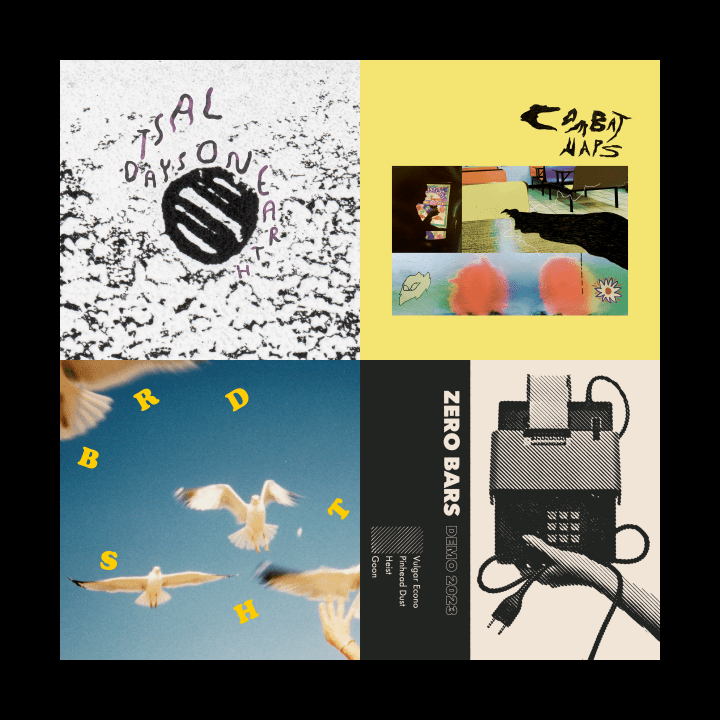
October is more than halfway over now, and Pressing Concerns continues to roll on with more great new music for you, the reader, to enjoy. This is a nice “under the radar” edition (even more than normal, yes), featuring new albums from Onyon, Al Murb, and Combat Naps, and a new EP from Zero Bars.
If you’re looking for more new music, you can visit the site directory to see what else we’ve written about lately. If you’d like to support Rosy Overdrive, you can share this (or another) post, or donate here.
Onyon – Last Days on Earth
Release date: October 13th Record label: Trouble in Mind Genre: Post-punk, punk, no wave, garage punk Formats: Vinyl, CD, cassette, digital Pull Track: Egg Machine
Last year was a relatively quiet one for Trouble in Mind Records, but one intriguing release they did put out was a reissue of Onyon, the self-titled debut EP from the Leipzig, Germany-based quartet. That record’s sharp garage-y post-punk indeed sounded promising to me, and I didn’t have to wait too long to hear more from Onyon, as their debut full-length album has landed about a year and a half later. Last Days on Earth feels like a more fleshed-out version of their debut’s sound, both on a surface level (it only has three more songs than Onyon, but it’s twice as long) and inside the individual songs, in which the band (guitarist/vocalist Ilka Kellner, keyboardist/vocalist Maria Untheim, bassist Florian Schmidt, and drummer Mario Pongratz) take advantage of the album’s extra space to get just a bit weirder, without losing any of their garage-y fire.
Last Days on Earth introduces itself with the dizzy guitar riff and taut rhythm section of “Alien Alien”, a layered but lean piece of post-punk that requires a bit of restraint to pull off–and while the band turn up the amps on the following “Talking Worms” and “Egg Machine”, they’re still leaning just as heavily on rhythm and timing as they are on punk aggression. Untheim’s keyboard is a sneakily important ingredient in Onyon’s sound throughout the record–the in-one’s-face post-punk vocals and careening guitar are so prominent that it takes a second to realize just how much that, say, the whooshing, eerie synths on “Two Faces” or the chaotic chirping in “Dogman” are integral to these songs’ sounds. Thirty-seven minutes is actually on the longer end for this kind of record these days, but it’s hard to see what “fat” could’ve been trimmed here–two of the longest songs on the record (“I Would Like To Eat The Newspaper” and “Mower”) pad out the end of the album, but they’re both hypnotic and successful pieces of garage punk that earn their places on Last Days on Earth. I’d go as far as to say that the stretched-out nature of these songs is instrumental in making Onyon’s debut album feel like a substantial forward step for the band. (Bandcamp link)
Al Murb – BRD SHT
Release date: October 13th Record label: Small Shot Genre: Lo-fi pop, psychedelic pop, experimental rock, 90s indie rock Formats: Digital Pull Track: Game Over
Al Murb is a Pocatello, Idaho-based basement rocker–his Bandcamp page features a steady stream of albums and singles dating back to 2017. Murb appears to be recording the bulk of his material himself, with a smattering of pseudonymous guest contributions on each record (BRD SHT features backing vocals from “Apples Over Oysters”, which appears to be a Scottish bedroom folk project, and “Beastmaster”, which could be a number of different things). BRD SHT is the sixth Al Murb album, following last year’s ACNE SCARS & BASKETBALL SHORTS, and on this one Murb is definitely making music for the true lo-fi indie rock scum amongst us. Although Murb certainly uses a few modern “bedroom pop” tricks, BRD SHT is more 90s indie rock-influenced than anything else. It reminds me of the latest album by Minneapolis’ Shrimp Olympics, but while that album’s guiding star is Martin Newell, Murb is more Malkmus/Berman (it has the low-key adventurousness of The Jicks, the sloppiness of early Pavement, and some of the Silver Jews’ twang).
Of course, having good influences is one thing, but none of that means much if Al Murb doesn’t have the songwriting skills to do something with them–thankfully, BRD SHT is a more than engaging enough listen. After the noisy intro track, “Mr. Huggable” opens the album on a weirdly fascinating note–it just sounds wrong, with Murb murmuring over an instrumental with a bizarrely forward drumbeat and a laid-back guitar groove. It takes until “Game Over” for BRD SHT to deliver something relatively straightforward, a guitar pop tune in which Murb puts on his best J. Mascis/Kurt Vile face to pull it off. This is how BRD SHT continues, Murb offering up psychedelic noisiness, multi-part prog-pop, and moments of clarity as he trips through these fourteen songs with a Dan Bejar-esque irreverence. On the one hand, Murb offers up overstuffed songs like “We’re Never Going Back to the Foam Pit” and six-minute closing track “The Moose’s Bitch”, and on the other hand, there’s stuff like the lo-fi drum machine jangle pop “Pumpkin Bowling” and the messy ballad of “Grief Jerky”. BRD SHT is a record that’s completely at home being all over the map. (Bandcamp link)
Combat Naps – Tap In
Release date: October 14th Record label: ABC Postman Genre: Power pop, indie pop, lo-fi pop, twee Formats: Digital Pull Track: Water Tower
Neal Jochmann started Combat Naps as a solo project while living in Chicago in the mid-2010s; in 2018, he moved to Madison and started amassing a stable of collaborators–Tim Anderson, Marley Van Raalte, Ivette Colón, Ilych Meza. Although I’ve not seen Combat Naps live, Jochmann describes a dichotomy between the lo-fi, offbeat pop of the band’s recorded output (frequently played entirely by Jochmann himself) and the loud, punk-y confidence of the five-piece’s live shows (a duality shared by several of my favorite bands, from Guided by Voices to Pere Ubu). The twelve-song, 25-minute “mini album” Tap In is the second Combat Naps release of 2023, following January’s White Page EP, and it once again finds Jochmann and his collaborators in pure pop mode. These dozen tracks are brief, friendly dispatches of lo-fi guitar pop; I hear early Of Montreal here, as well as the more mellow moments of Tony Molina’s pre-solo career band Ovens, although there are plenty of moments where Jochmann dodges the obvious move to give the record a personal spin and capture some of the same intangible charm of his influences.
If Combat Naps want to call Tap In a mini-album, then it’s a mini-album, but there’s more than enough here to qualify it as a proper full-length in my book. The record opens with the perfect bouncy power pop of “Water Tower”, a piece of post-LVL UP weird shininess, and “Shuffling Letters” adds a bit of Midwestern rootsiness to the record’s sound in a way that makes perfect sense. The next few songs on the record are breezy and relatively simple, lulling the listener into a false sense of security before “Always Asking” brings the off-center side of Combat Naps back into the open with a deconstructed piece of bass-driven, almost proggy indie dance pop that suggests that Jochmann has listened to plenty of Hissing Fauna, Are You the Destroyer?-era Of Montreal as well. Tap In doesn’t run out of steam, continuing to dart towards their acoustic pop bread and butter (“Ready to Fall”, “Had It All to Say”) and some more surprises (like “Up to the Task”, which injects a bit of electric power pop into its tightly-constructed writing). Especially for people who enjoy the kind of music I cover regularly on Pressing Concerns, I can’t imagine not liking at least some aspects of TapIn. (Bandcamp link)
Zero Bars – Demo 2023
Release date: September 29th Record label: Self-released Genre: Punk rock, hardcore punk, garage punk Formats: Cassette, digital Pull Track: Pinhead Dust
Zero Bars’ Bandcamp bio contains two words: “No filler”–and considering that their debut cassette EP clocks in at under six minutes, it’s pretty essential that the Toronto trio live up to that ethos. The information that the group have online is pretty minimal, as well–their four-song debut, Demo 2023, was recorded by the group’s three members, Alex, Chris, and Josh, this past summer, and it’s available via cassette or free download on Bandcamp. No context is really needed to enjoy this brief statement of purpose from Zero Bars, however. The band are already excellent practitioners of vintage punk rock of Demo 2023–their laconic approach to songwriting and the sung-spoken vocals reach back to early hardcore, even as the band’s stealthily lean and limber music owes more to post-punk, garage rock, and “egg punk”.
Demo 2023 feels like Zero Bars trying to distill their sound in real time–opening track “Vulgar Econo” is a gargantuan two minutes in length; by closing track “Goon”, they’ve gotten it down to forty-five seconds. Even though it’s the longest song on the record, “Vulgar Econo” also feels like one of the more straight-up punk-indebted songs on Demo 2023, with the lead singer’s bark of a vocal prowling across a slicing instrumental (the lyrics to Demo 2023 aren’t the focal point for me, but I will warmly nod to “Old Freddy Hayek can rest in piss” on this one). “Pinhead Dust” is perhaps the most esoteric moment on the EP; it’s a post-punk tune from the music, which emphasizes the plodding bass guitar and shuffling guitar parts, while the fuzzed-up “Heist” is the most garage punk that Zero Bars get. By the time that the trio have gotten to “Goon”, they’ve got this down to a science–a clean guitar riff opens the track, the rest of the band kick in, and the vocalist takes the mic to launch the song off with a propulsive momentum in under ten seconds. Zero Bars are absolutely ready to go. (Bandcamp link)
It’s been a historically busy week over here on Rosy Overdrive. The blog has seen four posts in four days–on Monday, we looked at albums from Soft on Crime, Hello June, Soft Covers, and The Small Intestines, Tuesday’s post featured Norm Archer, The Croaks, Luggage, and Blues Lawyer, and on Wednesday, we took a deeper look at the upcoming Pacing album. To cap it all off is the traditional Thursday Pressing Concerns, this time looking at new albums from A Day Without Love and The World Famous and new EPs from Dancer and Lightheaded. All four of them come out tomorrow!
If you’re looking for more new music, you can visit the site directory to see what else we’ve written about lately. If you’d like to support Rosy Overdrive, you can share this (or another) post, or donate here.
Dancer – As Well
Release date: October 13th Record label: GoldMold Genre: Indie pop, post-punk Formats: Cassette, digital Pull Track: Cordon Bleu
Good news, everyone–Glasgow’s Dancer are back already with their second EP (overall, and of 2023). The self-titled Dancer EP was such a compelling mixture of bright indie pop and sharp post-punk that it broke the implicit “no EPs” rule to show up on Rosy Overdrive’s Favorite Albums of 2023 So Far. The quartet of vocalist Gemma Fleet, guitarist/keytarist Chris Taylor, bassist Andrew Doig, and drummer Gavin Murdoch have plenty of notable musical background between them (Fleet, Taylor, and Doig play together in Order of the Toad, Fleet is also in Current Affairs, Doig is also in Robert Sotelo and Nightshift), but Dancer immediately established themselves as a promising “more than a sum of its parts” situation, which their sophomore record, As Well, only solidifies. The pop touches of Dancer are still here, but these five songs find the band sounding a little less fluffy, jumping fully into the pool of post-punk experimentation rather than just dipping a toe in the water.
That being said, Dancer still open As Well with “Cordon Bleu”, a jangly guitar pop number that falls somewhere in the Motorists realm of marrying pop with post-punk touches. “Chill Pill” one song later introduces a heavier Dancer while nevertheless being catchy in its own weird way–almost industrial in its deployment of fuzzy, drill-like guitars, the song clangs along with a still-pretty-melodic vocal from Fleet. The meditative indie pop of “Love” contains some math-y guitars (the press release for this EP mentions Slint and I can’t not hear it in the main riff), even as it’s probably the one song that can rival “Cordon Bleu” in terms of friendliness. Dancer ended itself with the darker “Telemark” and As Well isn’t to be outdone in this field–with “Pulp Thriller”, the band once again get to drilling, jerking, stopping, and starting as they make something standoffish but nonetheless intriguing, and “And Jesus Wept” throws together chunks of fuzzy guitar playing, a loping rhythm section, some blaring synths, and an all-over-the-place performance from Fleet to create a most interesting concoction of a sendoff. Maybe As Well is Dancer’s version of a “difficult second record”; luckily for us, they’re the kind of band where even that is quite enjoyable to listen to. (Bandcamp link)
A Day Without Love – A Stranger That You Met Before
Release date: October 13th Record label: Ur Mom Genre: Lo-fi indie rock, bedroom pop, emo, folk punk Formats: Vinyl, digital Pull Track: Show Friends
Like a basement show where you can tell something memorable is about to happen, A Day Without Love’s Brian Walker attempts to clear out those who aren’t “all in” early on in his latest album, A Stranger That You Met Before. “I sing in houses, and you sing for corporate / I know one of us sucks,” is how Walker begins “DIY or Die”, the second song on the record, and he follows this with more lyrics making it clear how important maintaining artistic independence is for him. It’s a bold pronouncement, and it’s going to be a turn-off for those who don’t see the vitality in building something outside of the structures that rule our day-to-day lives, but Walker spends all of A Day Without Love making clear that he’s not all bluster, and he’s just as (if not more) devoted to the positive aspects of community-building. It’s an album coming from someone who’s completely immersed himself in the world of underground punk, emo, folk, and indie rock, and who chooses every day to look at the beautiful art of that world, be thankful for the people he’s met while in the pursuit of it, and channel all this into excellent music of his own.
Even though the genres don’t quite match up, the iconoclastic, deep-thinking, conversational nature of Walker’s writing (and his refusal to be intimidated by being “too much”) reminds me a bit of St. Lenox, and while he’s clearly a folk punk veteran, on A Strange That You Met Before he veers more towards an offbeat bedroom folk sound (see “How Did We?” and “Rise”) or electric indie-emo-punk (“Day By Day” and “Caffeine”, a mode reminiscent of Proper., a band Walker mentions as one of the “friends” he’s talking about in highlight “Good Friends Are Hard to Find”). More than anything, Walker emphasizes the importance, the necessity, of real-life relationships at the base of any community from opening track “House” (“Let’s pretend that we’re friends / So I don’t have to be alone”) to the slick pied-piper rock of “Show Friends” to the couple of charming spoken-word dialogue-interludes between Walker and some acquaintances. The substantial number of guest musicians and vocalists on the album also reflects this, and this turns out to be another strength of A Stranger That You Met Before–it’s a wide-ranging and eclectic record led by a charismatic tour guide, to be sure, but it’s a journey that’s far from being taken alone as well. (Bandcamp link)
The World Famous – Totally Famous
Release date: October 13th Record label: Lauren Genre: Power pop, pop punk Formats: Cassette, digital Pull Track: Lipstick Trick
Back in August, Lauren Records released Bitch Unlimited by Star 99, which is hands-down one of the best West Coast power-pop-punk records in recent memory. Well, the label is back once again two months later with a record to rival that one in Totally Famous, the debut album from Los Angeles’ The World Famous. The five-piece band is led by singer Will Harris, who (along with the majority of the rest of the band) is originally from Massachusetts. The quintet cites two bands as cornerstones for their guitar pop sound, one from their place of origin and one from their adopted home–Weezer and The Lemonheads. They aren’t inaccurate starting points, but I’d also point to a surf-pop song construction, the suburban wandering pop of Fountains of Wayne, and the wide-eyed California inhabited by Jason Lytle as further bicoastal anchors for the sound of Totally Famous, an incredibly inviting and promising power pop debut.
The first half of Totally Famous gets off to a memorable start with the opening punch of the sparkling guitar pop of “Everyday Fear” and the punched-up classic 60s pop of “Nobody in LA”, and the Scarves-esque “Love Song for a Long Lost Friend” is certainly another early highlight. That being said, the B-side of Totally Famous is very close to perfect. The verses of “Lipstick Trick” are so catchy that it doesn’t even really compute to me when the chorus comes through and kicks its ass at its own game, and then the Teenage Fanclub-indebted “Danvers Opening” waves the “pure power pop” flag high. “O.C. Psychic” is a smart zippy song that’s only “minor” in comparison to what it has to compete with, like the multi-chorus, Grandaddy-ish deliberate fuzz-pop beast of “Candy Clouds” and the laid-back send-off of “Heartburst”. Band name aside, I’m aware that putting together a perfect power pop album isn’t enough to turn The World Famous into the next big stars–but they’re more than ready to be the next Big Star. (Bandcamp link)
Lightheaded – Good Good Great!
Release date: October 13th Record label: Slumberland Genre: Jangle pop, dream pop, indie pop, lo-fi pop Formats: Cassette, digital Pull Track: Mercury Girl
New Jersey’s Lightheaded are an indie pop group who put out a self-released album back in 2019 but are introducing themselves to the world (or, at least, the corner of it in which Rosy Overdrive lives) with their Slumberland debut, the five-song Good Good Great! EP. The band’s “core” (which I assume means “primary songwriters”) is Stephen Stec and singer Cynthia Rittenbach, and Sara Abdelbarry and Justin Lombardo round out the ensemble. On Good Good Great! Lightheaded come off as musicians who are first and foremost big fans of the kind of C86, jangle pop, and dream pop that fits well on their home label (both in terms of legacy bands and their modern peers; the group has posted an excellent playlist on streaming services featuring a ton of great current guitar pop groups, many of which have appeared on this blog in some form).
One of the strongest aspects of Good Good Great! is that it establishes in a relatively short amount of time the range of Lightheaded’s songwriting. Opening track “Mercury Girl” combines a reverb-y Cleaners from Venus-esque jangle (is it a coincidence that it shares a title with one of my favorite Martin Newell songs?) with a confident, polished vocal take, while the prominent bass and steady drumbeat on “Orange Creamsicle Head” is a more pastoral version of their sound (something that marks the breezy, folky “The Garden” as well). The electric guitar riff that’s at the foundation of “Patti Girl” is pure college rock, perhaps even in Guided by Voices territory, even as Rittenbach steers it into a more refined, Heavenly version of indie pop. Lightheaded close out the EP on an appropriately weightless note with the 60s pop of “Love Is Overrated”; the band cobble together something perhaps a bit more minimal than the classic “wall of sound”, but no less effective. (Bandcamp link)
Release date: October 13th Record label: Totally Real Genre: Anti-folk, bedroom pop, singer-songwriter, indie folk Formats: CD, cassette, digital
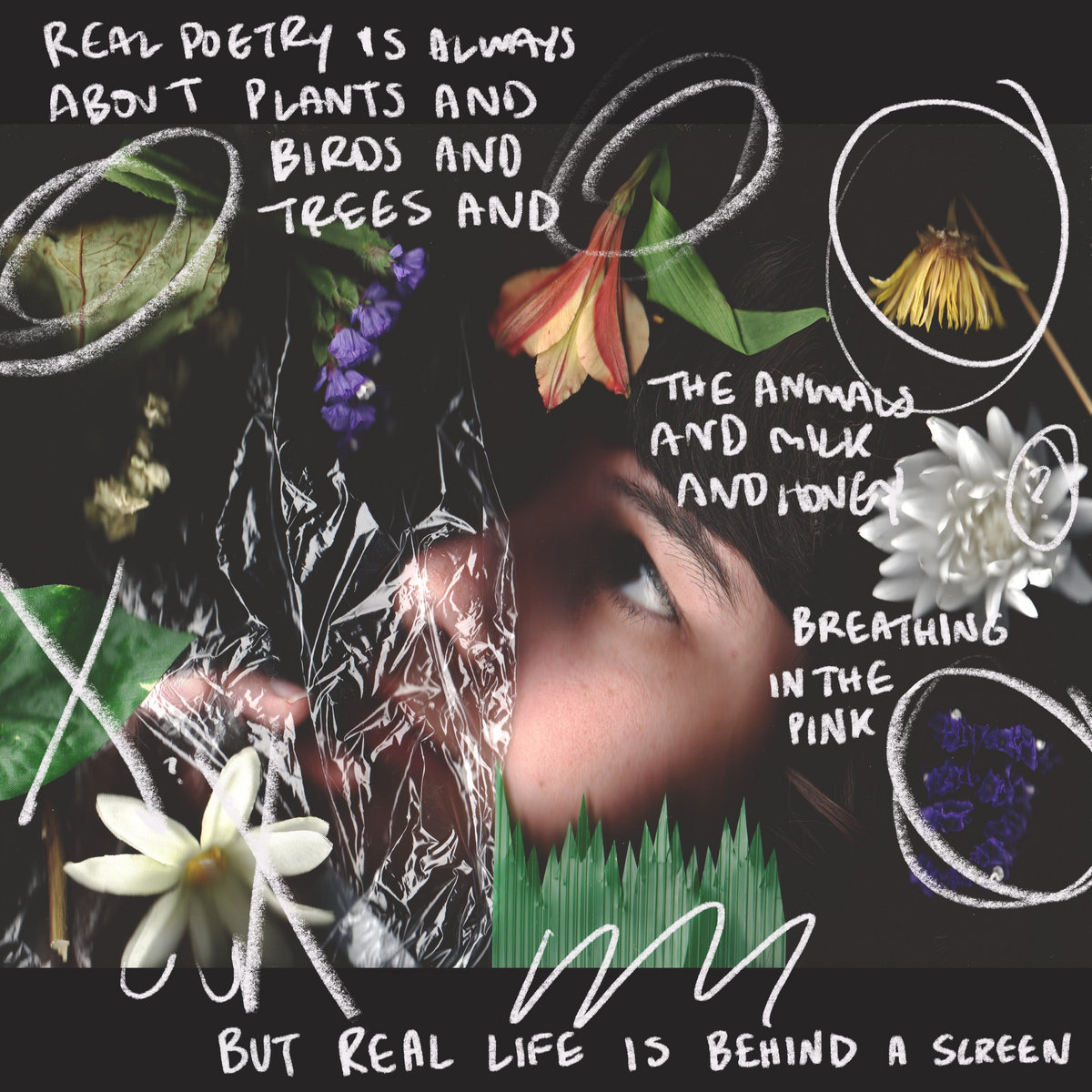
There are a number of different ways to pander directly to the person who runs Rosy Overdrive, but one of the most unique ways I’ve encountered would have to be making a three-song EP called Snake Facts where every song title is, indeed, a fact about a snake and the subject matter uses snakes as a jumping-off point for some particularly poignant writing (sample lyric: “Mostly I just want to be left alone / Crawl around in your attic, just waiting to die”). That’s what Katie McTigue, AKA Pacing, did earlier this year, which did indeed get the San Jose-based, Florida-originating singer-songwriter on my radar. Snake Facts also began Tigue’s collaboration with Totally Real Records (Onesie, TIFFY, Snake Lips), the label who is putting out the next Pacing release just a few months later. Real poetry is always about plants and birds and trees and the animals and milk and honey breathing in the pink but real life is behind a screen is the second Pacing full-length, following the 20-minute, 8 song Hatemail “mixtape” last year (and at a dozen songs and nearly reaching the half-hour mark, I don’t think it’d be too out of line to call it a “debut album”).
Real Poetry… is an album well-served by its title, as McTigue’s writing wriggles back and forth between stubbornly conversational and surprisingly poetic throughout its twelve tracks. Musically, McTigue is saddled with the “anti-folk” label, which she’s declined to shake off and embraced to some degree. I certainly would not be surprised to learn that Kimya Dawson was a formative influence on Pacing, but the record’s indie pop structures (while acoustic guitar-based, yes) range from sketched sparsely to keenly orchestrated; I hear the twee-folk of Sidney Gish, the country-rock asides of The Paranoid Style, the DIY showtunes of Smol Data, and the kitchen-sink folk experimentation of Noah Roth throughout Real Poetry… As anyone who’s bought physical Pacing media can attest, McTigue is a multi-disciplinary artist, so to say that her latest album is a “personal” record is to say that questions and musings about art, legitimacy, and presentation of concepts (“real poetry”) float through these songs as much as the typical emotional, interpersonal relationship-based content that gets this tag more frequently.
The way I interpret the album title (which is also the first line of opening track “Bite Me”) is not necessarily a rejection, but a true, open interrogation of the idea it posits about “real poetry” being the domain of “plants and birds and trees” (McTigue references the poem “You Can’t Have It All” by Barbara Ras as inspiration for this on Bandcamp. “I liked the poem, but something about how flowery it is put me into defiance mode,” she writes. “Why are Real Poets [so] obsessed with nature?”). The themes that come up again and again in Real Poetry…–self-referential, recursive, and fourth-wall-agnostic writing, almost ritualistic self-deprecation, emotional and musical whiplash–reflect just how thoroughly Pacing are committed to exploring the reality-curious titular phrase and other, similar questions.
“I Want to Go Outside” and “Live Laugh Love” are, for one thing, two early examples of the musical adventurousness of Pacing, but they’re also populated with lyrics that strike at the heart of the album. “I Want to Go Outside” is a personal look at a reversion to not just nature but the “outside world” more generally (“I might get in a wreck and I’d be paralyzed for the rest of my life, so I’d be stuck in side / Well, I guess that’d be alright,” this is one of the more memorable roadblocks–but hardly the only one–that McTigue discusses here). “Live Laugh Love” is even more of a bullseye, walking the tightrope (or riding the seesaw) between defeatist self-flagellation (“Everything I do is dumb”, “This part of the song is a placeholder / To save myself from saying something stupid”, “This song is dumb”) and defiant defensiveness (“But if you don’t like this song / Why don’t you just rip out my heart?”). The headline-worthy lines in “Live Laugh Love” are all good and I like them, but the most key one to me (and the one that relates a little more directly to the song’s title, I think) is a more subtle one: “It’s too late to be anything but ordinary”.
McTigue follows up “Live Laugh Love” with “Stupid”, a thirty-second acoustic outro reinforcing its title in a way that is definitely overkill (but this is also the point), and when Pacing revisit this seed in the very-real three-minute penultimate track “So Stupid”, there’s a lot of weight added to the title line after McTigue takes a winding highway to get to it. There are plenty of puzzle-piece moments strewn throughout Real Poetry… (I’ll throw some of these out here: “Plastic flowers never fade, but I’m not gonna die in Orangeville,” from “Orangeville”, the various cracks throughout the facade of “Annoying Email”, “None of this counts / In a couple of years, I’m gonna start my life for real,” in “unReal / forReal”) but it’s the title of “So Stupid”, combined with the hanging question at the end of the song, that cements it as the album’s central enigma. It’s a blanket, being “so stupid”–it’s equal parts comforting and obscuring. Kids are stupid, in the same way that fake plastic trees are stupid, talking to yourself is stupid, poetry is stupid, it’s stupid that it’s a hundred and three degrees outside, the infinite, divergent possibilities of the universe are stupid, and the fact that any of us are alive or not alive is stupid. That’s the easy part. But even as Real Poetry… is a record featuring several dispatches from inside this blanket, McTigue’s writing doesn’t stop there. After all, to paraphrase Syndrome from The Incredibles–when everything is stupid, then nothing is.
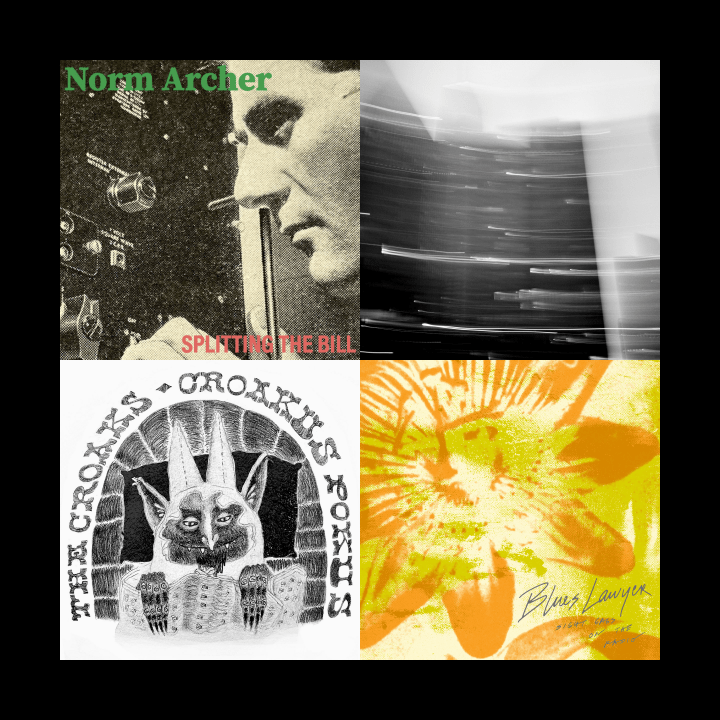
You just know that it’s going to be a good week when I’m able to put a Tuesday Pressing Concerns together. Hot on the heels of Monday’s post (which looked at new ones from Soft on Crime, Hello June, Soft Covers, and The Small Intestines), we’re back with a round-up every bit as good, featuring albums from Norm Archer and Luggage and EPs from The Croaks and Blues Lawyer. Without getting too much into it, there are some real short-listers in here.
If you’re looking for more new music, you can visit the site directory to see what else we’ve written about lately. If you’d like to support Rosy Overdrive, you can share this (or another) post, or donate here.
Norm Archer – Splitting the Bill
Release date: September 28th Record label: Panda Koala Genre: Power pop, 90s indie rock, pop punk, psych pop Formats: Digital Pull Track: On the Tyne
Norm Archer is Will Pearce, a Portsmouth-based “home recording enthusiast” who flew onto my radar with his debut album under the name, Flying Cloud Terrace. Though I was completely unfamiliar with Pearce beforehand, I recognized Flying Cloud Terrace as an instant classic in the field of lo-fi guitar pop music, a record that clearly displayed the tricks and hooks it had learned from bands like Guided by Voices, The Cleaners from Venus, and The Bevis Frond while also putting a bit of an underdog pop punk spin on the material. Although it took several years for Flying Cloud Terrace to come together, Pearce needed barely more than one to deliver a follow-up album that is every bit as rewarding as its predecessor. Unlike Flying Cloud Terrace, Splitting the Bill was recorded with all live drums (courtesy of Ben Whyntie, who played on a couple of the previous record’s tracks), allowing the music of Norm Archer to catch up just a little bit to Pearce’s kinetic energy. Splitting the Bill is still a pop record, but the edges of Norm Archer are as sharp as ever–if you enjoyed the way that, say, the most recent Taking Meds album merged power pop with Archers of Loaf-style 90s indie rock, Splitting the Bill is operating in the same area.
I truly cannot emphasize enough how skilled of a pop songwriter Will Pearce is; that much was evident on Flying Cloud Terrace, but every facet of it is on full display on Splitting the Bill. Norm Archer have never sounded more ready or able to deliver Pollard-esque tricky, overstuffed prog-pop anthems, nor have they been more prone to explode into blistering indie rock with a J. Mascis or Nick Saloman level of skill. As grandiose as Pearce makes the fourteen songs of Splitting the Bill sound, at his heart he’s got the spirit of a post-Westerbeg power-pop-punk. It irks me that Norm Archer aren’t big enough (yet) to give opening track “On the Tyne” the stadium-level treatment it deserves on a cross-continent tour, but I bet that Pearce could find a way to whip up a wall of sound to do justice to “Brain Today” in a basement.
“A Taste for Shame” is pitch-perfect jangly college rock–it’s almost shocking how straight Pearce and Whyntie play it, but it’s absolutely what the track calls for. Meanwhile, if Eric Bachmann had been able to write a post-grunge radio hit, it probably would’ve sounded something like the title track (does “it sounds like Fig Dish” mean anything to anyone?). “The Din Drifted In” towards the center of the record is a particularly wild flex, making an aggressive turn towards garage-y noise rock/post-punk and sounding very good at it, too, while the power chord choppiness of “Laramie” is no-funny-business, airtight pop punk. One of the ways Pearce pays tribute to his proggier/psychier sides is by breaking out the acoustic on the starry, spare “Dragging” and the aural daydream of “Saloon Mouse”. These function as quieter wrinkles in a larger tapestry, but because Pearce is the songwriter he is, they’re also no less potent pop songs than the electric cuts. Splitting the Bill is an ornate work, one in which a closer inspection of even its less showy moments reveals exquisite detail. (Bandcamp link)
The Croaks – Croakus Pokus
Release date: July 28th Record label: Self-released Genre: Folk rock, progressive folk, baroque folk Formats: CD, digital Pull Track: Rainbow Trout
The Croaks are a Boston-based prog-folk-rock band led by the duo of Anna Reidister and Haley Wood, who have been making music together since 2017 (previously in the band Ratslap, as The Croaks since about three years ago). Following the “The Court Jester” single in 2020, Croakus Pokus is the first Croaks record (their Bandcamp calls it an EP; the nine-song, thirty-minute collection feels like an album to me), and it’s one of the more fascinating-sounding releases I’ve heard so far this year. On the one hand, The Croaks are quite serious about incorporating the baroque and medieval into their music (instruments that can be found on Croakus Pokus include dulcimer, harp, flute, and violin), but on the other hand, the band (on this record, Reidister and Wood are joined by bassist Jasper Fleming and drummer Sammy DeSantos) are just as likely to emphasize the rock end of folk rock, with some guitar soloing, feedback, and a sharp rhythm section characterizing more than a bit of this record.
The Croaks’ version of “progressive folk” takes shape in the record’s first three songs. “The Court Jester” opens up with a Mekons-y piece of violin-aided folk rock that then zigs into a skipping mid-section and then finally zags into a pounding, dramatic finish. “Cuttyhunk Isle” finds the band creating similar music in a slightly more static mode, but their cover of Comus’ “Diana” gets us right back into the louder folk-rock storm. Once they’ve gotten a sketch of their sound down, however, Croakus Pokus immediately starts playing with it. The fuzzy “Big Bog” (which thematically reminds me of the Mountain Goats’ “Tollund Man”) throws some alt-country into the mix, the heavy “Lochness Lady” is some old-school stoner-prog-wizard shit, and there’s also “Rainbow Trout”, my favorite song on the record. Especially coming after “Diana”, it’s a shocking teleportation back into the (relatively) modern era, an incredibly bright, sweeping piece of indie folk rock with triumphant electric guitars, at least two separate hooks worthy of building a song around on their own, and lyrics that reveal just enough context to land the punch in the chorus most effectively. Croakus Pokus is a deep record in more ways than one–it feels like the work of two talented, in-sync collaborators who bring an adventurous energy to every aspect of their music. (Bandcamp link)
Luggage – Hand Is Bad
Release date: September 29th Record label: Amish Genre: Noise rock, experimental rock, post-punk Formats: Vinyl, digital Pull Track: Hand Is Bad
Chicago noise rock trio Luggage have been trudging along for the better part of a decade at this point, making a certain unflappable, minimalist style of music that certainly sounds akin to plenty of indie rock that’s come out of the Windy City in the past. Unsurprisingly recorded at Electrical Audio, Hand Is Bad is the fourth Luggage full-length and fifth record (it follows 2021’s substantial Happiness EP). On their latest album, drummer Luca Cimarusti, bassist Michael John Grant, and guitarist/vocalist Michael Vallera sound like they’ve been playing together long enough to stretch out a little bit and push some limits. Hand IsBad is relatively subtle about it, mind you–unlike, say, the latest from their neighbors in FACS, pretty much all of the album can be adequately described as a “rock record”, but the trio are locking in in a way that’s hypnotic and exploratory in its own right, echoing some of the more meditative post-hardcore albums that came out of the 90s underground.
On the Touch & Go frontperson spectrum, Michael Vallera is a lot closer to Brian McMahan than David Yow on Hand Is Bad. I’d say that Vallera’s stoic talk-singing lets the band do the emotional communication, but whatever message Luggage is trying to send here (beyond “vague unease”) is pretty enigmatic from the instrumentals as well. Hand Is Bad’s songs typically start as stark post-punk instrumentals leaning heavy on the rhythm section– sometimes competing with Vallera’s guitar, other times effectively on their own. Listening to Hand Is Bad’s ten tracks beyond their starts is kind of like playing Russian roulette–they’re equally likely to continue the instrumentals more or less as they started, declining to crack the tension, or to lapse into noisy conclusions led by Vallera’s guitar. “River” floats along and “The Poison” crawls in the record’s second half, while the band’s noisier side gets front page treatment with the opening title track and “Circled”. The weirdest moments on Hand Is Bad come near the end, with “Ends” and (especially) “Deep North” streamlining things down to near-ambient levels. It says something about the record’s cohesion that the band are then able to jump from the latter of those two songs to the full-speed rocking “Nowhere” like it’s nothing. (Bandcamp link)
Blues Lawyer – Sight Gags on the Radio
Release date: September 29th Record label: Dark Entries Genre: Noise pop, power pop, indie pop, fuzz pop Formats: Vinyl, digital Pull Track: Have Nots
2023 is the year of Blues Lawyer. The Oakland four-piece band released their third album, All in Good Time, back in February, debuting a new, revved-up power pop sound that represented quite the step forward for the band and made it one of my favorite albums of the first half of the year. Co-lead singer/songwriter Rob I. Miller put out an incredible solo album (featuring contributions from Blues Lawyer guitarist Ellen Matthews) in May to keep the momentum going, and last month found Miller and Matthew reuniting with drummer/vocalist Elyse Schrock on the second Blues Lawyer record of 2023, the four-song Sight Gags on the Radio seven-inch EP. On Sight Gags on the Radio, Blues Lawyer are as catchy as ever, but they’re also louder than ever–the band embrace distortion and fuzz in their pop songs in a way that even the more rock-based All in Good Time hadn’t quite suggested.
Opening track “Have Nots” is nothing less than one of the greatest pop songs I’ve heard in recent memory. Each element–the opening guitars (featuring a shoegaze level of reverb), Miller’s melodic bass, Schrock’s steady drumbeat, Miller’s calm-in-the-center-of-the-storm lead vocals, Schrock’s subtly pleasing backing vocals–introduces itself one by one, taking its place to form a full, complete masterwork. The rest of Sight Gags on the Radio doesn’t drop the ball after such a strong opening–in terms of energy and sheer force, “Our Divide” is right up there with “Have Nots”, and it even introduces some actually quite scorching lead guitar into the fray. “True Love’s Only Name” is the song on the EP that most recalls the band’s jangle pop roots, but it’s also yet another step forward for the band in being a true collaboration between the trio of Miller (who wrote the lyrics), Matthews (who wrote the music), and Shrock (who sings lead vocals on it). “Every Once in a While” closes things out with a song that sounds like a classic piece of twee-ish indie pop run through a healthy level of amplifier fuzz and overlaid with a hard-hitting rhythm section. Assuming Blues Lawyer don’t have anything up their sleeve for the next two months, they’ve closed out their 2023 on just a strong of a note as they began it. (Bandcamp link)
Believe it or not, it’s Monday again, and today’s extra-soft edition of Pressing Concerns is here in your inbox and/or browser. We’re looking at new albums from Soft on Crime, Hello June, Soft Covers, and The Small Intestines below this introduction. This is a great entry if guitar pop is your thing, and we also get to visit some exotic locales (Australia! Ireland! West Virginia!) with these records.
If you’re looking for more new music, you can visit the site directory to see what else we’ve written about lately. If you’d like to support Rosy Overdrive, you can share this (or another) post, or donate here.
Soft on Crime – Rarities Vol. 1
Release date: October 6th Record label: Eats It Genre: Power pop, indie pop, jangle pop, lo-fi pop Formats: Cassette, CD, digital Pull Track: Bored Harder
Back in February, Soft on Crime released their debut full-length, New Suite–it’s an immediate collection of vintage power pop, college rock, new wave, and psychedelia that quickly became one of my favorite records of 2023. Although their first album is less than a year old, the Dublin-based trio of Padraig O’Reilly, Lee Casey, and Dylan Phillips have been making music together for a few years now–they put out an EP in 2019 and a single in 2020. Interestingly, Soft on Crime have decided to follow up their instant classic of a first LP by reaching back into their vault, giving us Rarities Volume 1. The recordings on this album span from before any Soft on Crime material had been released to songs recorded concurrently with New Suite to even a handful of tracks recorded earlier this year, after their first album came out.
Soft on Crime are more relaxed on Rarities Volume 1 than on New Suite; while their proper album was sequenced to reel the listener in with a stacked A-side, the trio offer up a couple of older (circa December 2017), mid-tempo cuts to begin this compilation in “Show’s Over” and “Two Sides”. It’s low-key pop music, but the two actually wind up being some of the most “normal” sounding of the early Soft on Crime songs–the band chooses to bookend the album with their first recordings, and the three tracks that end Rarities Volume 1 are the three oddest. The stripped-down, Phillips-led “I’m Starving” is so casual that it captures someone chatting with one of the band member’s dads at the end of the recording; the claustrophobic, jazz-influenced “Cranky Family Holiday” and the slow-building “Jack the Fatalist” are less bare, but they’re still the band on the outskirts of their own sound.
The newer songs on Rarities Volume 1 are the ones that feel like Soft on Crime in “pop hitmaker” mode, and they’re also from where the bulk of my personal favorites come (always a good sign for an active band). Mind you, this still isn’t exactly the Soft on Crime of New Suite–the psychedelic country rock of “(Try Not to Piss In) The River of Time” is a new look for the band, but one they wear quite well. “Fibbers Observation Deck” was recorded in May alongside “The River of Time”, and its simple conceit might’ve sounded off in the middle of New Suite, but its huge garage-y power pop punk chorus shines in this context. Maybe my favorite of all of them is “Bored Harder”, an especially laid-back 2021 piece of lo-fi power pop that sounds like a lost Connections song. Even though it’s a different stripe than most of New Suite, it’s hard to believe Soft on Crime would leave it off of their debut album–but then, I suppose, that’s what Rarities Volume 1 is for. (Bandcamp link)
Hello June – Artifacts
Release date: October 6th Record label: 31 Tigers Genre: Alt-country, singer-songwriter, roots rock Formats: Vinyl, CD, digital Pull Track: Sometimes
Hello June’s self-titled debut album came out all the way back in 2018. Hello June was a solid collection of dream pop-fluent indie rock, with lightly fuzzy guitars dressing up singer-songwriter Sarah Rudy’s compositions, which also featured just a touch of alt-country that recalled the band’s home of West Virginia. The sophomore Hello June album, Artifacts, comes a half-decade later, and with it comes a pretty distinct reinvention of the band’s sound. Rudy challenged herself to write songs with more “straightforward” lyrics than the enigmatic nature of her writing on Hello June, and she and the band have given their music a similar streamlining. Artifacts is all crystal-clear, bare-sounding country rock, zeroing in on the “rootsiest” parts of the band’s past sound and embracing it in a way that Hello June, frankly, didn’t even really hint at. Perhaps the aspect of HelloJune the band holds onto the most is its pensiveness–there’s a quiet intensity to Artifacts, recalling the more introspective, introverted material from troubadours like Sarah Shook, Lydia Loveless, and Lilly Hiatt.
Listening to Hello June, it’s clear that Rudy was already destined for something behind the relative anonymity of “dream pop singer”–she was peeking out in those songs, but her personality is completely out in the open from the desert-sparse instrumental of “Sometimes”, Artifacts’ opening track. Some of the album’s songs are more “rock” than others–“Honey I Promise” and “Faded Blue” find the band playing louder than they typically do on the record–but Hello June never quite “let loose” here. It’s an incredibly focused album, with Rudy taking us on immersive rides everywhere from the since-faded relationship on the “Interstate” to the sense of finality that she experiences under the night sky in “The Moon”. On an album about sorting through pieces of what’s left of a once-whole past (the Artifacts to which the title refers), it’s fitting that it closes with a cover of “Take Me Home, Country Roads”. Back when I wrote about Spirit Night, I covered how that song and the state it’s come to represent are always looming over those who hail from it, regardless of where they go or what they do. I imagine, when choosing to end the album with it, Rudy had to weigh the fact that she and the people she knows have doubtless heard countless covers of the song–but Artifacts is, above anything else, an honest album. (Bandcamp link)
Soft Covers – Soft Serve
Release date: October 6th Record label: Hidden Bay/Little Lunch Genre: Indie pop, jangle pop Formats: Vinyl, cassette, digital Pull Track: Point of View
Our first selection of Australian indie pop in this edition of Pressing Concerns comes to us via Soft Covers, a three-piece who formed in Brisbane and currently reside in Melbourne. The band’s three members, Laura, James, and Dean, linked up after playing in several bands separately over the years (Dumb Things, People Mover, Future Haunts) and put out the Permanent Part Time cassette EP as a debut in 2020. Soft Covers’ first full-length, Soft Serve, is being co-released by Hidden Bay and Little Lunch, two labels who also teamed up to put out the last Australian album I wrote about, Pretty in Pink’s Pillows. If you were into Pretty in Pink’s minimalist guitar pop, Soft Covers may be up your alley, although Soft Serve is a more uptempo and sunny record than Pillows, and the songwriting is more conversational and lyrically wide-ranging.
There’s plenty to like immediately on Soft Serve with opening track “Every Week”, which deploys a cheerily-strummed acoustic guitar, a duet in the chorus, and some nice Flying Nun-ish keyboard parts. Soft Covers aren’t afraid to keep things simple, hanging onto a single chord or two in a Clean-ish way–the organ-featuring, steadily-moving-forward “Coming and Going” in particular reminds me of that band, and it’s certainly baked into the DNA of the pure sugar of “Shampoo” as well. Some other nice touches throughout Soft Serve includes what sounds like a marimba on the wandering nostalgia of “Nth Qld, Late 80s”, some hovering-in-place synths on “Big Jack”, and the melodica that plays off the excellent jangle pop closing track “Point of View”. The bright sound of the band fits the brief but memorable characters and scenes that show up in these songs, from the getting-older-but-not-dead-yet “Big Jack”, or their takes on Muriel’s Wedding and Tinker Tailor Soldier Spy with “The Real Housewives of Porpoise Spit” and “The Ballad of Ricki Tarr”, respectively. Soft Serve feels like listening to a friend tell you about a movie they saw, or an eccentric acquaintance, comforting in its casualness. (Bandcamp link)
The Small Intestines – Hide in Time
Release date: September 29th Record label: Meritorio/Lost and Lonesome Genre: Jangle pop Formats: Vinyl, digital Pull Track: Horse Riding
It’s a two-for-one deal on Melbourne indie pop in this post! Like Soft Covers discussed previously, The Small Intestines are an Australian trio inspired by jangly guitar pop whose members come from other local bands (drummer/vocalist Matt Liveriadis and bassist/vocalist Rob Remedios played in Chook Race, guitarist/vocalist Tristan Peach had his Peach Happening solo project). The Small Intestines have apparently been together since 2016, but Hide in Time is their debut release, coming to us via Lost and Lonesome and Meritorio (the latter of which also put out another excellent Australian guitar pop album earlier this year–There’s No I in Spice World by Spice World). It’s a smooth journey, the “debut” tag seemingly out of place on an album made by a group of musicians who’ve been playing (with each other and otherwise) for quite some time now.
Not quite as peppy as Soft Covers nor as sparse as Spice World, The Small Intestines make distant-outpost rock music on Hide in Time. It feels like a thirty-minute excerpt from an infinitely-rolling tape, like these guys are making low-key, timeless-sounding indie rock on a constant basis regardless of whether we’re listening. This kind of music always exists in the shadow of Flying Nun Records, and I’m not going to tell you that The Small Intestines don’t sound like The Bats in places on Hide in Time, but they filter it through a power trio, almost classic rock-indebted lens. Remedios’ bass work in particular I want to single out–he’s really going to town under the radar in songs like “Chimes of Love” and “L.O.V.E. Love”. The psychedelic jangle of “Under the Weather”, the giddy pop rock of “Stripped Away”, and the melody-laden “Old Town” are some of the record’s more Kiwi moments, but there’s also a coolness throughout the record that skips past the New Zealand scene entirely and goes straight to the source, The Velvet Underground. In that way, The Small Intestines’ peers are as much American groups like Advertisement, Weak Signal, and Glyders as C86/Dunedin-indebted southern hemisphere groups–they’re a pop band that also doesn’t shy away from a groove. (Bandcamp link)
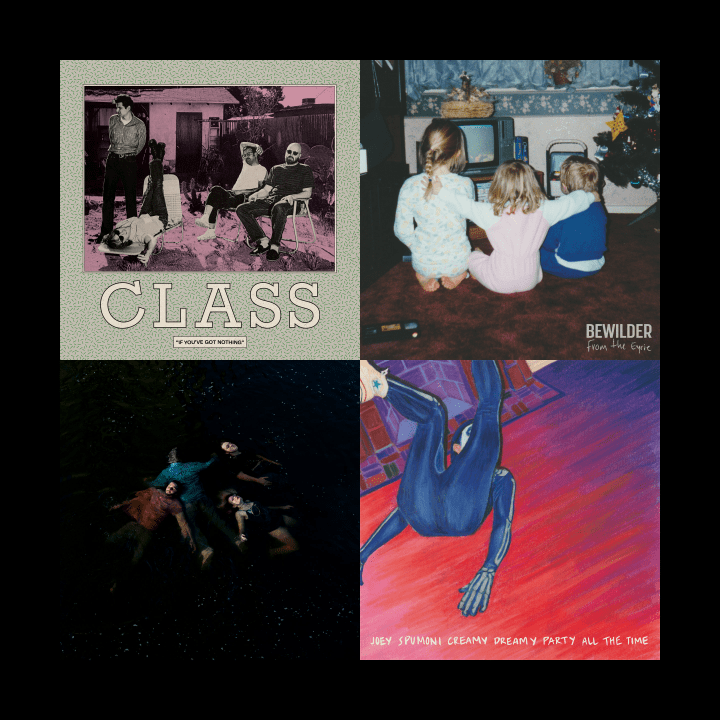
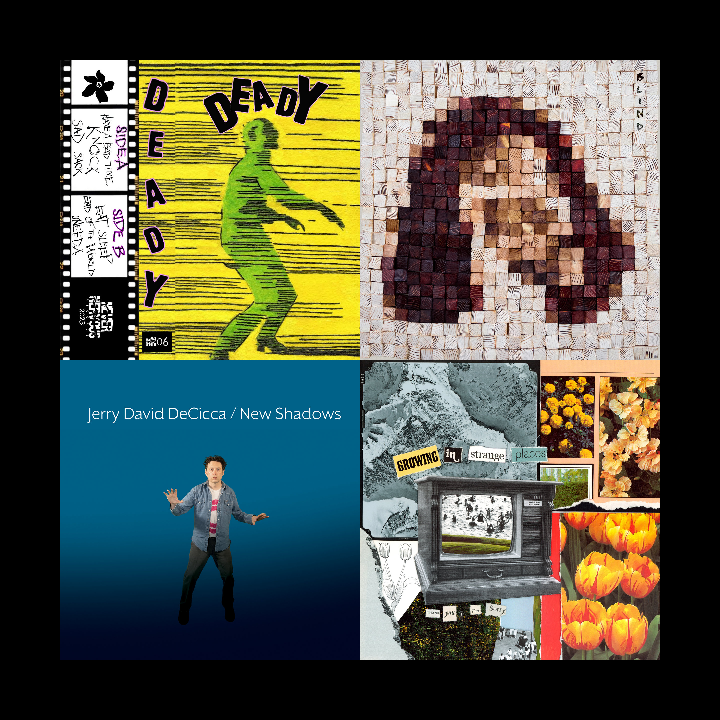
Welcome to the Thursday Pressing Concerns! Today, I’ve written about four albums that come out tomorrow: new ones from CLASS, Truth Club, Bewilder, and Joey Nebulous. Four great albums from four of the best labels in recent history! Rosy Overdrive has been on a tear lately; if you missed Monday’s look at records from Deady, Jerry David DeCicca, SIZ, and Thank You, I’m Sorry, or Tuesday’s September Playlist/Round-Up, then those are two more blog posts for you to check out.
If you’re looking for more new music, you can visit the site directory to see what else we’ve written about lately. If you’d like to support Rosy Overdrive, you can share this (or another) post, or donate here.
CLASS – If You’ve Got Nothing
Release date: October 6th Record label: Feel It Genre: Garage rock, punk rock, power pop Formats: Vinyl, digital Pull Track: As If It’d Even the Score
We can’t say that the last year and a half hasn’t had CLASS. The Tucson quartet have put out four records since June 2022 saw the release of their self-titled debut EP; last October’s Epoca de Los Vaqueros ended up being one of my favorite albums of last year, and February’s But Who’s Reading Me? EP continued CLASS’ hot streak into 2023. All of this has led up to If You’ve Got Nothing, their second full-length album and the most complete that CLASS have sounded yet. While Epoca de Los Vaqueros sounded like a talented group of musicians (guitarist/vocalists Andy Puig and Eric Meyer, bassist/vocalist Jim Colby, and drummer Ryan Chavira) trying on a few different strains of noisy garage rock, egg punk, and power pop, If You’ve Got Nothing is the result of the quartet zeroing in on the latter, bashing out a dozen ace pieces of glam-influenced power pop in half an hour, breaking out songs with plenty of hooks but still enough of the signature CLASS bite.
“Public Void” is a somewhat casual opening track, letting Colby’s bass do a lot of the talking as CLASS wind up to lob several power pop fastballs across the record’s first side–the ripped-from-the-70s smoothness of “Behind the Ball”, the toe-tapping “Coward’s Disaster”, the runaway train of “Between the Lines”, and the belt-along “Two-Way Track”. Three of the songs on the album are reused from But Who’s Reading Me? (and one from CLASS), but I can’t be too mad at hearing them again, particularly “Inspect the Receipt”, a hurricane of melodic guitars and bouncing hooks that fits perfectly on If You’ve Got Nothing. Another repeat, “Burning Cash”, stakes out a position in the record’s midsection along with “Just Another Number”, the twin sneering garage rockers letting us know CLASS still has a bit of that in them before once again accelerating to maximum punk-pop levels in the record’s home stretch. My favorite song might actually be the penultimate “As If It’d Even the Score”, a glam rock/AOR-flavored strut that is as catchy as anything else on the record, just a little weirder. It’s a good a sign as any that, while CLASS might be locked into a groove on If You’ve Got Nothing, they’re not on autopilot. (Bandcamp link)
Truth Club – Running from the Chase
Release date: October 6th Record label: Double Double Whammy Genre: Post-punk, noise rock, 90s indie rock Formats: Vinyl, CD, digital Pull Track: Is This Working?
Raleigh’s Truth Club arrived on the scene in 2019 with Not an Exit, a confident debut album that contained shades of post-punk, noise rock, and slowcore-y bedroom rock without being constrained by the limitations frequently inherent in any of those individual genres. It was a great fit for their then-label Tiny Engines, and looking back on it now it feels related more than anything else to similarly adventurous indie rock groups like Pile and former labelmates Peaer. Now on Double Double Whammy (2nd Grade, The Goodbye Party, Charlotte Cornfield), the original trio of Travis Harrington, Elise Jaffe, and Kameron Vann have been joined by multi-instrumentalist Yvonne Chazal for Running from the Chase, their long-awaited sophomore album. On first blush, the new album feels like a louder, beefed-up version of their debut–Truth Club certainly haven’t abandoned nuance and subtlety, but some of the lighter moments of Not an Exit have been replaced by a four-piece rock band confidently locking into place with each other and moving forward together.
Running from the Chase finds solid ground in unpredictability; it opens with a handful of “rockers”, but of different strains–the winding “Suffer Debt” and the steady advance of “Uh Oh” are both slow builders, reaching their noisy conclusions after a good deal of work to get there, while the fuzz-punk-ish “Blue Eternal” unleashes itself right out of the gate. The chugging “Clover” a couple songs later might be the heaviest Running from the Chase gets, taking a surprising turn into Hum-ish, downtuned power chord-heavy alt-metal territory. Even in that song, however, Truth Club explore moments of atmospherics and acoustic guitar to give us all some breathing room, and there’s a lot of liminal moments like this throughout the record as a whole. “77x” and “Exit Cycle” function as this end of the Truth Club spectrum in the album’s first half, while the second half looks behind the curtain in “Dancing Around My Tongue”, “The Chase”, and the first part of “Break the Stones”. The latter song explodes into yet another kinetic, noisy finish, although the album’s big crescendo–the ending of the six-minute “Is This Working?”–is a more controlled piece of earth-boring. It’s one final impressive statement from the band, slowly taking the form of their finest moment. (Bandcamp link)
Bewilder – From the Eyrie
Release date: October 6th Record label: Tiny Engines Genre: Midwest emo, folk rock, slowcore, post-rock Formats: Vinyl, digital Pull Track: Cooperative
Never thought I’d be writing about a new album from Tiny Engines in Pressing Concerns, no. Rosy Overdrive was founded after the label went under in late 2019, but their influence has been evident via so many bands who once released music on the label showingup ontheblogoverthepastfewyears. It seems appropriate to me that the first release on the rebooted version of the label isn’t one of their flagship acts, but the debut album from an under-the-radar, previously unsigned group that gets the label back to its emo-ish indie rock roots. Bewilder is the British duo of vocalist/guitarist George Brooks and multi-instrumentalist Thom Wilkinson; somewhat amazingly, they’ve been around since at least 2011, although their most recent release had been 2018’s Everything Up to Now EP. Brooks and Wilkinson are true emo fans, citing Mineral and American Football as influences, but From the Eyrie, their debut album, doesn’t feel like an attempt to recreate a late 90s second-wave record.
Rather, it’s the duo’s non-“traditional” emo influences (Carissa’s Wierd, Pinback) that give one the truest grasp on what From the Eyrie’s deliberate, ornate, delicate version of indie rock sounds like. I’d even go as far as to say that there are moments on the record that sound more like Modest Mouse or even The National than anything that came out on Jade Tree. Brooks’ vocals are an understated element in walking this balance–he’s more emotive than your typical slowcore singer, but he holds back more than your normal emo frontperson. They end up with something like opening track “Heavy Sweater”, which is downcast but still huge-sounding at the same time. The string deployment and crescendoing of “By the River” showcases Bewilder’s strengths, and they return to this basic structure several more times over From the Eyrie even as they add small but real wrinkles to it (the surprisingly-percussion-led “Breaking”, the two-minute, streamlined closing track “Cooperative”). It’s no small thing, being the record that bears the burden of reintroducing an imprint that was once quite important to me and many others, but From the Eyrie is sure of itself and up to the task of standing on its own. (Bandcamp link)
Joey Nebulous – Joey Spumoni Creamy Dreamy Party All the Time
Release date: October 6th Record label: Dear Life Genre: Indie pop, bedroom pop, synthpop, twee Formats: Vinyl, CD, digital Pull Track: Friends of Joy
Joey Nebulous has been around for a while. I remember the Chicago indie pop band touring a decent amount in the second half of the 2010s; around this time, Joey Nebulous was releasing a handful of cassette EPs on Sleeper Records (Puppy Problems, 2nd Grade, Ylayali) and solidifying into a quartet (founding singer-songwriter Joseph Farago, keyboardist Margaret McCarthy, bassist/guitarist Wilson Brehmer, and drummer Logan Novak). All this has led up to Joey Spumoni Creamy Dreamy Party All the Time, Joey Nebulous’ long-awaited debut full-length album, which was pieced together over the pandemic by the band and a handful of familiar faces providing instrumental and technical support as well (Options/Mister Goblin’s Seth Engel, Jodi’s Nico Levine, Ther’s Heather Jones, Lucas Knapp).
Joey Spumoni is a whirlwind queer pop record–Farago’s falsetto is the first striking thing about these eighteen songs, followed very closely by his lyrics, in which the singer-songwriter covers boys, love (and where these two things intersect), Hollywood, food (and, on multiple occasions, where this intersects with boys as well), and Bob’s Burgers, among many other subjects. Joey Spumoni kind of reminds me of the bedroom pop side of Shamir’s discography, although Farago spends plenty of the album establishing his own personality on highlight after highlight from the power pop rock of “Joey’s Tour” (“I got to go / Take the gay-mobile as far as I can go”) to the bursting “You’re Straight” (“…But I’m gonna be honest / If you were gay I’d be more excited”) to “Honeys in Hell”, somewhat of a mission statement (“God has sent them all down there / So I might as well follow them”). Joey Spumoni ends with a pair of reassurances: “Joey is always there for me / Joey is always on my time,” Levine sings on the stripped-down “Joey’s There”, and the band end with the polished pop of “Friends of Joey” and Farago’s declaration of “I’m always there for you when you want it”. Both of these final two songs are excellent in their own right, and they’re a fitting cap to an album that comes off as friendly and inviting throughout. (Bandcamp link)
Hello! It sure is October now, which means we’re wrapping up September with a good, old-fashioned round-up post. You’ll notice a fair selection of songs from 1993 in this one; if that particular section of this post intrigues you, stay tuned in the upcoming weeks for more on music from that era. Otherwise, the stuff on here is new, hot, and sure to be enjoyed by you, the listener.
The artists who have multiple songs on this playlist are Robert Earl Keen and Coventry.
Here is where you can listen to the playlist on various streaming services: Spotify, Tidal (each missing one song), BNDCMPR (missing seven). Be sure to check out previous playlist posts if you’ve enjoyed this one, or visit the site directory. If you’d like to support Rosy Overdrive, you can share this (or another) post, or donate here.
“Sidewalk”, Touch Girl Apple Blossom From EP (2023)
First of all, great band name. Touch Girl Apple Blossom are a new group that put out their four-song debut EP at the end of August–I don’t really know anything about the four-piece (“Olivia, Dustin, Daniel, John” according to their Bandcamp page), but they’ve been playing around their home city of Austin for a bit, I think. The Touch Girl Apple Blossom EP is vintage C86-inspired jangly guitar pop through and through–there’s just a bit of dreaminess, but it’s pretty peppy and uptempo as well. Statistically speaking, you’ll love it, especially opening track “Sidewalk”, a song that features one catchy section after another.
“Guitars”, Another Michael From Wishes to Fulfill (2023, Run for Cover)
Another Michael! I liked-but-didn’t-love their 2021 debut album, New Music and Big Pop. I know some people freaked over it, and no disrespect to them, but Wishes to Fulfill is more my speed, I think. The highlights just pop out a little more to me, and opening track “Guitars” is a large part of that. It’s big, building folk rock that introduces the record perfectly, and almost every line that Michael Doherty delivers is memorable (the lyrics are also just so true. Guitars do get acoustic sometimes! And they get electric sometimes! And I do feel like a character sometimes, too, Michael!). One might get caught up in the acoustic/electric guitar-based musical cues to miss the handclap-featuring one, so I’ll point that one out too.
“Poor Boy”, Lydia Loveless From Nothing’s Gonna Stand in My Way Again (2023, Bloodshot)
Unsurprisingly, the new Lydia Loveless has once again delivered the goods. Time will tell how Nothing’s Gonna Stand in My Way Again stacks up against their other albums, but “Poor Boy” is an instant classic as far as I’m concerned. Coming after the soft launch of “Song About You”, “Poor Boy” announces the return of Loveless in all their hard-charging glory, with the singer-songwriter dropping one Loveless-ism after another (“You’re the closest thing to normal that I’ll ever let go”, “Does this tattoo make it weird?”, and, of course, the title line). After the relatively subdued (but still very good) Daughter, “Poor Boy” also functions as a reminder that Loveless can do the barnburning roots rock thing as well as anyone.
“Chain Wallet”, Coventry From Our Lady of Perpetual Health (2023, Septic Jukebox)
The debut album from Chicago duo Coventry, Our Lady of Perpetual Health, is an accessible but decidedly offbeat collection of excellently-penned pop songs. “Chain Wallet” is the record’s most immediate pop standout, a sharp showcase of the chemistry between singer-songwriters Jon Massey and Mike Fox. Bright, mid-tempo acoustic pop rock marks the majority of the song (“Had a bitter fight over Shugo Tokumaru / You lost your temper and took the aux cord from me” receives a shockingly beautiful delivery from Fox), and then Massey takes the bridges and they both launch into guitar heroics overdrive for a huge showy finish. Read more about Our Lady of Perpetual Health here.
“The Boy Who Knew Too Much”, Tobin Sprout From Demos and Outtakes Two (2023, Persona Non Grata)
This Tobin Sprout guy sure knows how to write a song, huh? What a strange career it’s been for him–his most popular songs are the ones he did for a band in which he wasn’t even the primary songwriter, his solo career has been relatively sporadic but has slowly but surely grown to a respectable size over twenty-five years, and now he has two collections of demos and outtakes to his name. “The Boy Who Knew Too Much” (which as far as I can tell has never been released before, can any Sprout-heads confirm?) kicks off Demos and Outtakes Two with a triumphant Tobin Sprout classic–I’d recognize those vocals, that fuzzy melodic lead guitar, and the slightly off-sounding drumbeat anywhere.
“No Cigarettes / Stay Monkey”, Brontez Purnell From Confirmed Bachelor (2023, Upset the Rhythm)
Well, this certainly sounds like a Brontez Purnell song (and, to the uninitiated, that’s a very good thing). After the electronic detour of No Jack Swing earlier this year, the Younger Lovers frontman has once again picked up the garage rock-y power pop thread of his previous release, 2020’s White Boy Music EP. “No Cigarettes / Stay Monkey” is the first single from the upcoming Confirmed Bachelor LP (out on November 10th), and while a song that’s actually two songs mashed together might seem like an odd lead-off choice, when they’re as good as “No Cigarettes” and “Stay Monkey” are, I’ve got no complaints. The sharp, pop-punky former part shifts into the smoking glam rock of the latter with a skill only a veteran like Purnell could pull off.
“Into You”, The Jean Paul Sartre Experience From Bleeding Star (1993, Matador)
Bleeding Star, the third and final album from New Zealand’s Jean Paul Sartre Experience/JPS Experience, is far from my favorite album to come out of the Flying Nun/Dunedin-adjacent scene, but it does contain a song that’s as good as “Into You”, which is something 99% of albums just can’t claim. “Into You” kicks off the record with nearly four minutes of perfect fuzz-pop bliss, shoegaze-y indie rock gliding across sweet verses into that perfect underground-pop chorus.
“Pretty Pictures”, Cub From Betti Cola (1993, Mint)
“If I had a dog, he’d be my best friend / Once I thought it was you but now you’re gone again”. Ah, I love this song. It’s so beautiful. Absolutely ace twee/indie pop/whatever from Vancouver’s Cub, off of a record that’s full of the stuff. “Pretty Pictures” just does something to my mood; it captures a moment of zen after being let down and mistreated by someone, looking at the stars and the clouds and just having everything lock into place. “Everything will be okay, I’ll see you some other day”.
“Whenever Kindness Fails”, Robert Earl Keen From A Bigger Piece of Sky (1993, Sugar Hill/Koch)
Robert Earl Keen…one of the best to ever do it. I’ve been a fan of his for quite a while now, but I’m on team Keen even stronger than before after listening to A Bigger Piece of Sky, his best album. The entire first side of the album (going off the 2004 resequenced version) is perfect; hard to choose just one highlight from it, but the dark roots rock of “Whenever Kindness Fails” is as good a choice as any. “I only use my gun whenever kindness fails,” goes the chorus, as Keen’s narrator racks up a body count for every slight and hesitation directed towards him. Keen typically loves a bit of humor in his writing, but we’re on our own on this one.
“Float Away”, Slaughter Beach, Dog From Crying, Laughing, Waving, Smiling (2023, Lame-O)
Crying, Laughing, Waving, Smiling feels like Slaughter Beach, Dog’s most band-centric album yet, with a solidified five-piece lineup working subtly in lockstep to dress singer-songwriter Jake Ewald’s songs with a bit more refinement. The starry guitar pop of “Float Away” is one of the most instantly infectious moments I’ve heard on a Slaughter Beach, Dog album, and that’s aided both by Ewald’s increasingly-comfortable-sounding vocals and the band’s deft additions of guitar and keyboard accents to a typically wonderful Ewald lyric. Read more about Crying, Laughing, Waving, Smiling here.
“Kill Me”, Al Menne From Freak Accident (2023, Double Double Whammy)
I love that band Great Grandpa. They are, to me, among the most underrated indie rock bands of the past decade. So I was slightly disappointed that we got an indie folk solo album from Al Menne, Great Grandpa’s lead singer, instead of a proper follow-up from the Seattle group. This disappointment lasted about fifteen seconds into “Kill Me”, the excellent opening track to Freak Accident, Menne’s first solo album. Honestly–and I can get away with this because I’m not naming any names–Menne’s writing makes almost every “big name” in the festival/Best New Music-core folky-indie-circuit look like chumps. I’m not sure where I’ll be when the chorus to this song (“Do you remember saying, ‘It’d scare you to death to know how much I love you?’ / Kill me now, please, plеase, please”) pops into my head in a relevant way, but I’m sure I’ll want to be somewhere else.
“Stupid Ape”, Brian Damage From Previous Episodes (2023, Just Because)
Brian Damage is the latest project from Columbus’ Brian Baker, who leads the underrated group Brat Curse and previously played with the also-appearing-on-this-playlist Smug Brothers. Previous Episodes is the third Brian Damage album in as many years, and it contains a bit of the underdog, dreamy power pop Brat Curse sound, but with a bit more focus on synths. My favorite track from Previous Episodes is “Stupid Ape”, a driving tune that rolls out a winning combination of Baker’s earnest vocals, a big and bright synth hook, and a brisk, prominent bassline. In and out in under three minutes, but it feels like it could go on forever.
“Surprises”, Hell Trash From Surprises / Gold Little Things (2023, Rocket to Heaven)
Following their debut EP Live at Home, the Philadelphia duo Hell Trash have released their debut single of recorded material with “Surprises” backed with “Gold Little Things” (a nice piece of skeletal folk that appeared on Live at Home). The single’s previously-unheard A-side is a co-write between Rowan Horton and Noah Roth (who are also one-half of fuzz rock supergroup Mt. Worry). I remember a quote that I can’t find now where Roth told Horton they wanted the song to “sound like ‘Range Life’ [by Pavement]”, and the jangly country-rock that undergirds Horton’s vocals certainly feels like they were able to figure out how to do that, and it balances nicely with Horton’s singing, which sounds like they’re trying to shake off uncertainty by the “Can I trust in fortune now? / Can we leave surprises?” closing line.
“You Choose”, Hypnolovewheel From Altered States (1993, Alias)
Great, great album from the undersung New York-area indie rockers (bassist/vocalist Dan Cuddy plays in The Special Pillow now). Altered States is a record that pulls from both New Zealand indie rock and American stuff (I hear Sonic Youth, Dinosaur Jr., and their contemporaries in Yo La Tengo here), and, most importantly, it’s a big old, loud pop album. “You Choose” is an underground indie rock anthem to be sure, fuzz pop at its most immediate.
“Water – Temperature Controlled Mix”, Natural Palace From Change of Atmosphere (2023, Sound As Language)
There’s just something about “Water – Temperature Controlled Mix”, to me. Natural Palace are an intriguing new synthpop/post-punk quartet who’ve just released their debut EP, Change of Atmosphere, on the typically-ambient-centric Sound As Language label. The song’s elemental but wordy title is pure Wire, and there’s definitely come Ideal Copy-era stuff going on here–there’s some melodic bass, there’s pretty lead vocals and weird backing vocals, but it’s also pretty aggressively synth-forward in its construction and its attitude. It’s water, it’s water, it’s temperature-controlled water!
“I Should’ve Known”, Aimee Mann From Whatever (1993, Geffen/UMG)
Aimee Mann is just so great, isn’t she? “I Should’ve Known” was her debut solo single, and the opening track to Whatever, her first solo album. It kicks off one of the most consistently successful singer-songwriter discographies excellently–it’s a perfect piece of power pop that actually has a little bit of bite to it but is still recognizably Mann. Of course, Jon Brion’s touches are recognizable here and all over the record to, even beyond his backing vocals on this track (at this point, Mann and Brion’s sounds are so interconnected to me it’s hard to say who’s responsible for what).
“Either Way”, Patio From Collection (2023, Fire Talk)
I admittedly have a terrible track record at predicting these things, but if you told me that Collection was going to launch Patio into the stratosphere, I’d believe you wholeheartedly. Just listening to something like “Either Way”, a track that offers up increasingly affecting vocals, welcome pockets of earnest rolling indie rock and whoa-nelly, jerk-stop moments, and writing that reflects said push and pull (“I don’t need to know everything you’ve thought” on one end, “How can I do this right? How can I take your side?” on the other). It hits immediately, but gives us all plenty on which to chew after this first impact. What’s not to like here? Read more about Collection here.
“Sometimes”, Buzz Zeemer From Lost and Found (2023, MSM)
Philadelphia’s Buzz Zeemer released two records in the second half of the 1990s–1996’s Play Thing and 1998’s Delusions of Grandeur–before the quartet of Frank Brown, Ken Buono, Tommy Conwell, and Dave McElroy faded away. The material from Lost and Found comes from recordings that largely predate those two albums, as the band was transitioning from Flight of Mavis, a 1980s group that featured the majority of Buzz Zeemer’s lineup. It’s an intriguing piece of college rock and power pop (the bio mentions NRBQ, which will get my attention), placing the band as contemporaries (if not forebearers) of groups like the Gin Blossoms and Counting Crows. The accordion and mandolin of “Sometimes”, as well as Brown’s rootsy vocals, transports us all back to this pre-grunge era of “alternative” music in the best way.
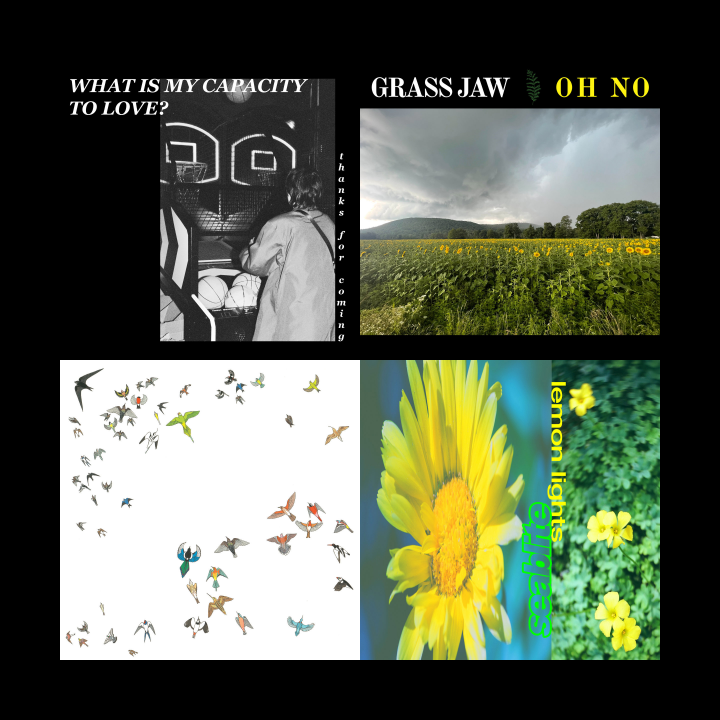
“Depends”, Thanks for Coming From What Is My Capacity to Love? (2023, Danger Collective)
What Is My Capacity to Love? comes against the backdrop of a disintegrated romantic relationship as well as the rise of Rachel Brown’s other band, Water from Your Eyes. The eight-song EP feels like a necessary step back for the always-busy Brown–the stripped-down “Depends” is both immediately “raw” and pensive, with the singer-songwriter turning over lyrics like “I swore we were meant to be, like raindrops on a car windshield in spring” over top of nothing more than a slightly-distorted electric guitar. Read more about What Is My Capacity to Love? here.
“Falling Down the Stars”, Even As We Speak From Feral Pop Frenzy (1993, Sarah)
Up until 2020, Feral Pop Frenzy was the only full-length album from Australian indie poppers Even As We Speak. If you were expecting some perfect twee-ish guitar pop from this Sarah Records-released album, you’d be right on the money, although the record also contains some weirder, offbeat moments. “Falling Down the Stairs” is, nevertheless, Even As We Speak at their most pop-pleasing, with a positively bouncy chorus being bashed out in gleeful jangle pop fashion.
“Sanity in the Asylum”, Matt Keating From Tell It to Yourself (1993, Alias)
This is a track that I initially heard after reading about it in Scott Miller’s Music: What Happened? (it’s gone in and out of print, but I highly recommend reading that book if you enjoy music writing and you can find it). I remembered it as an excellent piece of post-college rock power pop, and after listening to Tell It to Yourself as a whole for the first time, I can confirm that it holds up excellently. Bizarrely memorable lyric: “Someone said ‘go with the flow’; last I’d heard they’d drowned / But you never know, they might’ve been found”.
“Newest Thing”, Christopher Alan Durham & The Peacetime Consumers From Kicks or Macabre (2023, Soft Abuse)
I was unfamiliar with Detroit’s Christopher Alan Durham until recently, but the singer-songwriter’s latest album with his group The Peacetime Consumers caught my attention last month. Kicks or Macabre is a nice and sloppy Midwestern garage rock/country-fuzz album–it can rock, sure, but it’s also pretty laid-back, especially on opening track “Newest Thing”. It’s got this dug-up basement Americana feel that hits the same notes as David Nance does for me, even as it’s a bit woozier than Nance’s typical garage rock. Durham’s electric guitar touches give the song an alt-country edge, and his vocals are low in the mix but not too low that they’re unmemorable.
“Dagdream”, Dagwood From Everything Turned Out Alright (2023, Model City Music)
The Everything Turned Out Alright EP is a brief but quite strong statement from New Haven’s Dagwood. The power-pop-punk quartet puts together a half-dozen variable but coherent pop songs here, and even the “album tracks” hold their own against the previously-released singles. “Dagdream” is one of two songs here not to be given the single treatment, but it’s one of the most interesting and captivating things on the entire EP. It’s at the other end of the spectrum from Dagwood’s slick, clean side–vocalist Grady Hearn’s voice gets pushed to the background as the band explore swirling, almost shoegaze-y space rock, and there’s also some strangely interesting self-referential stuff going on here. Really catchy, also. Read more about Everything Turned Out Alright here.
“Sigalert”, Flat Worms From Witness Marks (2023, GOD?/Drag City)
For a band that put out two albums and two EPs in a four-year period, going over three years between albums is a pretty notable gap, but Flat Worms’ Witness Marks sounds like a group that hasn’t lost a step. The record particularly has a “back in the saddle” feeling, intently laser-focused on rolling through sharp garage rock as a single, in-lockstep unit. Opening track “Sigalert” is Flat Worms’ version of a raveup–careening guitars, fuzzed-out bass guitar, and barked but subtly malleable vocals all combine to make what I’d consider to be an excellent two-point-five minute pop song. Read more about Witness Marks here.
“Have a Bad Time”, Deady From Deady (2023, Never Nervous)
“Do you wanna go out with me tonight / Drink Vodka Sprite, have a bad time?” That’s the question that Mandy Keathley poses in the chorus of “Have a Bad Time”, the fiery piece of garage-punk that opens Deady’s self-titled debut EP (if Miller Lite is your drink of choice, she subs in that one in the refrain too). The chaotic, taunting guitar-carnival instrumental fits Keathley’s vocals so well that it’s surprising to learn that she was actually the last member to join the five-piece, Louisville-centered Deady–but it’s clear from the opening notes of the track that she’s the final piece locking everything into place. Read more about Deady here.
“Over My Head”, VANCAMP From Camper Van (2023, Sandy Floor)
“Over My Head” by VANCAMP is one of those songs that just works. Calvin Bakelaar is a singer-songwriter that falls somewhere between earnest indie folk rock and post-grunge/post-Westerberg “adult alternative” rock (Bakelaar is from Peterborough, Ontario, which feels right). “Over My Head” is my favorite song from his latest EP as VANCAMP, Camper Van–in the quieter verses, Bakelaar reminds me a bit of Mark Mulcahy, and in the big, big chorus…I can’t quite put my finger on who I’m thinking of there. Either way, it sounds great. “I got carried away last night” over top of Gin Blossoms chords…that’s a recipe for success.
“The Owl Presents…”, Circus Devils From Squeeze the Needle (2023, Guided by Voices, Inc.)
I never thought I’d see the day that Circus Devils would return to us. I guess I just didn’t learn from Guided by Voices’ “farewell tour”; if Robert Pollard wants any of his projects back, all he has to do is snap his fingers. Circus Devils have always been the most misunderstood and underappreciated of Pollard’s projects, something that he and the Tobias brothers (who generally make the instrumentals for Circus Devils) seemed hell-bent on keeping this way by releasing the abrasive “Here We Are” a day before the much friendlier “The Owl Presents…” Not that this is “Game of Pricks, part two”, mind you, but it’s a relatively straightforward piece of prog-pop that even has something of a melody to it. I was already excited for Squeeze the Needle; “The Owl Presents…” is confirmation that there’s still plenty of magic between Pollard and the Tobiases.
“Kind Ghosts”, Sparklehorse From Bird Machine (2023, Anti-)
What a treat! A new Sparklehorse album in 2023! And it’s pretty good, too! I haven’t spent as much time with it as I’ve meant to (me circa sophomore year of college would be ashamed of myself), but “Kind Ghosts” stuck out to me immediately as one of the biggest highlights of Bird Machine (“It Will Never Stop”, another such highlight, I wrote about last year when it first surfaced). The chorus is vintage Mark Linkous, the bittersweetly beautiful melody and lyrics exemplifying everything great about Sparklehorse, a band that still sounds as fresh as ever over a decade after Linkous’ death.
“Saint Guy”, Saint Black From Saint November (2023, Semi-Permanent)
Saint Black’s Saint November EP is one of these bedroom, lo-fi curiosities that I’d love to give more attention to if I had more resources to expand the output of Rosy Overdrive. Who is Saint Black? My guess is that whoever runs New Jersey’s Semi-Permanent Records is also the person who makes music under the name Saint Black, as the label has only released Saint Black material (an EP in 2017, an album in 2019, and now the six-song Saint November CD EP last month). Other than that I couldn’t tell you, although I can offer you “Saint Guy”, my favorite song on the Saint November EP. Like most of the record, it’s a wobbly piece of Beat Happening-esque deep-voiced indie pop, but this acoustic-based song feels a little more fully-realized that the rest of the EP. Of course, it still has the “found sound” kind of feeling, which, I imagine, is kind of the point. Not streaming, get it on Bandcamp.
“Pebbles to Throw”, Melancolony From Qualia Problems (2023, Louder Than Milk)
Santa Cruz’s Melancolony (the project of one Justin Loudermilk) quietly dropped Qualia Problems at the beginning of September, but its charms are immediate to anyone who’s heard it. It’s an immersive 80s indie pop-inspired experience, with Loudermilk pulling from the music of his youth (naming The Cure, The Church, and R.E.M. among others as inspiration) on the fifty-minute album. The brisk “Pebbles to Throw” incorporates synthpop and jangle pop in equal measure, using both to dress up what’s probably the most hummable melody on the record’s first side. Read more about Qualia Problems here.
“Coach House”, Coventry From Our Lady of Perpetual Health (2023, Septic Jukebox)
“Chain Wallet”, discussed earlier, probably gets the nod for single best moment of Our Lady of Perpetual Health, but the sub-two-minute, zippy “Coach House” is the one that comes closest to giving it a run for its money. It’s a piece of lo-fi fuzzy pop that also features excellent trade-offs between Fox and Massey in the lead vocals. There’s a nervous, almost paranoid impatience going on in the lyrics (“Two black eyes and blue out in the country / Data streams above me in the stark bright blue sky” is the superb opening line), which are game to zigzag with the music. Read more about Our Lady of Perpetual Health here.
“Swim”, Madder Rose From Bring It Down (1993, Seed/Big Beat)
Second month in a row Madder Rose gets on here. I thought they were more of a slowcore, dream-folk band but turns out they’re a lot closer to Belly-ish fuzz pop (still somewhat dreamy) on Bring It Down, or like if Mazzy Star were trying to be more power pop. That is to say, they’re not a band you’d expect to have a theme song, but “Swim” off of their debut album features a chorus that goes “Hey Rose! Hey Madder! Hey Rose, do I make you sadder?” If you’re gonna do something like that, you’d best bring your A-game, and Madder Rose inject their quasi-title song with an infectious pop energy.
“Gull”, Connie Lovatt From Coconut Mirror (2023, Enchanté US)
Coconut Mirror is Connie Lovatt’s debut solo album, but the singer-songwriter is an indie rock veteran, playing in 90s groups Alkaline, Containe, and The Pacific Ocean and contributing to multiple records by Smog (whose Bill Callahan sings on at least one song on Coconut Mirror). The breezy, deceptively deep folk rock of “Gull” opens the album–like the rest of the record, it’s only grown on me with time. The song, which features Yo La Tengo’s James McNew on bass and indie ringer Jim White on drums, is a bright pop song that rambles but never travels too far in its three minutes.
“Carry On, Young Cadavers”, Soft Screams From Life’s Labours Lost (2023, Corrupted TV)
From its Shakesphere-inspired title to the musings on capitalism and work culture contained therein, Life’s Labours Lost is perhaps Soft Screams’ most thematically heavy record yet–although, thankfully, it’s also one of sole member Connor Mac’s best as a pop songwriter. Mac’s love of chunky riffs helps build “Carry On, Young Cadavers” into one of the best pop moments on the album, and its chorus of “Carry on, you young cadavers / Got caught up in a dead man’s game” is one of the record’s best-sounding rebukes. Read more about Life’s Labours Lost here.
“Rainbow Flag”, Puppy Problems From Winter in Fruitland (2023, Anything Bagel)
At a brisk fifteen minutes, Winter in Fruitland’s eight songs make their points succinctly, but Puppy Problems’ Sami Martasian still has plenty to say on their second album. Early highlight “Rainbow Flag” features lyrics about the titular object above a record store where “they don’t let us [work] anymore”, listening to Harvard kids get drunk and play “the songs that our friends wrote back in 2016”, a line about circular nostalgia, and ending with “I don’t wanna look back until there is / Nothing left to look forward to,” accompanied by Bradford Krieger’s pedal steel–all in under two minutes. Read more about Winter in Fruitland here.
“Monochrome Rainbow”, Seablite From Lemon Lights (2023, Mt.St.Mtn.)
The second album from San Francisco’s Seablite offers up a sharp collection of fuzzed-out pop songs–some of them are more directly indebted to shoegaze than others, but everything on Lemon Lights reflects the band’s ability to pull off substantial pieces of indie pop. “Monochrome Rainbow” comes on the record’s second side, and it shows off the quartet’s dreamy jangle pop side–although the rest of the record is more devoted to conjuring up walls of sound, this track (as well as a couple of others, namely “Smudge Was a Fly” and “Faded”) reveal that the band is quite effective in this mode as well. Read more about Lemon Lights here.
“Winter Is Melting Away”, Single Bullet Theory From C. ‘79 (2023, Feel It)
Richmond, Virginia’s Single Bullet Theory emerged in the mid-1970s as a sharp power pop four-piece that could hang with the burgeoning punk rock scene happening a bit further north (they opened for the Talking Heads and Patti Smith in Richmond and even went so far as to tour with the Ramones). They never “broke”, but they were able to get an album and some singles out before breaking up in the mid-80s. Four solid Single Bullet Theory songs recorded in 1979, however, stayed locked up and unreleased for over forty years before being resuscitated by Feel It Records as an EP this year. “Winter Is Melting Away” is my favorite of the four tracks on C. ’79, a power pop tune that splits the difference between “polished” and “edgy”, with the band putting 110% effort into selling this piece of pop rock.
“Blow You Away”, Robert Earl Keen From A Bigger Piece of Sky (1993, Sugar Hill/Koch)
Somewhere else I described A Bigger Piece of Sky as if Richard Thompson was from Texas–a cover of Terry Allen’s “Amarillo Highway” is a key text in this interpretation, as is the Keen original “Blow You Away”. A beautiful, polished piece of mandolin-heavy country-folk, “Blow You Away” should be an American standard as far as I’m concerned, from Keen’s repetitive dagger-lyrics, striking guest vocals from Michael Snow and Maura O’Connell, and the gun-driven paranoia at the song’s core that’s as American as apple pie.
“Star Starter”, DAIISTAR From Good Time (2023, Fuzz Club)
“Star Starter” does what its title suggests–it opens the debut DAIISTAR album, Good Time, with a massive song that could’ve been a lost college rock hit from 1989, putting its best foot forward with a dancing beat, cruising guitars, and lead singer Alex Capistran’s melodic vocals. It’s a straight-up “alternative dance” anthem–DAIISTAR leans into Primal Scream/Loop/Spacemen 3-esque roaring psychedelic space-fuzz with their sound throughout Good Time, but these song that opens the record particularly lives up to the album’s title. Read more about Good Time here.
“Mistaken for Stars”, Smug Brothers From In the Book of Bad Ideas (2023, Anyway)
The newest album from Smug Brothers, In the Book of Bad Ideas, is yet another collection of distorted, hooky fare from the long-running Columbus lo-fi indie rock lifers. The Kyle Melton-led group makes a brand of Robert Pollard-indebted guitar pop that recalls a lot of music I touch on here on the blog, although they’ve been doing it for longer than most and with great consistency. Take something like “Mistaken for Stars”–it’s a sub-two-minute one, but there’s a ton of beauty in its brief, grainy lifespan, shining before winking out just like, oh, I don’t know, a shooting star. Read more about In the Book of Bad Ideas here.
“Enter the Sky”, Iceblynk (2023, 5BC)
Iceblynk are a Queens-based four-piece band who released their self-titled debut EP last year, a five-song collection of chilly shoegaze-influenced indie rock. Their first new material since Iceblynk is the “Enter the Sky” single, a near-five minute track that embraces the band’s brighter side, zeroing in on jangly dream pop that surprisingly veers into orchestral territory as well. Lead singer Andrea Lynn is a natural dream pop vocalist, injecting both mystery and emotion into the song’s melodies (I hear a bit of Bjork in Lynn’s vocals, in addition to a bunch of the more “classic” dream pop singers). There’s an intriguing, anonymous, humble quality to Iceblynk that I enjoyed, but, if the band are going to evolve as a unit, something as confident as “Enter the Sky” is the way to do it.
“Big Talk”, Lost Film From Keep It Together (2023, Relief Map)
Keep It Together is Lost Film’s version of a polished guitar-pop album. The Massachusetts group, led by Relief Map Records’ Jim Hewitt, have put together a record indebted to both 1980s post-punk/indie pop and 2010s greyscale bedroom pop, always hovering towards the “pop” side of these genres. The shining “Big Talk” emphasizes the pleasing push-and-pull that marks the record as a whole between the soaring, wide-eyed instrumentals and Hewitt’s warm, subtle melodic vocals. Read more about Keep It Together here.
“There Must Be a Pill for This”, The Reds, Pinks & Purples From Build Love (2023, Burundi Cloud)
There’s just so much new music from Glenn Donaldson as of late. There are, of course, proper albums from The Reds Pinks & Purples and Helpful People (his duo with Carly Putnam), as well as a steady trickle of quietly self-released EPs running parallel to these. The four-song Build Love EP is a humble one–half the songs are dreamy-ambient-pop instrumentals, and both of the songs with vocals are understated offerings from Donaldson. It’s a record that is not going out of its way to grab you, but I threw it on on a whim one morning at work and loved it immediately. “There Must Be a Pill for This” is stripped-down even in comparison to the rest of the EP, featuring Donaldson picking an acoustic guitar without other accompaniment. “There must be a pill for this / That only makes things worse,” is one of those lyrics that just rattles around in your head over and over again.
It’s a Monday! Even though I’m writing this over the weekend, odds are I’m feeling pretty shitty and lethargic this morning and there’s a good chance you are too. Well: these records will wake you up. New albums from Jerry David DeCicca, SIZ, and Thank You, I’m Sorry, along with the debut EP from Deady, await the reader below.
If you’re looking for more new music, you can visit the site directory to see what else we’ve written about lately. If you’d like to support Rosy Overdrive, you can share this (or another) post, or donate here.
Deady – Deady
Release date: September 29th Record label: Never Nervous Genre: Post-punk, math rock, post-hardcore Formats: Cassette, digital Pull Track: Have a Bad Time
“Do you wanna go out with me tonight / Drink Vodka Sprite, have a bad time?” That’s the question that Mandy Keathley poses in the chorus of “Have a Bad Time”, the fiery piece of garage-punk that opens Deady’s self-titled debut EP (if Miller Lite is your drink of choice, she subs that one in the refrain too). The chaotic, taunting guitar-carnival instrumental fits Keathley’s vocals so well that it’s surprising to learn that she was actually the last member to join the five-piece, Louisville-centered Deady; guitarists Sam Goblin (of Mister Goblin and Two Inch Astronaut) and Chyppe Crosby recruited rhythm section Clayton Ray (bass) and KJ Bechtloff (drums) before roping her in as a vocalist. Thanks to my undying affection for all things Mister Goblin, I’ve been on the Deady train for a few months now; in their previous appearances on Rosy Overdrive, I’ve described their music as weirdo, blaring, catchy egg punk, a potent Brainiac-ian mix of post-punk and post-hardcore noisiness. The Deady cassette, which collects their three singles and three previously-unheard songs, is the best-case scenario for a brief debut–it captures what the band do best and hints at where more long-form Deady material might go.
Deady had already shown a bit of range on the EP’s three advance singles–“Eat Sleep”, my favorite of the three, is the immediate piece of twisted new-wave-punk, debut single “Knock” is a little more D.C.-cruising, marked by a sharp, repetitive guitar riff, and “Uneeda”, which I covered pretty extensively when I premiered it last month, is the band at their noise rock heaviest. The new material more than holds its own against these singles, with “Have a Bad Time” in particular being a perfect opening track and perhaps even beating “Eat Sleep” at its own topsy-turvy game. What the other two tracks lack in collar-grabbing they make up for in uniqueness; the slick alt-rock of “End of the World” is Deady at their most polished, and “Sad Sack” is the biggest surprise on the EP, finding the band floating into a minimalist, percussionless piece of slowcore-y indie rock. When it’s all said and done, the fifteen minutes of Deady are comprised of one of the most exciting and fully-formed debuts of the year. (Bandcamp link)
Jerry David DeCicca – New Shadows
Release date: September 29th Record label: Bwatue Genre: Singer-songwriter, experimental rock, folk, synthpop, soft rock Formats: Vinyl, CD, digital Pull Track: Walking Stick
From somewhere outside of San Antonio comes New Shadows, the fifth solo album from lifer Jerry David DeCicca. In the 2000s and early 2010s, DeCicca co-led the Columbus folk rock group The Black Swans, releasing five full-lengths as part of that band. At some point in the past decade, DeCicca moved to Bulverde, Texas and began a solo career that has become just as substantial as the previous chapter in his music career. Perhaps reflecting this long-term experience in indie music, he’s been able to put together an all-star cast of musicians on his newest album, which features contributions from (among many others) David Hidalgo and Steve Berlin of Los Lobos, Tortoise’s Jeff Parker, and Rosali Middleman. One might go into a singer-songwriter record from Texas featuring several folk and roots rock musicians with a certain preconceived notion of how it might sound, but New Shadows declines to be so straightforward. The album utilizes a prominent horn section, synthesizers, and programmed drums in a genre-resistant way that owes as much to soft rock, orchestral pop, and sophisti-pop as it does to folk and country music.
The opening title track deploys Berlin’s baritone saxophone, Parker’s 80s-indebted guitar parts, Don Cento’s festering synths, and some Electric Light Orchestra-esque vocoder treatment to DeCicca’s voice–it’s a dark piece of unclassifiable rock music that indicates that just about anything can happen on this album. The first half of New Shadows brings us the polished indie pop of “Manzanita Bay” (featuring excellent backing vocals from Middleman) and a pair of dreamy ballads that form the album’s core in “Angelina” and “These Blues”. As adventurous as this record can be, DiCicca is at the center of things when it’s the most important–the straightforward lyrics to “When You Needed My Help” (“…I wasn’t around”) and “Walking Stick” (“You’ve got suction cups on your feet / You reproduce parthenogenetically”) are emphasized, rather than obscured, by the clarinet in the former and the reverb-y piano of the latter. New Shadows is a skilled record–subtle but pop-friendly, varied but coherent. (Bandcamp link)
SIZ – Blind
Release date: September 29th Record label: Flippin’ Freaks/Howlin’ Banana Genre: Fuzz rock, garage rock, grunge, psychedelic rock, shoegaze Formats: Vinyl, digital Pull Track: Strange Loop
Bordeaux, France fuzz rockers SIZ are led by Sylvain Palis, a member of “the Flippin’ Freaks collective” and contributor to music from labelmates TH Da Freak, among others. As a resident of a country that perhaps doesn’t have the largest history of guitar-based indie rock, Palis has the interesting perspective of taking in several distinct genres as one unit. An indie rocker growing up in the United States or the United Kingdom might view shoegaze, grunge, garage rock, and psychedelic rock as distinct, separate units, but Palis seems to have devoured them all equally (an incomplete list of bands who appear in SIZ’s bio: Osees, Nirvana, What Moon Things, Hotline TNT, My Bloody Valentine, Ovlov, Jagwar Ma). The second SIZ album, Blind, ends up sounding like a huge fuzz rock album with shoegaze wall-of-sound guitars and a bleak, depressive streak that pulls equally from 90s underground indie rock and more well-known grunge bands.
Although SIZ are reaching all across rock music’s history, they put together a nicely-blended stew of heavy rock music on Blind. The smoking riff that opens “It’s Over” gives way to a biting garage punk core, the band do their best shoegaze Alice in Chains impression on “Eyes Don’t Lie”, and Palis delivers a surprisingly emotional vocal performance over the fuzzy mid-tempo “Illuminated”. All these songs nevertheless fit together, as do the rest of the tracks–the zippy Ovlov fuzz-punk of “Ooook” gives way to the Ty Segall glam-stomp of “These Questions”, and the garage-y noise punk of “100% Toxic Waste” segues nicely into the hypnotic psych-fuzz of “Strange Loop”. The band (Palis, his brother Thoineau on guitar, Quentin Plantier on drums, and Rémi Lemoine on bass) deserve some recognition for pounding away as uniformly fiercely as they do throughout Blind; their unflagging energy is as much a reason for the record’s success as anything else. (Bandcamp link)
Thank You, I’m Sorry – Growing in Strange Places
Release date: September 29th Record label: Count Your Lucky Stars Genre: Emo-pop, pop punk, synthpop Formats: Vinyl, digital Pull Track: Autonomy Shop
Thank You, I’m Sorry began as the solo acoustic emo-folk project of singer-songwriter Lleen Dow, but transformed into a sturdy emo-pop-punk group with the release of 2020’s I’m Glad We’re Friends. Dow spent the three years in between the second and third Thank You, I’m Sorry albums releasing music under their own name, putting out an EP and a few singles that were more indebted to synthpop than any of their band’s past music. Now reunited with the band (bassist Bee Schreiner, drummer Sage Livergood, and guitarist Abe Anderson), Thank You, I’m Sorry has leveled up as a whole, as evidenced by what they’ve put into Growing in Strange Places. It’s not a rejection of the sound of I’m Glad We’re Friends so much as an expansion of it–the relatively barebones nature of that record gives way to a polished and busy feeling here, with the band incorporating synths, pop music, and mid-tempo indie rock while keeping one foot firmly placed in punk and emo.
Growing in Strange Places is eager to show off its new stripes from the get-go–opening track “Your Backyard” fakes an acoustic, lo-fi start before blooming into wide-eyed, crescendoing emo-indie-rock, single “Autonomy Shop” flings thundering pop punk guitar riffs and a brisk rhythm section at the listener after its synth-hinting intro, and “Brain Empty” dives head-first into synth-y electro-pop, pulling from a completely different bag of tricks. Thank You, I’m Sorry break out their synthpop side of them a few more times on the record (most notably on bummer-pop highlight “Lleeny Hut Jr.”), but lest you’re worried the synths have softened them up, the dramatic “Mirror”, the seething “Head Climbing”, and the wall-of-fuzz that ends the slowcore-ish “Traincar” demonstrate that the band are still very much a rock group (and besides, the “soft”est song on the album, “Parking Lots”, is a primarily acoustic guitar-based piece of folk-pop. And I’m nowhere near jaded enough to dislike that one). The amount of stuff that Thank You, I’m Sorry throw at the wall over the course of Growing in Strange Places is what helps this record stand out, and how enjoyable it is to listen to them do it is what keeps me going back to it. (Bandcamp link)
Thursday? Indeed. After an eventful week on Rosy Overdrive, the third and final Pressing Concerns of the week has arrived, offering up some thoughts on new albums from Modern Nature, Grass Jaw, and Seablite, and a new EP from Thanks for Coming. All of these records are out tomorrow, except for the Grass Jaw record, which is out today. If you missed either of this week’s earlier posts–Monday’s tackled records from Coventry, The Garment District, Soft Screams, and Guest Directors, while Tuesday’s rounded up releases from Puppy Problems, Neil Jung, Grand Drifter, and Surf Harp–I recommend checking those out too.
If you’re looking for more new music, you can visit the site directory to see what else we’ve written about lately. If you’d like to support Rosy Overdrive, you can share this (or another) post, or donate here.
Thanks for Coming – What Is My Capacity to Love?
Release date: September 29th Record label: Danger Collective Genre: Lo-fi indie rock, singer-songwriter, bedroom pop Formats: Digital Pull Track: Depends
Water from Your Eyes are certainly a good band, and I’m happy for them that they’ve finally started receiving critical attention for their unique and layered version of indie rock. Funnily enough, though, I personally gravitate towards the Brooklyn duo’s respective solo projects more often. I’ve written about a couple of Nate Amos’ records as This Is Lorelei, and while What Is My Capacity to Love? is the first time that Rachel Brown’s Thanks for Coming has appeared on Pressing Concerns, they’ve popped up here and there on the blog before as well. Like This Is Lorelei, Thanks for Coming is a prolific lo-fi pop project that’s slowed down a little bit as Water from Your Eyes has taken off–last year, Danger Collective put together a cassette of highlights from the eighty-something releases Brown’s put up on Bandcamp under the name (the compilation is a great starting place if one’s overwhelmed). The eight-song, twenty-one minute What Is My Capacity to Love? EP is the first new Thanks for Coming material since Brown joined up with Danger Collective, and I’m pleased and unsurprised to say that the immediacy and casual-yet-substantial feel of the project hasn’t been lost as it’s moved to a proper label and a somewhat more normal release schedule.
What Is My Capacity to Love? comes against the backdrop of a disintegrated romantic relationship as well as the rise of Water from Your Eyes, which found Brown touring more than ever before, and in new places unfamiliar to them. Although it certainly feels “raw” in places, the EP’s primary perspective feels like a necessary step back, with Brown writing more analytically and walking us (and themself) through questions like the one posed in the record’s title. Brown gives What Is My Capacity to Love? a typically stripped-down arrangement, with their guitar and vocals given barebones accompaniment. Their vocal delivery is typically stoic to the point where, when they do inject more emotion into it, it’s immediately attention-grabbing. Some of the EP’s strongest moments come on “Depends” and “Let It Be 10,000 Years (Or Just 0.01cm from Each Other)”, both of which feature Brown turning over lyrics like “I loved you like my life depended on it / You loved me like the moth to the flame,” over nothing more than a distorted electric guitar. Elsewhere, the loop-featuring “Loop”, the messy “Postcard”, and the dizzy synths and drum machine of “Melted” continue to no less effectively sketch the varying contours of the record’s central relationship and what Brown determines about themself through it. What Is My Capacity to Love? is a “working things out” record from someone who seems to always be on the move; thankfully, they put a pause on things long enough to put these songs together. (Bandcamp link)
Modern Nature – No Fixed Point in Space
Release date: September 29th Record label: Bella Union Genre: Post-rock, jazz, chamber pop, baroque pop, psychedelia Formats: Vinyl, CD, digital Pull Track: Tonic
After the breakup of his garage-y, psych-fuzzy-y indie rock duo Ultimate Painting, Cambridge’s Jack Cooper has followed a decidedly different path as the leader of Modern Nature. The debut Modern Nature album, How to Live, embarked on an exploration of the world of Woods-y psychedelic folk rock; it was already a departure from Ultimate Painting, and Cooper has spent the last few years moving even further away from it with 2020’s Annual mini-album and last year’s Island of Noise. As Modern Nature has become more of a rolling cast of contributors led by Cooper, he’s moved away from indie rock and cultivated a sound heavy on Mark Hollis-esque empty space utilization, as well as one prominently taking advantage of the jazz-and-woodwinds background of Sunwatchers’ Jeff Tobias, the project’s most consistent contributor other than Cooper. The Modern Nature of No Fixed Point in Space has, at this point, fully transformed into something else entirely–finally casting off the folk rock of its past, the album zeroes in on the freer moments from Island of Noise to create a record of seven expansive, lush, and completely unmoored post-rock songs.
In addition to Tobias and longtime drummer Jim Wallis, Cooper’s ensemble on No Fixed Point in Space includes Pere Ubu/This Is Not This Heat’s Alex Ward, The Necks’ Chris Abrahams, and singer Julie Tippetts (who’s been making music since the 1960s as Julie Driscoll, and whose voice adds a key dimension to the album’s sound). The beginning of the album finds Modern Nature in full-on Spirit of Eden/Laughing Stock territory, with twin seven-minute songs “Tonic” and “Murmuration” slowly traversing cavernous terrain featuring upright bass, woodwinds, and minimal percussion. Cooper’s voice is perhaps the only true anchor on the album–either on its own or accompanied by Tippetts, it’s the friendliest and most consistent feature throughout No Fixed Point in Space. At least, that is, until Cooper largely hands over those duties to Tippetts towards the end of the album–trusting her equally to land the bass-plodding of “Tapestry” and the sweeping “Ensō”. No Fixed Point in Space may be a relaxed-sounding album in places, but it isn’t a complacent one–it’s probing until its end. (Bandcamp link)
Grass Jaw – OH NO
Release date: September 28th Record label: Self-released Genre: Fuzz rock, lo-fi indie rock, alt-country, noise rock, slowcore Formats: Digital Pull Track: Two Things at Once
Grass Jaw is becoming a Pressing Concerns regular, a development that makes me happy to observe happening. Today, we’re greeted with the third album that Ithaca’s Brendan Kuntz has released under the name in as many years, following 2021’s Anticipation and last year’s Circles. Over his recent output, Kuntz has pursued a recognizable and underappreciated sound that mixes downcast, Exploding in Sound-style noisy indie rock, slowcore, and alt-country–and those who enjoyed his last two offerings will find plenty to enjoy on OH NO, the sixth Grass Jaw album. After leaning into the weary aspects of his sound on Circles, the follow-up feels a little bit more rousing than what Grass Jaw had been doing. Kuntz leans a little more into post-punk, noise rock, post-hardcore, and even a little bit of math rock on this one while still leaving plenty of space for the slower and subtler aspects of his sound, creating a distinct wrinkle in the ever-expanding Grass Jaw tapestry.
OH NO starts out humbly enough with the acoustic-led “No Reminders”, a song where Kuntz’s holler puts it into “gothic country/dark Americana” territory, before ending with a woozy, fuzzy rock final minute or so. The first side of OH NO picks up on the busier thread with which that song ends, from the worried, uneasy chaos of “Blue Skies” and the fascinating “Two Things at Once”, which uses saxophone (provided by Tom Yagielski) and prominent noise-punk bass to put it closer to something off of Dischord Records than anything else I’ve heard from Kuntz. Kuntz saves the less rocky material for the record’s second half, although the steady “Enough (To Feel About About)” and big closing track “Things You Can’t Take Back” both take advantage of Grass Jaw’s electric side. The most unique song on the record is the penultimate title track–there’s a crushing heaviness to it in a completely different way, one that embraces instrumental, glacial post-rock. It’s another side of Grass Jaw, but distinctly them as well. (Bandcamp link)
Seablite – Lemon Lights
Release date: September 29th Record label: Mt. St. Mtn. Genre: Shoegaze, fuzz pop Formats: Vinyl, digital Pull Track: Monochrome Rainbow
(Author’s note: after publication, it came to my attention that I listened to this album with an incorrect track order, and some of the writing reflects this. I’ve decided to leave it as-is; please consult your vinyl copy or digital provider of choice for comparison.)
The newest addition to Mt. St. Mtn.’s stable of exciting guitar pop groups is the San Francisco quartet Seablite, who have joined with the label to put out their sophomore album, Lemon Lights, after releasing an album and EP in 2019 and 2020, respectively, on Emotional Response. Across Lemon Lights’ dozen tracks, the band (co-led by guitarist Lauren Matsui and bassist Galine Tumasyan, also featuring Wax Idols’ Jen Mundy on guitar and the excellent Andy Pastalaniec of Chime School on drums) establishes themselves as true shoegaze devotees. The album (which was mastered by Ride’s Mark Gardener) offers up a sharp collection of fuzzed-out pop songs–some of them whip up more of a wall of sound than others, but all of them display the band’s ability to pull off effortless-sounding but still substantial pieces of indie pop.
Lemon Lights gets off to an attention-grabbing start with “Blink Each Day”, a noisy and fuzzy piece of shoegaze that is firing on all cylinders from the get-go, and while the somewhat darker “Drop of Kerosene” is a little more of a slow-burner, it works itself up into a distorted frenzy in its chorus too. Although the amped-up “Frozen Strawberries” and the overstuffed Britpop-fluent “Hit the Wall” continue the record’s shoegaze-heavy streak on side one, the lighter “Faded” reveals Seablite’s dreamy jangle pop side. It’s in the minority in Lemon Lights’s tracklist, but side two highlights like “Monochrome Rainbow” and “Smudge Was a Fly” reveal that the band is quite effective in this mode as well. It’s certainly not an either/or proposition, mind you, as tracks like “Hold My Kite” and “Pot of Boiling Water” are plenty heavy despite offering up some of the best pop hooks on the album as well. It’s not a simple thing to make loud music while still allowing the songs enough space to shrine through, but Seablite certainly pull it off throughout Lemon Lights. (Bandcamp link)
Okay, okay, okay, it’s a Tuesday. I know what you’re thinking–there was just a great Pressing Concerns on Monday, featuring great music from Coventry, The Garment District, Soft Screams, and Guest Directors. But what can I say? There’s just too much music I want to write about to be constrained to two editions this week. So we’re back, right now, at this exact moment, to talk about new albums from Grand Drifter and Surf Harp, and new cassettes from Puppy Problems and Neil Jung.
If you’re looking for more new music, you can visit the site directory to see what else we’ve written about lately. If you’d like to support Rosy Overdrive, you can share this (or another) post, or donate here.
Puppy Problems – Winter in Fruitland
Release date: September 22nd Record label: Anything Bagel Genre: Bedroom pop, indie folk, twee, lo-fi pop Formats: Cassette, digital Pull Track: Rainbow Flag
Boston/Providence’s Sami Martasian released their first album as Puppy Problems back in 2018 on Sleeper Records (Ylayali, 2nd Grade, Friendship). Sunday Feeling came out right in the middle of that big wave of tender indie folk that was being practiced by groups like Florist, Gabby’s World, Free Cake for Every Creature, Told Slant…some of those bands got huge, others faded away. Puppy Problems went dormant for a while, although Martasian partnered with Bedbug’s Dylan Citron to make a record as Rose, Water, Fountain in 2021. The second Puppy Problems album arrives on Anything Bagel (Vista House, Bluest, Generifus) a half-decade later–some of these songs have been around for quite a while (there are demos of “Rainbow Flag” and “Big Drink” on their Bandcamp page from 2019), but Winter in Fruitland thankfully doesn’t sound too labored over. Martasian and a small group of collaborators (Citron, multi-instrumentalist Bradford Krieger, and bassist/percussionist Stephen Chevalier) give these track a light feeling, coming off as the warm best-case scenario for this kind of lo-fi music.
At a brisk fifteen minutes, the cassette’s eight songs make their points succinctly, but Martasian still has plenty to say on Winter in Fruitland. Early highlight “Rainbow Flag” features lyrics about the titular object above a record store where “they don’t let us [work] anymore”, listening to Harvard kids get drunk and play “the songs that our friends wrote back in 2016”, a line about circular nostalgia, and ending with “I don’t wanna look back until there is / Nothing left to look forward to,” accompanied by Krieger’s pedal steel–all in under two minutes. “Him or Me” is another song that utilizes simplicity and repetition to great effect (“I need to know if you believe him or me”), and the one song that crosses the three-minute barrier (“Lost Sweater – Disney Wedding”) gets there by letting the long pauses echo the time passing since the events in the song’s title (and the parts that aren’t the pauses indicate that said time has not completely clouded the rear view mirror). “If I don’t say what I’m thinking, then you think I’m not thinking,” Martasian sings in the sub-one-minute opening track–Winter in Fruitland as a whole feels like a statement that, for them, these moments of silence and breaks from the noise contain so much more than the addressee of “Thinking” could understand. (Bandcamp link)
Neil Jung – Infinity Is Whatever
Release date: September 22nd Record label: Two Worlds Genre: 90s indie rock, fuzz rock Formats: Cassette, digital Pull Track: No Cavities
Sometimes, a group hits just the right amount of band/album name synergy for their music. Here, we have a Brooklyn four-piece group named after a Teenage Fanclub song, with a sound certainly indebted to underground 90s indie rock and power pop, and a debut EP titled Infinity Is Whatever. The newest group from singer/songwriter/guitarist Evan Brock, Neil Jung has been around for at least half a decade, but the pandemic got in the way of their debut record’s release until now. Originally tracked by the quartet (Brock, guitarist Kris Hayes, bassist Jeremiah Furr, and drummer Andrew McDonald) in late 2018 and early 2019, Neil Jung managed six half-finished songs and one live show before COVID ground things to a halt. Earlier this year, the band got TW Walsh (ex-Pedro the Lion) to master these songs, and the Infinity Is Whatever cassette finally saw the light of day earlier this month.
The debut Neil Jung release is a laid-back but airtight collection of fuzzy guitar pop songs; while the influence of their namesake band is certainly there, more than anything it feels like a flag-waving for All-American indie rock groups like Dinosaur Jr., Pavement, and maybe even a little bit of emo in there for good measure. Opening track “No Cavities” is a bullseye in this particular field, imagining J. Mascis attempting to write a jangly pop song, while the power chords and plodding bass of “Washing Machine” find the band in power-pop-punk mode while still retaining a “slacker” veneer. The sub-two minute “Waster” has a bit of post-Westerberg college rock in it even as it has just enough punk-y energy to its instrumental, and on the other end of the spectrum is the five-minute “Algae”, a slow-burning indie-progger that goes from understated pop rock to a Sonic Youth-y torrent of noise as it draws to a close. It’s a surprising ending, but after spending the bulk of Infinity Is Whatever coming off as immediately likable pop tunesmiths, Neil Jung can pull off just a little bit of an indulgence. (Bandcamp link)
Grand Drifter – Paradise Window
Release date: September 8th Record label: Subjangle Genre: Indie pop, jangle pop, folk pop, baroque pop Formats: CD, digital Pull Track: Unrecorded Feelings
Grand Drifter’s Andrea Calvo hails from a country that I’ve never covered on Pressing Concerns before (Italy), but the singer-songwriter makes a brand of guitar pop that is familiar to both me and, in all likelihood, anyone who is a regular reader of the blog. Calvo falls on the lush and ornate end of the indie pop spectrum–even as he plays nearly everything on his latest album, Paradise Window, himself, he still takes care to dress these seven songs in intricate and varied instrumentation over top of their simple acoustic foundations. Belle & Sebastian is the most obvious sonic comparison for the third Grand Drifter album, although any indie pop band that has incorporated a bit of sophisti-pop refinement into their sound–from The Cat’s Miaow to Trembling Blue Stars–will get you into the general vicinity of Paradise Window.
A short album at around 22 minutes, Paradise Window wastes no time in offering up smart guitar pop music. “Drawing Happiness” gets a ton of mileage out of little more than acoustic guitar and piano flourishes, while the next track, “Beautiful Praise”, expands the sound of Grand Drifter with a wider range of instrumentation while feeling like a smooth extension of the song before it. “Unrecorded Feelings” is a little more uptempo than its surrounding songs, although Calvo’s casual-sounding vocals keep it in line with the rest of Paradise Window. While sophisti-pop touches mark the entire record, the jazzy chords of “Peaceful Season” and the string-heavy title track in the record’s second half feel like Paradise Window’s clearest forays into this side of Grand Drifter’s sound. Calvo does his best to play and present the tracks of Paradise Window in delicate fashion, although at their cores, they are quite sturdy pop songs. (Bandcamp link)
Surf Harp – Language Is Lost
Release date: August 25th Record label: Shiny Boy Press Genre: Art pop, synthpop, prog-pop, sophist-pop Formats: Vinyl, cassette, digital Pull Track: Willowing
There’s something about Baltimore that seems to trigger the spawning of pop weirdos of every stripe, from Tomato Flower to Gloop to Smoke Bellow. The latest such group to grace the pages of Pressing Concerns is Surf Harp, a wide-ranging five-piece band with members in both Baltimore and Osaka. Language Is Lost is the third album from the quintet (Philip Bolton, Jeffrey Koplovitz, Aaron Perseghin, Christopher Sweeney, and Ryan Zadera), and the first in half a decade following 2018’s Mr. Big Picture. It sounds like Surf Harp has used the interstitial five-year period well–with Language Is Lost, the band have put together a forty-five minute, fully-realized art pop album with more than its fair share of ideas. Although a lot of the points of comparison for the record’s sound come from roughly the 1980s (new wave, synthpop, New Romantic, sophisti-pop), Language Is Lost is hardly captured by those genre tags, and feels entirely forward-looking.
Language Is Lost is a consistent listen despite (or maybe because of) how much it incorporates–while the soaring, wide-eyed synthpop of “Factory”, the chugging “Permissions from Hoari”, and the post-punk groove of “Planet Parent” all start in different places, Surf Harp bring a similar briefcase-of-tricks pop professionalism to all three of them, and they all shine equally brightly. The band references XTC in their notes, and I found myself, like one can do with that band, listening to Language Is Lost’s twisted pop songs and wondering which one could clean up nicely for consumption outside of this little world–the busy prog-pop of “Willowing” was the one that got a “radio edit” (and it has a nice “drop” moment at nearly two minutes in–DJs take note), while the slow-building “Messages from Horai” is Surf Harp at their most conventional-sounding (we’re still grading things on a curve, mind you). It’s a fun exercise, although Language Is Lost is best enjoyed by entering into this world wholeheartedly and just enjoying Surf Harp’s scenic route. (Bandcamp link)