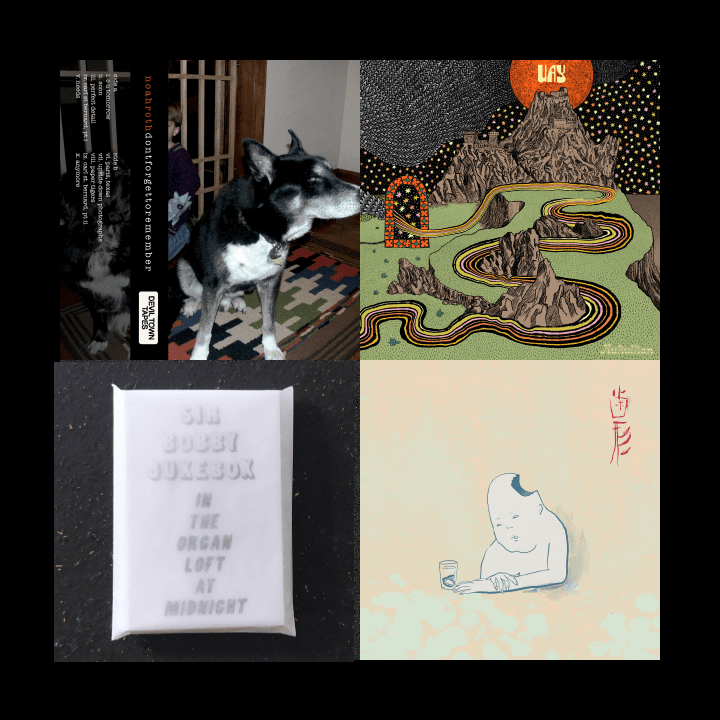
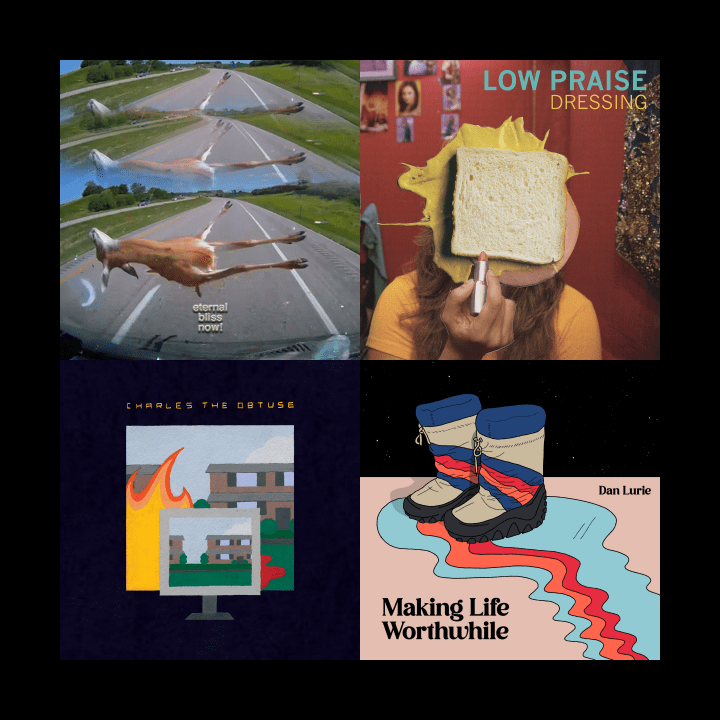
Welcome to Pressing Concerns! This is the first week in recent memory that’s only featured one of these, but today should be more than enough for you: we’ve got new albums from Noah Roth, Sir Bobby Jukebox, UAY, and TEKE::TEKE to talk about. If you missed the Rosy Overdrive May 2023 playlist, that went up on Monday, and I’d recommend checking that one out (it’s very good!).
If you’re looking for more new music, you can visit the site directory to see what else we’ve written about lately. If you’d like to support Rosy Overdrive, you can share this (or another) post, or donate here.
Noah Roth – Don’t Forget to Remember
Release date: June 9th Record label: Devil Town Tapes Genre: Lo-fi indie rock, folk rock, alt-country, experimental rock Formats: Cassette, digital Pull Track: Carl St Bernard, Pt 1
Last year, I wrote about Breakfast of Champions, an excellent record from the Philadelphia-based musician Noah Roth. Labored over for several years, Breakfast of Champions balanced more “traditional” folk rock with an experimentalist streak, making for an intriguing final product. For their follow-up, Don’t Forget to Remember, Roth took a different path–it was written and largely recorded during a three-week stay in their childhood home in the Chicago suburbs. Roth fully embraces their experimental, noisy, “fuck-up sounding” side on this one–being away from the studios, instruments, and musicians that helped record their last album necessitated this, to a degree, but I also suspect that Roth had already decided that the frayed edges at the ends of Breakfast of Champions were where they wanted to explore next.
This isn’t to say that Noah Roth isn’t still the songwriter they were on their last album–there are pop songs throughout Don’t Forget to Remember as well. Roth marries songs and noise in a way that reminds me of producer-songwriter John Vanderslice, what they’ve done recently with their other band, Mt. Worry, and the work of their recent tourmate Leor Miller. “C U Tomorrow” features melodic guitars and synths that battle against a wall of fuzz, “Perfect Detail” is based around some Vanderslice-esque acoustic distortion, and the surprising, bass-led “Carl St Bernard, Part 1” might actually be the catchiest song I’ve heard from Roth. “Needs” is, in a way, Don’t Forget to Remember summed up neatly–Roth takes an acoustic guitar-based song and contorts it, speeding it up and slowing it down in a way few people would think to do with this kind of music.
It feels like Don’t Forget to Remember stretches out a bit as it goes on, with songs like “Paris, Texas”, “Upside Down Photographs”, and “Carl St Bernard, Part 2” taking a bit more time to get where they’re going. There’s a breakup (“watching someone you loved become a stranger” as Roth puts it) at the heart of this album, and I hear it in these tracks: “When I see you again, I know we won’t be friends / But I promise you that I’m listening,” in “Paris, Texas”, in the entire outro of “Paper Tigers”, in the corrupted ballad of “Carl St Bernard, Pt 2”. I also hear it in closing track “Anymore”, a song that’s openly haunted and wounded–but there’s something else there, too. Maybe it’s the fuzz. (Bandcamp link)
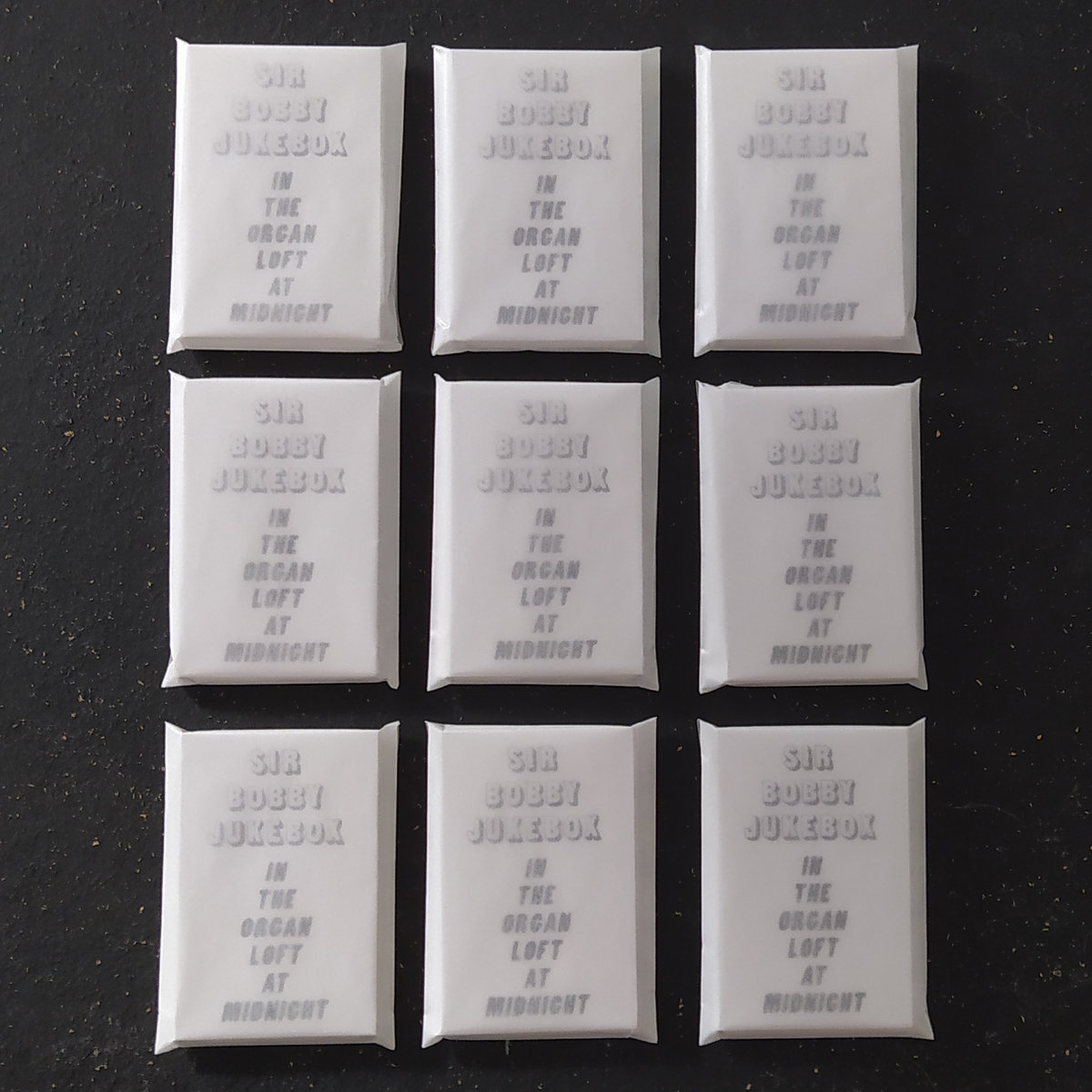
Sir Bobby Jukebox – In the Organ Loft at Midnight
Release date: June 9th Record label: Popical Island Genre: Indie pop Formats: Digital* Pull Track: You Lit a Candle Wrong…
Since the 2000s, Dublin’s Sir Bobby Jukebox has released twenty-something albums as a bandleader or solo artist. Many of those records have been with his indie pop group No Monster Club, whose Deadbeat Effervescent I wrote about last year–In the Organ Loft at Midnight is the second full-length to come out under the Sir Bobby Jukebox name. While it might be a tad more insular than Deadbeat Effervescent, Jukebox hasn’t taken a big step away from No Monster Club’s sound with this solo album–if you liked the previous album’s bright, shiny, Unicorns-esque tropical-feeling indie pop, you’ll find plenty to enjoy on In the Organ Loft at Midnight.
Sir Bobby Jukebox brings the energy necessary to make a strong pop album throughout In the Organ Loft at Midnight, from the humble conga line of “Don’t Say Goodbye” to the bouncy piano pop of “Tropical Bird Lingo” early on to the synthpop epic of “Radio Tumbleweed” and woozy singalong “In the Nettles” in the album’s second half. Although Jukebox is pretty much always offering up bright, shiny island pop, he doesn’t restrict his emotions to one-note cheerfulness in doing so–“Totally Out of Sync” laments in between its hooks, and “No Fly Zone” has a surprising amount of bile in it. The big pop jaunt of “Nudity” is Sir Bobby Jukebox at his most straightforward and memorable, although my favorite version of him is the one on “You Lit a Candle Wrong…”: exuberant, twisting, tossing out melodies..speaking in French? Anyway, it’s just another solid pop tune on In the Organ Loft at Midnight, available now via bubblegum card. (Bandcamp link)
UAY – Kukulkan
Release date: June 6th Record label: Half Shell Genre: Psychedelic rock Formats: Vinyl, digital Pull Track: Oye
UAY is a Guadalajara, Mexico-based psychedelic rock band who released their first record, Mexicadelia, back in 2015 (under the name Fauno). Kukulkan is the quartet’s third full-length album and second as UAY, following 2020’s La Selva. UAY have a few connections to the country to their immediate north–they’ve toured the United States a few times, have played with Thee Oh Sees, and are releasing their newest album on Seattle experimental rock label Halfshell Records. They’ve certainly heard their fair share of U.S. and European psychedelic and indie music, I’m sure, but UAY also cite bands from their home country (Caifanes) and the rest of Latin American (Os Mutantes) as ingredients in their sound.
Kukulkan leans heavy on the psychedelic end of psychedelic rock–listeners should expect to hear swirling guitars, hypnotic percussion, and bursts of noise all taking place in the context of songs that could very well be described as “odysseys”. The soulful, emotive vocals of guitarist Francisco Lopez and bassist Rodrigo Torres are what keep the album grounded as much as anything else–while these seven songs contain plenty of lengthy instrumental breaks, when the singers do show up, they unlock an extra dimension to songs like opening track “Oye” and “No sale el sol”. Both the shorter and longer songs on Kukulkan are exploratory–the three-minute, jazz-influenced “La Llorona” is just as intriguing as the eight-minute, percussive “Inexplicable”–and they all work together. (Bandcamp link)
TEKE::TEKE – Hagata
Release date: June 9th Record label: Kill Rock Stars Genre: Experimental rock, psych rock, post-punk, art pop Formats: Vinyl, CD, digital Pull Track: Doppelganger
TEKE::TEKE are a freewheeling seven-piece rock band with an omnivorous sound that touches on everything from Japanese pop and traditional music, psychedelic and surf rock, American post-hardcore/noise rock, and film soundtracks. The Montreal-based group is gearing up to release their second album on Kill Rock Stars, Hagata, and it’s an adventurous record that feels accessible despite (because of?) its wide-ranging nature. The band’s members bring a lot to dress up these ten songs–for example, Yuki Isami plays flute, shinobue, taisho koto, and synths, Etienne Lebel plays trombone, gaida, and percussion, and four different members (Sei Nakauchi Pelletier, Hidetaka Yoneyama, Mishka Stein, and lead singer Maya Kuroki) all have guitar credits.
TEKE::TEKE sound like a big tent at the start of Hagata–opening track “Garakuta” is a maximal march that goes heavy on the flute and horns, and the mid-tempo strut of “Gotoku Lemon” and the rocking “Hoppe” keep the energy going. TEKE::TEKE get a little pensive in the record’s midsection–“Onaji Heya” is a bit loose but resolves to pleasing indie pop, “Me No Heya” is a peaceful-sounding instrumental, and “Doppelganger” synthesizes the band’s “indie rock” and “otherworldly psychedelic” sides quite nicely. The seven-minute “Kaikijyu” is relatively sparse for most of its length, with the band drawing back a little bit to let the song build up organically. They’re still there and ready to make a racket, though–which they do as the song draws to a close. (Bandcamp link)
It’s time for a ton of new music this Monday. Today sees the grand unveiling of Rosy Overdrive’s May 2023 playlist, and boy, this one’s an all-timer. I would call it a classic (a word I would also use for many of the songs which make it up).
PONY, Poppy Patica, Greg Mendez, Rob I. Miller, and William Matheny all have multiple songs on the playlist.
Here is where you can listen to the playlist on various streaming services: Spotify, Tidal, BNDCMPR (missing one song). Be sure to check out previous playlist posts if you’ve enjoyed this one, or visit the site directory. If you’d like to support Rosy Overdrive, you can share this (or another) post, or donate here.
“Down South”, Cal Rifkin From Better Luck Next Year (2023, Really Rad)
It’s always nice when a new power pop band spawns. Or, new-to-me ones, at least. Washington, D.C.’s Cal Rifkin have just released their second EP, Better Luck Next Year, and it rides both the “fuzzy and loud” and “gentle and melodic” ends of the genre. Better Luck Next Year opens with “Down South”, their version of an unstoppable, massive jangly power pop anthem–lead singer Erik Grimm can sing that chorus as understated as possible, but it’s still going to be a runaway train. Read more about Better Luck Next Year here.
“Lost Keys”, Nicole Yun From Matter (2023, Kanine)
Eternal Summers were/are a Richmond band that showed up around the beginning of the 2010s, making a kind of reverb-heavy, pop-heavy indie rock that had a brief moment around this time. They were pretty good, but they’d kinda slipped from my radar. I’m not sure if the band is still active (their last album was in 2018), but lead singer Nicole Yun has put out two solo albums since then, and her most recent one (April’s Matter) is very good. Album highlight “Lost Keys” is, I think, impossible to dislike, a breezy pop rock tune that Yun really sells in a way that I’m not sure most distortion-heavy frontpeople would be capable of doing. There’s a Guided by Voices-esque effortless catchiness to a lot of Matter (which I thought before I learned that GBV’s Doug Gillard contributed guitar to her previous solo album, 2019’s Paper Suit).
“Trouble”, Fust From Genevieve (2023, Dear Life)
One of the best albums of 2021 was Fust’s Evil Joy, an excellent country record from the Aaron Dowdy-led project. For whatever reason, I was relatively lonely in my acclaim of Evil Joy, but it already feels different this time around, as I’ve seen the lead-up to their next album, Genevieve, gaining some steam. For one, there’s legitimate star power (fellow North Carolinians MJ Lenderman and Indigo De Souza play on the album), and there’s also “Trouble”, a transcendent country rock tune that might be the best Fust song yet. Steady electric guitar and piano let Dowdy’s typically excellent vocals soar as he unspools a hell of a lyric here. I’ll have more to say about Genevieve soon.
“The Habsburg Jaw”, Califone From Villagers (2023, Jealous Butcher)
The new Califone album opens with “The Habsburg Jaw”, which is to say that it opens with some odd-sounding synths that give way to a beautiful acoustic-based indie rock tune that still flirts with giving into those odd synth sounds throughout (and does towards the end). Horns rise when Tim Rutili sings “Talk to me in the voice you use to talk to the cat,” and then he sings along with a corrupted-sounding voice. Nobody does songs like this better than Califone (or comes even close, really).
“Sick”, PONY From Velveteen (2023, Take This to Heart)
The second PONY album is a monster of a pop record–plenty of bands have mined this style of formerly-radio-friendly 90s alt-rock in recent years; few have done it as deftly and catchily as the Toronto do on Velveteen. “Sick” feels eternal, aided in large part due to an excellent frontperson performance from Sam Bielanski–here, they sound like they’re grabbing the mic aggressively to vividly try and wrest control of something. “Break my spine just to prove I have one,” they memorably offer in the chorus (equally memorable is their enunciation of “comp-licated” a couple of lines earlier). Read more about Velveteen here.
“Awful Sound”, Poppy Patica From Black Cat Back Stage (2023, House of Joy)
Black Cat Back Stage opens with a perfect indie-pop-rock tune in “Awful Sound”, a track that excellently synthesizes the ramshackle poppiness of Stephen Malkmus at his most accessible with some sparkling new wave-y synths. It’s the perfect bait for a certain kind of indie rock fan to be drawn into Peter Hartmann’s bright sounding, incredibly stuffed, complex tribute to his former home of Washington, D.C. that is the rest of the record. Read more about Black Cat Back Stage here.
“Wedge”, Rob I. Miller From Companion Piece (2023, Vacant Stare)
Companion Piece gets better and better the more I hear it. It’s a breakup record with something of a dark cloud hanging over it, but Rob I. Miller is an excellent power pop songwriter, and the hooks here are only “subtle” in comparison to his quite eager-to-please “main” band, Blues Lawyer. Single “Wedge” is a massive piece of Teenage Fanclub fuzz-pop that glazes over some lyrics that…well, they sound like what I imagine a San Francisco-area breakup sounds like. Read more about Companion Piece here.
“Stop Breakin’ Down”, Hunter Senft From American Love Songs (2023, New Morality Zine/Best Life)
Last year I wrote about The Brass Tax, an intriguing EP from Oklahoma heavy shoegaze band Downward. The Brass Tax flirted with a few genres outside their wheelhouse, but none of them quite prepared me for American Love Songs, the latest EP from Downward’s lead singer Hunter Senft. “Stop Breakin’ Down” is one of–probably the most catchy power pop song I’ve heard this year. Senft mentions Tom Petty and Roy Orbison as influences for the EP, and they’re in this song, among many other things–it’s got a big 80s pop sheen, some saxophone, a big old recurring riff, and a chorus that’s so massive that it’s basically showtune-esque.
“The Cut Off”, En Attendant Ana From Principia (2023, Trouble in Mind)
I wrote about Principia back in February, but I didn’t put anything from it on the playlist for that month. This was a mistake; “The Cut Off” should’ve been on it, and now it’s here. Seeing En Attendant Ana live and being struck by how effective a frontperson Margaux Bouchaudon is helped me to realize this, but the exuberance of this song’s chorus (“Something’s missing!”) comes through just as clearly on record. Read more about Principia here.
“Tonight and Every Night from Now On”, William Matheny From Moon Over Kenova (2018, Misra)
“Tonight and Every Night from Now On” is tucked away on William Matheny’s 2018’s Moon Over Kenova EP–what little attention that EP has gotten has mostly centered on the transcendent, spiritual title track and an ace cover of Songs: Ohia’s “Just Be Simple”, but “Tonight and Every Night from Now On” is no slouch. It’s a slick moment for Matheny’s narrator, the surety of the refrain bouncing off against verses that cast a much wider net.
“Nutrition Facts”, Parister From Here’s What You Wonder (2023, Candlepin)
Parister’s Here’s What You Wonder is excellent Kentucky indie rock, with distortion and twang coloring guitarist/vocalist Jake Tapley’s songwriting. Album highlight “Nutrition Facts” is pure twinkling, jangly power pop, and the titular line is beautiful in an offbeat way (it has the MJ Lenderman thing of hanging on a seemingly mundane image for just long enough). Read more about Here’s What You Wonder here.
“Jupiter”, Upper Wilds From Jupiter (2023, Thrill Jockey)
Should’ve been on the April playlist, whoops! Anyway, new Upper Wilds is always a momentous event, and “Jupiter” is no different. The Dan Friel-led power trio are continuing their planetary explorations, following 2018’s Mars and 2021’s Venus (both of which were among my favorite records of their respective years). The title track to Jupiter was released along with the also-very-good “10’9””–this is the punchier, more playlist-friendly one, but it still manages (unsurprisingly) to do justice to our solar system’s largest planet in a three-minute screeching noise-pop-rock tune.
Like several highlights on Greg Mendez, “Clearer Picture (of You)” is a really raw, close-cutting song that very bluntly deals with the hurt that can only arise from being intimate (in some form another) with someone. It’s not exactly similar songcraft-wise, but “Clearer Picture (Of You)” hits on Exile on Guyville-level subject matter in its lyrics, particularly that really rough second verse. And also like Greg Mendez’s highlights, “Clearer Picture (of You)” just sounds beautiful. Read more about Greg Mendez here.
“D. Boon-Free (A Ninth Grade Crime)”, Centro-matic From The Static vs. the Strings Vol. 1 (1999, Quality Park/Idol)
So, I’m mentally ill, and sometimes this negatively impacts my life. Last month was a really really good/bad example of this. One of the ways I coped with this was asking for song recommendations on Twitter that fit a very specific messed-up 90s indie rock vibe. “D. Boon-Free (A Ninth Grade Crime)” wasn’t quite what I was looking for (it’s too poppy), but it turns out it’s the song I needed. I’ve never really listened to Centro-matic–I’d probably like them, I like a lot of similar bands, I just haven’t gotten around to it. This is still the only Centro-matic song I’ve heard, and it’s perfect. I could say it sounds like the Archers of Loaf trying to make a power pop No Depression song about the Minutemen or whatever the fuck but the point is I’ve lived my whole life without hearing this perfect song, and one day I just stumbled on it (well, I mean, Sebastian Stirling suggested it to me, but you get the point). There are a lot of songs like this out there that I’ve heard, and probably an infinite number of ones like this I haven’t heard yet. Maybe Centro-matic have another song like this. If they don’t, somebody else will, and I’ll find it. Shit, I have to keep living, I guess.
“We Don’t Fuck”, Leor Miller’s Fear of Her Own Desire From Eternal Bliss Now! (2023, Candlepin)
Eternal Bliss Now!, the latest album from Leor Miller’s Fear of Her Own Desire, is an adventurous and multi-layered collection of experimental, electronic-colored indie rock. “We Don’t Fuck”, one of the album’s singles, is an eerie, frayed take on bedroom rock that is still a pop song against all odds. I feel like I could write an entire essay just on Leor Miller’s opening couplet alone (“We don’t fuck / But I give birth to myself in your truck”–to me that’s a particularly vivid way of capturing the unusual, inexplicable-feeling nature of queer relationships, with more than a bit of Eternal Bliss Now!’s theme of merging the intra- and interpersonal also present, but that’s just me). Read more about Eternal Bliss Now! here.
“I’m Glad He’s Dead”, Charles the Obtuse From Charles the Obtuse (2023)
Charlie Wilmoth has been making good music with Fox Japan and Oblivz for a while now, and his debut solo EP (as Charles the Obtuse) only continues the trend. The impossibly cheery “I’m Glad He’s Dead” closes Charles the Obtuse, and it has lived in my head rent-free ever since I first heard it. Wilmoth sends everyone off by explicitly encouraging the listener to cheer, celebrate, and toast the death of some asshole (deliberately kept vague, so you can break this one out on any number of occasions). It’s both a good argument and a good soundtrack for such a party (apropos of nothing, happy Pride Month). Read more about Charles the Obtuse here.
“I Can Handle It”, Radiator Hospital From Can’t Make Any Promises (2023, Salinas)
Sometimes simplicity is the way. Radiator Hospital open their latest album, Can’t Make Any Promises, with the blunt melodic pop rock of “I Can Handle It”. “If we’re really going through with it, I gotta know right now,” Sam Cook-Parrott begins the song, which presents a few more “If, then, okay if not” statements from there. Maybe I’m projecting a bit, but I hear a lot of pain and frustration in the way that these major requests and assertions have been boiled away to their essence. “If you really wanna make it right, you better make it right now / I can handle it if you won’t, but I gotta know”.
“What Does It Mean?”, Cusp From You Can Do It All (2023)
Back in 2021, I wrote about Cusp’s debut EP, Spill. The then-Rochester-based band (now living in Chicago) made an intriguing mix of spiky, thorny indie rock with pop hooks not infrequently sticking out among the noise. Cusp’s self-released first full-length album, You Can Do It All, came out last month, and if you liked Spill, it continues and expands on that sound. My favorite track is the penultimate “What Does It Mean?”, a very catchy song that zags very pleasingly in its chorus.
“Secret Freezer”, Deep State From Diary of a Nobody (2023)
I hadn’t heard of Deep State before, but they’ve been around for a decade or so, and I was intrigued due to Christian “Smokey” DeRoeck (Blunt Bangs, Little Gold) being involved. DeRoeck plays guitar and sings, although it seems like primarily the project of Taylor Chmura, who’s singing “Secret Freezer” (and shouting DeRoeck out explicitly in the chorus). It’s an excellent piece of gently-swaying, slightly twangy guitar pop, and Chmura’s delivery of “Smokey don’t feel so good!” in the final chorus is so charming.
“Fracture”, Downhaul From Squall (2023)
Downhaul get a little weird and (for them) experimental on their latest release, the four-song Squall EP, but they’re still the same recognizable Richmond emo-alt-rock band, and opening track “Fracture” is vintage Downhaul through and through. It’s the song on the record that makes the biggest bid for “big-chorus anthem” status, and there’s a surprise in the form of a blistering guitar solo that kicks in at the end of the song. Read more about Squall here.
“Edible Arrangements”, Grave Saddles From There You Ain’t (2023, Really Rad)
Hemet, California’s Grave Saddles’ latest release is the relatively brief three-song There You Ain’t EP, but the four-piece fuzz rock band leave their mark with it, particularly on the excellent opening track “Edible Arrangements”. It’s the most Dinosaur Jr.-esque song on There You Ain’t–clearly a shoegaze-influenced band, the vocals are relatively buried here, but both their inflection and the loud pop sound of the song are very Mascis. “Thank you for the fruit / I didn’t know just what to do with it” is a hell of a refrain, too.
“Hide”, Rob I. Miller From Companion Piece (2023, Vacant Stare)
“It was just after dark, and you were light on your feet”. I’ve heard this story before. It doesn’t end well. I’ve listened to “Hide” quite a bit over the past month or so, but it still floors me how Rob I. Miller married these lyrics with the sound of a massive jangle-power-pop anthem. Miller sends the song into the stratosphere, kicking off the chorus with “I’m sure about you / But I wish I didn’t have a clue”. The brief guitar solo is the sonic equivalent of screaming into your hoodie sleeve. Read more about Companion Piece here.
“Jim Watson You’ve Had It Too Good for Too Long”, Dart Trees From Consider Two Beers (2023, Club)
What’s this chord progression called, again? It’s an oldie but a goodie. “Jim Watson You’ve Had It Too Good for Too Long” is my favorite song from Consider Two Beers, the latest EP from Ottawa’s Dart Trees. Their Bandcamp calls them “college drunk rock for good times and bad times”– “Jim Watson…” isn’t so much a slacker rock tune as a burnout anthem (“It’s ten A.M., I’ll guess I’ll chug a Gatorade”). I’ve known the narrator of this song before–I wonder how he turned out.
“All Flowers Grow”, The Fever Haze (2023, The Stooge)
The Fever Haze’s An Apple on the Highest Branch came out in December 2022–if I’d discovered it before early 2023 it probably would’ve been on my year-end list, but now I’m fully on board with the Michigan widescreen indie fuzz rockers. “All Flowers Grow” is a one-off single that just came out, and it expands on An Apple on the Highest Branch’s distorted country-Americana sound. Jackie Kalmink pushes her vocals in an exciting way here in the chorus, helping The Fever Haze really commit to turning in an anthem here.
“Lead Paint”, Ryan Wong From The New Country Sounds of Ryan Wong (2023, Rocks in Your Head)
Back in 2021, I wrote about Joy, a collection of psych- and folk-tinged basement indie rock from Ryan Wong, released under the name Supreme Joy. Wong also plays in San Francisco psych revivalists Cool Ghouls, and now the Bay Area-by-way-of-Denver musician is a full-on solo artist with The New Country Sounds of Ryan Wong. As the album title suggests, Wong indeed embraces his country side here, dressing up tracks like highlight “Lead Paint” with pedal steel and delivering songs with a slow, longing vocal style (though he wisely doesn’t overdo it). It’s not actually a world away from Wong’s lo-fi psych-folk side, but it still qualifies as a “new country sound”.
“Holding in a Cough”, Liquid Mike From S/T (2023, Kitschy Spirit)
Rosy Overdrive moves at its own pace. I was aware of Marquette, Michigan’s Liquid Mike before I saw any social media chatter about them, and now I’m finally getting around to writing about them after the Liquid Mike Hype has died down a bit. Liquid Mike’s S/T moves at a much quicker pace than I do–it roars through eleven beefed-up power pop songs in eighteen minutes, including the frantic-sounding, nonstop hook-fest of “Holding in a Cough”. The song is a bit dire (the titular activity being a metaphor for pointlessness), but Liquid Mike don’t sound like they’re going to roll with it quietly.
“Shine”, American Levitation Co. (2023, Superfuzz)
Thanks to the album/EP-centric nature of Rosy Overdrive, I don’t really cover a lot of bands’ debut singles. There’s something about “Shine”, the first song from American Levitation Co., however, that wormed its way into this playlist. American Levitation Co. (who are, of course, not American, but Swedish) are noise poppists in the vein of Spacemen 3, LOOP, and (definitely) The Jesus and Mary Chain–“Shine” is an inarguably pleasing pop song wrapped in the most distortion possible that still leaves its core intact.
“Grand Old Feeling”, William Matheny From That Grand, Old Feeling (2023, Hickman Holler)
It’s been six years since William Matheny’s last full-length album (the excellent Strange Constellations), so I’m excited for That Grand, Old Feeling to come out in August (on his friend Tyler Childers’ Hickman Holler label, no less). Lead single and semi-title track “Grand Old Feeling” is vintage Matheny, a power pop/alt-country hybrid tune with a sprawling set of lyrics. Matheny’s music is at the intersection of a few genres of music that favor tight craftsmanship, but he and his band also know how to rock out, and “Grand Old Feeling” feels like Matheny’s letting just a bit more of that creep into the studio than previously.
“Talking to Girls (On the Internet)”, Kicking Bird From Original Motion Picture Soundtrack (2023, Fort Lowell)
Kicking Bird’s debut album, Original Motion Picture Soundtrack, is a nonstop pop rock blast from the Wilmington, North Carolina five-piece, and “Talking to Girls (On the Internet)” might be the strongest of the batch. The track’s breezy surf-garage-pop is a great distillation of Kicking Bird’s Pixies-as-straight-power-pop sound, with the band’s various vocalists shouting at each other playfully but sharply in the chorus. Read more about Original Motion Picture Soundtrack here.
“Did You Know There’s a Tunnel Under Ocean Blvd”, The Reds, Pinks and Purples From You Know You’re Burning Someone (2023, Burundi Cloud)
Glenn Donaldson doesn’t slow down. The prolific nature of his group The Reds, Pinks and Purples is well-documented, but it’s still worth noting that less than a month after his very good album The Town That Cursed Your Name, Donaldson has returned with a four-song EP that showcases his uniquely strong skills as a pop songsmith and–hold on, I’m being told that “Did You Know There’s a Tunnel Under Ocean Blvd” is a cover of a song by someone named “Lana Del Rey”. Well, whoever they are, they’re an excellent jangle pop songwriter!
“Hatchet”, Langkamer From The Noon and Midnight Manual (2023, Breakfast)
I’ve been aware of Bristol’s Langkamer since last year’s Red Thread Route EP, but “Hatchet” is where they’ve really grabbed my attention. The clearest highlight from their latest album, last month’s The Noon and Midnight Manual, “Hatchet” is a two-minute slice of very catchy, quite British post-90s-indie rock guitar pop. It’s a very jaunty tune about mortality, with the titular hatchet proclaiming to the tree its about to fell that anyone’s lucky to be alive for any time at all in the chorus.
“Totally Cool”, Magazine Beach From Constant Springtime (2023, Take This to Heart)
Magazine Beach are a Washington, D.C.-based pop-punk-emo-power-pop group–their debut album, Constant Springtime, is a fun listen, with single “Totally Cool” being my favorite track on the record. It’s a big anthem of a track, with whoever’s singing the song (the band seems to have a couple different vocalists) really selling the swirling of emotions that somewhat contradict the song’s title, and also getting plenty of help as other voices in the band join in to sing along.
“NASA T-Shirt”, Slime City From Death Club (2023, Last Night from Glasgow)
“NASA T-Shirt” is nuts, which makes sense because most of Death Club is nuts. “I see you wearing your Ramones T-shirt, well name five of their albums / I see you wearing your Gap T-shirt, well name five big holes,” begins the track over a big, loud alt-rock sheen. Slime City feel fairly indebted to Mclusky sonically (the unhingedness does it), although that band is not writing anything anywhere near as improbably dancefloor-ready as “NASA T-Shirt”.
“Mystery”, Daisy Clover From State Fair (2023)
Here’s what I know about Daisy Clover–they’re based in Long Beach, California, they’re led by vocalist and multi-instrumentalist Aldo Elizalde, and their new album, State Fair, is being sold in “CD + zine” form, perhaps one of the most blessed forms in which an album can be sold. Daisy Clover make a lo-fi, quietly pretty version of jangle pop–there’s some distortion in “Mystery”, the album’s best track, too, but it only pops up for a brief moment and lets the song get back to jangling joyously.
“Manny’s Song”, Marni (2023)
Marni is the project of Nicolas Lara, a Los Angeles-based indie rock musician who plays guitar with the excellent Garb, and their one-off single “Manny’s Song” follows last year’s Whiskey Girl full-length. Like Lara’s other band, Marni trades in downcast but frequently noisy 90s-inspired indie rock–“Manny’s Song” is a fuzzy, swirly shoegaze-inspired track that also features Lara’s vocals trending into post-hardcore territory towards its end.
“Haircut”, PONY From Velveteen (2023, Take This to Heart)
“Haircut” is the final song on Velveteen, and the carnival synths and slick guitars that kick it off let us all know that we’re in for one final rousing tune. It’s a triumphant, down-but-not out dog anthem that hits the same spot that Charly Bliss’ Guppy does for me, and Sam Bielanski really sounds just exasperated enough in the “I feel dumb and I feel old and I just want somebody to hold” chorus. The song’s bridge says a lot (“She’s so cute, she’s so resilient…”) but it resists spelling out a straightforward narrative and lesson that a lot of bands would feel obligated to shoehorn in. Read more about Velveteen here.
There are a lot of good songs about sad subject matter, but Greg Mendez is a truly masterful example of spinning ugliness into prettiness on his new self-titled album. The pin-drop quiet of “Best Behavior” is the best of the bunch–hearing Mendez sing “I’m on my best behavior, do you like it?” feels chilling in a too-close way. I should claim a conflict of interest here–not that I know Mendez personally or anything, but I feel like “Best Behavior” knows me personally. Read more about Greg Mendez here.
“Karaoke”, Pynch From Howling at a Concrete Moon (2023, Chillburn)
Pynch’s Howling at a Concrete sounds like a combination of Captured Tracks-esque “chill” indie pop, 2000s “landfill indie”, and Britpop, and against all odds the London band pull the sound off pretty well. Some of the album is a bit “much” for me, but “Karaoke” is the just the right amount, a twinkling piece of indie pop with clear, melodic vocals from Spencer Enock that say a lot but do so in a plain enough way, leaving the necessary empty space for the song to chug along.
“Ruptured Lung”, Stimmerman From Undertaking (2023, Invisible Planet)
Eva Lawitts is a Brooklyn-based producer and guitarist (she’s worked with Oceanator among other bands); she also leads the band Stimmerman. Fittingly for a producer-led band, Undertaking is an eclectic album, bouncing between genres and taking a lot of left turns, but closing track “Ruptured Lung” is pure cathartic indie rock. Lawitts’ vocal performance is key in how it matches the explosive guitars that rise and fall on the song, and “I’ve got a reason to live now, but it’s somebody else” in particular is quite a line.
“Is It Any Wonder?”, Daisies From Great Big Open Sky (2023, Perennial/K)
Great Big Open Sky, the fifth-full length album from Olympia’s Daisies, is an intriguing record that harkens back to a time in the late 90s when both mainstream and indie music were flirting with incorporating electronic elements into their sound. The acoustic, Mazzy Star-esque dreamy country of closing track “Is It Any Wonder?” doesn’t sound like anything else on Great Big Open Sky–it’s both a great record-capper and an excellent dream pop single in its own right. Read more about Great Big Open Sky here.
“Kiwi”, Poppy Patica From Black Cat Back Stage (2023, House of Joy)
“Kiwi” is a fascinating song. Poppy Patica excel at stretching the song out–it starts out in a weird new wave-y place and somewhat morphs into a golden pop chorus (both the sudden repetition of the title and the “It’s hard to catch you…” part qualify as this). Over six minutes, Peter Hartmann and his collaborators close the excellent Black Cat Back Stage on this head-scratching but beautiful note. I’m choosing to believe that this song (which, unlike the rest of the album, was recorded in New Orleans with Video Age’s Ross Farbe) is about the bird. Read more about Black Cat Back Stage here.
It’s time for Pressing Concerns, to be sure. Today’s post features new albums from Generifus, Vulture Feather, and The Stools, and a new EP from Cal Rifkin. If you missed Tuesday’s post, featuring PONY, Parister, Good Looking Son, and Kicking Bird, check that one out too.
If you’re looking for more new music, you can visit the site directory to see what else we’ve written about lately. If you’d like to support Rosy Overdrive, you can share this (or another) post, or donate here.
Generifus – Rearrangel
Release date: June 2nd Record label: Anything Bagel/Bud Tapes Genre: Alt-country, folk rock Formats: Vinyl, cassette, digital Pull Track: Rearrangel
Olympia, Washington folk rocker Spencer Sult has been making and putting out music as Generifus with various casts of musicians since the mid-2000s, frequently on his own label, Sultan Serves. Rearrangel is the first Generifus record in three years–something of a long gap for the fairly prolific Sult–and for this one, he’s receiving help in releasing it through a couple of Pacific Northwest stalwart labels in Anything Bagel (Vista House, Bluest) and Bud Tapes (Jack Habegger’s Celebrity Telethon, Jonny G and the Music Factory). On Rearrangel, Sult is joined by a wide range of local musicians, including producer Zach Burba of Dear Nora and singer-songwriter Lee Baggett. These ten songs are sharply penned folk-country tunes dressed up smartly but not distractingly by Sult’s collaborators, creating an immediately friendly album with plenty of depth as well.
The opening title track to Rearrangel is a welcoming party of a song–it’s a breezy, busy, but laid-back folk rock featuring some ace guitar contributions from Baggett. The record segues nicely into some more subtle, cosmic country moments from there with “Didn’t Even Look at the Mountain” and “Heat of the Night”, and the ballad of “Island from the Car” climbs atop the middle of the album confidently. In the second half of Rearrangel, Generifus offer up another acoustic-strummed cruiser in “Drive Away”, which turns the aching at its core into something nevertheless pleasant. “My Teacher” presents itself as barebones folk rock, allowing the titular question Sult asks to resonate. The opening title track’s triumphant sound is matched by the closing country rock of “Fearless Dealer”, another track that finds a well of inspiration in an unlikely place. Generifus believe that the titular dealer deserves to be played out with excited guitar solos and spirited rock and roll, and I can’t find myself disagreeing with how it sounds. (Bandcamp link)
Cal Rifkin – Better Luck Next Year
Release date: May 30th Record label: Really Rad Genre: Power pop, pop punk, jangle pop Formats: Cassette, digital Pull Track: Down South
Cal Rifkin is a Washington, D.C. power pop trio who’ve been kicking around since 2018–this week’s Better Luck Next Year is their second EP, following a self-titled one in 2020 and a couple of singles. Two of their previously-released singles show up on their latest five-track record, which serves as an excellent introduction to the intriguing style of guitar pop that the group (guitarist/vocalist Erik Grimm, drummer Keith Butler Jr., and bassist Robin Rhodes) makes. Better Luck Next Year strikes a balance between the music–which cranks up the amps to evoke the fuzzier, louder end of the power pop spectrum–and Grimm’s vocals, which are gentle, melodic, and frequently harmonized, sitting on the “quietly pretty” end. I definitely hear some Teenage Fanclub here, but also the louder end of 2nd Grade, Supers -crush and -drag, and some Matthew Sweet.
Better Luck Next Year opens with “Down South”, their version of an unstoppable, massive jangly power pop anthem–Grimm can sing that chorus as understated as possible, but it’s still going to be a runaway train. Grimm declares “So just go on and break my heart in two / It’ll be the best thing you could do,” in the shimmering pop rock of “Break My Heart”–the whole thing’s a real Power Pop Moment. The wide-open spaces and power chords of “I Know I Can’t Stay” imagines a power pop version of modern heartland indie rock like Wild Pink, and the chugging title track offers up an interesting change of pace as well. The jangle pop “Skater Vidz” (as in “all I really wanna do is watch them with you”) closes the EP on a note of subtlety, humanity, and ace songwriting. (Bandcamp link)
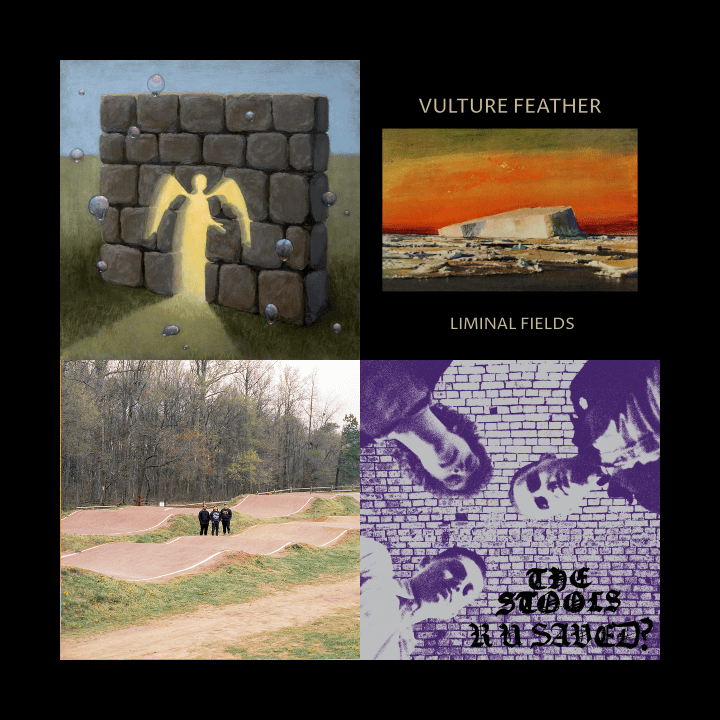
Vulture Feather – Liminal Fields
Release date: June 2nd Record label: Felte Genre: Post-punk, art rock Formats: Vinyl, digital Pull Track: Bell of Renewal
Wilderness were a Baltimore-based 2000s indie rock band who put out three albums on Jagjaguwar, recorded with Beauty Pill’s Chad Clark, and toured with Dan Friel’s pre-Upper Wilds band, Parts & Labor. All of that would suggest a band I would enjoy, but I never checked them out, and they seemed to disappear at the end of that decade. Fifteen years after their last album, however, half of Wilderness (guitarist Colin McCann and bassist Brian Gossman) have reemerged in the tiny northern California town of Hayfork, and along with drummer Eric Fiscus, have a new trio called Vulture Feather. From the bit of Wilderness I’ve now listened to, it sounds like McCann and Gossman have picked up where their last band left off, making a slow, deliberate, Lungfish-esque version of guitar-heavy post-punk.
While Liminal Fields, the debut Vulture Feather album, contains a bit of that 2000s indie rock bombast that aughts post-punkers like Wolf Parade practiced, the continued popularity of this kind of music into the 2010s and 2020s ensures that the band don’t sound dated–if anything, the zeitgeist has caught up to them. The primary difference is Vulture Feather’s lack of interest in speed or aggression–these songs move along at their own pace, feeling unhitched from any sense of time. The album is 38 minutes long, but you could’ve told me it was significantly shorter or longer and I’d probably have believed you. The rhythm section lumbers, McCann’s guitar chimes and drones, and his vocals sound focused but emotive, gamely supplying these eight songs with the final ingredient in turning a lot of them into unlikely anthems. (Bandcamp link)
The Stools – R U Saved?
Release date: June 2nd Record label: Feel It Genre: Garage punk, hardcore punk, blues punk Formats: Vinyl, digital Pull Track: Stare Scared
The Stools heard that you liked Detroit garage punk, and now they’re banging at your front door. Indeed, the press for R U Saved?, their debut album after a few EPs and singles, mentions a lot of Those names– MC5, Stooges, Gories (with whom The Stools are touring with later in the year)–but really, all you need to know about this music is that it’s loud, dirty, ripping garage punk. Okay, okay, one other Detroit band is worth mentioning here: Negative Approach. The Stools of R U Saved? (guitarist/vocalist Will Lorenz, bassist/vocalist Krystian Quint, drummer Charles Stahl) balance themselves between the version of punk rock that’s just mussed up rock-and-roll and the aggression of hardcore, and it’s a captivating place for them to be.
R U Saved? opens with the blues-y punk sprint of “Stare Scared”, and then The Stools follow it with a couple of songs that show off their fuzzy, frantic, hardcore side. The title track is a stomp, based around a massive riff and some chanted vocals that skulk around it, and the three-minute “Conner & Hell” takes the record into the direction of Cramps-esque strut-punk. “Into the Street” is a fun and incredibly cool-sounding tune that kicks off the second half of the album, letting you all know R U Saved? isn’t going to slow down any time soon. Highlights keep coming–the vintage punk rock of “Rum Runner”, the all-out “Bad Eye Bob”, and the cranked-up closing track “Tunnels” all stick out to me at this time. I’d open that door if I were you. (Bandcamp link)
Welcome to a rare Tuesday Pressing Concerns! Today, we’re rounding up new albums from PONY, Parister, Good Looking Son, and Kicking Bird. Also, if the website has looked weird for you lately, I’m sorry–Wordpress seems to have been having some major issues, and their support system has been quite unhelpful. I’ve done my best to at least make the front page navigable, but let me know if things still look too broken to use the website.
If you’re looking for more new music, you can visit the site directory to see what else we’ve written about lately. If you’d like to support Rosy Overdrive, you can share this (or another) post, or donate here.
PONY – Velveteen
Release date: May 19th Record label: Take This to Heart Genre: Power pop, pop punk, 90s alt-rock Formats: Vinyl, CD, digital Pull Track: Sick
There have been a lot of bands over the past decade or so that have used the more poppy, radio-friendly edge of alt-rock as a jumping off point for their music. It’s been arguably the dominant strain of “indie rock” since the excesses of blog rock died off in the early 2010s. One of those bands has been PONY, whose 2017 EP Do You I heard way back when and thought was pretty good, but whom I’d lost track of since then (Velveteen is their second album for Take This to Heart Records, actually). Honestly, I thought I got burnt out on this kind of music in recent years. Turns out that most people just aren’t stuffing it with enough hooks. Velveteen is a beast of a pop album, with PONY (singer/guitarist Sam Bielanski and multi-instrumentalist Matty Morand) wringing everything they can out of these ten songs, leaving nothing on the table.
Velveteen has an energy to it that I must compare to the pinnacle of the recent era of this genre, Charly Bliss’ Guppy. Bielanski is an excellent pop frontperson–they sound confident in every one of these songs, while still being able to sell the wide range of (frequently kind of rough) emotions these songs explore. The braintrust of Bielanski and Morand are a successful pair, as the duo (who play everything other than drums, handled by Josh Cassidy) give the tracks precisely what they need. Songs like “Peach” and “Sick” feel eternal–Bielanski takes a step back in the former to emphasize the aside nature of the lyrics, and they grab the mic aggressively in the latter to vividly try and wrest control of something (“Break my spine just to prove I have one,” that’ll stick with me). There are some other songs that deserve a specific mention (the churning grunge-pop of “Haunted House”, one last triumphant shit-kicking in closing track “Haircut”) but there’s not a dud on this one. (Bandcamp link)
Parister – Here’s What You Wonder
Release date: May 11th Record label: Candlepin Genre: Lo-fi indie rock, alt-country Formats: Cassette, digital Pull Track: Nutrition Facts
Parister is a three-piece band from Louisville, led by guitarist/vocalist Jake Tapley and rounded out by Matt Filip on bass and drummer Adam Dickison. Here’s What You Wonder is the band’s second album following 2021’s Please Take Back Your Seat, and their first for Candlepin Records. The humble presentation of Here’s What You Wonder’s songs, in addition to Parister’s not-infrequent use of 90s indie rock distortion, helps them fit in with other bands on their label, but there’s an obvious twang to Tapley’s songwriting that puts it more in line with the likes of MJ Lenderman and fellow Louisville band State Champion than anything else (this isn’t quite “country-gaze”, but if that term intrigues you, you’d probably like this album).
Here’s What You Wonder is a generous album, with its thirteen songs all feeling full and complete, unfolding with Tapley’s unassuming but steady vocals guiding them, and the band sounding as polished or as loud as any one track requires. Parister pull off twinkling, jangly power pop in “Nutrition Facts”, downcast but uptempo country rock in “Opening Day”, fuzzy garage-barn rockers with “Bookmark” and “Pullover”, and restraint in “You Are the Paywall” and the two-minute epic “Crutch”. As a writer, Tapley practices less-is-more in the relatively straightforward lyrics to “Pet Sounds II” and “Bookmark”, but also can’t resist a Lenderman-esque odd metaphor here and there (the PEZ dispenser in “E-Z-P-E-Z”, the bag of chips in “Nutrition Facts”, “You are the paywall I deserve”). At the end of this strong collection of songs, Tapley sings about “slicing up a sizzle reel” over blaring guitars, inadvertently summing up Here’s What You Wonder quite nicely. (Bandcamp link)
Good Looking Son – Confirmed Bachelor
Release date: May 26th Record label: Feel It Genre: Piano rock, power pop, singer-songwriter Formats: Vinyl, digital Pull Track: Glitter Everywhere
As the lead singer of Bloomington, Indiana garage-rock-power-poppers The Cowboys, Keith Harman helms one of Feel It Records’ flagship bands. Harman’s piano playing and classic pop sensibilities helped shade The Cowboys’ intriguing flavor of rock and roll, and now he’s made an album as Good Looking Son that embraces these parts of his songwriting. Confirmed Bachelor follows 2021’s Fantasy Weekend EP, and this LP is a positively jaunty-sounding collection of spirited piano-led pop rock that still shows a bit of Harman’s other band (but without going out of the way to pay lip service to garage rock). Good Looking Son is a four-piece band (also featuring Jerome Westerkamp and John Clooney of Vacation, and Andrew Jody of Barrence Whitfield & the Savages), and the group of musicians punch up these pop songs without overwhelming them.
Confirmed Bachelor opens with something of a hybrid in the mid-tempo guitar pop of “Lovely Land of Massacre”, but Good Looking Son don’t hide their baroque sixties piano-pop side early on: “Forty Night Stand” and (especially) “*Glasses Clink, Men Laugh*” and “The Soft Open for the Cabaret” mark the album’s first half. While the latter features a mesmerizing guitar solo, it’s a piano-led song and no worse the wear for it. Good Looking Son show off their pop skills in the second half with the sugary circus-tent energy of “Glitter Everywhere” and the bouncy “The Unicorn”, refusing to run out of steam. The more garage rock-based songs on the album (“Lord Demon’s Delight”, “Long Form Girlfriend”, a sharp cover of the Bee Gees’ “I Don’t Think It’s Funny”) don’t feel out of place because they’re hook-fests as well. The Good Looking Son of Confirmed Bachelor follows Harman wherever he goes, and it’s all the better for it. (Bandcamp link)
Kicking Bird – Original Motion Picture Soundtrack
Release date: May 19th Record label: Fort Lowell Genre: Pop rock, power pop, indie pop Formats: Vinyl, digital Pull Track: Talking to Girls (On the Internet)
While I’ve written about plenty of East Coast bands in Pressing Concerns before, Wilmington, North Carolina’s Kicking Bird hail from a part of the Atlantic shoreline I believe I’ve yet to touch on. Released on local label Fort Lowell, Original Motion Picture Soundtrack is the five-piece band’s full-length debut, following a handful of singles and an EP in 2021. The first Kicking Bird album is a big old guitar pop record, an overstuffed collection of songs that feature three different vocalists (guitarist/bassists Shaun Paul and Tom Michels and keyboardist Shaylah Paul) and makes itself home in the world of vintage college rock, jangle pop, power pop, and wide-eyed indie rock.
Original Motion Picture Soundtrack knows how to make a good first impression–the roaring “Names Are Changing”, the smooth and persistent “Lauren”, and breezy surf-garage-pop of “Talking to Girls (On the Internet)” are all Pixies-as-straight-power-popper classics. The opening trio is hard to beat, but Kicking Bird toss out more rock-solid pop rock throughout the rest of the album– “Stuck” anchors the midsection of Original Motion Picture Soundtrack quite gamely, “238” chugs and handclaps its way into the heads of anyone who would hear it, and the fluffy “Rip Off” closes things out with a track that really underlines Kicking Bird’s 60s girl-group influences. It’s a commendable, hot-out-of-the-gate debut from a quite likable band. (Bandcamp link)
Welcome to Pressing Concerns! Today’s issue features four albums that come out tomorrow: new ones from Westelaken, Ben & Keely, Miranda and the Beat, and Soft Idiot. Earlier in the week, I wrote about new albums from Gnawing, Brewster, Sumos, and GracieHorse–check that one out too.
If you’re looking for more new music, you can visit the site directory to see what else we’ve written about lately. If you’d like to support Rosy Overdrive, you can share this (or another) post, or donate here.
Westelaken – I Am Steaming Mushrooms
Release date: May 26th Record label: Self-released Genre: Folk rock, alt-country, slowcore Formats: CD, cassette, digital Pull Track: Fixed Up by Orange Light
Toronto country group Westelaken shuffled onto the scene in 2018 with their self-titled debut album, which they followed up in 2020 with their second record The Golden Days Are Hard. The sophomore album found the band (led by singer-songwriter-guitarist Jordan Seccareccia and also featuring bassist Alex Baigent, drummer Rob McLay, and keyboardist Lucas Temor) stretching out their songs a bit, something that also clearly marks I Am Steaming Mushrooms, the quartet’s third record. However, their previous album’s frequently chaotic and noisy country rock is not the dominant mode here–over eight songs and one hour, Westelaken allow silence, empty space, slowed tempos, and overall subtlety to populate their new recordings. Throughout the record, Westelaken explore cavernous, percussion-led slowcore, ghostly, minimal folk songs, probing jam sessions, and, yes, still some moments of explosive folk rock.
I Am Steaming Mushrooms begins with summiting the thirteen-minute peak of “Ozzy’s Palace”, a breathtaking and meandering trek whose piano and “rock band instruments” rise and fall several times, reminding me a bit of earlier Okkervil River or some of Simon Joyner’s more expansive moments. Westelaken blow their songs up to similarly long lengths a few more times on the record, each time sounding like themselves but showing off a different side–the eight-minute “Annex Clinic & Pharmacy” is a sparkling, piano-heavy piece of (rough around the edges) chamber rock, while the ten-minute “Fossilhead” is a somewhat droning piece of fuzzy folk rock that appeals to the Microphones/Neutral Milk Hotel/Jordaan Mason part of their sound. These widescreen tracks anchor I Am Steaming Mushrooms, but the songs that connect them to each other–particularly the beautiful folk of “Pear Tree”, the swinging Canadiana of piano rocker “Fixed Up by Orange Light”, and the skeletal “Ribcage”–are anything but mere interludes. The sequencing of these tracks–varying in size and appearance but in conversation with another–helps I Am Steaming Mushrooms feel like a living, breathing ecosystem of an album. (Bandcamp link)
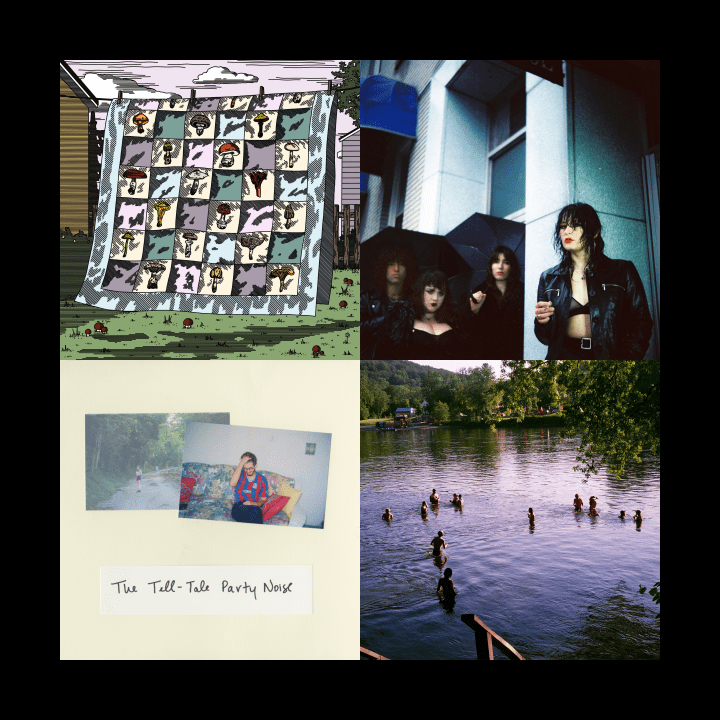
Ben & Keely – The Tell-Tale Party Noise
Release date: May 26th Record label: Count Your Lucky Stars Genre: Slowcore Formats: Cassette, digital Pull Track: Fine
A couple of years ago, I wrote about Ways of Hearing, the debut record from Philadelphia slowcore band The Goalie’s Anxiety at the Penalty Kick. That group is led by two-singer-songwriters, one of which is Ben Curttright, who recently moved across the country to Omaha along with Keely McAveney, and the two of them commemorated this major life change by making an album together. For those of you familiar with the Goalie’s Anxiety at the Penalty Kick record, you will probably not be surprised to hear that The Tell-Tale Party Noise (featuring McAveney on harp and vocals and Curttright on all other instruments and also vocals) explores the kind of heartbreaking, acoustic guitar-and-piano-heavy slowcore favored by Curttright’s other band. Unlike the six-piece The Goalie’s Anxiety at the Penalty Kick, however, The Tell-Tale Party Noise is by necessity more minimal of an endeavor–often there’s little more accompanying the vocals than the acoustic guitar or piano, and the percussion is programmed, if it’s there at all.
The Tell-Tale Party Noise starts off on a fittingly quiet note, with Curttright whispering through the acoustic strumming and keyboard accents that populate opening track “Fine”. Curttright and McAveney’s vocals then intertwine in a couple of songs that up the scale a little bit (“Old” and “Hail Song”). While they don’t exactly built to post-rock crescendoes, the two frequently sing over each other in what becomes Ben & Keely’s “dramatic” mode. The Tell-Tale Party Noise keeps things humble throughout–“Toaster” is mostly some acoustic picking with mumbled vocals, a song featuring a drum loop prominently is titled “Loop”, and the forty-second “Recluse” has two lines (“If I was a recluse, I never would have met you / And we would’ve never fallen in love”). Songs like “Gun” and “Union of One” stretch out to five minutes, taking Ben & Keely’s basic ingredients and making some fairly grand statements–the album’s relative simplicity is far from limiting. (Bandcamp link)
Miranda and the Beat – Miranda and the Beat
Release date: May 26th Record label: Ernest Jenning Record Co./Khannibalism Genre: Garage rock, psych rock, soul Formats: Vinyl, digital Pull Track: Concrete
Although Miranda and the Beat have roots in southern California (and currently reside in New York), the four-piece band trade heavily in a specific and welcome brand of Motor City garage-soul-punk. For one, they’ve got a Farfisa player in the band (Dylan Fernandez, who rounds out the quartet along with bassist Alvin Jackson and founding duo Miranda Zipse and Kim Sollecito), and they’ve also put out a single on Third Man Records. They’ve toured extensively with The King Khan and BBQ Show, and Khan’s label is co-releasing their debut record along with Ernest Jenning Record Co. (Beauty Pill, Pigeon Pit, Blunt Bangs). That’s all well and good, but, more importantly–do the songs on the self-titled, Nick Zinner-produced Miranda and the Beat album hold up on their own? Decidedly yes–it’s a spirited and varied collection of rock and roll music that pulls from several decades and sounds like the work of people quite inspired and excited by it.
Miranda and the Beat opens in the middle of a hell of a groove with “Sweat”, a mid-tempo workout that pretty much immediately lets us know we’re not dealing with some one-gear garage punks here. Songs like “Out of My Head” and “I’m Not Your Baby” are sharp, timeless pop rock songs that are in the same vein as contemporary bands like Sheer Mag and Romero, although Miranda and the Beat have perhaps a more traditionalist streak in their interpretation of this kind of music. This isn’t Miranda and the Beat’s only mode, however, as the ripping new wave-y rocker “Concrete” and the forty second punk rock of “ODR” demonstrate. The fact that the band can actually let loose, as those songs demonstrate, makes their restraint and discipline in delivering the rest of the record more impressive. (Bandcamp link)
Soft Idiot – Some Captured Light
Release date: May 26th Record label: Oliver Glenn/Cicada Choir Genre: Folk rock, indie folk Formats: Cassette, digital Pull Track: Songbird
Justin Roth is a Philadelphia-based folk rock musician who has been making music under the name Soft Idiot since the mid-2010s. Like most of his music, the latest Soft Idiot album, Some Captured Light, was self-recorded largely by Roth alone (with a couple instrumental credits from live band member Mike Whalen, and co-writing credits by Whalen, Rob Blackwell, Eric O’Neill, and David Solomon on “I Can’t Make It Make Sense”). Soft Idiot had been putting out records regularly up until 2021’s Younger Moments, at which point Roth found himself disillusioned with making music (the Bandcamp description for that album refers to it as “the final soft idiot record”), but with Some Captured Light, a record full of “songs about birds and mammals mostly”, Soft Idiot is reinvigorated and exploratory again.
Some Captured Light is clearly the work of someone who’s a fan of plenty of folk-tinged indie rock, and while I can hear bits and pieces of Roth’s influences in these songs (Magnolia Electric Co. but less sprawling, Neutral Milk Hotel but calmer, Peaer but more acoustic), the album builds its own leisurely style out across these eleven songs. Soft Idiot bounce through some full-sounding but concise folk rock in “Owl” and “I Can’t Make It Make Sense”, although the mid-section of Some Captured Light is where Roth really makes his mark. The floating “Captured Light I” and the bare strumming of “My Head Became a Pool” both distill Roth’s songwriting down to its finest points, and right in between the two of them is the nine-minute “Songbird, Pt. 2”, which towers quite nicely (and “Songbird”, which follows this trio, is an equally-rewarding piece of three-minute fuzz-folk). The whole thing is sturdy and welcoming. (Bandcamp link)
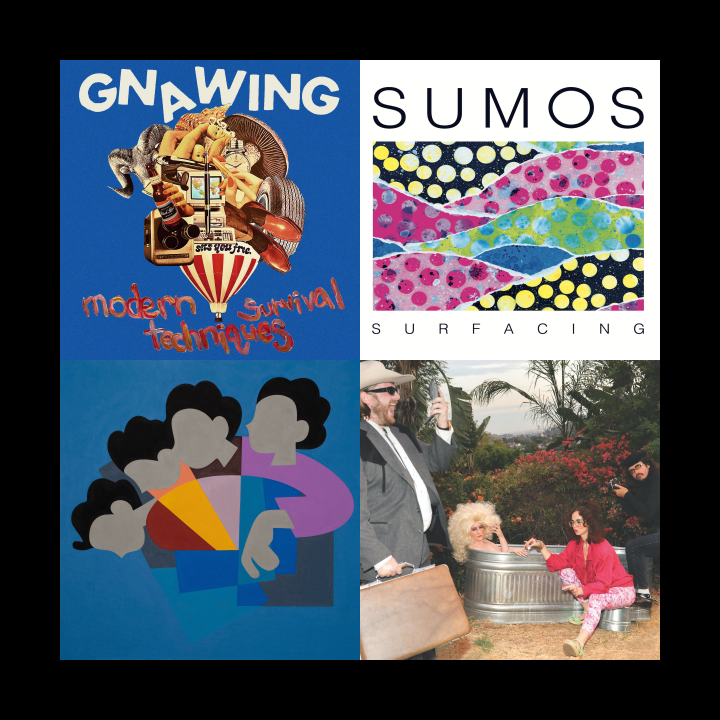
It’s Monday! We’ve got four great new albums to wake you up in Pressing Concerns! New ones from Gnawing, Brewster, Sumos, and GracieHorse grace Rosy Overdrive today.
If you’re looking for more new music, you can visit the site directory to see what else we’ve written about lately. If you’d like to support Rosy Overdrive, you can share this (or another) post, or donate here.
Gnawing – Modern Survival Techniques
Release date: May 12th Record label: Refresh Genre: Alt-rock, 90s indie rock, fuzz rock, punk Formats: Vinyl, digital Pull Track: Gimme Tinnitus
Back in 2021, I wrote about You Freak Me Out, the debut album from Richmond 90s indie rock revivalists Gnawing. It was an intriguing record of Dinosaur Jr./early Nirvana-inspired fuzz rock with more than a bit of alt-country influence peeking out through the racket, all held together by the songwriting of John Russell. Since then, Gnawing have put out a live album, the one-off “Germs Burn” single, contributed a track to the Rock Against Bush split EP–and now the band has released their follow-up to You Freak Me Out, this month’s Modern Survival Techniques. If the tuneful noisiness of Gnawing’s first album appealed to you, their second one retains the same basic formula, although the band sounds a little more laid-back here–the fuzz is still present, to be sure, but Russell and his band (Christian Monroe, Garrett Whitlow, and Chris Matz) are content to let the songs shine through it more frequently, letting the writing take a bit more of a central role.
Gnawing kick things off with “Off Screen Death”, a song that certainly retains the band’s underground punk edge but presents it in just a slightly more clear package. Gnawing up the electricity on single “Gimme Tinnitus”, which contains a monster chorus and is perhaps the band’s most obvious “anthem” yet, and on “Clean Up Your Act”, which leans into the “slacker” band’s anxious and nervous side (it’s no accident that it gets a hardcore “redux” towards the record’s end). Russell delivers the “I need you to bulldoze me” line in “Bulldoze Me” in a surprisingly understated manner, but it works for the effortless-sounding fuzz-pop song, and “I Saw a Ghost” is a delicate guitar pop tune to which Gnawing give one of the most distorted treatments on the album. “Cool/Uncool” is Modern Survival Techniques‘ ballad–in context, it’s an incredibly weary-sounding and much-needed breather before the band sends everyone off with “Amherst Jam”, a seven-minute exploration that displays a new side to the group. (Bandcamp link)
Brewster – Honey Shake Me
Release date: April 7th Record label: Fort Blanket Genre: Alt-country Formats: Digital Pull Track: Best Western
Brewster are an alt-country-indie rock band from New Jersey led by singer-songwriter Mark Bucci. The band was initially Bucci’s solo project, but it has expanded considerably for Honey Shake Me, the second Brewster album. The spirited version of Brewster assembled for the recording of Honey Shake Me (Bucci accompanied by drummer Tom Devinko, pianist Chuck Bucci, pedal steel guitarist Tim Kelly, and lead guitarist Phelan Tupik) certainly adds a lot to the record’s songs. Bucci comes off as a very specific type of passionate music nerd in his writing, standing at the center of alt-country/“heartland rock”, power pop, and sincere indie rock in a way that is reminiscent of his East Coast peers in The Tisburys, Labrador, and The Human Fly, and reflects his influences like John K. Samson (who the band shout out in the description for the album) and Wilco (who Bucci explicitly references in “No One Told Us the Secret Yet”).
The sharp, sweeping twang-rock of “Me and My Somersaults” takes Bucci’s understated-feeling songwriting to a grand place to kick off Honey Shake Me, and Brewster transition to something a bit more subtle deftly with the Fender Rhodes-and-pedal-steel-led “No One Told Us the Secret Yet”. Brewster can offer up gently rolling dreamy-country tunes like “Red River Drive” and “Countryside”, but like a lot of the album’s subject matter, the band feels like they’re constantly traveling and moving–soon, they’re on to the emotive country rock of “Best Western”, or the gently but confident singalong of “Bound to See Headlights”. This type of music can have a tendency to fade into the background over time, but Brewster save some of Honey Shake Me’s best moments for the ending–namely, the upbeat rock and roll of “You Got to Give It When You Got It” and final track “An Easy Love to Leave”, which lingers on a couple memorable images before closing the book on Honey Shake Me. (Bandcamp link)
Sumos – Surfacing
Release date: May 12th Record label: Meritorio/Safe Suburban Home Genre: Indie pop, power pop, jangle pop Formats: Vinyl, digital Pull Track: Small Talk
Manchester’s Sumos have been around since their debut EP, Weird Summer, came out in 2020, but this month’s Surfacing is their first full-length album. They’re a four-piece group by now, evolving from the initial singer-songwriter-guitarist duo of Joel Sloan and Kyle Tarbuck to include rhythm section Siobhán Tarbuck (bass) and Andy Kilroy (drums). Accordingly, Surfacing is a pop album that sounds like it was recorded with a full band, with Sumos giving these nine songs an extra “kick” to them that serves the bucket of hooks they possess quite well. It’s a quite polished album, presenting pristine indie pop in both a clean-cut jangly college rock package as well as in some busier, surprisingly intricate forms.
The jangly “Small Talk” was the single that caught my attention initially, and the shimmery guitar lines and Sloan’s melodic vocals still make that song stand as an excellent achievement in guitar pop. The first half of Surfacing is full of strong pop songs that reach the same level of that track, from the gauntlet-throwing opener “Finding a Way” to the exuberant “Enemies” to ever-so-slightly melancholic “Blood Blisters”. The acoustic folk-pop of “Mostly Harmless” is a really big left-turn in the album’s center, and the almost-shoegaze noise-pop of “The Other One” a couple of songs later displays the other end of Sumos’ range. Both of those songs are still quite catchy, however, and they’re also buffered by two more “traditional” indie pop offerings from the band (“Come On Over” and “Quiet Place”). Under half an hour, Surfacing still covers plenty of ground. (Bandcamp link)
GracieHorse – L.A. Shit
Release date: May 19th Record label: Wharf Cat Genre: Alt-country, country rock Formats: Vinyl, CD, digital Pull Track: Hollow Head
GracieHorse released an album under the name Gracie back in 2015, and she was also half of the Boston indie rock duo Fat Creeps for a good portion of the last decade. Now based in Los Angeles, Gracie Jackson has added a “Horse” to her stage name, embraced a rich country rock sound, signed to Wharf Cat Records, and made her first album in quite some time with the appropriately-titled L.A. Shit. GracieHorse enlisted a bunch of Southern California ringers to bring this album’s nine songs to life, including members of Ty Segall, Bonnie “Prince” Billy, and King Tuff’s bands, and the result is a record that’s full-sounding and laid-back, working well with GracieHorse’s songwriting.
As it’s been almost a decade since the Gracie album, it’s not too surprising to learn that some of the songs on L.A. Shit are fairly old. Nonetheless, GracieHorse and her band walk the tightrope of making these songs fit together without them blurring together quite nicely. The first half of L.A. Shit is an impressively varied collection of country-infused rock music, from the casual, windows-open first track “Hollow Head” to the sleek cowpunk of “By the Light of His White Stetson” to the polished balladry of “What I’m Missing” to the echoing folk of “Northwind”. Although L.A. Shit’s Side A is very well-executed, the album’s second half holds up pretty well on its own–my favorite from the flipside is closing track “Words of the New West”, the galloping closing track that acknowledges GracieHorse’s new West Coast home but, tellingly, still sounds like the writing of an outside observer rather than someone fully assimilated into it. (Bandcamp link)
Welcome to the Thursday edition of Pressing Concerns! Today we’ve got four brand new records to talk about: albums from Leor Miller’s Fear of Her Own Desire, Low Praise, and Dan Lurie, and an EP from Charles the Obtuse. It’s been a busy week on Rosy Overdrive: on Monday, we looked at new albums from Daisies and The Ashenden Papers as well as reissues from Heavenly and Pigeon Pit, and on Wednesday I shared my thoughts on a bunch of albums from 1981 that I listed to for the first time ever last month.
If you’re looking for more new music, you can visit the site directory to see what else we’ve written about lately. If you’d like to support Rosy Overdrive, you can share this (or another) post, or donate here.
Leor Miller’s Fear of Her Own Desire – Eternal Bliss Now!
Release date: May 19th Record label: Candlepin Genre: Experimental pop, lo-fi indie rock, dream pop Formats: Cassette, digital Pull Track: We Don’t Fuck
I’ve written a lot about Candlepin Records on this blog over the past year, as the cassette label has put out a lotof greatcontemporary 90sindie rock-inspired music as of late. Their latest release is maybe the most adventurous one I’ve heard yet from them. Leor Miller is a New York-based singer-songwriter who’s been making noisy, hazy rock music on her own for several years now–there’s a ton of EPs and albums on her Bandcamp page dating back a decade. Eternal Bliss Now! is mostly a guitar-based album, but it’s not one that lives entirely in the world of indie rock. I can hear how Miller has been inspired by non-rock genres (hip hop, electronica, and hyperpop, per her bio) in presenting these songs, even as she approaches them from an indie rock perspective.
“Crown of Thorns / Cacophony of Birds” opens Eternal Bliss Now! with one of the most electronic moments, a blaring piece of psychedelic synthpop that nevertheless features Miller’s surreal words front and center. Single “We Don’t Fuck” follows it up with an eerie, frayed take on bedroom rock (it feels wrong to call a song that opens with “We don’t fuck / But I give birth to myself in your truck” a pop song, but that’s what it is). Miller explores some lo-fi indie rock in the middle of the record with the slowcore-ish “Shrieking Matter” and the wobbly “Marijuana Goldmine”. “Sunrise” is the song that rivals the album opener in its use of electronic elements–Miller’s AutoTuned vocals and piano-synths place this somewhere between today’s pop music and that of the 1980s.
It’s towards the end of Eternal Bliss Now! that I think Miller really hones in on what the record’s title is doing (and it seems, at this moment, that it’s also key to note that her moniker is “Leor Miller’s Fear of Her Own Desire”). “I Don’t Wanna” is the album’s quiet, acoustic sort-of-title track, and the way Miller lets the song float on for five minutes really allows the unapologetic nature of her simple realizations be understood. The song begins with Miller discussing what she wants and doesn’t want for herself (like the line that gives the album its title), and she ends by landing on “We need freedom”. Miller closes the album by continuing this thread on “Become One”, a song that encourages, and in fact argues for the necessity of, probing beyond one’s self in order to realize one’s self. “You and I are gonna find the truth / One day you and I’ll become one from two”. (Bandcamp link)
Charles the Obtuse – Charles the Obtuse
Release date: May 15th Record label: Self-released Genre: Synthpop, indie pop Formats: Digital Pull Track: I’m Glad He’s Dead
Charles the Obtuse is Charlie Wilmoth, the West Virginia-originating, Los Angeles-based professional gambler whom Rosy Overdrive’s readers will know from his work with power pop group FOX Japan and synthpop duo Oblivz. The five song Charles the Obtuse EP is his first work as a solo artist, and his first entirely electronic project. It picks up the more synth-based thread that Wilmoth had been exploring on his last two records (Oblivz’s Uplifts and Managers EPs), but he doesn’t have guitarist Andrew Slater to lean on here. Charles the Obtuse’s songs are brief (they range from about one-and-a-half to two-and-a-half minutes), and Wilmoth’s stated influence of The Magnetic Fields’ The Wayward Bus is borne out here–these are not dense psychedelic soundscapes so much as discreet synth-based pop songs that get busy, but not overwhelmingly so.
Wilmoth may be experimenting with the instrumental side of his songwriting, but Charles the Obtuse’s songs are packed with plenty of lyrical subjects and themes that will be familiar to longtime listeners–soulless capitalism, suburban decay, paranoia, and at least one potential horror movie plot. “Gated Community” is a Wilmoth all-timer, the narrator observing a ritual sacrifice while mainly feeling glad that it’s not his lawn that’s getting messed up (“What happens in our gated community / Stays inside our gated community”), and the way-too-catchy “James from the Suburbs” is a slightly-more-direct excoriation of a Type of Guy who holds all the power and capital in the world and still finds a way to whine about it (the last non-chorus line, which I’m absolutely not going to quote here, is my favorite one).
The always-moving scammers in “Better Come Up” are served well by that instant, over- the-top synth explosion in the chorus, while the curious, drum machine-pounding “Feeling My Way Around” is the one song where Wilmoth hints at what a Charles the Obtuse record that wasn’t as intently focused on being immediate might sound like. Still, the EP ends on one last killer pop song, the impossibly cheery “I’m Glad He’s Dead”, which has lived in my head rent-free ever since I first heard it. Wilmoth ends Charles the Obtuse by explicitly encouraging the listener to cheer, celebrate, and toast the death of some asshole (deliberately kept vague, so you can break this one out on any number of occasions). It’s both a good argument and a good soundtrack for such a party. (Bandcamp link)
Low Praise – Dressing
Release date: May 19th Record label: Medium Friends Genre: Post-punk Formats: Vinyl, digital Pull Track: Forget That It’s Summer
Low Praise are an Oakland-based post-punk trio made up of guitarist/vocalist Chris Stevens, baritone guitarist/vocalist Warren Woodward, and drummer Andrew Marcogliese. The band released a couple of EPs in the late 2010s, but Dressing is their COVID-delayed full-length debut album, and what they’ve finally put out is a lean piece of post-punk-influenced rock music that flexes its power trio muscle. Dressing has a garage band energy, and it doesn’t fall cleanly into the “Devo-core/egg punk” or “low-voiced guy with brute force backing music” camps that mark most modern post-punk groups. Dressing is pleasingly varied, jumping from downcast 90s indie rock-sounding moments to perky, locked-in dance punk, but the band don’t lose their energy throughout the album.
Dressing kicks things off with the rhythmic “Forget That It’s Summer”, a rhythmic, hypnotic, and inspired piece of post-punk that sets a high opening bar. Although Low Praise don’t revert to dance-punk that cleanly again on the record, it informs some of the other tracks, like the glam-flavored “Supermind” or the nervous-sounding closing track “Entertainment”. Elsewhere on the album, Low Praise show off their garage rock side, like in the roaring “Gate”, and the mid-tempo “Angela” is probably what their idea of pop music is. Some of Dressing’s best moments come in some of the less immediate songs, like “Time Is Calling” and “No Way”, which are really just some rock-solid indie rock guitar jams. These songs don’t go out of their way to be accessible, but Low Praise do have a way of wringing melody out of what they’re playing. (Bandcamp link)
Dan Lurie – Making Life Worthwhile
Release date: May 16th Record label: Literal Gold Genre: Folk rock, lo-fi indie rock, psychedelic pop Formats: Vinyl, digital Pull Track: New Order of Living
Dan Lurie is a Minneapolis-originating, Portland-based singer-songwriter who’s been making home-recorded solo albums for over a decade now. Making Life Worthwhile, his latest record, is his first made in a recording studio and with an outside producer–Cameron Spies (The Shivas, Reptaliens), who also contributed synths and bass guitar to the album. Making Life Worthwhile sounds like a record really made in the studio–Lurie’s background is as a folk-influenced bedroom rocker, and that sound is present on the album, but the record also incorporates lush, vintage pop rock and even some 80s synth-led pop music.
Making Life Worthwhile starts off brilliantly with a slow-building, bubbling synth-aided indie rock anthem in “Applying the Rule of Reason”, which sets the scope for the record. The excited, bursting earnestness of “New Order of Living” continues the album’s hot opening and also features an infectious refrain. “Feeding the Intellect” is the first big left-turn moment on Making Life Worthwhile with its grooving bassline, slick delivery from Lurie, and some well-placed synth accents. On floating pop songs like “Regeneration” and “Little Grains of Sand”, Spies’ arrangements are on full display, adding several more dimensions to Lurie’s songwriting. Spies’ assistance also enables some of the weirdest moments on Making Life Worthwhile–the oddball studio pop of “Superior Superiority Super” and the synth-funk of “Exalting the Ego”. Lurie has put together a record that skillfully avoids any dull moments. (Bandcamp link)
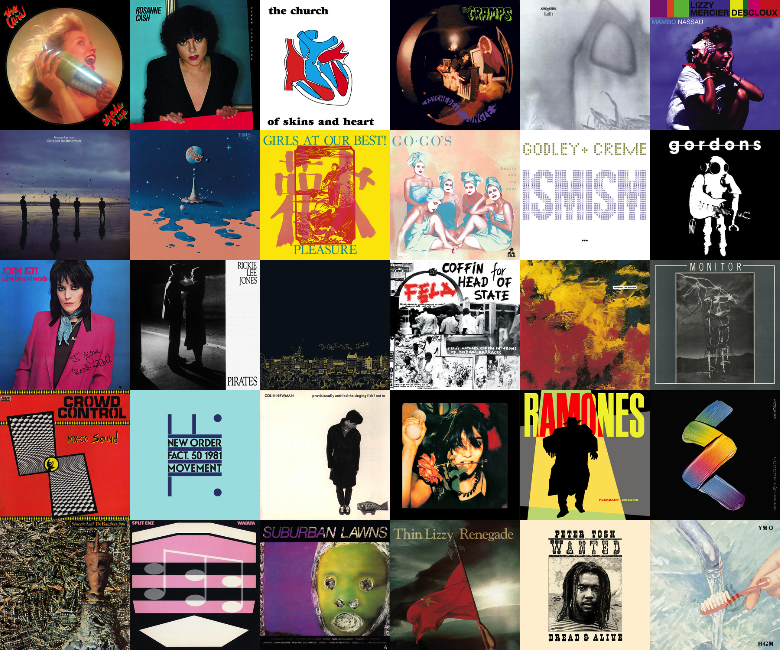
Back in January, I listened to one new-to-me album from 1997 every day for the entire month, and posted a few sentences about each one in the Rosy Overdrive Discord channel. When I was done, I cleaned it up a bit and put it on the blog, with a mention that I was planning on doing a different year soon. I ended up doing 1981, and, partially because I’m significantly less familiar with the 1980s than I am the 1990s, this one has gone on even longer than my 1997 project. So, I’m splitting it up into two parts, with part one going up today, and the second part (which is still in progress and you can see early if you join the Discord channel) going up probably next month (edit: view part two here).
Keep in mind, these records are all ones that I’d never listened to in full before. There are plenty of great albums from 1981 (Solid Gold, Stands for Decibels, Re*ac*tor, Black Snake Diamond Role, Youth of America, Odyshape, and at least a dozen more) I already know and love and thus do not appear here.
Bandcamp embeds are provided when available, but most of these albums aren’t on there, so I’ve created a playlist (Spotify, Tidal) of a song from each one of these records you can use to listen along if you’re so inclined. So, without any more ramblings from me, let us dive deeply into music from over four decades ago.
March 25th: The Gordons – The Gordons (self-released)
So this is the New Zealand band that eventually became noise pop/shoegaze group Bailter Space at the end of the decade. Given some of the other underground NZ music I’d heard from this time, I thought this might be some really ramshackle noise, but it’s actually relatively clear-sounding (if lo-fi and somewhat meandering) post-punk. Not going to get mistaken for Joy Division or The Cure audio quality-wise, sure, but it’s closer to that world than, say, the Dead C. There are some instrumental rave-ups here that prefigure Sonic Youth, wonder if Thurston Lee and Kim were listening. They save the real chaotic, almost Birthday Party kind of stuff for “Laughing Now” at the end. Really solid record, sounds better today than a lot of the “big stuff”.
March 26th: Siouxsie and the Banshees – Juju (Polydor)
This is a very good album. I don’t wanna say that you don’t hear music like this any more because that’s obviously not true, but it’s instructive in how it pulls together different kinds of rock music from around the time. Siouxise and the Banshees were “goth” and rightly described as so, but “Spellbound” is equally jangly proto-college rock. “Monitor” is, like, jammy swirling psych rock. “Sin in My Heart” goes harder than pretty much anything any contemporary punk group was doing. The rhythm section gets a post-punk workout throughout but they get mileage out of all kinds of guitar textures and styles as well. It all coheres, and it’s just more fun to listen to something like this than a “post-punk” band that’s just a Fall/Joy Division clone or an “indie pop” band that’s just recreating the Smiths or whoever.
March 27th: Thin Lizzy – Renegade (Vertigo)
Going to try to spread all these post-punk records out a bit, so we’re listening to Thin Lizzy today. Lizzy had a full-time keyboard player at this point in their career which is…not a great sign for them, and the record kicks off with a big old synth—but this turns out to be something of a fake-out. For the most part, this sounds like a 70s Thin Lizzy album. “Angel of Death” is one of the wildest Thin Lizzy songs I’ve heard—the rest of the album doesn’t go that hard but it’s a lot stronger and more consistent than most bands would be on their eleventh album. Other than “Angel of Death”, this feels like a record of album-track-quality Thin Lizzy songs (which is certainly fine, since their vintage album tracks are great). It does lose a little bit towards the end (“Fats” is boring and let’s just gloss over “Mexican Blood”) but “It’s Getting Dangerous” is a solid send-off.
March 28th: Josef K – The Only Fun in Town (Postcard)
A British post-punk record that’s highly acclaimed and I’ve always meant to check out but never got around to (get ready for a lot of albums that match this description to some degree). Josef K were a band, not a guy (named after a Kafka character apparently), this was the only album they released during their three years as an active band. It’s on the agitated and caffeinated end of post-punk, but not smooth in a Gang of Four way, much more shambolic (both have great bass work, though). Over in under 30 minutes. Everything feels a little off musically, especially on the fast ones, but even the “hits” are like interestingly disjointed. Certainly feels like it was destined to wind up in the “cult undercard” part of this whole movement.
March 29th: Minutemen – The Punch Line (SST)
The first Minutemen album, which I’ve never heard despite liking the two biggest albums and most of the EPs/Post-Mersh stuff I’ve heard. It’s certainly no Double Nickels, it’s not What Makes a Man Start Fires, but that has to do with its brief length as much as anything else. If you thought their other albums had short songs, how’s 18 in 15 minutes? It’s also just not as refined as where they’d end up-they were definitely already weirdos, but they’re still holding onto a lot of the hardcore punk aggression that they’d mostly shed on their best work. This is maybe their darkest album, although it’s not completely black. D. Boon only has time to deliver a couple of lines in most of these songs, but songs like “History Lesson” and the title song are arguably enhanced by this. Also, RIP Spot
March 30th: The Church – Of Skins and Heart (Parlophone)
It’s pretty cool that I get to do one of these for a band whose new music I’d write about forty-plus years later on the blog. Anyway, Of Skins and Heart was the debut Church album, and it’s pretty far away from the dense psych rock that The Church are making now—it’s an incredibly shiny, friendly guitar-forward new wave/post-punk album. Choppy power chords, big choruses, a bit of a New Romantic attitude. They’d have to mellow out a bit to become the US college rock staples they’d be later this decade, but they were already ace pop songwriters, and stuff like the jangly “Bel-Air” shows off just a little bit of subtlety. The darker second half of the album hints at what depths The Church were capable of exploring, but the massive pop of the opening three tracks mostly set the tone for this album as a whole.
March 31st: Rosanne Cash – Seven Year Ache (Columbia)
And…now for something completely different! Funny how a lot of modern “alt-country” kind of sounds like mainstream country from forty years ago. At least (given that I’m hardly an expert on the subject), it sounds kind of like this album. Texas country rock ringer Rodney Crowell produced and contributed musically to this album, which I imagine helped shape this record’s rock edges (check opening track “Rainin’”, for one). It’s a bit all over the place, and it’s not just “the rockier ones are my favorites”—the title track and “Only Human” are both really nice mid-tempo piano pop, while on the other hand “What Kinda Girl?” is just….yeah, I have no idea what to say about that one.
April 1st: The Cure – Faith (Fiction)
Here were are on the silliest of days, listening to the most serious of albums. I’ve liked a Cure song here and there, but this is perhaps my most prolonged exposure, diving headfirst into what seems like one of the most Cure-y albums to ever Cure. I’m not going to try to wring fantastical takes out of every one of these for the sake of being fantastical; this is just to say—I thought this album was pretty fine. It’s about what I expected an early 80s Cure album to sound like. It’s definitely “good”, although I didn’t really connect with it in a major life-changing way. I feel like it deserves more listens at some point; I may just need to be more in the “Cure mindset” to be fully on board with it. Still, even if it’s just “above average dour 80s post-punk album” to me that’s nothing to dismiss.
April 2nd: Girls at Our Best! – Pleasure (Happy Birthday)
Flash-in-the-pan British indie pop (with power but not “power pop”) group—lasted long enough for a handful of singles and this, their only album. The punk/post-punk of the era are there, absolutely, but this is a pretty timeless-sounding record, which is nice to hear amidst the (still mostly good) music I’ve been listening to that sounds very ‘81. Extroverted, right-up-in-there record—it’s got a never-flagging pop energy but the impressive rhythm section that stands up against more “serious” bands of the time. A bit frontloaded (those first four songs are a high bar, sure), but there are highlights all the way through (“Fast Boyfriends” is one of their best). Definitely an undersung group/album—h/t Dan Gorman of The Discover Tab for putting this one on my radar.
April 3rd: MX-80 Sound – Crowd Control (Ralph)
So I’ve heard MX-80’s 1980 album Out of the Tunnel and it’s great—weirdo “art” punk album that prefigured a ton of stuff that was to come on SST/Touch and Go/Dischord etc. Crowd Control is the second half of this, and it kind of follows the “jammier, stranger follow-up” trajectory a la Up on the Sun or Solid Gold (although it’s still punk-y, and OOTT was decently jammy and weird). Regardless it’s a great, adventurous punk album, quite possibly as good as OOTT. Maybe a little less “out there” than contemporary Pere Ubu and Flipper, but it’s in this world.
April 4th: New Order – Movement (Factory)
Another big one—at least big in my circles. I’m a very staunch New Order > Joy Division person, so it makes some sense that the only pre 21st-century New Order album I hadn’t gotten around to is the one that’s thought of as their most Joy Divisiony. Listening to it in full pretty much bears this out; this band was about to advance light-years with their next few of albums and singles. This is like the definition of a transitional album. It’s dark and hard to grab onto anything here immediately, but still, I think there’s something to it (it’s another one where it’d benefit for me personally ignoring the name on cover).
April 5th: Suburban Lawns – s/t (I.R.S.)
Oh, yes, this is good. This is certainly not the most well-known album on this list, but it IS one of the most “surprised I’d never listened to this in full” ones before in hindsight. Its influence on a lot of the modern garage punk/post-punk/“egg punk” that I listen to feels pretty obvious. Suburban Lawns would be a contemporary RIYL Devo and (especially) Talking Heads band, but they have a looseness and a garage-y feel to them that those other, more buttoned-up groups don’t (which is why this record feels arguably more “current” than any of those other bands’).
April 6th: Public Image Ltd. – The Flowers of Romance (Virgin)
So—never cared about The Sex Pistols in any way, really, but I’ve always been intrigued by PiL. And “intriguing” is the right word for The Flowers of Romance, I’d say. It blows up one aspect of punk/post-punk to the point where most of the record is a thundering rhythm section with occasional caterwauling over it by John Lydon. Certainly one of the least immediate records I’ve done in this (unless the previous description is your definition of “immediate”, somehow). I am into it, though. It works—none of it would really work on its own (cough cough later PiL), but together it makes something nice, cold and energetic. Obligatory John Lydon is a twat, also.
April 7th: Lizzy Mercier Descloux – Mambo Nassau (Philips)
This is an interesting one. Mercier Descloux comes from the big post-punk hotbed of France, released a couple records and kind of disappeared and died in the mid-2000s (there’s a good Pitchfork piece about her from a decade ago that I read if anyone’s more curious about her). Mambo Nassau is a fun funk/afrobeat-influenced dance punk album that holds up pretty well to my ears. It’s more minimal/no-wave than what the Talking Heads were doing around this time (maybe we made a mistake of only canonizing one band’s style of this kind of music?) but certainly not any less legit-sounding because of it. Shoutout bassist Philippe Le Mongne, who seems to have only ever played on French things I’ve never heard of.
April 8th: Echo & the Bunnymen – Heaven Up Here (Korova)
Maybe they added more of the new wave/college rock sound I always assumed they had later, but this is purely a post-punk record. It reminds me of (but isn’t quite) Joy Division in how it sounds driven and intense. It’s a very tight-sounding record also, with the rhythm section being locked in—it stays in its post-punk lane very carefully. I’ll admit though that, while it does sound impressive, I’m not really connecting to this one very much. Perhaps I’m just tired of this type of post-punk, both in terms of modern bands who are doing something similar, and in the context of this project, where the last few have all broadly been post-punk. I have some decidedly non post-punk things lined up for the next few days, though, so stay tuned.
April 9th: Peter Tosh – Wanted Dread and Alive (EMI/Rolling Stones)
And with that, we veer into reggae. Peter Tosh was fairly accomplished at this point—he was in The Wailers and this is his fifth solo album—and this album feels like an attempt to reach out beyond his reggae roots. This is most obvious with single “Nothing But Love” (which incorporates R&B and 70s pop) and the piano ballad “Fools Die (For Want of Wisdom)”, but as a whole it feels very polished and some of-the-time horns and keyboards are applied to the whole record. Definitely mixed results here, and the more purely reggae tracks (like “Coming in Hot” and “Guide Me from My Friends”) feel like the highlights here. The European and North American editions of the album are different, listening to everything that was on either runs about an hour and there are highlights exclusively on both versions (“Guide Me…” and “That’s What They Will Do”).
April 10th: Electric Light Orchestra – Time (Jet)
Whoa, this is actually very good. Not that I expected it to be bad, mind you—I like plenty of ELO singles and this album is fairly well-regarded—but I didn’t expect what I’m pretty sure is the first ELO non-greatest hits album I’ve ever listened to in full to be one of the biggest highlights of this so far. It has the big welcome orchestral Beatles pop sound of all their 70s hits just about equally merged (shockingly well) with a pretty timeless version of contemporary synthpop. The sci-fi concept stuff isn’t exactly the draw for me but it was clearly a great source of inspiration for Jeff Lynne. Later Apples in Stereo and New Pornographers were clearly massively influenced by this record.
April 11th: Joan Jett & the Blackhearts – I Love Rock ‘N’ Roll (Boardwalk)
Ay, this one’s real fun. I’ve heard the first Joan Jett album and it’s fine, but this is a much more solid front-to-back record. I don’t ever need to hear the title track again, but at least it’s first so we get it out of the way. “(I’m Gonna) Run Away” and “Love Is Pain” are some still-great sounding punk/power pop, and while doing “Crimson and Clover” I’d consider pretty cliche now I have no problem with this version (hell, this is probably a big part of why it’s a cliche). Second half of the album is pretty solid as well, with only the “Little Drummer Boy” cover feeling inessential—and at least it’s at the end, so I can dip out early.
April 12th: Split Enz – Waiata/Corroboree (Mushroom/Polydor)
Alright, time to see what the Finn brothers were up to in 1981. This is not the most well-known Split Enz record (in fact, it’s sandwiched between arguably their two biggest ones), but I’m enjoying it. It has an interesting sound—it’s got the keyboards and excited energy of “new wave” but it’s less polished than a bunch of stuff that came to define that genre. Not a punk album, but I could believe “punk” mutated into this. I know these guys were big influences on Ted Leo (who I’m a big fan of); it particularly shows on “History Never Repeats”.
April 13th: Ramones – Pleasant Dreams (Sire)
Sounds like a Ramones album.
Alright alright I’ll say a little more. Already knew the well-known songs from this one, “She’s a Sensation” (great), “We Want the Airwaves” (okay), and “The KKK Took My Baby Away” (fascinating, beyond the scope of this exercise). It comes right after the Phil Spector album, and it feels like a compromise w/r/t that album’s mixed success—definitely higher production values than the first few Ramones albums, but not as much as End of the Century. Truthfully I don’t think any of this matters too much—like I said, it’s a Ramones album, it’s got a bunch of catchy pop punk songs and I enjoyed it but it didn’t shatter my world or anything.
April 14th: Colin Newman – Provisionally Entitled the Singing Fish (4AD)
Colin Newman’s first solo album, A-Z, is basically a lost fourth Wire album, comprised of songs that were slated to follow up 154. A real hidden gem. This album is…not like that. Twelve (mostly) instrumental tracks (titled “Fish 1” through “Fish 12″) that certainly fall under the “experimental” end of Newman’s work. If they were just Wire-esque songs without vocals, that’d be one thing, and some of the songs sort of approach that, but mostly it alternates between a minimalist post-punk sound and more ambient-atmospheric stuff. Not quite as out there as what his former and future Wire bandmates were doing in Dome, but far from Pink Flag as well.
April 15th: The Go-Go’s – Beauty and the Beat (I.R.S.)
I’m not sure why this was never really on my radar until now. Maybe I dismissed it because of its massive pop success, but I like The Bangles and Blondie and this is pretty clearly in the same category as those bands. I’m on my second listen and enjoying it more this time—I guess I need to be in the California pop rock mood. I get that this is a big “80s pop album” and I’m sure that it’s influential for…several reasons, but it’s also striking to me how far off this sounds from the synth-pop-rock that defined this decade’s mainstream “alternative” music. This is almost all guitars! Good stuff, too, if a little frontloaded.
April 16th: The Cramps – Psychedelic Jungle (I.R.S.)
Hey, it’s The Cramps! Another band I certainly enjoy/respect but have never been in a hurry to hear their full albums. This is their second album, the one with Kid Congo Powers on second guitar. I was surprised by just how much of the album is covers—the two “Cramps classics” I already knew here, “Goo Goo Muck” and “The Crusher”, both are. Truly masters at making songs their own. Like the Ramones, you pretty much know what you’re going to get with a Cramps album, but unlike Pleasant Dreams, they’re clearly at their peak here. Front to back quite strong, I think I enjoyed this more than Songs the Lord Taught Us. Do the hammer lock, you turkey necks—the vampire lesbos are after me.
April 17th: Yellow Magic Orchestra – BGM (Alfa)
This one was already on my list before Ryuichi Sakamoto’s death last month—now it feels as right as ever to finally give Yellow Magic Orchestra some attention. It seems that BGM, the fourth YMO album, is an important electronic rock/synthpop work—genres that I’m not super familiar with. It sounds very cool and ambitious—these songs all stretch out and it’s impressive how they develop stuff this early in the history of this genre. Still not exactly my “thing” but glad I heard it. Not really about individual songs here, but the “hit” is “Cue” (キュー).
April 18th: Fela Kuti – Coffin for Head of State (Kalakuta)
Like YMO yesterday, Fela Kuti put out (at least) two albums in 1981. Unlike YMO, I’ve already heard the other one, Original Sufferhead, but Coffin for Head of State I’m fairly certain I’ve never listened to. I do know the story behind it, which definitely adds a lot to the single 22-minute song (it involves the murder of his mother by the Nigerian government). Like most Kuti albums/songs, its starts with a lengthy jam, before Kuti begins singing. The topic is hardly unique for him, but he is understandably quite single-minded here, focusing entirely on the corrupt, destructive, and violent regime of his home country.
April 19th: The Cars – Shake It Up (Elektra)
The Cars—that’s a good band. The short version of their career is that after their debut album they were on a downward trajectory until Heartbeat City revived them, but this one actually did a little better than the previous one, 1980’s dark and underrated Panorama. Shake It Up is fine—you can certainly do a lot worse with new wave/power pop—but it does suffer a bit in comparison to their other albums. It’s not wall to wall hits, nor does it have much of a unifying theme. The singles are the first four songs, and for the most part (nods to “Think It Over”) they’re the best ones, so it’s pretty frontloaded. Again, not an issue for most bands, but this IS The Cars.
April 20th: Rickie Lee Jones – Pirates (Warner Bros.)
Another left-turn here with an album that doesn’t sound like anything else that I’ve done in this exercise yet. Piano-based singer songwriter pop rock album with a bit of jazz influence (yes, Donald Fagen is a contributing instrumentalist). This isn’t my primary musical area (I remain ambivalent about Steely Dan), but Jones seems like an interesting songwriter. A couple songs don’t really grab me at this point, but there are compelling songs both in the pop-friendly areas (the title track) and weirder ones (“Woody and Dutch on the Slow Train…”, a jazz-funk song that works better than it should). Also, according to Wikipedia this is a breakup album about Tom Waits. Wild!
April 21st: Monitor – Monitor (World Imitation/Ata Tak)
This is definitely one of the most interesting things I’ve found by doing this. Monitor lasted for one record and were a mostly-unremembered California experimental punk band (their drummer is probably the most well-known member; he went on to play with Mazzy Star and Opal). It’s pretty clearly the work of a rock/post-punk group, although it’ll veer into weirder corners quite a bit. It’s somewhere between the more accessible side of This Heat and the less accessible side of Pere Ubu. The Meat Puppets play a proto hardcore punk song toward the end of the record. I pretty much immediately liked this, even though it feels like an album that asks for patience a little bit. Recommended!
April 22nd: Shoes – Tongue Twister (Elektra)
Ah, Shoes. The pride of Zion, Illinois. I listened to Black Vinyl Shoes forever ago and it didn’t do much for me, but maybe I need to give it another go, because this album is some solid power pop. It has a very interesting sound in that it “rocks” but is somehow a little muted about it—Shoes didn’t self-produce this, but they are studio rats, so I bet they had an intentional hand in that. Some good, hooky rock songs like the first couple and the last one, but also pulls out 60s pop (“Karen”) and jangly stuff (“Yes or No”, “Only in My Sleep”).
April 23rd: Godley & Creme – Ismism (Polydor)
Good lord, this album. When the great 10cc fractured in the mid-70s, the more pop half of the band kept the name and the two “weirdos” (Kevin Godley and Lol Creme) started their own group. And Ismism is certainly the work of uninhibited weirdos. It veers from the extremely goofy novelty of “Snack Attack” (which is actually pretty good for what it is, if entirely too long) to the dark, serious, and minimal “Under Your Thumb”. This is a very British album—“Joey’s Camel” sounds like one of those weird XTC/Martin Newell songs that most people skip to get to the ones that sound like The Beatles, but it fascinates me. I thought I was going to pan this at first, and there’s still rough stuff (“Ready for Ralph” feels like purgatory in a bad way) but it’s just too interesting for me to dismiss.
Welcome to Pressing Concerns! Today’s issue touches on two vinyl reissues from Heavenly and Pigeon Pit and two new albums from Daisies and The Ashenden Papers. Every record here is either from an Olympia, Washington band or has some kind of connection to Olympia, so that’s kind of neat!
If you’re looking for more new music, you can visit the site directory to see what else we’ve written about lately. If you’d like to support Rosy Overdrive, you can share this (or another) post, or donate here.
Heavenly – Le Jardin de Heavenly (Vinyl Reissue)
Release date: May 12th Record label: Skep Wax Genre: Indie pop, twee Formats: Vinyl Pull Track: So Little Deserve
The news that Heavenly were reissuing all four of their albums through band members Amelia Fletcher and Robert Pursey’s label, Skep Wax, was certainly received warmly by Rosy Overdrive when it was announced last year. The vinyl re-pressing of their debut album, 1991’s Heavenly Vs. Satan, kicked off the campaign last November, and I was happy to write about that album in Pressing Concerns. This May sees the second album in the chronology come back into print, 1992’s Le Jardin de Heavenly. I’ve always had a fondness for both of the first two Heavenly albums, but they’ve always kind of run together in my mind, so it was nice to listen to and appreciate Le Jardin de Heavenly as a unit in the leadup to the reissue. Heavenly were always more “polished” sounding than a lot of other twee bands–they were, in a way, fully formed by the time their first album came out–but Le Jardin de Heavenly is the first album they did with keyboardist/vocalist Cathy Rogers, who adds another dimension to the Heavenly sound.
The edges to Heavenly’s sound are still present on Le Jardin de Heavenly–these songs are massive pop hits to their cores, but they also all rock. Songs like opener “Starshy” and the stop-start “Tool” have several layers to them, although not enough to obscure Fletcher’s vocal melodies. The simply excellent guitar hook on “Orange Corduroy Dress” similarly sticks out against Heavenly’s more noise-pop leanings, and the band explores an intriguing balance of busyness and simplicity on some of the more melancholic tracks on the record (like “Different Day” and the particularly sublime “So Little Deserve”, originally a non-album single that is a bonus track here). Heavenly also get up to bashing out a genuine fuzz-pop-punk song in “Sort of Mine”, and, oh–this is the album that has “C Is the Heavenly Option” on it. I’ve probably heard that song a million times, and it sounds as good as it ever has to me (I’m not even a big Calvin Johnson fan, but I can’t imagine anyone else doing the other part to the track better).
In addition to “So Little Deserve”, the bonus tracks on Le Jardin de Heavenly also include that single’s B-Side (“I’m Not Scared of You”) and the K Records “She Says” / “Escort Crash on Marston Street” single. “So Little Deserve” is, of course, one of Heavenly’s best songs, but the rest of the bonus tracks also serve as reminders that this band didn’t always put their greatest songs on proper albums (or even as the A-sides to singles, as the sharp “Escort Crash on Marston Street” shows). Like the Heavenly Vs. Satan bonus singles, they do nothing but add to an already great pop album, and certainly earn their place at the table. (Bandcamp link)
Pigeon Pit – Treehouse (Vinyl Reissue)
Release date: May 19th Record label: Ernest Jenning Record Co. Genre: Folk punk Formats: Vinyl, digital Pull Track: Peach
I became aware of Pigeon Pit at the beginning of last year, when I heard their song “Milk Crates” from Feather River Canyon Blues–an album that ended up catching the attention of Ernest Jenning Record Co. (Beauty Pill, Blunt Bangs, SAVAK), who put it out on vinyl. Although I’m not exactly a ritualistic listener of folk punk at this point in my life, there was something about “Milk Crates” (and the rest of that album) that I found undeniably captivating. Pigeon Pit lives in the folk punk world, clearly, but they fall on the (earlier) Mountain Goats side of a fervent belief in unadorned simplicity and immediacy, and in the power of frontwoman Lomes Oleander’s voice. Ernest Jenning is now putting out Pigeon Pit’s 2017 Treehouse cassette tape out on vinyl, and this reissue stands as proof that Oleander was already penning strong songs at this point in Pigeon Pit’s life.
Treehouse is a short record–seven songs, eighteen minutes–and it sounds like everything on the album was recorded by Oleander herself, too. She presents these songs completely on their own, and from the giddily-strummed acoustic opening track “Peach” onward, it’s more than enough. “Hot Knives” rides itself out to four minutes, starting off relatively subtly before Oleander makes “I’m just falling apart on the back porch” part of an inarguable acoustic anthem. Although the rest of the record contains some more “classic”-sounding folk punk (the second half of “Tall Cans”, “Take Out”) Oleander has the range to pull off some beautifully delicate Pacific Northwest indie folk-type songs in “Black Metal” and “Plum” as well–both of these songs help make Treehouse feel significantly more substantial than its sub-twenty minute runtime would suggest. Whether or not we’ll hear something this stripped-down from Oleander again (and, wherever she goes from Feather River Canyon Blues, I’m interested in hearing it), Treehouse stands as a sturdy testament to the power of this kind of music. (Bandcamp link)
Daisies – Great Big Open Sky
Release date: May 12th Record label: K/Perennial Genre: Indie pop, electronic, psych pop, dream pop, trip hop Formats: Vinyl, digital Pull Track: Is It Any Wonder?
Daisies is a quartet from Olympia, Washington that I’ve only recently heard of, but who have been making music pretty consistently–Great Big Open Sky is their fifth full-length album since 2019. The band’s Bandcamp refers to them as “purveyors of the electronic Paisley Underground”, and that’s a solid (if incomplete) starting point for Daisies’ familiar-in-places, unique-as-a-whole sound that they explore throughout Great Big Open Sky. The album harkens back to the 90s, a time when both mainstream and indie music were flirting with incorporating electronic elements into their sound–Great Big Open Sky’s songs feel adventurous in this fashion, even as they’re, at their base, wildly friendly pop-rock tunes.
The vocals throughout Great Big Open Sky are expressive, friendly, but distinct–the Bjork and trip hop comparisons in the press for this record are not far off, especially over top of the inventive, bright, and varied music conjured up by Daisies throughout the album. Great Big Open Sky serves up floating pop songs early on–the hushed, understated opening track “Glistening”, the confidence of “We Don’t Need Money”, and the steady “Down in the Keys”. “Blue Cowboy” introduces industrial flourishes into the mix, and “Goin’ in Circles” rides a top-tier vocal performance into some psych-rock grooves. The acoustic, Mazzy Star-esque dreamy country of closing track “Is It Any Wonder?” doesn’t sound like anything else on Great Big Open Sky–it’s a great single in its own right; here, it’s just another piece of pop to cap the record off. (Bandcamp link)
The Ashenden Papers – Night Walk
Release date: May 5th Record label: Secret Center/Lost Sound Tapes/Subjangle Genre: Jangle pop, indie pop Formats: Vinyl, CD, cassette, digital Pull Track: Summer’s Coming On
Jason Dezember has been a part of the Sacramento music scene for three decades or so now, playing in bands like Nar, The Ski Instructors, and The Bright Ideas. The now-Concord-based musician has also been leading The Ashenden Papers for a decade and change–that group released their debut album in 2011, and the last couple years have seen a steady stream of singles from the band. Night Walk, released earlier this month, compiles the Ashenden Papers’ eight recent digital singles for a physical release (CDs through Subjangle, vinyl through Secret Center, and cassettes through Lost Sound Tapes), creating a pleasant listen of jangly, thoughtful indie guitar pop from a veteran on the subject.
Plenty of indie pop fans will recognize Tiger Trap/Go Sailor’s Rose Melberg’s voice singing along with Dezember on opening track “Summer’s Coming On” (and later on in “Little Jumpy T” as well)–it’s a nice bonus, but as the rest of Night Walk demonstrates, Dezember can deliver indie pop capably on his own as well. The Ashenden Papers do breezy jangle pop very well on the record’s first two songs, both of which are extremely well-put-together collections of hooks. The five-minute, probing, noisy pop rock of “Your Starlit Eyes” reminds me of Yo La Tengo, while the fuzzy, jaunty “Left on Henderson” pushes The Ashenden Papers towards something louder and cockier. The record ends with “The Margins”, a deft exercise in expanding the band’s sound into something jammy and psychedelic without losing too much pop–it feels like the work of somebody who’s been at it for a while but is still inspired by it all. (Bandcamp link)
Welcome to Thursday’s Pressing Concerns. Today, we have new albums from Rob I. Miller and Autoescuela, a new EP from Downhaul, and a pair of new EPs from Dogwood Tales. If you missed Monday’s post (featuring Michael Cormier-O’Leary, Gueersh, BIKE, and Alien Eyelid), I suggest checking that out too.
If you’re looking for more new music, you can visit the site directory to see what else we’ve written about lately. If you’d like to support Rosy Overdrive, you can share this (or another) post, or donate here.
Rob I. Miller – Companion Piece
Release date: May 12th Record label: Vacant Stare Genre: Lo-fi indie rock, jangle pop, singer-songwriter, power pop Formats: Cassette, digital Pull Track: Wedge
One of the best records of the year so far by my estimation is Blues Lawyer’s All in Good Time, an incredibly sharp, catchy, and weighty album from the Bay Area power pop quartet that came out in February. Little did I know at the time that one of the band’s two principal songwriters, Rob I. Miller, had an entire solo album in the works as well–Companion Piece, out this Friday on cassette via his own label, Vacant Stare. It was a little surprising to me that Miller had a solo album ready to go concurrently despite having a (very good) full band outlet for his songwriting, but one listen to Companion Piece makes one hear why it’s a “Rob I. Miller” album and not a Blues Lawyer one. For one, it’s a full-on breakup album, with the album’s eleven songs focusing intently on a disintegrating (and subsequently disintegrated) relationship. And, befitting of the solo nature, Companion Piece is a lot more humble-sounding than All in Good Time’s relative polish, mostly recorded at home by Miller himself (with drums from Marbled Eye/Public Interest’s Andrew Oswald and a couple guitar contributions from Blues Lawyer’s Ellen Matthews).
But in a formal studio or at home, alone or with others, Miller is still the same songwriter, and his pop instincts are no less potent on Companion Piece. Miller starts the record on a subtle note with “Clean”, an understated song whose chorus (“We couldn’t clean, we could only move the dirt around,”–Miller says a lot with a little here) nevertheless sticks with you. A lot of these songs fall on the sparser end, like the ruminative “Capacity”, or are otherwise less friendly, like the cold noise pop/shoegaze of “Bloodlust”. Miller still exercises his power pop muscles throughout Companion Piece, however, and the sweetness sharpens some of the tougher lyrics–“In Circles” stomps around a relationship that’s clearly doomed but still chugging along, “Hide” sends “I wish I didn’t have a clue” into the stratosphere, and “Wedge” is a massive piece of Teenage Fanclub fuzz-pop that glazes over some lyrics that…well, they sound like what I imagine a San Francisco-area breakup sounds like. Companion Piece ends with a pretty brutal moment of clarity in “Wrong for Us” and the curious “The One”, which is as catchy as it is uncertain. “The One” decidedly doesn’t wrap up the album cleanly, although Miller makes the ending sound great. (Bandcamp link)
Downhaul – Squall
Release date: May 10th Record label: Self-released Genre: Alt-rock, emo Formats: Cassette, digital Pull Track: Fracture
Back in 2021, I wrote about Downhaul’s PROOF on this blog–a massive, towering record of emo, alt-rock, and post-rock from the Richmond band, it ended up being one of my favorite albums of that year. Since then, Downhaul’s singer Gordon M. Phillips has kept himself busy with a solo album, a collaborative EP, and some one-off singles, while the band themselves roared back into the picture in February with their standalone song “The Riverboat”. Yesterday, Downhaul surprise-released their most substantial offering since PROOF, a four-song EP called Squall. Released all at once, these four tracks are all in the same key, bleed into each other, and can be thought of as “one 12-minute song with four suites”, according to the band. I personally think the tracks are distinct enough to be considered on their own, but either way, it’s a dozen minutes of Downhaul doing what they do best without sounding complacent at all.
The Downhaul of the past few years has such a recognizable sound–rising and falling emo-tinged alt-rock (or alt-rock tinged emo) guided by Phillips’ distinct vocals–that it takes a second to realize just how weird they get on Squall. The EP opens with “Fracture”, the song on the record that makes the biggest bid for “big-chorus anthem” status, but by the time that blistering guitar solo kicks in at the end of the song, the band have already moved on towards trying some other things. “Sink” is, for most of its runtime, Downhaul at their most restrained–they can’t resist ending it with a really triumphant-sounding dueling vocal, however. “Autumn” might be the weirdest one here–it starts in a vintage Phillips-esque way (when the music drops out and he sings “You want something beautiful and all I want is quiet”–nobody else does it quite like him) before basically deconstructing itself in its second half. The minimal “Up” is a closing sigh in comparison. At four songs, it feels all too brief, but Downhaul make the most of Squall’s dozen minutes. (Bandcamp link)
Dogwood Tales – 13 Summers 13 Falls / Rodeo
Release date: November 18th / May 12th Record label: WarHen Genre: Alt-country, country rock, folk rock Formats: Vinyl, CD, digital Pull Track: 13 Summers 13 Falls / Rodeo
Dogwood Tales is a five-piece group that hails from Harrisonburg, Virginia, and they make an intriguing blend of folk and country music that’s befitting of their scenic, relatively isolated home. The band has grown from the founding duo of singer-songwriters Kyle Grim and Ben Ryan to also include bassist Danny Gibney, drummer Jake Golibart, and pedal steel player Stephen Kuester, which is the lineup that contributed to the most two recent Dogwood Tales releases: last November’s 13 Summers 13 Falls and this week’s Rodeo EPs. Coinciding with the release of Rodeo, Charlottesville’s WarHen Records is also putting out an LP and CD featuring both of the EPs. Both EPs are excellent country-folk; 13 Summer 13 Falls might place a bit more emphasis on dreamy, reverb-y folk rock and Rodeo is more of a country-rocker, but there’s overlap between the two and they work well together.
13 Summers 13 Falls captivated me immediately with its lost-in-time folk rock sound, captured excellently by the blurry Ferris wheel on the record cover. “Hard to Be Anywhere” is a weary but rousing opener with a big chorus, and the EP also offers up emotional ballads (“25”) and the band’s clearest foray into dream pop (“Since Yesterday”). The title track’s casual alt-country is both a great sendoff to the first EP and a solid transition to Rodeo, which opens with the instrumental twang of “GRVANGL”. Songs like “Stranger” and “Only Want Out” have an Anywhere, USA Americana feel to them that reminds me of Matthew Milia’s Keego Harbor, and the breathtaking title track and “Paul’s Valley” find Dogwood Tales practicing their restraint and letting these songs fully develop from their pin-drop quiet beginnings. Whether you take in 13 Summers 13 Falls and Rodeo as two separate EPs or one album, there’s a lot to appreciate here. (Bandcamp link)
Autoescuela – Mal
Release date: March 31st Record label: Humo Internacional Genre: Lo-fi indie rock, lo-fi pop Formats: Vinyl, digital Pull Track: Bien Ho
Autoescuela are an indie rock duo from northwestern Spain who have been at it since the mid-2010s. The band (“David y Santi”, per their Bandcamp page) have put out a lot of music–their latest album, Mal, is being released through Humo Internacional, a label I hadn’t heard of but seems to put out a lot of Spanish indie/alternative/punk music (I’ll have to keep an eye on them in the future). Although it doesn’t come from any of the areas I’m used to it coming from, Autoescuela make a familiar kind of music to me on Mal–barreling through fourteen songs in twenty-five minutes, David and Santi are clear aficionados of Guided by Voices-esque lo-fi pop, and they’re also definitely inspired by a sort of early Wire-esque guitar-forward, post-punk informed pop music (which also brings to mind Guided by Voices, notably big Wire fans).
Mal is sort of a choose your own adventure–though brief and relatively simple, these songs all “hit”, it’s just which version of Autoescuela’s minimal, drum machine-riding pop rock feels better to you at any given time. The album opens with a couple of weirder tunes in the atmospheric “Vs.” and the crunchy “Muay Thai”; “Arthur” is a no-nonsense, mid-tempo earworm that works almost perfectly. Mal really shines in its mid-section–the fuzz rocker “Colloto Dax” into the acoustic, lo-fi Pollardesque “Mos Eisley” into the big alt-rock anthem “Bien Ho” is an incredible streak. Mal ends where it begins–with the weirder, more experimental side of the band rearing its head, even more so than before: “7up” is a woozy, swaggering piece of psych-fuzz, and “Radiotaxi” closes the record with a noise piece. (Bandcamp link)