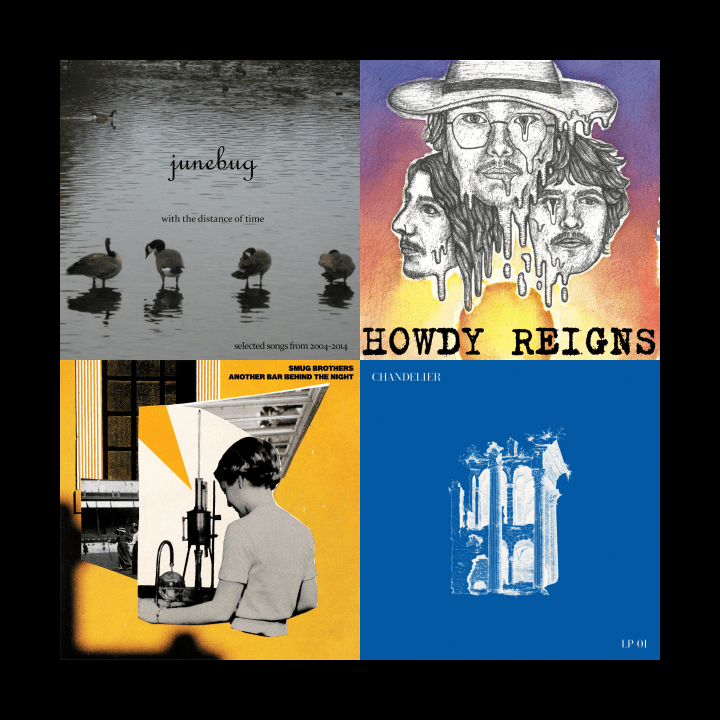
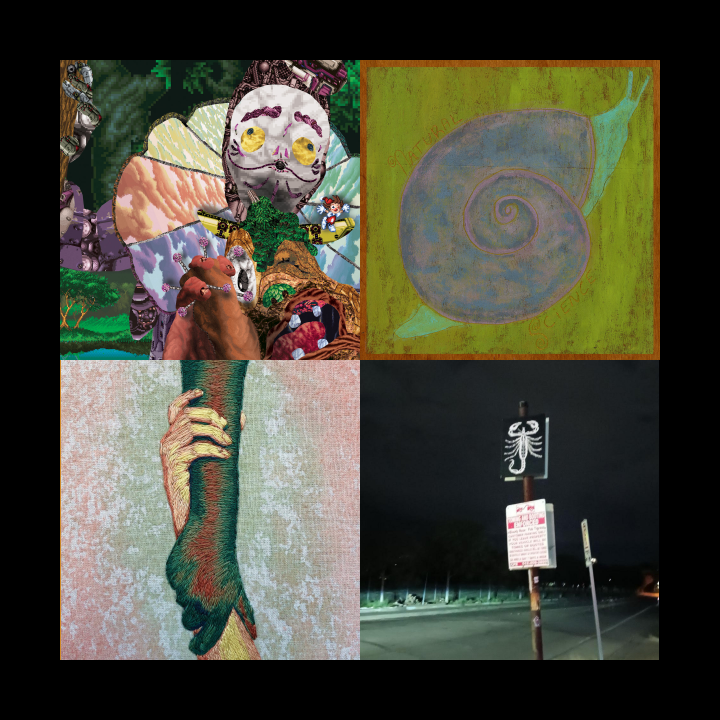
Welcome to the Tuesday Pressing Concerns! In this edition, we’ve got new albums from Captain Howdy & The Sunset Serenaders and Chandelier, a new EP from Smug Brothers, and an archival release from Junebug below. If you missed yesterday’s blog post (featuring BBsitters Club, Flowerbomb, Pretty Bitter, Lindsay Reamer, and Obscuress), check that one out here.
If you’re looking for more new music, you can visit the site directory to see what else we’ve written about lately. If you’d like to support Rosy Overdrive, you can share this (or another) post, or donate here.
Junebug – With the Distance of Time
Release date: July 21st Record label: Subjangle Genre: Indie pop, twee, jangle pop, lo-fi pop Formats: CD, digital Pull Track: Town and Country
Indie pop singer-songwriter Teresa Daniele first gained notoriety in the early 2000s as one-half of the duo Sarah, Plain and Tall along with Ian Jackson (Persian Rugs); over the course of that decade and the first half of the next, the Ontario-based artist showed up in groups like The Haircuts, Two If By Sea, Paint Your Wagon Red, and Seashells, all of which were long-distance collaborations between Daniele and another musician. Daniele hasn’t been releasing new music to my knowledge over this past decade, but thanks to a recent retrospective compilation of the work of The Haircuts (Words to Remember Me By on Boring Spaghetti Records), she ended up unearthing a collection of recordings from Junebug, her solo project, from around the same time period. With the Distance of Time: Selected Songs from 2004-2014 is the first time Daniele’s work as Junebug has seen a proper release–a CD via indie pop stalwart Subjangle–and features members of Seashells, The Haircuts, and Two If By Sea aiding the singer-songwriter across its eight tracks. The recordings range from entirely constructed by Daniele to full-blown postal collaborations, the songs are mostly originals with a couple of covers–but all of With the Distance of Time points toward the work of a low-key but undeniable indie pop talent.
The first half of With the Distance of Time is made up of songs recorded by Daniele alone on a four-track in 2004 (mixing from The Haircuts’ Ryan Marquez being the only outside contribution). Lo-fi and twee, these songs have a K Records-esque ramshackle charm to them, and despite (or, realistically, because of) the homespun nature of the tracks, they’re the most immediately welcoming material on With the Distance of Time. The combination of primitive percussion, bright guitar chords, and shy-sounding, somewhat unpredictable vocals makes the first half of the CD oddly memorable (and when Daniele needs to clean up the sound a bit to pull off the runaway train instrumental of “Town and Country”, she proves she can do that, too). The back end of With the Distance of Time features the collection’s two covers–Marine Girls’ “A Place in the Sun” and the Grateful Dead’s “Box of Rain”, with the worried undertones of the former and the dreariness of the latter (which is a duet with guitarist John McLoughlin) being the first major shifts in mood on the record. The final two songs on With the Distance of Time are collaborations between Daniele and her erstwhile Two If By Sea bandmates–Lisle Mitnik contributes all the music on the reverb-y dream-folk of “Tomorrow”, and Kevin Clark helms the lo-fi, 80s-indebted “A Promise”. These are the two most “produced” tracks on the compilation, but they, just like the covers and the solo recordings, are held together by Daniele’s voice. (Bandcamp link)
Smug Brothers – Another Bar Behind the Night
Release date: July 12th Record label: Just Because/Anyway Genre: Lo-fi power pop, jangle pop, psych pop Formats: Cassette, digital Pull Track: Javelina Nowhere
When we last checked in on Columbus’ Smug Brothers, it was fall of 2023, and the Kyle Melton-led power pop group was gearing up to release the most recent of their many full-length records, In the Book of Bad Ideas. That LP itself followed late 2022’s Emerald Lemonade EP by less than a year, and the quartet keep their prolific streak alive with Another Bar Behind the Night, their latest record. Despite the constant stream of new music, it’s actually been a time of turnover for Smug Brothers–lead guitarist Scott Tribble left in the middle of recording In the Book of Bad Ideas, and Another Bar Behind the Night is the first record to feature the band’s newest member, Ryan Shaffer (of Stark Folk Band). Other groups might’ve taken some time to retool in the midst of all this, but not Smug Brothers–Kyle Melton’s got hooks to deliver. He finished In the Book of Bad Ideas as a trio along with drummer Don Thrasher and bassist Kyle Sowash, and the newly-minted quartet roll through six songs in ten minutes on their most recent EP like a well-oiled machine. Smug Brothers have always been a “low-fat” kind of band, but the format of Another Bar Behind the Night gives the band no breathing room, with even the relatively small excesses of their last LP shaved off here.
Only two of Another Bar Behind the Night’s six songs go on for longer than two minutes–one of them is opening track “Javelina Nowhere”, which features what’s easily the most indulgent moment on the entire EP (a brief, fifteen-second mellotron-led instrumental intro). Eventually (about at the seventeen-second mark if you’re impatient), “Javelina” blooms into a jangly, Guided by Voices-fluent mid-tempo anthem that’s carried over the top with Melton’s melodies. “Seamus the Younger” is the first side’s “rocker”–it’s also the first of several “blink and you’ll miss them” flyby tracks, but it gets an entire spirited idea across before the curtains close. The midsection of Another Bar Behind the Night is its delicate part, with “Alexander for Two” offering up an off-the-cuff lo-fi power ballad and “The Seven-Year Inch” being the token moment of instrumental minimalism. After the sixty-one second basement twirling pop of “Cricket Blessings” (now there’s a Robert Pollard-influenced title if I’ve ever heard one), “Shedding Polymer” closes the EP with Smug Brothers as smooth classic rock operators. At least, that’s what the song’s main guitar riff gives off, but Melton’s lead vocal is as earnest and Midwestern-garage-pop as it always is. I don’t know if it’s ever “easy” to get up and make art over and over again, but being driven without being overly precious about it probably helps. (Bandcamp link)
Captain Howdy & The Sunset Serenaders – Howdy Reigns
Release date: August 2nd Record label: Sunset Serenade Genre: Psychedelic rock, garage rock, alt-country Formats: Digital Pull Track: Shady Grove
Captain Howdy & The Sunset Serenaders are a new psychedelic garage rock trio from Lawrence, Kansas (I’m fairly certain I’ve never written about any bands from there until now) who made their debut last year with the LIVE/HOWDY live album. Their first studio album, Howdy Reigns, follows less than a year later, giving the songs that appeared on the live record a proper reading. Bassist James Barnett, drummer Jon Chappell, and guitarist Keller Welton have clearly worked these songs out while gigging, as they come into Howdy Reigns ready to rip through blistering, unhinged rock and roll that comes off as a more Midwestern take on freewheeling West Coast psych rock from acts like Ty Segall and Thee Oh Sees. Although Captain Howdy & The Sunset Serenaders filter everything through a fuzzed-out lens, their stated Western, country, and folk influences do come through, both in their ability to swerve into psychobilly/cowpunk musical detours and in the writing hidden underneath the music, which seems to key in on the darker horrors of “Americana” and the less valiant reality of western male archetypes like cowboys and frontiersmen.
If we assume “Captain Howdy” is the person singing these songs, he’s certainly not the friendly character one might want to attach to the name. It doesn’t take long for the restless narrator of opening track “Cold Rain” to move from his grousing to staging a murder ballad–no matter that the “ballad” in this instance is a six-minute high-octane psych-trasher that’s almost entirely moved on to “instrumental jam” territory after ninety seconds. “Shady Grove”, smack dab in the middle of Howdy Reigns, marries their most overtly cowpunk instrumental with a particularly unhinged vocal take that assures us that not only is Captain Howdy destructive to his surroundings, but entirely self-destructive as well. The creepy-feeling “You Can’t See Me” is a slower, more deliberate version of fuzz rock, with the ominous chorus (“I can take you, I can take you / Far away from here, far away from here”) sounding anything but comforting and reassuring. There’s a palpable darkness throughout Howdy Reigns to be sure, although Captain Howdy & The Sunset Serenaders are good enough storytellers to ensure the record doesn’t become a slog. Sure, there’s obvious stuff like the goofy “La Llorona”, but I also mean that it’s enjoyable to listen to the band locking together in songs like the blues-garage “All for You” and penultimate slowburn explosion “Pass Me By”, too. Captain Howdy & The Sunset Serenaders certainly have a fair bit of ambition for an unknown psych rock band from Kansas, but so far they’re wearing it well. (Bandcamp link)
Chandelier – Chandelier
Release date: July 12th Record label: Self-released Genre: Post-punk, art punk Formats: CD, digital Pull Track: Enemy
Chandelier are a new post-punk quartet from Atlanta who put out their debut self-titled album last month, and it’s a memorable one. The group (vocalist/lyricist Karl Green, guitarist/drummer Dennis Bowen, guitarist Bryan Scherer, and drummer Thomas Martino) refer to themselves as an “esoteric guitar band”, a description I could imagine grating on me in the wrong context–but here, they’re just being honest. The instrumentals on Chandelier are crystal clear, mid-tempo post-punk/noise rock that tread into Lungfish territory on the slower numbers and evoke other Dischord groups when they pick up the pace a little bit. The guitars and drums feel laser-focused and all business–when they kick up the noise for a couple seconds in an instrumental break, it’s simply because it’s the best thing to do. Green, meanwhile, is an underground punk oddball in the vein of Al Johnson or Daniel Higgs, although not overly similar to the exact style of either of those vocalists. He’s speak-singing, yes, but neither in a yell-y monotone or an ignoring-the-music ramble–he speaks rhythmically, his opaque (and, yes, esoteric) lyrics form-fitting to the rest of Chandelier.
The riff that opens “Straddle the Line” sounds ready to go, even as Green does his best to temper Chandelier’s opening track–and as the rest of the band add to the instrumental, it works, ending up with a final product that sounds kind of like a tranquilized Landowner. Chandelier is a record of subtle shifts–it’s not like “Pleasure Zone” is a huge departure, but the extra low-end in the instrumental and a slight change in Green’s voice (Listen to the way he almost taunts “Echoes from the velvet womb, emerging from the pleasure zone”) give it a completely different feel. Eventually some more of Chandelier begins to seem concrete, aided by moments like the pummeling drums in “Naught”, the eerie spoken word outro of “Palace”, and the stuttered vocals in “Mirror Calling”. In “Disco Columbine”, Green seems positively bored in the verses before becoming the most animated he is on the record in the chorus, which sounds kind of like Wall of Voodoo if Stan Ridgeway had even worse vibes. The most surprising moment on Chandelier is easily “Enemy”, in which Chandelier pull off a legitimate dance-punk song by, again, shifting their sound up just a little bit. In the song’s chorus, Green stutters his way through declaring war on time, an explicit proclamation borne out by the rest of Chandelier, a record that suggests infinite diverging possibilities in its practice of imperfect, slightly-altered repetition. (Bandcamp link)
It’s a great Monday here at the Rosy Overdrive music blog. Why? Well, because we’ve got four superb records for you to enjoy right below this introduction. New albums from Lindsay Reamer and Obscuress, a split/collaborative EP from Pretty Bitter and Flowerbomb, and a live compilation from BBsitters Club are all featured in Pressing Concerns today. Read on!
If you’re looking for more new music, you can visit the site directory to see what else we’ve written about lately. If you’d like to support Rosy Overdrive, you can share this (or another) post, or donate here.
BBsitters Club – Joel’s Picks Vol. 2
Release date: August 16th Record label: Hausu Mountain Genre: Jam band, experimental rock, country rock, funk rock Formats: CD, cassette, digital Pull Track: Party in My Chevy
Doug Kaplan and Max Allison co-run Hausu Mountain Records, a Chicago-based imprint that’s on the frontlines of some of the wildest experimental electronic music out there–it’s not the kind of fare I typically cover on Rosy Overdrive, though they did put Erica Eso’s R&B-tinged art pop/rock record 192. Kaplan and Allison, perhaps unsurprisingly, are just as into the weirder corners of punk and rock music (in fact, I first heard of them when they guested on the And Introducing podcast to talk about the Minutemen), and BBsitters Club is their outlet for their “rock and roll” instincts. Kaplan’s on MIDI guitar and vocals, Allison plays bass, and they’re joined by guitarist/vocalist Charlie Olvera and drummer Paul Birhanu to round out the versatile core quartet. They’ve only put out one studio album, but they gig pretty regularly around Chicago and embrace their inner Grateful Dead by engaging in lengthy jams and encouraging live taping of their shows. Joel’s Picks Vol. 2 (named after prolific taper and friend of the band Joel Berk) is the second in a series of compilations of these live recordings, following Vol. 1 in 2020, and the hourlong tape (recorded at various shows at Cafe Mustache, Cole’s Bar, and Sleeping Village) has everything one could want in such a record–absurdly long classic rock explorations, previously unreleased gems, and even a Captain Beefheart cover.
Of the tape’s eight tracks, three of them stretch over ten minutes in length, and all three of them seem to be staples of the BBsitters Club repertoire. One of these, “Joel Reprise > Told Ya”, kicks the record off with the explosive opening reprise (whose lyrics are just “Joel!” shouted over and over) and the sprawling country-rock second half serving as the real hook. The other lengthy songs find BBsitters Club delving into funky swamp rock and the capital-B Blues, respectively, continuing the chameleonic nature of the group found throughout Joel’s Picks Vol. 2. On the other end of the spectrum, the record’s two most obvious “hits” to my ears are the relatively brief “Party in My Chevy” and “Cutie Girls”, the former being a previously-unreleased four-chord southern-style rocker that’s full steam ahead for its entire five minutes, and the latter (which appeared on their sole studio album, 2020’s BBsitters Club & Party) shooting for garage rock, early punk, and even a bit of power pop in its urgent catchiness. BBsitters Club somehow get the Red Hot Chili Peppers themselves to appear on the tape, playing their unreleased funk-rock anthem “West of Your State”, which has the potential to be their best single since “Scar Tissue”, and the BBsitters Club return to give Captain Beefheart’s “Kandy Korn” an appropriately noisy freakout of a reading. Part of the charm of Joel’s Picks Vol. 2 is that it’s primarily made up of audience recordings–like many tape-friendly bands before them, it’s thrilling to peek in on something from a somewhat muddy (but just clear enough) remove. (Bandcamp link)
Pretty Bitter & Flowerbomb – Take Me Out
Release date: August 1st Record label: Self-released Genre: Emo-y indie rock, alt-rock, indie pop Formats: Digital Pull Track: Never Better
Pretty Bitter and Flowerbomb are a pair of like-minded Washington, D.C.-based indie rock groups–the former is a quintet led by vocalist/lyricist Mel Bleker and also featuring Ekko Astral drummer Miriam Tyler on bass, Zack Berman on guitar and keyboard, Chris Smith on guitar, and drummer Jason Hayes, while the latter is a power quartet led by vocalist Rachel Kline and rounded out by Dan ABH (drums), Connor White (guitar), and Abby Rasheed (bass). Both bands have been around since late last decade (Pretty Bitter put out LPs in 2019 and 2022, Flowerbomb put out an album in 2020 and two EPs earlier this year), and both of them have a sound that blends the more stripped-down side of “stately” 2000s indie rock with emo and just a hint of indie pop/power pop/pop punk–one of them cites Rilo Kiley as an influence, and the fact that I can’t remember which one of them it was is pretty telling. All things considered, the two bands are natural partners for a collaborative/split EP (featuring two songs from each band and one credited to the both of them)–I imagine very little onboarding was needed to turn Take Me Out into a success.
Take Me Out was co-produced by emo busybody Evan Weiss, and the EP sounds at home in this world from the get-go. Pretty Bitter kick the record off with an instant hit in “Never Better”, an earnest, propulsive song whose gigantic emo-synth hook from Berman hints at a way to tell the two bands apart. Flowerbomb have an anthem of their own with “Nothing to Do With Me”–the guitars crash and Kline soars, but between the less-obvious chorus and the thematic mess at the center of the track, this one is more rewarding with repeat listens. Both bands get a little more experimental on their second songs–on “Youbuiltafinelife”, Pretty Bitter try a dance-friendly bassline and bubbling synthpop on for size, while Flowerbomb embrace synthesizers themselves on the curious “I Always Knew”. When two bands who are collaborating sound as similar as Flowerbomb and Pretty Bitter do, Take Me Out benefits from both of them bringing such an openness to the table–and the closing title track, featuring writing credits from members of both bands and credited to both of them, continues this thread. Nothing on the EP leads us to expect country guitars and banjo, but that’s what “Take Me Out” puts forward, with Bleker leading a combination Pretty-bomb band in an upbeat alt-country-folk-emo conclusion. Everyone on the last track sounds equally comfortable in this guise–it sounds natural even as it’s pretty different than everything else on Take Me Out. (Bandcamp link)
Lindsay Reamer – Natural Science
Release date: August 16th Record label: Dear Life Genre: Alt-country, country rock, folk rock, singer-songwriter Formats: Vinyl, CD, digital Pull Track: Red Flowers
Alt-country/folk rock singer-songwriter Linsday Reamer is from Massachusetts and lives in Philadelphia, although up until last year she worked as a field scientist, taking her across the United States. Her debut EP, Lucky, was recorded during this stint and released in February 2021 by Dear Life Records (right before that label got on my radar, actually; their following release, MJ Lenderman’s Ghost of Your Guitar Solo, was the first record of theirs I wrote about in Pressing Concerns). The lineup on Reamer’s debut album, Natural Science, is a real who’s who of Philadelphia indie rock/country/folk–Lucas Knapp recorded it, Ther’s Heather Jones mastered it, Thank You Thank You’s Tyler Bussey plays guitar and banjo, Florry’s Will Henriksen is on the fiddle, and Eliza Niemi plays the cello, among others. Reamer, at the helm, leads her collaborators through an impressively-orchestrated, polished record that takes advantage of the tools at its disposal but still comes off as breezy and pop-forward. It’s one of the most “instant-gratification” alt-country records to come out of Dear Life in a while–but Reamer isn’t put into a box by that at all, gleefully hopping from upbeat country rock to dreamy, layered folk music throughout Natural Science.
That being said, Natural Science opens with a curveball with the lush cosmic folk-rock of “Today”. Bussey, Henriksen, and Niemi’s instruments swirl together hypnotically for three and a half minutes–and then Reamer’s off to the streamlined folk-pop vibes of “Spring Song” and “Red Flowers”, which feigns a slow start before launching into a jaunty but laid-back electric country tune. The turn towards acoustic and more traditional folk in “Sugar” doesn’t dent the record’s momentum, nor does the grand mid-record “Lucky” (I’d consider the latter the record’s centerpiece, which means the heart of the album is the moment where Reamer wakes up next to last night’s takeout food, says “‘fuck it’ and [takes] a bite”). If “Lucky” isn’t as immediately accessible as “Spring Song” or “Red Flowers”, Reamer’s writing ensures that it’s just as memorable–although it’s not an “either/or” proposition on Natural Science, as the two tracks with my favorite lyrics in the record’s second half (“Necessary” and “Figs and Peaches”) are both pleasing and upbeat numbers. The latter finds Reamer digging deep to pull something worthwhile out of a landscape of invasive species and power plants, while the former gets by with a plainspoken truism for a refrain (“It’s okay to depend on somebody / Not just okay, but necessary”). Natural Science more than earns its epilogue, a star-studded (Michael Cormier-O’Leary, Peter Gill, Frank Meadows, Jon Samuels) cover of Townes Van Zandt’s “Heavenly Houseboat Blues”. (Bandcamp link)
Obscuress – Namesake
Release date: July 26th Record label: Texas Archives Genre: Post-rock, slowcore, ambient, folk Formats: CD, digital Pull Track: Five Names
Obscuress is a new collaboration between two longtime Texas music oddballs. In the early 1990s, Christina Carter co-founded Houston’s longrunning experimental folk/psych band Charalambides, which has released music on labels like Kranky and Siltbreeze over the past thirty years. Spencer Dobbs has stayed a bit more under the radar, but he’s been putting out solo albums of lo-fi, sparse folk music for a couple of decades, as well (the electric blues-tinged If the Moon Don’t Turn Its Back on You, which surfaced on Bandcamp and streaming services last year, is my personal favorite). Released under Dobbs’ Texas Archives imprint, Namesake is their first record as a duo, and the five-song CD is something distinct from either musician’s most well-known works. It’s a full-length album, with the tracks ranging from five to ten minutes long apiece, and its crawling minimalist instrumentals put it in the worlds of post-rock, ambient, and slowcore. Although there are guitars in this ether, keys and “sampled noise” contribute to Namesake being less easily to categorize as “folk” music than Dobbs’ solo albums, while Carter’s beautiful, traditional lead vocals are the album’s clearest structural force, preventing Obscuress from fully feeling like a free-form project.
About half of Namesake is taken up by its opening and closing tracks, the eight-minute “Nemesis” and ten-minute “Obscure Consensus”, respectively. If everything else about Obscuress–from the previous work of its two members to the record’s haunting cover–wasn’t already clue enough, the glacially wandering opening track is more confirmation that Namesake isn’t going to provide much instant gratification. “Nemesis” builds to nothing–Carter perhaps sounds a little more insistent as the song draws to a close, but little else has changed in the world of Obscuress. The middle three songs of Namesake are the most “accessible” merely by being under six minutes long, although there’s also traces of folk and jazz-influenced slowcore in “Uniform” that reminds me a bit of a more stripped-down Hannah Marcus. The guitars and piano in “Five Names” flirt with sounding a little warm, but “Carousel of Voices” gets Obscuress back into worried and paranoid territory both in the stretched tension of the instrumental and in Carter’s voice. Even as it crosses ten minutes, “Obscure Consensus” closes Namesake with arguably the record’s simplest track–the guitar and Carter’s voice are more constant than most of the album here, the former ringing for just long enough before the next note comes and the latter taking the shape of a slow but steady stream of consciousness. Against all odds, Namesake ends with us fully hooked and engrossed. (Bandcamp link)
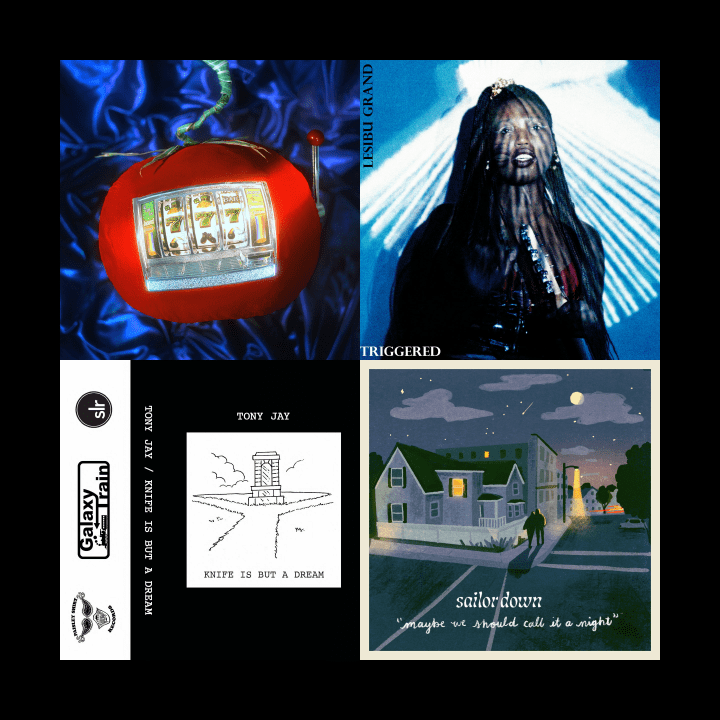
The Thursday Pressing Concerns is here, and it’s got four records coming out tomorrow, August 16th, for you to check out below (new LPs from Wishy, Tony Jay, and Lesibu Grand, and a new EP from Sailor Down). Earlier this week, we looked at Fast Execution, Real Companion, Cowgirl, and Brown Dog (on Monday) and The Ekphrastics, Purseweb, Greaser Phase, and Box Elder (on Tuesday), so check those ones out if you missed ’em.
If you’re looking for more new music, you can visit the site directory to see what else we’ve written about lately. If you’d like to support Rosy Overdrive, you can share this (or another) post, or donate here.
Wishy – Triple Seven
Release date: August 16th Record label: Winspear Genre: Noise pop, shoegaze, dream pop, fuzz rock Formats: Vinyl, CD, cassette, digital Pull Track: Sick Sweet
Towards the end of last year, Indianapolis’ Wishy debuted with a promising five-song EP called Paradise. Co-led by singer-songwriters Kevin Krauter and Nina Pitchkites, Wishy’s first impression was that of a band who already knew their way around a nice guitar pop song, as well as how to use dream pop and fuzzed-out 90s rock music as vessels. Krauter and Pitchkites eventually added guitarist Dimitri Morris, bassist Mitch Collins and drummer Conner Host to the fold and, just a few months after Paradise, already have a full-on Wishy LP in the form of Triple Seven. Triple Seven is, above anything else, a loud pop album–effectively, it’s like the Wishy of Paradise, but more. Wishy aren’t a “shoegaze band” in the same way that they aren’t a dream pop band or a 90s radio-rock band–these genres are tools to be picked up and wielded throughout Triple Seven, and Wishy clearly know how to use their weapons of choice. The towering pop moments are the throughline on Triple Seven–whether Wishy are being suave and slippery or blunt and pummeling, the record’s ten songs fit together under that particular banner. I’m not sure if Wishy could turn off this part of their DNA even if they wanted to; even as Triple Seven embraces louder guitars and longer song lengths, it’s somehow even more of an effective pop record than their debut.
Any trepidation about Wishy’s continued success one might have is immediately put to rest by opening track “Sick Sweet”, in which the band absolutely knock “maximalist first statement” out of the park. It’s one part distorted, punk-y power pop (this is a band that’s played shows with Dazy and Guided by Voices recently, after all) but there’s a huge Mellon Collie-like grandiosity to the track as well (there’s just a hint of “Tonight, Tonight”-like swelling strings underneath the noise, and one needs a Corganesque confidence to sing “You’re like an afterlife and I really wanna die tonight,” as a chorus like Krauter does). After that, Pitchkites brings the band’s bright mid-tempo, turn-of-the-century pop rock instincts to the forefront with the title track, a mode in which Wishy still excel. Pitchkites also helms another one of Triple Seven’s most casual indie pop moments, second half highlight “Just Like Sunday”–but she also sings co-lead on the massive-sounding shoegaze-fluent alt-rocker “Persuasion”, and Krauter gets a delicate moment of his own in the first half of single “Love on the Outside”, which surprisingly flirts with emo pop before the cranked-up guitars kick in after a minute or so. After a varied assortment of recordings, Wishy pleasingly close Triple Seven like they’ve got a surplus of decibels they need to burn through–“Honey” is a piece of peeling beauty that’s probably the closest thing to a “pure” shoegaze song on the record, and “Spit” closes things out with an all-or-nothing five-minute grunge-gaze finale. Most bands wouldn’t create something as fun-sounding and catchy as “Spit” out of its greyscale ingredients, but Wishy sound great going against the grain on Triple Seven. (Bandcamp link)
Tony Jay – Knife Is But a Dream
Release date: August 16th Record label: Slumberland/Paisley Shirt/Galaxy Train Genre: Lo-fi indie rock, experimental folk, indie pop, bedroom rock Formats: Cassette, digital Pull Track: The World in Julia’s Eyes
Over the handful of years that this blog has existed, few people in the world of guitar pop have been more prolific than Mike Ramos. I’ve written about multiplerecords from Flowertown, his duo with Cindy’s Karina Gill, multipleLPs from his solo project Tony Jay, and just this year he’s contributed to new albums from Sad Eyed Beatniks and Chime School. With several irons in the fire, I suppose it’s not a big surprise that Ramos saves his quieter and more experimental moments for Tony Jay, whose records are generally home-recorded by Ramos himself. Tony Jay’s debut for Slumberland Records, last year’s Perfect Worlds, took a hesitant step towards cleaning up and refining the project’s sound, but 2024’s offering from Tony Jay is not so compromising. Knife Is But a Dream was recorded in May of this year at home, like most Tony Jay albums, but while Perfect Worlds featured a handful of human guest musicians, the only other being credited on Ramos’ latest record is his fourteen-year-old cat, Penny. According to Ramos, Penny’s declining health is reflected in Knife Is But a Dream, which even by Tony Jay standards is a tricky one. It’s quite insular, can be standoffish and abrasive at times, and makes one work for the warmth eventually revealed throughout the record in spades–much like a cat, I suppose.
Two of Knife Is But a Dream’s first three songs–“Ancient Slice” and “Cool Beat”–are noise pieces, the former a chaotic collage all the way through and the latter primarily an ambient rhythm that gets thornier and louder over two and a half minutes. In between the two is a pin-drop quiet acoustic recording called “Something Kind”. This kind of barely-there, drawn-out version of pop music feels like all Ramos can muster across the first half of Knife Is But a Dream–“Grey Is the Night” is similarly drab, although the title track and “Doubtfully Yours” are, at the very least, a little lighter (Ramos duets with white noise in the former, and the twinkling guitars in the latter are the brightest moment on the record up until that point). Knife Is But a Dream seems to warm up to the listener as it goes on–an intriguing cover of Todd Rundgren’s “A Dream Goes on Forever” near the midpoint is a clue, and while “The World in Julia’s Eyes”, “Water in a Cage”, and “The Darkest Corner” aren’t individually huge departures in tone, Knife Is But a Dream offering three pop songs of any kind in a row feels like a concession. The final two songs on Knife Is But a Dream are called “This Sux (Amen)” and “It Destroys Me”–it’d be a lie to say Ramos closes the album on an upbeat note, but at least he’s feeling something. (Bandcamp link)
Lesibu Grand – Triggered
Release date: August 16th Record label: Kill Rock Stars Genre: Power pop, punk rock, new wave, art rock Formats: CD, digital Pull Track: Emotional Disguise
Lesibu Grand was formed in Atlanta in 2018 by longtime friends Tyler-Simone Molton and John Renaud–the former is the band’s vocalist, the latter plays bass, and the duo are the band’s primary songwriters. Their first record, the Legend of Miranda EP, came out the following year, and the band became a quintet with the addition of Lee Wiggins on drums, Brian Turner on guitar, and Warren Ullom on keyboards. Songs that would eventually wind up on Triggered, the first Lesibu Grand full-length, started showing up as singles in 2020–about half the record looks to have been released in some form in the years leading up to the album. Even those already hip to Lesibu Grand still have plenty of new material to sift through on Triggered, however–their Kill Rock Stars debut is a sixteen-song CD-length album that stretches to nearly an hour and is unlikely to leave anyone feeling shortchanged. Lesibu Grand sound right at home in the expansiveness of Triggered–it’s an adventurous rock and roll album that pulls together tons of different ideas and influences excitedly.
You can call Lesibu Grand a “punk band”, and sonically and attitude-wise you wouldn’t be wrong, but it’s hardly an orthodox exercise in its equal love of new wave, power pop, and pop punk (I wasn’t sure if comparing them to Blondie would be too reductive, but the band do it themselves on their Bandcamp page, so I can say “Lesibu Grand remind of Blondie” with no hesitation now). Those looking for punk throwback anthems will find them via appropriately-titled songs like “Anarchy”, “Pull the Trigger”, and “We Fuckin’ Suck”, but I find myself being drawn to the other tenets of Lesibu Grand’s sound, whether it’s eager-to-please power pop/new wave (the compelling synth/power chord weapon “Ordinary Girl”, the equally-bursting penultimate party track “Friends with My Friends”, the excellent car song “Heartbreak Blue”) or subtler, less in-your-face moments (the impressively restrained five-minute opening track “Scary Mary”, the low-self-worth power ballad “I’m Not Sorry”, the melancholic, jangly indie pop of “Emotional Disguise”). One really gets the full range of Molton and Renaud’s writing on Triggered–on “Not Sweet Enough” and “We Fuckin’ Suck”, Lesibu Grand is excoriating evil (on an individual level for the former, and societally for the latter) with white-hot punk rage, while the band that’s playing songs like “Jennifer, My Girl” and “Emotional Disguise” sounds like they’d be more at home on K or Sarah Records than Kill Rock Stars. I for one am grateful to get so much of Lesibu Grand on Triggered–some of this band’s best work is done on the periphery of their sound. (Bandcamp link)
Sailor Down – Maybe We Should Call It a Night
Release date: August 16th Record label: Relief Map Genre: Midwest emo, indie folk Formats: Cassette, digital Pull Track: I Can’t Make You
Sailor Down began at the beginning of the decade as the solo bedroom folk project of Northampton, Massachusetts’ Chloe Deeley–her first EP under the name, 2021’s Skip the Line, was one of the first releases on New England label Relief Map Records (Convinced Friend, Old Moon, Kitner). Although Deeley began to expand Sailor Down’s sound on her first LP (last year’s Lookout Park), the project’s second EP is its first as a proper quartet. On Maybe We Should Call It a Night, Sailor Down is Deeley, drummer Nat Peirce, bassist Kevin McGrath, and guitarist Ben Husk (also of Lost Film), and it’s pleasing to hear that the group already have a distinct sound down as a unit on the record. The six songs of Maybe We Should Call It a Night pull together 90s Midwest emo, no-frills indie rock, and the more melancholic sides of twee and indie pop for a nostalgic, accessible, but hardly surface-level record (if you’re into the emo-indie rock-indie pop midpoint that Count Your Lucky Stars’ releases have explored lately, particularly on Polkadot’s album from earlier this year, Sailor Down are speaking a similar language).
“I Can’t Make You” kicks off this era of Sailor Down with emo-y indie rock’s version of a pop anthem–Deeley’s vocals (joined by McGrath and Husk’s, too) hug a simple pop melody and lean heavily into earnestness, and the chorus sounds on the brink of falling apart in the best way possible. Those waiting for Sailor Down to fully display their emo colors will be increasingly satiated as Maybe We Should Call It a Night advances–in particular, the run from the hard-fought “Vacation (Forgive Me Evan)” to the gorgeous dizzy guitars of “Locals Night” (with the plodding, contemplative “I Am the News” hanging out in between) contains some of the best “emo-adjacent” moments I’ve heard this year. Deeley’s songwriting, as it turns out, is well-suited for this type of music, as Maybe We Should Call It a Night is disproportionately full of memorable lyrics and lines for a small release. The writing in these songs feels drawn from imagined conversations and late-night pacing sessions, which makes the realizations and punchlines (“Some of us were made just to melt into water / But that’s a heavy thing to say when we’re out on a Friday,” from “Locals Night”, “I went to the ocean / It made me feel worse,” from “Last One Sober”) feel stumbled-upon and thus land even harder. Of course, this is all balanced by Sailor Down the band, whose gait feels firm, even, and purposeful. (Bandcamp link)
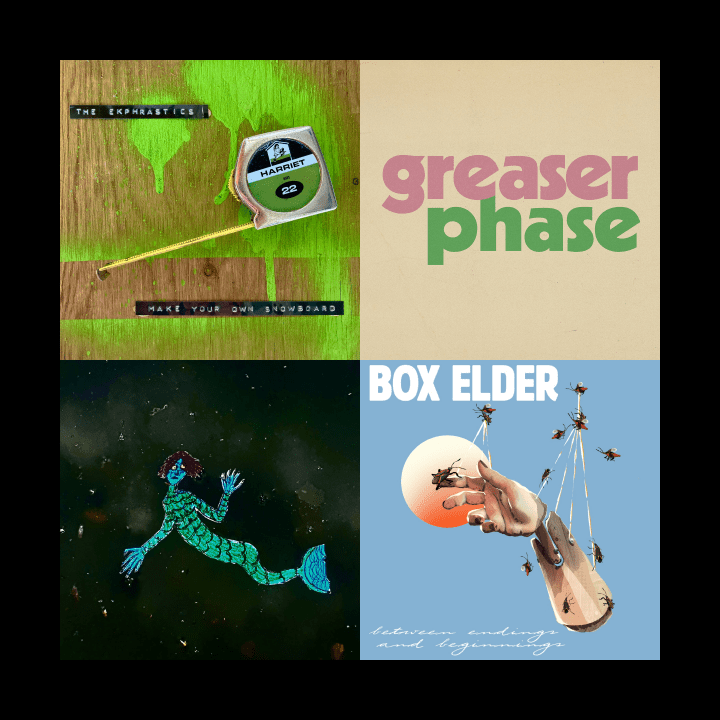
This Tuesday Pressing Concerns is an exciting one, collecting some LPs (from The Ekphrastics and Greaser Phase) and EPs (from Purseweb and Box Elder) that have come out over the past month and a half. If you like great under-the-radar indie rock, indie pop, emo, et cetera, you’ll find something here. And if you missed yesterday’s post, featuring Fast Execution, Real Companion, Cowgirl, and Brown Dog, check that one out here.
If you’re looking for more new music, you can visit the site directory to see what else we’ve written about lately. If you’d like to support Rosy Overdrive, you can share this (or another) post, or donate here.
The Ekphrastics – Make Your Own Snowboard
Release date: August 3rd Record label: Harriet Genre: Indie pop, 90s indie rock, singer-songwriter Formats: CD, digital Pull Track: The Arrival of the Graf Zeppelin
Fans of a certain style of 1990s American indie pop/lo-fi indie rock/twee will fondly remember the early work of Frank Boscoe, a Pittsburgh-originating singer-songwriter who led bands like Wimp Factor 14 and The Vehicle Flips in the nineties who released the bulk of their material on recently-revived indie pop label Harriet Records (Linda Smith, The Extra Glenns, Tullycraft). Like an unfortunately large number of 90s underground greats, Boscoe slowly retreated from making music in the following years (his post-Vehicle Flips band, The Gazetteers, seemed to peter out at the beginning of the 2010s), but like a fortunately substantial number of said greats, the pandemic kicked off a new era in the world of Boscoe. Now based in Maine, the musician began collaborating with his ex-Vehicle Flips bandmate Johnny Lancia (drums) and Sinkcharmer’s Paul Coleman (bass), with Mark Wolfe joining on guitar when The Ekphrastics became a real-world band in 2022. The first Ekphrastics album, Special Delivery, showed up the following year, and their sophomore LP, Make Your Own Snowboard, has materialized a mere sixteen months later. With only a passing familiarity with Boscoe’s previous work, I was immediately drawn in by his latest album, a fantastic exercise in storytelling with laid-back, folk-y indie pop as the fruitful vessel.
Described as “a collection of short stories about doing one’s level best”, the eleven songs with words on Make Your Own Snowboard are all self-contained works that encourage close listening. Some songs on the album are pretty straightforward narratives (like the handyman movie theater employee who hacks a pinball machine in “The Intrepid Concessionaire” or the human enigma who’s the titular character of “Superbarista”), while songs like “Amy and Jens” (based on an essay Amy Rigby wrote about the song “Black Cab” by Jens Lekman) and “Keys to My Heart” (a brilliant metatextual piece) gain something with a bit of digging and context. Make Your Own Snowboard is refreshing in its ability to unpretentiously step into the world of nerdy, bookish 90s indie pop, recalling it both in its subject matter (looking at you, “The Arrival of the Graf Zeppelin” and “Searching for Lillian Gatlin”) and when The Ekphrastics explicitly nod to their own small corner of the world with “A Good Day for Sailing”, which begins with “I traded my Mountain Goats records for a small sailboat” and a clip of the familiar whirring of that band’s Panasonic RX-FT500 (Incidentally, the similarities between Boscoe and John Darnielle don’t go unnoticed by me, even as I’d personally suggest that Franklin Bruno and DiskothiQ would be equally correct touchpoints if we’re talking about early Shrimper Records/Inland Empire bands).
There’s something very inspiring about Boscoe’s writing, the casualness with which he performs the public service of pulling things like the Graf Zeppelin and Lillian Gatlin from history rather than lean on what we already know and understand to be common reference points. It’s an antidote to the navel-gazing attitude I’ve come to detest from countless writers and culture vultures, the ones who spend more time debating whether people will “remember” a given album or movie in a hundred years than actually engaging with art. I don’t know or particularly care about how many people will remember Make Your Own Snowboard in 2124, but if they do, it’ll be because it’s an album that stubbornly refuses to dwell on this op-ed, horse-race mindset, rolls up its sleeves, and gets its hands dirty. As Boscoe sums things up the titular character in “The Intrepid Concessionaire”:
“Hail to those who open the backs of things And make the necessary hacks to things Sometimes they are promoted Other times they’re fired Mostly all are unaware What has transpired”
Release date: June 29th Record label: Self-released Genre: Lo-fi indie rock, bedroom pop Formats: Digital Pull Track: Souls Attend
Jake Gascoyne is a Manchester-based musician who began releasing music as Purseweb in late 2022 with an EP called Come to Me With Every Hour. A few standalone singles have followed since that point, as well as another EP, The Cars and Birdsong Are Changing Me, in February of this year. The third Purseweb EP overall and second of 2024 came out at the end of June–continuing the tradition of heady and evocative titles, this one’s named From Your Tears Came This Aquarium. Running through four songs in fourteen minutes, From Your Tears Came This Aquarium reflects Gascoyne’s stated appreciation of dream pop, emo, and indie pop, sounding a lot like the greyscale, chilly mid-2010s era of lo-fi bedroom pop (Gascyone mentions one of the most prominent of these acts, Teen Suicide, as an influence, though he also reaches further back to classic indie pop group Rocketship and sad rock music godfathers The Cure). Gascoyne’s downcast, mumbled vocals and the dour streak to the instrumentals threatens to land From Your Tears Came This Aquarium on the bleaker end of the “bedroom pop” spectrum, but a layered pop attitude and upbeat moments turn the EP into something more than practiced wallowing.
From Your Tears Came This Aquarium starts with what’s probably its brightest moment–the brisk guitar pop instrumental that marks the beginning of “Souls Attend”. The track eventually cools its jets, but it never loses its edge, and the brakes squeal as Gascoyne murmurs “I’ll be availed always / A hundred times more so / Carry me wherever I go,” and the song bows out. The five-minute “Pylon Tower” is more of a slow burn, starting as sparse bedroom folk before the percussion arrives about a minute in and turns the track into something propulsive as well. The title track is both the shortest on the EP and the one that feels the most “classic lo-fi bedroom pop”–it wastes no time before jumping into a distorted vocal and a utilitarian indie rock backdrop, delivering a hefty portion of deeply-felt, dramatic opacity (“Croak my worth / Hide my feelings / When I think of you I start bleeding from my eyes”) in about two minutes. Closing track “Butter Knives” was released as an advance single, which feels strange to me, as it takes the “Pylon Tower” route of taking time to build on its acoustic foundation (over two minutes of ramping up, in fact), and even when it reaches the mid-tempo final swoon, it’s hardly the most accessible moment on the EP. If you’re making something like From Your Tears Came This Aquarium, though, I supposed that’s not foremost in your mind. You’re making something curious for the curious, something worth figuring out for the people who want to figure it out. (Bandcamp link)
Greaser Phase – Greaser Phase
Release date: June 28th Record label: Shambotic Genre: Power pop, garage rock, rock and roll Formats: CD, digital Pull Track: Lonely Hearts Killers
I’m not exactly sure what I was expecting a New York-based rock and roll duo named Greaser Phase to sound like, but their self-titled debut album feels like it’s probably the best-case scenario for such an act. On Greaser Phase, the band’s core duo (vocalist Jonny Couch and bassist/guitarist Benny Imbriani, assisted by Kevin Shea on drums) barrel through ten electric power pop songs in twenty-nine minutes, and the group’s barebones instrumental setup doesn’t stop Greaser Phase from incorporating early punk rock, mod, 60s pop rock, and even rockabilly into their pop music. Greaser Phase seem to get more confident in stretching out their material in real-time: every one of the first four songs are under three minutes long, and the last six are all longer than three minutes. There’s no dip in quality across the world of Greaser Phase, however–like The Cars’ self-titled record without any of those fancy synths, the duo’s debut album plays like an unearthed greatest hits from a band fully-formed at birth.
Although I certainly meant it when I said Greaser Phase retains its quality throughout its entire length, there’s a certainpleasing immediacy to the record’s first three songs that will undoubtedly particularly appeal to those of us who like their guitar pop short, strong, and sweet. “Lonely Hearts Killers” is a brilliant opener, a power pop propeller in love with rock both classic and punk in a way that recalls the more bite-sized moments of Ted Leo and the Pharmacists, while “Back in California” is Greaser Phase’s sunny, groovy entry into the “surf rock songs about the Golden State” sweepstakes, and “Believe It” has just a hint of country-rock-and-roll in its laid-back lead guitars. As Greaser Phase get into their longer material, even more shades to their sound are unlocked–sometimes they’re content to just ride out the power pop-rock and roll dragon for an extra minute or two (“Knockin on Your Window”, “False Paradise”), but we also get “The Belle of Clarksville Mississippi”, a song in which Imbriani dares to indulge in some vox combo organ to enhance Couch’s pop frontperson storytelling, and “Nervous Minds”, a somewhat faded-sounding power (pop) ballad that doesn’t overdo the modulating guitars and vocals too much. Greaser Phase closes with a song called “Over and Out”–yet again, it’s incredibly catchy, but the song feels jagged and dissonant around the edges like a lot of inventive “classic rock era” music. It’s hard to say what exactly makes it work as well as it does, other than “it keeps doing what Greaser Phase clearly excel at doing”. (Bandcamp link)
Box Elder – Between Endings and Beginnings
Release date: July 31st Record label: Wheelbite Genre: Pop punk, emo, emo-punk Formats: Digital Pull Track: Bug
I’m not sure what malady causes someone to form an emo band in Wyoming, but Box Elder has a clear case of it. The quintet from Jackson was founded by singer/guitarist Christopher Archuleta in the early 2020s, and a couple of Box Elder EPs (2021’s These Distractions Are Constant, 2022’s Sell the Heart Records-released Minimums) surfaced as an Archuleta solo project with some guest contributions. A couple of these collaborators (drummer Oscar Garcia-Perez, synth player Claire Holden) soon became full members, guitarist Ian Tompkins and bassist Wil Ziegler joined the fray, and a proper full-band Box Elder began touring the Western U.S., playing shows with bands like Bug Seance. The six-song Between Endings and Beginnings EP is Box Elder’s first as a five-piece, featuring three new songs and three reworkings from their previous releases. Archuleta’s new bandmates instantly get to work polishing and expanding his emo-shot songwriting, giving Between Endings and Beginnings a loud but still somewhat downcast reading that incorporates bits of pop punk and chilly alt-rock. It comes out to a record that recalls the turn-of-the-century moment where emo went “pop” into the mainstream–but still with an underdog charm to it.
“The devil’s taking notes on you / Seeing through the person that he thought he knew,” is how Archuleta chooses to start “Takes One to Know One”, the EP’s lead-off track. What follows is a four-something-minute-long track in which Box Elder lean hard on their emo and melodramatic tendencies, but Between Endings and Beginnings doesn’t just keep trying to get more juice out of that combination. “Bug”, on the other hand, is a big alt-rock/power pop anthem, dealing in soaring instrumentals marked by guitar heroics–the earnestness of Archuleta’s vocals being the biggest “emo” marker on the track. There are no “down moments” on Between Endings and Beginnings–“Clarity” is a little bit “dreamo”, but in a “cavalcade of guitars” way, while “Minimums” turns its refrain into, improbably, the most memorable hook on the record. After the brisk, swinging backbeat of “Arrows” injects even more life into a record hardly suffering for lack of it, “Keeper” closes the EP out with the classic slow burn final track. Even in its first, quietest minute, though, the guitars are still doing tricks and the drums sound pretty tough–I can’t imagine anyone being surprised that Box Elder eventually charge into an all-hands-on-deck crescendo. Seeing it on the horizon doesn’t lessen the impact once we get there, though. (Bandcamp link)
The first Pressing Concerns of the new week looks at three records that came out last Friday, August 9th (new LPs from Real Companion and Cowgirl, and an EP from Fast Execution), as well as an album from Brown Dog that came out back in May. A bunch of great music below!
If you’re looking for more new music, you can visit the site directory to see what else we’ve written about lately. If you’d like to support Rosy Overdrive, you can share this (or another) post, or donate here.
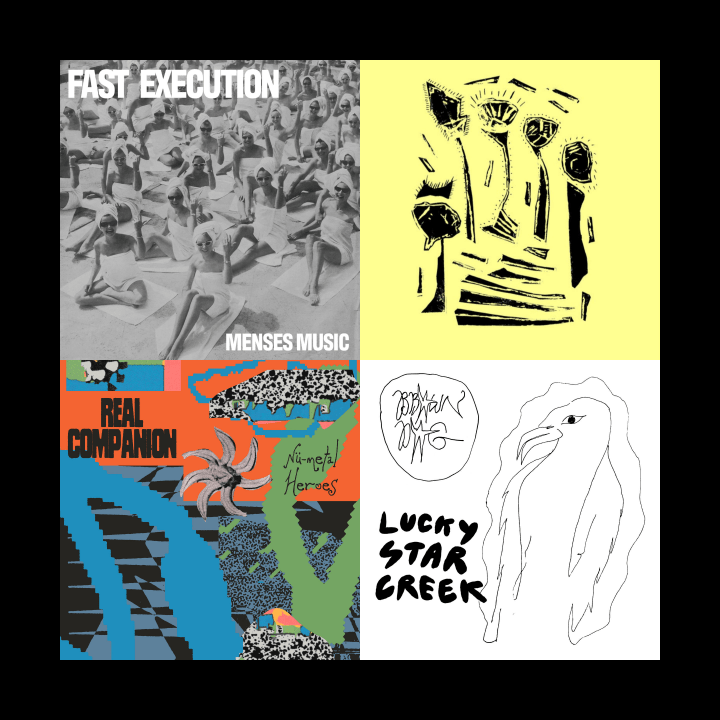
Fast Execution – Menses Music
Release date: August 8th Record label: Dandy Boy Genre: Punk rock, pop punk, fuzz rock, riot grrl Formats: Vinyl, digital Pull Track: All You See Is Weather
Oakland’s Fast Execution are a new punk rock group led by guitarist/vocalist Alex Velasquez (also of Smile Too Much) and featuring her husband, cinematographer Paul Abueg-Igaz, on drums. Their debut record is a six-song 10” vinyl EP out through Bay Area stalwarts Dandy Boy Records called Menses Music, recorded with Dylan Plisken on bass (The 1981’s Alex Halatsis has since joined the band on the four-string, permanently filling the slot). From the title on down, it’s not hard to gather that Velasquez (the band’s main songwriter) is drawing from classic riot grrl on Fast Execution’s first record, although it’s firmly on the more polished and tuneful side of the subgenre–the trio make their brief but memorable first impression to the tune of garage rock, power pop, and West Coast pop punk on Menses Music. As a frontperson, Velasquez does indeed pull off riot-punk sloganeering, but for a record whose press bio says it was inspired by “ire” (at the male-dominated nature of rock music) and “hatred” (of “patriarchal machinations in rock music/modern society at large”), she displays range beyond the anger one would expect across the sub-fifteen minute EP.
Menses Music opens with a song called “Don’t Give Up (Pt. 2)”, which could also be called “the Fast Execution mission statement”. After an audio clip discussing the “hostility” of rock music towards women, the punk guitars launch in a most satisfying manner and Velasquez begins with “I’ve got a message to say, but it’ll probably go unheard / Who’s ever listened to a woman when she’s in rock and roll?”. “Don’t Give Up (Pt. 2)” pulls out all the “punk anthem” stops, but Fast Execution don’t just repeat themselves on Menses Music. The next song on the record, “All You See Is Weather”, is just as catchy but in a more casual way–its hook is a distorted but quite pleasing guitar riff, suggesting a lighter version of the grunge-soaked surf punk of one of their biggest stated influences, Wipers. “What’s Wrong with Me?” is even more of a departure from the opening statement, with the Weezer-esque fuzzy power chords soundtracking a song where Velasquez sounds much more understated, possibly even shy (“Is there something wrong with me? / Why can’t I let it be? / I think I annoyed you once again”). The other sweeping punk anthem on the EP is “Examine Yourself”, which kicks off the record’s second side and revitalizes the acid-tongued punk side of the band. Songs like this one and “Don’t Give Up (Pt. 2)” are clearly the “headlines” of Menses Music (and considering how Velasquez begins the record by speculating she won’t be heard, it makes sense that Fast Execution throw all they’ve got into songs like these)–but what the band are doing below them is almost more compelling. (Bandcamp link)
Real Companion – Nü-metal Heroes
Release date: August 9th Record label: Primordial Void Genre: Country rock, folk rock, alt-country Formats: Vinyl, cassette, digital Pull Track: Painted Hammer
Seth Sullivan is “a sober dad who owns a cheeseburger restaurant”, and he’s also the lead singer and songwriter of Boone, North Carolina group Real Companion. After a demo EP last year, the project properly debuts this year with their first album, Nü-metal Heroes. Along with the other member of Real Companion, multi-instrumentalist/producer Derek Wycoff, the duo create a rich record of alt-country and folk-tinged rock music that’s an inspired choice to dress up Sullivan’s writing. Sullivan grew up in nearby Burke County, and much of Nü-metal Heroes is drawn from recollections and stories from earlier in his life, when he was still traversing down the path that would eventually lead to sobriety, child-rearing, and sliders. Recorded at Wycoff’s “backyard studio”, Nü-metal Heroes feels off-the-cuff but fully developed–whether the duo are trying their hand at spirited country-rockers or more streamlined, almost dreamy folk-pop, their instrumental contributions are pleasing but never taking away from the yarns Sullivan spins at the center of the songs. It all amounts to a palpably Appalachian rock record–one that isn’t constrained by its roots, but that bears the marks of them nonetheless.
Opening track “Painted Hammer” is a keyboard-aided alt-country triumph, its laconic lyrics living up to the music (“My boss was an asshole when I was 21 / I’m almost 40 now and I ain’t got one”), but Nü-metal Heroes doesn’t wait too long to display its other side with the contemplative small town reminiscing of “Amy Lynn” (“Wet swimsuits in an empty grocery bag / Six grandkids all squeezed into the back”). The record’s “rockers” are some of Real Companion’s most immediately impactful moments–the breezy, traditional southern rock of “Great Valley” is a blast, while the psych-tinged “Liberty Dreams” (with poignant lyrics about rural North Carolina teenage goths) and the six-minute “Piedmont Reason” (which is perhaps the western Carolinian version of krautrock) both register as highlights. On the other end of the spectrum, the drum machines and synths placed prominently in tracks like “Weekend Ritual” and “Wild Oak Love Song” give these tracks a more casual, almost bedroom pop feeling (even as the extra instrumental touches the duo give them ensure that there’s a bit more going on under their surfaces). Somewhere between these two ends is “Hometown Snakes”, a slow-moving country-folk shuffle in which Sullivan’s sung-spoken observations conjure up the work of Bill Callahan. “Optimism is at an all time low / But Oxycodone keeps the living slow,” sings Sullivan at the beginning of the track, and while I wouldn’t reductively call the song’s one-word refrain (“Hosanna”) “ironic”, it’s clearly shaped by the lines before it (“A decade of rope / A decade of chains / It’s all the same”). (Bandcamp link)
Cowgirl – Cut Offs
Release date: August 9th Record label: Safe Suburban Home Genre: Power pop, fuzz rock Formats: Vinyl, digital Pull Track: Fading Lights
After a handful of singles and EPs, York quartet Cowgirl made their full-length debut back in 2021 with a seven-song, nineteen-minute self-titled record. Short and sweet, Cowgirl put the band in line with a secretly strong York guitar pop scene also populated by Sewage Farm, The Illness, and their own record label, Safe Suburban Home. For their second album, the band (co-led by singer/guitarists Danny Trew Barton and Sam Coates and rounded out by bassist Jack Jewers and drummer Jack Holdstock) have decided not to fix what isn’t broken–Cut Offs once again spans seven tracks and finishes in slightly under twenty minutes. Nonetheless, Cut Offs (recorded by Euan Hinshelwood at London’s Vacant TV Studios, same as Cowgirl) has plenty of time to impart several albums’ worth of fuzzed-out power pop hooks before it’s all said and done. The record veers from messy garage rock to (relatively) polished college rock throwbacks, but just about everything on Cut Offs is a pop success that ensures the short runtime doesn’t leave anyone feeling shortchanged. With multiple songwriters in the group, it’s perhaps not surprising that the record ranges from “basement Weezer/Velvet Crush ambitions” and “leisurely following pop melodies wherever it takes them”, but Cowgirl ensure that this becomes one of their most endearing qualities.
Cowgirl hit the ground running–the insistent drumbeat of “Against the Night” and the aural coolness of the verses of “Wake Up” start Cut Offs with the quartet at their zippiest. The energy is already there, but the middle of the record is where the band really launch themselves into the power pop stratosphere–between “Fading Lights” (a genuine slacker-pop anthem that pulls together the best of Evan Dando and Gerard Love in its jangly college rock construction and go-for-broke chorus) and “Adeline” (an easy entry into the “power pop songs whose titles are just a girl’s name” hall of fame), some of the best guitar pop music I’ve heard this year is right in the center of this little album. The Flying Nun-tinged guitar-hook excellence of “Out of Place” would be a clear highlight in most places, but here it merely keeps the massive momentum Cowgirl have conjured up rolling steady. With no space for “weak spots”, the stop-start, distortion-laden “Nobody Cares” is probably the closest thing Cut Offs has to an “album track”, but there’s still plenty of catchiness strewn about that one, and “Wasting Time” indulges just a bit in dramatics to create a memorable final rock and roll sendoff. It’s a strong final statement–but once again, it’s just Cowgirl keeping things consistent. (Bandcamp link)
Brown Dog – Lucky Star Creek
Release date: May 28th Record label: River House Genre: Alt-country, folk rock Formats: CD, digital Pull Track: Auditorium
Back in 2021, Berkeley’s Brown Dog released See You Soon, the act’s first record. At the time, the band was a duo made up of singer-songwriter Milo Jimenez and multi-instrumentalist Haniel Roland-Holst, but in the past few years a live lineup has congealed featuring bassist Stew Homans, pedal steel player Jeff Phunmongkol, and drummer Elihu Knowles, all of whom (along with backing vocalist Sayler McBean) contribute to Lucky Star Creek, the second Brown Dog LP. As the presence of pedal steel suggests, Lucky Star Creek does indeed fit comfortably into the worlds of alt-country and twangy folk rock, but what the expanded lineup does not portend is loud, electric country rockin’. There are a few noisier moments on the album, sure, but on the whole Lucky Star Creek is a restrained and pensive listen, the extra instruments being more likely to dress up a song indebted to bedroom folk and even slowcore than they are to launch a rambling rocker. Jimenez sounds weary as a writer and vocalist throughout Lucky Star Creek, and the rest of Brown Dog manage to sound full and clear while still matching (or, at the very least, not contradicting) their frontperson.
Brown Dog move through a dozen songs in 34 minutes in Lucky Star Creek–a lot of these songs are on the brief side, and along with their laid-back delivery, require a couple of listens to really reveal themselves. One such song is “Red Teeth”, the minimal, pin-drop quiet opening track, a Sparklehorse-esque piece of rural creek folk music that never gets louder than the mandolin, banjo, and harmonica-led introduction of the song. If that doesn’t hook you immediately, there’s a good chance you’ll perk up with the advent of the record’s next couple of tracks, the pedal steel-heavy alt-country of “Auditorium” and the deliberate but fully-developed country rock of “No Answers”. The majority of Lucky Star Creek falls somewhere between these two tentpoles–the chilly “Estuary Sara” and (especially) the downcast drama of “Shoulders” bring the electric side of Brown Dog to the forefront later on in the record, but they still sit nicely alongside quieter fare like “Apartment 12” and “Four Miles”. Lucky Star Creek departs just as quietly as it came into frame–the instrumental, ambient-country “Leaving Words” gives way to one last acoustic folk song, in this case the title track. “Lucky Star Creek” ends with a little bit of post-song noise–maybe it’s the band shutting off the recording and leaving the room to let you sit with the album alone. (Bandcamp link)
It’s time for the Thursday Pressing Concerns, and today we’ve got a bunch of great albums that are coming out tomorrow, August 9th, to look at below. New LPs from Quivers, Jr. Juggernaut, Energy Slime, and Share grace this edition, so check them out and get excited for ’em below. This is a great finale to a great week on the blog, which also featured a Monday Pressing Concerns (looking at records from Biz Turkey, Friendship Commanders, TIFFY, and Smokers) and the July 2024 playlist on Tuesday, so check those out, too.
If you’re looking for more new music, you can visit the site directory to see what else we’ve written about lately. If you’d like to support Rosy Overdrive, you can share this (or another) post, or donate here.
Quivers – Oyster Cuts
Release date: August 9th Record label: Merge Genre: Indie pop, power pop, college rock, jangle pop Formats: Vinyl, CD, digital Pull Track: Pink Smoke
I’ve written about a fairamountofAustralian indie pop bands on this blog before, but, believe it or not, I’ve only really scratched the surface of everything going on down there. For instance: before now, I’d never written about Quivers, a Hobart-originating, Melbourne-based quartet who were last seen in 2020 releasing an album-length cover of R.E.M.’s Out of Time and then an original album (Golden Doubt) on Bobo Integral and Ba Da Bing! the following year. Quivers actually have roots going back even further than that–half of the band (vocalist/guitarist Sam Nicholson and guitarist Michael Panton) appeared on the first Quivers record, 2018’s We’ll Go Riding on the Hearses, but Golden Doubt added bassist/vocalist Bella Quinlan and drummer Holly Thomas, and this is also the lineup that appears on Oyster Cuts, their debut for Merge Records. On their third album of original material, Quivers are dogged pursuers of perfect guitar pop–their mix of college rock, C86, power pop, and new wave is as shined up and sparkly in its presentation as Nicholson and Quinlan’s vocals are intimate and distinct. For all its ambition, Oyster Cuts stubbornly declines to embrace anonymity–it doesn’t hide the fact that it was made by Australian lifers who love The Chills and Pavement, nor does it stop at that surface-level descriptor.
I don’t want to get too hung up on the first track, because all of Oyster Cuts is worth dissecting, but “Never Be Lonely” is such an incredible proof-of-concept song for the entire idea of “indie pop”. It’s just as effective in its laser-precision as “real” pop music with its chugging power chords and flourishes of guitars and synths, and Quinlan touches something palpably emotional as a vocalist. But at the same time, Quivers have the freedom to sing something like “All I ever wanted was a true friend / All I wanted was a friend with benefits / All I ever wanted was transcendence,” let it linger with the power of the greatest 80s pop songs you could name–and then move onto something completely different with “Pink Smoke”. “Pink Smoke” recalls the more low-key, laid-back side of Aussie guitar pop, but when Quivers sing “People go together ‘til they’re intertwined” as a unit, it sounds just as huge as the song that preceded it. The “Shady Lane” nod in “Apparition” is pretty undeniable, both in how good Quivers make it sound and its ability to commune with the rest of the track (another key lyric: “I can hear you loud and clear, but I don’t know what you’re saying”). Oyster Cuts indulges in three different five minute power ballads, but that’s hardly an issue given their quality (the smooth soft rock of “Grief Has Feathers” is my favorite, but I won’t hear a bad word about the swooning “Screensaver” or the smoky “Reckless”, either). This side of Quivers is quite impressive–but then, so is their ability to seemingly put everything they’ve got into something like that and then turn around and rip through a two-minute power pop tune like “Fake Flowers”. (Bandcamp link)
Jr. Juggernaut – Another Big Explosion
Release date: August 9th Record label: Mindpower/Nickel Eye Genre: Alt-rock, power pop, grunge pop, fuzz rock Formats: Vinyl, digital Pull Track: Come Break My Heart
Who doesn’t love Sugar’s Copper Blue? I’ll tell you who certainly loves Sugar’s Copper Blue–Jr. Juggernaut, a Los Angeles-based alt-rock/power-punk trio who’ve just put together an album honing in on the sound Bob Mould’s band achieved on their 1992 classic. Jr. Juggernaut have actually been around for quite a while–since 2005, they’ve put out three full-length albums and a handful of EPs and singles (including a split release with the great Two Cow Garage in 2009). Singer/guitarist Mike Williamson and drummer Wal Rashidi have been in the band since the early days, but they welcome bassist Noah Green to the fold on Another Big Explosion, their fourth LP and first in eight years. Green’s main band, The Pretty Flowers, makes more laid-back, Replacements-indebted pop punk, but Jr. Juggernaut embraces a louder, more dramatic sound pulled from the moment “underground rock” bubbled to the surface. There’s nothing on Another Big Explosion that could be described as “slacker” or halfhearted, from Williamson’s 110% all-the-time vocals to the Modern Rock Radio-ready hooks to the cranked-up, heavy-duty alt-rock sheen of the music (Washidi and Williamson co-produced the record, and were clearly on the same page as to how huge it should sound).
There’s a Mouldian “pop music as endurance test” element to Another Big Explosion–the ten songs are almost all in the four-to-five minute range, and they’re roaring at full blast pretty much the entire time. It’s a key ingredient in making the album feel like a towering mountain, but Jr. Juggernaut summit it nonetheless, from the triumphant yet chilly all-in opening of “Come Break My Heart” onwards. Lyrically, Williamson traverses well-trod pop music territory, with songs like “Hang On”(punched up by pop punk “woah-ohs”) and “Everything I Touch” (“…turns black and blue”) taking the shapes of their title sentiments. I don’t mean to make it sound like faint praise, but the simplicity works on Another Big Explosion–the most impressive and important part is that Williamson, after leading a punk band for two decades, can tap into something this primal to match the urgent, frantic, sweeping pop songs that Jr. Juggernaut are playing here. Williamson’s howls are all of that, but they’re also form-fitting, able to sell the moments of might and of shier power pop hooks in tracks like “Million Miles”, “I Believe”, and “Lonely Boy” (which bounce between a few different classic punk-pop tricks, keeping things just fresh and distinct enough). Another Big Explosion also separates itself from the pack by going just as hard in the clear “album tracks” (like mid-record pounder “Inclined” or closing barnburner “Total Darkness”) as in the obvious singles like “Everything I Touch” and “Come Break My Heart”. It would’ve been a record worth fishing out of the bargain bin thirty years ago, and it’s worth taking in as a whole now. (Bandcamp link)
Energy Slime – Planet Perfect
Release date: August 9th Record label: We Are Time Genre: New wave, synthpop, post-punk Formats: Vinyl, digital Pull Track: Clowning Around
As a producer and engineer, Vancouver’s Jay Arner has worked with bands like Tough Age, Apollo Ghosts, and Fortunato Durutti Marinetti, but he’s made his own music for just as long–he spent the 2000s playing in Western Canada groups International Falls and The Poison Dart, and he put out three solo albums in the 2010s. All of Arner’s solo material has featured instrumental and vocal contributions from his spouse, Jessica Delisle, and the couple also have a project they co-helm called Energy Slime. Energy Slime debuted back in 2014 with a lo-fi psych pop EP called New Dimensional–after a decade away, Planet Perfect is the group’s first full-length, and it finds the duo adapting their sound for the big screen. Arner and Delisle are still pretty offbeat–psychedelia, prog-rock, and synth-funk shade these ten songs–but on Planet Perfect, these odd detours are kept to the margins and only ever employed in the service of dressing up pop songs. Planet Perfect is a home-recorded synthpop album that isn’t at all constrained by the circumstances of its creation, both in the memorable vocal hooks (delivered by both Delisle and Arner) that would shine through no matter what and in the maximalist yet streamlined arrangements the duo give these tracks.
To some degree, Planet Perfect sounds like giving a couple of 80s pop wizards the keys to the recording studio and letting them cook–with the lack of excess or obviously dated production choices being the primary timestamp suggesting otherwise. The record is one lavishly-presented polished pop exercise after another, with “Throw Me a Bone” featuring soaring synths and a real-deal guitar solo right in the midst of its lackadaisical structure, while “Negative Attention” is a piece of garishly-bright pop balladry, and “Magic Wand” bubbles under the surface of Arner’s relatively subtle vocals. The synth-led power pop of “Clowning Around” combines that robotic main riff with propulsive verses and an almost prog-pop chorus–it shouldn’t be on paper, but it’s one of the most immediately accessible songs on Planet Perfect. The new wave-y “High Society” recaptures some of that energy in Side Two, but the album’s back end is also where Energy Slime let some of their more groove-based tendencies rise to the surface. Although this manifests in “Live or Die” mainly via a greater emphasis on rhythms, the title track is full-on electro-funk, spoken-word segment and everything, and “After Life” embarks on a five-minute steady synthpop trek to close out the album. Planet Perfect starts to feel like a real place after a while–after ten years away, Energy Slime are immersed in it enough to fully embody the feeling the phrase evokes. (Bandcamp link)
Share – Have One
Release date: August 9th Record label: Forged Artifacts Genre: Alt-country, garage rock, basement rock Formats: Cassette, digital Pull Track: County Lines
Share is a new band made up of three Bay Area indie rock veterans–singer/guitarist Jeff Day has played in post-hardcore groups Calculator and Never Young, Peter Kegler (also singer/guitarist) leads alt-country group Half Stack, and bassist/drummer Dylan Allard has been busy between Freak No Hitter, Fake Fruit, and Jay Som. Share arose during the pandemic–all three of them had songs they were working on, and this new project allowed them to bring all their ideas to the table as “creative equals”. Day moved to Los Angeles in 2021, delaying their on-record debut, but they continued to piece Have One together, finally finishing it last year and releasing it via Forged Artifacts (Greg Mendez, Ahem, Sonny Falls). The three-headed composition is perhaps why Have One is such an odd-sounding record–it’s certainly in the realms of “slacker rock” and “college rock”, putting it alongside new records from indie rock lifers like Dogbreth, Dusk, and their labelmates Ahem, but it’s not as cleanly devoted to power pop as those acts. That’s certainly a part of it, but Share is a repository for all sorts of rock and roll ideas, from garage rock to post-punk to psychedelic alt-country.
“Fallin Back on U” kicks off Have One with a pleasingly Frankensteined-together rock anthem–there are moments of Thin Lizzy-esque guitar soloing, country rock dust, jangle pop, and a lead vocal that’s way more aggressive and almost paranoid-sounding for this kind of song. It’s kind of an “anything goes” mission statement opener–which means that, even though the mid-tempo, Big Riff-led garage-y post-punk of “It Spins” that immediately follows it is a sharp left turn, it’s not exactly “out of nowhere”. The highest concentration of “Share as a pop band” is found right in the middle of Have One–“(Surfing to) My End” is some pleasing West Coast psychedelic country pop, “Memories” finds the trio polishing up their sound for a bit of smooth, propulsive alt-rock, and “County Lines” provides enough “power pop” for the entire record in its four-point-five-minute windows-down ecstasy. The back end of Have One does offer up one last slacker-rock singalong anthem (“Cruiser”), but the record bows out with a six-minute tune called “The Light, It Pulls You In” that spends the majority of its length meditating on a simple, slow-building instrumental before finally finding blown-out catharsis in its final minute. It’s a memorable cap for a record that doesn’t have a “central” leader but nonetheless never feels aimless or directionless. (Bandcamp link)
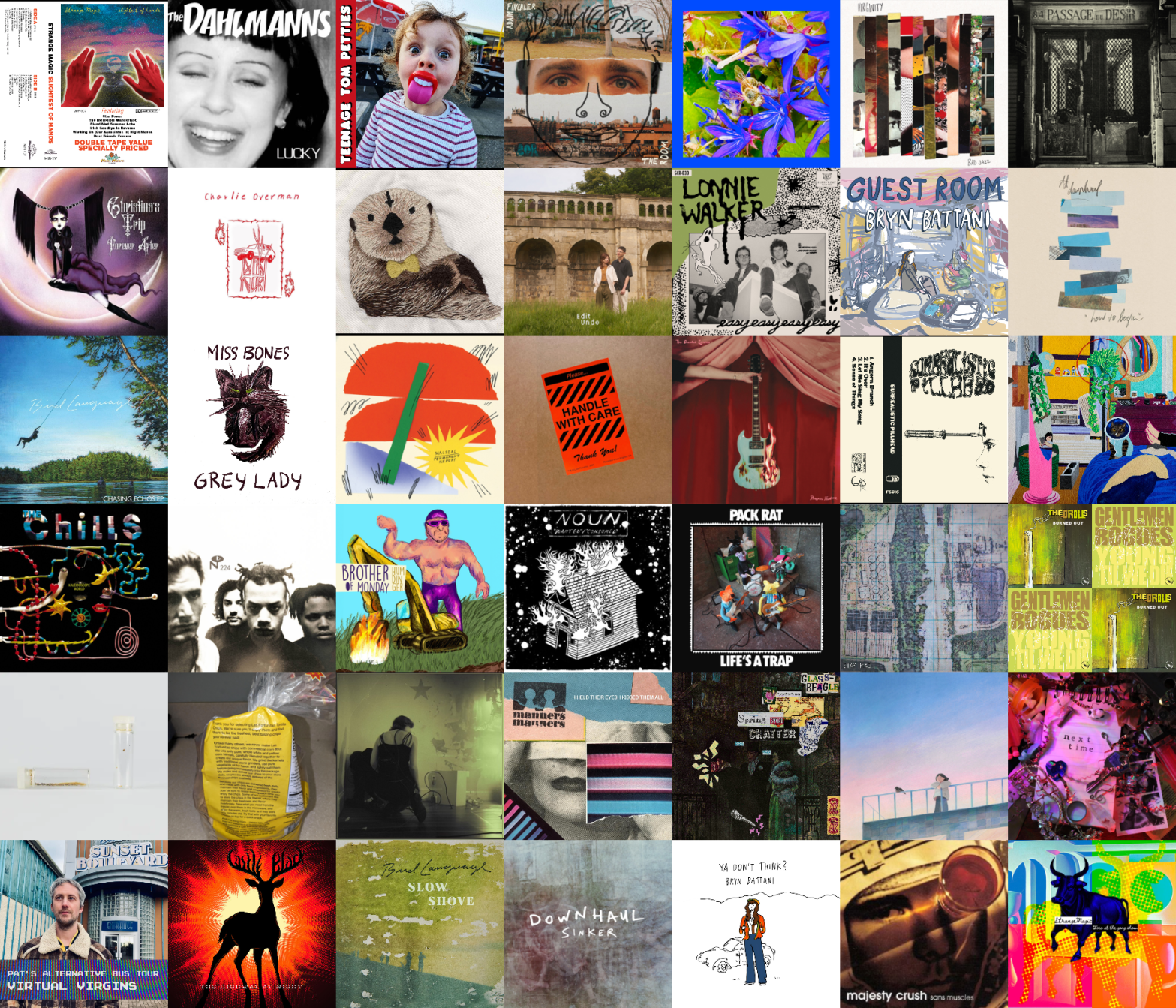
Hey there, readers and guests! The July 2024 playlist is here (I thought about trying to get it done last week, but I had a few things to wrap up around the end of the month and August 6th isn’t that late), and it’s an instant classic, I can tell. A ton of new music is down below–almost everything here is from this year, although there are a couple of exceptions for a recently-departed indie pop icon, an excellent undersung band I saw live recently, and a newly-reissued lost 90s shoegaze group. Read on to find out what I mean by those!
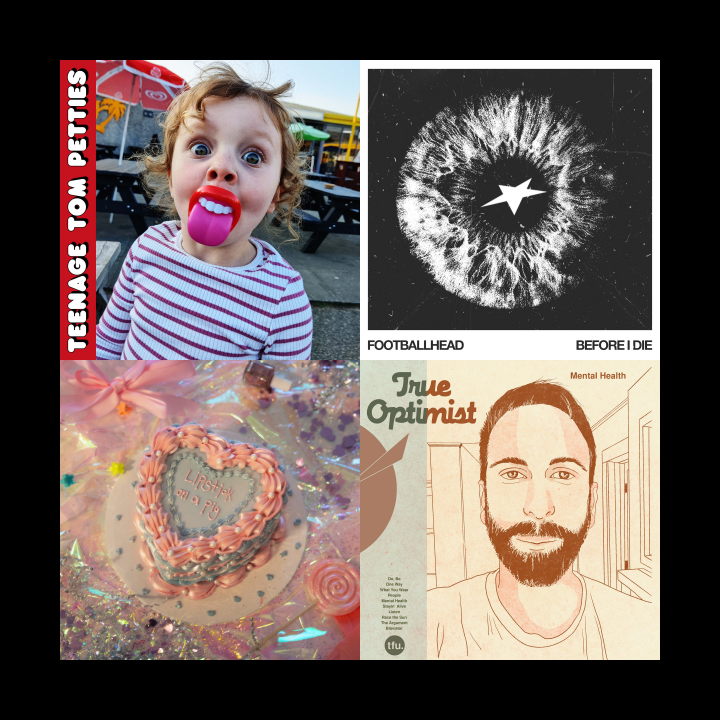
Teenage Tom Petties, Christina’s Trip, and Adam Finchler all have more than one song on this playlist (two apiece).
Here is where you can listen to the playlist on various streaming services: Spotify, Tidal (missing a song), BNDCMPR (missing three songs). Be sure to check out previous playlist posts if you’ve enjoyed this one, or visit the site directory. If you’d like to support Rosy Overdrive, you can share this (or another) post, or donate here.
“Hold on to the Dream, Dreamer”, Strange Magic From Slightest of Hands (2024, Mama Mañana)
An underappreciated member of the current power pop revival, one can’t say that Albuquerque, New Mexico’s Javier Romero hasn’t been busy as of late. Arising from a self-imposed mission to write, record, and mix one song a week for all of 2022, the following year saw the release of four different albums from his project Strange Magic. Admittedly, these slipped by me–but not to worry, as Romero put together a cassette of twenty-two highlights from these records called Slightest of Hands that came out in May. There’s a lot of good stuff on it, but “Hold on to the Dream, Dreamer” hits hard and immediately–it’s the perfect mix of distorted, darkly-clouded guitars and delicately melodic vocals. The instrumental surges in the song’s refrain, but we can hear Romero just well enough.
“Lucky”, The Dahlmanns From Lucky (2024, Snap)
Hey, check out this cool new guitar pop band I just stumbled upon! Well, “new” probably isn’t the right word for The Dahlmanns, as the Scandinavian group have been around since at least the beginning of the 2010s. They’ve put out a couple of albums, but the bulk of their releases have been singles and short EPs–which also describes the record that caused me to discover them, the three-song Lucky. The record contains two covers as B-sides (their take on Tom Petty and the Heartbreakers’ “A Thing About You” is excellent), but the original A-side and title track is my favorite. It’s just pitch perfect power pop/indie pop from the get-go, starting with choppy power chords, adding in an ascending jangle, and the chorus sounds weary but strong enough to stand up against the energy The Dahlmanns (a pseudonymous group; there’s supposedly five of them on this EP) give the rest of the track.
“I Got Previous”, Teenage Tom Petties From Teenage Tom Petties (2024, Repeating Cloud/Safe Suburban Home)
The third Teenage Tom Petties album in as many years (and second self-titled one) is almost entirely bedroom-recorded alone by Tom Brown, but it’s got the attitude to match last year’s full-band Hotbox Daydreams. Opening track “I Got Previous” is a massive-sounding power pop/slacker rock anthem (yes, it’s worth of the A-word) that balances instant mythmaking (the title phrase, which I suspect will enter my lexicon as soon as I figure out how to incorporate it), nods to the trailblazers (“I got a plan, though / I’m Evan Dando”, as well as The Blue Album just in the song’s whole vibe), and self-effacement (the humble delivery of “Hey Jeanine / Yeah, it’s me / Tom from ‘93”, as well as the use of “clusterfuck” and “liquid lunch” as personal descriptors)–all over a wobbly but effective wall of guitars. Read more about Teenage Tom Petties here.
“Patrick”, Adam Finchler From The Room (2024, Window Sill)
Musically, “Patrick” is one of the absolutely friendliest and most immediate moments on The Room–it’s an incredibly potent guitar pop song that finds Adam Finchler fully embracing peppy indie pop. Lyrically, “Patrick” is a cypher–Finchler studies the titular character with an obsessive voice, with every line almost revealing something (“Patrick, everybody loves you / Patrick, no one doesn’t like you … / Patrick, every little movement / Patrick, you create a universe / Patrick, you’re a cosmic dancer”), up until Finchler reaches the conclusion that sounds uneasily fantastic in light of all that’s come before it (“I wish I could be just like you / I could own your ugliness”). Read more about The Room here.
“My Toxic Friend”, The Reds, Pinks & Purples From My Toxic Friend (2024, Burundi Cloud)
You have to listen to all of it. All the “normal” LPs, all the Bandcamp-only albums, the covers EPs, the one-off singles, the self-recorded, self-released outtakes. Because with Glenn Donaldson, you just never know. In mid-July, Donaldson released a two-song single under his Reds Pinks & Purples alias, and the A-side of it might just be my favorite song he’s ever done. At the very least, it’s some of the best power pop-adjacent writing the San Francisco “sadcore” singer-songwriter has ever pulled off–Donaldson’s no stranger to soaring electric guitars, to be sure, but it’s still exhilarating and just a bit surprising when “My Toxic Friend” really just goes for it in the chorus. Maybe Donaldson has to make “My Toxic Friend” sound like this, as a way of exorcising the rough relationship alluded to in the song’s title. The lyrics are blunt, but you know what Donaldson means by them (if you don’t, I envy you).
“Any Good Thing”, Virginity From Bad Jazz (2024, Smartpunk)
Daytona Beach’s Virginity are the latest Florida band competing in the power pop-pop punk-emo sweepstakes to come to my attention, on the occasion of their third album, Bad Jazz. Their Bandcamp page says that they’re “just trying to be Superdrag”, and they also covered Superdrag’s “I’m Expanding My Mind” back in 2020, practically begging me to use that band instead of Weezer as their major 90s power pop sonic touchpoint. Well, I’m sidestepping that debate a bit, as the song I liked most from Bad Jazz, “Any Good Thing”, takes a step away from the alt-rock wall-of-sound guitars and steps into the world of jangly college rock. That guitar intro is incredibly blissful, and it’s a short but eventful walk from there to the chorus, where Virginity really embrace their power pop side–both in the construction of it, and in the refrain (“I could talk myself out of almost any good thing”, repeat ad nauseam).
“Scooter Blues”, Johnny Blue Skies From Passage Du Desir (2024, High Top Mountain)
Alright, Sturgill Simpson, you’ve won me back. Not that he’d ever “lost” me–his bluegrass albums and The Ballad of Dood & Juanita were perfectly fine with limited replay value in my book–but Passage Du Desir is pretty clearly his best work in this decade, if not his greatest front-to-back LP overall as of yet. Simpson–sorry, “Johnny Blue Skies”, which he’s calling himself to remind us that he’s a very special guy–sounds revitalized and relaxed throughout Passage Du Desir, and nowhere is that more apparent than “Scooter Blues”, the album’s lynchpin. From the opening lyrics (“I’ve been feeling like a piece of rice paper / Think I’ll move to an island and turn into vapor”) onward, it’s a powerful piece of smooth country-rock manifesting–Simpson doesn’t even need to state the obvious like he does in the refrain (“When people say, ‘Are you him?’ I’ll say, ‘Not anymore’”), but he sounds so great doing it that I don’t mind.
“I’ll Take It”, Christina’s Trip From Forever After (2024, Cherub Dream)
Forever After is the most pop-forward record I’ve heard from Cherub Dream Records yet–led by Christina Busler’s clear vocals, the album’s eight songs float pop melodies towards the listener wistfully but confidently. The guitars are loud but not overly distorted or blanketing, recalling underappreciated 90s indie rock groups like The Spinanes and Velocity Girl and even early guitar-based dream pop, while the band’s lo-fi, off-the-cuff attitude evokes prime K Records. The second half of the record might be the best half–at the very least, that’s where you’ll find “I’ll Take It”, the song that, despite being a bit of a departure from the rest of the album, was the one that hooked me initially. It’s a showstopper–a searing four-chord ballad that’s breathtaking in its blunt discomfort–and it will leave you with an emotional hangover of sorts. Read more about Forever After here.
“Cuttin’ My Hair”, Charlie Overman From Charlie Overman (2024)
Lately I’ve been finding myself impressed with the self-titled debut album from Charlie Overman, a country singer-songwriter from Lexington, Kentucky. Charlie Overman is pretty much exactly what I want in an Appalachian country record these days–in touch with tradition but not wedded to it, incredibly catchy, funny, and with plenty of fiddle and banjo. “Cuttin’ My Hair”, my favorite song on the album (closely followed by “Canada Thistle”, which just missed this playlist), is Overman’s best attempt at proving his bluegrass bona fides. Overman’s train of thought is gripping as always on this one, jumping from reminiscing about being stoned by the university to “doing tattoos after art school” to imagining a life as a “rock and roll star”. I believe this is the “longhair bluegrass” that Robbie Fulks sang about.
“Anton Lavey”, Awful Din From Sunday Gentlemen (2024, We’re Trying)
For whatever reason, I always get Anton Lavey and Timothy McVeigh confused–so I was definitely confused by the title of the lead-off song from Awful Din’s latest EP at first. I’m on the same page as them now, and I’m definitely on board with the Brooklyn quartet’s oddly catchy emo-punk ambivalent tribute to the founder of the Church of Satan. There are two equally potent hooks here, the grandeur of the first half of the hook (“Taming lions and Marilyn Monroe / You’re so apocryphal”) and the quiet-loud stopping and starting of the second half that gives the EP its name. “Anton Lavey” the song doesn’t hesitate to go in on the titular figure (“Are you worshipping power or worshipping Pan? / Can you innovate or just regurgitate Rand? / …. / There’s no conviction in what you’re about / There’s always a way out”), but is the rejection of Lavey just continuing the thread of what he championed? Eh, whatever, sounds great.
“Infinite Possibilities”, Happy Accidents From Edit Undo (2024, Alcopop!)
Musical duo (and real-life couple) Rich Mandell and Phoebe Cross have been known to me for a while as the rhythm section of ME REX, one of the best bands currently going “across the pond”, but the two of them have been making music together as Happy Accidents for a decade. I admit that I hadn’t checked out Happy Accidents before now, but the lead single from their most recent, upcoming record Edit Undo got my attention immediately. “Infinite Possibilities” is a slow-moving, snaking pop song that soaks up every second of its four-minute runtime. Mandell’s casual-sounding vocals surprisingly kick things up a notch for a “slacker” but still moving chorus (Cross, behind the drumkit, joins him briefly but memorably in the refrain), and the lyrics slowly but agreeably give into paranoia and dread when it comes to the titular limitlessness (“Infinitely catching colds / Infinitely breathing mold”).
Raleigh, North Carolina’s Lonnie Walker follow in the tradition of the more sprawling side of southern garage rock on Easy Easy Easy Easy, taking scenic routes and augmenting their barebones rock and roll setup with extended jams and hot, humid psychedelia to match the frantic energy of frontperson Brian Corum’s writing and performance. Several songs on Easy Easy Easy Easy cross the five-minute barrier–like “Busy Bold Sounds”, a triumphant piece of garage-y power pop that sounds effortless and doesn’t drag for a moment. The fist-pumping chorus and the jangly, shimmering guitars that immediately follow it are both so pleasing that Lonnie Walker can repeat them for as long as they want and I don’t think they’d ever lose their respective charms. Read more about Easy Easy Easy Easy here.
“Ya Don’t Think?”, Bryn Battani From Guest Room (2024)
“I don’t think your parents would like me much / They’re in the business of keeping their son / And I’m a distraction,” great stuff from Minneapolis’ Bryn Battani, here. There’s a lot that goes into the lead-off track of her latest EP, Guest Room–there’s a kind of whimsical 2000s alt-pop attitude to the construction and delivery, there’s some 2010s “indie folk” whistling and violin, while at other moments the song takes a rootsier/“Americana”-tinged shape. In the wrong hands, this combination would suck, but Battani has an excellent song on her hands with “Ya Don’t Think?”, a track that pulls off lightheaded and deep, oversharing but still keeping some things close to the vest, and dodging between the various genres without sounding contrived.
“Sinker”, Downhaul From How to Begin (2024, Self Aware/Landland)
Rosy Overdrive has been a booster of all things Downhaul ever since their last LP, 2021’s PROOF, so it’s no surprise that I’m heavily anticipating their upcoming third album, How to Begin (and their first for Self Aware Records, a Coastal South pairing that just makes too much sense). There are two songs from the album out already–my favorite of the two is lead single “Sinker”, which I knew was a classic pretty much from the moment I heard it. The notes for the album indicate that Downhaul attempted to make something more streamlined and accessible after the experimental emo/post-rock touches of PROOF and last year’s Squall EP, and “Sinker” is certainly a success in that regard. Singer Gordon Phillips sounds right at home on the song’s rambling alt-country instrumental, gliding across a sharp two-minute pop song that doesn’t lose any of Phillips’ keen, attention-grabbing writing regardless.
“Slow Shove”, Bird Language From Chasing Echos (2024)
Bird Language is a quintet from Boston made up of a few longtime local indie rockers; their first album, 625 Days, showed up in 2022, and the four-song Chasing Echos EP is their first record since then. The group’s Bandcamp page describes their sound as “ambient pop rock”, a descriptor that I imagine could mean a variety of different things to different people. To Bird Language, it apparently means “sounds like Matthew Sweet”–or, at least, that’s what the EP’s lead-off track, “Slow Shove”, recalls to me. It’s a great pop song regardless, mind you–it’s a mid-tempo, well-orchestrated power pop track with a bit of maximalist 1970s AOR energy to it, too. About two-thirds of the way through “Slow Shove”, it shifts entirely, picking up the tempo and drama for a big finish. It’s effectively two ideas grafted together, but Bird Language pull it off seamlessly.
“McRib”, Miss Bones From Grey Lady (2023)
“McRib” is the best song I’ve heard about being trans in a long time. Okay, okay, let’s back up for a second. Miss Bones is the project of June Isenhart, who plays in The Michael Character along with Lonesome Joan’s Amanda Lozada, and Miss Bones and Lonesome Joan recently did a string of shows together I was fortunate enough to catch. “McRib” blew me away when I saw it, both in Miss Bones’ incredibly electric, spirited version of the track at the show and in the lyrics (the refrain begins with “I’m breaking back into the garden / I’m taking back what I was promised”, and lands the titular metaphor from that starting point). The recorded version is a little slower and more like dreamy folk-pop (compared to a more power pop reading live), but either way it’s great and powerful stuff.
“Permanent Repeat”, Macseal From Permanent Repeat (2024, Counter Intuitive)
Back when Yeah, No, I Know came out in 2017, Farmingdale, New York’s Macseal was a clear-cut fourth-wave emo group, but they’d been hinting at a sonic expansion ever since 2019’s Super Enthusiast. While Ryan Bartlett and Cole Szilagyi still sound like “emo vocalists”, it’s more than fair to say that Macseal has straight-up transformed at this point–their latest record, Permanent Repeat,immerses itself in the worlds of power pop, polished pop punk, and even widescreen “heartland” indie rock across its eleven tracks. The title track is both a clear example of this and something of a subversion–the band barrels through “Permanent Repeat” for nearly three minutes before tacking the full version of the refrain (the catchiest single moment on the entire album) on at the end, upending any sort of traditional pop structure. Read more about Permanent Repeat here.
“Just Like Eddie”, Love Fiend From Handle with Care (2024, In the Red)
Hey, Love Fiend–Ric Ocasek called, he said “Let the good times roll”. It’s probably unfair to reduce Love Fiend to a modern-day Cars tribute act (not that that’s a bad thing to be), given that the delivery of the band’s lead singer makes them sound closer to that than they actually are, but their In the Red debut, Handle with Care, is some excellent 80s power pop regardless. My favorite song on the Los Angeles quintet’s latest is “Just Like Eddie”, a saxophone-powered rock and roll anthem that’s pretty undeniable to anybody who’s open to the kind of thing I’ve described in these past few sentences. As the band say in the chorus: “Don’t stop, let it rock”. That’s so true, Love Fiend!
“Life Is Funny”, The Dreaded Laramie From Princess Feedback (2024, Smartpunk)
On their first album, Princess Feedback, Nashville’s The Dreaded Laramie are power pop/pop punk mercenaries, zeroing in on the mainstream side of 90s alt-rock revival and blowing it up to eleven. As huge and polished-sounding as its inner contents are messy and uncomfortable, frontperson M.C. Cunningham delivers gut-spiller after gut-spiller throughout the album, largely focused around a breakup but leaping all over the place. As fun as “Life Is Funny” is to listen to, it’s a wildly unhealthy quasi-relationship described therein, the messaging and connecting continuing even after Cunningham’s been left feeling ego-bruised and “humiliated” by the person in question. Read more about Princess Feedback here.
“It’s Over”, Surrealistic Pillhead From Surrealistic Pillhead (2024, Future Shock)
I’ve had this song on the playlist for a while now, and it still confuses me a bit. Surrealistic Pillhead are a new band from Philadelphia featuring a few notable musicians (guitarist Ian Corrigan plays in Star Party, bassist Hart Seely in Sheer Mag), and their debut EP is out via legendary Cincinnati garage rock imprint Future Shock. That being said, I’m not quite sure how to describe “It’s Over”, my favorite song from the EP. Its instrumental is certainly poppy (from the opening melodic guitar line onward), while vocalist Greg Cordera is a rambling speak-singer in the verses and a psych-punker in the chorus. There’s a classic garage rock rousing aspect to the refrain–but the loitering that Surrealistic Pillhead do in the verses in between choruses is pretty entertaining, too.
“Darker Now”, Spirit Night From Time Won’t Tell (2024)
Almost exactly one year after the release of Bury the Dead(one of my favorite LPs of 2023), Spirit Night’s Dylan Balliett has announced his impending fifth album under the name, Time Won’t Tell. After tackling some heady subject matter about his roots in small town eastern panhandle West Virginia on Bury the Dead, Time Won’t Tell (recorded with Miserable chillers’ Miguel Gallego on bass and Rozwell Kid’s Jordan Hudkins on drums) seems like a chance for Balliett to make a breezier jangly power pop album. “Darker Now”, the record’s lead single, is compellingly playful, from its Flying Nun-esque keyboards to its guitar accents (“Jazzmaster noodles” is how Balliett describes them) to the classic handclaps. It’s also about depression, obviously–the lyrics do their best to fight off the seemingly insurmountable darkness at the edge of the hidden bay.
“Satin Doll”, The Chills From Kaleidoscope World (1986, Flying Nun/Creation)
What is there to say about Martin Phillipps? Unlike Chris Knox or (to a degree) David Kilgour, Phillipps’ genius was always front and center in his writing, the most clearly “pop” of the Dunedin greats. Phillipps’ personal struggles meant that there aren’t as many records of his compared to his contemporaries, but all of them from 1987’s Brave Words to 2021’s Scatterbrain are sharp indie pop albums anyone with a passing interest in the genre would do well to check out. I’m sure I’m not the only one whose favorite Chills release is the Kaleidoscope World compilation–obviously the title track and “Pink Frost” are classics, I’ve always been partial to “Doledrums”, but “Satin Doll” is the one that stuck out to me when I put it on the morning I learned of Phillipps’ passing. Its half-awake chamber pop sound was one of the Chills’ most beloved modes, and they excelled at it again and again–as messy as the song’s desk is, there’s never any doubt that it’s going to come up to the podium and nail the chorus.
“Dumb Enough”, Teenage Tom Petties From Teenage Tom Petties (2024, Repeating Cloud/Safe Suburban Home)
The latest Teenage Tom Petties album has enough bangers on it that it’s understandable to get overwhelmed by it all. Tom Brown has sequenced it pretty well, though–the first half balances lighter fare like “Tuff Top” and “This Autumn Body” with what might the record’s centerpiece, “Dumb Enough”. The electricity of this one is palpable pretty much from the get-go, and it wastes no time in establishing itself as a straight-up Superdrag/Rentals torpedo of a track that would easily be the best thing on the record if there wasn’t also a lot of other very good songs on it. It made this playlist over “Night Nurse” and “Handstands for You Love” and “Hawaiian Air”, true, but really that just means it sounded slightly better than those ones at the moment I had to decide between them. Hard to choose anything else when you get to that chorus, though. Read more about Teenage Tom Petties here.
“Playthings”, Christina’s Trip From Forever After (2024, Cherub Dream)
I’ve already touched on “I’ll Take It”, a breathtaking selection from Christina’s Trip’s Forever After that’s my personal favorite from the album. The only way to follow something like that up is to change tack completely, and Christina’s Trip launch into my second favorite song on the record, “Playthings”, immediately afterwards. The band embrace lo-fi indie punk and American twee in ways they hadn’t previously in the record’s more stately, restrained dream pop/noise pop beginnings on “Playthings”, to pretty undeniable results, and Christina Busler is really on one here (“Are we born to be our parent’s playthings? / To be bought and sold and fucked,” absolutely blistering delivery here). Read more about Forever After here.
“Seine”, Majesty Crush From Butterflies Don’t Go Away (2024, Numero Group)
Like (I’m guessing) many others, my first exposure to 90s shoegaze group Majesty Crush was via Third Man Records’ 2020 Southeast of Saturn compilation, a document of Detroit’s “buzzy, thriving space-rock scene”. Their song “No. 1 Fan” led off that album, and I’ve been waiting for Majesty Crush’s out-of-print discography to get reissued in full since then. Numero Group finally did it with Butterflies Don’t Go Away, pulling together their lone full length plus EPs and singles–my favorite song on it (other than “No. 1 Fan”, which is hard to beat) is one of their final recordings, “Seine”. Originally from 1994’s Sans Muscles EP, “Seine” is a beast, with Hobey Echlin’s bass absolutely slicing through the mix and nicely complimenting David Stroughter’s dark but compelling lyrics and delivery.
“Humdinger”, Brother of Monday From Humdinger (2024, Wilbur & Moore)
Mastered by longtime Robert Pollard collaborator Todd Tobias, Humdinger captures the basement melancholy of pre-Propeller Guided by Voices in the songwriting of Newark, Delaware’s Peter Bothum, aka Brother of Monday. On his second album under the name, his hooks and guitars push against their lo-fi recording but never in a way that makes it feel anything but the appropriate vehicle for the material. In particular, the just guitar-and-vocals recording of the title track captures the pastoral urgency of some of Pollard’s most intimate Suitcase offerings–it evokes the same feeling of something that, upon being “incomplete”, has actually stumbled onto an even more powerful piece of art. Read more about Humdinger here.
“Wanted”, Noun From Wanted/Consumed (2024, Muffler)
Screaming Females may be dead and disbanded (bowing out with last year’s excellent Desire Pathway and this spring’s companion EP Clover), but the good news is that their former frontperson, Marissa Paternoster, isn’t going anywhere. The last EP from her Noun project, In the Shade, was one of my favorites of 2021, and after a quieter solo album released under her own name, she’s picked up the Noun moniker to get back to heavy rock and rolling. Now joined by drummer Phillip Price, “Wanted” leads off a fiery two-song Noun single, an absolute wrecking ball that burns brighter than anything Screaming Females had done in the years before their break-up. It’s vintage Paternoster, recalling brute force rock music from the 70s with her own distinct stamp on it–loud, catchy, and angry.
“Sleepless”, Pack Rat From Life’s a Trap (2024, Hosehead/Drunken Sailor)
Vancouver’s Patrick McEachnie plays in the band Chain Whip, but in 2021 he released a solo album under the name Pack Rat called Glad to Be Forgotten. In the following years, Pack Rat has become a full-on quartet of its own featuring members of Bratboy and Corner Boys, and the evolution is quite apparent on their second LP, Life’s a Trap. Indebted to vintage garage and punk rock, Life’s a Trap is an easily digestible hook-fest; my favorite song is a zippy single going steady called “Sleepless” that’s sung by someone other than McEachnie (it could be anyone–guitarist Bella Bebe, bassist Ripley McEachnie, and drummer Tony Dallas all have vocal credits on the record). The vocals are game to skip along with the music, the motormouth delivery matching the theme of the song (“I don’t know what to do / I wanna go, I wanna be alone”).
“Glide”, Stay Mad From Buddy (2024, Candlepin)
Trying to keep abreast of the plethora of releases that have come out recently via Candlepin Records, one album that caught my ears was Buddy, the debut solo album from Mic Adams. Most notably the drummer for Cincinnati indie rock group The Ophelias, the first record from Stay Mad is a brief but impressive collection of lo-fi rock, bedroom pop, and indie fuzz that fits well on Candlepin’s roster. My favorite song on Buddy is probably mid-record ballad “Glide”, a starry, jangly tune whose lo-fi sheen doesn’t dampen its wistful beauty. It’s a highlight from a rewarding record that suggests Adams should step out from behind the kit more often.
“Happy Hour”, The Drolls From The Drolls/Gentlemen Rogues Split (2024, Snappy Little Numbers)
I’d heard of Austin’s Gentlemen Rogues before listening to their split single with Seattle’s The Drolls, but it was the new-to-me band who really impressed me with their two tracks on the record. A trio featuring Julie D from Guest Directors and Chinchilla and Denny Bartlett and Josh Rubin from Sicko, this split follows an LP in 2022 and a 7” in 2023. “Happy Hour” is a two-minute power-pop-punk anthem that’s over before one knows it, but not before bashing out a multitude of pop hooks and all-hopped-up energy along the way. Their other track, “Burned Out”, is a bit more of a traditional power pop tune (and it’s quite good at it, too), but the sugar rush/pogo-bait of “Happy Hour” is the one that really hooked me.
“The President’s Colonoscopy”, Adam Finchler From The Room (2024, Window Sill)
“You are the president, I’m your colonoscope / We show the people how to take good care / I am swimming in your bile, I’ll be here for awhile / Just looking for the polyp in the world”. Swear to god, this song is really, really good. The Room, the first solo record from Adam Finchler in a dozen years, is irreverent, wide-ranging, and fairly unpredictable–it’s one of the most striking and unique-sounding albums I’ve heard this year. I’ve come to accept that the penultimate song on the album, “The President’s Colonoscopy”, actually might be my favorite one on the record, somehow. The schmaltzy keyboard (both in terms of tone and playing style) fits the “public service announcement” nature of the track. I don’t really know why and how it all works, but somehow when the band joins Finchler as he reaches that final stanza, it’s oddly cathartic. Read more about The Room here.
“I Want a Life”, Mid-Range Jumper (2024)
Once again, Rosy Overdrive finds itself in the relatively rare position of writing about a band’s debut single. This time around, it’s Austin, Texas’ Mid-Range Jumper, a trio of singer-songwriters (Andrés Garcia, Jonah Brown, and Paulo Zambarano) who’ve previously played in bands like Quiet Light, sleep well., and Eli Josef. Although I’m not really familiar with any of their previous work, the first song from Mid-Range Jumper places the trio in the world of fuzzed-up alt-country. “I Want a Life” has a little bit of emo-adjacent earnestness to it, like if Conor Oberst was from Texas, and the song’s rich, mid-tempo verses are just dynamic enough that the chorus can get away with doing little more than repeating the title line longingly. It’s a good start!
“Tortilla Chip Bag Song”, Pacing (2024)
There’s that cliche that people say about singers: “I could listen to them sing the phone book”. I’d say that if this applies to anybody singing these days, it’d be Pacing’s Katie McTeague. When people say that, they mean that the vocalist in question has a really great singing voice, which is certainly true for McTeague, but when I say it, it’s more like “she’d somehow find the most interesting and compelling part of the phone book to sing and have us all on the edges of our seats while singing about various plumbers and electricians”. Anyway, this song is called “Tortilla Chip Bag Song”, and its lyrics are the back of a bag of Las Fortunitas Tortilla Chips. In Pacing’s hands, the bag’s spiel is turned into a peppy, minimal folk-pop hit single, McTeague gamely explaining to us how to microwave chips taken from the freezer (“where they maintain their freshness and flavor indefinitely”) and reminding us to reseal the bag “each time [we] enjoy the chips”. Maybe we’re not supposed to dissect writing like this, so I don’t know if the Las Fortunitas Tortilla Chips bag has an especially memorable essay attached to it, but “Tortilla Chip Bag Song” certainly makes it feel like it.
“Prove Me Wrong”, Jimrat From Jimrat (2024, Who Is)
I don’t know who Jimrat is. I heard about them through an incomprehensible email that sent me to an even more incomprehensible website (Are these photos of the band? No one can say for sure). They seem to be from Boston and have put out music through Denizen Records and Who Is Records (which might be their own label). Their latest record is a self-titled three-song EP with shades of lo-fi bedroom pop, nu-shoegaze, and various other experimental, noisy kinds of pop and rock music. My favorite track on Jimrat is “Prove Me Wrong”, an offbeat fuzz-pop song that sounds like it features either two lead vocalists or one doing a vocally-manipulated duet with themself. Either way, “Prove Me Wrong” is hypnotic and transfixing to me, so I’ll do my best to try to follow whatever Jimrat is.
“Yr Well”, Manners Manners From I Held Their Eyes, I Kissed Them All (2024, 20/20)
I Held Their Eyes, I Kissed Them All, the debut album from Baltimore’s Manners Manners, is the work of indie rock veterans who are still wide-eyed pop believers. The vocals on single and highlight “Yr Well” stay on top of the backing music, but the roaring, dramatic indie rock of that song is the closest that Manners Manners come to crashing onshore–aided by three members of the band $100 Girlfriend on guitar, synthesizer, and vocals, the band thunders through an overwhelming instrumental that only grows and grows. Nonetheless, the chorus comes through clearly: “I have been to your well, and it only flows backwards, upside-down, and to itself”. With the gale force winds of the music behind it, the song’s central rebuke is made all the more strong by its intangibility and opacity. Read more about I Held Their Eyes, I Kissed Them All here.
“Waiting for the Lizard”, Glass-Beagle From Spring Sword Chatter (2024, G-B, Inc.)
Spring Sword Chatter is the debut EP from Glass-Beagle, a Chicago group led by vocalist/multi-instrumentalist Nathan Zurawski and also featuring drummer Mark Burjek, pedal steel player Michael Conway, and guitarist Jack Tekiela. Judging from their first record, Glass-Beagle’s sound can concisely be described as “folk-y alt-country psychedelic fuzz rock”, or something to that effect. Mainly what I know is that my favorite song on the record, “Waiting for the Lizard”, sounds fantastic. The song kicks off with a nice, big electric guitar riff, but it’s not so overwhelming that Conway’s pedal steel and Zurawski’s understated vocals aren’t able to get their moments in the spotlight, too. Glass-Beagle shamble triumphantly through “Waiting for the Lizard”, the first great song from a band I hope to hear more from.
“Handlebars”, Fuvk From What Is the Purpose of Your Visit? (2024, Start-track)
It’s been a minute since I checked in on Austin’s Shirley Zhu and her project Fuvk, but she’s remained busy ever since I named Goodnight, Moon one of my favorite EPs of 2022. Just this year alone, she’s put out two EPs–the latter of which, What Is the Purpose of Your Visit?, is from where “Handlebars” comes. I would imagine that the title of the EP, its Bandcamp description (“corner taken quickly 2024”), and the opening lyrics of “Handlebars” ( “25’s off to a great start / Flipping over your handlebars / Sat with you in the ER”) are all related. At the very least, misfortune has led to another classic piece of folk-tinged indie pop/bedroom pop from Fuvk–Zhu hits a lot of her benchmarks (upfront, frank but melodic speak-singing, acoustic guitars melded seamlessly with electronic elements) in about eighty seconds, leading off another humble but welcome entry into the ever-expanding Fuvk discography.
“Evening Drive”, Bacchae From Next Time (2024, Get Better)
On their second LP, Washington, D.C. punk band Bacchae more smoothly mesh together their post-punk, punk, and pop instincts together for frequently cathartic results. “Evening Drive”, a highlight of the second half of Next Time, is Bacchae’s version of a car song–it’s pop-friendly, with a propulsive beat and exciting guitar soloing, yes, but vocalist Katie McD (who’s spent the majority of Next Time balancing on the edge of nervousness and droll disdain) is still throwing out harrowing descriptions of sharks in the water and other isolation-evoking images. “Hey, maybe / We’ll wait and see / Delay the end / We’ll bide our time,” sings McD in the chorus. Combined with the backing music, the whole ordeal feels great–but then again, so does hitting the slots one more time. Read more about Next Time here.
“Down at the Casino”, Pat’s Alternative Bus Tour From Virtual Virgins (2024)
Glasgow’s Andrew Paterson is a guitar pop veteran, and Virtual Virgins hardly disappoints on this front–the songs are based around breezy, acoustic, C86-influenced indie pop foundations and its leader’s conversational, heavily-Scottish-accented vocals. Paterson’s knack for storytelling and character-building helps the record stand out in a crowded scene, an aptitude that shines on “Down at the Casino”, one of the most polished pop moments on Virtual Virgins. The mid-record highlight is a song as deceptively bright and cheery as the machinery about which Paterson sings–“If it makes you feel better, we’re no longer enjoying ourselves”, he says, as the characters populating the song relinquish their savings to slots and online gambling apps. Read more about Virtual Virgins here.
“Heart Can’t Feel”, Castle Black From The Highway at Night (2024)
It’s a good idea to stick with a record from beginning to end even if it isn’t grabbing you. Castle Black’s The Highway at Night wasn’t doing much for me, but because I let it play through, I got to the record’s final track, “Heart Can’t Feel”, which distills the band’s sound into a sharp power pop-new wave-punk package that works very well. After trying on a few different costumes on The Highway at Night, the New York duo of Leigh Celent and Joey Russo pull off a sharp, energetic closing track that wastes not a second of its three-minute runtime (from the in-the-thick-of-it opening lyric to the sharp rein-pulling of its closing).
Hey there, and welcome to the first Pressing Concerns of the week! If you like the more “eclectic”/”grab bag” kinds of blog posts, this one’s for you: we’ve got new albums from Biz Turkey and Smokers, a new EP from TIFFY, and an alternate version of Friendship Commanders‘ sophomore album down below.
If you’re looking for more new music, you can visit the site directory to see what else we’ve written about lately. If you’d like to support Rosy Overdrive, you can share this (or another) post, or donate here.
Biz Turkey – Biz Turkey
Release date: May 31st Record label: Third Uncle Genre: 90s indie rock, lo-fi indie rock Formats: Vinyl, digital Pull Track: Dylan Goes Electric
Here are a few names I didn’t know about until very recently: Biz Turkey, Graham Wood, Third Uncle Records. The latter two of those have a history together going back to the mid-2000s, when Wood was making music regularly as Gray Home Music, playing with a wide assortment of musicians including Ian Stynes, Matt Retzer, and Josh Hunter (various combinations of the four of them have also played in several other groups together; refer to this Instagram post for details). A few years after the last Gray Home Music album (which came out in 2014), Retzer and Wood both found themselves in Maine and begin making music together as Biz Turkey, although their long-in-the-making self-titled debut record is an amorphous thing–befitting of an album made by a tight-knit group of musicians, Biz Turkey features remote and/or in-person contributions from various sessions featuring Stynes, Hunter, and Retzer dating back to 2016 (the fifth member of Biz Turkey, the mysterious guitarist Conrad Carpenter, is of unknown origins and whereabouts to me). As piecemeal as its origins are, Biz Turkey sounds like the work of a real, coherent band of collaborators (which it is, new project or no), with a clear handle on their specific style of pessimistic-feeling, pop-friendly electric indie rock.
If you like the less jammy side of Built to Spill and the more guitar-based music of Grandaddy, I’ve got great news for you with regards to what Biz Turkey sounds like (the group also recently played a show with fellow Portland, Maine musician Brock Ginther, and the more melancholic moments of his bands Midwestern Medicine and Lemon Pitch are something else of which Biz Turkey remind me). Biz Turkey captures the moment where the basement indie rock of the 90s started transforming into something larger and more aware of the concept of “the outdoors”. As a vocalist, Wood sounds lost but still alert in the midst of these wandering instrumentals–every musician on any given track sounds like they’re following something different, but they’re all so in tune with each other that the puzzle pieces fit nonetheless. “Dylan Goes Electric” is a compelling first song–it gives the feeling that we’ve just stepped aboard a sinking ship. Biz Turkey filters themselves into something resembling power pop in “Loudest Voice in the Room”, an upbeat song that they match a few songs later in the Dough Martsch-ian swirling march of “Well Done” (and then zag in the form of the Jason Lytle-esque “I’m Not Here to Make Friends” right after). Biz Turkey almost gets more of a spine as it progresses, with the last few songs ringing the loudest and clearest. It’s great to hear the full might the band conjure up in “Step Aside” and “What a Disaster”, yes–but that doesn’t take away from the equally-intriguing sound of Biz Turkey groping about in the darkness. (Bandcamp link)
Friendship Commanders – BILL (The Steve Albini Mixes)
Release date: July 22nd Record label: Trimming the Shield Genre: Noise rock, punk rock, alt-rock Formats: Digital Pull Track: Outlive You
In late 2017, Nashville duo Friendship Commanders traveled up to Chicago to record what would become their second album, 2018’s BILL, at Electrical Audio with Steve Albini. The band (singer/guitarist Buick Audra and bassist/drummer Jerry Roe) have always had an interesting sound–on their debut, 2016’s DAVE, they’re an energetic, heavy punk rock group, while they’d fully transformed into an even-heavier, sludgier stoner rock group by last year’s MASS. Charting their trajectory in hindsight, Albini is the perfect choice to aid in that transition, as he’d helped bands like Screaming Females and Cloud Nothings turn from punk-inspired indie rock groups into something more towering in landmark records. BILL was tracked live to tape by Albini and eventually mixed by Roe, but the band held onto Albini’s original mixes and planned to release them at some point–Albini’s sudden and unexpected death became the impetus for the mixes to finally see the light of day. Albini’s touch was already felt throughout BILL via his recording, of course–this new version of the album is less a spotlight on him as an engineer than as a welcome chance to revisit a record that still sounds powerful and tough over a half-decade later.
Plowing through thirteen songs in thirty-three minutes, BILL definitely feels like a punk album–at the very least, Friendship Commanders are making “heavy rock and roll” at this point in their music career. The songs rush by in a blur, whirlwinds of crushing rhythm sections, loud guitars, and Audra’s commanding, centered vocals. Fast punk-powered instrumentals like “Horrify”, “Saw and Heard”, and “Outlive You” stick around just long enough to sear an impression into one’s brain–there are pop sensibilities in their respective refrains, neither outshining nor being swallowed up by the instrumental might found elsewhere in the tracks. Signs of Friendship Commanders’ slower, heavier future are less frequent on BILL, but they’re there, and quite prominently so when they are. Opening track “Your Fear Is Showing”, closing number “Desperately Seeking”, and mid-record centerpiece “In the Afterthoughts” all qualify–one can tell by their positioning in the record and the weight Albini and the band give them that they were proud of being able to pull the likes of these songs off, and it’s not surprising they latched onto this side of their sound in the future. That being said, Friendship Commanders sound their best on BILL when they’re barreling through the last gasps of their punk rock past, which they continue to do as the record winds down in “The Choice”, “Resolution of the Wants”, and “Of the We”. Kind of remarkable how one engineer consistently found himself in the right place at the right time, no? (Bandcamp link)
TIFFY – 2
Release date: August 2nd Record label: Self-released Genre: Dream pop, indie punk, 90s indie rock, power pop Formats: Digital Pull Track: Surf Camp
After a couple of EPs, Somerville, Massachusetts singer-songwriter Tiffany Sammy made her full-length debut as TIFFY last year with So Serious. I referred to that album as an “inspired marriage of jagged alt-rock and more polished pop” at the time, and it felt like what her various smaller releases (also including a few singles and demos) had been leading up to for nearly a half-decade. I wasn’t expecting to hear another TIFFY record less than a year later, but she’s turned around and released a new EP called 2 (somewhat confusingly, her third EP and fourth record), containing three brand new songs and one reworking of a song from So Serious. Perhaps understandably, 2 feels looser and more “low-stakes” than the TIFFY LP–recorded by ringer Justin Pizzoferrato and featuring instrumental contributions from Tom Stevens and Ben “Cutty” Cuthbert, Sammy’s latest release is a pleasing coda to So Serious. While 2 doesn’t try to do everything that Sammy did on her last album, it offers up a bit of what worked on that LP and tries a couple of things beyond that “sound”, as well.
Sammy self-describes her music as “fuzz-tinged dream rock”, and nowhere is this more true than in 2’s opening track, “Mirror”. “Mirror” is also the song from the EP that sounds like it would’ve been the most at home on So Serious to my ears–Sammy and Stevens’ dual guitar attack is on point, offering up a buffet of memorable, catchy leads while Sammy slowly adds more and more drama to her performance as a vocalist as the song rolls forward. “Surf Camp” feels like the classic “B-side that’s secretly better than the A-side” to me–it’s a more laid-back version of TIFFY’s guitar pop, but it’s incredibly well-done, and it really does feel like it’s about to crash upon shore by the time it’s over. Redos of old songs are starting to become a TIFFY staple (both So Serious and the TIFFY EP had at least one)–this time around, she offers up a new version of “Lost in the Shuffle” from her last album. A minute longer than the 2023 recording, “Lost in the Shuffle (2024)” is an extended, more rock-based take on the original’s polished, danceable dream pop (it’s still danceable–I imagine that this louder version is closer to how it sounds in a live setting). “L.A. Fade” closes the record with a memorable, offbeat pop closer, going from bouncy, guitar-forward bummer pop to dreamy and floating and then back again. It’s a strong cap to a brief but welcome drop-in from TIFFY. (Bandcamp link)
Smokers – The Rat That Gnawed the Rope
Release date: June 14th Record label: Mouth Magazine Genre: Punk rock, garage rock, post-punk Formats: Vinyl, digital Pull Track: The Irish Tenor
Oakland’s Smokers have been kicking around for about a decade at this point, and the band’s four members (vocalist/guitarist Andy Asp, bassist Cyrus Comiskey, guitarist Omen Starr, and drummer Jim Nastic) are all Bay Area punk veterans, but The Rat That Gnawed the Rope is the quartet’s first full-length as a group. Some of these tracks had previously shown up as singles and on demo tapes, but the band finally hammered out these fifteen tracks via sessions at San Francisco’s El Studio (with Phil Becker) and Oakland’s Tuff Bunker. The resultant LP is a compelling rock and roll record–calling themselves “pub punk”, Smokers have a somewhat seedy sound harkening back to the earliest days of punk rock. Blistering garage rock and pub rock certainly have footholds throughout The Rat That Gnawed the Rope, but this is straight-up “punk” if I’ve ever heard it, right out of the era before the darker and angrier edges of the genre had splintered into “post-punk” and “hardcore”–listening to The Rat That Gnawed the Rope is to take all of it in at once.
Roughly three decades removed from his work with Lookout! Records country-punk group Nuisance, Asp remains a sharp punk showman of a vocalist, a limited “technical” range supplemented with an impressive emotional one that can switch from conversational to smarmy to tortured easily. With fifteen songs to blast through, Smokers aren’t one to give into embellishments and overproduction on The Rat That Gnawed the Rope, but the occasional trick up their sleeve (like the Hammond organ found in the dark opening track “The Irish Tenor”, or the barroom piano and tambourine injecting just a bit of garage rock chaos into “Rum Ration”, or the acoustic guitar frantically trying to keep up with the rest of “The Strand”) hardly detracts from the band’s raw power. Smokers are certainly serious punk rockers–in some ways, this is a photo negative of the goofy West Coast pop punk that they’ll always be just a degree removed from–but the skill and energy of the group (who, again, have been playing with each other for a decade by now) ensure that stuff like “Cutting Class” and “East of Oakland” are anything but chores to listen to. One of the most spirited songs on the record is the penultimate track, “Deviant Career”–it’s got a spaghetti western outlaw bent to it, but one could apply it to the four-person gang playing these songs, as well. (Bandcamp link)
In a superb Thursday Pressing Concerns, we’re looking at four new records coming out tomorrow, August 2nd: new LPs from Teenage Tom Petties, Cowboy Boy, and True Optimist, as well as a “mini-album” from Footballhead. It’s been a great week on the blog, so if you missed Monday’s post (featuring Nightshift, Sylvia Sawyer James, Goodbye Wudaokou, and Manners Manners) or Tuesday’s (featuring Birdie, Miserable chillers, Rated Eye, and Lowmoon), be sure to check those out, too.
If you’re looking for more new music, you can visit the site directory to see what else we’ve written about lately. If you’d like to support Rosy Overdrive, you can share this (or another) post, or donate here.
Teenage Tom Petties – Teenage Tom Petties
Release date: August 2nd Record label: Safe Suburban Home/Repeating Cloud Genre: Lo-fi power pop Formats: Cassette, digital Pull Track: Handstands for Your Love
Three years, three Teenage Tom Petties albums–and oddly enough, two self-titled ones. The Teenage Tom Petties emerged in 2022 as the lo-fi power pop solo project of Bath, England’s Tom Brown, previously best known as one-half of Rural France (who are still going strong, having released an LP earlier this year, as well). The home-recorded first Teenage Tom Petties album was an entirely Brown affair, but the group ballooned to a three-guitar, five-piece rock and roll band for last year’sHotbox Daydreams, an impressive step forward in more ways than it being the act’s first “studio” album. Brown writes at too quick of a clip for his own band to keep up with him (the fact that two of them live in the United States seems like it’s also a hindrance), so, while there are “plans” for future full-band Teenage Tom Petties albums, the latest record under the name finds Brown back in his bedroom, recording (mostly) alone yet again (Safe Suburban Home’s Jim Quinn contributes some bass, and Repeating Cloud/Lemon Pitch’s Galen Richmond some backing vocals). In a very Weezer-esque move, Brown has declared the second Teenage Tom Petties to be a sequel to the first one by giving it the same title (what nickname will TTP-heads eventually give this record to differentiate it? “The one with the kid on the cover” doesn’t even work).
Brown’s been a sharp pop songwriter for as long as I’ve known of him, but Hotbox Daydreams was a real leveling-up moment for him–it’s just hit after hit. Maybe the band brought it out of him at first, but Teenage Tom Petties II is a worthy sequel not just to its homonymous predecessor, but to the group’s sophomore record, bedroom or no. Opening track “I Got Previous” is a massive-sounding power pop/slacker rock anthem (yes, it’s worth of the A-word) that balances instant mythmaking (the title phrase, which I suspect will enter my lexicon as soon as I figure out how to incorporate it), nods to the trailblazers (“I got a plan, though / I’m Evan Dando”, as well as The Blue Album just in the song’s whole vibe), and self-effacement (the humble delivery of “Hey Jeanine / Yeah, it’s me / Tom from ‘93”, as well as the use of “clusterfuck” and “liquid lunch” as personal descriptors)–all over a wobbly but effective wall of guitars. “Hawaiian Air” is the archetypal “second track” for this kind of music–a little weirder, a little “cooler”, sneakier but just as effective in its hooks (if we’re doing the sequel thing, it qualifies as a more subtle version of “Lambo” from the first album).
The breezier moments on the first half of the album do exactly what they need to do–in the case of “Tuff Top”, it’s to trail off while Brown sings a bit of Jackson 5 over the chords, and “This Autumn Body” has to tilt towards jangly college rock but without abandoning the swagger of the louder side of the Teenage Tom Petties. In both cases, they’re just light enough to compliment “Dumb Enough”, a straight-up Superdrag/Rentals torpedo of a track that would easily be the best thing on the record if there wasn’t also a lot of other very good songs on it. A lot of these rivals are found on the second half of Teenage Tom Petties, which could very well be the best half of the record–it’s a strong argument between “Night Nurse” (a sub-two-minute careening thing that has enough juice for a song that’s three or four times its size), “Handstands for Your Love” (a big-hearted, timeless-sounding thing that was my first favorite and will probably be yours, too), and “Ex Gf Day” (Brown landing an airplane that I didn’t even realize we were on, calling back to the opening track and ending the album on the phone with an ex). Once Teenage Tom Petties became a “real band”, they could’ve slowed down and started putting out increasingly polished and “developed” albums every couple of years or so, like a “normal” act. Luckily for us, Tom Brown isn’t following any trajectory but his own. (Bandcamp link)
Cowboy Boy – Lipstick on a Pig
Release date: August 2nd Record label: Get Better Genre: Pop punk, power pop, alt-rock Formats: Vinyl, digital Pull Track: Nice Girl
The latest album from Los Angeles duo Cowboy Boy begins with vocalist Olivia Maria singing “Somebody said on the internet, ‘You’ll never meet your soulmate at Great Scott’ / And it makes me laugh ‘cause I think it’s true in every single other case but ours”, and one of the last things on the record is a song called “Dume” in which Maria decides against saying “hey” or apologizing to an ex and declaring “That’s why I can’t love you anymore”. It’s been a long time since high school English, so I don’t think this fits the definition of “dramatic irony” (if you’re reading this, Mr. Adams, I’m sorry)–but it’s certainly dramatic and ironic. As is putting together a whirlwind messy breakup album in which the central relationship is intertwined with serious self-image issues and then titling said album Lipstick on a Pig. But such is the way of Cowboy Boy–Maria and Mike Nevin, who began making music in Boston in the mid-2010s, putting out a couple of EPs (2017’s Princess, 2021’s Good Girl) before emerging in southern California with their first proper full-length album. The band’s early recordings were intriguing combinations of alt-rock, pop punk, and even a bit of emo, but Lipstick on a Pig feels like a big step forward, Maria and Nevin moving in lockstep to make a tour de force power pop album that sounds big enough to capture Maria’s writing.
Maria truly runs the gamut throughout Lipstick on a Pig, appropriately for an album that charts her mental trajectory in incredibly frank terms. “Great Scott” uses the now-defunct Boston venue as a jumping-off point for a genuinely incredible love song; she’s dusting the wreckage off of herself in “Nice Girl”, she pulls off sheer desperation in “Dissolver Part 2”, and she just lays it all out there in mid-record power ballad “Perfectly”. The main theme of Lipstick on a Pig is expanded upon via songs like “Grown Up”, a reckoning with being failed and abandoned by some kind of parental/guardian figure, and “Clean Girl”, a classic despairing “endless scroll” anthem. The subject matter of “Clean Girl” is hardly an original one these days (in fact, their labelmates Bacchae had a good one about it on their new album last month); in context, though, it adds to the poisonous concoction ticking in Maria’s mind. The guitar solos help, too–Nevin’s ambitious, showy guitar playing puts the “power” in Cowboy Boy’s “power pop”; it’s a bit like another “break-up soundtracked by guitar heroics” album from recently, The Dreaded Laramie’s Princess Feedback. While that record had something of a self-aware remove to it, though, Lipstick on a Pig features much less clarity–Maria comes off as much more “in the thick of it” throughout the entire album, right up to the switching between “I wish I didn’t love you anymore” and “That’s why I can’t love you anymore,” in “Dume”. “Are we over, is this over yet?” she sings in the final track “Over”–there’s no answer, but the guitar that plays the song out sounds great. (Bandcamp link)
Footballhead – Before I Die
Release date: August 2nd Record label: Tiny Engines Genre: Alt-rock, pop punk, emo-punk, fuzz rock, grunge-gaze Formats: Digital Pull Track: Before I Die
Last year, I wrote about Overthinking Everything, the self-released debut album from Chicago’s Footballhead. Led by Ryan Nolen and aided by collaborators Adam Siska and Snow Ellet, Footballhead’s first LP offered plenty of catchy, 90s alt-rock-indebted power pop and and caught the ear of the newly-revived Tiny Engines, who re-released the record this March as one of their first post-hiatus records. Those of us who had heard Overthinking Everything beforehand didn’t have to wait long for Tiny Engines to put out brand-new Footballhead music, however–just a few months later, we’re greeted with Before I Die, a “mini-album” featuring seven new Footballhead songs. Engineered and mixed by Snow Ellet, the latest from Footballhead continues the band’s exploration of slick, polished alt-rock with pop punk hooks–they already sounded like a heavier and darker version of Snow Ellet’s own music, and Before I Die hones in on these traits. Guitar pop music at its most greyscale, Footballhead is dead serious about walls of guitars and supercharged hooks–no grinning, not even a smirk, just craft.
“It’s not all that bad for me / ‘Cause I find peace in apathy,” Nolen sings in Before I Die’s title track, one of the most vibrant moments on the mini-album. One part grunge-gaze and one part power pop, the great compromise of “Before I Die” arrives smack dab in the middle of a record that spends its first half diving into the depths of Footballhead’s sound. “My Direction” sprints with the energy of 90s punk rock, with Nolen’s skulking lead vocal performance not too laden with chains to soar in the chorus, while “Crushing Me” is the record’s first indication that Footballhead could have a very nice career appealing to the subset of alt-rocker who can’t go two sentences without mentioning Hum or Deftones, should they choose to pursue it. The title track and the similarly-minded “Stupefied” (whose scribbled alt-rock guitar hook almost sounds–dare I say it–fun) offer up something of an olive branch, but Footballhead still bring a jagged edge to the rest of the record– “Your Ghost” is a furnace of guitar riffs, and the otherwise-atmospheric “As for What?” has a genuine hardcore breakdown right in the middle of it. As mid-tempo closing track “In Motion” trails off towards its uncertain conclusion, Footballhead wrap up an intriguing record–something that feels fairly distinct from Overthinking Everything, and a record that in the future we’ll be able to categorize as either an interesting detour or the first indication of where the next Footballhead full-length would go. Right now, though, I’m just appreciating Before I Die as some enjoyably sharp and dour alt-rock. (Bandcamp link)
True Optimist – Mental Health
Release date: August 2nd Record label: Self Aware Genre: Post-punk, art rock, experimental rock, jazz-pop Formats: Digital Pull Track: One Way
Evan Plante is a punk veteran–since the late nineties, he’s played in several emo, screamo, hardcore, and post-hardcore groups from Massachusetts and Virginia (Light the Fuse and Run, Forcefedglass, Bastian) before eventually settling in Charlotte, North Carolina. Plante continued in playing in bands like Black Market and Hello Handshake up until at least the mid-2010s, but somewhere along the way became fairly disillusioned with “the same old music” and “didn’t touch an instrument” for four years. The void left by punk rock became filled with bossa nova, afrobeat, and pop music of several decades past, with Plante being drawn in by music emphasizing some of the furthest concerns from his previous output–namely, well-crafted, polished pop hooks and hypnotic, meditative rhythms. Eventually he found himself wanting to try a hand at making that kind of music and True Optimist, Plante’s first solo project, was born. Assisted mainly by his wife, Susan Plante, on keyboards and backing vocals (you may remember her as one-half of 90s alt-rock revivalists Faye), Mental Health is low-key but inspired, featuring snaking basslines and perfunctory percussion traversing the landscape alongside Plante’s low, in-command crooning.
We’re a long way from hardcore punk, but Mental Health’s opening track, “Do, Be”, is confrontational in a different way–it’s five minutes of minimal, mechanical percussion, circular keyboard and bass rhythms, and ambient piano, with fairly infrequent vocals popping up throughout the song. “One Way” is a little louder, but still feels captivatingly scattered–the bare post-punk rhythm section occasionally is accompanied by almost random-seeming moments of guitar (often sounding “too loud” in comparison to the rest of the song), while Plante’s falsetto is more coherent but almost out-of-place. “Almost” is a key word for True Optimist–after living in the world of the perfunctory, Plante gets to explore the offbeat and intangible throughout Mental Health, like how “What You Wear” never quite congeals into the brisk post-punk song it hints at, or how “People” almost points towards reggae and jazz but never clearly breaks through. That being said, when Plante really embraces the “pop” side of True Optimist, the wrinkles become less pronounced–the sunny, dreamy synthpop of “Stayin Alive”, the bedroom jazz-rock charm of “Race the Sun”, and the sturdy, warm keyboard tones of “The Argument” (which pleasingly evokes Smoke Bellow) give Mental Health some varied “hits” in its second half. By the time we reach closing track “Bloviator”, Plante sounds the most confident he’s been yet, adopting a smooth falsetto (and centering it in the mix) to sing nothing but the song’s title over and over again. Head-scratching, but there’s undeniably something there. (Bandcamp link)
In a classically eclectic Tuesday Pressing Concerns, we’ve got two new albums (from Rated Eye and Lowmoon), a new “mixtape” from Miserable chillers, and a reissue of a 90s indie pop classic from Birdie below. There’s definitely something here for you, the reader! If you missed yesterday’s post, featuring Nightshift, Sylvia Sawyer James, Goodbye Wudaokou, and Manners Manners, check that one out here.
If you’re looking for more new music, you can visit the site directory to see what else we’ve written about lately. If you’d like to support Rosy Overdrive, you can share this (or another) post, or donate here.
Birdie – Some Dusty (Reissue)
Release date: July 26th Record label: Slumberland Genre: Indie pop,twee, baroque pop, chamber pop Formats: Vinyl, digital Pull Track: One Two Five
The most recent reissues from longtime indie pop label Slumberland have included the sole full-length from Rose Melberg’s 90s San Francisco supergroup Go Sailor and a compilation from pre-Velvet Crush band The Springfields–two records qualifying as “legendary guitar pop” and setting the bar incredibly high for the imprint’s continuing crate-digging activities. At the very least, British band Birdie has the pedigree to match these high expectations–they were formed in the mid-nineties by Debsey Wykes (of essential indie pop/post-punk group Dolly Mixture) and Paul Kelly (of the underappreciated East Village, who also received a Slumberland reissue a few years ago) while they were both playing in Saint Etienne’s live band. Some Dusty, the first of the band’s two albums, came out in 1999 and featured string arrangements from The High Llamas’ Sean O’Hagan. The record’s sound really does place it at the end of the twentieth century, although that certainly doesn’t mean that its ten songs don’t sound just as fresh now, a quarter-century later.
As “indie pop” and “twee” moved away from its relatively slapdash beginnings and into a more ornate, baroque period in the mid-to-late 90s, Wykes and Kelly’s backgrounds had more than prepared them to rise to the occasion. It’s not hard to see Birdie in the context of bands like O’Hagan’s High Llamas, but while other indie pop veterans (Everything But the Girl, Ivy, Stereolab) were embracing electronics to gesture towards a “post-genre” utopia, Birdie explored a more subtle and cautious version of this movement on Some Dusty. Wykes and Kelly zero in on the precision and studiousness of their beloved 1960s pop, and Some Dusty makes the most sense as an attempt to update and interpret it using the streamlining found in “indie” guitar pop and the lushness afforded to the group via (then-) modern technology.
The word that comes to mind over and over listening to Some Dusty is “impressive”. Not in a “technically proficient but boring” kind of way–Birdie get around that trap by embracing some of the most warm and welcoming moments in pop music history–but in how the record’s accents and choices all take Some Dusty down the freshest possible paths. Wykes’ vocals can’t go unremarked upon–almost always somehow summoning up the approachability of twee pop, even when she’s matching the most professional moments of the music, while the instrumental choices (pianos set to “jaunty” on “Laugh”, horns laid-back on “Dusty Morning” and just a little on-edge when they surface in “Let Her Go”) are just as confoundingly natural. It’s tempting to call some of the more outwardly distinct moments on Some Dusty (“One Two Five”, whose rhythms accomplish the same thing as a lot of the more electronic-curious indie pop bands of the time without the bells and whistles, and the effortless college rock/C86 studies of “Port Sunlight” and “Folk Singer”) “boasts”, but that’s not really in the nature of Birdie. Even when Some Dusty was brand new, I have to imagine those listening to it recognized that Wykes and Kelly were making something built to last for the long haul. (Bandcamp link)
Miserable chillers – Great American Turn Off
Release date: June 21st Record label: Self-released Genre: Art pop, pop rock, soft rock Formats: Digital Pull Track: Done Dancing
Who are Miserable chillers? Well, it’s a project let by one person–Miguel Gallego, a New Jersey-originating, Brooklyn-based musician who’s been making music under the name for at least a decade. The Miserable chillers discography seems to be rather sprawling and varied–there are “proper” albums released on a “real” label, self-released Bandcamp-only records, music made alone and with collaborators. The latest Miserable chillers release has been given the “mixtape” designation by Gallego, and while it’s “new” to us, some of the material here has been gestating for up to six years. Great American Turn Off is an exercise of sorts–Gallego gave himself the task of completing a bunch of long-unfinished songs, and the fourteen-song mixtape (initially released only on YouTube and via Gallego’s website, both as a tribute to Cindy Lee and as a way of distinguishing it from more cohesive, “official” Miserable chillers records) is what he ended up with as a result. Unsurprisingly, Great American Turn Off is an eclectic listen, but Gallego is more or less operating in the world of vintage “studio pop” here, pulling together soft rock, sophisti-pop, psych pop, and yacht rock of yore to make rich-sounding pop compositions.
If you’re thinking, “well, that kind of sounds like the 80s-influenced art pop revival currently being spearheaded by folks like Sun Kin’s Kabir Kumar”, you wouldn’t be far off–the two have collaborated together, and Kumar is one of the many featured vocalists on Great American Turn Off (Kumar sings “After the Show”, and Silent Light’s Alex Robertson, Spirit Night’s Dylan Balliet, and Kate Ehrenberg are among the others who contribute vocals to the mixtape). Of course, Gallego is the sole writer of thirteen of these fourteen songs, and Great American Turn Off is able to make something quite strong out of its stable of stars due to his guiding hand. Miserable chillers flit between dutifully-engineered polished pop throwbacks and more offbeat fare that pushes against these boundaries, with both styles being rich avenues of exploration for Gallego and his collaborators. The roots-tinged “The Shaft” and Ehrenberg’s simple guitar pop-led “Journeying with Julian” set up the house of cards only for alien funk rock and Robertson’s manipulated vocals to knock them down in “Pastime”. Great American Turn Off skips through tons of ideas in forty minutes, but it’s worth taking it in actively to key in on some later highlights, like the low-key, slightly-dangerous-sounding “Get the World Off My Ass”, the Beach Boys-y slow burn of “Done Dancing”, and the easy-listening soft-country of closing track “Go West Boys”. Great American Turn Off doesn’t have to be an “album”; it’s got more than enough going on on its own. (Bandcamp link)
Rated Eye – Rated Eye
Release date: May 10th Record label: Wax Donut Genre: Noise rock, art punk, no wave, punk blues Formats: Vinyl, digital Pull Track: Pig’s Eye
Here’s something that I know will interest a small subset of blog readers–a new obscure, avant-garden noise rock band from an American Rust Belt city. Rated Eye are a Pittsburgh-based quartet featuring musicians who’ve played in several other local bands (Microwaves, Night Vapor, Brown Angel, The 1985), but their self-titled debut album (released on vinyl via upstart Wax Donut Records) is their first release together. Vocalist Albert C. Hall, guitarist Anthony Ambroso, bassist Dan Tomko, and drummer John Roman make a distinctly American blend of ugly underground rock music, drawing from both “highbrow” (no wave, jazz) and “vulgar” (hard rock, sludge) influences to create a virtuosic assault that would’ve been right at home between the Butthole Surfers and Killdozer during their shared time on Touch & Go Records. Like many great noise rock records, the eight-song, twenty-seven-minute Rated Eye is marked by four disparate musicians forming some kind of twisted harmony on equal footing–Ambroso’s showy, fiery classic rock guitar soloing, Tomko’s caveman-level low-end, Roman’s reliable time-keeping, and Hall’s just-as-primal delivery, liable to jump from a mutter to a howl to a growl at any given moment.
“Burn Barrel” is Rated Eye’s version of an “atmospheric” opener, an eerie utilization of empty space and light math rock touches before it eventually smolders in its second half. “Mia Demon II” is the moment where Rated Eye really starts to eat away at itself, with the guitar flaring up like a skin condition and the rhythm section locking into something hypnotic and dangerous-sounding, and then all hell breaks loose in “Pig’s Eye”, a piece of punchy-but-sludgy Americana punk-blues. In that song, we hear Ambroso running towards AOR guitarplay while Hall starts sounding more and more like a hardcore frontperson, creating a massive cord of tension between them. The second half of Rated Eye (obviously) offers no relief–the drums and the guitars seem to be trying to outdo each other throughout “The Crying Man”, “Economy Boro” lurches through a particularly robust rhythm section workout while Hall rumbles about “a deer running full speed into the plate glass of a bank”. There is nothing particularly “accessible” on Rated Eye, but “Miss Bliss” is a neat sub-three-minute summation of the band’s sound, ticking off guitar heroics, ironclad rhythms, and a relatively dynamic vocal performance from Hall before it bows out. Still, one probably will have a sense of whether Rated Eye is “for them” by the midpoint of “Burn Barrel”, where the post-rock guitars give way to Hall grunting about self-immolation amongst garbage and cultural detritus. This album is for those who arrive there and say, “well, let’s hear them out”. (Bandcamp link)
Lowmoon – Monochrome
Release date: June 28th Record label: Safe Suburban Home Genre: Lo-fi pop, post-punk, dream pop Formats: Cassette, digital Pull Track: Closer
Mikey Wilson is a British musician who put out a record on Safe Suburban Home back in 2022 as one-half of York duo Kimber. His latest project, Lowmoon, is an entirely DIY affair–Wilson wrote, performed, produced, mixed, and mastered Monochrome, his debut under the name, all on his own. As Lowmoon, Wilson gravitates toward a recognizable sub-genre of lo-fi guitar pop music–a reverb-y, melancholic version that pulls heavily from the “indie” and “alternative” music of the 1980s. Monochrome chews up and spits out post-punk, jangle pop, and dream pop, leaning on a distinct combination of melodic New Order-esque chorused basslines, reverb-drenched guitar lines, utilitarian drum machines, and breathy vocals. Wilson is hardly the only person out there making such music in 2024–I’ve written about bands like The Death of Pop, Old Moon, and Lost Film that also run in these circles, and you can find plenty of playlists out there full of modern bands reared on The Cleaners from Venus and the best of the Captured Tracks catalog. Do we really need another eight-song, twenty-minute cassette of this kind of music? Well, no, in the same way we don’t “need” electricity or reliable internet access–but I’d rather live in a world with it.
Monochrome doesn’t waste any time establishing just what Mikey Wilson has in store for us with the debut Lowmoon record–the sparkling guitars are present from the get-go of opening track “Closer”, within fifteen seconds the Roland TR-505 is rolling along and Wilson’s already doing Peter Hook heroics, and the vocals (clearly not Wilson’s focal point, but not quite “afterthought” either) finally show up at about thirty seconds. From that moment forward, the core sound of Monochrome is effectively set–don’t expect any major detours. Nevertheless, Wilson tinkers with the “post-punk” and “new romantic” dials and knobs throughout “Photograph” and “Decay”, and the title track lets the shining guitars take the center stage even more so than normal. “1997” and “Monday Night” might be a little more low-key, “Summers Gone” a little more peppy, but the second half of Monochrome mirrors the first half nicely, even to the point where the final track on the tape (“Book Club”) is just an effective distillation of Lowmoon’s sound as “Closer” is. There’ll be more bedroom pop singer-songwriters with chorus pedals coming down the line, I’m sure (some of them might even name their solo project a phrase that uses the word “moon”), but the light from Monochrome is illuminating on its own for the moment. (Bandcamp link)