The second annual Rosy Overdrive Reader’s Poll has now been summed, tallied, and assembled! We asked you about your favorite albums, songs, EPs and label of the year, and we got fifty-seven different responses! These ballots included 377 different albums, 394 different songs, 87 different EPs, and 33 different record labels. Just like last year, this year’s results once again demonstrated the excellent taste of Rosy Overdrive readers; I’m looking forward to filling in my personal blind spots with the ones on here I haven’t yet checked out.
Your top choices are revealed below; for more detailed and complete results, here’s a spreadsheet with everything that got at least one vote on it. For albums, your top choice got ten points, second place got nine, et cetera (for songs, it was twelve points for first place); ties were broken via number of ballots something appeared on and number of first-place votes received.
Here’s a playlist of every song that either A) appeared on multiple ballots and/or B) got a first-place vote (Spotify, Tidal).
If you’re looking for more new music, you can visit the site directory to see what else we’ve written about lately. If you’d like to support Rosy Overdrive, you can share this (or another) post, or donate here. To anyone who participated in this poll, or even if you didn’t, if you shared the blog or even just regularly read it in 2024: thank you very much. On to 2025!
Your Top 50 Albums of the Year:
49. [TIE] This Is Lorelei – Box for Buddy, Box for Star (Double Double Whammy) / Why Bonnie – Wish on the Bone (Fire Talk) / Francis of Delirium – Lighthouse (Dalliance)
48. Jessica Pratt – Here in the Pitch (Mexican Summer/City Slang)
47. Nada Surf – Moon Mirror (New West)
46. Beachwood Sparks – Across the River of Stars (Curation/Sludge People)
Alright, here we are on New Year’s Eve, with the last Pressing Concerns of 2024. There literally can’t be another one; it’s the last day of the year! I have to stop! But before we ring in 2025, we’re looking at a pair of reissues that came out late this year from MOVIELAND and W-2, as well as new albums/tapes from Austin Leonard Jones and Unforced Levers. If you missed the other “under the wire” post this week, from yesterday (featuring Assistant, Boyracer, Attract Mode, and Shoplifter), check that one out, too. Stay tuned for the results of the Rosy Overdrive 2024 Reader’s Poll, which should go up later this week.
If you’re looking for more new music, you can visit the site directory to see what else we’ve written about lately. If you’d like to support Rosy Overdrive, you can share this (or another) post, or donate here.
MOVIELAND – Then & Now
Release date: December 13th Record label: 604 Decades Genre: Shoegaze, fuzz pop, psychedelia Formats: Digital Pull Track: San Francisco
Alan D. Boyd was an Edmonton-born garage rocker bouncing around Canada, eventually settling in Vancouver in 1991. Despite this exciting new genre called “grunge” happening just south in Seattle, Boyd instead was infatuated with the nascent British shoegaze movement, and formed a band with drummer Justin Leigh and bassist John Ounpuu (later replaced by Clancy Denehy and Cam Cunningham after the original rhythm section formed the band Pluto) to try his own hand at it. MOVIELAND put out a couple of well-received cassettes EPs in the early 1990s, but it turns out the ceiling for a Canadian shoegaze band at the time was fairly low and the project petered out with Boyd relocating to England. That should have been the end of the MOVIELAND story, but luckily for them, one of their relatively few fans was Jonathan Simkin, who would go on to be the co-founder and president of powerful Canadian label 604 Records. Recently, 604 has found time in between releasing Carly Rae Jepsen records and keeping post-grunge radio well-stocked with CanCon-approved records to start a reissue imprint, and the first release is a collection of early MOVIELAND recordings called Then & Now. The fifty-four minute compilation (featuring songs from both cassettes and some odds and ends) is a compelling look at a high-flying band who was influenced by My Bloody Valentine and Slowdive, yes, but played with the sturdy backbone of a North American indie rock group.
The first four songs on Then & Now come from MOVIELAND’s first EP, and clearly the band already had an idea of what kind of music they wanted to make from the get-go. That being said, there’s a good deal of variety here–“Hello” is the wistful, dreamy opening anthem, “Rant” introduces a Madchester-influenced danceable bassline and sneering, fuzzed out instrumentation (and vocals) to the mix, “San Francisco” is the full-on fuzz-pop sugar rush, and “Everything” is the nearly ten-minute epic vapor trail. They hadn’t settled on a single “sound” by their next release, but they did seem to get sharper at their various lanes–“I Relate” feels like a more natural incorporation of psychedelia and alt-dance into their sound, “Cake” is a more aggressive foray into fuzzed-out rock and roll, “(A Sort of) Icarus” shaves the nine minutes of “Everything” down into a clean seven and a half, and so on. The compilation closes with the two songs that Boyd recorded with MOVIELAND’s second and final lineup (including the massive-sounding “She’s a Mountain”, which might’ve been the band’s heaviest and firmest embrace of full-on shoegaze) and a “soft” version of “I Relate” that keeps the psychedelic dance vibes of the louder version and makes it feel a little sleazier and hazier. There are plenty of also-ran first-wave shoegaze groups out there to discover, yes, but I was presently surprised by how much I enjoyed Then & Now from front to back. Good work, 604! (Bandcamp link)
W-2 – Demo Tape (1980)
Release date: December 6th Record label: Vacant Stare Genre: Post-punk, art punk, no wave, garage punk Formats: Cassette, digital Pull Track: Dancing on the Head of a Pin
In the mid-1970s, Robin Hall was the vocalist for New York proto-punk/no wave group Jack Ruby. In the early 1980s, Russell Berke played bass for East Village post-punk band Certain General, appearing on the long-running band’s early releases before departing in 1983. In between these two bands, however, the two musicians met up and co-founded a group called W-2, which existed for less than a year and about a “half-dozen shows” between 1979 and 1980. W-2 (who never had a permanent drummer, but did have a bassist known only as Shelby) never made an album, but they did pass around a four-song demo tape to various New York club promoters. Jack Ruby received a reissue series last decade, but the members of W-2 believed their only recordings to be lost until one turned up via a donated archive from Jim Fouratt (the gay rights activist and co-founder of the Danceteria nightclub). With these recordings in hand, W-2 were finally able to release their demo tape via Rob I. Miller’s Vacant Stare Records; in addition to the four original songs, there’s also a rehearsal session recording of a song called “Goodbyes” and an interview between Hall and Miller (who is the former’s nephew, incidentally).
Historical intrigue aside, these recordings sound quite fresh and spirited in 2024. Of the four proper demo recordings (engineered by Steve Rutt at Rutt Video and featuring Bill Bacon on drums), half of them are upbeat art punk/proto punk tunes and the other half veer into the weirder corners of New York no wave. In the former category, “Dancing on the Head of a Pin” and “Soho What” are built on Berke’s messy but showy rock and roll guitarplay, while “Toxic Love” also leans heavily on the guitars but to swampier and (yes) more toxic ends. The final track on the original demo tape, “Sprezzatura”, is perhaps the most “New York” track on the record; it’s a squall of noisy guitar, a firm rhythm section, and muttering sing-spoken vocals from Hall, in a way that puts W-2 squarely on a timeline from The Velvet Underground to Sonic Youth. The seven-minute rehearsal recording of “Goodbyes” (featuring Dougie Bowne on drums) doesn’t sound like any other W-2 song; it’s a seven-minute “funeral march” (Hall credits Browne for adding this new dimension to their sound) recalling the more pensive moments of Lou Reed as the band pay tribute to Hall’s then-recently departed Jack Ruby bandmate George Scott III. The archivist in me is happy that Demo Tape (1980) is out there in the world in and of itself, while the present-day music fan in me is pleased that it sits well alongside the modern-day punk and art rock I write about here. (Bandcamp link)
Austin Leonard Jones – Famous Times
Release date: November 26th Record label: Perpetual Doom Genre: Folk, country, singer-songwriter Formats: Cassette, digital Pull Track: Bad Will
If an album gets a strong reaction out of you, that’s something worth interrogating, right? Well, I’ve certainly felt some things in my time with Austin Leonard Jones’ latest cassette release, Famous Times. I’ve felt skeeved out. I’ve felt highly uneasy. I’ve felt some lighter emotions, too, but varying shades of “unpleasant” are the vibes that emanate from the most recent release from the prolific alt-country troubadour. The last time I wrote about Jones, it was in the context of his 2022 album, Dead Calm, which used gentle pedal steel and gentler songwriting to evoke a confusing but warm neon-lit peacefulness; on the one hand, it’s hard to believe how different the general feel of Famous Times is, but on the other hand, Jones still sounds more or less the same here. It’s a pretty informal album–barely cracking twenty minutes in length, most of these songs are built off of little more than Jones’ voice and guitar (with occasional piano and percussion), and the majority of them are under two minutes in length, too. Jones recently collaborated with singer-songwriter Nick Flessa for his album The Politics of Personal Destruction, and you can hear more fleshed-out versions of a few of Famous Times’ tracks on that album, but I keep finding myself drawn toward this collection of skeletal sketches.
“It’s the porno, a police procedural / Snail-trailin’ all around the studio,” Jones sings in “Theme from the Dick Gibson Show”–this little acoustic country number might take the “unsettling imagery” sweepstakes, but there’s more to be found in the deceptively jaunty “Nightlife of a Southern Apologist” (“It’s five o’clock forever, my life won’t ever change,” Jones sings over rinky-dink piano) or the burnt-out folk carcass of “What They Did to Marcus Fiesel”. Interspersed between these moments of blackness are tracks that remind me just how strong of a traditional country songwriter Jones can be–specifically, the wavering “This One’s for the Watchers” and the one-long-metaphor “Any Given Sunday” find him tapping into something difficult to pull off successfully. “I’m Gonna Leave” is much in the same vein, saying more in about ninety seconds than most writers accomplish in a whole record, while the swaying “Bad Will” sounds like the clearest descendant of Dead Calm here, its balladry reduced to a quietly earnest vocal, guitar, and occasional piano. Maybe Jones intended to flesh these songs out some more before deciding to let them be, maybe the brevity is the point, but the result is a full album’s worth of ideas contained within songs stubbornly refusing to pad themselves out. (Bandcamp link)
Unforced Levers – Clear
Release date: November 10th Record label: Self-released Genre: Experimental, post-rock, drone, lo-fi, psychedelia, industrial Formats: Cassette, digital Pull Track: Second Sounds
I first wrote about Minneapolis musician Jason Allen Millard last year with the release of The Truth Is Always Changing, his latest solo album, which was an excellent collection of minimalist, lo-fi acoustic folk songs. Millard’s other solo releases and bands have ranged from experimental and deconstructed to punk and rock and roll, and his latest one is a far cry from the folky intimacy of The Truth Is Always Changing. Unforced Levers is a new duo made up of Millard and Rebekah Teague, who came together due to a shared love of experimental rock, jazz, and psychedelic acts (naming Can, Faust, Les Rallizes Denudes, and Milford Graves, among others) and whose debut album (a cassette called Clear) reflects these touchstones. Clear is an instrumental record, and the bandmembers are credited with playing eighteen different instruments (including “wooden flute”, “ocean drum”, and “Sansula thumb piano”) between the two of them. Although some of the acts claimed as inspirations build their music from solid rhythmic foundations, Clear is much more unmoored–these nine compositions drift and wander through the worlds of clamorous, beautiful post-rock and free jazz.
At the very least, Clear starts with a bang–that would be the ninety-second industrial clatter of “Lil Hit”, which sounds more or less like a trash compactor serenaded by mournful wood instruments somewhere underneath the noise. After the relatively tense, minimal-percussion-built “Second Sounds”, Unforced Levers find some “peace” in the middle of the tape between the ambient sounds, string hauntings, and more rhythmic ruckus found in “Third Rain”, “First Mood”, and “Second Mood”. By the end of “Second Mood”, Unforced Levers sound like they’re ready to make some more noise, but “Big Hit” doesn’t quite deliver on the threat of its title, and Clear is content to drift into the minimal, droning pieces “Beret 2” and “Careful Day 2” instead. Clear never sounds completely relaxed, but aside from its opening warning shot, it’s never quite outright hostile either–this experience continues all the way to the finale, “Second Rain”, which is the closest Unforced Levers get to “rock music” (meaning that they sort of sound like an instrumental rock group as the track finally fades away). I don’t write about this kind of music all that often, and I’m not really sure what Millard and Teague are doing, exactly, to make Clear stick with me more than most records of its kind have done, but I’m happy to keep listening to maybe find some clarity. (Bandcamp link)
It is (glances at calendar) New Year’s Eve’s Eve, and we’re still fitting in albums from 2024 in Pressing Concerns before the calendar flips (and we aren’t completely done with this year yet, so stay tuned). This time, we’ve got new albums from Assistant, Boyracer, and Attract Mode, plus the debut EP from Shoplifter. End your 2024 right with some indie pop, power pop, post-punk, and shoegaze!
If you’re looking for more new music, you can visit the site directory to see what else we’ve written about lately. If you’d like to support Rosy Overdrive, you can share this (or another) post, or donate here.
Assistant – Certain Memories
Release date: November 17th Record label: Laurie/Subjangle Genre: Indie pop, folk rock, jangle pop, singer-songwriter, dream pop Formats: Vinyl, CD, digital Pull Track: My Phone Began to Ring
Assistant are a Brighton-based indie pop trio (made up of guitarist/vocalists Jonathan Shipley and Peter Simmons, keyboardist/vocalist Anne Sophie Marsh) who formed in 2002 and have released four albums in the last two decades. This year, they’ve signed with Subjangle Records and have been reissuing their discography with the label, culminating in a brand-new fifth Assistant LP called Certain Memories. Assistant have an enjoyably subtle guitar pop sound on their latest album–of the bands they mention as influences, I think that Felt and the quieter end of Yo La Tengo are the most accurate, but if you like any band on the more tired-sounding end of the C86 indie pop spectrum, you’ll appreciate where Assistant are coming from on Certain Memories. Unlike a lot of their influences, though, the overarching theme of Certain Memories is integral to everything about the album–it’s dedicated to Shipley’s mother, Jil, and the album chronicles living with a deteriorating illness in one’s family (either directly via songs like “Song for Jil” and “Jil Is Fading” or slightly more obliquely via “My Phone Began to Ring” and “Before and After You”).
Certain Memories is bookended by a pair of difficult lyrics–the acoustic-led folky indie pop of “My Phone Began to Ring” begins with “They said you couldn’t treat it with anything / And that’s just life, that’s just death”, while the minimal synth/ambient pop finale “A Million Stars” ends the record with “I love you so much / But it feels like you’re a million miles away”. In between this seemingly inevitable journey are songs about despair and hope, songs about the present and songs reminiscing about the past. The trio wind through these tracks with their typical laid-back take on guitar-driven indie pop, taking in every moment with equal weight. Certain Memories is by nature a very revealing album, even as Assistant don’t play up the drama in moments like “Jil Is Fading” (“And the pain is appalling / No amount of warning / Can prepare”) and “Overwhelming” (“Wake up / Got to do it all again / … / Somehow”). The song I keep coming back to is called “Raking Leaves”, though, which contains little explicit signs of the illness at the heart of Certain Memories. The narrator is just raking leaves (“Raking leaves / goes on forever”); over top of a relaxed, slowed-down instrumental, they have time to list every kind of leaf being raked (apple, cherry, beech, lilac, et cetera). “I don’t know what I’m doing it for,” concludes the singer, realizing that they’re just acting out another endlessly repeating task. This is the main strength of Certain Memories to me; it’s a record that captures how the present-tense drudgery continues to go on despite whatever mountains of grief and pain rise in the background. (Bandcamp link)
Boyracer – Seaside Riot
Release date: October 31st Record label: Emotional Response Genre: Power pop, indie pop, twee, lo-fi pop, pop punk Formats: Vinyl, digital Pull Track: Stale Mate
When we last checked in on Stewart Anderson’s long-running indie pop project Boyracer, it was 2021, the British-originating musician (and head of Emotional Response Records) was in Arizona, and he’d recorded his fourteenth Boyracer album, Assuaged, with a lineup featuring guitarist/vocalist Christina Riley (of Artsick) and longtime multi-instrumentalist Matty Green. Fast forward to this year, and Anderson appears to have traded the desert for the seaside–Seaside, Oregon, to be specific, which is where Boyracer is currently based and is also presumably the namesake for the fifteenth Boyracer album, Seaside Riot. Riley is back for this one, and Anderson has also enlisted a couple different longtime Boyracer collaborators–Chuk Reutter, also of the Bright Lights, and Simon Guild, who first appeared on a Boyracer record in 1992–as well as Mario Hernandez of Kids on a Crime Spree. The quintet cobbled these songs together between their various homes (including, amusingly enough, the Monterey Bay town of Seaside, California), resulting in a joyfully sloppy fifteen-song collection of twee, indie punk, and power pop hits. If you’ve heard either of the two Under the Bridge compilations of ex-Sarah Records artists, you’ve already heard two of these songs, and, as “Larkin” and “Unknown Frequencies” demonstrated in 2022 and earlier this year, respectively, Boyracer’s well of ideas has hardly run dry.
Seaside Riot is perhaps a bit more wide-ranging than Assuaged was, but both records come from the “blow through as many ideas for pop songs as quickly and enthusiastically as possible” school of thought. At the very least, you can always count on Boyracer to put a bunch of hits right up front–between the handclap-laced opener “Salt on My Tongue”, the bouncy, Riley-sung “Stale Mate”, and the bundle of guitar hooks that is “Larkin”, Seaside Riot draws us in as well as any indie pop record could. Boyracer doesn’t “get experimental” in the middle of the record, per se, but we’re given some alternate models of Boyracer songs–“Boosey and Hawkes Childhood” and “Midweek Soulcrusher” are noisier and more cacophonous, “Roads” is a bit quieter, “You Don’t Love Me” features a bit more swagger. Of course, we’re still given perfect guitar pop songs like the agreeably-titled “Graeme Downes” and “Unknown Frequencies” (which I don’t mind hearing again at all, it’s still very good) in the meat of the record. And some of the best pop songs on Seaside Riot benefit from Boyracer mussing them up a bit, too–the lo-fi, slacker attitude they bring to late-record highlight “Sharp Edges” only allows it to shine brighter, while the shrill edges of “Rails” enhance its ample energy, too. The players and locales may change, the years pass by, but Boyracer is still doing Boyracer things. (Bandcamp link)
Attract Mode – The Art of Psychic Self-Defense
Release date: December 6th Record label: Self-released Genre: Post-punk, college rock, new wave, power pop, darkwave Formats: Cassette, digital Pull Track: “Sure”
Chris McCrea is a Washington, D.C.-based musician who has a simple goal with his current project, Attract Mode: combine classic post-punk and darkwave of the 1980s with 60s pop rock/power pop hooks. It’s a mission I can get behind, and regardless of how clean of a synthesis it is of those two tentpoles, The Art of Psychic Self-Defense is certainly a catchy collection of songs. McCrea used to play in the synthpop trio Motion Lines and put out an Attract Mode album (SYZYGY) in 2018, but this appears to be the musician’s first new music of any kind in six years. The Art of Psychic Self-Defense is a brief reintroduction (eight songs in under twenty minutes), but there’s no fluff here–from the insistent post-punk basslines to the punk-clip drumming to McCrea’s melancholic vocal melodies (often helped out by Cinema Hearts’ Caroline Weinroth), everything about this record is whittled and sharpened down to exactly what it needs to be maximally effective. Attract Mode is hardly the only modern indie rock band utilizing post-punk as a vehicle for pop music (see Humdrum’s romantic college rock in Chicago, or the propulsive jangle practiced by Motorists in Canada), but the juxtaposition between McCrea’s deep vocals and grey instrumentation with undeniable hooks is particularly stark.
The Art of Psychic Self-Defense certainly gets off on a “punchy” note–the in-one’s-face bassline of “Vanish/Doom” is the first thing we hear, and it gives way to a brisk post-punk energy jolt that gets the job done in about two minutes, and the noisy but focused “Spite As an Act of Affection” marries verses in the trenches with a soaring, sweeping refrain to keep the dark party going. Although the swooning new wave of “Fade” is just a little brighter and more overtly New Order-y than what preceded it, don’t mistake this for a tonal shift; The Art of Psychic Self-Defense gets right back to it with the swirling, hazy alt-rock-tinged “Absolute Monster”, the catchy, thrashing garage-post-punk of “’Sure’”, and the warped, compacted balladry of “Twitch” (featuring some of the best backing vocals on a record with plenty of solid ones). Just a blink or two and we’re at the eighth and final song on The Art of Psychic Self-Defense, the percussionless “Dreams”. It’s the only “breather” on the album, McCrea crooning over an electric guitar, Weinroth’s harmonies, and some suspended synths. Attract Mode sounds pretty good in “subdued” mode too, but their ability to keep the foot on the gas for so long without sacrificing anything else in these songs is the real hook of The Art of Psychic Self-Defense. (Bandcamp link)
Shoplifter – EP
Release date: November 15th Record label: Self-released Genre: Noise pop, shoegaze, post-punk, garage punk, lo-fi indie rock Formats: Cassette, digital Pull Track: Goof Ball
There seem to be a fair amount of bands called “Shoplifter” (or some variation on the word), but the one we’ll be fixing our attention upon today is a trio from Victoria, British Columbia, Canada who have just released their debut EP. The trio of Curtis Lockhart, Cam, and Matt E previously played together in another Victoria group called Numbing, which I only know about thanks to a Swim into the Sound article about a live show they played with Guitar and Pardoner earlier this year. When Lockhart reached out to me about this EP, he referred to Shoplifter as a “shoegaze band”, which is partially true; those two aforementioned bands who shared the bill with them back in May are helpful reference points, particularly the latter. Like Pardoner (and Guitar, to a lesser degree), Shoplifter make a weird, distorted, and oddly catchy kind of music that synthesizes basement 90s indie rock, arty post-punk, and, yes, wall-of-sound shoegaze. It’s a particularly subdued take on these genres, too; compared to the relatively wild attitude of Guitar towards their recordings and Pardoner’s bouts of high energy, the debut Shoplifter record really does sound like it was made by a band with their gaze fixed firmly on their footwear.
Not that EP doesn’t lean into the “rock” side of indie rock when Shoplifter feel like it; opening track “Goof Ball” is a nice ninety-second catchy fuzz-pop tune that sounds like the band wanted to do a Dinosaur Jr. thing but didn’t really commit to seeing it through (but isn’t a half-assed Dinosaur Jr. song a fitting tribute to J. Mascis?). The sturdy and relatively clean post-punk of “HW” is probably just about as “polished” as Shoplifter are going to get–after holding the line nicely for nearly five minutes, they reward themselves by letting “Weaver” lapse into some moments of fuzzed-out feedback in between the “song” parts. The most Pardoner-like moment on the EP is “Cohesive”, a clanging, metallic-sounding piece of garage-egg-punk with some relatively unhinged sing-speaking vocals. Aside from “Goof Ball”, every track on EP is four to five minutes long–one must imagine silent, stoic jam sessions mainly composed of distortion at band practices and gigs like the one I keep leaning on for reference. After showing just a bit of emotion in “Cohesive”, Shoplifter dial it back to close things out via the mid-gaze finality of “Softie”, which rides steady fuzzed-out guitars to the very end of the record. You do kind of have to speak Shoplifter’s language to get the most out of EP, but it’s a promising debut for the fluent. (Bandcamp link)
Today, we’re closing out Rosy Overdrive’s 2024 editorial lists with my favorite reissues and compilations from this year. As this list encompasses a fairly wide range of releases, it is unranked, unlike my Top Albums and Top EPs lists. This isn’t the end of all year-end lists on the site, however: the results of the 2024 Rosy Overdrive Reader’s Poll will go up next week (you have until midnight EST tomorrow to get your ballot in if you haven’t already!). Plus, there’ll be one last Pressing Concerns before the New Year.
Here are links to stream this list on various services: Spotify, Tidal. To read about much more music beyond what’s on this list, check out the site directory, and if you’d like to support Rosy Overdrive, you can share this (or another) post, or donate here. Thanks again for reading.
American Football – American Football (25th Anniversary)
Release date: October 18th Record label: Polyvinyl Genre: Midwest emo, jazz-rock, math rock, post-rock Formats: Vinyl, digital
Hey, have you listened to the American Football album recently? It still sounds very good! It’s hard to believe, but it’s still a very fresh-feeling LP, legions of imitators be damned. Actually sitting down with this one for the purposes of putting this list together, it’s clearer than ever to me that all the bands who’ve attempted to use this record as a blueprint (some of which have ended up with something quite good in their own right, mind you) miss the deft aimlessness, the lost quality to American Football that makes it sound so timeless. It’s, like, barely an emo album, right? Even two and a half decades of newer bands attempting to shift the Emoverton Window in its direction haven’t really changed that. So, yeah, American Football–check ‘em out!
Big Ups – Eighteen Hours of Static
Release date: September 20th Record label: Dead Labour Genre: Post-hardcore, noise rock, punk rock, garage rock, experimental Formats: Vinyl, digital
Big Ups were indisputably key figures in a specific era of 2010s East Coast DIY indie rock/punk. Drummer Brendan Finn, vocalist Joe Galarraga, guitarist Amar Lal, and bassist Carlos Salguero Jr. were already a whirlwind of a band on the twenty-eight minute original version of Eighteen Hours of Static, a live-wire record that slams together meaty noise rock, sinewy, claustrophobic 90s post-hardcore/post-rock, and Black Flag-like self-combusting punk rock. The liner notes for the tenth anniversary reissue, written by Dayna Evans, do (knowingly) contain the phrase “man, you just had to be there”, but even those who came to Big Ups later don’t have to close our eyes and imagine that we’re in Brooklyn’s Shea Stadium to get rocked by Eighteen Hours of Static ten years later. (Read more)
The Cat’s Miaow – Skipping Stones: The Cassette Years ‘92-’93
Release date: May 3rd Record label: World of Echo Genre: Indie pop, dream pop, lo-fi pop, twee Formats: Vinyl, cassette, digital
Another collection of early music from the great Australian indie pop group The Cat’s Miaow? Don’t mind if I do! Two years after the Songs ‘94-’98 compilation pulled from songs from the mid-to-late era of the Melbourne band’s run (and one year after Selected Songs 1997-2003, a compilation from three of the members’ post Cat’s Miaow band, Hydroplane), World of Echo has returned to this fertile soil with Skipping Stones: The Cassette Years ‘92-’93. This may comprise some of The Cat’s Miaow’s earliest recordings, but there are no signs of growing pains on this thirty-three-track, hour-long release; the band’s ability to turn brief, minimal snippets of indie rock into charmed, amber-frozen pop music was apparent from the get-go.
Cloud Nothings – Here and Nowhere Else (10th Anniversary)
Release date: October 2nd Record label: Pure Noise Genre: Post-hardcore, noise rock, punk rock Formats: Vinyl, digital
What’s your favorite Cloud Nothings album? Push comes to shove, I’d probably have to go with 2012’s Attack on Memory, but I’m not going to look at you askance if you ride for Here and Nowhere Else, Dylan Baldi’s seemingly-Sisiphian attempt to recreate the lightning-in-a-bottle conditions of their breakthrough album and more or less succeeding. I do my best to not take the humming consistency of the modern version of the band (as seen on this year’s Final Summer) for granted, and listening to Cloud Nothings hammer out the contours of their desperate, pounding pop music as they had to do on Here and Nowhere Else only confirms just how impressive the whole Cloud Nothings “thing” is. Oh, and “I’m Not Part of Me” is maybe the best rock song of the 2010s, so it has that going for it, too.
Drive-By Truckers – Southern Rock Opera (Deluxe)
Release date: July 26th Record label: New West Genre: Alt-country, country rock, southern rock Formats: Vinyl
With an appreciative nod towards the Jason Isbell-featuring winning streak on which they’d embark immediately afterwards, Southern Rock Opera is nonetheless my favorite Drive-By Truckers album some twenty-odd years after its initial release. The ugliness, the ambition, the mythology, the lightning-rod writing, and, of course, the rock and roll are all high water marks for what “southern rock” or “alt-country” or “country rock” (pick your flag to wave) can and should be. And for all the band’s understandable seeking to distance themselves from “The Southern Thing” (or more accurately, what “The Southern Thing” became for a certain subset), there’s no shortage of more prescient and nuanced moments (plus there’s “Wallace”, the other end of the spectrum). And even if Southern Rock Opera didn’t hold up in that regard, a cemetery full of songs like “Women Without Whiskey”, “Zip City”, and “72 (This Highway’s Mean)” (and those are just the Cooley ones!) would be a great haunting indeed.
Willie Dunn – Son of the Sun
Release date: August 14th Record label: Light in the Attic Genre: Folk, country, singer-songwriter Formats: Digital
Light in the Attic’s work resurfacing the catalog of Mi’kmaq folk singer Willie Dunn has been one of the most vital reissue campaigns that anybody’s done thus far this decade, from the career-spanning Creation Never Sleeps, Creation Never Dies compilation in 2021 to the streaming availability of his 1970s albums to the crown jewel of this year, a digital reissue of his hour-long 2004 album Son of the Sun. Every newly-available Willie Dunn record confirms that the singer-songwriter was too large of a figure to be captured by a single release, and this album, which contains then-contemporary recordings, decades-old takes from the 1980s, and a couple of live tracks from Berlin, is a huge piece of the puzzle. Whether Dunn is helming sparse, meandering folk diatribes or relatively polished-up country songs, he’s always a commanding voice.
Elf Power – When the Red King Comes
Release date: May 3rd Record label: Orange Twin/Elephant 6 Genre: Psychedelic pop, 90s indie rock, fuzz rock Formats: Vinyl, digital
This year in Elephant 6 and associated acts included the debut of a new project from The Olivia Tremor Control’s Derek Almstead, a deluxe reissue of The Ladybug Transistor’s The Albemarle Sound, and the first new OTC songs in a decade (and, sadly, the last to be released before co-founder Will Cullen Hart passed away in November). I want to focus on the often-underappreciated Elf Power here, whose second album, 1997’s When the Red King Comes, saw a remixed and remastered re-release this year. I’ve come to think of it as one of the great indie rock “transitional” albums, midway between the lo-fi bedroom rock of 1995’s Vainly Clutching at Phantom Limbs and the polished pop-rock of 1999’s A Dream in Sound. Neutral Milk Hotel-esque acoustic adventurousness combines with Apples in Stereo-like 60s-inspired pop songwriting, creating a forty-minute blast of an LP.
Fust – Songs of the Rail
Release date: January 5th Record label: Dear Life Genre: Alt-country, folk rock, lo-fi folk, singer-songwriter Formats: Digital
Before North Carolina alt-country band Fust became one of the best practitioners of the genre in the early 2020s, bandleader Aaron Dowdy put out seven EPs (featuring four songs each) on his own in 2017 and 2018. When Fust became more than Dowdy and his computer, Dowdy began writing for a full band and decided to “leave the computer songs alone”, shelving his initial desire to expand these twenty-eight songs beyond their initial, raw forms. After 2023’s Genevieve brought a certain amount of spotlight on the band, however, Fust and Dear Life put together Songs of the Rail, a digital compilation of all seven EPs–nearly 90 minutes of music–in one place. Dowdy’s intimate, lo-fi bedroom pop take on alt-country here results in a blurry picture, with songs running into each other as Fust moves from one sleepy-sounding idea to the next. (Read more)
Heavenly – The Decline and Fall of Heavenly
Release date: February 2nd Record label: Skep Wax Genre: Indie pop, twee, jangle pop, power pop, pop punk Formats: Vinyl
After their first two records, 1991’s Vs. Satan and 1992’s Le Jardin de Heavenly, saw vinyl re-pressings in 2022 and 2023, respectively, Skep Wax has moved onto the twee legends’ 1994 album The Decline and Fall of Heavenly this year. Even for a Heavenly album, the proper The Decline and Fall of Heavenly is a short one (about twenty-five minutes), but the band’s momentum hadn’t slowed down a bit on the original eight songs. Although all the Heavenly vinyl reissues have featured bonus tracks drawn from non-album singles released concurrently, this reissue’s extra material is particularly notable. 1993’s “P.U.N.K. Girl” and “Atta Girl” singles and their B-sides both appear on side two of The Decline and Fall of Heavenly, ensuring that those five songs–regarded as some of the best the band ever put to tape–aren’t left out of this reissue series. (Read more)
Hell Trash – SMASH HITS! Early Tracks 2021-2024
Release date: October 4th Record label: Self-released Genre: Experimental rock, art pop, psych pop, folktronica, synthpop, lo-fi pop Formats: CD, digital
The rollout of Philadelphia-originating, Chicago-based duo (now a quartet) Hell Trash has been decidedly unorthodox. After a two-song single and a live EP, 2024 has brought SMASH HITS! Early Tracks 2021-2024, the most complete picture of Hell Trash thus far. The Hell Trash found here contains bits of the folkiness of their previous releases, but this isn’t even the primary mode of SMASH HITS! (and similarly, the experimental folk-pop of Noah Roth’s solo career and the fuzz rock of their other band, Mt. Worry, aren’t really all that close to these songs, either). It reminds me of a more “folk”-based version of late 90s indie pop, incorporating electronic and psychedelic touches and even some trip hop-esque beats into Rowan Roth’s songwriting. (Read more)
The Long Winters – The Worst You Can Do Is Harm / When I Pretend to Fall / Ultimatum / Putting the Days to Bed / So Good at Waiting (Rarities 2000-2017)
Release date: February 23rd Record label: Barsuk Genre: 2000s indie rock, folk rock, psychedelic pop, singer-songwriter Formats: Vinyl, CD, digital
The Long Winters hovered around the periphery of Pacific Northwest indie and alternative rock music, recording three great albums and plenty of supplemental material in their heyday of the 2000s. This year, Barsuk reissued it all–all three albums plus the Ultimatum EP and a digital rarities compilation called So Good at Waiting. The three records are all distinct from one another–The Worst You Can Do Is Harm is the dark, uncertain post-90s debut, When I Pretend to Fall is the gorgeous orchestrated indie-pop-rock debutante ball, Putting the Days to Bed the streamlined, whittled-down final Hail Mary–but the unintuitive, singular writing of John Roderick connects all of them together. When I Pretend to Fall should’ve been the hit, yes, but it’s also the tip of an iceberg best examined as a whole.
Hannah Marcus –The Hannah Marcus Years: 1993-2004
Release date: April 5th Record label: Bar None Genre: Slowcore, sadcore, folk rock, singer-songwriter, jazzy/noire-y indie rock, lo-fi indie rock Formats: Digital
New York-originating singer-songwriter Hannah Marcus is a lifelong musician, but it wasn’t until she ended up in the Bay Area in the 1990s that she found the kind of music she’d end up making in her solo career–long, dramatic, drawn-out folk-indie-rock in the vein of American Music Club and Red House Painters (slowcore, or, as the micro-genre is even more specifically referred to, “sadcore”). From 1994 to 2004, Marcus released five albums and an EP recorded in San Francisco and Montreal. Bar None (who handled the American release for a couple of her albums) put together The Hannah Marcus Years: 1993-2004, a career-spanning digital compilation featuring selections from both the Bar None albums and her earlier, still-unavailable-in-full discography (as well as one previously-unreleased track). (Read more)
Mclusky – The Difference Between Me and You Is That I’m Not on Fire
Release date: October 4th Record label: Beggars/Too Pure Genre: Noise rock, post-punk, post-hardcore Formats: Vinyl, digital
We all know that 2002’s Mclusky Do Dallas is a masterpiece (write that one down if you don’t), but I will now use my admittedly small platform of this blog to proclaim that the third and (for now, at least) final album from the Welsh/English noise punks is just as good as that one, if not, perhaps, even better. Revisiting The Difference Between Me and You Is That I’m Not on Fire twenty years later, it’s remarkable how white-hot and weird it still sounds. As abrasive and mean as Mclusky Do Dallas is, at the very least it makes sense, but The Difference Between Me and You… is a headscratcher. From the irresistible oddness of “She Will Only Bring You Happiness” to the creepy moments of silence of “Slay!” to the noise-punk thrashers that are as noisy and punk-like (and thrashing) as anything else the band put out–it’s all just as overwhelming to visit in 2024.
Rose Melberg – Things We Tried to Hide (Selected Songs, 1993-2023)
Release date: August 2nd Record label: Antiquated Future/Two Plum Press Genre: Twee, indie pop, indie punk, lo-fi indie folk Formats: Cassette, digital
Portland-based Antiquated Future Records has a series of cassettes called “Selected Songs” where they compile music from across an artist’s career in one cassette tape. Indie pop troubadour Rose Melberg, who has a sprawling discography stretched across several projects of varying notoriety, is a great choice for this kind of compilation–and it’s all laid out in one place as Things We Tried to Hide (Selected Songs, 1993-2023). Per the Bandcamp page, the twenty-five-song cassette comes from ten different projects, twenty different records, and a dozen different labels, ranging from Melberg’s most well-known 1990s acts (Tiger Trap, The Softies, Go Sailor) to perhaps more overlooked bands from the 2010s (Knife Pleats, PUPS, Imaginary Pants). There’s more to Rose Melberg than Things We Tried to Hide, true, but if you’re unsure where to start with one of the greatest indie pop artists of all-time, it’s pretty perfect. (Read more)
The Mountain Goats – The Coroner’s Gambit
Release date: June 28th Record label: Merge Genre: Lo-fi indie folk, singer-songwriter Formats: Vinyl, CD, digital
My favorite era of the Mountain Goats is the late 1990s up until 2000–after the super early southern California duo-era recordings, before All Hail West Texas and Tallahassee (slowly but surely) became the earliest mile-markers for most fans of the band. The Coroner’s Gambit is the dark, breathtaking capstone of this era–after an uncharacteristic three year LP absence populated by strong EPs like New Asian Cinema and Isopanisad Radio Hour, John Darnielle returned with a mid-fi indie folk masterpiece that faced death outright, gasping through “Shadow Song” and “Bluejays and Cardinals” and ruminating on the title track and “Elijah”. “Baboon”, “Family Happiness”, and “Jaipur” are angrier and scarier than anything the Mountain Goats had done up until that point, and given the loss of these frayed edges in their music not long afterwards, they haven’t really been reached since, too.
The Mountain Goats & John Vanderslice – Moon Colony Bloodbath
Release date: May 31st Record label: Cadmean Dawn Genre: Folk rock, singer-songwriter Formats: Vinyl, digital
There are days when Moon Colony Bloodbath is my favorite “studio-era” Mountain Goats-related release. The sub-twenty minute collaborative with John Vanderslice holds a unique place in both of their discographies, marrying the low-stakes (breezy singer-songwriter-y folk rock, at a time when both John Darnielle and Vanderslice were moving away from it in their respective works) and high-stakes (an absurd prog-level concept about organ-harvesting colonies on the moon, of which the record’s album art only gives us a small taste). It works in no small part due to the fact that both Darnielle and Vanderslice bring way too strong material for a tour-only vinyl EP (which is what it was in 2009); “Surrounded” is a Mountain Goats classic, “Sudden Oak Death” shouldn’t be far behind, and Vanderslice (whose solo material I also love, just to be clear) hasn’t written many more songs greater than “Lucifer Rising”.
Pulsars – Pulsars
Release date: September 13th Record label: Tiny Global Productions/Damaged Disco Genre: Power pop, new wave, alt-rock, synthpop Formats: Vinyl, CD, digital
Dave Trumfio is perhaps most well-known as a producer and engineer; as a frontperson and songwriter, however, his most beloved work is with The Pulsars, the 1990s technologically-minded new wave revival duo he led with only his brother Harry on drums. Chewed up and spat out by the post-grunge major label industry, The Pulsars managed to release one album in 1997 before their upstart label folded. However, Pulsars have resurfaced in recent years, with this year bringing a vinyl reissue of Pulsars a quarter-century later. Pulsars doesn’t sound like the late 1990s, but it’s undoubtedly a product of its time in an odd way; The Cars-y new wave/synthpop homage baked into the record’s sound is still laced with some irreverent Chicago 90s power pop/alt-rock. (Read more)
Skeet – Simple Reality
Release date: August 16th Record label: Efficient Space Genre: Post-punk Formats: Vinyl, digital
It’s hard to believe that there are still excellent, unknown first-wave British post-punk bands to be unearthed, but that’s exactly what we have with Coventry trio Skeet and the band’s first ever officially-released music, the eight-song Simple Reality collection. Although it took some Australians to help Skeet’s discography see light of day (the prolific Mikey Young mastered it, and Melbourne’s Efficient Space put it out), Simple Reality indeed sounds like it was pulled straight from the minimal end of Britain’s post-punk scene (the Young Marble Giants comparison in the album’s bio is more than warranted, although Skeet were a bit more jammy). Skeet may have been a small part of this era of history (they played “as few as” ten shows and, guitarist Gary Meffen’s stint in early Oi! band Criminal Class aside, none of them went on to greater heights), but that doesn’t mean they didn’t create something strong enough to reverberate far beyond that with Simple Reality.
Strange Magic – Slightest of Hands
Release date: May 3rd Record label: Mama Mañana Genre: Power pop, lo-fi pop, college rock Formats: Cassette, digital
An underappreciated member of the current power pop revival, one can’t say that Albuquerque, New Mexico’s Javier Romero hasn’t been busy as of late. Arising from a self-imposed mission to write, record, and mix one song a week for all of 2022, the following year saw the release of four different albums from his project Strange Magic. Admittedly, these initially slipped by me–but not to worry, as Romero teamed up with Mama Mañana Records to put together a cassette of twenty-two highlights from these albums called Slightest of Hands. There’s a lot to love on this hour-long treasure-trove of a tape–distorted, darkly-clouded guitars, delicately melodic vocals, a charmingly Elvis Costello-esque “toying with power pop” writing style, a southwestern desert-evoking expansiveness, to name a few of the qualities Slightest of Hands reveals over time.
Swervedriver – 99th Dream
Release date: January 19th Record label: Outer Battery Genre: Shoegaze, noise pop, psychedelic pop, alt-rock Formats: Vinyl, CD, digital
When we talk about how Swervedriver is the most underrated band of the original wave of shoegaze (“we” being me, yes, but I know that there are others out there), this is usually in the context of their gargantuan 1993 masterpiece Mezcal Head (and, to a lesser degree, its rough-sketch prequel Raise from 1991). But, perhaps just as remarkably, Swervedriver was able to weather the years after the shoegaze explosion subsided in a way that most of their peers weren’t–for a while, at least. The excellent 99th Dream was the band’s fourth album, originally released in 1998, and it links their noisier, revved-up past with the expansive psychedelic pop of the then-present with a remarkable deftness. One must wonder what 99th Dream’s legacy would’ve been if it hadn’t come from the minds of a band who were regarded as second-level on a genre that was yesterday’s news; this comprehensive re-release is an especially gregarious invitation to revisit it nonetheless.
Various Artists – From Far It All Seems Small: A Compilation from Seattle’s Underground
Release date: May 24th Record label: KR Genre: Fuzz rock, shoegaze, power pop, punk rock Formats: Vinyl, CD, cassette, digital
There’s been a lot of talk about San Francisco, Philadelphia, even Cincinnati as of late, but a new compilation presents a strong argument that “Seattle, the major hub for indie and alternative rock” isn’t something that should be relegated to Sub Pop retrospectives. From Far It All Seems Small is a collection of fourteen new songs from fourteen Seattle-hailing bands which all pull from a few pleasingly-varied strains of modern indie rock. There’s a bit of the Bay Area’s foggy indie pop to this new “Seattle sound”, but it’s louder, more distorted, and blown-out in classic Washington state fashion. Big pop hooks abound, delivered in everything from shoegaze to fuzzy garage punk to 90s-style indie rock. (Read more)
Various Artists – Tales of a Kitchen Porter: A Tribute to Cleaners from Venus
Release date: September 27th Record label: Dandy Boy Genre: Jangle pop, lo-fi pop, power pop Formats: Vinyl, digital
Assembled by Oakland’s Dandy Boy Records and featuring fifteen bands’ takes on songs from the Cleaners from Venus discography stretched across two sides of a vinyl record and a “special edition” extra 7″, Tales from a Kitchen Porter attempts to right a cosmic wrong (a deep underappreciation of its tribute subject and the project’s ringleader, Martin Newell). I’ve written extensively about the Bay Area indie pop scene from which many of these bands have originated, so it’s not exactly a huge surprise that I enjoy Tales from a Kitchen Porter front-to-back. It’s also not shocking that, given the amount of Newell in these bands’ DNA, that these covers are largely fairly faithful. That doesn’t mean that the acts don’t put their own unique stamps on them, however–some are dreamier, some are noisier, some are more polished, some are more ramshackle-sounding. (Read more)
Winston Hightower – Winston Hytwr
Release date: May 31st Record label: K/Perennial Genre: Lo-fi indie rock, experimental rock, post-punk Formats: Vinyl, digital
The Columbus, Ohio-based Winston Hightower has been making lo-fi indie rock since the mid-2010s, sometimes just via uploading songs to his Bandcamp and other times via cassettes and CDRs on small labels. Hightower has never released a vinyl record and is still fairly unknown outside of his local region–two problems that K and Perennial Records sought to fix this year with Winston Hytwr, a vinyl compilation of a dozen Winston Hightower songs selected from across his career thus far. Hightower clearly deserves to be considered as an essential part of Ohio’s modern lo-fi pop scene, but Winston Hytwr paints a picture of a musician who isn’t constrained to power pop and 90s-style indie rock either. Plenty of that is there, of course, but Hightower also incorporates more experimental usage of synths and a bit of offbeat jazz sensibilities, among other influences. (Read more)
Workers Comp – Workers Comp
Release date: May 31st Record label: Ever/Never Genre: Garage rock, fuzz rock, alt-country, lo-fi rock Formats: Vinyl, digital
Between 2022 and 2023, three different four-song cassette EPs and a 7” single from power trio Workers Comp (singer/guitarist Joshua Gillis, drummer Ryan McKeever, bassist Luke Reddick) surfaced on the Baltimore-based Gillis’ own label, Glad Fact, all of which displayed a strong grasp of distorted, blustery lo-fi garage rock. Their first long-player is a compilation of this previously-released material, put out through Ever/Never Records with the addition of one new song (“Basic Values”). Taken as a whole, Workers Comp evokes a specifically blown-out, ragged version of Americana and rock and roll practiced by the likes of Omaha’s David Nance (with whom the Nebraska-originating McKeever is associated). Wherever Workers Comp go from here, it seems likely they’ll be fuzz-fried and ramshackle to the end. (Read more)
Hey there, readers! It’s a big holiday week, but Rosy Overdrive is sending you to your various family gatherings and festivities with four more good records in tow. We have a vinyl release of a shelved mid-90s album from John’s Black Dirt, plus new albums from Distant Reader, Jose Israel, and Hunger Anthem for you to check out below. There won’t be a post tomorrow, but there should be something up on the day after Christmas (if I get the reissues/compilations list done by then, it’ll be that; it’ll be a Pressing Concerns if not).
If you’re looking for more new music, you can visit the site directory to see what else we’ve written about lately. If you’d like to support Rosy Overdrive, you can share this (or another) post, or donate here. And last but not least: don’t forget to vote in the 2024 Rosy Overdrive Reader’s Poll (deadline is this Friday, 12/27)!
John’s Black Dirt – Horrible Moments of Upness (Vinyl Release)
Release date: November 25th Record label: Belligerent/Sullen Teen Genre: 90s indie rock, fuzz rock, garage rock, noise rock Formats: Vinyl, digital Pull Track: Bushwacker
If you’re tuned in enough to what’s left of “the indie music press”, you might’ve seen a story from earlier this month about how Conor Oberst told his record label at the time, Wind-Up, not to release the debut album from post-grunge detritus Creed. It’s bad enough that Grass Records (as they were known then, pre-rebrand) inflicted My Own Prison on us in their successful bid for a mainstream rock breakthrough, but it also came at the expense of smaller (and actually good) bands like John’s Black Dirt, who were lost in the shuffle. After releasing Perpetual Optimism Is A Force Multiplier on Grass in 1994, the Minneapolis trio met up with Mercury Rev’s Dave Fridmann the following year to record a second album called Horrible Moments of Upness, but due to the aforementioned record label shenanigans, it never saw the light of day until a quarter-century after its completion. With help from Steve Albini and Taylor Hales (Paper Mice), John’s Black Dirt transferred the recordings from DAT to digital in 2017, made it available to stream in 2020 and, finally, released it on vinyl last month via Belligerent Records. So, what does what turned out to be the final album from bassist Brett Mizelle (who played in Unrest), drummer Mike Huber (who drums on Mercury Rev’s Yerself Is Steam), and guitarist Seth Mindel (apparently the only one of the three who played in another notable Minneapolis band–Mother’s Day) sound like?
Well, to put it reductively–it sounds like the mid-90s indie rock record that its bargain-bin-friendly album artwork (provided by Matt Franzen) hints at. It’s not as angry as the Archers of Loaf, not as heavy as Arcwelder, not as deconstructed as The Grifters, not as poppy as (later) Unrest–but these are the bands I think of when listening to Horrible Moments of Upness. It’s pure blustery Midwestern basement rock music–even in the wild, wild west of mid-90s alternative rock radio, there wasn’t really room for something as earnestly sloppy as “Bushwacker”, the record’s scene-setting opening track. And that’s probably the most accessible thing on Horrible Moments of Upness! John’s Black Dirt aren’t an outwardly abrasive band on this record, but that just means that Horrible Moments of Upness’ inherent oddness is of a more subtle variety. I’m way too deep down the rabbit hole to engage with an album like this normally; to me, the post-grunge Minutemen punk of “In a Dark Room” and the Quarterstick Records-like “My Heart & the Real World” are potential hit singles. The explosive, ugly “How to Destroy Art” is the fiery rock and roll mission statement, the burnt-out slow swayers “Gimme Some Time” and “Carl C. Reep” gorgeous power ballads. That’s what Horrible Moments of Upness sounds like to me–and who are you going to trust, Rosy Overdrive or Alan and Diana Meltzer? (Bandcamp link)
Distant Reader – Place of Words Now Gone
Release date: November 8th Record label: Lily Tapes & Discs Genre: Folk, slowcore, singer-songwriter Formats: CD, digital Pull Track: Emergency
Emmerich Anklam is a singer-songwriter from northern California–born in Santa Rosa, currently based in Berkeley–who has been making music as Distant Reader since 2017. Sometimes Distant Reader treads into the worlds of ambient and drone music, other times towards a more song-based slowcore and folk sound, but there appear to be threads connecting Anklam’s work–like the intersection of nature, man-made climate change, and the mythological nature of “California”, which Anklam has explored in albums like Six Fires in Northern California, Sea Level, and Home Power. The latter of those three was released on Rochester experimental folk imprint Lily Tapes & Discs (Ylayali, Hour, Michael Cormier-O’Leary), and after a period of self-released records, Place of Words Now Gone marks Distant Reader’s return to their roster. Anklam’s latest is a gorgeous slow-folk record–even though his writing is still linked to California, Place of Words Now Gone does remind me of the quieter side of upstate New York folk rock acts like Another Michael, Ben Seretan, and Blue Ranger, so Lily Tapes & Discs feels like a natural place for this record. Anklam recorded Place of Words Now Gone with multi-instrumentalist Andrew Weathers last year at Wind Tide in Littlefield, Texas, and the two of them balance the intimate, quiet nature of Anklam’s writing with a full sound including pedal steel, saxophone, and field recordings from Weathers.
Lily Tapes & Discs describes Place of Words Now Gone as a “fully-realized narrative suite” that “describes an eerie spell of silence that spreads through a remote community”. In this way, it’s in the same vein as Advance Base’s recent album Horrible Occurrences, which also uses silence and hushed tones to mirror the unspoken darkness of small-town America. Anklam doesn’t clearly unspool an obvious story throughout Place of Words Now Gone; the physical CD comes with a lyric booklet so you can try to piece the events together if you’re so inclined, landing on key lines and depictions like the “suffocating smoke” in “Outpost”, or the ten houses “drifting on planks so close to the shore…where one could feel at home once, but never more” in “Ten Houses” (with the striking sound of seagulls present in the background). Weathers and Anklam do dress these seven songs up with the aforementioned instrumentation, but Place of Words Now Gone is unmistakably a folk album at its core; every track centers Anklam’s voice and lyrics, the ambient instrumental side of Distant Reader used as a (nonetheless potent) way to connect these central pieces. It feels right that I’m writing about this album in the no-man’s-land of late December; this is the kind of album that should be stumbled onto unsuspectingly, only to stick with you long after this initial moment. (Bandcamp link)
Jose Israel – To Live in Brief Wonder
Release date: October 31st Record label: 7Songs Genre: Experimental rock, post-punk, art rock, math rock, lo-fi indie rock Formats: Digital Pull Track: Bring Me Back 2 Life
At the beginning of this year, I heard an EP called Fragments by Chicago quartet Rotundos. The four-song EP (as seen on Rosy Overdrive’s Top 25 EPs of 2024) covered everything from garage rock to post-punk to post-hardcore to pop punk in its brief runtime, and it was more than enough for me to be interested in any future records from the band. The new Rotundos album isn’t out yet (sources tell me it may appear early next year), but in the meantime I was happy to find out that one of the band’s members, Jose Israel, has put together a solo album called To Live in Brief Wonder. The record (whose tracklist appears to be different on streaming services than it is on Bandcamp) reflects the adventurousness seen in Israel’s band–To Live in Brief Wonder is a brief but electric collection of everything from polished-up indie rock to lo-fi garage punk to experimental, math-y guitar pop, among several other genres. Israel clearly has enough talent to pull off this kind of jumping around–there are moments in To Live in Brief Wonder so disparate as to be nearly aurally whiplash-inducing, but it’s not like there’s one “truer” part of Israel’s sound than another. Israel’s decided to put it all out there for us to take in on To Live in Brief Wonder, and it’s a good enough album to command the attention it requires.
To Live in Brief Wonder may traverse a lot of ground in a short amount of time, but Jose Israel still takes pains to roll out the red carpet with the attention-grabbing, shined-up indie rock of “Bring Me Back 2 Life” at the start of the record (at least, the version I’ve been listening to). Not that the next few tracks aren’t catchy in their own ways, too, but they’re more muddied, with “Make Me” exploring a distorted, punk-tinged sound in under two minutes and “Yo Voy Con Ti” tempering its bounciness with some moments of rage. To Live in Brief Wonder really goes off the beaten path towards the middle of the record–“Stars in My Eyes” is part mid-tempo indie rock ballad, part jazz-pop, and “Waiting in the Sitting Room” similarly combines fine-edged rock music with outside influences to intriguing ends. If you’re expecting To Live in Brief Wonder to clear things up as it draws to a close, you’ll be left disappointed, as the album finishes with a sixty-second garage punk ripper (the appropriately-titled “Corto!”), a wild post-hardcore track (“Permanent”), and a brief, quiet jazzy benediction called “I Can’t Tell”. This is To Live in Brief Wonder, and we have to either take it or leave it as is. I’ll take it. (Bandcamp link)
Hunger Anthem – Lift
Release date: December 6th Record label: Cornelius Chapel Genre: Power pop, pop punk, college rock, punk rock Formats: Vinyl, CD, digital Pull Track: Lift
Hunger Anthem began in the early 2010s as a solo project for singer/guitarist Brendan Vaganek in Buffalo, New York; Vaganek eventually relocated to Athens, Georgia and added drummer Cameron Kelly and drummer Margo for a tight power trio lineup. Hunger Anthem’s output has been pretty sporadic–a self-titled album in 2011, an EP in 2015, a few scattered singles–but their long-in-the-making second LP, Lift, sounds like the band attempting to make up for lost time. Released via notable southern punk rock label Cornelius Chapel, Lift zips through a dozen tracks that range between a snotty, garage-y flag-waving pop punk sound and the catchy college rock in which Hunger Anthem’s hometown is steeped. Pretty much every ingredient for a classic pop punk record is here–a bunch of hooks, Vaganek’s anthemic bleat of a lead vocal, a firing-on-all-cylinders instrumental trio, Margo’s sparingly-used but expertly-deployed backing vocals. It’s all over in a little over a half-hour, but there’s more than enough on Lift for us to sit with for however long it takes Hunger Anthem to make some more tunes.
Lift starts with nothing less than the “Sun”, a song that begins with a clean electric guitar and eventually congeals into a utilitarian but still potent mid-tempo power pop introduction. Hunger Anthem’s punk side first shows up in the slightly mussed up southern punk of “Remedy” (and then again not long afterwards in the vaguely threatening “Ways”), while the bright, jangly “Patron” warps Hunger Anthem’s sound into a slightly more on-edge sounding version of classic college rock (rivaled only by excellent penultimate track “Pattern” in this regard). I think my favorite version of Hunger Anthem’s sound is when the trio stretch things out and get a bit more ambitious–the first indication of this on Lift is on “Soul of Clay”, which is a far-reaching power-punk-ballad that’s nearly twice as long as anything else on the record up until that point. My overall favorite moment on Lift is the title track, though–it doesn’t quite sound like anything else on the record, and the refrain is slowly pieced together rather than mercilessly flogged. “Lift” is a desperate-sounding track, with the guitar chords frantically bashed out; the bass does the melodic heavy lifting, which is the most “pop punk” thing about it. Or maybe it’s the vocal trade-off between Margo and Vaganek that slowly takes shape over the course of the track, which only adds to the eventual catharsis. Most records like this don’t have something like “Lift” on them, but thankfully Hunger Anthem either don’t know that or don’t care. (Bandcamp link)
Hey there, everyone! It’s a Thursday Pressing Concerns; usually, I’d be looking at new albums coming out tomorrow in this column, but because there isn’t anything coming out this Friday that I want to write about (that I’ve heard yet, at least), we’re instead looking at some records from November and earlier this month I’ve been meaning to get to: a “lost EP” from Poem Rocket, and new albums from Loose Koozies, Daydream Three, and Dead Senses. It’s been a busy week, so if you missed either Monday’s Pressing Concerns (featuring Mystery Fix, Yussa-Exide, Possum in My Room, and Schande) or Rosy Overdrive’s Top 25 EPs of 2024 (which went up Tuesday), check those out, too.
If you’re looking for more new music, you can visit the site directory to see what else we’ve written about lately. If you’d like to support Rosy Overdrive, you can share this (or another) post, or donate here. And last but not least: don’t forget to vote in the 2024 Rosy Overdrive Reader’s Poll!
Poem Rocket – Lend-Lease
Release date: November 15th Record label: Silver Girl Genre: Art rock, post-rock, post-punk, noise rock Formats: Vinyl, digital Pull Track: Depth Charge
Poem Rocket are a New York indie rock band that formed in the 1990s, and they do indeed sound like a New York indie rock band from the 1990s. Husband and wife duo Michael Peters (vocals/guitar) and Sandra Gardner (vocals/bass) co-founded the band in 1992, eventually adding guitarist Mike Knowlton (who has recently started making music as Unlettered) and drummer Peter Gordon, both previously of the band Gapeseed, in the late 90s. The bulk of the band’s output (two albums and two EPs) came out between 1995 and 2000, with 2007’s double album Invasion! being the only new Poem Rocket material since that point. This year brought an unexpected Poem Rocket resurgence, however–new live shows, talk of new material in 2025, and the unearthing of Lend-Lease, the band’s “lost EP”. These four songs were recorded in 1999 but shelved until last month, when Silver Girl Records (Dewey Defeats Truman, The Summer Hits, Spare Snare) put the record out on vinyl. Lend-Lease is a portrait of a band tapping into a long line of New York art rock groups from Sonic Youth to Live Skull to Blonde Redhead, but it’s also a document of a group in its own prime and speaking a unique, self-cultivated language.
Lend-Lease is a sprawling record–it takes twenty-six minutes to wind its way through these four songs. The music of Poem Rocket is a bit hard to describe; it’s almost easier to say what they don’t sound like on Lend-Lease. They aren’t low-end-worshipping Unsane-ish cavemen noise rock, nor are they clear-cut Sonic Youth distortion/fuzz architects–and they’re not comparable to any of the main “post-rock” bands either. Poem Rocket’s version of rock music is deliberately moving, fully-sketched out but not overwhelming, and lengthy without being “jammy” or drone-y. Lend-Lease is a marvel of well-orchestrated indie rock made with a utilitarian toolkit–every surprising acoustic bit, every piano accent, every confident step taken forward by the electric guitars feels like the result of much deliberation and mapping. The first half of the EP is Poem Rocket at their purest, with “Depth Charge” and “Vera Shore” both largely digging into the soil of post-punk and experimental rock steadily and skillfully. On the flipside of Lend-Lease, it’s time for some relative extremes: the acoustic guitar that grounds “Black Freighter Contraband” helps Poem Rocket hold back just enough to pull off the folk and blues phantoms injected into the track, while eight-minute closing track “A.R.P. (Air Raid Protection)” is Poem Rocket at their most urgent, indeed sounding like an air raid siren for parts of the song. This only applies to parts of “A.R.P.”, though, not all of it–like the rest of Lend-Lease, Poem Rocket are running a marathon, not a sprint. (Bandcamp link)
Loose Koozies – Passing Through You
Release date: December 6th Record label: Tall Texan Genre: Country rock, alt-country Formats: Vinyl, CD, cassette, digital Pull Track: The Butterfly
California label Tall Texan’s underappreciated discography as of late has included everything from Houston alt-country to Bay Area jangle pop to Pittsburgh post-punk; the imprint got its foot in the door in the world of Michigan indie rock by releasing a 7” from Idle Ray last year, and they’ve reaffirmed their commitment to the Mitten this year by putting out Passing Through You, the second LP from Detroit quintet Loose Koozies. Guitarist/vocalist/songwriter E.M. Allen, pedal steel guitarist Pete Ballard, bassist Erin Davis, drummer Nick German, and guitarist Audrey Moran are a group of Michigan ringers (German’s played in the band Don’t with Interior Geometry’s Jared Sparkes, Davis in Failed Flowers with Fred Thomas and Anna Burch) who came together to make rollicking country rock in the late 2010s, with a string of singles culminating in their debut, 2020’s Feel a Bit Free. Passing Through You might’ve taken four more years to materialize, but Loose Koozies’ follow-up statement is a solid and thorough one; these fourteen songs are impeccably written and presented, sounding polished but loose and automatic but thoughtful. There are a few surprises to be found across the forty-odd minute LP, but for the most part the five Koozies lock in and play their parts to their best abilities, turning in a very smooth journey.
Even on Passing Through You’s quietest moments, the songs still bear the mark of a five-piece band–and, by the same token, even Loose Koozies at their most “rock” is a bit more reserved and clever than your Replacements-level alt-country group. “Haworthia” opens the curtains on the record with the platonic ideal of mid-tempo country-infused rock music, while the bass-forward rock and roll of “Stuntman” (“I’m a stuntman / Give me something stupid to do and I’ll do it for you”) gets the train rolling and the charming duet between Allen and Kelly Jean Caldwell in “I Won’t Be Leaving Here (Unless It’s With You)” is accented by Moran’s guitar leads. A record as substantial as Passing Through You can be broken up into several distinct sections–there’s a laid-back stretch after the opening gunshot, followed by a resurgence in the run from “Highways Gone” to “Wobbly Wheel”. This time around, though, the rousing country rock of the band flirts with new ideas in the former track’s almost psychedelic embrace of kraut-y rhythms and with the surprising synth accents found in the song immediately after it, “The Butterfly”. There’s plenty more to absorb and dissect throughout Passing Through You; thankfully Loose Koozies have built up the record in a way that welcomes us back to the well as many times as we need to do so. (Bandcamp link)
Daydream Three – Stop Making Noise
Release date: November 8th Record label: Self-released Genre: Fuzz rock, noise rock, garage rock, 90s indie rock Formats: Vinyl, digital Pull Track: Death Makes Fun of Us
Sicilian musician Enzo Pepi has played in local groups Twig Infection, The Pepiband, and Carmelo Amenta’s band, and at the end of last decade he started a solo project called Daydream Three. Stop Making Noise is the third Daydream Three album (following 2019’s Daydream and 2021’s The Lazy Revolution), and it was recorded live by Carlo Barbagallo at the Arsonica concert hall in Syracuse, with the goal being to capture the sound of the Daydream Three live band (Pepi, bassist Alessandro Formica, and drummer Vincenzo Arisco) as accurately as possible. Both the ironic album title and the (presumably less ironic) name of the band paint an accurate picture of what Daydream Three sound like at their most plugged-in–a loud, fuzzed-out indie rock group in the vain of the more straightforward side of Sonic Youth, Crazy Horse, and other groups who favor blunt, stoic, and noisy rock music. Even with the setup favoring maximum rock and roll, however, Stop Making Noise has plenty of subtler moments, and Pepi’s performance as a frontperson (a particularly European mix of blasé, nostalgic, sarcastic, and nihilistic) is as key to the feel of the album as the buzzing six-strings.
Stop Making Noise opens with “Death Makes Fun of Us”, which is a quite fitting introduction to Daydream Three–it’s loud, it’s catchy, Pepi sounds like he’s shrugging in his vocals, and the lyrics will probably make you feel bad. It’s hardly the only real rocker on the record–Stop Making Noise is full of lumbering walls of sound, from the twitching “We Are Not Guilty” to the windswept “Flow” to the almost-glam “Mad Dog” to the big riff of “You Can’t Deceive Me Anymore”. Daydream Three are so committed to seeing out this side of their music that the exceptions stick out even more strongly; for one, the decision to put the half-asleep, acoustic guitar-led “Meat Sauce” second in the album’s sequence is a bold one (ah, a Sicilian band with a song called “Meat Sauce”; can’t make this stuff up). There’s a bit of fuzz in mid-record highlight “Only Sweet Words”, but it’s in the service of a cavernous, subdued mid-tempo slowcore-influenced song that shows a lot more restraint than Daydream Three bother with elsewhere on the album. And then of course there’s “You Have No Control”, the album’s closing dirge, which ends Stop Making Noise with that cheery message about life. Let’s, uh, turn the amplifiers back up rather than dwell on that for too long, shall we? (Bandcamp link)
Dead Senses – DREAMLESS
Release date: November 1st Record label: Record Heads Genre: Noise rock, post-hardcore, post-punk Formats: Vinyl, digital Pull Track: That’s Amoré
There’s no mistaking it; Dead Senses are a noise rock band. Bassist/vocalist Michael Siciliano, guitarist Sal Lorenzana, and drummer Scott Werren have all played in “punk, hardcore, metal, noise rock, and power violence bands in LA, Chicago, and Pittsburgh” before meeting in the former of those three cities to form Dead Senses in 2022 and getting to work by putting out two demo EPs and a full-length (via Already Dead Tapes) over the next year and a half. Their second album is called DREAMLESS, and while the trio may have wide-ranging musical backgrounds, they’re locked in on that classic noise rock sound for the entirety of the nineteen-minute LP. Sure, they mention all the right names in their biography–Chat Pile, The Jesus Lizard, Pissed Jeans–but it takes more than that to make something vital-sounding in this subgenre. DREAMLESS is pulverizing, angry, and hopeless–Siciliano, Lorenzana, and Werren all seem to be on the same dismal page with regards to this sound. Siciliano is a classic rant-yeller, and the rhythm section is just as rock-solid as one could possibly want in a noise rock record–there’s nothing fancy to be found on DREAMLESS, of course.
Dead Senses make the inspired decision to open up DREAMLESS by beating us all into submission with “Writhe”–Siciliano wields the titular word like a giant club, both commanding us to do what it suggests and describing what the band themselves do throughout the song. The drain-circling gives way to the unhinged “Fake”, a more limber rocker featuring a particularly wild Siciliano vocal (“So wipe those tears away / We’re fake / And no one cares!” is Dead Senses’ positive message this time around). The electric, hot-to-the-touch garage punk instrumental of “That’s Amoré” is oddly catchy, but rest assured that Siciliano’s “That’s love!” is delivered with the bluntest sarcasm. The gray fireworks simply don’t stop as DREAMLESS roars into its second half–the noisy flare-ups in the title track are a nice touch, and Dead Senses practically sum up their entire record with the pointed noise-punk of “It Just Gets Worse” (Siciliano oscillating between raging against the titular fact and dejectedly accepting it). I wouldn’t call Dead Senses a “neat” band, but they wrap up their business in clean fashion–all eight songs on the record are between a minute and a half and three minutes, and the LP itself is done in under twenty. Dead Senses respect the mercy rule, even if the world they depict in their music decidedly doesn’t. (Bandcamp link)
Hot on the heels of Rosy Overdrive’s Top 100 Albums of 2024 last week, the next year-end list on the blog gives the little guy some attention. And by “little guy”, I mean EPs, obviously. This is the EP list. Putting together 100 LPs is the most time-consuming part of the year-end list season for me, so I’m probably most “proud of” that list, but the EP list might be my favorite one to do for the blog, because it typically results in highlighting the smallest and least-praised acts of any of RO’s lists.
Here are links to the EPs on this list that are on streaming services: Spotify, Tidal. Look for a Best Compilations/Reissues of 2024 list and a couple more Pressing Concerns before the year’s out. To read about much more music beyond what’s on this list, check out the site directory, and if you’d like to support Rosy Overdrive, you can share this (or another) post, or donate here. Thank you for reading, and, last but not least: don’t forget to vote in the 2024 Rosy Overdrive Reader’s Poll!
25. Mei Semones – Kabutomushi
Release date: April 5th Record label: Bayonet Genre: Jazz-pop, indie pop, bossa nova, orchestral pop Formats: Vinyl, CD, cassette, digital
I hadn’t been familiar with Mei Semones before hearing Kabutomushi, but the Michigan-originating, Brooklyn-based singer-songwriter has been putting out singles and EPs for a couple of years and seems to have gotten a bit of buzz despite no full-length albums as of yet. It’s hard not to like her after hearing her latest five-song EP, however–Kabutomushi offers up superb indie pop music with bits of jazz, J-pop, bossa nova, folk, indie rock, and orchestral pop. It’s certainly “pop music from somebody who studied guitar at Berklee”, but the writing of Semones (who sings in both English and Japanese) is simply too warm and vibrant to fall into the potential pitfalls that come with such a designation.
24. Fold Paper – 4TO
Release date: July 12th Record label: Royal Mountain Genre: Math rock, post-punk, noise rock Formats: Digital
Recorded by Electrical Audio’s Greg Norman and mastered by Stuck’s Greg Obis, 4TO finds Winnipeg’s Fold Paper declaring themselves to be part of the burgeoning scene of noisy North American post-punk and math rock made up of bands like Pardoner and their tourmates Pile. Although 4TO only has four tracks, each of them stretches past four minutes, and they all contain intriguing and kinetic moments of inspired experimental rock music, ensuring that it’s a memorable first statement from Fold Paper. 4TO does a lot in its brief runtime (from hypnotic instrumental math rock to fiery garage rock to blunt-object post-punk), hinting at several exciting directions in which Fold Paper could expand themselves from here. (Read more)
23. Rotundos – Fragments
Release date: January 12th Record label: Self-released Genre: Garage rock, post-punk, art punk Formats: Digital
Chicago group Rotundos have been pretty active as of late (not to mention a recent solo album from one of their members, Jose Israel), but I’m going all the way back to January for their four-song EP Fragments. Fragments introduces the band in a brief but quite variable package–it covers art punk, garage rock, post-punk, and maybe even a bit of mathy post-hardcore, all in under a dozen minutes. It’s hard to get a handle on Rotundos here; one minute, they’re firing off the ragged power poppy-punk rock of “Maybe”, another one and they’re plowing through the furious garage punk of “I’m on the Run from Your Heart”. It’s certainly exciting to try and figure them out on Fragments, though.
22. Dazy – IT’S ONLY A SECRET (If You Repeat It) / I GET LOST (When I Try to Get Found)
Release date: October 25th/December 5th Record label: Lame-O Genre: Power pop, fuzz rock, fuzz pop, pop punk, alt-dance, Madchester Formats: Digital
I have no problem combining these two Dazy EPs, since they’re still only fifteen minutes long (and thus shorter than several other entries on this list) when taken together. Brief three-song EPs were important in the early days of James Goodson’s one-man fuzzy-power-pop project, and he’s returned to the format for the most substantial new Dazy music since 2022’s OUTOFBODY and its companion EP OTHERBODY. The trick that Dazy pulls on IT’S ONLY A SECRET (If You Repeat It) and I GET LOST (When I Try to Get Found) is remarkable–it’s a clear sonic evolution, leaning more than ever on electronic and dance music, but it still only sounds like Dazy. (Read more – IT’S ONLY A SECRET)
21. Citric Dummies – Trapped in a Parking Garage
Release date: August 9th Record label: Feel It/Saalepower 2 Genre: Garage punk, punk rock, hardcore punk Formats: Vinyl, digital
“I’m driving a piece of shit, because I’m a piece of shit”. “Look out world, I’m eating Arby’s”. And, of course, “I’m trapped in a parking garage”. These are but a few of the Citric Dummies’ proclamations on Trapped in a Parking Garage. Just a few months after the Minneapolis trio bravely took on their hometown heroes in Zen and the Arcade of Beating Your Ass, the Wesley Willises of Midwestern garage punk returned with a four-song 7” assault that continues their steamrolling balance of raw rock aggression and an irreverent, charmingly goofy side. There’s hardly a shortage of hardcore and garage-infused punk bands across these United States at the moment, but few are doing it with as much personality as the Citric Dummies.
20. Various – CYLS Split Series #5
Release date: November 22nd Record label: Count Your Lucky Stars Genre: Power pop, pop punk, emo, alt-rock, indie pop, slowcore Formats: Vinyl, digital
Nearly a decade after the fourth entry in their split 7” series, key fourth-wave emo label Count Your Lucky Stars Records is experiencing a renaissance of its own, with both new bands and familiar faces releasing great music on the label over the past few years. It seemed like a perfect time to renew the series, and label head Keith Latinen didn’t have to look far to find worthy contributors. The four bands on CYLS Split Series #5 have all released great albums on Count Your Lucky Stars within the past two years and change, and the exclusive tracks they bring to this EP are all just-as-strong entries into these acts’ relative discographies. Regardless of one’s previous relationship (or lack thereof) with Camp Trash, Expert Timing, Mt. Oriander, and Thank You, I’m Sorry, this is a great place to begin familiarizing one’s self with them. (Read more)
19. Podcasts – Supreme Auctions
Release date: September 13th Record label: Omegn Plateproduksjon Genre: Jangle pop, post-punk, power pop Formats: Digital
The first Podcasts release since their 2023 self-titled debut LP is a brief but welcome EP called Supreme Auctions, which zips through “3.5 songs” in about eight minutes. It’s the Oslo quartet at their most laconic yet–nothing on this EP is longer than three minutes, and the first song (an instrumental introduction that I’ll assume is the “.5” track) comes in at under a minute. More than just the song lengths, though, Supreme Auctions contains some of the band’s most unvarnished pop songwriting yet–the odd, tricky detours in Podcasts’ jangly power pop haven’t vanished exactly, but with little time to spare, they’re kept more towards the margins, giving these tracks a bit more runway with which to take off. (Read more)
18. Tulpa – Dismantler
Release date: February 7th Record label: Self-released Genre: Indie pop, fuzz pop, power pop, dream pop Formats: Cassette, digital
Leeds’ Tulpa have already played shows with some bands I like (Lightheaded, 2nd Grade), so I suppose it’s not a huge surprise that the band’s debut EP, Dismantler, is right up my alley. It’s a very strong indie pop record of several stripes–the polished side of Tulpa is up front via the slick power pop group of the title track and the punchy twee-punk of “Danse Macabre”, while the other four tracks on Dismantler show off Tulpa’s ability to make noisier, more mussed-up guitar pop music. Tulpa deploy distortion expertly (see “Hellbound” and “Echo Maker”) but they aren’t wedded to it, leading to a pleasingly varied first statement.
17. Surrealistic Pillhead – Surrealistic Pillhead
Release date: May 8th Record label: Future Shock Genre: Garage rock, art punk, garage punk Formats: Cassette, digital
Surrealistic Pillhead are a new band from Philadelphia featuring a few notable musicians (guitarist Ian Corrigan plays in Star Party, bassist Hart Seely in Sheer Mag), and their debut EP is out via legendary Cincinnati garage rock imprint Future Shock. Surrealistic Pillhead is a fairly hard-to-categorize rock record–there’s a garage rock and punk attitude, yes, and “Angora Branch” is snotty enough for the entire four-song EP, but there’s power pop, classic rock, and a bit of glam in EP’s more accessible moments (like my favorite track, “It’s Over”). Right up until the wild synths wiggle throughout closing track “Sense of Things”, one gets the sense that Surrealistic Pillhead are already pretty good at several different things, and I’d certainly be interested in hearing more from them.
16. Rip Van Winkle – The Grand Rapids
Release date: February 23rd Record label: Splendid Research Genre: Post-punk, experimental rock, lo-fi indie rock Formats: Vinyl, CD, digital
I liked the one Guided by Voices album that came out this year (June’s Strut of Kings), but my favorite Robert Pollard release of 2024 was the debut from his new Rip Van Winkle side project. For those of us who believe Pollard is always at his most brilliant with a little bit of unpredictability and weirdness thrown into the mix, The Grand Rapids EP is a breath of fresh air, a throwback to early Guided by Voices grab-bag EPs where huge pop songs sit side by side with clanging basement post-punk. The triumphant lo-fi “The Metal Clip That Goes Over” and the acoustic fragment of “Storage” have to share space with the freaky instrumental “Images from a Dead Planet” and the raving “He Did the Clock”, and everything feels all the more vital for it.
15. The Gabys – The Gabys
Release date: September 6th Record label: Fruits & Flowers Genre: Dream pop, indie pop, lo-fi pop, slowcore Formats: Vinyl, digital
Though they may be across the globe in Britain, The Gabys fit very well among the quieter side of the current guitar pop revival happening in the San Francisco Bay Area–if that’s your speed, you will find The Gabys’ ability to make timeless-sounding, wistful indie pop songs from the most basic of ingredients quite impressive as well. The Gabys has a few hallmarks–simple chord progressions delivered with as much feeling as possible, wispy, gazing-out-the-window dream pop-style vocals, unobtrusive drum machines, classic rock and roll slowed to a crawl. It’s an EP that’s gotten the art of giving us exactly what’s needed and nothing more down pat. (Read more)
14. Honeypuppy – Nymphet
Release date: January 24th Record label: Indecent Artistry Genre: Indie pop, twee, fuzz rock, power pop Formats: Cassette, digital
Honeypuppy are a new group from Athens, Georgia featuring four-fifths of the lo-fi indie rock group Telemarket. Nymphet is our first glimpse of Honeypuppy, and they seem more like straight shooters than Telemarket–bandleader Josie Callahan is an excellent pop songwriter, as all of these songs boast big hooks. And yet, Honeypuppy still find time to break out some noisy, speedy, guitar-freakout indie rock in their opening statement, almost certainly benefiting from the quartet’s previous experience playing together. Nymphet is always a pop record, whether it’s via girl-group-on-Kill Rock Stars vibes, subtle toe-tappers, or laid-back sunny flower-garden pop. (Read more)
13. Apollo Ghosts – Amethyst
Release date: February 23rd Record label: You’ve Changed Genre: Jangle pop, guitar pop, power pop, college rock Formats: Vinyl, digital
Apollo Ghosts are a Vancouver-based college rock/jangle pop quartet who I was surprised to learn have been around since at least the late 2000s. I’d seen some raving about the group (guitarist/vocalist Adrian Teacher, bassist Amanda Panda, guitarist Hasan Li, and drummer Dustin Bromley) around the time of the 2022 double album Pink Tiger–it passed me by, but I caught February’s Amethyst, and it hooked me. On the seven-song record, Apollo Ghosts fall somewhere in between fellow Canadian guitar poppers Kiwi Jr. (the sardonic, Pavement-fluent side) and Ducks Ltd. (the casual, flowing melodic side); sometimes Teacher comes off as more serious, sometimes fairly goofy, but regardless of that, Amethyst is always on some fully-developed, all-in New Zealand-style guitar pop.
12. Fast Execution – Menses Music
Release date: August 8th Record label: Dandy Boy Genre: Punk rock, pop punk, fuzz rock, riot grrl Formats: Vinyl, digital
From the title on down, it’s not hard to gather that Oakland’s Fast Execution are drawing from classic riot grrl on Menses Music, although the punk trio’s debut release is firmly on the more polished and tuneful side of the subgenre; their brief but memorable first impression is made to the tune of garage rock, power pop, and West Coast pop punk. As a frontperson, Alex Velasquez does indeed pull off riot-punk sloganeering, but for a record whose press bio says it was inspired by “ire” (at the male-dominated nature of rock music) and “hatred” (of “patriarchal machinations in rock music/modern society at large”), she displays range beyond the anger one would expect across the sub-fifteen minute EP. (Read more)
11. Dagwood – Pollyanna Visions
Release date: September 3rd Record label: Self-released Genre: Power pop, slacker rock, pop punk Formats: CD, cassette, VHS, digital
After a decade of home recording their sharp, hooky alt-rock, power pop, and punk, New Haven’s Dagwood decided it was time to make a record in a proper studio. None other than go-to indie punk engineer Justin Pizzofferato was enlisted for the task, and the band traversed up to his Easthampton studio, Sonelab, to record the six-song Pollyanna Visions EP. Perhaps a tinge more laid-back than last year’s Everything Turned Out Alright, Dagwood on the whole lose little of their charm in a formal recording setting and continue to deliver hook-heavy, punk-influenced power pop effortlessly. I thought home-recorded Dagwood sounded just fine, but if the studio helped continue the band’s hot streak, then I’m all for it. (Read more)
10. Slake/Thirst – Hunting Dust
Release date: March 2nd Record label: Self-released Genre: 90s indie rock, slowcore, lo-fi indie rock Formats: Digital
Slake/Thirst made a joke about “beat[ing] the ‘sounds like Pavement’ allegations” upon sending their debut EP, Hunting Dust, to me, and while that band is definitely an ingredient in Hunting Dust (vocalist Bobby Cardos does sound a bit like Stephen Malkmus, yes) as well as several of their contemporaries, it impresses me just how confident Slake/Thirst are in their explorations of 90s-inspired indie rock. The Brooklyn trio microgenre-hop across the 22-minute EP, stretching their sound into the cosmos and truncating it for quick hitting, but they find melody in just about everything they do. Slake/Thirst really sound like they’ve hit on something already–I even wish the long songs went on a bit longer here. (Read more)
9. Loto – A Year in Review
Release date: January 12th Record label: Self-released Genre: Lo-fi indie rock, experimental rock, bedroom pop, folk rock Formats: Digital
A Year in Review is a four-song EP that came out at the beginning of this year and, according to Loto’s Lautaro Akira Martinez-Satoh, sums up their 2023 (“It sucked”). Despite such a dour point of origin, A Year in Review is a quite beautiful record, even as a close reading of Loto’s lyrics reveal images of torment, despair, and pain among their lo-fi but full-sounding pop music. Loto pull together a small but substantial collection of music that’s surprising and all-over-the-place but quite accessible when it wants to be–about half of it is lo-fi and folk/rock based, while the other half leans a bit more into experimental music and “art pop”. As good as A Year in Review is, I do still hope that Loto had a better 2024. (Read more)
8. Mealworm – Mealworm
Release date: February 9th Record label: Mealworm Genre: Singer-songwriter, indie pop, bedroom pop, folk Formats: Digital
I’ve heard a decent amount of Portland-based singer-songwriter Colleen Dow’s solo material and their main band, Thank You, I’m Sorry, but the debut EP from their latest project Mealworm is the best thing front-to-back that I’ve heard from them yet. The Mealworm EP is brief–three songs, less than nine minutes–but it’s a heavy listen as Dow immerses themself fully in writing about people formerly in their life who’ve since passed away. Dow sounds lucid and clear moving through the jaunty pop and bedroom folk rock of “Stick n Poke” and “Meal Plans”, respectively, while the dramatic, synth-colored “Takeout Receipts” is the one track where the haziness of Dow’s remembrances starts to be reflected in the music.
7. ME REX – Smilodon
Release date: May 1st Record label: Self-released Genre: Indie pop, synthpop, folktronica(?) Formats: Digital
After releasing a rare proper full-length last year, 2024 saw ME REX make a triumph return to their preferred format–the four-song EP. The digital-only, self-released Smilodon feels like ME REX’s conscious attempt at a “lower-key” release–only, the songs didn’t seem to get the memo. If you’ve enjoyed the London trio’s unique sound on previous records–smartly-written indie folk rock in the vein of the Mountain Goats or Frightened Rabbit but with a wholehearted embrace of synths and sparkling pop music–you will find plenty to enjoy on Smilodon, an EP that does everything you’d want a ME REX record to do in ten minutes and change. (Read more)
6. Sailor Down – Maybe We Should Call It a Night
Release date: August 16th Record label: Relief Map Genre: Midwest emo, indie folk Formats: Cassette, digital
Chloe Deeley began Sailor Down as a solo bedroom folk project, and its second EP is its first as a proper quartet. On Maybe We Should Call It a Night, Sailor Down already have a distinct sound down as a unit on the record; its six songs pull together 90s Midwest emo, no-frills indie rock, and the more melancholic sides of twee and indie pop for a nostalgic, accessible, but hardly surface-level record. Maybe We Should Call It a Night is disproportionately full of memorable lyrics and lines for a small release; the writing in these songs feels drawn from imagined conversations and late-night pacing sessions, which makes the realizations and punchlines feel stumbled-upon and thus land even harder. (Read more)
5. Friends of Cesar Romero – Last Summer a Year from Now
Release date: June 13th Record label: Doomed Babe Genre: Power pop, garage rock, pop punk Formats: Digital
South Dakota’s J. Waylon Porcupine once again had a busy year releasing strong power pop and garage rock as Friends of Cesar Romero–the two song “More Like Norman Fucking Mailer” single deserves a mention, but Porcupine’s most substantial release of 2024 was the five-song, nine-minute Last Summer a Year from Now EP. Last Summer a Year from Now is Friends of Cesar Romero in the lightning round, with only one track breaking the two-minute mark, but every song on here is a reminder that this is one of the most consistently strong power pop projects going. It’s hook after hook after hook here, with even the token punk track (“Kinetic Threat”) getting its fair share in.
4. Mt. Worry – Die Happy
Release date: February 2nd Record label: Mountain of Worry Genre: Shoegaze, fuzz rock, lo-fi indie rock, noise pop Formats: Digital
Philadelphia-originating fuzz rock supergroup Mt. Worry have an impressive pedigree, but last year’s debut EP A Mountain of Fucking Worry developed a sound distinct from the members’ various other projects, one that fits in well with their city of origin’s shoegaze/noise pop scene. Now with its members evenly split between Philly and Chicago, Mt. Worry are thankfully still going strong, with Die Happy arriving almost exactly a year after their first EP. Die Happy is brief–it’s ten-minutes long, and features only four songs–but it’s incredibly strong nonetheless, retaining the loose, “anything goes” energy of the debut but while also feeling like the work of a more cohesive unit. Explosive power pop, lumbering fuzz rock, and mutant, heavily-distorted bedroom pop all work in tandem with each other here. (Read more)
3. Mister Data – Missing the Metaphor
Release date: September 13th Record label: Little Lifeforms Genre: Folk rock, power pop, indie pop Formats: CD, digital
Mister Data’s latest, a five-song EP called Missing the Metaphor, is a pretty big departure for the Houston group. Much of this can be chalked up to some major lineup changes since last year’s Pleasure in a Fast Void, including dropping down to a trio from a quintet. Missing the Metaphor is the sound of a band soldiering forward nonetheless, finding a new sound that emphasizes the songwriting and lyricism–and in the process, creating their strongest work yet. Intentionally or otherwise, Missing the Metaphor’s writing touches on stumbling forward uncertainly but bravely, dealing with the agony and ecstasy in trying to live for something–anything–bigger than one’s self. Missing the Metaphor is remarkable in its unflinching, cohesive cosmic ugliness, reaching for interstellar utopianism but still suffering from the indignity of life on Earth nonetheless. (Read more)
2. Mopar Stars – Burning Question
Release date: May 3rd Record label: Furo Bungy Genre: Power pop, fuzz rock, alt-rock Formats: Digital
One of my favorite under-the-radar debut EPs of last year was Mopar Stars’ Shoot the Moon, an awesome record of fuzzed-out Philadelphia power pop helmed by Nao Demand (who also plays in Poison Ruïn and Zorn). Despite Demand’s other musical concerns, Mopar Stars (also featuring Bill Magger and Evan Campbell) is back a year later with Burning Question, a six-song EP every bit as catchy and smooth as their first one. The opening title track and “Severed Head” are two of the best power pop songs you’ll hear this year easily, and that’s not to diminish the rest of Burning Question either–the cranked-up rock and roll of the middle two tracks and the more sprawling final two songs ensure that we’re given Mopar Stars’ strongest single statement yet.
1. Wavers – Wavers
Release date: May 21st Record label: Musical Fanzine Genre: 90s indie rock, fuzz rock, lo-fi indie rock, lo-fi pop Formats: CD, cassette, digital
Wavers are a new Pacific Northwest quartet who proudly declare their love of Discount, J Church, and Versus on their Bandcamp page (with “any of the emo stuff that NUMERO GROUP has reissued” helpfully added on for those of you who aren’t familiar with those could’ve-been-canonical-indie-rock groups). Their first release is a self-titled cassette EP, which finds Wavers sketching out their sound–a little bit of emo, some 90s indie rock, lo-fi indie pop, and even a bit of punk attitude in between the cracks–in under ten minutes. There’s no cover or shelter of any kind on such a short release–every moment of the EP counts, and Wavers deliver nothing less than five massive, economical indie rock songs in it. I’ve got a very good feeling about this band–get on the Wavers train early with me right now, and thank me later. (Read more)
Welcome to the second half of December! There’ll be more year-end wrapping up coming on the blog soon (hot on the heels of last week’s Top 100 Albums of 2024), but we’re starting off the week with a Pressing Concerns that pulls from a handful of underappreciated releases from the past couple of months: new albums from Mystery Fix, Possum in My Room, and Schande, plus a two-album cassette compilation from Yuasa-Exide.
If you’re looking for more new music, you can visit the site directory to see what else we’ve written about lately. If you’d like to support Rosy Overdrive, you can share this (or another) post, or donate here. And last but not least: don’t forget to vote in the 2024 Rosy Overdrive Reader’s Poll!
Mystery Fix – Life to Life
Release date: October 4th Record label: Gare Du Nord Genre: Synthpop, indie pop, pop rock, psych pop Formats: CD, digital Pull Track: Cinnabar
It might be unrealistic to hunt down and listen to every record associated with Anton Barbeau, but one could do far worse than trying. We last checked in on him last year upon the release of his double album Morgenmusik/Nachtschlager, but he’s been busy since then; as of late, Barbeau is one-half of the core duo of Mystery Fix alongside Tim Walters, the project’s founder. Walters, an Oakland-based “electroacoustic musician”, might seem like an odd collaborator for Barbeau (if anyone could be considered “odd” next to Barbeau, I suppose), but they’ve both collaborated with Scott Miller and The Loud Family–Walters contributing to Days and Days and Attractive Nuisance, Barbeau taking co-lead billing on What If It Works?–so they’ve got that in common, at least. After a few singles in 2022 and 2023, Mystery Fix has put together an entire full-length called Life to Life, and it’s clear that the combination of Walters (handling all the music aside from a couple of guest horn contributions) and Barbeau (the lyricist and lead vocalist, for the most part) is a winning one. It turns out that Walters has an ear for pop music and can put some great instrumentals to tape when the moment calls for it–the final product is a slightly more synthetic version of the irreverent, freewheeling pop rock of Barbeau’s solo career, and the vocalist is more than happy to meet the music where it’s at.
Walters’ electro-pop and synthpop creations are solid but not overly showy throughout Life to Life–typically, Barbeau’s vocals are the most prominent feature of the record. That doesn’t mean that Barbeau is all that discernable as a writer–for every relatively easy-to-grasp pop lyric like the easy, breezy, somewhat sleazy “Bask and Be”, there’s two tracks where he keeps literal meaning close to the vest. Not that songs like the whirling “Fragments” and the robotic “Insect Crawls” are completely opaque, mind you–every once in a while, Barbeau breaks through the freaky imagery to land something (“Whispers and rumors / The old water cooler / Lies and deception / Immaculate con job” in the former, “Once in a while next door neighbor smiles / Waves in a well meaning way, hello / Strapped to your chin, plastic human grin / You try but still you know” in the latter). One of the strongest moments is an entirely Walters-concocted number–“Cinnabar”, a really spare piece of almost-ambient synthesizer and uncertain but melodic vocals from the beatmaker. Barbeau takes the reins once Mystery Fix want to get a little more chaotic again–like in penultimate track “We Play Along”, where the horns squeal and Barbeau sings “Mingus, Monk, and Bird / The cosmic slop gets stirred / Music from the stars / Beams down into tiny cars”. Barbeau’s clearly bemused by this image, but it’s up to us to make something of it beyond that. (Bandcamp link)
Yuasa-Exide – Information and Culture + Naturally Reoccurring
Release date: November 8th Record label: Round Bale/Ape Sanctuary Genre: Lo-fi indie rock, fuzz rock, noise pop, post-punk, lo-fi pop Formats: Cassette, digital Pull Track: RJR Nabisco Takeover
Douglas Busson is a Kentucky-originating musician who’s been a part of Minneapolis-St. Paul’s “sub-underground music community” for nearly two decades now. In 2021, Busson was left in constant pain and with limited mobility due to a spinal injury and subsequent surgeries–and he responded to these difficulties by making entirely too much music. From March 2022 to August of this year, Busson has (by my count) released seventeen full-lengths under the name Yuasa-Exide, as well as an EP, an outtakes compilation, and two “primers” pulling from these releases. He’s gotten help from some regular collaborators (Adam Bubolz, Matt Helgeson, and Emily Garber, among others), but the bulk of the heavy lifting is done by Busson himself. All of these records have been digital-only up until now; thanks to Mankato experimental label Round Bale Recordings, you can now hear Yuasa-Exide on cassette. Rather than going for the “discography-wide cherry-picking” approach of Busson’s digital compilations, the Information and Culture + Naturally Reoccurring cassette is simply the two most recent Yuasa-Exide albums–one on each side of the tape. What we’re left with is nearly an hour of unfiltered music from a persistent talent, an invigorating collection of lo-fi pop, fuzzy basement indie rock, and a few noisy experiments.
Information and Culture is the more accessible and “rocking” LP of the two to my ears, zipping through almost exactly thirty minutes’ worth of clanging, distorted underground indie rock that’s either on the scuzzier end of Flying Nun Records or the brighter end of Xpressway, and is likely going to be up the alley of anyone whose mind has even been blown by a Sebadoh recording. The lo-fi flag-waving is hardly surprising given everything about Yuasa-Exide, but the pop strengths are remarkable; throughout the record, song after song–“RJR Nabisco Takeover”, “Parallel Realities”, “Heaven’s Porch”, “Comfortable as Alex”–is just significantly stronger than the average lightning-quick self-releaser regularly pens (and I’m a big-time defender of a lot of those types, too). I don’t mean to make Naturally Reoccurring sound uninviting by comparison, but it’s a fitting B-side to Information and Culture’s lead-off slot–it’s more likely to echo than rock out, there are more confrontational moments, and even the record’s catchiest songs (the buzzing psych-fuzz pop of “Account Services”, the acoustic but forward-marching “I Never Turn Off the TV”) achieve their successes in a more roundabout way. The format of Information and Culture + Naturally Reoccurring is an enjoyable one–we’re dropping in on something remarkable happening in the upper Midwest, checking out the sixteenth and seventeenth albums from the project of a musician too busy to properly welcome us in but whose work is nonetheless worth the effort. (Bandcamp link)
Possum in My Room – POSSUMGHOST
Release date: October 18th Record label: Sad Marsupial Genre: Alt-country, lo-fi indie rock, post-punk, gothic country, slowcore Formats: Digital Pull Track: Roadkill
Rockaway, New Jersey’s Ted Orbach appears to be a classic Bandcamp toiler–dating back to 2019, their project Possum in My Room has put out a bunch of singles, EPs, and generally informal-seeming releases on a steady basis. As of late, Possum in My Room has been a trio rounded out by Claire Ruiz on bass and Konner Hunter on drums, and it’s this lineup that recorded their latest album, POSSUMGHOST, with Max Rauch at Domestic Bliss Recording. The resultant album is a full-band exploration of a dark Americana, influenced by slowcore and alt-country but without fitting neatly into either of those boxes. Orbach sounds like a biting folk rock singer possessed on some tracks, and smoothly fits on top of polished instrumentals on others. The thirty-five minute LP only has seven songs on it, so Possum in My Room are plenty sprawling throughout POSSUMGHOST, although they rarely strain themselves in the same direction twice (it’s probably reductive to say it reminds me of Neutral Milk Hotel just because of guest musician Thor Speeler’s singing saw contributions, but there’s something to that, I think, in parts of the album).
Opening track “Roadkill” is one of the more electric tracks on POSSUMGHOST, but it’s anything but a welcoming opening, as Orbach bitterly unspools a scene of chemicals, carrion, and vices over top of the agitated country-rock dagger of an instrumental. “&&&the Dogs are Howling in the Night” is the only other track on POSSUMGHOST I’d call a “rocker” with any kind of confidence, but it takes a different track to get there–its instrumental is minimal power-trio folk rock, leaving plenty of empty space for the titular line to echo over its significant repetition. In between and around these two tracks lurks the rest of the album, populated with thorny and uneasy songs like “Oystercatcher” and “The Song at the End of the World”, both of which balance slow-moving beauty with the ugliness that never fully escapes Orbach’s writing. POSSUMGHOST certainly benefits from having a full band behind it (not to mention guests like Speeler and guitarist Dan Taggart), with the gothic folk of “No More Love//No More Death” and nine-minute closing epic “The Truth” reaching surprising places I wouldn’t necessarily expect a solo project to find. As the latter track finally staggers to a close, there’s a sense of relief, like the spirit of a hard-luck possum finally stepping out of its corporeal form. It’s not easy to make the feel-bad hit record of this winter, but Possum in My Room are on it. (Bandcamp link)
Schande – Once Around
Release date: September 27th Record label: Daydream Library Genre: 90s indie rock, art rock, post-punk Formats: Vinyl, digital Pull Track: Palimpsest
Most of you probably don’t recognize the name Jen Chochinov (aka Jen Schande), but she is a thirty-year indie rock veteran at this point, playing in American bands like Shove, Boyskout, and Schande at various times in her life. In recent years, Chochinov (who is also a history professor) has been living in London, and the current lineup of Schande (bassist Giovanni Villaraut and drummer Ryan Grieve) is based in the United Kingdom, as well. Chochinov has also done time in the Thurston Moore Guitar Ensemble (touring with them in 2018 and 2019), so when it came time for the first Schande LP in twenty years (and first record of any kind since 2019’s Pedigree EP), Moore’s Daydream Library imprint was the one who put it out. Despite Chochinov’s somewhat daunting background, Once Around is a pretty straightforward and accessible indie rock record–there are certainly moments in the nine-song, sub-thirty-minute album that feel like they were made by well-seasoned musicians, yes, but the LP feels primarily like a vessel for some sharp indie rock songwriting and to compliment the just-as-sharp interplay between the band’s three members.
Once Around does indeed sound like the work of a band with ties to Sonic Youth, although Schande mostly keep their guitar-forward, rumbling version of noisy indie rock to brief two-to-three-minute bursts. The most obvious example of this in the record’s first half is “Palimpsest”, an excellent version of droning, electric pop music from the get-go, but it’s hardly the only moment on the album where Schande turn their sights to big choruses and instrumental catharsis without any obvious academic hangups. “Apogee” and “Gregor MacGregor” both end up in this bliss zone as well; at their climaxes, Schande sound transcendent, achieving pop music perfection in an unlikely medium without sacrificing anything to get there. Impressively, Schande keep this winning streak going into Once Around’s second half–after the four-minute instrumental chapter-turner “Relevant Campaigns”, Chochinov, Villaraut, and Grieve jump right back into the thick of it. Well, they need a minute to warm up in the sprawling “Double Hackner”, but once the trio have locked in again, “We’re Not Twins” and “52 hz” ensure that Once Around is just as spirited and energetic in its homestretch as anywhere else on the album. Decades into their musical career, Chochinov and Schande seem most interested in making studious, disciplined rock music that’s still a blast to listen to, and Once Around is the rewarding result. (Bandcamp link)
Hey there, everyone! In case you missed it, Rosy Overdrive’s Top 100 Albums of 2024 went up this week; if you’re still working your way through those, that’s understandable. However, there’s still new music coming out, and today looks at three albums coming out either tomorrow (December 13th) or this Saturday (the 14th): new LPs from The Sewerheads, Snow Caps, and Magic User. We’ve also got an album from Lose a Leg that came out last week thrown in for good measure, too.
If you’re looking for more new music, you can visit the site directory to see what else we’ve written about lately. If you’d like to support Rosy Overdrive, you can share this (or another) post, or donate here. And last but not least: don’t forget to vote in the 2024 Rosy Overdrive Reader’s Poll!
The Sewerheads – Despair Is a Heaven
Release date: December 13th Record label: Tall Texan Genre: Post-punk, art punk, noise rock, folk rock Formats: Vinyl, digital Pull Track: Memories
The tail end of 2024 features a notable beginning–the debut album from The Sewerheads, a new band made up of several Pittsburgh indie rock/post-punk/garage rock veterans. Guitarist/vocalist Eli Kasan is known to some as a member of the underrated Gotobeds, while drummer/pianist Evan Meindl played in the recently-broken-up Rave Ami, violinist/vocalist Shani Banerjee was in Empty Beings, and Matthew “My War” Schor is an engineer who runs a studio called The War Room (and if that’s not enough, Mint Mile bassist Matthew Barnhart recorded their debut LP at Electrical Audio, and it features trumpet and organ from fellow Gotobeds member Dane Adelman). Despair Is a Heaven, the first Sewerheads full-length, falls on the dark and gothic side of the post-punk spectrum, making ample use of Banerjee’s violin and Kasan’s drab lead vocals. String-heavy post-punk always reminds me of the Mekons, and there’s some of them in the album’s lighter moments, but the record’s mix of electric garage rock tangles, prowling noir-rock, and burnt-out Rust Belt folk-punk (in a Poguesian sense) is kin to gutter-scrapers like The Birthday Party, Mark Lanegan, Iceage, and (known Gotobeds collaborators) Protomartyr. Kasan mentions being inspired by outlaw country in his songwriting, and while I’m not going to call Despair Is a Heaven “twangy”, the combination of a rambling ne’er-do-well frontperson with a skilled band that can do both “sprawling” and “tight” is an intriguing one.
Despair Is a Heaven isn’t an overly welcoming album, but at least it opens with “It Came As a Surprise”, which is about as catchy as The Sewerheads’ whole get-up can be. Kasan and Banerjee trade off their vocals in a way that creates a dialogue (a tool that the band utilizes to impressive ends over and over again on the album), while Banerjee’s soaring violin stands on equal footing with Meindl and Schor’s unblinking rhythm section. It feels confrontational to have the particularly grey “Diary of a Priest” in the record’s first half, but if you press forward you’ll reach a couple of songs that flex The Sewerheads’ clanging art punk muscles (“Daughter of a Child of Sorrow” and the title track) and Despair Is a Heaven’s second half, where the band’s traditionalist side gets a genuine spotlight. Kasan and Banerjee commune in “Your Old Bedroom”, the record’s mid-tempo folk rock centerpiece, while “Memories” is the closest The Sewerheads get to “country punk” and the scorching, Banerjee-led “Little Fugitive” is a surprisingly all-in western ballad. Despair Is a Heaven is a lot to take in for a band’s first statement–right up until the final track, “Trick of the Rain”, which lapses into noise and false conclusions to make a taxing last stand. The Sewerheads are on the board now, and Despair Is a Heaven is hardly a record to take lightly. (Bandcamp link)
Snow Caps – Notes
Release date: December 13th Record label: Strange Mono Genre: Post-punk, new wave, bedroom pop, lo-fi pop Formats: Cassette, digital Pull Track: Broke Bay
I’m happy to introduce the music of Andrew Keller to you all. Well, maybe you’ve already heard of them–they’ve played in Philadelphia bands Hermit Thrushes and Jonagold, and the first album from their solo project Snow Caps came out all the way back in 2008 on Single Girl Married Girl Records (Kate Ferencz, No One and the Somebodies, Power Animal). Snow Caps is new to me, although their latest album, a ten-song cassette simply called Notes, feels oddly familiar. Notes’ version of pop music is warped but still potent; Keller’s influences are iconoclastic experimentalists like Kate Bush and Arthur Russell, as well as literature (citing the works of Virginia Woolf and Edmund White among others), and their music subsequently ends up sounding like offbeat pop rock from several decades past (from The Beatles to XTC and The Cleaners from Venus to They Might Be Giants). The Bandcamp page for this album highlights Keller’s “bizarre, beautiful melodies”, and I really can’t say it better myself–it’s a key ingredient to these ten songs, which are also carried by the inspired bedroom pop instrumentation and Keller’s layered vocals, which sound like an entire choir singing modern new wave hymns.
The non-intuitive left-turns, brisk tempos, and unstoppable hooks are all present from opening track “Blanket” onwards. Notes is never really full-on chaotic, but it’s always on edge; there’s a nervousness to this brief but full-feeling album nicked straight from the genesis of this kind of music. The chorus of “Broke Bay” has an “eerie carnival” vibe to it, wobbling and grinning uncertainly as Snow Caps stick the landing nonetheless. This somewhat mutated version of lo-fi guitar pop marks a lot of Notes, actually–there’s an Andy Partridge-like “pop music but falling off a melodic cliff” component to Keller’s writing, maybe more apparent in “Mere Mirror” and “Projected” but pretty much always present. Notes noodles around a little more in the second half–between the elastic jangle of “Pine Cloud” and the rumbling prog-pop of “Lie Ripened”, Keller has plenty more tricks up their sleeve–but it’s a refreshingly concise and consistent listen, succeeding all the way up to the final duo of “Dry Tone” (a minimal post-punk track that’s no less catchy) and “Shell in the Flower” (the triumphant big finish). The rhythms are firm and deft, the guitars frequently offer up blasts of catchiness, and when synths surface, they do much the same; it’s hard to put one’s finger exactly on what makes Snow Caps so odd, but it clearly has something to do with the attitude of their frontperson. (Bandcamp link)
Lose a Leg – The Vale of Awful Sound
Release date: December 6th Record label: Self-released Genre: Post-rock, folk, psychedelia, chamber music, orchestral folk Formats: Digital Pull Track: I Shot an Arrow into the Air // Crown Shyness
Last December, I wrote about Lose a Leg, the self-titled fourth LP from David Roy’s instrumental post-rock solo project. The Glasgow musician (who’s played in bands like Sputniks Down, Multiplies, and Dananananaykroyd over the years) had been on an (at least) one Lose a Leg album a year schedule since 2020, but the stripped down (only electric guitar, bass, and drums) nature of Lose a Leg was something of a departure for the typically more orchestral-focused musician. Roy has once again returned with a Lose a Leg album right before the calendar flips to another year, this time with a five-song collection called The Vale of Awful Sound. Having gotten his “punk” album out of his system last year, The Vale of Awful Sound marks a return to a more expanded palette; both the “orchestral” and electronic-tinged sides of instrumental post-rock mark the record’s forty-one minutes. If guitars are present on the record, they’re generally of the tastefully-plucked acoustic variety, and while some of the tracks do have a drumbeat, it’s far from an integral, foundational tenet of these wandering, drifting pieces of music.
Roy softly eases us into The Vale of Awful Sound with “I Shot an Arrow into the Air // Crown Shyness”, a bright eight-minute track that features swooning strings, pianos, jazzy percussion, and a sparkling guitar part (it kind of reminds me of a busier version of the most recent Seawind of Battery album). The quiet, fuzzy, almost ambient electronic touches of “The Tree Held Him & Didn’t Drop So Much as a Leaf” make it a remarkable comedown from the commanding opening, cavernously beautiful in its own right, and the steady, hypnotic “A Walk Across the Treetops” attempts to find a midpoint between these two extremes (and ends up somewhere near Tortoise circa TNT, a more-than-welcome landing spot). “The Cailleach // Turning Back the Sun” once again turns towards the bright, folky tones Lose a Leg explored earlier, as do moments of closing track “A Poem Called ‘The Lure of the Pine Marten, The Scent of the Mink’ for a Dog That Went Off Overtoun Bridge”. The nearly twenty-minute finale takes up about half of The Vale of Awful Sound, and Roy really goes through it all on this progressive orchestral folk number–from bright and hopeful to tense and quiet to melancholic and thoughtful to a whipping whirlwind to a cold, empty finish. The song could stand on its own, but here it is hidden in the back of somebody from Scotland’s instrumental Bandcamp solo project. (Bandcamp link)
Magic User – Shadow on the Door
Release date: December 14th Record label: Dandy Boy Genre: Fuzz rock, 90s indie rock, lo-fi indie rock Formats: Cassette, digital Pull Track: Mirror World
When I think of Oakland’s Dandy Boy Records, it’s usually related to their position at the center of the thriving Bay Area jangle pop scene (perhaps best exemplified by their recent Martin Newell covers compilation), but the imprint has put out some solid sore thumbs recently, too–the fuzzed-out slacker-gaze of Nothing Natural, the grimy post-punk of Weird Numbers, and the punk blast of Fast Execution. The latest band to debut on Dandy Boy is Magic User, a project started by singer/guitarist Jordan Martich and rounded out by drummer Digger Barrett, guitarist Charles Thomas, and bassist Colin McDonald. Of the previously-mentioned bands, the one that Shadow on the Door reminds me the most of is Nothing Natural, but the main difference is that they’re even more “slacker rock” on their debut LP. Shadow on the Door is a thoroughly fuzzed out throwback to indie rock’s basement era, with the quartet blending loud guitars and downcast melodies together in vintage Dinosaur Jr. fashion while also reminding me of modern groups mining a similar vein like Gnawing and Late Bloomer.
Shadow on the Door isn’t really a “shoegaze” album, but Magic User get their shit together for a proper three-minute wall-of-sound opening track called “Cowboy”, which yanks us into the quartet’s world of distortion and bummer pop forcefully. Magic User then veer right into the world of rainy, bleary-eyed Pacific Northwest indie rock with “Machine” (which sort of reminds me of what Spiral XP are up to currently), the riff showcase of “Like the Moon”, and the stumbling mid-tempo “Never Better” (“I’ve never been better / And I’ve never told the truth” goes the refrain of that one, a 90s rock lyric if I’ve ever heard one). There’s plenty of aloof-but-still-noticeable pop moments in these songs, and they’re still there in Shadow on the Door’s somewhat more heavy second half; “Nothing” and “Thread” both alternate between noisy rave-ups and more subdued breaths of fresh air, and then the record ends with an excellent fuzz-pop tune in “Mirror World”, an oddity in “Flower” (a dark song that eventually disembowels itself into noise) and an all-in dramatic closing track called “The Distance”. You know what, maybe Magic User aren’t slackers after all. (Bandcamp link)
Here we are! Rosy Overdrive’s 25 favorite albums of 2024, revealed today along with albums 50 through 26, and coming a day after albums 51 through 100. I believe I wrote about over four hundred albums on the blog this year, which means that whittling it down to these twenty-five was no easy task. This is the best of the best! Once again, thank you for reading, vote in the Rosy Overdrive Reader’s Poll, and stay tuned for upcoming EP and compilation lists as well as a few more Pressing Concerns.
Release date: June 7th Record label: Ernest Jenning Record Co./Safe Suburban Home/Totally Real Genre: Art punk, garage rock, post-hardcore, dance punk Formats: Vinyl, CD, cassette, digital
Over the past few years, New England trio Perennial have been honing a unique sound that mixes Dischord Records post-hardcore, turn-of-the-century dance punk, and retro garage rock together with just a hint of frayed experimentation around the edges. Their third album, Art History, finds Perennial doing exactly what they do best–making excellent rock music and pushing just a bit forward. This time around, the 60s pop rock influence feels less “implied” than ever and more and more central to their sound, and the experimentation continues to erode into the pop music. I was already fully on board the Perennial train before this album, and I’m just as excited as ever to witness the band continue to build in real-time something entirely distinct, huge, and befitting of the title Art History. (Read more)
24. Guidon Bear – Internal Systems
Release date: July 31st Record label: Antiquated Future/YoYo Genre: Indie pop, synthpop, folk Formats: CD, cassette, digital
At the end of last decade, two indie rock veterans, Mary Water and Pat Maley, reunited as Guidon Bear, making guitar-based indie folk and guitar-based pop with increasingly prominent synth/electronic elements–which leads us to Internal Systems. The buzzing and chiming synths added by Maley to these songs fit perfectly alongside the duo’s guitar-based indie rock sound–it doesn’t reduce Guidon Bear’s “old” style so much as add to it, and it’s no less devoted to enhancing Water’s incredible songwriting. Internal Systems is a winding, rich listen–it’s a dozen tracks and nearly fifty minutes long, and Water’s lyrics are just as engrossing and vivid as the music they accompany, if not more so. (Read more)
23. Zero Point Energy – Tilted Planet
Release date: May 17th Record label: Danger Collective Genre: Post-punk, art punk, college rock Formats: Vinyl, CD, cassette, digital
Genesis Edenfield and Ben Jackson played together in mid-2010s Atlanta, Georgia art punk group Warehouse–now based in Brooklyn, the duo have reunited as Zero Point Energy. Their debut album, Tilted Planet, is a collaborative reintroduction to Edenfield and Jackson–both of them play guitar, both sing, and both wrote material for the twelve-song, forty-two minute record. Tilted Planet reinvents Edenfield and Jackson’s sound into something more polished and restrained, but still quite unique. American post-punk and garage rock still abound, but Zero Point Energy also adopt a mellow pop rock attitude that puts them towards the jammier end of classic college rock. Edenfield and Jackson meld together excellently here, creating a beautiful, obstinate, simple, complex melting pot of a debut album. (Read more)
22. Jr. Juggernaut – Another Big Explosion
Release date: August 9th Record label: Mindpower/Nickel Eye Genre: Alt-rock, power pop, grunge pop, fuzz rock Formats: Vinyl, digital
On Another Big Explosion, their fourth LP and first in eight years, Los Angeles alt-rock/power-punk trio Jr. Juggernaut deliver an eighteen-wheeler of a love letter to Sugar’s Copper Blue. Jr. Juggernaut embrace a loud, dramatic sound pulled from the moment “underground rock” bubbled to the surface–there’s nothing on Another Big Explosion that could be described as “slacker” or halfhearted. There’s a Bob Mouldian “pop music as endurance test” element to Another Big Explosion–the ten songs are almost all in the four-to-five minute range, and they’re roaring at full blast pretty much the entire time. It’s a key ingredient in making the album feel like a towering mountain, but Jr. Juggernaut summit it nonetheless. (Read more)
21. Aluminum – Fully Beat
Release date: May 24th Record label: Felte Genre: Shoegaze, noise pop, Madchester, fuzz rock Formats: Vinyl, digital
Fully Beat is a huge leap forward for San Francisco shoegaze-pop group Aluminum, both sharpening and expanding their sound to create some of the most exciting, spirited, and downright fun rock music I’ve heard this year. The studied, carefully-constructed band on their debut EP, Windowpane, has been replaced with true believers in loud, bursting-at-the-seams indie rock throughout their debut LP. Fully Beat is the result of a band taking a big swing on their first full statement–it comes at you like a stampede in its loudest, most chaotic moments, but devotes plenty of time to filling in the gaps that they blast into their foundation, as well. (Read more)
20. Teenage Tom Petties – Teenage Tom Petties
Release date: August 2nd Record label: Safe Suburban Home/Repeating Cloud Genre: Lo-fi power pop Formats: Cassette, digital
Three years, three Teenage Tom Petties albums–and oddly enough, two self-titled ones. The lo-fi power pop group ballooned to a three-guitar, five-piece rock and roll band for last year’s Hotbox Daydreams, but the latest record under the name finds Bath, England’s Tom Brown back in his bedroom, recording (mostly) alone yet again, just like the 2022 Teenage Tom Petties album. Hotbox Daydreams was a real leveling-up moment for Brown–maybe the band brought it out of him at first, but Teenage Tom Petties II is a worthy sequel not just to its homonymous predecessor but to the group’s sophomore record too, bedroom or no. (Read more)
19. Best Bets – The Hollow Husk of Feeling
Release date: September 27th Record label: Meritorio/Melted Ice Cream Genre: Power pop, garage rock, pop punk Formats: Vinyl, digital
On the New Zealand band’s sophomore album, Best Bets put together a grounded, unsubtle collection of power pop, garage rock, and even glam rock that eschews the hazier and subtler sides of their home country’s guitar pop scene. The Hollow Husk of Feeling is the first Best Bets album where bassist Joe Sampson steps up for songwriting duty alongside Olly Crawford Ellis and James Harding, and this record feels full to the brim of smart pop craft and energy. The album as a whole is a cathartic listen–there’s an edge to Best Bets’ jangly, fuzzed-out tunes, and its vocalists are more likely to sound pensive or even aggravated than clearly blissful. The “feeling” may be a hollowed-out husk at this point, but Best Bets are going to squeeze every last spark out of it before their latest album is all said and done. (Read more)
18. American Motors – Content
Release date: October 4th Record label: Expert Work/The Ghost Is Clear Genre: Noise rock, post-hardcore, post-rock, post-punk Formats: Vinyl, digital
American Motors are based out of Lancaster, Pennsylvania and have roots in West Virginia, but they could be from anywhere in the United States that’s far away enough from bustling urban centers but close enough that the ruins of something once more lively hover around unavoidably. The trio recorded their debut album, Content, with J. Robbins, who helped them zero in on a Rust Belt-inspired post-punk/noise rock/post-rock sound, keenly sharpened and honed much more finely than a lot of bands in their shoes would dare to even attempt. American Motors understand that the monster you can’t see is even scarier, and Content utilizes a huge amount of empty space to hover around the edges of these songs, while glimpses of something we probably shouldn’t see drift in and out of focus. (Read more)
17. Late Bloomer – Another One Again
Release date: March 1st Record label: Self Aware/Dead Broke/Tor Johnson Genre: Punk rock, 90s indie rock, fuzz rock, college rock Formats: Vinyl, cassette, digital
As far back as 2013, Charlotte’s Late Bloomer were melding 90s indie rock, punk, and pop hooks together in a way that’s only gained popularity in the years since. Not only were the trio trailblazers in this specific revival, they’ve also been one of the best to do it–so it’s quite pleasing to hear Late Bloomer plug in their electric guitars and continue to tap into the sort of ragged-but-catchy Dinosaur Jr.-indebted indie rock they’ve done so well in the past on Another One Again, their first album in six years. At the same time, though, Another One Again thematically and thoughtfully reflects the passing of time in a way that makes it distinct from the rest of the band’s discography, entering their second decade as a band with a clear path forward. (Read more)
16. Upstairs – Be Seeing You
Release date: September 27th Record label: Obscure Pharaoh Genre: Art rock, post-punk, experimental rock, indie pop Formats: Digital
Upstairs features Rosy Overdrive regular Jon Massey, and their second album, Be Seeing You, does indeed contain shades of his projects Coventry and Silo’s Choice. The Cincinnati/Chicago quintet are a bit more varied, though–Be Seeing You alternatively embraces electronics, strings, and “rock” instrumentation across its dozen tracks, veering into several ditches but also using “pop music” as a jumpscare tactic (in the form of swooning, swelling indie folk rock or relatively humble piano-pop). Be Seeing You sounds like a mess sometimes, but its most beautiful moments are far from mutually exclusive with this side of Upstairs. Like most incredible art rock LPs, calling it an “incredible art rock LP” hardly does it justice. (Read more)
15. Downhaul – How to Begin
Release date: September 20th Record label: Self Aware/Landland Colportage Genre: Alt-country, emo-indie rock, power pop, roots rock, folk rock Formats: Vinyl, cassette, digital
On How to Begin, Richmond quartet Downhaul ditch the massive-sounding, post-rock-indebted emo-alt-rock of their last album (2021’s PROOF) for something laconic, polished-up, and alt-country/power pop-infused. How to Begin is an album made by a band who consciously decided to go into the studio with the attitude of honing songs into sharp points rather than “adding onto” them–it’s a pop album, even if it’s not a “traditional” one. Songs end almost at the exact moment when they feel they’ve made their point, Gordon Phillips’ lyrics are just as thorny and gripping as ever, and Downhaul as a whole still feel like a band that exists in their own little world. That is to say, it’s still a Downhaul album, even as the band have shifted around their angles of attack in executing it. (Read more)
14. True Green – My Lost Decade
Release date: February 1st Record label: Spacecase Genre: Lo-fi indie rock, lo-fi pop, psych pop, singer-songwriter Formats: Cassette, digital
Minneapolis’ Dan Hornsby is a novelist–perhaps unsurprisingly, his knack for storytelling and flawed, deeply-felt character studies is pervasive in My Lost Decade, the debut from his project True Green. What does surprise me is that the singer-songwriter chooses lo-fi, reverb-y psychedelic guitar pop to deliver it all. There are acoustic guitars, but Hornsby isn’t a folk troubadour, rather making music that’s generally thought of as the domain of Beatlesesque bashers like The Cleaners from Venus. My Lost Decade is a pleasingly varied-sounding record, but Hornsby and multi-instrumentalist Tailer Ransom develop a distinct musical style, a busy, kitchen-sink pop attitude that reflects True Green’s confidence that Hornsby’s striking songwriting will shine even if they whip up an instrumental storm around it. And it does. (Read more)
13. 2nd Grade – Scheduled Explosions
Release date: October 25th Record label: Double Double Whammy Genre: Power pop, lo-fi pop Formats: Cassette, digital
Like any power pop band with a penchant for shorter songs, 2nd Grade have been blessed or cursed with Guided by Voices comparisons pretty much since their inception as a Peter Gill solo project–even if Gill’s early writing is fairly distinct from the balance between wonderment and darkness, between lo-fi bashfulness and rock and roll might marking Robert Pollard’s writing. On Scheduled Explosions, the fourth and best album from the Philadelphia power pop group, Gill and company unambiguously shoot for and subsequently nail this aforementioned balance for the first time in 2nd Grade’s brief but fruitful career. A patchwork record, Scheduled Explosions doesn’t abandon the “power” side of power pop even as it’s rarely the sound of five musicians playing together in a room. (Read more)
12. Sun Kin – Sunset World
Release date: April 19th Record label: Self-released Genre: Art pop, indie pop, synthpop, singer-songwriter Formats: Digital
Sun Kin is the project of Bombay-originating, Los Angeles-based Kabir Kumar, who’s been making music under the name for a dozen years in addition to playing in the band GUPPY and collaborating with Rosy Overdrive favorite Pacing. Sunset World, Sun Kin’s latest, is an ambitious pop album in which Kumar corrals a ton of their musical collaborators and acquaintances in service of an eleven-song, thirty-minute record with boundless energy. Sunset World is a record about destruction (“apocalyptic LA pop”, they call it), but it’s bright and sunny and never loses sight of the positives involved in ruins and decay–it’s just clearing more space for what really matters. (Read more)
11. Liquid Mike – Paul Bunyan’s Slingshot
Release date: February 2nd Record label: Self-released Genre: Power pop, pop punk, fuzz rock, alt-rock Formats: Vinyl, digital
The breakout act of 2023 was a punk band from the upper peninsula of Michigan called Liquid Mike, whose eleven-song, 18-minute self-titled record got them a fair amount of buzz. Liquid Mike took eleven months to follow up S/T with Paul Bunyan’s Slingshot, and the group’s pop punk energy, power pop hooks, and 90s indie rock sense of driven listlessness are not only intact, but expanded here. Paul Bunyan’s Slingshot is the sound of a band completely rising to the occasion–they’ve turned around and made a record that feels like a huge step forward from the (quite good, mind you) music that got them the modicum of attention in the first place. (Read more)
10. Toby the Tiger – Demapper
Release date: October 10th Record label: Peligroso es Mi Nombre Medio Genre: Emo-y indie rock, singer-songwriter, folk rock, bedroom pop Formats: Digital
Demapper is the first album from Brock Ross and his Toby the Tiger project. Whatever led to this Boise father of two to arrive at recording and releasing original music out into the world, I’m grateful for it, as Demapper is a transcendent indie rock record that walks the line between emo and delicate indie pop recalling Pedro the Lion, Death Cab for Cutie, and Kevin Devine. Ross is adept at unearthing pop melodies, but there’s an electric side to Demapper, too, with Ross using as wide a spectrum as he can to capture what he’s composed for the record. Ross’ writing weaves tangled, religious-inspired webs across its nine songs–Toby the Tiger really do need to use everything from orchestral folk to post-hardcore-tinged emo to do it justice. (Read more)
9. Hell Beach – BEACHWORLD
Release date: August 9th Record label: Uncle Style/Bad Time Genre: Pop punk, power pop, punk Formats: Vinyl, digital
Hell Beach seem to be Manchester, New Hampshire’s premiere snotty, hooky, golden-age pop punk group with an odd “beach” titling motif between the band and album name. Well, whatever’s behind the magic of their debut record, BEACHWORLD, is fine by me, as this is some of the straight-up catchiest and most energetic power-pop-punk music I’ve heard in quite some time. I can’t listen to this without getting worked up in some way! BEACHWORLD is an album where I could throw a dart and hit a hook most bands won’t match in their entire career–even though Hell Beach keep things a lean twenty-nine minutes and eleven tracks long, it still feels positively greedy of them.
8. Sonny Falls – Sonny Falls
Release date: March 1st Record label: Earth Libraries Genre: Fuzz rock, garage rock, alt-country Formats: Vinyl, digital
Since 2018, Chicago’s Ryan Ensley aka Hoagie Wesley aka Sonny Falls has been putting out fiery, unique records that are loose-feeling but incredibly deep underneath their garage rock/fuzz-country exteriors. The fourth Sonny Falls album is a self-titled one that feels like an attempt to pack all the ambition strewn across the project in ten tracks and thirty-five minutes. The songs on Sonny Falls don’t sound like anything but Sonny Falls songs, but every track on the album feels stretched and teased out in a new way, Ensley spending a bit more time composing and arranging his sprawling writing instead of fully leaning into his street-raving side. At this point, Ensley has a very strong baseline as a songwriter, but it’s quite exciting to watch him figure out how to add to it. (Read more)
7. Ther – Godzilla
Release date: April 5th Record label: Julia’s War Genre: Art rock, folk rock, post-post rock, alt-rock, slowcore Formats: Cassette, digital
On every record thus far from Philadelphia’s Ther, the band (led by So Big Auditory’s Heather Jones) has reinvented their sound in some form, so it’s no surprise that Godzilla sounds like none of their previous records once again. Godzilla asserts itself in Ther’s discography by embracing electric guitars and loud, dramatic indie rock to a previously unseen degree. Jones has worked with experimental shoegazers They Are Gutting a Body of Water frequently, and while that doesn’t really describe what Godzilla sounds like, Jones has perhaps taken inspiration from that side of indie rock to create what can at times feel almost like a photo negative the skeletal folk of Ther’s last album, in which her vocals alternatingly fight against or become entirely swallowed up by swirling, all-encompassing rock instrumentals. (Read more)
6. Ahem – Avoider
Release date: May 17th Record label: Forged Artifacts Genre: Power pop, pop punk, jangle pop Formats: Vinyl, digital
You can call it power pop, pop punk, alt-rock, or college rock–whatever it is, the second album from Minneapolis power trio Ahem has more than enough in its ten songs to please fans of any of those genres. You’ll hear the band’s Twin Cities indie rock forbearers in Avoider, a massive collection of loud guitar-based pop music, and they expertly meld their Westerbergs, Harts, and Moulds with their off-the-cuff “indie punk” style and just a hint of high Midwestern folksiness/rootsiness, too. Whether it’s in service of roaring catharsis or lighter, breezier sunset-strummers, Ahem know what they’re doing and where they’re going–and it’s a treat to hear. (Read more)
5. The Triceratops – Charge!
Release date: November 1st Record label: Learning Curve Genre: Punk rock, noise rock, power pop, alt-rock, fuzz rock, grunge Formats: Vinyl, digital
The Triceratops are a new Brooklyn-based duo formed by two indie rockers who go way back together; their first record is called Charge!, and it feels like a special one to me. It’s an urgent-sounding album–it does feel like the work of a couple of people who haven’t gotten to make a full-length statement of an LP in a while and maybe don’t know when or if they’re going to get to again, so they’ve put as much as they can into it. The Triceratops deliberately and intentionally walk the line between “pop” and “heavy” rock music on Charge!’s fifteen songs. It reminds me of, more than any other band, the Archers of Loaf–huge and catchy without being dogmatically “punk” or “noise rock”. It’s just The Triceratops. (Read more)
4. Miscellaneous Owl – You Are the Light That Casts a Shadow
Release date: March 1st Record label: Self-released Genre: Indie folk, indie pop, bedroom pop, singer-songwriter Formats: Digital
Huan-Hua Chye’s latest as Miscellaneous Owl is You Are the Light That Casts a Shadow, a dozen-song record she wrote, recorded, and played entirely on her own over the course of February (which is, apparently, “Album Writing Month”). Given its method of incubation, it’s not surprising that You Are the Light That Casts a Shadow could loosely be described as a “bedroom pop/folk” record, although that doesn’t do justice to the music contained herein, which covers jangly, almost twee indie pop, offbeat guitar-pop singer-songwriters of decades past, and beautiful straight-up indie folk. Chye’s writing is clearly the work of a major talent, and just about everything on You Are the Light That Casts a Shadow merits much thought and engagement. (Read more)
3. Bad Moves – Wearing Out the Refrain
Release date: September 13th Record label: Don Giovanni Genre: Power pop, pop punk Formats: Vinyl, CD, digital
At their best, D.C. power-pop-punk quartet Bad Moves are a walking, talking, harmonizing example of how pop music can be jam-packed with meaning and intent without losing any other part of itself in the process–and Wearing Out the Refrain is Bad Moves at their best. The band have always smashed heady, whip-smart political and cultural observations and firecracker, all-in, hook-laden power pop together like it’s no one’s business, but this one ups the ante even further. Wearing Out the Refrain lives up to its name; it’s the sound of some of the best hook merchants in broadly-speaking punk music leaning fully in and capturing the moment the rollercoaster starts gaining downhill momentum. (Read more)
2. Mister Goblin – Frog Poems
Release date: April 26th Record label: Spartan Genre: Singer-songwriter, alt-rock, folk rock, post-punk Formats: Vinyl, digital
Frog Poems is notable in that it’s the first time Sam Goblin has released new music on a label other than Exploding in Sound Records (dating back to the first single from his old band, Two Inch Astronaut, in 2012)–and it feels like a new era by collecting and expanding on everything Mister Goblin has done up until this point. Frog Poems is a statement of active intent, a declaration that regardless of who’s around Sam Goblin (who’s moved states multiple times in the past few years) and what label he’s on, Mister Goblin will find a way to exist, with the “post-hardcore power trio” and “introspective folk rock” versions of the project both showing up here. (Read more)
1. Rosie Tucker – UTOPIA NOW!
Release date: March 22nd Record label: Sentimental Genre: Art rock, power pop, pop punk, alt-rock Formats: Vinyl, CD, cassette, digital
The snippets of Rosie Tucker’s discography I’d heard before now definitely did not prepare me for the adventurous, overstuffed, and punchy rock record that is UTOPIA NOW!, an album seemingly engineered to appeal specifically to me. As a songwriter, Tucker is lethally sharp, pulling out massive power pop/pop punk hooks out of nowhere, oftentimes completely at odds with where the track had been leading up to beforehand, but never in a way that feels overly shoehorned. UTOPIA NOW!’s sound is just as commendable–like the majority of Tucker’s output, it was produced by themself and their longtime collaborator Wolfy, and they gleefully veer between chilly bedroom pop/folk/rock, slick alt-rock, and limber, jerky art rock/new wave across the record’s thirteen tracks. Nothing else makes me feel the way I do when listening to UTOPIA NOW!. I did my due diligence (not that Rosie Tucker is a household name, but they’re the most high-profile artist to nab the top slot so far, so I really thought about it), but in hindsight this was always going to be at the top of this list. (Read more)
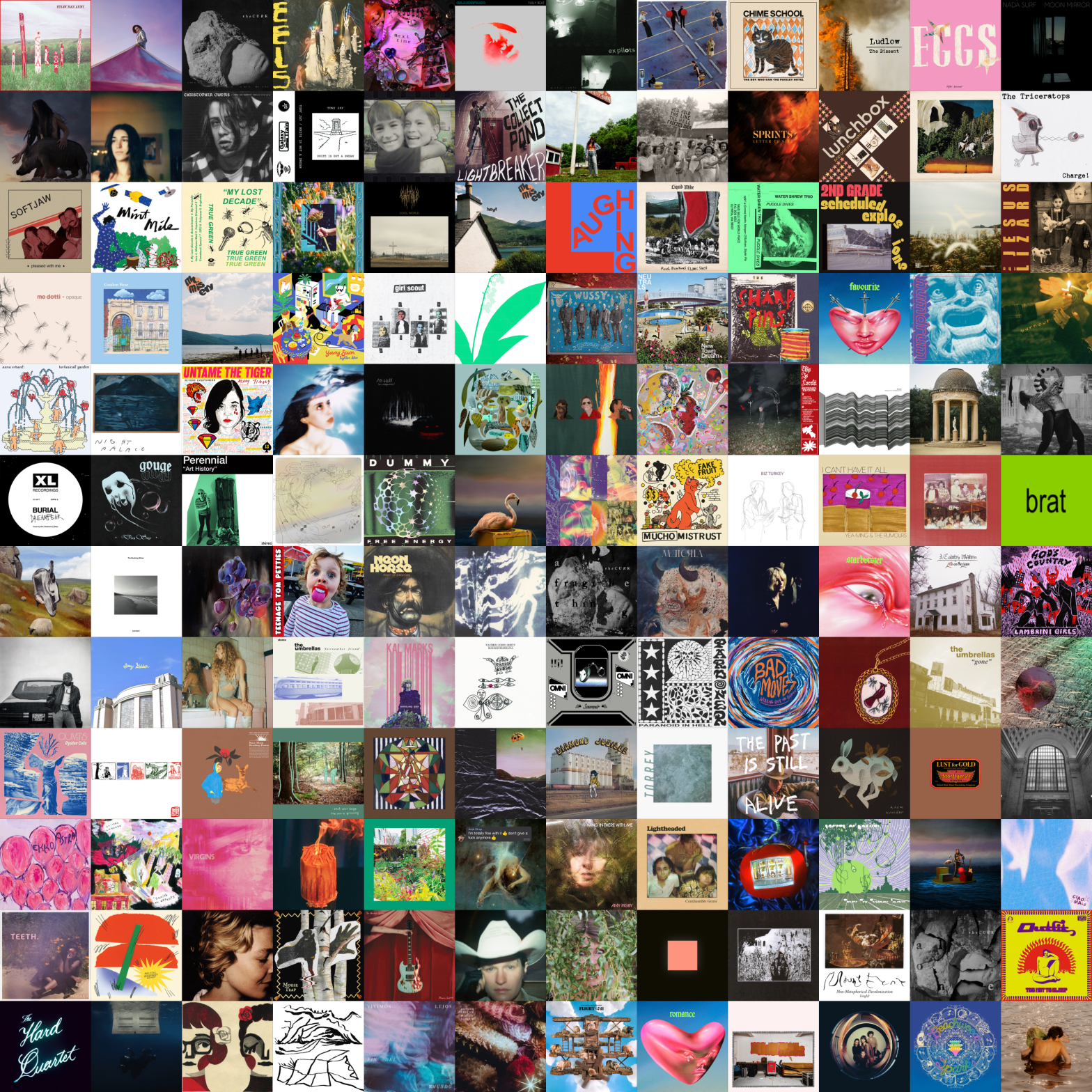
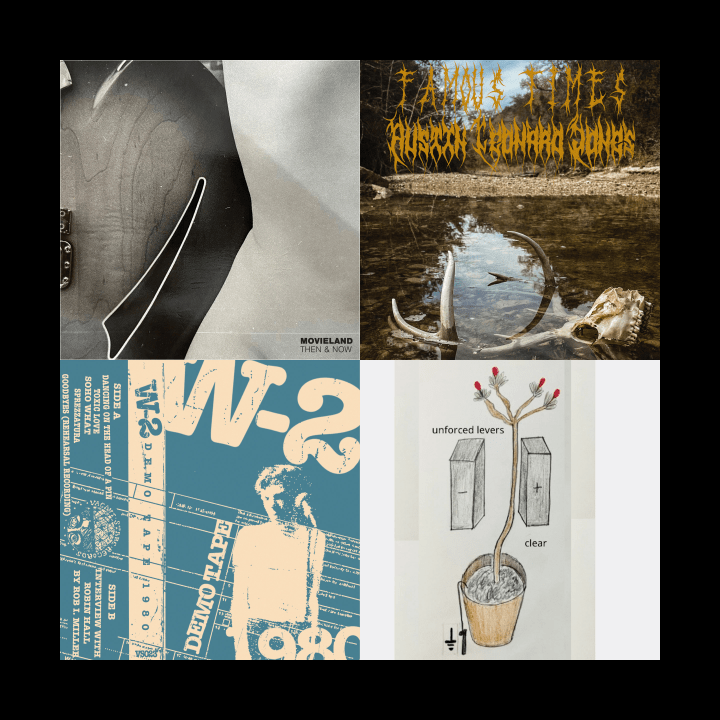
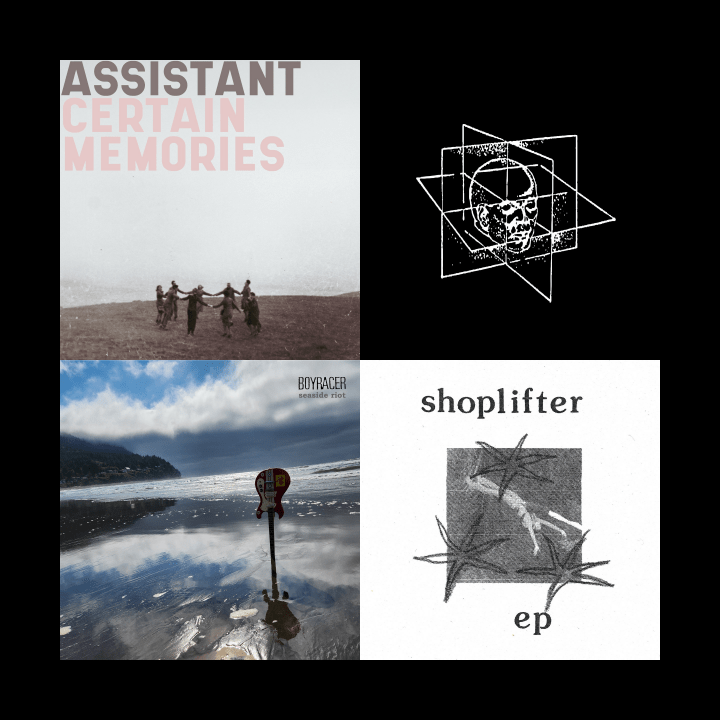
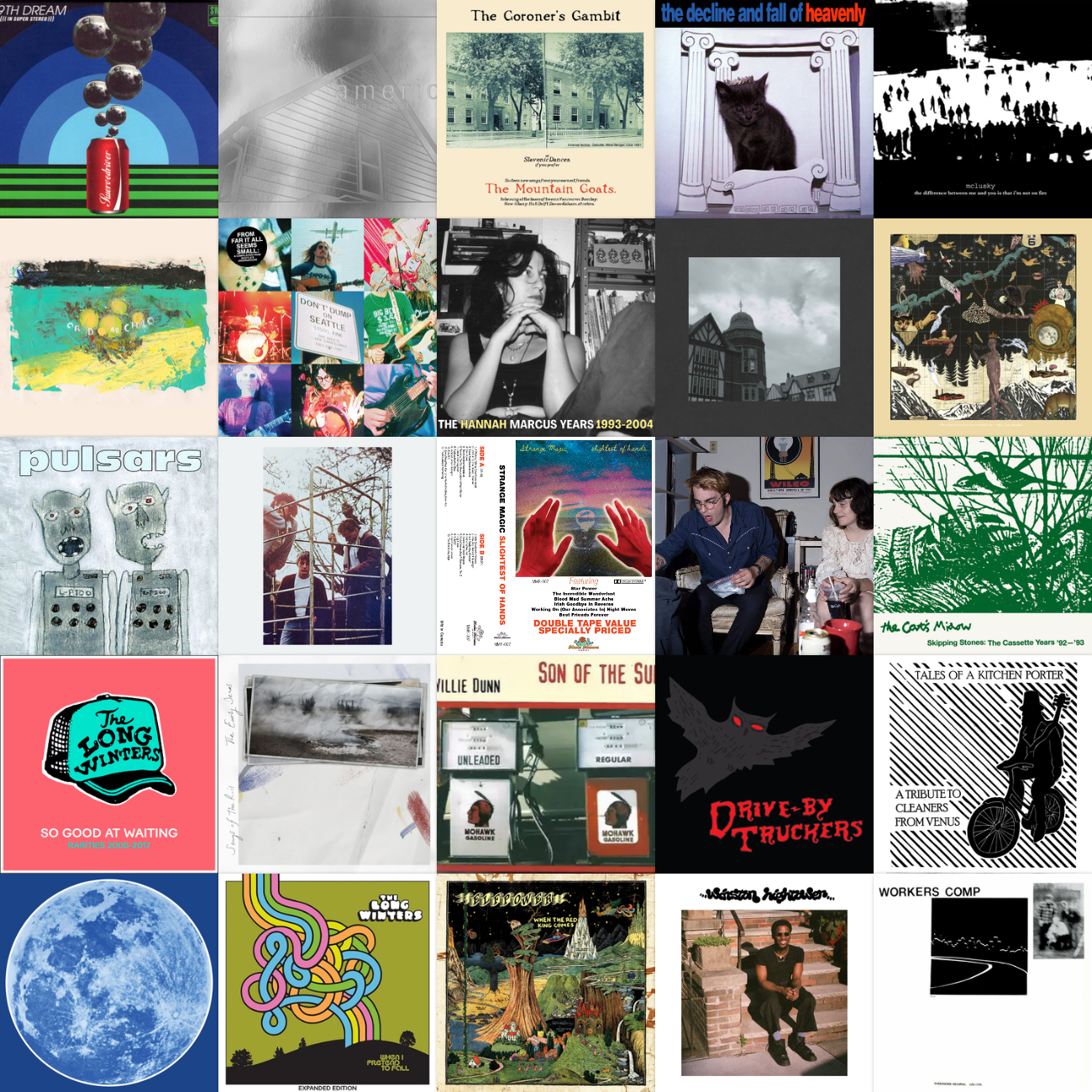
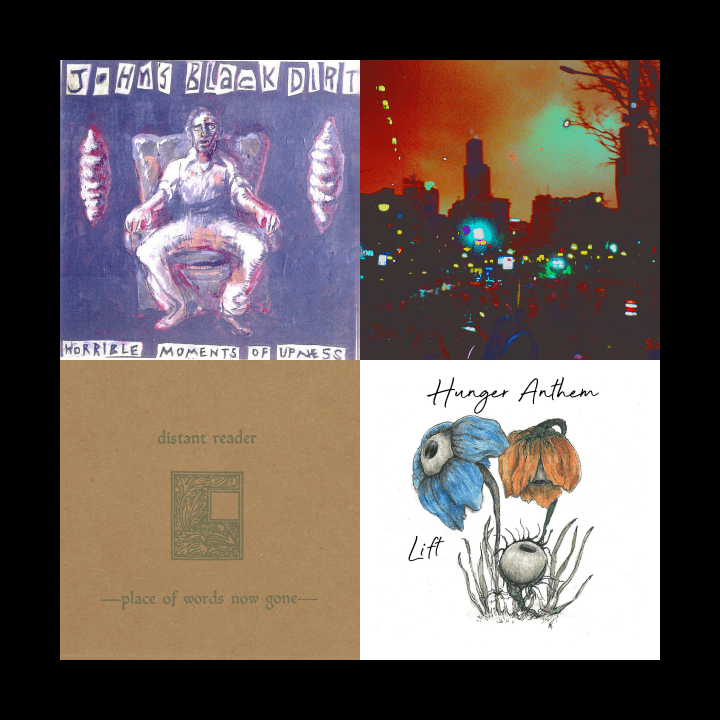


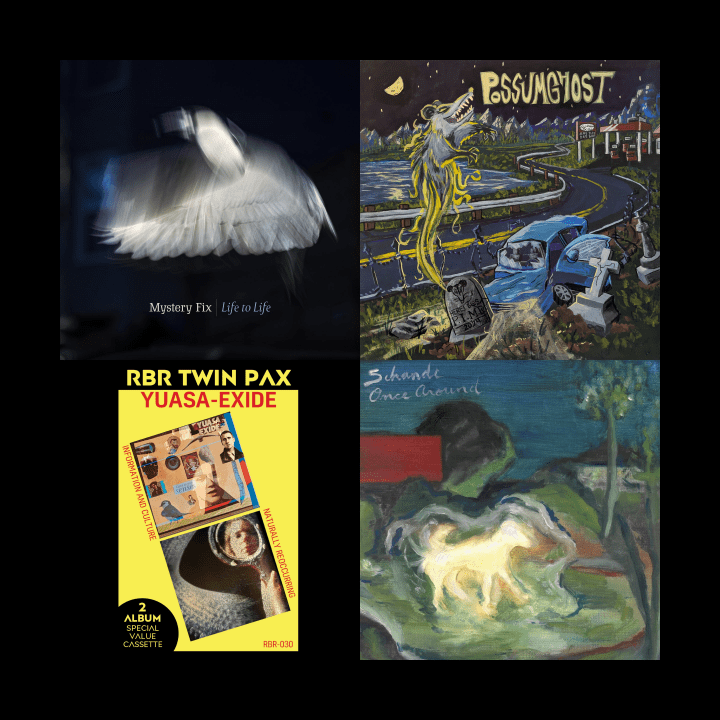
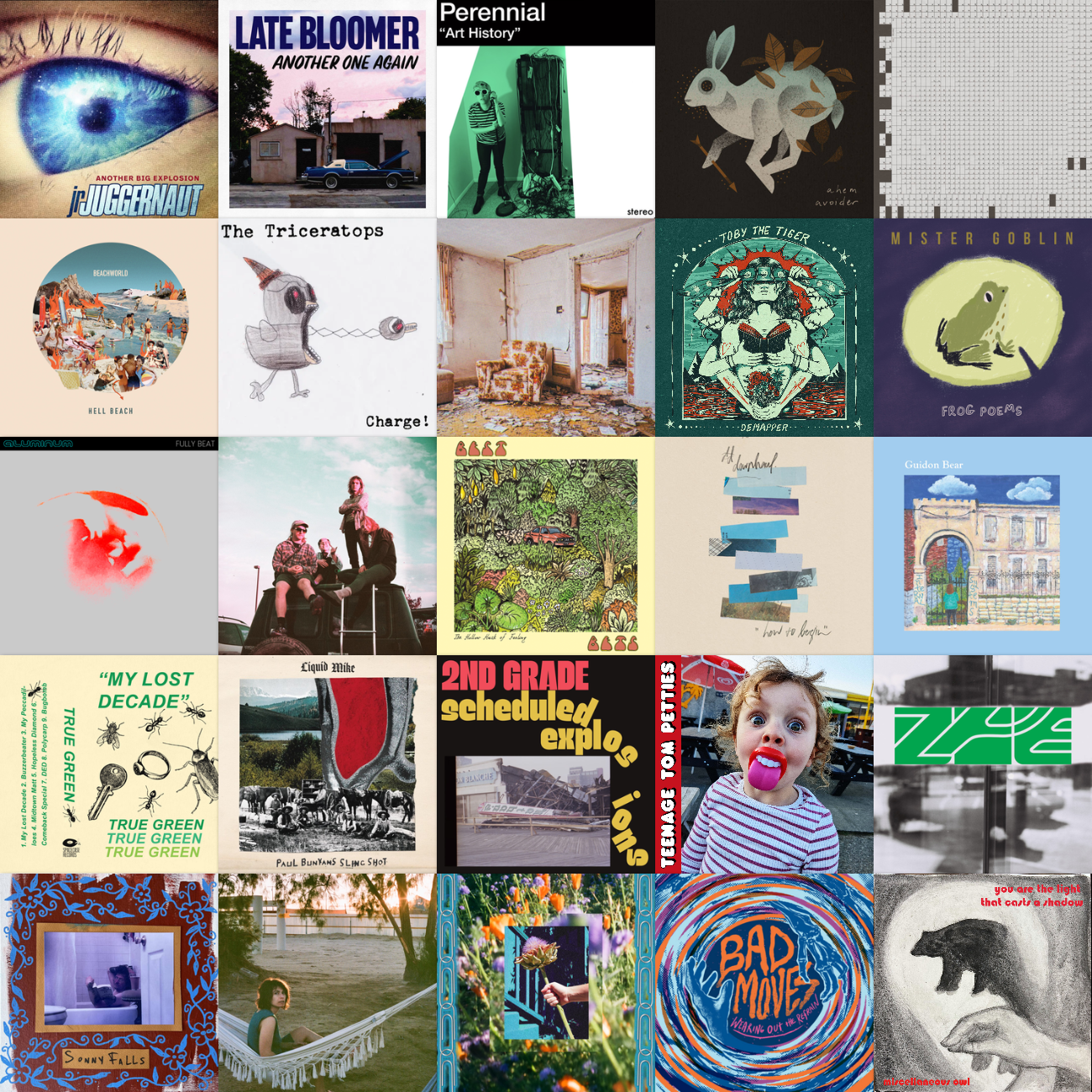
 Rosy Overdrive