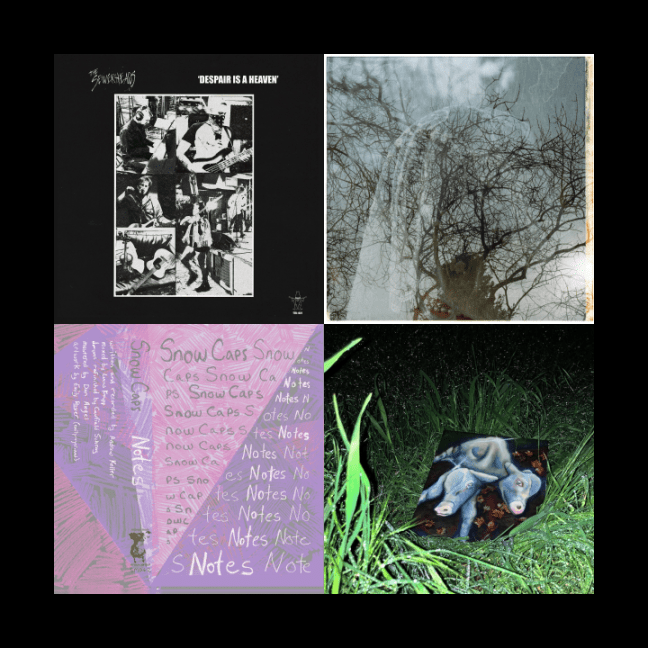
Hey there, everyone! In case you missed it, Rosy Overdrive’s Top 100 Albums of 2024 went up this week; if you’re still working your way through those, that’s understandable. However, there’s still new music coming out, and today looks at three albums coming out either tomorrow (December 13th) or this Saturday (the 14th): new LPs from The Sewerheads, Snow Caps, and Magic User. We’ve also got an album from Lose a Leg that came out last week thrown in for good measure, too.
If you’re looking for more new music, you can visit the site directory to see what else we’ve written about lately. If you’d like to support Rosy Overdrive, you can share this (or another) post, or donate here. And last but not least: don’t forget to vote in the 2024 Rosy Overdrive Reader’s Poll!
The Sewerheads – Despair Is a Heaven
Release date: December 13th
Record label: Tall Texan
Genre: Post-punk, art punk, noise rock, folk rock
Formats: Vinyl, digital
Pull Track: Memories
The tail end of 2024 features a notable beginning–the debut album from The Sewerheads, a new band made up of several Pittsburgh indie rock/post-punk/garage rock veterans. Guitarist/vocalist Eli Kasan is known to some as a member of the underrated Gotobeds, while drummer/pianist Evan Meindl played in the recently-broken-up Rave Ami, violinist/vocalist Shani Banerjee was in Empty Beings, and Matthew “My War” Schor is an engineer who runs a studio called The War Room (and if that’s not enough, Mint Mile bassist Matthew Barnhart recorded their debut LP at Electrical Audio, and it features trumpet and organ from fellow Gotobeds member Dane Adelman). Despair Is a Heaven, the first Sewerheads full-length, falls on the dark and gothic side of the post-punk spectrum, making ample use of Banerjee’s violin and Kasan’s drab lead vocals. String-heavy post-punk always reminds me of the Mekons, and there’s some of them in the album’s lighter moments, but the record’s mix of electric garage rock tangles, prowling noir-rock, and burnt-out Rust Belt folk-punk (in a Poguesian sense) is kin to gutter-scrapers like The Birthday Party, Mark Lanegan, Iceage, and (known Gotobeds collaborators) Protomartyr. Kasan mentions being inspired by outlaw country in his songwriting, and while I’m not going to call Despair Is a Heaven “twangy”, the combination of a rambling ne’er-do-well frontperson with a skilled band that can do both “sprawling” and “tight” is an intriguing one.
Despair Is a Heaven isn’t an overly welcoming album, but at least it opens with “It Came As a Surprise”, which is about as catchy as The Sewerheads’ whole get-up can be. Kasan and Banerjee trade off their vocals in a way that creates a dialogue (a tool that the band utilizes to impressive ends over and over again on the album), while Banerjee’s soaring violin stands on equal footing with Meindl and Schor’s unblinking rhythm section. It feels confrontational to have the particularly grey “Diary of a Priest” in the record’s first half, but if you press forward you’ll reach a couple of songs that flex The Sewerheads’ clanging art punk muscles (“Daughter of a Child of Sorrow” and the title track) and Despair Is a Heaven’s second half, where the band’s traditionalist side gets a genuine spotlight. Kasan and Banerjee commune in “Your Old Bedroom”, the record’s mid-tempo folk rock centerpiece, while “Memories” is the closest The Sewerheads get to “country punk” and the scorching, Banerjee-led “Little Fugitive” is a surprisingly all-in western ballad. Despair Is a Heaven is a lot to take in for a band’s first statement–right up until the final track, “Trick of the Rain”, which lapses into noise and false conclusions to make a taxing last stand. The Sewerheads are on the board now, and Despair Is a Heaven is hardly a record to take lightly. (Bandcamp link)
Snow Caps – Notes
Release date: December 13th
Record label: Strange Mono
Genre: Post-punk, new wave, bedroom pop, lo-fi pop
Formats: Cassette, digital
Pull Track: Broke Bay
I’m happy to introduce the music of Andrew Keller to you all. Well, maybe you’ve already heard of them–they’ve played in Philadelphia bands Hermit Thrushes and Jonagold, and the first album from their solo project Snow Caps came out all the way back in 2008 on Single Girl Married Girl Records (Kate Ferencz, No One and the Somebodies, Power Animal). Snow Caps is new to me, although their latest album, a ten-song cassette simply called Notes, feels oddly familiar. Notes’ version of pop music is warped but still potent; Keller’s influences are iconoclastic experimentalists like Kate Bush and Arthur Russell, as well as literature (citing the works of Virginia Woolf and Edmund White among others), and their music subsequently ends up sounding like offbeat pop rock from several decades past (from The Beatles to XTC and The Cleaners from Venus to They Might Be Giants). The Bandcamp page for this album highlights Keller’s “bizarre, beautiful melodies”, and I really can’t say it better myself–it’s a key ingredient to these ten songs, which are also carried by the inspired bedroom pop instrumentation and Keller’s layered vocals, which sound like an entire choir singing modern new wave hymns.
The non-intuitive left-turns, brisk tempos, and unstoppable hooks are all present from opening track “Blanket” onwards. Notes is never really full-on chaotic, but it’s always on edge; there’s a nervousness to this brief but full-feeling album nicked straight from the genesis of this kind of music. The chorus of “Broke Bay” has an “eerie carnival” vibe to it, wobbling and grinning uncertainly as Snow Caps stick the landing nonetheless. This somewhat mutated version of lo-fi guitar pop marks a lot of Notes, actually–there’s an Andy Partridge-like “pop music but falling off a melodic cliff” component to Keller’s writing, maybe more apparent in “Mere Mirror” and “Projected” but pretty much always present. Notes noodles around a little more in the second half–between the elastic jangle of “Pine Cloud” and the rumbling prog-pop of “Lie Ripened”, Keller has plenty more tricks up their sleeve–but it’s a refreshingly concise and consistent listen, succeeding all the way up to the final duo of “Dry Tone” (a minimal post-punk track that’s no less catchy) and “Shell in the Flower” (the triumphant big finish). The rhythms are firm and deft, the guitars frequently offer up blasts of catchiness, and when synths surface, they do much the same; it’s hard to put one’s finger exactly on what makes Snow Caps so odd, but it clearly has something to do with the attitude of their frontperson. (Bandcamp link)
Lose a Leg – The Vale of Awful Sound
Release date: December 6th
Record label: Self-released
Genre: Post-rock, folk, psychedelia, chamber music, orchestral folk
Formats: Digital
Pull Track: I Shot an Arrow into the Air // Crown Shyness
Last December, I wrote about Lose a Leg, the self-titled fourth LP from David Roy’s instrumental post-rock solo project. The Glasgow musician (who’s played in bands like Sputniks Down, Multiplies, and Dananananaykroyd over the years) had been on an (at least) one Lose a Leg album a year schedule since 2020, but the stripped down (only electric guitar, bass, and drums) nature of Lose a Leg was something of a departure for the typically more orchestral-focused musician. Roy has once again returned with a Lose a Leg album right before the calendar flips to another year, this time with a five-song collection called The Vale of Awful Sound. Having gotten his “punk” album out of his system last year, The Vale of Awful Sound marks a return to a more expanded palette; both the “orchestral” and electronic-tinged sides of instrumental post-rock mark the record’s forty-one minutes. If guitars are present on the record, they’re generally of the tastefully-plucked acoustic variety, and while some of the tracks do have a drumbeat, it’s far from an integral, foundational tenet of these wandering, drifting pieces of music.
Roy softly eases us into The Vale of Awful Sound with “I Shot an Arrow into the Air // Crown Shyness”, a bright eight-minute track that features swooning strings, pianos, jazzy percussion, and a sparkling guitar part (it kind of reminds me of a busier version of the most recent Seawind of Battery album). The quiet, fuzzy, almost ambient electronic touches of “The Tree Held Him & Didn’t Drop So Much as a Leaf” make it a remarkable comedown from the commanding opening, cavernously beautiful in its own right, and the steady, hypnotic “A Walk Across the Treetops” attempts to find a midpoint between these two extremes (and ends up somewhere near Tortoise circa TNT, a more-than-welcome landing spot). “The Cailleach // Turning Back the Sun” once again turns towards the bright, folky tones Lose a Leg explored earlier, as do moments of closing track “A Poem Called ‘The Lure of the Pine Marten, The Scent of the Mink’ for a Dog That Went Off Overtoun Bridge”. The nearly twenty-minute finale takes up about half of The Vale of Awful Sound, and Roy really goes through it all on this progressive orchestral folk number–from bright and hopeful to tense and quiet to melancholic and thoughtful to a whipping whirlwind to a cold, empty finish. The song could stand on its own, but here it is hidden in the back of somebody from Scotland’s instrumental Bandcamp solo project. (Bandcamp link)
Magic User – Shadow on the Door
Release date: December 14th
Record label: Dandy Boy
Genre: Fuzz rock, 90s indie rock, lo-fi indie rock
Formats: Cassette, digital
Pull Track: Mirror World
When I think of Oakland’s Dandy Boy Records, it’s usually related to their position at the center of the thriving Bay Area jangle pop scene (perhaps best exemplified by their recent Martin Newell covers compilation), but the imprint has put out some solid sore thumbs recently, too–the fuzzed-out slacker-gaze of Nothing Natural, the grimy post-punk of Weird Numbers, and the punk blast of Fast Execution. The latest band to debut on Dandy Boy is Magic User, a project started by singer/guitarist Jordan Martich and rounded out by drummer Digger Barrett, guitarist Charles Thomas, and bassist Colin McDonald. Of the previously-mentioned bands, the one that Shadow on the Door reminds me the most of is Nothing Natural, but the main difference is that they’re even more “slacker rock” on their debut LP. Shadow on the Door is a thoroughly fuzzed out throwback to indie rock’s basement era, with the quartet blending loud guitars and downcast melodies together in vintage Dinosaur Jr. fashion while also reminding me of modern groups mining a similar vein like Gnawing and Late Bloomer.
Shadow on the Door isn’t really a “shoegaze” album, but Magic User get their shit together for a proper three-minute wall-of-sound opening track called “Cowboy”, which yanks us into the quartet’s world of distortion and bummer pop forcefully. Magic User then veer right into the world of rainy, bleary-eyed Pacific Northwest indie rock with “Machine” (which sort of reminds me of what Spiral XP are up to currently), the riff showcase of “Like the Moon”, and the stumbling mid-tempo “Never Better” (“I’ve never been better / And I’ve never told the truth” goes the refrain of that one, a 90s rock lyric if I’ve ever heard one). There’s plenty of aloof-but-still-noticeable pop moments in these songs, and they’re still there in Shadow on the Door’s somewhat more heavy second half; “Nothing” and “Thread” both alternate between noisy rave-ups and more subdued breaths of fresh air, and then the record ends with an excellent fuzz-pop tune in “Mirror World”, an oddity in “Flower” (a dark song that eventually disembowels itself into noise) and an all-in dramatic closing track called “The Distance”. You know what, maybe Magic User aren’t slackers after all. (Bandcamp link)
Also notable:
- Creve Coeur – Catastrophes
- Straw Man Army – Earthworks
- Devils Cross Country – Possession Is Ninetenths
- Various – Hit the North Pole: A Festive Charity Compilation for the Palestine Children’s Relief Fund
- Dialup Ghost – May You Live Forever in Cowboy Heaven
- Dazy – I GET LOST (When I Try to Get Found) EP
- Paper Mice – Neurotic City EP
- Billy Mack Collector – Searching for the Pink Elephant
- Shrimp Olympics – Live Shrimps
- Miri Tyler – A Very Miri X-Mas (Volume 1) EP
- Grapes of Grain – Christmas Grapes EP
- David Nance – Don’t Take That Way, That Way’s a Mess: Outtakes 2020-2024
- Trevor Bates – Brief Pearls
- Thundermoon – We Can Do Better Than This EP
- Shinyhunt – Sea-Salt Ice Cream
- Urika’s Bedroom – Big Smile, Black Mire
- Birthday Dad – Hollywood Forever Cemetery EP
- The Black Pacific – Here Comes Our Wave
- Cali Bellow – Ciao Bella
- Strangerfamiliar – La Pena
- J Spaceman & John Coxon – Music for William Eggleston’s Stranded in Canton
- Little Shrine – Heart Instruction
- The Necks – Bleed
- WANU – Magma
- Rogue Spore – HIBISKUS MENUSKUS


2 thoughts on “Pressing Concerns: The Sewerheads, Snow Caps, Lose a Leg, Magic User”