New Playlist: February 2026

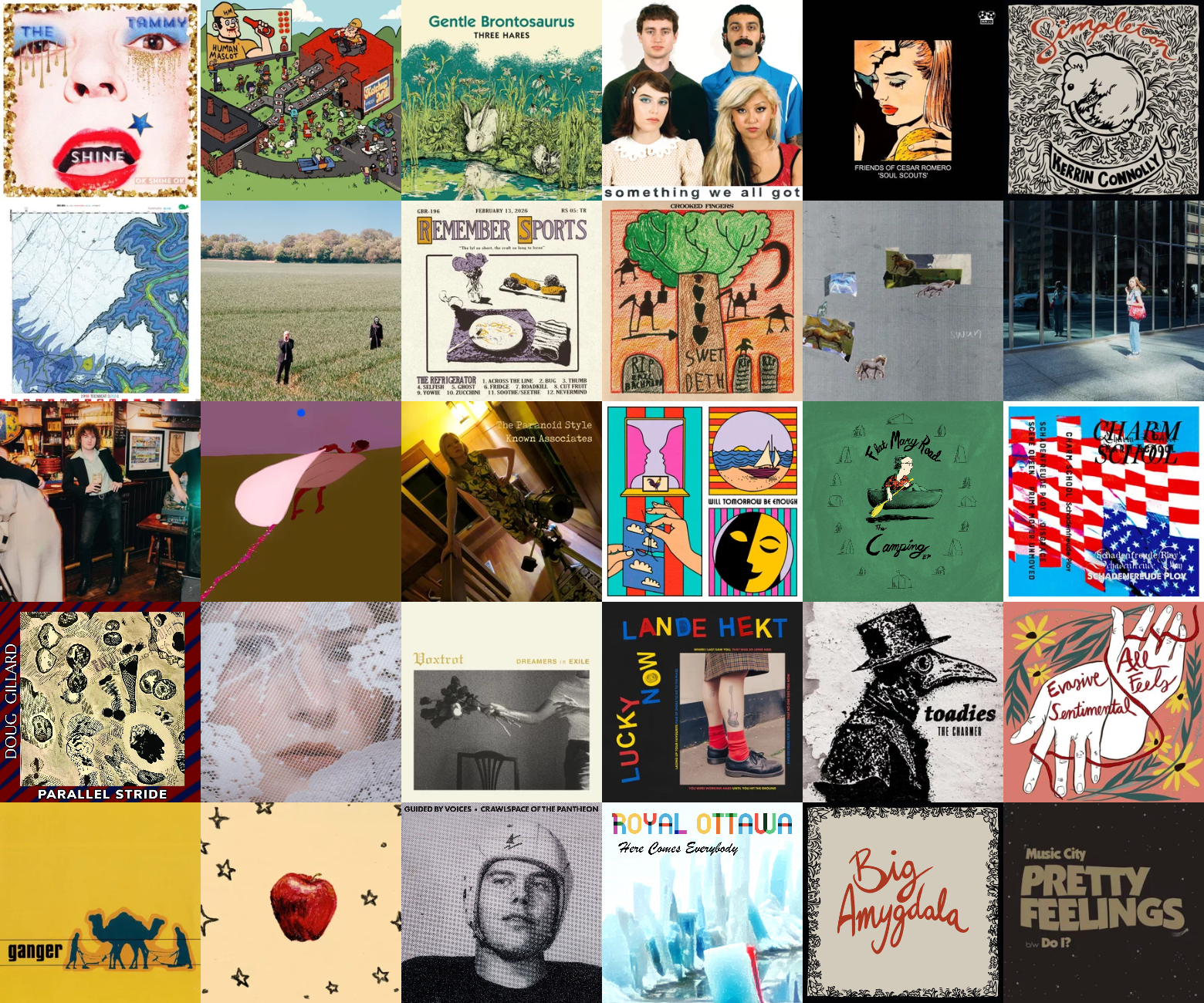
Here it is: the February 2026 playlist! The new year feels in full swing, and we’ve got selections from some truly great albums below.

Gentle Brontosaurus, Cootie Catcher, Friends of Cesar Romero, Flin Flon, Kerrin Connolly, Fazed on a Pony, and Remember Sports have two songs each on this playlist.

Here is where you can listen to the playlist on various streaming services: Spotify (missing two songs), Tidal (missing one song). Be sure to check out previous playlist posts if you’ve enjoyed this one, or visit the site directory. If you’d like to support Rosy Overdrive, you can share this (or another) post, or donate here.

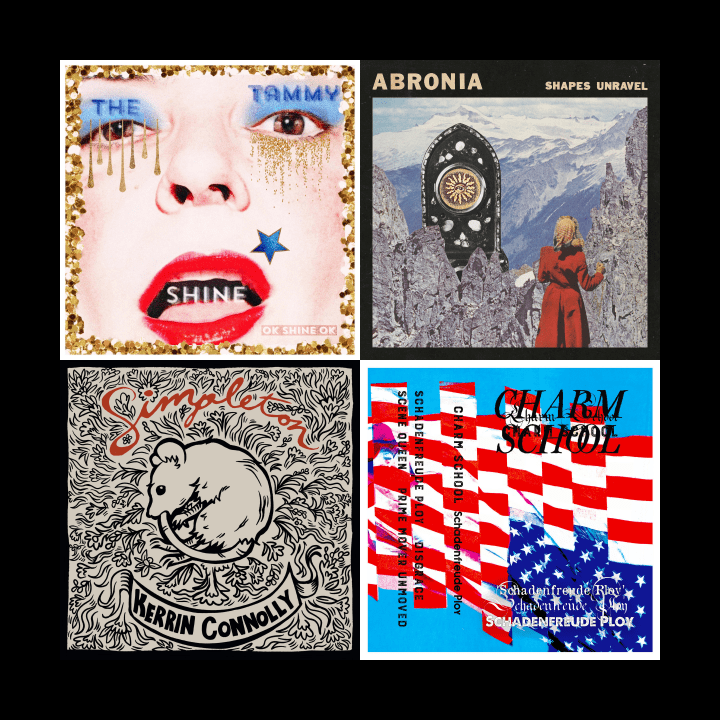
“Junkmail”, The Tammy Shine
From Ok Shine Ok (2026, HHBTM)

The Tammy Shine is Tammy Eaton, who you may also know as the frontperson of the Denver-originating, Elephant 6-associated group Dressy Bessy. “Junk Mail”, the fourth song on The Tammy Shine’s debut album Ok Shine Ok, caught my attention immediately. It’s a bonkers pop song–it’s bratty, campy, euphoric, fiery, whatever; it sounds like mall-pop-punk at one point, like a Guided by Voices track at another point, like turn-of-the-century alt-pop another. It has at least five hooks you could build a song out of, slammed together like a can of Fanta crushed by a cartoon anvil. Read more about Ok Shine Ok here.

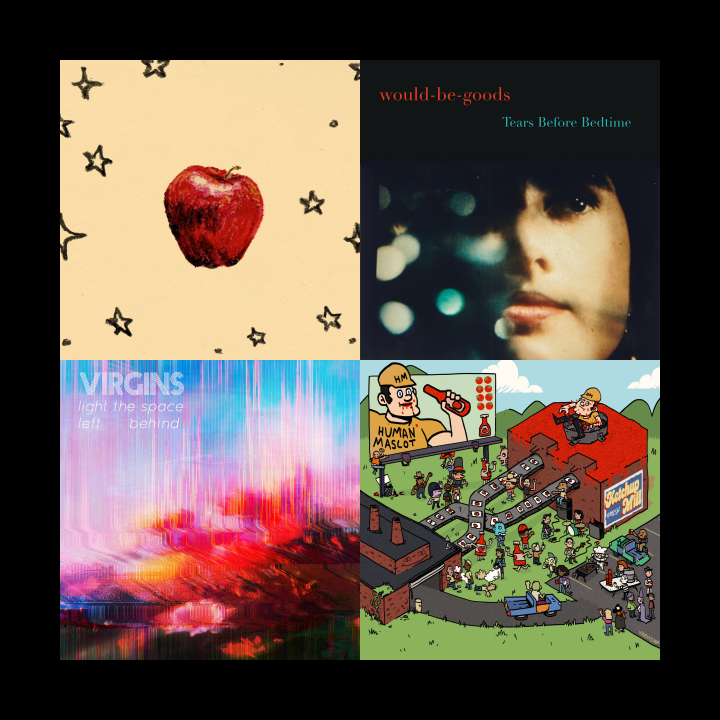
“Mail Pouch Chew”, Human Mascot
From Ketchup Mill (2026)

Human Mascot are a self-described “Americhaotica”, “countrygaze”, and “art punk” trio from Boston, and Ketchup Mill appears to be their second record. On this one (seven songs, twenty minutes, call it an EP or LP based on your preference I suppose), Human Mascot continue in the grand tradition of New England math rock bands that know how to write a pop hook, from Pet Fox to Rick Rude to Lane. Blown-out noisy guitars veer into golden melodies (of both the instrumental and vocal variety), exemplified when the claustrophobic opening track “Hollow Log” gives way to the weird but undeniably catchy alt-math-country-pop-rock thing “Mail Pouch Chew”. Read more about Ketchup Mill here.

“Bend the Knee”, Gentle Brontosaurus
From Three Hares (2026)

I’ve written about the Madison, Wisconsin singer-songwriter Huan-Hua Chye via the two most recent albums from her solo project, Miscellaneous Owl; however, she’s also been the primary (but not only) lead vocalist and songwriter for the five-piece band Gentle Brontosaurus dating back even further than Miscellaneous Owl’s inception. Three Hares is the band’s third album and first one since 2018; those of you who enjoyed Chye’s clever, catchy indie pop songwriting in Miscellaneous Owl will find plenty of it here. Both Chye’s writing and the band’s playing make conscious efforts to cohere on Three Hares; relationship dissatisfaction and interpersonal dead-ends are noticeable recurring themes, like in the bouncy power pop send-off “Bend the Knee”. Read more about Three Hares here.

“Loiter for the Love of It”, Cootie Catcher
From Something We All Got (2026, Carpark)

On Something We All Got, their first for Carpark Records, Cootie Catcher have clearly “gone for it”; armed with a label with a larger reach and (presumably) more resources than before, the quartet have polished the stranger, “out-there” side of their sound away and honed in on making big-hook, excitable indie pop songs. Were the wonky, oftentimes headscratching synth-trails of last year’s Shy at First part of Cootie Catcher’s initial appeal to me? Sure, but any worry that the band may have inadvertently sanded off their strong suits is laid to rest by the gorgeous, twinkling opening ballad “Loiter for the Love of It” (You think you know slacker-twee? Cootie Catcher will show you slacker-twee). Read more about Something We All Got here.

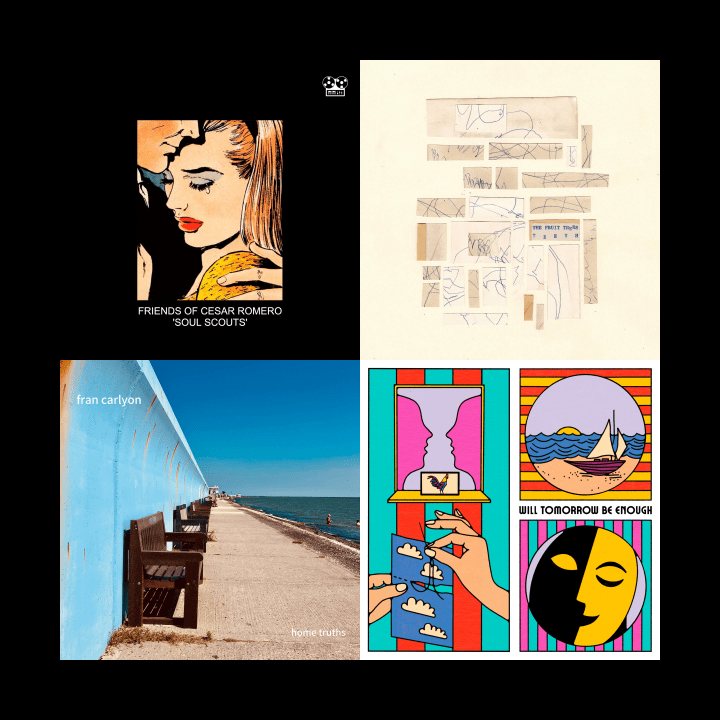
“Trauma Blonding”, Friends of Cesar Romero
From Soul Scouts (2026, Doomed Babe/Kit Fox)

The first Friends of Cesar Romero offering of 2026 (coming almost exactly two months after the previous one, December’s Cars, Guitars, Girls EP) is a ten-song, eighteen-minute jolt called Soul Scouts, and it’s my favorite release of the South Dakota project in quite a while now. Friends of Cesar Romero records run the gamut from sunny, hook-heavy power pop to ripping basement garage punk; Soul Scouts hews towards the latter, but, as always, there’s a trace of the former in these songs as well. J. Waylon Porcupine absolutely tears into “Trauma Blonding”, an early highlight that’s all quick tempos, lurking fury, and very pleasing guitar tones. Read more about Soul Scouts here.

“Big Amygdala”, Kerrin Connolly
From Simpleton (2026)

Over the past decade, Boston’s Kerrin Connolly has gone from a musician with a YouTube following to an artist with multiple records to their name; they’ve put out two albums, an EP, and a “mini-album” since 2020. They’ve self-described their latest album, Simpleton, as a “12-song concept album detailing the modern hero’s journey”; written, produced, and performed almost entirely by Connolly themself, it’s a massive, imminently attention-grabbing pop-rock album. It’s a shiny mess of power pop, orchestral pop, musical theater, and 80s-evoking synthpop, often all in short succession. Read more about Simpleton here.

“Ukraina”, Flin Flon
From A-Ok (1998, Teen-Beat)

For as much as I love those late-period Unrest albums, I’ve never really explored co-founder (and Teenbeat labelhead) Mark Robinson’s music after that band’s mid-90s dissolution, until last month at least. Flin Flon was Robinson’s second post-Unrest band after the short-lived Air Miami; 1998’s A-Ok was the first album of what seems to be a few. Compared to Unrest, it’s more direct; the spacier, post-rock kind of side of that band is absent on A-Ok, replaced by a fairly smooth rhythmic post-punk sound over which Robinson is free to do his golden indie pop thing. “Ukraina” is maybe the best song on the album (the other candidate is also on this playlist); it’s a sub-three-minute triumph of the indie pop/post-punk experience.

“Chateau Photo”, Vegas Water Taxi
From Long Time Caller, First Time Listener (2026, PNKSLM)

Vegas Water Taxi is a new-ish London-based alt-country band led by Ben Hambro; their second album is actually two EPs in one, last year’s Long Time Caller with a new one called First Time Listener tacked onto it. I was admittedly skeptical that a British guy named Hambro would have much interesting to say in a facsimile of “Americana”, but Vegas Water Taxi’s strong grasp on Teenage Fanclub-esque guitar pop goes a long way towards winning me over. Some of this stuff just works on every level, and that’s all there is to it–the second song on the album, “Chateau Photo”, where Hambor sings “She left me for a guy who’s working in PR / He’s putting out a press release that I’m crying in a bar” over lilting pedal steel? I’m fully on board with that. Read more about Long Time Caller, First Time Listener here.

“Roadkill”, Remember Sports
From The Refrigerator (2026, Get Better)

It’s startling to realize that it’s been five years since Remember Sports’ last album, Like a Stone, although there was an EP called Leap Day in 2022 and solo albums from vocalist/guitarist Carmen Perry and bassist Catherine Dwyer (as Spring Onion) in the interim. The original trio of Perry, Dwyer, and guitarist Jack Washburn welcomed new drummer Julian Fader (Sweet Dreams Nadine, Lane) into the group shortly after their last album, and the four of them went to Chicago’s Electrical Audio to self-produce The Refrigerator in 2024 (“just after” the sudden passing of the legendary studio’s founder, Steve Albini). The torrential distorted-pop-fest “Roadkill” is a second half highlight; like the bagpipe-laden “Ghost”, it’s the pop-punk group pushing their envelope with dynamic shifts, unusual instrumentation, and pop music inverted. Read more about The Refrigerator here.

“From All Ways”, Crooked Fingers featuring Matt Berninger
From Swet Deth (2026, Merge)

Sweth Deth, Eric Bachmann’s first album as Crooked Fingers in fifteen years, features an impressive list of guest vocalists, including The National’s Matt Berninger on the gentle soft rock glide of “From All Ways”. As recognizable as Berninger’s voice is in general, I didn’t realize it was him on “From All Ways” at first; it’s a bit of an odd placement for him, his stoic baritone in the chorus functioning as a balance to the brisk tempo Berninger brings to the verses (and if the latter wins out, it’s still interesting to hear Berninger try to keep up in this situation). Read more about Sweth Deth here.

“Flashes”, Fazed on a Pony
From Swan (2026, Meritorio/Melted Ice Cream)

I first heard New Zealand singer-songwriter Peter McCall and his project Fazed on a Pony in late 2022, when he released his debut album, It’ll All Work Out. At the time, I noted that McCall (while still being indie pop-ish) sounded more in line with American folk rock groups like Wild Pink and Friendship than the kind of indie rock for which his home country is known, and McCall continues to pursue this avenue in Swan, the second Fazed on a Pony LP. The alt-country influence is incorporated tastefully and reverently, but I think it makes the most sense to approach Swan as an indie pop album first and foremost. Blink and you’ll miss one of the best moments, the two-minute “Flashes”, a simple-sounding but secretly brilliant pop construction. Read more about Swan here.

“Gonna Be Good”, Triples
From Every Good Story (2026, Bleak Enterprise)

I knew nothing about Triples when I put this song on this playlist; apparently it’s the Toronto-based project of Eva Link, sister of PACKS’ Madeline Link (who also played in an earlier version of the band). Compared to her sister’s more consciously downbeat, muddled work, Triples’ new EP Every Good Story is go-ahead polished power pop at its core; opening track “Old Routine” has some sunny “adult alternative” pop vibes, and my favorite song, “Gonna Be Good”, is positively bouncy as it trots its way to the teen-movie-soundtrack kinda chorus. 

“Pretty Feelings”, Music City
From Welcome to Music City (2026, Redundant Span/Sentric)

Welcome to Music City is a classic power pop album connected to but distinct from the more garage-y rock and roll of ringleader Conor Lumsden’s other band, The Number Ones. Lumsden positions himself as a pop rock bandleader influenced by the classic rock and new wave-y pub rockers of his city of origin (Dublin) and of the polished side of what us Americans probably think of as “music city” (that’d be Nashville). Welcome to Music City walks an impressive tightrope between well-earned swagger and a more bookish pop rock attitude, though much of the best of Welcome to Music City, like “Pretty Feelings”, transcends this “either/or”-type thing and just shoots for all-encompassing, unflagging power pop brilliance. Read more about Welcome to Music City here.

“Transducer”, 2070
From Big Blue (2026, Danger Collective)

Big Blue is the third album from Los Angeles fuzz rock group 2070, and their debut for Danger Collective Records. Perhaps reflecting the quartet’s most stable lineup yet, Big Blue takes a step back from the excitable, kinetic attitude of 2024’s Stay in the Ranch and gets to work at creating a more subdued, cohesive statement. The shoegaze and lo-fi pop of Stay in the Ranch haven’t gone anywhere–indeed, they’re key ingredients in the hazy, murky, psychedelic pop music of Big Blue. The wonky, crawling “Transducer” is pretty catchy, but it doesn’t beat you over the head with it. Read more about Big Blue here.

“DFL”, The Paranoid Style
From Known Associates (2026, Bar/None)

“DFL” is my favorite Paranoid Style song in a minute–and, given that Known Associates is their third album since 2022, there’s been plenty of competition for that. The folk rock/college rock/power pop revivalists led by writer Elizabeth Nelson (and, as of late, also featuring blog regular William Matheny as well as Peter Holsapple of the dB’s) are always good for some whip-smart, catchy post-Elvis Costello music journalist rock, and “DFL” is everything you could want in such an endeavor (it stands for “dead fucking last”, for any confused Democratic–Farmer–Labor Party members). 

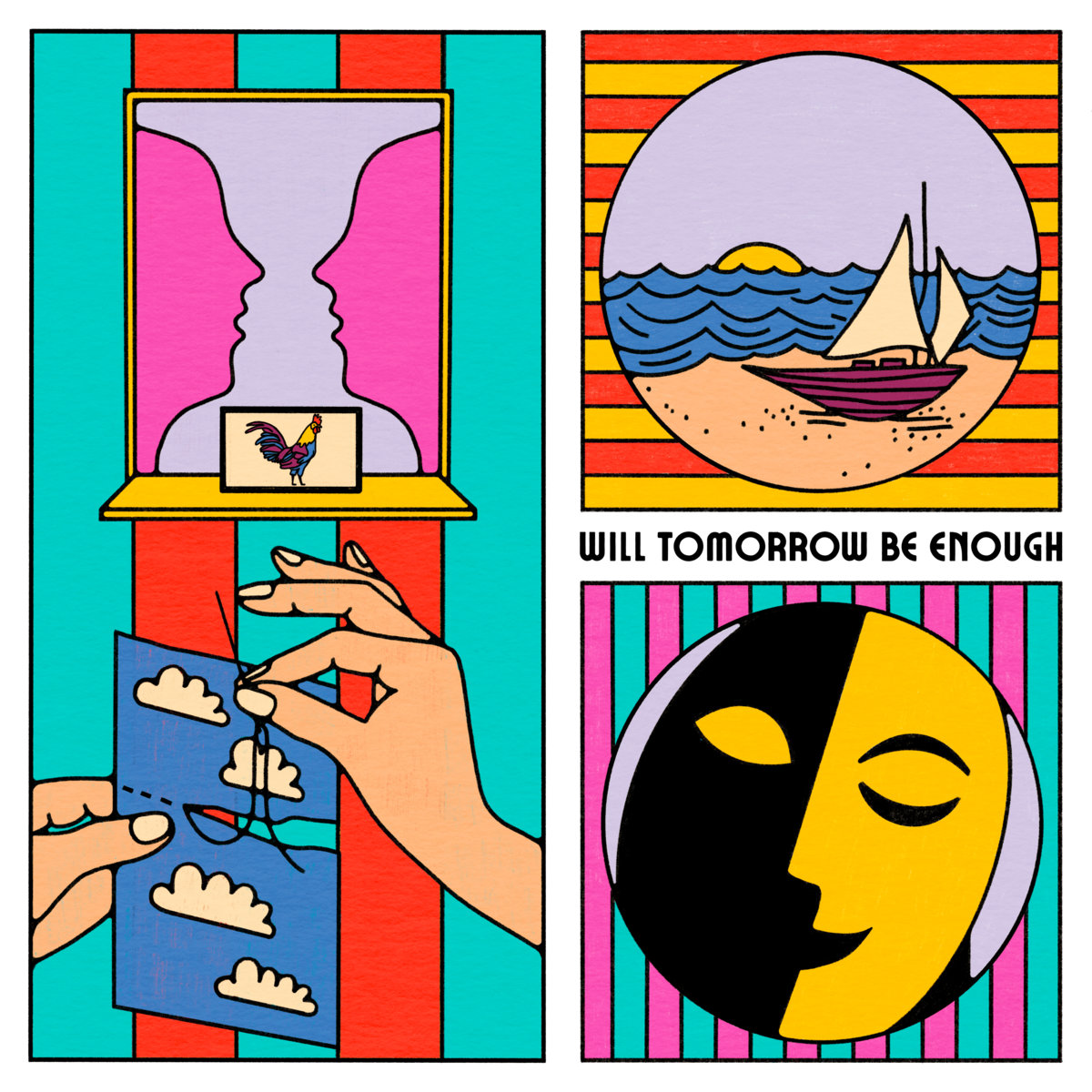
“Gwendolyn, Approximately”, The Sylvia Platters
From Will Tomorrow Be Enough (2026, Dutch Customer)

Every couple of years, the Vancouver quartet The Sylvia Platters turn up with a brief collection of breezy, jangly power pop. Fast forward two years after 2024’s Vivian Elixir, and The Sylvia Platters are back with a new lineup and a new five-song cassette EP called Will Tomorrow Be Enough, a twenty-minute record that’s further confirmation that The Sylvia Platters are honors students of Teenage Fanclub and their jangly indie pop ilk. The five-minute “Gwendolyn, Approximately” is Will Tomorrow Be Enough’s crown jewel; this multi-part college rock opera piece has a massive chorus and all sorts of twists and turns in between repetitions of it. Read more about Will Tomorrow Be Enough here.

“Mind the Gap”, Kerrin Connolly
From Simpleton (2026)

We’ve got a pair of excellent selections from Kerrin Connolly’s latest album on this playlist. “Mind the Gap” (alongside “Big Amygdala”, also from Simpleton and appearing earlier on this playlist) is one of the catchiest power pop songs I’ve heard this year, showcasing Connolly’s ability to shoehorn whip-smart writing into big hooks. It reminds me of recent material from the likes of Pacing, Rosie Tucker, and Career Woman, which is no small feat–these are acts that have landed at or near the top of the blog’s year-end lists before. Read more about Simpleton here.

“Therapy Anthem”, Flat Mary Road
From The Camping EP (2026)

Flat Mary Road’s warm and clever take on folk rock, jangly power pop, and Paisley Underground on their 2023 LP Little Realities reminded me of classic college rock, and the Philadelphia’s quartet’s first new music since then (the three-song Camping EP) is a brief dispatch that nonetheless reaffirms that Flat Mary Road are remarkably adept at what they do. “Therapy Anthem”, the EP’s final song, effectively starts at 100%, with a guitar riff that sounds like the sun rising over mountains and lead singer Steve Teare declaring “Nobody wants to hear about somebody else’s dream anymore”. Read more about The Camping EP here.

“Prime Mover Unmoved”, Charm School
From Schadenfreude Ploy (2026, Surprise Mind/Karmic Tie)

Last year, Louisville noise rock quartet Charm School released their debut album, Debt Forever, a snarling, furious post-punk record about financial anxiety and other American topics. Now based in Los Angeles, this year’s four-song EP Schadenfreude Ploy is still Charm School at their 90s underground rock-evoking best. “Prime Mover Unmoved” is one of the band’s most adventurous songs yet, a mess of post-rock/math rock, an odd psychedelic pop interlude, and an ascendant garage rock part that Charm School stubbornly refuse to turn into the song’s centerpiece. Read more about Schadenfreude Ploy here.

“Face of Smiles”, Doug Gillard
From Parallel Stride (2026, Dromedary)

The first of two Guided by Voices-related songs on this playlist, “Face of Smiles” is the lead single from longtime Robert Pollard collaborator and current GBV guitarist Doug Gillard’s upcoming solo album Parallel Stride. It’s Gillard’s fourth solo LP and first since 2014’s Parade On; given that Guided by Voices (who he rejoined in 2016) continue to put out multiple new albums every year, it’s not surprising it took a bit of time to get another one of these together (although true fans know that his two songwriting contributions to the 2017 GBV album August by Cake are some of the best ones on there). “Face of Smiles” is classic Gillard, breezy but muscular in the hooks and guitar riff departments; I look forward to the rest of Parallel Stride.

“Quarter Note Rock”, Cootie Catcher
From Something We All Got (2026, Carpark)

Montreal quartet Cootie Catcher won me over early last year with their sophomore album, Shy at First, an electronic-twee pop balancing act that ended up being an unlikely breakout record. Less than a year later, vocalist/bassist Anita Fowl, vocalist/guitarist Nolan Jakupovski, vocalist/synth player Sophia Chavez, and drummer Joseph Shemoun have returned with a record of glittering, undeniable pop music in Something We All Got–“Quarter Note Rock” is a straight-up monster of a guitar pop song, and the record-scratching and talking-singing (particularly the “You / could be / An essential part of the team…” part) provides a strong link to their previous record. Read more about Something We All Got here.

“Middle of Summer”, PONY
From Clearly Cursed (2026, Take This to Heart)

It’s been a little under two years since Toronto group PONY released Velveteen, which I called a “monster of a pop album” with the hooks to back up its 90s-alt-pop-rock worship. On Clearly Cursed, the band’s founding duo of vocalist Sam Bielanski and guitarist Matty Morand (aka Pretty Matty) are joined by bassist Christian Beale and drummer Joey Ginaldi, though the alternatively dreamy and grungy power pop that’s resulted is in lockstep with PONY’s previous output. “Middle of Summer”, my favorite song on Clearly Cursed, is a breezy song about death–it may not be the “largest” song on the album, but it’s one of the catchiest and just right for its subject matter.

“Rock & Roll Jesus”, Voxtrot
From Dreamers in Exile (2026, Cult Hero)

The Austin, Texas quintet Voxtrot were a mid-2000s “blog rock” band, building buzz off of a pair of EPs and then releasing one album before breaking up at the end of that decade. Ramesh Srivastava, Jason Chronis and Matt Simon are described as the band’s current “nucleus”, but all five original members of Voxtrot contribute to Dreamers in Exile, and the quintet have made an incredibly polished, vibrant, multi-layered, “mature” pop album together. If this kind of thoughtful, AM-fluent post-chamber indie pop is in any way relevant to you, Dreamers in Exile plays like a lost greatest hits collection; there isn’t a dull moment whether Voxtrot are leaning into the strings or getting more electric. See “Rock & Roll Jesus” for the latter: it genuinely does rock. Read more about Dreamers in Exile here.

“Bitter But Better”, Friends of Cesar Romero
From Soul Scouts (2026, Doomed Babe/Kit Fox)

I could list all of the exciting, blistering garage-pop-punk moments on Soul Scouts all day, but funnily enough, it’s the closing stretch where Friends of Cesar Romero’s power pop streak really starts to dominate–it turns out that bandleader J. Waylon Porcupine saved the biggest, most straightforward power pop anthem for last with closing track “Bitter But Better”. If Soul Scouts feels like an album-length (well, an eighteen-minute-length) letting-off-of-steam, “Bitter But Better” is both the light at the end of the tunnel and a summation of the process that led us to this moment. “I don’t miss missing you” is a simple enough line, but Porcupine spends all of Soul Scouts making sure it lands. Read more about Soul Scouts here.

“A Million Broken Hearts”, Lande Hekt
From Lucky Now (2026, Tapete)

Bristol musician Lande Hekt put out a pair of solo albums in the early 2010s as her previous band, Muncie Girls, was winding down, but Lucky Now is her first LP in four years and the first after the official breakup of the 2010s trio she led. Like Hekt’s recently-defunct Tapete labelmates Ex-Vöid, Lucky Now is an earnest, emotional take on British guitar pop, C86 and jangle pop delivered without sacrificing personality for recreation. “A Million Broken Hearts” is my favorite song on the record; it’s got shimmering guitars, bittersweet vocals, and a pretty undeniable hook.

“Odessa”, Flin Flon
From A-Ok (1998, Teen-Beat)

Although A-Ok is more laid back than the best pop albums from Mark Robinson’s previous and more well-known band Unrest, the best songs on this album are, in their own way, as good at being pop music as Unrest’s highs were. “Odessa” is a brilliant piece; it’s clearly indie pop excellence from the beginning, but when the danceable, shuffling rhythms take over around the thirty-second mark, it really digs its nails in and doesn’t let go for four minutes. Also, all the songs on A-Ok seem to be named after cities and towns in northern Canada, which as far as I can tell doesn’t have anything to do with the actual music. That’s pretty cool.

“Selfish”, Remember Sports
From The Refrigerator (2026, Get Better)

Remember Sports have been in Philadelphia for nearly a decade now, and they’re solidly enmeshed in the city’s indie rock scene. I’m thinking about all the power pop and alt-country that’s come out of that city lately–the former has always been a part of Remember Sports’ sound, and Like a Stone even hinted at the latter, but The Refrigerator is the album that confirms that they’re all intertwined. Remember Sports’ approachability, for lack of a better word, sets them apart from other big indie/alt-country names–they don’t set out to inspire the kind of hyperbole other acts inevitably attract, they just happen to make perfect albums. “Selfish” has a subtle rootsiness, incorporated with all the respect a Midwestern pop punk band currently on the East Coast can give to it. Read more about The Refrigerator here.

“The Charmer”, Toadies
From The Charmer (2026, Spaceflight)

The Toadies, eh? There are a handful of 90s alt-rock one-hit-wonders that retain cult followings to this day–Local H and my personal favorite, Harvey Danger, come to mind–and though I think that also applies to the Fort Worth, Texas authors of “Possum Kingdom”, I’d never really looked into them until I happened to catch the title track of their upcoming new album The Charmer. They recorded the album with Steve Albini at Electrical Audio weeks before his sudden passing, and, as it turns out, that environment is the exact right kind of backdrop for the Pixies-ish barebones, mid-tempo indie-alt-rock thing that the band is doing on this song. I’ll have to check this one out.

“Wild Bones”, All Feels
From Evasive Sentimental (2026, Flower Sounds)

All Feels are a western Massachusetts-based indie rock quintet who release music on Flower Sounds (The Fruit Trees, Wendy Eisenberg, The Lentils) and are led by vocalist/keyboardist/guitarist Candace Clement (also of Footings). Their latest release is a Justin Pizzoferrato-recorded six-song EP called Evasive Sentimental, and the group (also featuring guitarists Noah and Kate Dowd, bassist Will Meyer, and drummer Jon Shina) reveal themselves to be adept creators of comfortable-sounding, dreamy indie guitar pop throughout it. The reverby guitars and big vocals of “Wild Bones” calls to mind a dreamier version of emo-y indie punk groups like Katie Ellen and early Remember Sports, hardly a bad place to land.

“Blue”, Gentle Brontosaurus
From Three Hares (2026)

As somebody who has enjoyed Huan-Hua Chye’s solo project Miscellaneous Owl over the past couple of years, hearing her as the frontperson of a real-deal indie rock band is an interesting experience. Collaboration is what sets Three Hares apart from a busier Miscellaneous Owlbum: the five-piece band setup (featuring horns, keys, and all the “rock band” instrumentation one could want) really does add a lot to the music. I’ve heard Chye tackle self-image in her writing before, but, by bringing the race and gender exploration of “Blue” to Gentle Brontosaurus, the band are able to turn it into something soaring and jaw-dropping. Read more about Three Hares here.

“Cats Dogs and Babies Jaws”, Ganger
From Hammock Style (1998, Domino)

1998’s Hammock Style was the sole LP from the Glasgow post-rock group Ganger; they’d put out several singles and EPs beforehand, though, and they’d already experienced some major lineup shifts by the time Hammock Style rolled around. “Scottish post-rock” is probably defined by Mogwai (with whom Ganger apparently toured) more than anyone, but Ganger’s minimal, guitar-based, sometimes instrumental, slightly jazz/math-influenced take on it feels more American—specifically what was going on in Chicago around this time. The six-minute, skewed indie pop/math rock/post-rock opening track “Cats Dogs and Babies Jaws” actually feels quite current today!

“Saved the World, Left Us All”, Keta Ester
From Love Apple (2026)

I’ve been familiar with the music of Keegan Graziane thanks to his work with Bruiser & Bicycle, the Albany-originating psychedelic folk band he co-founded with Nicholas R. Whittemore. Bruiser & Bicycle have released three great albums from 2019 to 2025, but Graziane decided he needed to make a solo album on top of that, apparently. The sprawling, fifty-minute Love Apple leaves the convoluted, surprising, and progressive pop sensibilities of Graziane’s other band intact, with the main difference being a more stripped-down, folk-influenced take on this kind of music that provides something of a breather from Bruiser & Bicycle’s “sensory overload” vibes. The beautiful morning folk rock of “Saved the World, Left Us All” nonetheless finds Keta Ester exploring relatively new terrain. Read more about Love Apple here.

“Wrong Party”, Fazed on a Pony
From Swan (2026, Meritorio/Melted Ice Cream)

Swan is catchy and, at times, jangly enough to fit on the two esteemed guitar pop record labels that are co-releasing it, and Fazed on a Pony work to combine that side of their sound with folk-y indie rock and whatever the New Zealand version of “Americana” is on this album. For one, Fazed on a Pony employ a pedal steel player throughout the album (Shaun Malloch) and the album’s Bandcamp page isn’t shy about invoking the likes of MJ Lenderman, David Berman, and Sparklehorse. The pop-forward, earnest indie rock anthem “Wrong Party” is as good as those from any “heartland rock”/power pop-straddling band over in the United States (in Philadelphia, or anywhere). Read more about Swan here.

“We Outlast Them All”, Guided by Voices
From Crawlspace of the Pantheon (2026, GBV, Inc.)

If the Doug Gillard song from earlier on this playlist wasn’t enough Guided by Voices-adjacent material for you, we’ve got the band themselves on here with the lead single from their upcoming forty-fourth studio album. Of course, Robert Pollard leading his collaborators in a rousing Guided by Voices-core song called “We Outlast Them All” is pointed in its own way, but there’s a lot more to like from our first sample of Crawlspace of the Pantheon than just mythology. Pollard sneaks both the name of the album and “Shit Midas” (the name of a Suitcase demo from 2000) into the lyrics, and the music has a steady, unwavering guitar pop quality to it that Guided by Voices are often reluctant to embrace so fully. Promising!

“Here Comes Everybody”, Royal Ottawa
From Here Comes Everybody (2026, The Beautiful Music)

The long-running Canadian band Royal Ottawa first came onto my radar in 2023 with their massive double album Carcosa, but they’ve been releasing music off and on since the 1990s. After a career spent releasing music fairly sporadically, it’s a pleasant surprise to get a brand-new EP from Royal Ottawa less than a year and a half after Carcosa–the four-song, twenty-two-minute Here Comes Everybody. Half of Here Comes Everybody is taken up by the ten-minute title track, and it’s here where Royal Ottawa fully give in to the motorik vibes and endurance-test desert rock music that hover around the edges of their sound. There are plenty of different “kinds” of ten-minute songs out there; “Here Comes Everybody” is the steady, forward-chugging kind, one that doesn’t flag for a second. Read more about Here Comes Everybody here.
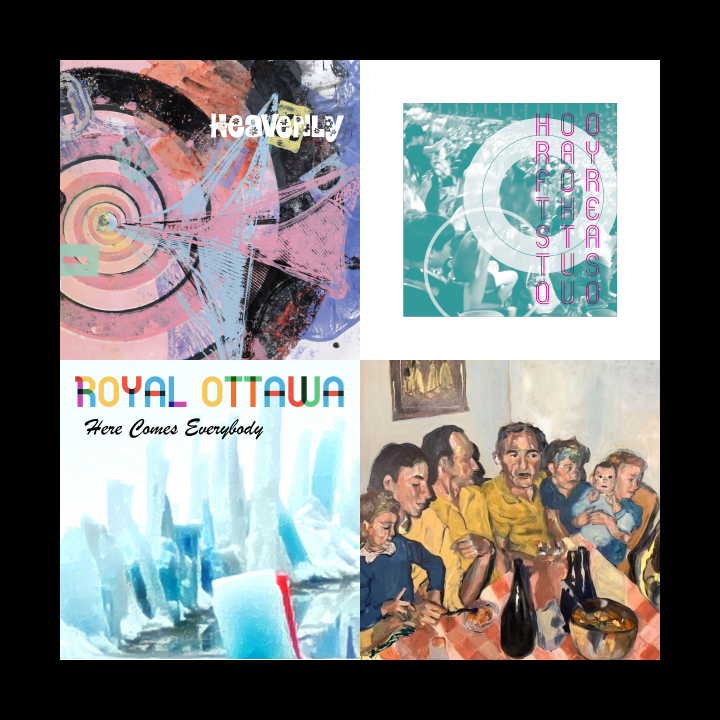
Pressing Concerns: Heavenly, Royal Ottawa, Me, You, & My Metronome, Michael Cormier-O’Leary

Welcome to a Monday Pressing Concerns! We’ve got a new album from Heavenly and new EPs from Royal Ottawa, Me, You & My Metronome, and Michael Cormier-O’Leary. Check them out below.

We do have a Tuesday blog post this week.

If you’re looking for more new music, you can visit the site directory to see what else we’ve written about lately. If you’d like to support Rosy Overdrive, you can share this (or another) post, or donate here.

Heavenly – Highway to Heavenly

Release date: February 27th
Record label: Skep Wax
Genre: Twee, indie pop, power pop
Formats: Vinyl, CD, digital
Pull Track: Excuse Me

Highway to Heavenly has been a long time coming now. The legendary British twee-pop quintet understandably disbanded after the death of their drummer, Matthew Fletcher, in 1996, and Heavenly was let to lie until earlier this decade: the quintet began reissuing all of their records on Skep Wax (the label co-owned by Heavenly vocalist/guitarist Amelia Fletcher and bassist Robert Pursey), they played a few reunion shows with Ian Button on drums where they road-tested new music, and the single “Portland Town” showed up last June. It was only a matter of time before Heavenly released a new album, and here we are almost exactly twenty years after Operation Heavenly with the fifth Heavenly LP, Highway to Heavenly. The remaining original members (Fletcher, Pursey, guitarist Peter Momtchiloff, and keyboardist Cathy Rogers) formally welcomed Button in on drums, and the five of them recorded the songs of Highway to Heavenly in Kent and London with producer Toby Burroughs (Clémentine March, Sassyhiya, Rozi Plain).

More than most 90s indie rock groups, there seems to be a sense of trepidation around the idea of a “Heavenly reunion album”; it’s probably a combination of the simplicity of the “twee” music they pioneered, their tragic original end, and the personal connection many have to Heavenly’s music. The secret, though, is that the members of Heavenly never went away or stopped making good music–there were the two post-Heavenly bands in Marine Research and Tender Trap, and Fletcher, Pursey, and Momtchiloff all have multiple currently-active bands, many of which have appeared on this blog, including The Catenary Wires, Swansea Sound, Railcard, and Would-Be-Goods (Rogers, who pursued careers in reality television production and neuroscience after Marine Research ended, is the one exception). These acts may not be well-known outside of devoted indie pop lifers, but you can listen to them and learn that the members of Heavenly still very much know what they’re doing; this (as well as Fletcher and Pursey’s sharp taste in new indie pop bands exemplified by who they’ve signed to Skep Wax) was enough to have plenty of confidence in Highway to Heavenly before I heard it.

Highway to Heavenly sounds like how you’d want it to sound–Heavenly aren’t trying to erase twenty years of growing their sound and musicianship with other acts and revert to 1996, but they’ve naturally created something that slots nicely after Operation Heavenly nonetheless. The massive indie pop opening stretch from “Scene Stealing” to “Press Return” would make this whole Heavenly revival thing worth it even if the rest of Highway to Heavenly was disappointing (even if I don’t think I necessarily needed a Heavenly tribute to Portland, Oregon, the desire for refuge for nonconformists coming from these longtime fiercely independent upstream-swimmers is quite resonant). Thankfully, though, the rest of Highway to Heavenly continues the winning streak, giving us things to chew on between “Deflicted” and “The Neverseen” and nailing more indie pop hits with “She Is the One” and “Excuse Me”. “That Last Day” closes Highway to Heavenly with a sudden collision of sadness and loss; about the death of Fletcher’s mother, “The Last Day” is an affirmation both that tragedy and death are part of Heavenly’s story and that the band can continue on in the face of it. Fletcher ends “That Last Day” on an uncertain note, asking “Did I do all that I could?”; this query feels unlike anything Heavenly had broached before, but it’s also always been in their nature to tackle whatever lay before them with indie pop. (Bandcamp link)

Royal Ottawa – Here Comes Everybody

Release date: February 4th
Record label: The Beautiful Music
Genre: Psychedelic rock, Paisley Underground, college rock, desert rock
Formats: Vinyl, digital
Pull Track: Here Comes Everybody

The long-running Canadian band Royal Ottawa first came onto my radar in 2023 with their massive double album Carcosa, but they’ve been releasing music off and on since the 1990s (and their origins go back even further than that, as multiple band members played in short-lived 1980s post-punk group Bugs Harvey Oswald). Carcosa was a hefty dose of dense, hard-to-classify, long-in-the-tooth rock music; I referenced bands like Eleventh Dream Day, The Church, and The Dream Syndicate when I wrote about it, which should give you some idea. After a career spent releasing music fairly sporadically, it’s a pleasant surprise to get a brand-new EP from Royal Ottawa less than a year and a half after Carcosa; perhaps their new partnership with The Beautiful Music has encouraged them, as the Ottawa-based label has stepped up to put out the four-song, twenty-two-minute Here Comes Everybody on vinyl.

Royal Ottawa continue cataloguing their version of post-college rock, post-Paisley Underground psychedelia/folk rock on these four songs: like a lot of the greatest moments on Carcosa, opening track “Golden Eyes” is a rocker that sounds like it just came into being one day, or like it’s an excerpt of some kind of eternal jam. “Range Road” similarly conjures up this lost feeling, though it’s a bit of a softer folk rock take on it, pairing nicely with “Pine” (probably the closest thing to the “guitar pop” side of college rock on here). Of course, half of Here Comes Everybody is taken up by the ten-minute title track, and it’s here where Royal Ottawa fully give in to the motorik vibes and endurance-test desert rock music that hover around the edges of their sound. There are plenty of different “kinds” of ten-minute songs out there; “Here Comes Everybody” is the steady, forward-chugging kind, one that doesn’t flag for a second and achieves meditative bliss in a way that’s not unlike how it feels to take in Carcosa as a whole. Royal Ottawa are clearly locked into something–their sound is aged, but as exciting as any new band. (Bandcamp link)

Me, You, & My Metronome – Hooray for the Status Quo

Release date: February 6th
Record label: Petite Village
Genre: Indie pop, jangle pop, dream pop, chamber pop
Formats: Digital
Pull Track: Settle Down

Me, You, & My Metronome is Jon Sakata, a lo-fi pop artist who has apparently been making music under the name since the mid-2000s and during stints in San Francisco and Austin. Some of those early recordings are collected on Bandcamp, but Me, You & My Metronome’s recent history begins in late 2024, when Sakata, now based in Montreal, released an EP called Red Pipes under the name via Petite Village Records (The Wesleys, Museums, Othello Tunnels). A little over a year later, Me, You & My Metronome is back with another EP, again on Petite Village–this time it’s a seven-song, twenty-three minute affair called Hooray for the Status Quo (“Things can go south pretty quickly, so waking up feeling the same as the day before can be pretty special,” Sakata writes on Bandcamp regarding the title).

I know exactly the kind of music in which Me, You, & My Metronome deals, and you likely do too if you read this blog reguarly: dreamy, lo-fi, romantic, 80s-inspired guitar pop, with bits of new wave, synthpop, jangle pop, college rock, and C86-inspired indie pop all in play here. I can think of countless bands and projects currently toiling away in relative obscurity nailing this kind of thing, from Goodbye Wudaokou in England to Melancolony in the Bay Area to EEP and Ross Ingram in El Paso to Lost Film in New England; Petite Village mentions fellow Montrealers Prism Shores as a similar act, I don’t disagree. We get one lilting, catchy but melancholic pop song after another to start off Hooray for the Status Quo; if you can be patient with the deliberate chamber pop opening track “Neighborhood Anthem” and the swelling strings of “Cut Back the Sound”, you’re rewarded with fuzz-pop hit “Embroiled in Meaning”, the EP’s one unqualified “rocker”. Hooray for the Status Quo is ultimately a record for those of us who can appreciate material like the mini-orchestral, Sparklehorse-evoking pop music of “Settle Down”; if this is Me, You, & My Metronome’s status quo, they’re maintaining a high standard. (Bandcamp link)

Michael Cormier-O’Leary – Proof Enough

Release date: February 25th
Record label: Dear Life
Genre: Indie folk, chamber folk, singer-songwriter
Formats: Cassette, digital
Pull Track: Pressed Flowers

Michael Cormier-O’Leary stays busy: he’s busy co-running Dear Life Records (the Rosy Overdrive-staple alt-country/folk label he founded), he’s busy leading the instrumental chamber music ensemble Hour, he’s busy playing in bands like Friendship and 2nd Grade (that latter one’s new since we last checked up on him). He makes solo records too, of course; in recent years we’ve gotten two “song”-based ones (2021’s More Light!! and 2023’s Anything Can Be Left Behind) plus a piano-improvisation collection (2022’s Heard from the Next Room). Cormier-O’Leary’s latest solo release is a six-song cassette EP called Proof Enough that explores “family roots” and “generational pain”; created almost entirely by Cormier-O’Leary himself (backing vocals from Heeyoon Won of Boosegumps and 22º Halo the only accompaniment), it’s the kind of release that naturally gets overshadowed by someone with a large and constantly-expanding body of work.

Nonetheless, it’s worth digging into Cormier-O’Leary’s writing here, as it’s very deliberate and thoughtful. Inspired by memories of his own family, his own marriage and fatherhood, and fiction (the EP’s title comes from Sense and Sensibility), Proof Enough is empathetic, intricate chamber-folk music; the imparting of “Sky Is Blue” and the portrait of “Del” are some of the most complete writing I’ve heard from Cormier-O’Leary yet. The music is humble but it, too, feels very developed; it’s in line with his previous work, but fans of slow-moving chamber folk like American Music Club or Lambchop will appreciate the compositions here. “Pressed Flowers” closes Proof Enough with an undeniably beautiful song inspired by Cormier-O’Leary’s marriage; like so much related to “family”, it’s saccharine on the surface and layered deeply below. (Bandcamp link)

Also notable:

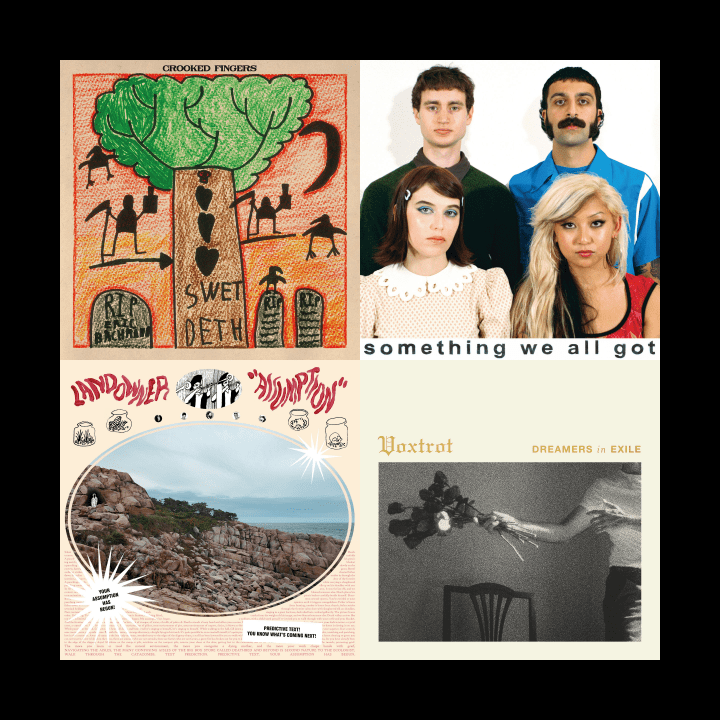
Pressing Concerns: Crooked Fingers, Landowner, Cootie Catcher, Voxtrot

The Thursday Pressing Concerns features four albums coming out tomorrow, February 27th: new ones from Crooked Fingers, Landowner, Cootie Catcher, and Voxtrot. These are some heavy hitters! Check these out, and check out this week’s two previous blog posts (Monday’s featured Friends of Cesar Romero, Fran Carlyon, The Fruit Trees, and The Sylvia Platters, and Tuesday’s featured Keta Ester, Virgins, Would-Be-Goods, and Human Mascot) if you’ve yet to do so.

If you’re looking for more new music, you can visit the site directory to see what else we’ve written about lately. If you’d like to support Rosy Overdrive, you can share this (or another) post, or donate here.

Crooked Fingers – Swet Deth

Release date: February 27th
Record label: Merge
Genre: Folk rock, chamber rock, art rock, singer-songwriter
Formats: Vinyl, CD, digital
Pull Track: From All Ways

Crooked Fingers was Eric Bachmann’s second act–after the dissolution of the North Carolina’s tight, noisy, intense 90s indie rock quartet Archers of Loaf, he reinvented himself as a more folk rock/AM radio-esque frontperson with a loose and revolving cast of backing musicians. When Archers of Loaf released their first album in twenty-plus years in 2023 with Reason in Decline, it was a very intentional affair–the group spent a long time deciding whether or not they even wanted to make it, and then they had to figure out how to return to (and deviate from) a style initially abandoned partially due to its unsustainability. The first Crooked Fingers album since 2011, conversely, came about in a more organic fashion–while attempting to make another solo album (he’s put out two of those since Crooked Fingers’ last LP), Bachmann found himself with a bunch of songs that “belonged to a larger space than [his solo material]”. So, he pulled together a few collaborators and Swet Deth, a collection of songs about mortality inspired by the morbid but vibrant cover (drawn by Bachmann’s son in school), was born.

Bachmann’s musical collaborators here are a pair of musicians who’ve played on his solo albums (drummer Jeremy Wheatley and pedal steel player Jon Rauhouse), but this time there’s an impressive list of guest vocalists featuring longtime associates (Superchunk’s Mac McCaughan), surprising new faces (The National’s Matt Berninger and Sharon Van Etten), and current players in Bachmann’s live band (Avery Leigh Draut and Skylar Gudasz). Swet Deth feels like a Crooked Fingers album, a nebulous enough concept that’s more than large enough to contain the bright, bittersweet pop rock of opening track “Cold Waves” (featuring McCaughan on harmonies and sounding not unlike his own band’s recent material) and the gentle soft rock glide of “From All Ways” (in which Berninger sings the chorus).

As recognizable as Berninger’s voice is in general, I didn’t realize it was him on “From All Ways” at first; it’s a bit of an odd placement for him, his stoic baritone functioning as a balance to the brisk tempo Bachmann brings to the verses (and if the latter wins out, it’s still interesting to hear Berninger try to keep up in this situation). Dark undercurrents to “Insomnia” and “Empty Love and Cheap Thrills” aside, Swet Deth probably owes more to “swet” than “deth” as it’s been realized. It’s nice to hear Bachmann pursue Crooked Fingers-style pop music again–“Spray Tan Speed Queen (In a German Car)”, “Lena”, and “Hospital” deserve mentions in addition to the aforementioned opening duo. This side of Bachmann’s music, despite having been his dominant mode of artistic expression for almost all of this century, is probably underappreciated compared to the (understandable, justified) love Archers of Loaf still get to this day. We all ought to be as grateful for Crooked Fingers’ records as Bachmann sounds to be alive and creating them in 2026. (Bandcamp link)

Landowner – Assumption

Release date: February 27th
Record label: Exploding in Sound
Genre: Post-punk, garage punk, egg punk, post-hardcore, art punk
Formats: Vinyl, digital
Pull Track: Linear Age

What are Landowner? They’re a “abrasively-clean minimalist punk” band from western Massachusetts–not that this description clears anything up, really. They’re a very intense quintet, owing just as much to Dan Shaw’s frantic lyric-sputtering as to their furious rhythm section (bassist Josh Owsley and drummer Josh Daniel, the latter also of Editrix) and their squeaky-clean six-string spaghetti (provided by Elliot Hughes and Jeff Gilmartin). People like to compare them to The Fall and “egg punk”; I went with Minutemen and Pere Ubu when I wrote about their last album, 2023’s Escape the Compound (I’d throw Knowso on there now, too). They’ve always been very “New England” to me, and Assumption doesn’t change that. Maybe you’re game for a band hammering out an unrelenting, anti-punk opus littered with environmental destruction, fractured Americana, and bastardized religious iconography (no, I’m not sure if they’re the Puritans or the witches yet). We do live in a society, after all; the least we can do is join Landowner in properly maiming it.

Ninety-second bloodlettings remain an essential part of Landowner’s sound–the primordial “Rival Males”, the sardonic “Pray for the Environment”, and “Enemy Attack” (which lives up to its title) all make sure of that. If Landowner let one of their unforgiving grooves go on for more than three minutes though, watch out–those are the ones that’ll leave a mark. We’ve got the opening title track, in which we are kindly informed that “your time has come / your assumption has become”. We have the vat-of-acid-drenched “Unboxing”, in which Shaw bellows “I am the Daniel Boone of the New Contamination Wilderness” over top of deteriorating rock music. We have “Linear Age”, a three-point-five-minute history of humanity as a video game speedrun (“Develop bronze! / You have successfully developed bronze”), complete with rockets and landfills and all the hits. The last song is six minutes long; it’s called “Normal Returns to Normal”, and Shaw repeats that title like a mantra. I don’t know if “Normal Returns to Normal” is an observation or a prediction (or what even “normal returning to normal” even means, necessarily); I’m not the one making assumptions here. (Bandcamp link)

Cootie Catcher – Something We All Got

Release date: February 27th
Record label: Carpark
Genre: Indie pop, twee, experimental pop, electronica, power pop
Formats: Vinyl, CD, cassette, digital
Pull Track: Loiter for the Love of It

Montreal quartet Cootie Catcher won me over early last year with their sophomore album, Shy at First, an electronic-twee pop balancing act that ended up being an unlikely breakout record for vocalist/bassist Anita Fowl, vocalist/guitarist Nolan Jakupovski, vocalist/synth player Sophia Chavez, and drummer Joseph Shemoun. Later that year, they (along with their tourmates, fellow rising indie pop group Good Flying Birds) were picked up by Carpark Records (Cloud Nothings, The Beths, Ducks Ltd.), and a new Cootie Catcher LP has arrived less than a year after Shy at First. On Something We All Got, Cootie Catcher has clearly “gone for it”; armed with a label with a larger reach and (presumably) more resources than before, the quartet have polished the stranger, “out-there” side of their sound away and honed in on making big-hook, excitable indie pop songs.

Were the wonky, oftentimes headscratching synth-trails of Shy at First part of Cootie Catcher’s initial appeal to me? Sure, but any worry that the band may have inadvertently sanded off their strong suits is laid to rest by the gorgeous, twinkling opening ballad “Loiter for the Love of It” (You think you know slacker-twee? Cootie Catcher will show you slacker-twee). There’s no getting around the fact that “Straight Drop”, “From Here to Halifax”, and “Quarter Note Rock” are straight-up monsters of guitar pop songs, and every one of Something We All Got’s fourteen tracks contains at least some elements of that side of them. The weird is still here–burbling synths and skittering beats are scattered here and there, less central but still integral to “Rhymes with Rest” and “Lyfestyle”, the most “offbeat” moments on the album. “Pirouette” is effectively a straightforward twee-jangle-pop song with some incessant synths refusing to be cowed, while “Stick Figure” suggests a different path for Cootie Catcher, flirting with noise-pop kitchen-sink vibes in its refrain. If another band made Something We All Got, I might call it a “transitional” album, but everything I know about Cootie Catcher suggests they’re right at home here. (Bandcamp link)

Voxtrot – Dreamers in Exile

Release date: February 27th
Record label: Cult Hero
Genre: Indie pop, folk-pop, dream pop, power pop, chamber pop
Formats: Vinyl, CD, cassette, digital
Pull Track: Rock & Roll Jesus

The Austin, Texas quintet Voxtrot were a mid-2000s “blog rock” band, building buzz off of a pair of EPs and then releasing one album before breaking up at the end of that decade. They’d been a name I sort of recognized for a long time, but it wasn’t until they reunited and began reissuing their older material that I discovered that the group (vocalist/guitarist Ramesh Srivastava, guitarist Mitch Calvert, bassist Jason Chronis, keyboardist Jared van Fleet and drummer Matt Simon) were an impressive indie pop band that holds up well today. Even so, Dreamers in Exile is Voxtrot’s first new album in almost twenty years (and only their second overall); it’s a reintroduction to a music landscape that looks completely different than it did when Voxtrot put out Raised by Wolves in 2005. Srivastava, Chronis and Simon are described as the band’s current “nucleus”, but all five original members contribute to Dreamers in Exile, and the quintet have made an incredibly polished, vibrant, multi-layered, “mature” pop album together.

“Another Fire” is both grand-sounding and approachable, a string-swept orchestral/chamber pop opening statement that also serves to introduce Srivastava as a compelling pop frontperson, too. As strong as the opening track is, it doesn’t fully prepare us for what Voxtrot have done in Dreamers in Exile–from there, the propulsive, synthpop/new wave-esque power pop of “Fighting Back” and the title track are nice surprises. If this kind of thoughtful, AM-fluent post-chamber indie pop is in any way relevant to you, Dreamers in Exile plays like a lost greatest hits collection; there isn’t a dull moment whether Voxtrot are letting the strings lead us into starry-eyed territory with “The Times” and “Esprit de Coeur” or getting a little more electric with “Change” and “Rock & Roll Jesus” (the latter of which genuinely does rock, although it “works” for much the same reasons other Voxtrot songs do). Now we know what a Voxtrot album in 2026 sounds like–a band making the absolute most of its second act. (Bandcamp link)

Also notable:

Pressing Concerns: Keta Ester, Virgins, Would-Be-Goods, Human Mascot

In this here Tuesday Pressing Concerns, we have new albums from Keta Ester and Would-Be-Goods, an new album-ish from Human Mascot, and the final release from Virgins. Check ’em out below, and if you missed yesterday’s Pressing Concerns (featuring Friends of Cesar Romero, Fran Carlyon, The Fruit Trees, and The Sylvia Platters), check that out, too.

If you’re looking for more new music, you can visit the site directory to see what else we’ve written about lately. If you’d like to support Rosy Overdrive, you can share this (or another) post, or donate here.

Keta Ester – Love Apple

Release date: February 20th
Record label: Self-released
Genre: Folk rock, psychedelic folk, psychedelic pop
Formats: CD, cassette, digital
Pull Track: Saved the World, Left Us All

I’ve been familiar with the music of Keegan Graziane thanks to his work with Bruiser & Bicycle, the Albany-originating psychedelic folk band he co-founded with Nicholas R. Whittemore. Bruiser & Bicycle have released three great albums from 2019 to 2025, and they’re still going strong (you can catch them playing shows in upstate New York with Cootie Catcher and Blue Ranger, among others), but Graziane decided he needed to make a solo album on top of that, apparently. Taking the name Keta Ester, Graziane enlisted Bruiser & Bicycle’s current rhythm section (bassist Zahra “Z” Houacine and drummer Joe Taurone) as well as flautist Stone Filipczak (of @ and E.R. Visit, acts that feel akin to Bruiser & Bicycle) to record Love Apple with the prolific Scoops Dardaris (Laveda, Cusp, Buddie).

The sprawling, fifty-minute Love Apple sure does sound like a solo album from one of the guys from Bruiser & Bicycle (which, to be clear, is a very good thing). The convoluted, surprising, and progressive pop sensibilities of Graziane’s other band are left entirely intact here, with the main difference being a more stripped-down, folk-influenced take on this kind of music that provides something of a breather from Bruiser & Bicycle’s “sensory overload” vibes (the most recent Bruiser & Bicycle album, last year’s Deep Country, had glanced in this direction, but Love Apple is a full-on embrace of it). “Big Stomp, Big Stomp” and “Teacher of the Earth” are effectively streamlined Bruiser & Bicycle songs, but other moments on the album, such as the soft 80s pop “Truth Is a Land Mine”, the quiet flute-aided folk of “Who Bares This Life?”, and the beautiful morning folk rock of “Saved the World, Left Us All” find Keta Ester exploring relatively new terrain. Bruiser & Bicycle fans will undoubtedly enjoy Love Apple, but I see it having some reach beyond that band’s niche, as well. (Bandcamp link)

Virgins – Light the Space Left Behind / Transmit a Little Heaven

Release date: February 19th
Record label: Blowtorch/Old Crows
Genre: Shoegaze, noise pop, alt-rock, dream pop
Formats: Vinyl, digital
Pull Track: Reveries

I wrote about the somewhat questionably-named Belfast shoegaze group Virgins back in 2024, when they released their debut album Nothing Hurt and Everything Was Beautiful. As it turned out, Nothing Hurt and Everything Was Beautiful was also fated to be the final Virgins LP, as the quintet broke up less than two years after its release. The quintet (vocalist Rebecca Dow, guitarists Dave Sloan and Michael Smythe, bassist Mo O’Kane, drummer Matt McMullan) had recorded three final songs last September, however, and these represent the final Virgins release, Light the Space Left Behind. The physical edition of Light the Space Left Behind also takes the opportunity to press some miscellaneous Virgins material to vinyl, including the non-album single from last year “b l o o m s” and their debut EP, 2022’s Transmit a Little Heaven (meaning that the first and last Virgins recordings are now on the same physical record).

The five Transmit a Little Heaven songs are some solid modern shoegaze, but “b l o o m s” and Light the Space Left Behind are the ones that highlight how much Virgins grew over the course of a half-decade. The non-album single sounds cavernous, really exemplifying why they once called themselves a “deafening dream pop” group, and the fourteen minutes of Light the Space Left Behind close the book on Virgins on an undoubtedly high note. The quintet once again collide wall-of-sound shoegaze with the ethereal on “Crucible”, while the acoustic guitars and swooning feedback of “Passing” is a lovely reminder that Virgins were hardly one-trick ponies. I can’t say that Virgins left anything on the table by closing the EP with “Reveries”, which is a massive five-minute grand finale of giant drums, soaring vocals, and transcendent guitars. It’s exactly how Virgins should wrap it up, if they must. (Bandcamp link)

Would-Be-Goods – Tears Before Bedtime

Release date: February 13th
Record label: Skep Wax
Genre: Indie pop, jangle pop, twee
Formats: Vinyl, CD, digital
Pull Track: The Gallopers

British indie pop group Would-Be-Goods have been around since the late 1980s: they put out a handful of singles and albums in their first few years of existence, and then they released three LPs on Matinee Recordings in the 2000s. A lengthy gap was broken at the beginning of this decade with four digital EPs in 2021 (compiled on a CD called The Night Life two years later), and the band linked up with fellow indie pop veterans Skep Wax to release their sixth proper album, Tears Before Bedtime. Although frontperson Jessica Griffin was the group’s sole founder, Would-Be-Goods’ current lineup–guitarist Peter Momtchiloff (Heavenly, Railcard), drummer Debbie Greensmith (The Headcoatees), and bassist Andy Warren (The Monochrome Set)–has been in place for twenty years now, and that’s who’ve come together to realize this latest collection of Griffin’s vintage indie pop songwriting.

The Would-Be-Goods’ style is a recognizable one, one that arose during the indie pop heyday in which they participated and hardly out of fashion today–gentle, plain-spoken, quite British, and 60s-indebted. Opening track “The Gallopers” puts it all together quite nicely, and “The Back of Your Bike” is a classic youthful tragedy song that makes it clear that the 1960s influence on Griffin’s songwriting is much more than mere dabbling. Tears Before Bedtime covers a lot of ground in its fourteen songs and thirty-six minutes–with “The Rose Tattoo”, we get the sparse, doomed ballad, “Don’t Come Crying to Me” is a horn-laden kiss-off, “Carmilla” brings organ to the forefront, and “The Moon Doesn’t Mind” skips away to the tune of dream pop and woodwinds. I write about plenty of indie pop records in the vein of Tears Before Bedtime on this blog, but I certainly welcome Would-Be-Goods dropping in to remind us how it’s done any time. (Bandcamp link)

Human Mascot – Ketchup Mill

Release date: February 6th
Record label: Self-released
Genre: Math rock, art rock, garage rock, experimental pop
Formats: Digital
Pull Track:
Mail Pouch Chew

I get it. It’s been a long day. You’re tired. You look at the sensory-overload, ketchup-infused, fever dream-esque cover art to Ketchup Mill (credit Andy Soda) and think “I can’t deal with this bullshit right now”. Maybe you see that they refer to themselves as “Americhaotica”, “countrygaze”, and “art punk”, which probably doesn’t help. I am here to report about good music, though, and Human Mascot have pretty easily made the cut with Ketchup Mill. They appear to be a trio from Boston, and this appears to be their second record (after an EP called This! Is Your Human Mascot in 2024). On this record (seven songs, twenty minutes, call it an EP or LP based on your preference I suppose), Human Mascot continue in the grand tradition of New England math rock bands that know how to write a pop hook, from Pet Fox to Rick Rude to Lane. Blown-out noisy guitars veer into golden melodies (of both the instrumental and vocal variety), exemplified when the claustrophobic opening track “Hollow Log” gives way to the weird but undeniably catchy alt-math-country-pop-rock thing “Mail Pouch Chew”. “Pee/Spit” and the title track are frantic garage rockers that pound and chime their way into “hit” status, respectively, and even something as unhinged as “Debuild” has its pop moments. This is what “indie rock” should sound like, in my opinion. It’s cool that there are still bands out there like Human Mascot, and it’s cool that Rosy Overdrive exists so I can direct the rest of you to them. (Bandcamp link)

Also notable:

Pressing Concerns: Friends of Cesar Romero, Fran Carlyon, The Fruit Trees, The Sylvia Platters

Welcome to a Monday Pressing Concerns! We have new records from Friends of Cesar Romero, Fran Carlyon, The Fruit Trees, and The Sylvia Platters below (one of them is an EP, one is an LP, and you’ll have to use your best judgement on the others). Check them out!

There will be a blog post tomorrow.

If you’re looking for more new music, you can visit the site directory to see what else we’ve written about lately. If you’d like to support Rosy Overdrive, you can share this (or another) post, or donate here.

Friends of Cesar Romero – Soul Scouts

Release date: February 6th
Record label: Doomed Babe/Kit Fox
Genre: Garage rock, punk rock, power pop
Formats: Digital
Pull Track: Bitter But Better

J. Waylon Porcupine is back, and he sounds pretty fed up. The Rapid City, South Dakota-based musician is a one-man garage rock/power pop machine; one thing we can rely on in this day and age is a new single, EP, or short album from his Friends of Cesar Romero project every couple of months. The first Friends of Cesar Romero offering of 2026 (coming almost exactly two months after the previous one, December’s Cars, Guitars, Girls EP) is a ten-song, eighteen-minute jolt called Soul Scouts, and it’s my favorite release of his in quite a while now. Friends of Cesar Romero records run the gamut from sunny, hook-heavy power pop to ripping basement garage punk; Soul Scouts hews towards the latter, but, as always, there’s a trace of the former in these songs as well. Nonetheless, Soul Scouts begins with Porcupine absolutely tearing into “The Rapid City Is Boring”, a blistering early punk rock throwback that’s fun and bratty; “Trauma Bonding” and “A Sonnet for Lee Lazy Horse” keep the quick tempos, lurking fury, and very pleasing guitar tones up and “Gate Around the Classy Apple” just barely has a breather moment at the beginning.

I could list all of the exciting pop punk moments on Soul Scouts all day; funnily enough, it’s the closing stretch where Friends of Cesar Romero’s power pop streak really starts to dominate again. “Nurse Midwife Crisis” is right in the middle of “blistering tempo” and “golden-melody chorus”, and “Tassels” is the first thing on the record that could reasonably be called “jangly”. “Lost Her to a Lost Boy” makes the bold choice to get a bit mid-tempo with it, and it turns out that Porcupine saved the biggest, most straightforward power pop anthem for last with “Bitter But Better”. If Soul Scouts feels like an album-length (well, an eighteen-minute-length) letting-off-of-steam, “Bitter But Better” is both the light at the end of the tunnel and a summation of the process that led us to this moment. “I don’t miss missing you” is a simple enough line, but Porcupine spends all of Soul Scouts making sure it lands. (Bandcamp link)

Fran Carlyon – Home Truths

Release date: February 6th
Record label: YYZ
Genre: Lo-fi folk, bedroom folk, slowcore
Formats: CD, digital
Pull Track: Tripping Over My Heart

I’ve known about Southend-on-Sea’s Fran Carlyon thanks to his music blog heavymetalkids.uk, which you should probably add to your rotation if you haven’t been checking it out before. Perhaps this makes me predisposed to like Carlyon’s own music, but I’d say it’s less “music blogger solidarity” and more “well, I know that I like his taste in music, which gives him a leg up”. Plus, his debut mini-album Home Truths comes with co-signs from two musicians I’ve written about before in Goodbye Wudaokou’s Matthew Mills and Assistant’s Jonathan Shipley, who’ve co-released it on the fledgling label they’ve co-founded, YYZ (in fact, it’s the first record not made by themselves they’ve put out).

Home Truths is not precisely the kind of homespun indie pop with which I’ve associated Carlyon and his labelheads before, but it captures the “intimate” and “lo-fi” parts of them at the very least. Carlyon makes very stark, hushed folk music with atmospheric synths floating around the periphery; melodies are still in play, to be sure, but the acoustic fingerpicking and cavernous feeling are the more immediately noticeable traits of Home Truths. It’s a pretty short experience (the streaming version is only six songs and eleven minutes long, with two extra tracks on Bandcamp and CD), but it doesn’t feel slight; once you’re in Home Truth’s chilly, vaguely haunted world, it commands your full attention. Instrumental passage lapse into stunning slowcore-ish folk/pop material like “Running on Emptiness”, “Ten Years”, and “Tripping Over My Heart” in a dream-like state, and I come out of Home Truths with the same waking feeling of trying to piece together what I remember from my previous state of consciousness. (Bandcamp link)

The Fruit Trees – Teeth

Release date: February 2nd
Record label: Flower Sounds
Genre: Folk rock, psychedelic folk, dream folk
Formats: Digital
Pull Track: My Opal

Los Angeles musician Johnny Rafter keeps plenty busy these days with his project The Fruit Trees. There’s been a steady stream of new music over the past few years; sometimes it’s basically Rafter on his own, sometimes he’ll invite other musicians, sometimes the music hews towards “song”-based folk rock, other times it’s more experimental or amorphous. The latest Fruit Trees album, Teeth, is a pop-literate folk record made by Rafter with the cast of Beth Rosenholtz on piano, Hannah Ford-Monroe (Rafter’s main collaborator on last year’s An Opening) on vocals, Pearce Gronek on upright bass, Brooke Tannehill on violin, Adam Weddle on guitar, and Fletcher Barton on trumpet (with some degree of instrumental musical chairs going on). The Fruit Trees’ version of folk music is refreshing in its unvarnished attitude; this isn’t alt-radio-bait “indie folk”, but rather something that sounds pieced together by a group of musicians with the seams showing. The tempos are wobbly, the strings are droning, and the vocals drift in and out of focus. Some songs, like the vibrant opening track “Parallel” and the peaceful late-record ballad “My Opal”, I struggle to imagine anyone not finding beautiful; other tracks, like the vaguely nightmarish title track and the wonky march of “River Gifs”, might take a bit more patience. They’re different sides of The Fruit Trees’ coin, though–taken together, it’s an overview of an act with a bag of instruments, a bag of concepts, and with oftentimes unusual but always intriguing ideas on how to merge the two. (Bandcamp link)

The Sylvia Platters – Will Tomorrow Be Enough

Release date: February 6th
Record label: Dutch Customer
Genre: Power pop, jangle pop, indie pop
Formats: Cassette, digital
Pull Track: Gwendolyn, Approximately

Every couple of years, the Vancouver quartet The Sylvia Platters sees fit to drop a brief collection of breezy, jangly power pop; we got the Youth Without Virtue EP in 2022 and the LP (of only slightly longer length) Vivian Elixir in 2024. Fast forward another two years, and The Sylvia Platters are back with a new lineup (founding members Nick and Tim Ubels are joined by new faces Kyle Schick and Ian Fildes, although former guitarist Alex Kerc-Murchison still has a co-writing credit on one song) and a new five-song cassette EP called Will Tomorrow Be Enough. The twenty-minute record is further confirmation that the Ubels are honors students of Teenage Fanclub and their jangly indie pop ilk: “False Colours” rushes up to greet us with a brisk tempo, romantic vocals, and guitars that do exactly what you want them to do. “Tactical Lunchbox” throws some new wave-y/Attractions-style keyboards into the mix (oh, and some nice tambourine), and “Alone” is the “requisite pastoral ballad”, but the five-minute “Gwendolyn, Approximately” is Will Tomorrow Be Enough’s crown jewel; this multi-part college rock opera piece has a massive chorus and all sorts of twists and turns in between repetitions of it. As usual, The Sylvia Platters’ latest missive ranges from solid to transcendent, and they remain worthy of a listen for all indie pop devotees. (Bandcamp link)

Also notable:

Pressing Concerns: The Tammy Shine, Kerrin Connolly, Abronia, Charm School

Welcome to the Thursday Pressing Concerns! We’ve got new albums from The Tammy Shine, Kerrin Connolly, and Abronia, plus a new EP from Charm School. Check ’em out below, and if you missed either of this week’s earlier blog posts (on Monday, we had a Pressing Concerns featuring Flat Mary Road, Rocket Bureau, Annabelle Chairlegs, and Tacoblaster, and on Tuesday we went deep into the year 1998), check those out too.

If you’re looking for more new music, you can visit the site directory to see what else we’ve written about lately. If you’d like to support Rosy Overdrive, you can share this (or another) post, or donate here.

The Tammy Shine – Ok Shine Ok

Release date: February 20th
Record label: HHBTM
Genre: Power pop, indie pop, glam, twee
Formats: Vinyl, CD, digital
Pull Track: Junk Mail

I listen to a lot of music for this blog. I throw a bunch of stuff on my phone and go through the playlists, and I often won’t remember anything about the artist in question by the time I get to them. I eventually made it to “Junk Mail”, the fourth song on Ok Shine Ok. That one caught my attention immediately. It’s a bonkers pop song–it’s bratty, campy, euphoric, fiery, whatever; it sounds like mall-pop-punk at one point, like a Guided by Voices track at another point, like turn-of-the-century alt-pop another. It was enough for me to ask: who the fuck is The Tammy Shine?

The Tammy Shine is Tammy Eaton, who you may know as the frontperson of Dressy Bessy. Arising from Denver, Colorado in the mid-90s, the Elephant 6-associated group are the only band that can say they appeared on soundtracks for both But I’m a Cheerleader and The Powerpuff Girls, carving out their own place in a vibrant scene. The most recent Dressy Bessy album, Fast Faster Disaster, came out in 2019; they’re still going (currently as a trio featuring The Apples in Stereo’s John Hill on drums and Craig Gilbert on bass), but The Tammy Shine is Eaton’s “solo project”. How Ok Shine Ok specifically differs from Dressy Bessy I’m not sure, but if Eaton devised The Tammy Shine to give her personality a place to (ahem) shine, then: mission accomplished, and then some. 

“Shaky Shaky” is one hell of an opening statement; the music is an instant reminder that we’re dealing with indie pop royalty here, and Eaton’s conversational but melodic voice instantly puts a unique stamp on Ok Shine Ok too. “Baby, I’ll B There”, “Love Letter”, and “Speed Date” could all be more or less called “garage rock”, but that doesn’t do justice to an album encompassing everything from the blazing showtune “So Very Little” to the minimal nursery rhyme indie pop of “Tic Tac” to the ascendent synth-rock anthem “Auto Pilot”. And then there’s “Junk Mail”, which has at least five hooks you could build a song out of, slammed together like a can of Fanta crushed by a cartoon anvil. I think that’s what Ok Shine Ok is about. It’s how it feels, at least. (Bandcamp link)

Kerrin Connolly – Simpleton

Release date: February 20th
Record label: Self-released
Genre: Indie pop, synthpop, power pop
Formats: CD, digital
Pull Track:
Big Amygdala

Over the past decade, Boston’s Kerrin Connolly has gone from a musician with a YouTube following to an artist with multiple records to their name, releasing the LP Almost in 2020 and an EP called Don’t Be Afraid in 2022. 2024’s mini-album Transitions was the first Connolly release I heard, but it was their latest album, Simpleton, that really caught my attention. Self-describing it as a “12-song concept album detailing the modern hero’s journey”, Connolly has written, produced, and performed (with help from Ellis Piper on strings) a massive, imminently attention-grabbing pop-rock album. It’s a shiny mess of power pop, orchestral pop, musical theater, and 80s-evoking synthpop, often all in short succession.

Early hits “Big Amygdala” and “Mind the Gap” are two of the catchiest power pop songs I’ve heard this year, and they both showcase Connolly’s ability to shoehorn whip-smart writing into big hooks; they remind me of recent material from the likes of Pacing, Rosie Tucker, and Career Woman, which is no small feat. Meanwhile, stuff like “Flowers Pt. 1” and “Pt. 2”, “How Easy It Is”, and “Avalanche” are (relatively speaking, I mean) not as “in-your-face”, but that just gives Connolly an even clearer stage to seize. And besides, “He Doesn’t Die in The End” and “The End” ensure that there are bangers as Simpleton draws to a close. Even if I didn’t necessarily follow the aforementioned hero’s journey from plot point to plot point, the ordeal more than earns the guitar-soloing power ballad finale in “Simple”. (Bandcamp link)

Abronia – Shapes Unravel

Release date: February 20th
Record label: Cardinal Fuzz/Feeding Tube
Genre: Psychedelic rock, garage rock
Formats: Vinyl, CD, digital
Pull Track: New Imposition

The six-piece Portland, Oregon psychedelic rock band Abronia showed up in 2017 with a five-song album called Obsidian Visions/Shadowed Lands, and ever since then the group (currently vocalist/saxophonist Keelin Mayer, pedal steel player Rick Pedrosa, drummer Robert Grubaugh, bassist Danny Metcalfe, and guitarists James Shaver and Eric Crespo) have been reliably dropping LPs on their twin homes of Cardinal Fuzz and Feeding Tube Records. Shapes Unravel is the group’s fifth, and while it represents some changes for Abronia (Metcalfe and Grubaugh are new, and Shaver has switched instruments), it nonetheless sounds like a band completely immersed in their own psychedelic world. 

Featuring a generous seven songs this time, Shapes Unravel finds Abronia smoothly and casually injecting enough personality into their music that it never feels like we’re merely wading through another “modern psych-rock album”. Just as likely to put swirling saxophones in the spotlight as gentle pedal steel, Shapes Unravel isn’t full-on “desert rock” or “jazz rock”, but it’s been out west and to the big city. Another point in Abronia’s favor is that they do genuinely “rock”; opening track “New Imposition” in particular is a tour de force, but there’s also a heftiness backing stuff like the intense “Walker’s Dead Birds” or the tight rhythms of “Weapons Against Progress”. Abronia’s version of psychedelia is one in which they retain control of the momentum; it’s a testament to their sense of direction that Shapes Unravel gets us to exactly where you want a record like this to go. (Bandcamp link)

Charm School – Schadenfreude Ploy

Release date: February 20th
Record label: Surprise Mind/Karmic Tie
Genre: Noise rock, post-punk, garage rock, post-hardcore
Formats: Cassette, digital
Pull Track: Prime Mover Unmoved

Last year, Louisville noise rock quartet Charm School released their debut album, Debt Forever, a snarling, furious post-punk record about financial anxiety and other American topics (it was one of my favorite LPs of last year). A little over a year after Debt Forever, Charm School have returned with a brief endeavour, a four-song EP called Schadenfreude Ploy; they are apparently based in Los Angeles now, and the lineup for this one is bandleader/guitarist/vocalist Andrew Charm, bassist Brian Eduardo Vega, and two new faces (Toby Van Kleeck and Chase Palmer) sharing drum duty.

Different players aside, Schadenfreude Ploy is still Charm School at their 90s underground rock-evoking best; the opening title track immediately sets up shop with an overwhelming sense of dread, iron-grey rhythms, and no wave skronkiness over top of it all. “Scene Queen”, with its quick garage-y tempo, is the the “hit” of the EP and the clearest link to the groovier side of Debt Forever; don’t get too comfortable, though, as “Disgrace” is a full reimmersion in the murky waters of bleak noise rock (that song seems to be about AI in some way, which may explain that). “Prime Mover Unmoved” is one of Charm School’s most adventurous songs yet, a mess of post-rock/math rock, an odd psychedelic pop interlude, and an ascendant garage rock part that Charm School stubbornly refuse to turn into the song’s centerpiece. Charm School wield the hammer and scalpel as deftly as ever throughout Schadenfreude Ploy. (Bandcamp link)

Also notable:

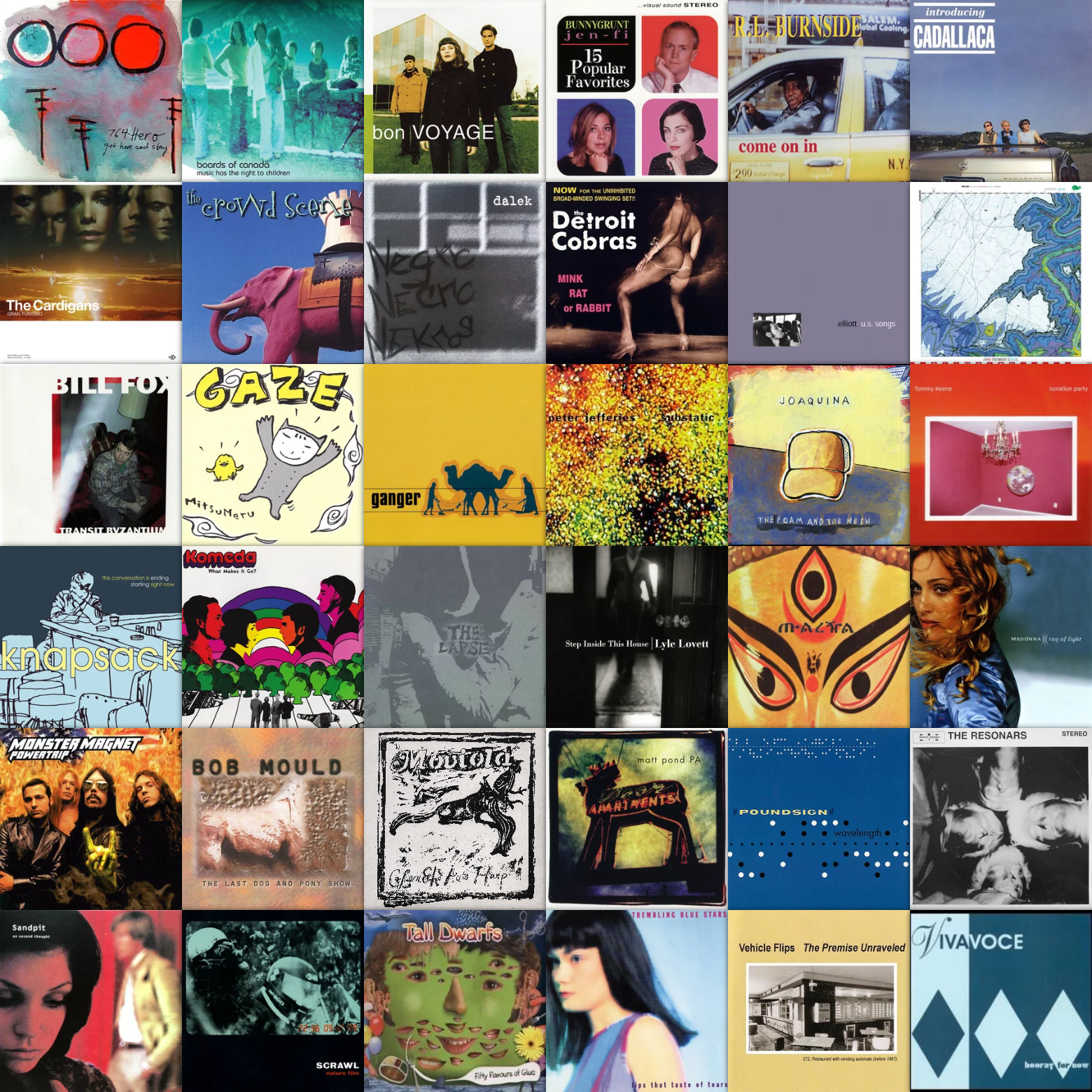
My 1998 Listening Log

It’s time for another listening log post! If this is the first one of these you’ve encountered, here’s the deal: during this January, I listened to one new-to-me album from 1998 every day (this continued sporadically into February), wrote down a little bit of what I thought about it, and posted said thoughts in the Rosy Overdrive Discord (which you’re encouraged to join if you haven’t). This post collects my work: 36 albums’ worth. This is the fifth one in a series also featuring 1981, 1993, 1994, and 1997 (if you enjoyed this post, maybe head to those next!).

Note that these are only albums I’d never listened to in full before, so if you’re wondering why something well-known/up Rosy Overdrive’s alley from 1998 isn’t here, it’s probably because I’ve heard it already. Those are the rules!

Bandcamp embeds are included when available.

1/1: The Resonars – s/t (Star Time)

An early record from Matt Rendon’s Arizona psychedelic power pop project. This album is definitely, aggressively 60s pastiche, but I don’t even think “psychedelia” is all that applicable here—most of The Resonars is straight-up bubblegum pop in barebones 90s indie rock dressing. Early GBV is again an obvious analogue, or a more slapdash, looser Sharp Pins, to keep things current. It’s a little “punk” but not in a Ramones way. It’s more like early 60s Beatles played with a mid-period Who energy. I dunno if we’re talking about an album full of perfect pop songs or anything like that, but the simplicity/enthusiasm is a breath of fresh air compared to where most bands go when they’re trying to evoke this era. Great drums, too.

1/2: Moviola – Glen Echo Autoharp (Spirit of Orr)

A selection from the large discography of the long-running Columbus alt-country band. I’m not even sure if this is 1998; their own Bandcamp says ‘97, but Discogs said ‘98 and that’s the basis on which I chose it. At this point there’s a hissing lo-fi 90s indie rock element to their sound; it doesn’t sound like Guided by Voices but it does feel of the same time and place. But there’s legitimate twang under the tape hissing—violins are all over the place, and “Spin the Car” for instance is basically a Sebadoh song but built off of a rockabilly riff. Starts off strong, sags a little in the middle, but gets really good again with “Pigeon Shot” onward. Recommended if it sounds like your thing.

1/3: Matt Pond PA – Deer Apartments (Lancaster)

This was the debut, before Matt Pond and company became a solidly reliable B-class indie rock group of the 2000s. This is definitely one of those “haven’t figured out what they want to be yet” first albums; there’s a post-grunge greyness, more rustic folk rock, and orchestral/symphonic touches all trying to work with each other here. At its best, it rules—“Fortune Flashlight” is an awesome pop song, and if you want an anthem, “Stars and Scars” works just fine. In a lot of their more hit-and-miss moments, they remind me of The Tragically Hip; I like the Hip, though it’s hard for a band from Pennsylvania to consistently pull off (“For Sale” is pretty good though). My least favorite moments on the LP lean too hard into melodrama; these just don’t really work at all. Still, the rough-around-the-edges quality is part of what makes it an interesting if inconsistent listen.

1/4: Tall Dwarfs – Fifty Flavours of Glue (Flying Nun)

Fifty shades of Tall Dwarfs. I’ve heard bits and pieces of this one (mainly whatever was on that Merge Records retrospective from 2022) but never listened to it front to back. It doesn’t seem to be one of the more well-regarded Tall Dwarfs album, but it’s a Tall Dwarfs album, and that’s a precious commodity. It’s the full Tall Dwarfs experience—stuff that sounds like Satanic children’s TV show music, freak folk, kazoos, nightmare fuel, gross/skewed humor, great pop music. Not every song here is essential but like an off-the-beaten-path Bob Pollard album, that’s not really the point. No other band would be capable of putting “Gluey, Gluey”, “The Future See”, “The Fatal Flaw of the New”, and “Just Do It!” on the same album and have it all make sense. And, honestly, just about every song from track 9 onwards rules; this is almost comically backloaded (including with “Round These Walls”, possibly the greatest song of all time).

1/5: The Crowd Scene – Turn Left at Greenland (EggBert/Harvey)

The Crowd Scene make a very specific kind of guitar pop music that comes from power pop and “college rock”; largely mid-tempo, acoustic and slightly folky, 60s-inspired but not in a recreation way. Less “cool” alternative history figures come to mind: Robyn Hitchcock, World Party, John Wesley Harding, 10,000 Maniacs. One of the two lead vocalists is named Grahame, which seems right. Truthfully I think the other singer, Ann Rodgers, has the best moments on this album— “Backtracking”, “Stupid People”, “Crush Me”, and “Permanent One” are all rock-solid pop songs. Grahame has his moments, too; if anything, this album’s also kind of backloaded, as that’s where most of the strongest material lies. Although this seems like it’ll take a couple of listens, so that might have something to do with it too.

1/6: The Vehicle Flips – The Premise Unraveled (Magic Marker)

I’ve written a fair amount about Frank Boscoe’s current band The Ekphrastics on this blog, and I’ve also touched on his early 90s group Wimp Factor 14 in these. The Vehicle Flips spanned from the late 90s to early 00s, bridging the gap between the two aforementioned acts, and, sensibly, the first album of theirs that I’ve heard combines the lo-fi, twee-ish 90s indie rock style of the latter with the folk rockier Mountains Goats-ish storytelling of the former. A vaguer/more opaque version of Boscoe’s recognizable narrative voice is here; I can easily hear it in “Requiem for a Canceled Program”, “Florence Scene Report”, and “Honeywell Round Thermostat”. Thanks in large part to “Song of the Slag Pile”, this is the most “Pittsburgh” Boscoe record I’ve heard yet. Oh, and “Self-Pity 6.0.1” is probably the best song ever about ClipArt.

1/7: Poundsign – Wavelength (Fantastic)

A Santa Cruz indie pop quartet with connections to The Aislers Set, Kids on a Crime Spree, and Dressy Bessy, among others. This was their first album of two; you might guess from the album artwork and title that this is one of those turn of the century “indie pop goes electronic-curious” albums, and you’d be in the ballpark. For Poundsign, though, this mostly just means prominent but recognizably melodic synths washing over their music, which works very well for their very melancholic style that’s bits of chamber pop and soft rock but still more or less “twee-pop”. Really beautiful album overall. Definitely a CD-era runtime but not much in terms of obvious filler (in the past, this likely would’ve been broken up into an LP and EP/single, probably the ideal format for this kind of music, but I can get into this).

1/8: Boards of Canada – Music Has the Right to Children (Warp/Skam/Matador)

Every one of these provides me with opportunities to get out of my comfort zone…and we’re way out of it now. This is electronic music! Not electro pop, or folktronica, or synthpunk, or whatever. I know this is a really important one, downtempo and IDM and Warp Records and whatnot. I did Autechre in a previous one of these, and it’s funny…this is pretty clearly more “normal”/accessible-sounding than Autechre was, but I think I liked listening to Autechre more. I’m not sure what I “want” out of electronic music, but I don’t think it’s this. It’s “sort of” many things; sort of ambient, sort of psychedelic, sort of pop…but not exceptional at any of them. Just not much for me to grab onto. I mean, it’s not like there aren’t interesting moments; the thing’s 70 minutes long, it’d be impressive if there weren’t. Out of respect for my peers who are into this more than I am, I’ll refrain from saying “more like Bored-s of Canada”.

1/9: Gaze – Mitsumeru (K)

Oh, here’s a notable K Records/twee album I haven’t heard! Gaze were only active for a couple years but they still released two LPs before breaking up; this is the first one. I’ve mentioned them in passing as one of the many bands Rose Melberg played in (she was the drummer), but they were actually co-led by Miko Hoffman and Megan Mallet, neither of whom have been in any other bands that I know of. Unsurprisingly, this is very good; vocal-wise, it is (ahem) soft like The Softies, but the instrumentals are louder and tougher, more on the power pop/punk-ish side of twee (Melberg’s drumming helps punch these songs up). There is of course a lot of great indie pop still being made, but, still…they don’t really make songs like “Peeking Shows His Ignorance” anymore. It wouldn’t hit the same way in 2026, anyway.

1/10: Peter Jefferies – Substatic (Emperor Jones)

A legend in New Zealand indie rock between his earlier bands and later solo work, both of which straddled lines between lo-fi experimental post-punk and pop. This one is entirely within the former category—it’s an instrumental post-rock album, five tracks in forty minutes, without any recognizable trace of “Kiwi pop”. Rhythms are important; they form the foundation of “Index”, “Signal”, and “Kitty Loop” (the drone-y “Damage” is the exception). Jefferies’ distinctive piano playing is also all over this album, occasionally as reprieve from the busyness, but even more frequently he’ll just be plonking along with the noise. If you’ve absorbed all that, you’re ready for the seventeen-minute closing track called “Three Movements”.

1/11: Bill Fox – Transit Byzantium (SpinArt)

Believe it or not, I’ve never really listened to much Bill Fox. The Cleveland guitar pop cult favorite is linked to a bunch of music I like between his 80s group The Mice and his solo material, and ‘98 saw the release of the second of his two 90s solo albums. Seems a little less popular than his first one, but I still quite enjoyed this one. I definitely hear the influence he had on Tony Molina; this is the midpoint between acoustic folk rock troubadour and 60s ornate jangle pop bliss. Much like Elliott Smith, I can imagine a legion of bedroom pop musicians hearing this and thinking “oh, I can do this”. Unlike Smith’s deceptively intricate pop music, though, Fox’s recordings really are that simple—you just have to write songs as good as “I’ll Give It Away” and “My Baby Crying” to get there. Good luck with that!

1/12: Tommy Keene – Isolation Party (Matador)

As much as I love his 1980s albums and his Keene Brothers project with Bob Pollard, Tommy Keene’s two 90s albums are blind spots for me. Like many cult power pop acts, he returned to the indie world after a “failed” major-label stint (though Matador in ‘98 is not a bad consolation prize, I’d think), but Isolation Party hardly carries itself that way. The 90s alt-rock-scape was littered with bands emulating the half-mast pop brilliance of Paul Westerberg, but Keene stood alone in shooting for the full-fledged early power pop from which Westerberg himself drew inspiration. The 80s-hit-bait largesse of Keene’s early work is scarcely turned down here, nor should it be; these songs should sound huge. He covers Mission of Burma. Jay Bennett plays on a couple of tracks. It’s high praise for me, but as of now I see no reason why this shouldn’t be on the level of Songs from the Film and Blues and Boogie Shoes. Peak Keene.

1/13: Bon Voyage – s/t (BEC)

There was a Starflyer 59 album this year, but there was also this, the first album from Starflyer bandleader Jason Martin’s other project, Bon Voyage (a duo with his wife Julie on lead vocals). This is more blatantly “pop music” than anything by Starflyer I’ve heard; it’s full-on fuzzy indie-power-pop verging on “twee”. It’s very nineties, yes—the Martins bravely conduct a series of experiments marrying Belly/Breeders noise to the tenderness of The Sundays and that Sixpence None the Richer song (and sometimes Rentals-like synth hooks are there, too). “Kiss My Lips” even does the noir-pop thing that was super en vogue at the end of last century. Of course, it also sounds like it could’ve come out this decade, because there are still so many bands trying to recreate this kind of music. Unsurprisingly I quite like this. It’s immediate, which helps for these “initial impressions” things, but I also really felt like there was a very high percentage of “hits” here.

1/14 Cadallaca – Introducing… (K)

I’m not sure how I’d never heard of this one before (at least I think I hadn’t); this was the only album from a trio led by Corin Tucker and featuring the underrated Sarah Dougher on Farfisa organ and backing vox. With the stripped-down setup (the third member is the drummer) and the heavy Farfisa usage, this should land squarely in Nuggets/60s garage rock territory, but you also have Corin Tucker sounding exactly like Corin Tucker, so it’s also like an alternate-universe Sleater-Kinney album. This rules! It should probably be more well-known! It’s easy to forget how great Corin Tucker was around this time (unless you’ve listened to Dig Me Out or The Hot Rock recently, I mean), but this is a welcome reminder that should be more than a footnote.

1/15: Joaquina – The Foam and the Mesh (Future Farmer)

I believe this was the only album from these irreverent California alt-country/folk rockers. They were more successful as labelheads, as Future Farmer, apparently run by 2/3 of the band, eventually put out albums from recognizable names like M. Ward, The Minders, and David Dondero. As for The Foam and the Mesh…it’s set-up like an acoustic version of mid-90s landfill slacker rock, but the album’s preoccupations (dead-end jobs, getting out of one’s hometown, alcohol) are indeed classic country. From the state that brought us Steinbeck, the Laurel Canyon, and the Bakersfield Sound, we get a tongue-in-cheek ode to moving to Fresno and multiple songs about throwing up. The highlights, “Fresno” and “Child Star”, are really good roots-pop-rock songs, and while I can’t fault any of the individual brief throwaway folk-indie-country rock songs, it could’ve used a couple more heavy hitters (especially because “The Day the Dogs Took Over” shows they can develop those kinds of songs a bit). Maybe an uneven listen, sure, but the kind of thing worth digging up for the best parts of it. Stick around for one last joke song where they pretend to be The Beatles.

1/16: Sandpit – On Second Thought (Fellaheen)

We’re once again doing “sole album by an obscure 90s indie rock band” here, but this time we hop over to Australia to hear the first and only LP by Melbourne trio Sandpit. This is a more stone-faced and gray version of “90s-slacker-indie”; it’s a noisy, fuzzy, post-Sonic Youth kind of sound. It didn’t stick with me on the first listen, but I’m on a second, more active, one now, and it sounds a lot stronger; there’s a really nice diamond-in-the-rough melodic quality to these songs that feels more like Eric’s Trip or even mid-period Sebadoh. They have some fun influences, but there’s nothing truly “out there” on this album (arguably “D.I. Eclipse”, I guess); it’s an indie pop album at its core, and it seems to work quite well at it.

1/17: Trembling Blue Stars – Lips That Taste of Tears (Shinkansen/Elefant/Clover/Noise Asia)

The Field Mice and Trembling Blue Stars (which vocalist/guitarist Robert Wratten founded after the former broke up) remain a huge indie pop blind spot for me. Is the 70-minute sophomore Trembling Blue Stars album the place to start? I’m guessing most fans would say no, but this is what came out in 1998, so we’re going headfirst into this thing. And, drumroll please: I really like this! As you may be able to guess from the album title, this is a heady, messy, too-romantic breakup album; TBS get to eat their cake and have it too musically, with room for jangly, guitar-led indie pop and 80s synthy/sophisti-art-pop twisters. It was the back-to-back experience of “Made for Each Other” and “Letter Never Sent” (not an R.E.M. cover) that sold me on this; both are perfect pop songs, but only the latter starts out making this known. There’s a lot more in here I’m still figuring out (the 7-10 minute tracks, for example…). My blog is named after a Scott Miller song—I love when simple pop emotions get given the complex, deconstructed (still) pop treatment like this.

1/18: Monster Magnet – Powertrip (A&M)

1998 was a special time. For example, it was apparently exactly the right moment for a stoner-groove metal/hard rock/space rock band from central New Jersey to get their big break. I can hear why “Space Lord” became a flukey rock radio hit; it’s just the right concoction of post-grunge acoustic guitars and real-deal Soundgarden riffs (right at the time “alternative rock” had started drifting away from things of that sort). It’s alright, but there are better moments on Powertrip than that. It’s a fun, heavy, and goofy listen; to demonstrate how unfamiliar I am with this kind of music, I found myself thinking “this sounds like Electric Six” at points here. It’s better than the Electric Six album I know, I think. Referencing MODOK in ‘98 (as they do in “Baby Götterdämerung”) is wild work, as is letting the harpsichord-organ(?) go crazy on “See You in Hell”, their ode to infanticide(??).

1/19: Komeda – What Makes It Go? (Minty Fresh/North of No South)

I don’t know a ton about this band, but they were a psychedelic pop group from Sweden active from 1991 to around 2003; this album was successful enough to get them an opening tour slot for Beck, apparently. Stereolab comparisons are begged here, although this record is a lot less high-concept; for the most part, this is a flowery, groovy, Scooby-Doo 60s pop rock album (with strings, occasional horns—the works) and then sometimes the synths will make wet and/or whooshing sounds. This is perhaps not the most essential or life-changing version of this kind of music that I’ve ever heard, but there’s good stuff on here, and worth listening to if it sounds up your alley. Plus the last song genuinely rocks.

1/20: Elliott – U.S. Songs (Revelation)

Elliott are a name I see come up fairly regularly discussing 90s emo (loosely speaking, I mean; their second and seemingly most popular album came out in 2000) but I’ve never heard more than a song here and there. This was the Louisville group’s first LP, and while their hometown was known (to me, at least) for a post-rock/experimental bent to their underground music, that’s not really what we get with U.S. Songs. Their emo is light on its feet, with a punk rock/proto-orgcore sound in line with California groups like Jawbreaker, Samiam, and Knapsack. There’s no math rock here (although, like a lot of math-y emo albums, the drums are great), and the heaviest they get is scattered chunky power chord riffs and vocals. “The Watermark High” and “Suitcase and Atoms” were the songs that stood out to me the most, but on the whole I was pretty impressed with this one. Super solid.

1/21: Bob Mould – The Last Dog and Pony Show (Rykodisc/Creation)

For whatever reason, Bob Mould’s mid-career records are largely dismissed by most, enough so where his 2010s records got the “return to form” treatment. This is the first Mould album from that 18-year gap between the end of Sugar and 2012’s Silver Age that I’ve heard in full, I think; it turns out that it’s a pretty good 90s power pop album! It’s a really bright, upbeat listen; a bunch of these songs are every bit the anthemic, electric alt-rock experiences with which Mould is well-associated (pretty much all the first half, especially “Moving Trucks”). You could maybe criticize it for being “Sugar-lite” if you wanted, or for moving a bit too much into that mid-tempo 12-string acoustic territory in its second half, but not every album can sound like Copper Blue (and if you can’t see the charm in stuff like “Vaporub”, idk what to tell you). “Megamanic” sucks, sure, but nobody ever says New Day Rising is a bad album because of “How to Skin a Cat”, so…

1/22: R.L. Burnside – Come On In (Fat Possum)

One of the undercurrents of 90s indie music that I don’t see discussed much these days is the resurgence of a handful of O.G. Delta blues musicians, almost single-handedly spearheaded by Fat Possum Records but certainly aided by garage rock bands conscious of their lineage like Jon Spencer Blues Explosion and The Gories. I intended to choose a “normal” one of these albums to listen to, but it turns out the album I chose is basically a collaboration between the late Burnside (who would’ve been in his early 70s at this time) and producer Tom Rothrock (whose credits at the time included Beck, the Foo Fighters, and…Elliott Smith). Basically, Rothrock took a bunch of Burnside recordings and added electronic/dance elements to them—Wikipedia even calls it a remix album. This is just what people did in 1998. I would characterize this experiment as “hit and miss”. Rothrock has good material to work with, of course, and I can believe that the person who remixed “Let My Baby Ride” and “Rollin’ Tumblin’” understands how the blues is supposed to sound and feel. On the other hand, though…I like Beck, and I even like that one Primitive Radio Gods song just fine, but it seems like one ought to aim a little higher than that when working with a living, breathing blues legend. It’s really easy to be romantic about the blues and how it still sounds really powerful and timeless a century later—and with that in mind, there’s something truly profane about taking that and layering the chintziest, cheapest late 90s production signifiers all over it (“Don’t Stop Honey” maybe the clearest example, but far from the only). But…shouldn’t the blues be profane, anyway? Maybe, I guess…but maybe not really like this.

1/23: The Detroit Cobras – Mink, Rabbit or Rat (Sympathy for the Record Industry)

The first album from the crate-digging Motor City garage rock group. This is one of those albums that cemented Detroit as the garage rock capital of the world—or, at least, helped carry that reputation into the 21st century. The group take an early R&B/rock-n-roll-forged sledgehammer to a bunch of selections from 60s girl groups, early soul, Motown, and at least one of their contemporaries (the Oblivians). The songs are all very well-chosen, the late Rachel Nagy is everything one could want in a powerhouse vocalist, and it’s a tight 31 minutes. Trying to list highlights invariably results in naming half the record—there’s the rock and roll party of “Putty (In Your Hands)” (probably my favorite), the garage-punk side in “The Summer the Slum” and “Bad Girl”, “Hittin’ on Nothing” (from which the album title comes), “Midnite Blues”…

1/24: Dälek – Negro Necro Nekros (Gern Blandsten)

This is the first album from the cult experimental rap group from New Jersey; MC dälek has been the project’s only constant member, and for this one it looks like it’s him, producer Oktopus, and multi-instrumentalist Joshua Booth. I got a little nervous after selecting this album when I found out that the whole thing is just five tracks, but I went along for the ride nonetheless. They get there with a bunch of wild, lengthy instrumental segments in between (and, typically, after) MC dälek’s verses; honestly, this is probably an easier sell for me then seven/eight minute tracks of nonstop rapping. It’s not “trip hop”, but the effect is trippy, psychedelic, hallucinogenic, more or less. It’s not like I’ve actively disliked any of the more mainstream rap albums I’ve done in previous exercises, but this feels closer to something I’d choose to listen to outside of them.

1/25: Madonna – Ray of Light (Maverick)

Today’s forgotten indie rock band is a New York group most notable for an earlier association with Sonic Youth and—haha, I’m just kidding. It’s Madonna! We’re doing Madonna today. All I knew going into this one more or less is that it’s the “acclaimed”/critics’ favorite Madonna album (and it comes years after all her biggest albums, which is interesting in and of itself). This is a 66-minute-long “turn of the century” electro-pop album, with stoic beats, new agey sound effects, measured vocals; it’s the “ethereal” going mainstream, basically. Not that I know much about what Madonna albums sound like, but I don’t imagine it’s much like this. I see why people chose this as the respectable Madonna album! If that sounds backhanded: I do think I enjoyed listening to this. Tasteful can be good, sometimes (like it is here, yes). It’s not like “indie” pop wasn’t (in a scaled-down way, of course) exploring similar ideals around the time, and I like a good deal of that. Of course it’s too long, but what are you going to do about that? Tell Madonna to cut songs from her Seminal Album(TM)?

1/26: Ganger – Hammock Style (Domino)

It’s been a couple days since I’ve done an indie rock album! We need to get back on track, and that’s what today is for. Sort of. We’re going to Glasgow now and listening to the sole LP from the Scottish post-rock group Ganger. This might’ve been the band’s only “real” album, but they put out several singles and EPs, and they’d already experienced some major lineup shifts by the time Hammock Style rolled around. “Scottish post-rock” is probably defined by Mogwai (with whom Ganger apparently toured) more than anyone, but Ganger’s minimal, guitar-based, sometimes instrumental, slightly jazz/math-influenced take on it feels more American—specifically what was going on in Chicago around this time. Or (and maybe this is just because I only know a few Scottish bands) the parts with vocals are kind of like “post-rock Life Without Buildings”. This actually sounds very fresh now; I’m surprised I hadn’t heard of this before. It’s not like Domino is some obscure, forgotten record label or something.

1/27: Knapsack – This Conversation Is Ending Starting Right Now (Alias)

I referenced Knapsack in an earlier one of these, so I better listen to one of their albums to make sure I know what I’m talking about. I’ve always thought of them as one of the quintessential “emo/punk” groups of the 90s even though I’d only heard a handful of their songs; this is their third and final album (the three LPs all seem to be well-regarded). It turns out that they sound pretty much like how I thought they sounded! Very emotional punk rock music we’ve got here, frayed and ragged and always finding away to make some kind of shout-along chorus out of the mess. Maybe it’s a side effect of hearing a fair amount of this kind of music recently, but this didn’t really blow me away. Nothing wrong with it, and some of these songs are quite good, but I’m not sure this makes it to the upper echelons of the sub-genre.

1/28: Flin Flon – A-OK (Teenbeat)

For as much as I love those late-period Unrest albums, I’ve never really explored co-founder (and Teenbeat labelhead) Mark Robinson’s music beyond those. This was Robinson’s second post-Unrest band after the short-lived Air Miami; this is the first album of what seems to be a few. Compared to Unrest, this is more…direct? The spacier, post-rock kind of side of that band is absent here, replaced by a fairly smooth rhythmic post-punk sound over which Robinson is free to do his golden indie pop thing. That being said, when Unrest went “pop” they had a tendency to go all-out, and A-OK is more laid-back for the most part. That being said, though, the best versions of this (“Odessa”, “Ukraina”, “Colgate”) are, in their own way, as good at being pop music as Unrest’s best. Also, if you want to hear Robinson list off a bunch of food, check out “Yellowknife” (which is actually a pretty good song). Also also, all the songs on this album seem to be named after cities and towns in northern Canada, which as far as I can tell doesn’t have anything to do with the actual music. Cool!

1/29: The Lapse – Betrayal! (Gern Blandsten)

One of a countless number of short-lived late 90s bands whose members also played in more well-known acts, The Lapse was formed by Chris “brother of Ted” Leo (The Van Pelt) and Toko Yasuda (Enon, also The Van Pelt for a bit) and lasted for two albums; this is the first one. I’ve always thought of The Van Pelt and Enon as “emo” and “art punk”, respectively (vaguely, I mean; maybe I need to put them in future ones of these), and this album is somewhere in between the two. It’s emo-ish at parts, but there’s also a lot of post-Sonic Youth art rock kind of construction and decision-making and even a bit of Dischord-like post-hardcore in here. To be perfectly honest, I’m not sure that this album works as a whole for me; much of it feels like the kind of thing done better by other bands and lacking in standout qualities. There are some interesting moments here, between “The Threat” and “Consent” (the latter of which is sort of my impressions of how Enon sound), though I wish there were more of those. This is probably most notable today for “The A, B, C, and D’s of Fascism”, which…I’m not sure I’d call it a 100% successful anti-fascist anthem, but they gave it a shot, bless ‘em.

1/30: Viva Voce – Hooray for Now (Cadence)

Something about this band’s history intrigued me. They’re from Alabama, moved to Portland (Oregon) in the early 2000s, and made music there until the couple at the center of the band broke up in the early 2010s. Their bio notes that they opened for Sunny Day Real Estate towards the beginning of their career and Silversun Pickups towards the end of it, meaning they effectively played the undercard through multiple eras of “alternative rock”. Hooray for Now feels very of its time, but this ironically makes it sounds very current—there are no shortage of “grunge-gaze”, “bubblegrunge”, “dreamgaze” etc bands out there right now making a similar kind of music mixing post-Smashing Pumpkins alt-rock with more explicit dream pop and shoegaze influences. I found it to be a fun listen! You might too if you like this kind of thing.

1/31: 764-Hero – Get Here and Stay (Up)

764-Hero are one of the names that come up when you’re talking about 90s indie rock from the Pacific Northwest; they weren’t as successful as Modest Mouse or Built to Spill, and they don’t have the present-day cult following of Unwound or even Lync, but their connections to those acts are numerous and they seen well-regarded by those in the know today. There isn’t an “easy hook” that would give this album a shortcut to intergenerational appreciation—there’s no post-hardcore angst whatsoever, none or the guitar heroics of mid-to-late BTS, and not even much of the post-twee-pop hooks of early MM/BTS. You kind of have to be on board with the whole indie rock thing to get into this. But if you are, this is really good at that. It’s an incredibly well-flowing and naturally-feeling album; the band (the founding duo and Lync’s James Bertram on bass) sound like they’re linked together telepathically or something. It’s the kind of album where the band can segue into “dub reggae and vibraslap” (“Typo”) and it barely even registers as a shift.

2/1: Bunnygrunt – Jen-Fi (No Life)

Bunnygrunt reissued the album before this one last year and I enjoyed it, so why not queue up the follow-up? Action Pants demonstrated a twee-pop/“cuddlecore” act who nonetheless wanted to tour everything from garage rock to krautrock; Jen-Fi has a lot of the same elements, though it has a different feel to me. It’s overall a more straight-laced album, sticking to bursts of two-minute garagey indie pop for much of its 30 minutes. It’s a pretty solid exhibition of the “twee band with a 60s rock streak” archetype, though I also like when they slow it down a bit with stuff like “Downbeat for Danger”. I’d recommend Action Pants for the better overall experience, but this is a worthy sequel.

2/2: Macha – s/t (Jetset)

The first album from the Athens, Georgia Numero Group-core band (surprisingly, it wasn’t until last year that the archival label formally partnered with them). Their claim to fame seems to be described as “post-rock, but with gamelan and other East Asian instrumentation”, which is an…incomplete assessment of what I heard on Macha. That’s a good enough description for the instrumental opening track, sure, but “Cat Wants to Be Do is wonky psychedelic pop music, and “The Buddha Nature” is scuzzy, noise indie rock in the same universe as The Grifters or even Archers of Loaf. I think the gamelan (which is, indeed, given prominent placement throughout the album) may have obscured how just-as-important post-punk and pop are to their sound. Like, other than “exotic” instrumentation I don’t think they’re really that comparable to Tortoise. Even when things get pretty spacey in the back half—8-minute trip “Visiting the Ruins” is closer to The Jesus Lizard than anything I’d call “jazz”, and the sharp guitar riff of “Capital City” is as important as anything else on that track.

2/6: The Cardigans – Gran Turismo (Stockholm)

I’ve never listened to a full Cardigans album before. This is the one after the one that had their fluke retro-pop hit “Lovefool”, and there’s nothing as outwardly sugary as that one here. To be clear, it’s still very much a pop album, but it’s of a more laid-back, languid trip hop-influenced dream pop variety. It leans heavily on electronic beats and strong but sensitive lead vocals; “rock band mode” is used sparingly but is welcome when it does show up (like in “Hanging Around” and “My Favourite Game”). It’s very “of its time”, but that’s hardly a bad thing; it was a good time for “alternative” pop music (however you define that)! Maybe I’m not rushing to check out any of their other albums but I wouldn’t mind hearing more of them at some point.

2/11: Lyle Lovett – Step Inside This House (MCA)

Who doesn’t love Texas? The music of it, I mean. What a beautifully unique place it is culturally, despite the best efforts of some. Lyle Lovett knows about this, and he made an eighty-minute folk-country album where he covers a bunch of Texas songwriters to prove it. A few of these names—Robert Earl Keen, Guy Clark, of course Townes Van Zandt—are familiar to me; many more aren’t. Paradoxically, it doesn’t feel like a covers album because I don’t know most of these songs (aside from “Flyin’ Shoes” and “If I Needed You”, both classics) and Lovett makes them sound similar enough, but it’s too sprawling to feel like a “normal” album either. My indie rock brain thinks of it like a scene-report compilation, a bunch of similarly-minded acts grouped together as a survey. Perhaps not something I’d return to, but it’s a nice one to tour, and it does make me want to look into some of these songwriters more.

2/12: Scrawl – Nature Film (Elektra)

We’re closing this out with the final album from the cult Columbus, Ohio power trio (well, final for now at least; they’re still active, apparently). My impression is that this one isn’t as well-regarded as some of their earlier albums, but it hardly sounds like a band on its last legs to me. Starts off with a couple great, taut, post-punk-y rockers, and, like the other Scrawl albums I’ve heard, delivers both more of those and some more nebulous material. Best example is right in the middle of the album where they go from a rollicking cover of “Public Image” by PIL (really!) to a listless, meandering New Year’s observance called “11:59 (It’s January)”. The dour, bass-heavy title track is another instantly memorable one.

Pressing Concerns: Flat Mary Road, Rocket Bureau, Annabelle Chairlegs, Tacoblaster

Welcome to a Pressing Concerns Monday! We’ve got new EPs from Flat Mary Road and Rocket Bureau and new albums from Annabelle Chairlegs and Tacoblaster! Check ’em out below!

There will be a Tuesday blog post this week!

If you’re looking for more new music, you can visit the site directory to see what else we’ve written about lately. If you’d like to support Rosy Overdrive, you can share this (or another) post, or donate here.

Flat Mary Road – The Camping EP

Release date: January 30th
Record label: Self-released
Genre: Folk rock, college rock, indie pop, jangle pop
Formats: Digital
Pull Track: Therapy Anthem

I first heard Philadelphia quartet Flat Mary Road in 2023, when they released Little Realities, an indie rock album I thought was strong at the time and have only appreciated more in the interim. Flat Mary Road’s warm and clever take on folk rock, jangly power pop, and Paisley Underground reminded me of classic college rock (I mentioned Miracle Legion at the time, which still holds), influences sorely underappreciated in the current landscape. Vocalist/guitarist Steve Teare, bassist Dan Papa, drummer Alex Irwin, and guitarist Alex Lewis’s first new music since Little Realities is the three-song Camping EP, a brief dispatch that nonetheless reaffirms that Flat Mary Road are remarkably adept at what they do. 

The opening quasi-title track “The Last Time I Went Camping” is just beautiful, a shimmering, semi-psychedelic indie folk rock epic, winding its way like it’s traversing in the canoe on the cover (and in the lyrics) across miles of terrain on its own pace. It starts slow and gets giant. In most instances, “The Last Time I Went Camping” would be the “hit”, but Camping ends with an even larger-sounding one in “Therapy Anthem”. Unlike the EP’s opener, “Therapy Anthem” effectively starts at 100%, with a guitar riff that sounds like the sun rising over mountains and Teare declaring “Nobody wants to hear about somebody else’s dream anymore,” and Flat Mary Road are off to the races. When Teare sings “I am going into therapy again,” it’s given none of the winking awkwardness writers are all too prone to lapse into when talking of such matters; it’s given the same mystical but tangible feeling as the camping trip in “The Last Time I Went Camping” or the matter-of-fact goodbyes in “Parking on the Lawn”. I imagine it’s easier to commit to something when you have a band as strong as Flat Mary Road backing you, of course. (Bandcamp link)

Rocket Bureau – Maybes of Gold

Release date: February 3rd
Record label: Self-released
Genre: Power pop, jangle pop
Formats: Digital
Pull Track: Don’t Take Too Long

Madison, Wisconsin power pop project Rocket Bureau first came onto my radar last year thanks to their Party Armz EP; I called it a “seasoned, expertly-wielded collection of classic power pop touched with bits of early punk rock, garage rock, and straight-up rock and roll” and was impressed by one-man-band Kyle Urban’s ability to conjure all that up himself. Party Armz was the first Rocket Bureau record in five years, but we didn’t have to wait so long for Urban to return with new music: merely four months after that five-song EP, we’ve gotten another one called Maybes of Gold.

As a companion piece to Party Armz, Maybes of Gold is a coda that leans a little more into jangle pop and college rock than garage rock, although the “windows down anthems” are still present, particularly in closing track “Don’t Take Too Long”. Nonetheless, Maybes of Gold starts on a more subdued note with the ennui-laden pop rock of “Early Riser”, and the jangly title track feels like a more direct version of mid-tempo Guided by Voices classics. “Josie Lane”, right in the middle of the EP, is the record’s true ballad, complete with pensive arpeggios and self-harmonies, before “Til the Night Don’t Love You Anymore” initiates a more dramatic “big finish” completed by the aforementioned “hit” in “Don’t Take Too Long”. Over the course of two records and a third of a year, Kyle Urban’s put out ten spirited power pop songs and turned Rocket Bureau into a name that modern guitar pop fans ought to know. (Bandcamp link)

Annabelle Chairlegs – Waking Up

Release date: January 30th
Record label: TODO
Genre: Psychedelic rock, garage rock, desert rock
Formats: Vinyl, digital
Pull Track: Concrete Trees

Annabelle Chairlegs is Lindsey Mackin, a musician who first got her start in the Santa Fe band Treemotel and then began her current project after moving to Austin in 2013. Self-released Annabelle Chairlegs albums followed in 2015 and 2020; Waking Up is her first album in a half-decade, though she did release a few singles and an EP in the interim. This time, Mackin has partnered with new Texas/New York label TODO (The Narcotix, Surfbort, Porcelain) and enlisted garage rock maven Ty Segall to produce Waking Up, a confident collection of Lone Star State garage-psych rock. Waking Up reintroduces Annabelle Chairlegs by jumping around her areas of expertise: the opening title track is built from an a capella introduction and a simple groove once the music kicks in, “Concrete Trees” is sleek, quick-paced garage rock and roll, “Ice Cream on the Beach” is synth-drenched psychedelic pop, and “Above It All” veers into sunny 60s acoustic folk-pop. Eventually, Annabelle Chairlegs settles into a more overtly Western-evoking garage-psych-rock sound, but that doesn’t mean the second half is any less interesting (“Patty Get Your Gun” is an incredibly fun workout of this kind of thing, “Heavy Sleeper” is some toe-tapping retro-fuzz-pop, et cetera). It doesn’t sound like Mackin had any rust in need of shaking off, and Waking Up is as fresh and shined-up as anything in the genre. (Bandcamp link)

Tacoblaster – Digital Fun-Zone!

Release date: January 30th
Record label: Les Disques Du Paradis/Flippin’ Freaks/Howlin’ Banana
Genre: Garage rock, psychedelic pop
Formats: Vinyl, digital
Pull Track: I Stay

Tom Caussade is one of the several Bordeaux, France-based musicians trying to turn their mid-sized European home city into a garage rock hub (see also TH Da Freak, Opinion, and SIZ). Tacoblaster is a power trio (featuring drummer Rémi Tourneur and bassist Sabina Ben Marzouk) as a live act, but in the studio, it’s more or less Caussade’s solo project. Digital Fun-Zone!, the fifth Tacoblaster album since 2021, was made almost entirely by Caussade and producer/multi-instrumentalist Stéphane Gillet (Ben Marzouk drops by for vocals on one track, and Jach Ernest’s Stéphane Jach plays trumpet on one). Caussade and Gillet take their curation of this “fun zone” quite seriously; they’re alchemists combining the elements of classic new wave-y power pop and trashy (er, I mean “surf-y”) turn-of-the-2010s garage rock. Either the post-punk bass, treadmill tempo, whirring synths, and Wavves-y chorus of opening track “Toxic Surfer” will do it for you or they won’t. But even if that isn’t your cup of tea, odds are that something will hit: the flowering psych-pop of “Pyjama”, the mid-tempo stroll of “Wendy”, the lo-fi pop punk of “Magic Dog”, the sludgy detour of “Toyland”, the perfect Ramones-core power pop of “I Stay”. This piece of bubblegum is an easy additional point towards Bordeaux in the garage-pop sweepstakes. (Bandcamp link)

Also notable:

Pressing Concerns: Remember Sports, Gentle Brontosaurus, Sanpaulo, Middleman

Welcome to the Thursday Pressing Concerns! We have four records coming out tomorrow, February 13th: new albums from Remember Sports, Gentle Brontosaurus, and Middleman, plus a “mini-album” from Sanpaulo. If you missed Monday’s blog post (which featured Dru the Drifter, Dennis Callaci and L. Eugene Methe, Fazed on a Pony, and Immaterialized), check that out, too.

If you’re looking for more new music, you can visit the site directory to see what else we’ve written about lately. If you’d like to support Rosy Overdrive, you can share this (or another) post, or donate here.

Remember Sports – The Refrigerator

Release date: February 13th
Record label: Get Better
Genre: Pop punk, power pop, alt-alt-country
Formats: Vinyl, CD, cassette, digital
Pull Track: Roadkill

It was 2021’s Like a Stone that cemented Remember Sports as one of the great bands of their generation in my eyes. They’d followed an agreeable, well-worn path to get there–the Midwestern scrappy college indie-punk group moves to a major city (Philadelphia) and makes a more “mature” album (2018’s Slow Buzz). It’s all good, but Like a Stone was like a culmination everything they’d done up until that point and they sounded sharper than ever before to boot. It’s startling to realize that it’s been five years since Like a Stone, although there was an EP called Leap Day in 2022 and solo albums from vocalist/guitarist Carmen Perry and bassist Catherine Dwyer (as Spring Onion) in the interim. The original trio of Perry, Dwyer, and guitarist Jack Washburn welcomed new drummer Julian Fader (Sweet Dreams Nadine, Lane) into the group shortly after their last album, and the four of them went to Chicago’s Electrical Audio to self-produce The Refrigerator in 2024 (“just after” the sudden passing of the legendary studio’s founder, Steve Albini).

Remember Sports have been in Philadelphia for nearly a decade now, and they’re solidly enmeshed in the city’s indie rock scene–their members have spent recent years either playing in or with members of Friendship, 2nd Grade, and The Fragiles. I’m thinking about all the power pop and alt-country that’s come out of the city lately–the former has always been a part of Remember Sports’ sound, and Like a Stone even hinted at the latter, but The Refrigerator is the album that confirms that they’re all intertwined. The genre transition is a lot more natural and intuitive than, say, Waxahatchee’s, and they aren’t high-stakes “Americana” strivers like Wednesday–but, looking around now, these are Remember Sports’ peers. Remember Sports’ approachability, for lack of a better word, sets them apart. They don’t set out to inspire the kind of hyperbole those other acts inevitably attract; they just happen to make perfect albums.

In some ways, The Refrigerator picks up right where Like a Stone left off; specifically, the first four songs hit the exact same sweet spot of emo-ish introspection, rollicking indie-punk tempos, and massive power pop hooks. Having proved they still “have it”, Remember Sports then get weird with a five-minute piece called “Ghost”. With twangy violins, a locked-in rhythm section, and, oh right, a shocking amount of bagpipes, “Ghost” is like nothing Remember Sports have ever done before, but it’s still quite “them”. The Refrigerator is broken open from that point forward. The band offer up stuff like the hushed semi-title track “Fridge”, the torrential distorted-pop-fest “Roadkill”, and the quiet-loud 90s-esque euphoria of “Soothe Seethe”; no two songs are all that similar, but they all fit together. This is, of course, what great bands do in their second decade as a unit. (Bandcamp link)

Gentle Brontosaurus – Three Hares

Release date: February 13th
Record label: Self-released
Genre: Indie pop, power pop, twee pop, chamber pop, jangle pop
Formats: CD, digital
Pull Track: Bend the Knee

I’ve written about the Madison, Wisconsin singer-songwriter Huan-Hua Chye via the two most recent albums from her solo project, Miscellaneous Owl; however, she’s also been the primary (but not only) lead vocalist and songwriter for the five-piece band Gentle Brontosaurus for even longer than Miscellaneous Owl’s inception. Three Hares is the band’s third album and first one since 2018; those of you who enjoyed Chye’s clever, catchy indie pop songwriting in Miscellaneous Owl will find plenty of it here. I’ve gotten used to Chye’s albums being scattershot (indeed, “miscellaneous”) collections of wide-ranging songs both thematically and musically; Gentle Brontosaurus is different, and both Chye’s writing and the band’s playing make conscious efforts to cohere.

Relationship dissatisfaction and interpersonal dead-ends are noticeable recurring themes; the complete incompatibility of “Tumbleweed”, the bouncy power pop send-off “Bend the Knee”, and the complex, thorny pornography/mythology meditation “My Favorite Monster” (“My favorite monster looks like loneliness / And loneliness looks just like a man,” a refrain in which Chye resists her more straightforward side) all qualify. The crown jewel of this side of Chye’s writing is “Cassini”, a ballad in which she plays the other woman to a married Neil deGrasse Tyson fan (this is, I think, the epitome of “down bad”). “Cassini” was co-written by a frequent Chye collaborator, England’s Tom Morton, and “collaboration” is what sets Three Hares apart from a busier Miscellaneous Owlbum. For one thing, the five-piece band setup (featuring horns, keys, and all the “rock band” instrumentation one could want) adds a lot to the music; I’ve heard Chye tackle self-image in her writing before, but, by bringing the race and gender exploration of “Blue” to Gentle Brontosaurus, the band turn it into something soaring and jaw-dropping.

For another, Chye isn’t the only singer-songwriter here; guitarist Scott Stetson brings two songs to the table, and keyboardist/trumpet player Nick Davies (also of Spiral Island) gets one. Stetson brings a slight post-Paul Westerberg Midwestern college rock edge to his songs (ironically, given one of the songs is called “Edge to Lose”, as in “I talk as if I ever had an…”) that Gentle Brontosaurus are able to shoehorn into their twee-horn-power-pop sound nonetheless. Davies’ sole song is the album closer, “Feeling of an Earthquake”, in which the band dabble in tasteful chamber pop and soft rock. Closing their album on a song led by somebody who hadn’t sang lead vocals anywhere else on the LP while also exploring a style they hadn’t really pursued up until that point is a statement about the big tent of Gentle Brontosaurus in and of itself; whether it’s the trumpet or the general sentiment that more ties back “Feeling of an Earthquake” to what came before it, the most important thing is that it does. (Bandcamp link)

Sanpaulo – Konstrukts Vol 1

Release date: February 13th
Record label: Tone Scholar Recordings/Old 3C
Genre: Post-rock, ambient rock, post-punk, minimal synth stuff
Formats: Digital
Pull Track: ¡Maybe It’s Mold!

It’s been a good time for members of the band Closet Mix as of late. The quartet of Columbus, Ohio indie rock veterans put out an LP in 2024, and guitarist/vocalist Keith Novicki’s other band, Eleven Plus Two = Twelve Plus One released an album at the beginning of this year, too. Not to be outdone, Closet Mix vocalist/bassist Paul Nini (who’s also played in Great Plains, Log, and Peck of Snide) has now booted up his solo project Sanpaulo for a new digital EP called Konstrukts Vol 1. Nini also runs the Old 3C Label Group, a “cooperative…[of] artist-run, micro-indie record labels” that have released music from all of the aforementioned bands, and Sanpaulo’s discography has all been under this umbrella as well. Much of Sanpaulo’s output has been in the form of two-track singles, so this eight-song, eighteen-minute EP is a pretty substantial release for Nini.

Directly inspired by Young Marble Giants’ Testcard EP (an instrumental release decidedly less beloved than that band’s lone full-length), Konstrukts Vol 1 is indeed a collection of minimal, languid indie rock instrumentals (or, yes, “constructs”). The more “guitar rock”-based tracks, like “¡Welcome Webelos”, “¡Maybe It’s Mold!”, and even the post-rock-ish “¡Aggrieved Am I!”, feel like an extension of Nini’s even-keeled work with Closet Mix without vocals, while “¡Amazon Prime Minister!” and “¡Pancake Day!” find Nini messing around with synths and organs a little more in true Testcard fashion (although both still have one foot in rock music). Really, if there’s an outlier on Konstrukts Vol 1, it’s penultimate track “¡The Age of Steam and Sail!”, which pairs vibrant, uplifting guitar picking with water sound effects; it’s kind of a “cosmic country/folk”-type diversion, in an interesting way. Konstrukts Vol 1 is a curiosity from somebody who’s been making music for a long time but seems to be still looking for new angles on it; that bodes well for Nini’s future endeavors, and this EP is entertaining on its own, too. (Bandcamp link)

Middleman – Following the Ghost

Release date: February 13th
Record label: Evil Speaker
Genre: Punk rock, post-hardcore, 90s indie rock
Formats: Vinyl, digital
Pull Track:
Carry the Lie

Middleman know their underground rock history, I can tell you that much. Over the course of two very good EPs (2022’s Cut Out the Middleman and 2024’s John Dillinger Died for You), the London quartet (Noah Alves, Harper Maury, Rory White and Ted Foster) honed decades of indie, garage, punk, and even emo-rock history with an affinity for the likes of Hüsker Dü, Dinosaur Jr., Jawbreaker, and Guided by Voices. They’re in the realm of fellow 90s indie rock revivalists Fluung and Late Bloomer (and similarly can veer from punk rock to surprisingly melodic moments), although they’ve got a British polish to their sound that makes it feel like they aren’t merely trying to recreate their favorite records. Their debut album, Following the Ghost, is short and sweet–at twenty-six minutes, it’s their largest statement yet, but it’s still a quick run-through of angsty, catchy, laser-focused punk rock. Following the Ghost’s resting state is “post-hardcore garage rock”, injected with regular bursts of J. Mascis-esque guitar soloing and/or Robert Pollard-worthy arena rock flourishes. The album’s slower tracks like “All But the Flame” and “Morning All the Time” demonstrate that Middleman are just as fluent in “guitar pop” as their other interests, but that isn’t to say that the rockers aren’t just as catchy (I’d earmark the guitar workout “Vacant Days”, the bottle-rocket “Long Goodbye”, and the light-on-its-feet “The Furthest Place” in particular). It’s a consistent step forward from a band that looks to be quite reliable already. (Bandcamp link)

Also notable:

Pressing Concerns: Dru the Drifter, Dennis Callaci and L. Eugene Methe, Fazed on a Pony, Immaterialize

The first Pressing Concerns of the week offers up new albums from Dennis Callaci and L. Eugene Methe, Fazed on a Pony, and Immaterialize, plus two new albums from Dru the Drifter. Read ’em below!

The blog will next update this Thursday.

If you’re looking for more new music, you can visit the site directory to see what else we’ve written about lately. If you’d like to support Rosy Overdrive, you can share this (or another) post, or donate here.

Dru the Drifter – The Atomizer / The Thinker

Release date: January 1st / January 29th
Record label: Self-released
Genre: Garage rock, punk rock, garage punk, lo-fi punk, synthpunk
Formats: Digital
Pull Track: Who’s Outside My Door? / I Left My Keys in a UFO

I first heard of the Nashville musician Dru the Drifter early last year when they released Power Drifter, a split EP with the very good Virginia egg/synth/garage punk group Power Pants. After looking into Dru the Drifter some more, I learned that they’re quite prolific, averaging seemingly about one (typically digital-only, self-released) album a month (a non-exhaustive list of 2025 Dru the Drifter titles: The Hunter, The Plumber, The Creeper, The Spider, The Timer, The Bank Robber). With that in mind, it’s not all that surprising that one of the first new records that crossed my path in 2026 was a Drifter album–specifically The Atomizer, which dropped on New Year’s Day. If you’re looking for some distorted, lo-fi southern garage punk to liven up your winter, then The Atomizer is twenty-eight minutes of what you’re seeking.

There’s a bit of the synth-y, hooky garage punk of Power Pants in here, but Dru the Drifter strikes me more as an iconoclast less inclined to commit to one tenet of rock and roll for too long (like somebody who doesn’t stay in one town for long…if only there was a more concise word for that). We’ve got garage-y power pop songs like “Who’s Outside My Door?”, “Doctor Doctor”, and “Utility Hat”, lo-fi pop nuggets like “Something” and “Arson for Hire”, heavier, nearly Ty Segall-esque garage heaviness like “Clam Sauce”, and whatever you want to call the melting, radioactive four-minute conclusion that is “Atomizer”. This is the first Dru the Drifter album I’ve listened to on the whole, and if they’re really putting something as good as The Atomizer out every month, I’m not planning on it being the last. I’ll be paying attention this year.

But wait, there’s more! In the time between I wrote about The Atomizer and publication date, Dru dropped another album called The Thinker, and I, true to my word, immediately queued it up when I saw that it had been released. Featuring fifteen songs, none of which are over two minutes long, The Thinker is more slapdash than The Atomizer’s occasional heaviness, but it’s otherwise every bit the tour de force of garage punk with varying levels of “pop”, “hardcore”, and “synth” that Dru’s previous LP was. Plus, it has a song called “I Left My Keys in a UFO” that lives up to its title. Perhaps The Atomizer is the more adventurous listen, and The Thinker is the straight-shooter, so you can chart your own course when it comes to dipping a toe in the Dru the Drifter world. Now I better hurry up and publish this before they release another album. (Bandcamp link 1) (Bandcamp link 2)

Dennis Callaci and L. Eugene Methe – The Last Chance Lottery

Release date: January 23rd
Record label: Shrimper/Gertrude Tapes
Genre: Experimental rock, lo-fi indie rock, post-rock, sound collage
Formats: Vinyl, digital
Pull Track:
I Only Came Here to Hear About You

Between his time in the underappreciated Inland Empire, California indie rock group Refrigerator (which he co-founded with his brother, Allen, in 1990) and his work as the leader of long-running lo-fi label Shrimper Records (which is still going strong, recently releasing records from Goosewind, Son of Buzzi, and Ben Woods), Dennis Callaci has led a singular and impressive music life. Meanwhile, over in Omaha, L. Eugene Methe has his own record label called Gertrude Tapes (Linda Smith, Dan Melchior, Andrew Weathers) and has played violin and/or piano on records from the likes of the Mountain Goats, Simon Joyner, and, yes, Refrigerator. A collaborative record between the two of them (co-released by their respective imprints) makes a load of sense, but it’s hard to predict what they’d make together based on their wide-ranging backgrounds. 

The result of Callaci and Methe’s team-up, The Last Chance Lottery, is on the more “experimental” end of the two’s spectrums. Neither the warm lo-fi pop of Callaci’s main band nor the (relatively) straightforward folk music with which Methe has been intermittently associated are the dominant elements of this LP. Methe, responsible for the music on the album, conjures up a broken tapestry of pianos, strings, and abstract atmospherics. Callaci, who lends his voice, moves between a Howe Gelb-esque lazy talk-singing and a more frightened, nervous undercurrent. It reminds me of the stranger corners of New Zealand underground music, weird Xpressway albums that eschewed the “pop” side of Dunedin but clearly were made by people connected to that scene nonetheless. There’s a haunting beauty to the album’s piano ballads, namely “This House at Night” and “Faded Temple University”, and there’s sharp if scattered construction at the core of the noirish “Cherry Red Blues”, the post-rock claustrophobia of “Black Napkins”, and the simmering “I Only Came Here to Hear About You”. The late David Thomas was fond of saying, regarding his band: “Pere Ubu is not experimental. We know what we’re doing”. It’s a quote that came to mind listening to The Last Chance Lottery. (Bandcamp link)

Fazed on a Pony – Swan

Release date: January 23rd
Record label: Meritorio/Melted Ice Cream
Genre: Folk rock, alt-country, indie pop
Formats: Vinyl, digital
Pull Track:
Wrong Party

I first heard New Zealand singer-songwriter Peter McCall and his project Fazed on a Pony in late 2022, when he released his debut album, It’ll All Work Out. At the time, I noted that McCall (while still being indie pop-ish) sounded more in line with American folk rock groups like Wild Pink and Friendship than the kind of indie rock for which his home country is known, and McCall continues to pursue this avenue in Swan, the second Fazed on a Pony LP. Swan is catchy and, at times, jangly enough to fit on the two esteemed guitar pop record labels that are co-releasing it, and McCall works to combine that side of his sound with folk-y indie rock and whatever the New Zealand version of “Americana” is on this album. For one, Fazed on a Pony employ a pedal steel player throughout the album (Shaun Malloch, who rounds out the quartet’s lineup with bassist Rassani Tolovaa and drummer Hamish Morgan) and the album’s Bandcamp page isn’t shy about invoking the likes of MJ Lenderman, David Berman, and Sparklehorse.

The alt-country influence is incorporated tastefully and reverently, but I think it makes the most sense to approach Swan as an indie pop album first and foremost. The acoustic-led opening track “The Perfect Swan” and the violin-aided “Heart Goes Blank” are the exceptions–in between and around them, there are pop-forward, earnest indie rock anthems like “Flashes”, “Wrong Party”, “Wait Forever”, and “Not Even Trying”, all of which are as good as those from any “heartland rock”/power pop-straddling band over in the United States (in Philadelphia, or anywhere). Even way into the album’s B-side, I’m struck by how concise and economical of a pop songwriter the person who’s penning stuff like “Rising Star” and “Anything Else” must be. McCall might’ve chosen a different way of going about making guitar pop than many of his Kiwi peers, but that doesn’t mean Fazed on a Pony isn’t partaking in a rich tradition on Swan nonetheless. (Bandcamp link)

Immaterialize – Perfect

Release date: January 23rd
Record label: Fire Talk/Angel Tapes
Genre: Dream pop, synthpop, indie pop, electronica
Formats: Cassette, digital
Pull Track:
Never Rained

Last December, Angel Tapes (the “emerging artists” sublabel of Fire Talk Records) released an EP called Sea Songs by Dorothy, a trio from London made up of three musicians who’d already put out a decent amount of music via other names. The first Angel Tapes release of 2026 comes from a similar type of group, albeit from Chicago this time–the duo Immaterialize are made up of Alana Schachtel (who has a solo project called Lipsticism) and Erik Fure (who’s released ambient music as DJ Immaterial). Immaterialize began in 2024 with a pair of non-album singles, one of which featured Windy City producer Angel Marcloid (AKA Fire-Toolz), who then went on to master the duo’s debut album, Perfect, and contribute bass guitar and songwriting to album opener “Everything But Myself”.

Together, Fure and Schachtel make what I’d call “dreamy indie pop”, although the nine-song, twenty-nine minute Perfect is wide-ranging enough that it’s still a little challenging to get a handle on Immaterialize. “Everything But Myself” opens the record with some late-90s-style electronic-tinged pop (it’s not quite trip-hop, but the beat is nonetheless a key ingredient in the song). “It’s a Vision” continues this thread in a more subdued fashion; “Cheesecake Factory”, a slow-moving, explosive synthpop ballad, feels like the first outlier on Perfect, but it’s not the last, as the minimal guitars of “Holds the Key” ensure just a couple of tracks later. If Perfect ever settles into a “groove”, it’s probably the delicate, deliberate pop music exemplified in the second half of the album by “Never Rained” and “Evolution”, although the acoustic guitar-led closing track “Marked Man” throws us one last curveball before Immaterialize end their first LP. Perfect may be the sound of Immaterialize figuring things out, but it’s fun to listen along to the process. (Bandcamp link)

Also notable: