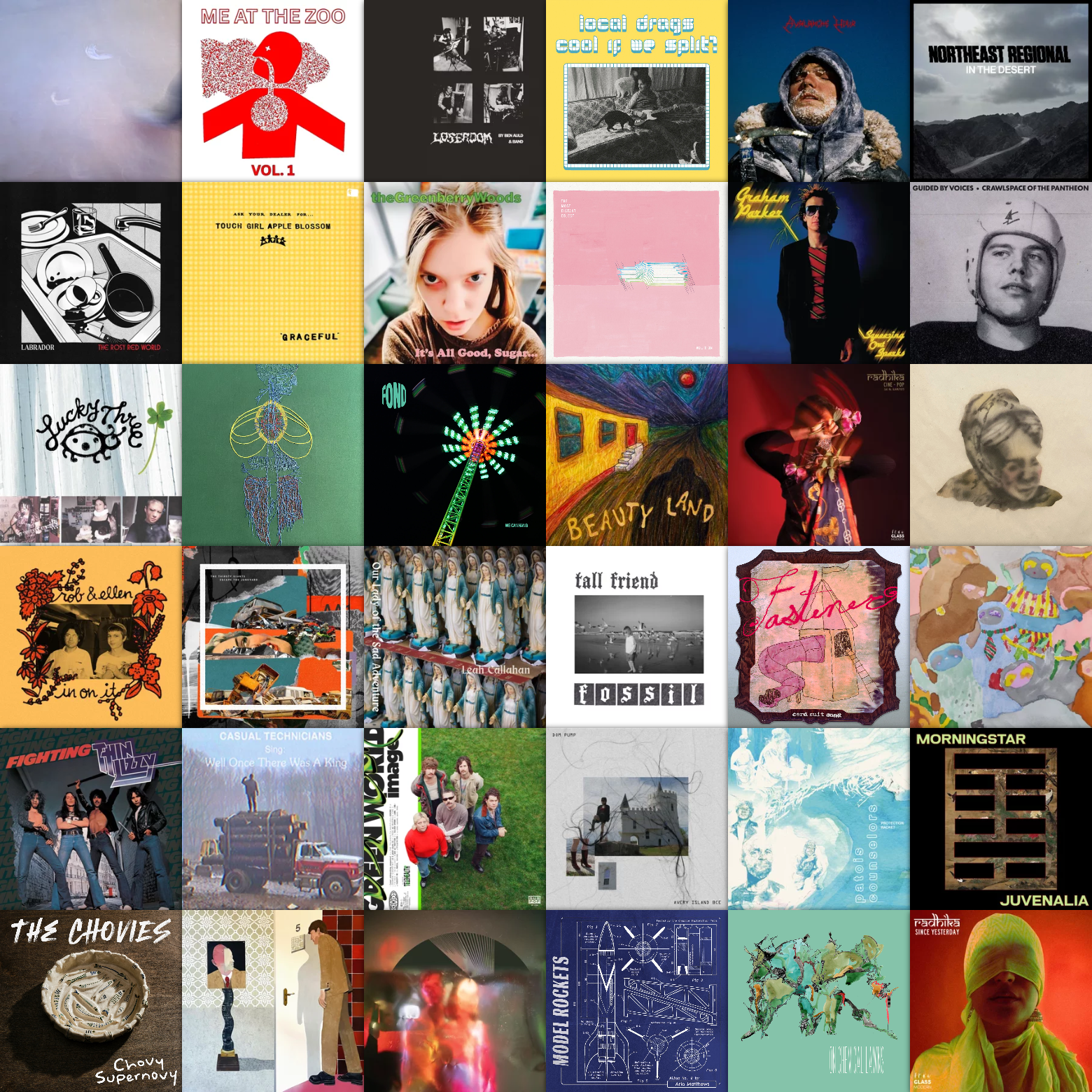
Welcome to the May 2026 playlist! We’ve got a bunch of songs on here that I enjoyed last month; some from earlier this year, a few are older pulls, and whatnot. Check them out below!
Me at the Zoo and Labrador have two songs on this playlist.
Here is where you can listen to the playlist on various streaming services: Spotify (missing three songs), Tidal (missing two). Be sure to check out previous playlist posts if you’ve enjoyed this one, or visit the site directory. If you’d like to support Rosy Overdrive, you can share this (or another) post, or donate here.
“SOL”, Shortcuts
From SOL (2026, Calendar)
“Are you S.O.- / Are you so low? / Are you shit out of luck like me?” asks Philadelphia group Shortcuts, a slacker rock/fuzz pop quartet led by vocalist/guitarist Stephen Svacina and also featuring drummer Tyler Wolff, bassist Eric Braden, and guitarist Tony Aquilino. Svacina is an Austin transplant, spending time in bands like Radioactivity and Mind Spiders before moving to the East Coast and putting out an album called Gather in 2024. “SOL” is the title track to Shortcuts’ newest three-song EP, and it really does sound like Svacina has acclimated well to the “distortion-aided power pop” side of his new home city based on this one.
“Cicadas”, Me at the Zoo
From Vol. 1 (2026, Vacant Stare)
The great Oakland indie pop quartet Blues Lawyer haven’t broken up, but with half the band having moved out of California in recent years, it’s not surprising that the first new music we’ve heard from their members since 2023 comes via different projects. Now in Easton, Pennsylvania, Blues Lawyer guitarist/vocalist Rob I. Miller started a new group called Me at the Zoo and released its debut EP, Vol. 1, on his own Vacant Stare label. Me at the Zoo rip through some wall-of-sound power pop fuzz in opening track “Cicadas”, cranking the amps a bit louder than Blues Lawyer typically do. Read more about Vol. 1 here.
“Red Bandana”, Ben Auld
From Loserdom (2026, Repeating Cloud/Safe Suburban Home)
Ben Auld arrived on the scene in 2022 with Lemongrass, a humble solo outing of 1960s-influenced jangle pop, folk rock, and psychedelia. Auld released Lemongrass while living in Bristol, but soon after he returned to his hometown of Norwich and recruited a few local musicians to be his backing band. His new collaborators seem to have given Auld the power to explore more electric power pop, with Loserdom evoking classic early guitar-hero-era Tony Molina. The first song (just barely) over two minutes in length on Loserdom is “Red Bandana”, a brilliant power pop track featuring power chords and distortion in the verses colliding with a vintage Teenage Fanclub chorus. Read more about Loserdom here.
“Can Get Through”, Local Drags
From Cool If We Split? (2026, Stardumb)
Springfield, Illinois power pop masters Local Drags are good for at least one song as good as this per album. Whether or not “Can Get Through” is as good as “Aloe” or “Left in the Sun” remains to be seen, but early returns on this one are very strong. My favorite song on the Midwesterners’ latest LP, Cool If We Split?, technically takes a minute or two to really take off, but the excellent melodies and jangly guitars are present from the get-go. When Local Drags ask “What in God’s name / Are we gonna do with our Friday nights?”, though, that’s when the rocketship leaves the launchpad.
“In the Alpine”, Jack Shields & The Mojave Rush
From Avalanche Hour (2026)
The Los Angeles-based Jack Shields plays guitar in the Montana-originating folk rock group Richy Mitch & The Coal Miners, and he’s spent time as a singer-songwriter in Nashville, too. Recorded “quickly in the gaps between tours”, Avalanche Hour is an intriguing album that was clearly made by a country musician, but by one who’s channeled his songwriting into distorted guitars and a gritty, electric sound (it’s almost like an…“alternative” kind of country?). My favorite moment on the album, “In the Alpine”, is an atmospheric, dark alt-country song with a massive hook nonetheless. Read more about Avalanche Hour here.
“Meander”, Northeast Regional
From In the Desert (2026, Tor Johnson)
Northeast Regional are a garage punk/post-hardcore band from Richmond, Virginia founded by vocalist/guitarist Jeff Byers and congealing into a quintet over the past few years. As they’ve grown into a proper band, vocalist/guitarist Mike Morris has started to sing and contribute songs to the project as well, and his contributions take In the Desert in a different, more power pop-friendly direction. “Meander”, for instance, owes more to Superdrag, The Lemonheads, and even Teenage Fanclub than Fugazi or Hot Snakes. Read more about In the Desert here.
“Your Home Is an Eyesore”, Labrador
From The Rosy Red World (2026, No Way of Knowing)
After moving from New York to Philadelphia, Pat King retooled his solo project Labrador into the polished country rock/folk rock group seen on the 2023 LP Hold the Door for Strangers and its 2025 follow-up, My Version of Desire. The third Labrador album in four years, The Rosy Red World, keeps the band moving forward by embracing a more kinetic country-punk (relatively, speaking) sound and delving explicitly into the realm of protest music. “Your Home Is an Eyesore” keep the pace at “blistering” in the record’s second half; there’s an unhinged irony to it that’s unusual for an overly earnest band operating in overly earnest genres, but amping up the absurdity keeps The Rosy Red World barreling down the tracks. Read more about The Rosy Red World here.
“Heart-Go”, Touch Girl Apple Blossom
From Graceful (2026, K/Perennial)
A couple of years ago, an indie pop quartet from Austin called Touch Girl Apple Blossom started gaining some buzz on the strength of their debut record; perhaps it was due to that EP or perhaps due to Beat Happening reference in their name, but K Records (alongside their sibling label Perennial) signed the band to put out their debut LP, Graceful. Like a lot of the best of these kinds of records, Graceful is a whirlwind that only kind of slows down in the midsection before revving its engines once again as the B-side begins–hit it, “Heart-Go”! Read more about Graceful here.
“Very Good Year”, The Greenberry Woods
From It’s All Good, Sugar… (2026, Big Stir)
The Greenberry Woods are a 90s-originating power pop band featuring three main songwriters with similar but discernible styles and a love of Beatlesesque harmonies–the Sloan comparisons practically write themselves. The only song on It’s All Good, Sugar…–the Maryland band’s first new album since 1995, by the way–that I’d say very explicitly sounds like Sloan is “Very Good Year”, though. Fans of losing the state of California and waking up covered in Coke fizz will enjoy the exuberant power pop of this one. Read more about It’s All Good, Sugar… here.
“In the Valley”, The Most Distant Object
From Volition (2026, Landland Colportage)
The Most Distant Object are a Chicago trio founded by a couple of Windy City indie rock veterans in C-Clamp’s Tom Fitzgerald and Dianogah’s Jason Harvey during the pandemic, and joined by C-Clamp drummer Frantz Etienne sometime after their 2022 debut album. Volition, the band’s second LP, is a sublime and intriguing collection of electronic-tinged rock music (“Post-punk atmosphere and melodic precision. Synthesizers and bass and the space between notes,” writes Landland Colportage, their current label). There’s “Chicago post-rock” in Volition’s DNA, but songs like “In the Valley” are pop music at their cores.
“Don’t Get Excited”, Graham Parker & The Rumour
From Squeezing Out Sparks (1979, Sony)
I’ve been listening to a lot of prime-era Elvis Costello lately, which naturally led to (among other side-quests) finally giving Graham Parker & The Rumor’s 1979 opus Squeezing Out Sparks a long-overdue critical listen. It is, unsurprisingly, very good, though it has the odd problem of putting what to me is clearly the best song in the final spot in the tracklist. I appear to be in the minority here, as “Don’t Get Excited” doesn’t seem to be as popular as most of the rest of the album, but to me it crystallizes the punk-sneering, pop-reaching new wave of Costello as well as anything else I’ve heard not by the man himself.
“Out with a Theory”, Guided by Voices
From Crawlspace of the Pantheon (2026, GBV, Inc.)
“Out with a Theory” is one of my favorite “new” Guided by Voices songs in a while (so, like, two years or six albums). It’s a surprising, bouncy mid-tempo pop rock track in which the drums don’t kick in until halfway through–it reminds me of “Make a Record for Lo-Life” (by GBV side project Boston Spaceships) in how Robert Pollard just pulls a song that sounds like it must’ve always existed somewhere out of nowhere. Like “Lo-Life”, it’s a track about the act of making music itself; it’s semi-autobiographical per Pollard himself, but I want the song’s title and reference to Mitch Easter in the lyrics to be references to Game Theory, a known favorite of GBV guitarist Doug Gillard. Read more about Crawlspace of the Pantheon here.
“Bird of My Life”, Natasha Sandworms
From Lucky Three (2026, Cherub Dream)
The six-song Lucky Three split EP brings together three upstart northern California bands in Oakland’s Christina’s Trip, Merced’s Mox, and San Jose’s Natasha Sandworms (led by Natasha Sandborn). The three acts share a fair bit of overlap in their sounds–all of them can be described as distorted pop music inspired by 90s indie rock, more or less–but these six tracks are more than enough to get a picture of three distinct emerging artists. Natasha Sandworms’ “Bird of My Life”, with its propulsive drumbeat, Liz Phair frontperson performance, and shimmering guitars, might be the most brilliant pop song on Lucky Three. Read more about Lucky Three here.
“Reduce Your Motion Blur”, Comprador
From Please Stay Off My Ass (2026)
A little under two years since their 2024 album Please Stay Off the Statue, Philadelphia’s Comprador are back with a similarly-titled “art rock” album that once again combines pop brilliance with a vague unease, perhaps more hand-in-hand now than before. Intense, intricate pop music is the name of the game in the opening salvo of Please Stay Off My Ass– early on, “Reduce Your Motion Blur” walks an interesting tightrope between “grand, sweeping anthem” and “apologetic”. Read more about Please Stay Off My Ass here.
“Loserville”, FOND
From We Can Hang (2026, Slepping In)
Alexandria, Virginia punk quartet FOND’s debut EP, last year’s Complacent, found the band knee-deep in 90s alternative rock, power pop, and pop punk with the skill and weariness of scene veterans (which the members are, of Richmond and D.C.). Coming in at under ten minutes in total length, We Can Hang is a briefer affair than Complacent was, but this EP is still a welcome drop-in from a band seemingly on a roll. At the very least, lead-off track “Loserville” is very likely FOND’s best song yet, a massive one comparable with the best of blog-favorite power-pop-punk acts like Dagwood and The Pretty Flowers. Read more about We Can Hang here.
“Looking Out Your Window”, Greg Mendez
From Beauty Land (2026, Dead Oceans)
Greg Mendez’s 2023 self-titled album was a surprising sensation, a longtime Philadelphia underground fixture riding a folk record of hushed Elliott Smith-bait pop music all the way to various year-end lists and a Dead Oceans record deal. Mendez’s first album for the big leagues, Beauty Land, stubbornly refuses to alter itself to fit on the big screen; if you liked Greg Mendez, you’ll like this one, and if that one’s appeal eluded you, I don’t think Beauty Land will be the skeleton key. But maybe you should listen to “Looking Out Your Window” just to be sure, because it’s one of the best pop songs I’ve heard this year.
“Since Yesterday”, Radhika
From Cine-Pop (2026, Glass Modern)
Radhika Meera Dade is a second-generation Scottish indie pop artist, and, like her father (Sushil K. Dade aka Future Pilot A.K.A.), she brings the influence of Indian music to Glasgow indie pop. Cine-Pop apparently features contributions from current or former members of Teenage Fanclub, Camera Obscura, and The Pastels; its indie pop pedigree is unquestionable, but it’s a strong song-forward, guitar-based dream pop album in its own right. Cine-Pop goes down some interesting detours, but it’s just as likely to offer up strong guitar-centric indie pop like “Since Yesterday”. Read more about Cine-Pop here.
“Caroline Off Grace”, Prathloons
From Lowcountry (2026)
After embracing slowcore on last year’s Breadbox, it may be useful to think of Prathloons’ latest album, Lowcountry, as a journey to the other side of the Minnesota-originating, Chicago-based band. The quintet have welcomed blog favorite musician Jon Massey (of Silo’s Choice, Upstairs, and Coventry) into the group, and the five of them return enthusiastically to the realms of swooning, orchestral, ornate indie/art rock. Prathloons aren’t always a “pop” band, but “Carolina Off Grace” is up there with The Kansas Wind’s “Chagrin” in terms of their most immediately catchy material. Read more about Lowcountry here.
“So Many Californias”, Rob & Ellen
From In on It (2026, Take a Turn)
Rob & Ellen reunites Blues Lawyer’s Rob I. Miller with the band’s guitarist, Ellen Matthews–their debut as a duo, In on It, is a full-on embrace of the jangly indie pop side of Miller’s songwriting. Released on cassette via Take a Turn Records (R.E. Seraphin’s label), these seven songs conjure up a more laid-back, “couple of friends making low-key pop music” informal setting. Miller brings his A-game in terms of songs, though, and Matthews’ intricate, melodic guitar lines are a helpful reminder that Blues Lawyer wasn’t “just” a vessel for two talented songwriters’ solo output–opening track “So Many Californias” is West Coast jangle pop perfection. Read more about In on It here.
“No Future”, The Thirsty Giants
From Escape the Junkyard (2026, Round Bale)
The first “proper” Thirsty Giants LP, Escape the Junkyard, was recorded over a “long weekend” in October of last year, and it captures a band in the process of evolving from a pandemic-era Black Flag/Stooges/Circle Jerks cover band to something more wide-ranging. This thirteen-song, thirty-minute LP ranges from early hardcore punk rock-and-roll rave-ups to more meditative, less-easily-categorizable rock music. The thrashing, hardcore-informed garage punk of the first three proper songs on the record is entertaining and furious enough on its own to turn one’s attention to The Thirsty Giants, but it’s the mid-tempo punk rock brooding of “No Future” that suggests that the trio is looking beyond their genre of origin on Escape the Junkyard. Read more about Escape the Junkyard here.
“Fall in Love with Your Mind”, Leah Callahan
From Our Lady of the Sad Adventure (2026)
After coming up in various underground Boston bands in the 1990s and 2000s, Leah Callahan returned from a musical hiatus in a big way at the beginning of this decade. On Our Lady of the Sad Adventure, her fifth solo album of the 2020s, Callahan’s distorted, dreamy indie rock once again remains dominant, but she and her team expand the palette to more wholeheartedly embrace lengthy synthpop, post-punk, and even psychedelic pieces. Six-minute opening track “Fall in Love with Your Mind” is worth the price of admission on its own, rumbling and tumbling through a rhythmic but spacey journey. Read more about Our Lady of the Sad Adventure here.
“Laughing Gull”, Tall Friend
From Fossil (2026, Window Sill)
Tall Friend’s Fossil was actually recorded mostly in 2018 before frontperson River Pfaff’s gender transition, but the complexity of such a huge personal shift led him to shelve the album for nearly a decade. After testosterone began to affect his voice, Pfaff added some backing vocals to these songs, an interesting wrinkle for an album that feels drawn from a different time in more ways than one. Fossil sounds very much like 2018, feeling at home in that era’s folky, lo-fi, twee indie rock movement led by the likes of Frankie Cosmos, Free Cake for Every Creature, and Gabby’s World. The sixty-second lead single “Laughing Gall” could genuinely be called “jaunty”. Read more about Fossil here.
“Beach I”, Fastener
From Card Suit Song (2026)
Fastener are a quartet from Olympia, Washington marrying vintage Pacific Northwest indie rock with 90s emo and featuring members of Pigeon Pit and Wavers among their lineup. Their sophomore album, Card Suit Song, is a dozen-track, twenty-eight minute punk album that also brings the spunkier side of The Lonesome Crowded West-era Modest Mouse and some classic K Records into their second-wave emo fray. The majority of the riff-based “Beach I” is instrumental, throwing a bit of a curveball into Fastener’s emo-punk early on in Card Suit Song’s runtime. Read more about Card Suit Song here.
“High Hopes (Ballad of Rural France)”, Rural France
From Sloths (2026, Meritorio)
Tom Brown’s trademark fuzzed-out, 90s lo-fi power pop sound (most prominently seen in his Teenage Tom Petties project) took on a bit of a melancholic streak on Rural France’s 2024 LP, Exactamondo!. SLOTHS, the latest Rural France album, seems to lean into that terrain as well. Deciding to make something “a little slower and a little more melancholy”, the duo cleaned up their sound from “early Pavement” to “mid-period Pavement”, invited John Hare to play horns on a couple songs, and even enlisted a full-time drummer. I think my favorite song on SLOTHS is “High Hopes (Ballad of Rural France)”, a slowly-unfurling anthem that embraces a bit of worldbuilding as the LP draws to a close. Read more about SLOTHS here.
“Fighting My Way Back”, Thin Lizzy
From Fighting (1975, Mercury)
Been listening to a lot of Thin Lizzy lately! Or at least I was earlier this month, and “Fighting My Way Back” stuck in my head long enough to make this playlist. I go through a Thin Lizzy spree once every few years now, and it’s always enjoyable to revisit–well, pretty much all of their albums, but particularly the Vagabonds of the Western World-to-Jailbreak run. Why did “Fighting My Way Back”, the sort-of-title-track to 1974’s Fighting, stick with me in particular this time? I don’t know, but you can listen to the quick-punch opening riff and maybe tell me.
“Higher Power”, Casual Technicians
From Well Once There Was a King (2026, Historic New Jersey)
Back in 2024, a strange psychedelic folk-pop trio named the Casual Technicians released two albums: a self-titled one in March, and Deeply Unworthy in November. Those LPs had more than their fair share of Elephant 6-style “warped Beach Boys” pop music, but it was delivered in the casual package of three geographically far-flung friends meeting up to create something together. Well Once There Was a King continues the strong streak that Casual Technicians began with their first two albums; if anything, Well Once There Was a King is the Casual Technicians at their most “chill” yet. Read more about Well Once There Was a King here.
“The Telehealth Shuffle”, Telehealth
From Green World Image (2026, Sub Pop)
I quite enjoyed Telehealth’s 2023 debut album, Content Oscillator, but even I wouldn’t have guessed that Sub Pop would look at this group of high-concept, color-coordinating late-capitalist Devo disciples and say “yes, we need them on our roster”. Regardless, Green World Image is Telehealth taking their robotic, danceable, corporate post-punk to the Big Screen; if you’re joining us just now, I’d say that “The Telehealth Shuffle” does a good job of getting us all up to speed. I appreciate them rhyming “prices” with “missile devices” in this one, as well as spelling “T-E-L-E-H-E-A-L-T-H” out loud and injecting some content from actual telehealth providers too.
“Fear of Difference”, Avery Island BCE
From Dom Pump (2026, Tough Gum)
Avery Legendre has played in the New Orleans groups STEEF, Jess Joy, and Butte over the past few years; her first solo album under the name Avery Island BCE, Dom Pump, reveals an interesting and (in her label’s own words) “hard to pin down” art rock project. Dom Pump is less wedded to “punk rock” than Legendre’s past bands–in fact, I’d go as far as to say that it’s hardly a punk record at all. Opening track “Fear of Difference” is, at the very least, math rock-influenced, but it owes just as much to progressive rock, chamber rock, or even jazz-pop. Read more about Dom Pump here.
“Generational Riffs”, Patois Counselors
From Protection Racket (2026, Ever/Never)
Protection Racket is the fourth album of new material from Charlotte quintet Patois Counselors, and it finds them knee-deep in their particular strain of hypnotic avant-garde agitprop post-punk. The album’s Bandcamp page names some familiar canonical post-punk acts as influences (Pere Ubu, Devo, Wire, etc.) but the inspiration is primarily attitudinal; Protection Racket hardly sounds like any of those groups, and it hardly even sounds “punk rock” at all in a recognizable way for the most part. That being said, the rave-up “Generational Riffs” is a pretty exhilarating “rocker” in its own right; it’s even a bit “power pop”, allowing for a broad definition of the term. Read more about Protection Racket here.
“Hair of the Dog”, Morningstar
From Juvenalia (2026)
Juvenalia was pitched to me as “like [if] Neil Young ran a post punk band”. The Maine group Morningstar have indeed inherited a disregard for punctuality from Crazy Horse, both in terms of song length (every track is at least five minutes long, with a couple well beyond that) and in tempo (a leisurely stroll, more often than not). There are a few indie rock bands Juvenalia reminds me of from time to time–Silkworm, Lungfish, and, of course, Magnolia Electric Co.–although Morningstar’s sprawling, messy, occasionally rootsy electric sound isn’t overly indebted to anyone in particular. “Hair of the Dog” is the kind of rock music that just kind of washes over you; it’s time to let it do so. Read more about Juvenalia here.
“Sorry All Around”, The Chovies
From Chovy Supernovy (2026, Graysh)
The Chovies are a new Brooklyn power pop group led by one Brendan McLaughlin, a “veteran TV writer and producer” who apparently has VH1, Comedy Central, and MTV credits to his name. With a “rotating slate of collaborators” he’s put together a rock-solid collection of guitar pop called Chovy Supernovy (sure, sure); “See Myself Out” is very good also, but I ended up giving the nod to the mid-tempo post-Westerberg bounce of “Sorry All Around” for the playlist. It’s an excellent, automatic slice of “college rock” that makes it hard to believe that The Chovies haven’t been at this for twenty years or as many albums.
“Hedgesitting”, Cola
From Cost of Living Adjustment (2026, Fire Talk)
Cost of Living Adjustment follows a little under two years after The Gloss, and it finds the post-punk-ish Montreal band Cola taking an uneasy step ever so slightly out of their comfort zone. Of course, The Gloss was such a smooth experience than any amount of deviation from it would naturally feel less “comfortable”, so I don’t want to overstate the effect that these wrinkles (more emphasis on vocal melodies, a healthy amount of studio layering and experimentation, just a bit more Feelies nervousness) have on Cola’s overall sound. The warped “Hedgesitting” is one of the most obvious of these “experimental” moments, but it lands on an unbeatable groove nonetheless. Read more about Cost of Living Adjustment here.
“Wedge”, Me at the Zoo
From Vol. 1 (2026, Vacant Stare)
Rosy Overdrive put a song on one of its playlists that it previously put on a 2023 playlist? Seems like they’re getting a bit lazy, no? In my defense, the 2023 version of “Wedge” was from Rob I. Miller’s solo album Companion Piece, and this is a re-recording with his brand-new fuzz-pop band Me at the Zoo. If Miller is allowed to recycle this song, so am I! And we’re both well within our rights to do so, as “Wedge” is a sterling example of thorny, bitter, complicated-feelings power pop in any of its forms. Read more about Vol. 1 here.
“We Drew Straws”, Labrador
From The Rosy Red World (2026, No Way of Knowing)
It would almost be disingenuous for a band to claim folk music, punk rock, Neil Young, and soul as influences without having something to say about the state of things. With The Rosy Red World, Labrador enters the protest-music arena white-knuckled and with gritted teeth, but with the purpose and precision of musical craftsmen–and “We Drew Stars” is the beating heart of this country punk record. It’s a dire and sweeping song in its first half, and that’s all apparent even before Pat King explicitly evokes genocide and war crimes in his bellowing as the song burns to a close. Read more about The Rosy Red World here.
“Ethical Vampire”, American Cream Band
From Twin (2026, Quindi)
Minnesota group American Cream Band are back with a new album called Twin, and though strange, rhythmic rock music from decades past remains the largest influence on the band, this record introduces Liz Buhmann as a new primary lead vocalist and subsequently changes things up a bit. Founder Nathan Nelson’s voice still pops in here and there, and American Cream Band use their new singer (as well as the interplay between the two) to delve more intently into the realms of dance-punk and art pop. It kind of reminds me of a more krautrock-y B-52’s, and Twin is exactly as fun as one would hope from that kind of description. See: the exuberant party-pop “Ethical Vampire”, one of those songs where words can’t quite do justice to what’s going on there. Read more about Twin here.
“Model Rockets”, Arlo Matthews
From Model Rockets (2026, SolarTune)
Arlo Matthews is a Boston-based musician who put out his debut album, Waiting for Daybreak, back in 2022; Model Rockets is his second LP, made with the help of an almost comically large list of local guest musicians. Model Rockets takes inspiration from 70s folk rock among other genres; the title track, my favorite song on the album, starts as an acoustic folk-pop song before blooming into a saxophone-featuring AM gold finale. “Model Rockets” gets a lot of mileage out of its titular metaphor, perhaps even structuring itself to model a takeoff of its own.
“Swamp Thing”, Lirra Skirra
From On Chemical Lawns (2026, Dead Definition)
Chrystine Rayburn and Patrick Glennon are Lirra Skirra, an experimental duo who have been putting out music on their label Dead Definition for a decade now. The duo claim Mark Hollis as an influence, and while I certainly hear Talk Talk-like empty-space chamber-post-rock on On Chemical Lawns, Lirra Skirra’s compositions can more cleanly be divided into “electro-acoustic ambience” and “slowcore-esque folk rock beauty”. The slightly electronic but mostly guitar-based slowcore of “Swamp Thing” is a big highlight among the album’s latter category. Read more about On Chemical Lawns here.

