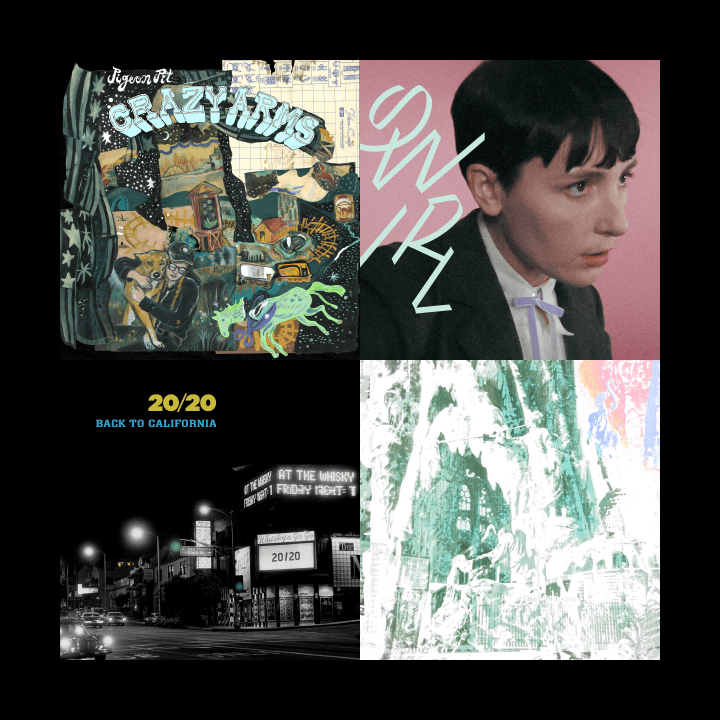
Hello! Hi! Welcome to the Thursday Pressing Concerns! It feels like the first “big” week for new music of 2025 is upon us, and today’s blog post looks at three records that come out tomorrow (January 17th) from Pigeon Pit, 20/20, and Flora Hibberd, as well as an album from Some Fear that comes out today. This is actually the third blog post to go up this week (to my surprise; I was planning on keeping it lean until the end of January), so if you missed Monday’s Pressing Concerns (which looked at records from Good Flying Birds, All My Friends Are Cats, Moscow Puzzles, and CuVa Bimö) or Tuesday’s post (which went long on the mini-album Songs by Pacing), check those out, too.
If you’re looking for more new music, you can visit the site directory to see what else we’ve written about lately. If you’d like to support Rosy Overdrive, you can share this (or another) post, or donate here.
Pigeon Pit – Crazy Arms
Release date: January 17th
Record label: Ernest Jenning Record Co.
Genre: Folk punk, folk rock
Formats: Vinyl, CD, cassette, digital
Pull Track: Bronco
It seems like every Pigeon Pit release gets me to reconsider something or contemplate making some kind of major life change. The first song of theirs I heard, “Milk Crates” from their 2022 breakout album Feather River Canyon Blues, forced me to reevaluate my conceptualization of “folk punk” as a movement that reached its conclusion in the 2010s (in hindsight, it’s obvious that it will, for better or worse, never die), and the simple power of Treehouse (an album from 2017 originally recorded when Pigeon Pit was a Lomes Oleander solo project, reissued in 2023 by their current label, Ernest Jenning Record Co.) made we want to get back into writing music (a desire that proved to be short-lived). Anyway, in the three years since Feather River Canyon Blues, Pigeon Pit has solidified into a six-piece “country/punk maximalist” group led by Oleander and featuring a bunch of Olympia-area ringers (including Joshua Hoey of Wavers and Fastener and Jim Rhian, also of Fastener). Crazy Arms is both a culmination of “Pigeon Pit the Band” and a statement of their current power; Oleander is still a “folk punk” frontperson, yes, but her vocals and writing have evolved to also encapsulate the kind of world-reverent folk-y indie rock practiced by heroes like the Mountain Goats, The Weakerthans, and certain eras of Against Me!–and, of course, the band is key in helping her realize a more expansive sound for these songs, too.
Pigeon Pit is always giving about 120 percent on Crazy Arms, even (perhaps especially) when Oleander is singing about being run-through and tired. The (for Pigeon Pit, at least) polished folk-rock-punk opening salvo of the first three songs (including a Pigeon Pit-ified cover of “Alone in the Basement” by Japanther, interestingly enough) rolls out the red carpet in a way that feels new but one that hardly abandons the “Pigeon Pit” sound; “Tide Pools” follows immediately after those with a just-Oleander-and-warped-sounding acoustic guitar recording, and it’s exactly the right choice for the “contemplative but also moving at a hundred miles an hour mentally” track. I said “expansive” in the past paragraph, and the 2025 Pigeon Pit umbrella is large enough to include everything from “Dear Johnny” (a party anthem that images Thin Lizzy if they came out of the queer Olympia basement show scene), “Maddy’s Song” (a piece of psychedelic Pacific Northwest folk written and sung by the band’s banjoist), and “Josephine County Blues” (in which Pigeon Pit lean on fiddle-aided folk-country more strongly than ever before). And if you’re looking for a transcendental anthem with the power of “Milk Crates”, there are a few contenders here–rambling, sneakily suave single “Bronco” is the first one that’s stuck out to me, and if you want a subtler take on it, “Hot Shower Winter Morning” gets to the same place with just a little bit more restraint. And then there’s lead single “Keys to the City”–the title comes from a clever name for a “pair of bolt cutters under [Oleander’s] back seat”, and the band are present but stand off to the side to let this track ring through on its own. It’s the kind of song that makes me want to move to a new city, one where I can walk around and let myself get absorbed into it. Memphis is nice. Maybe St. Louis. I can see myself there now. (Bandcamp link)
20/20 – Back to California
Release date: January 17th
Record label: SpyderPop/Big Stir
Genre: Power pop, jangle pop, roots rock, alt-country, college rock
Formats: Vinyl, CD, digital
Pull Track: Lucky Heart
Power pop legends 20/20 got their start in Tulsa, Oklahoma, but California is where the group made the bulk of their history. It’s where the group (co-founders Steve Allen and Ron Flynt, plus then-keyboardist Chris Silagyi and drummer Joel Turrisi) made their self-titled debut album in the late 1970s and became part of that initial wave of “power pop” alongside acts like fellow Oklahoma transplant Dwight Twilley. They put out three albums before breaking up in the early 1980s, and while Allen and Flynt brought 20/20 back for two more LPs in the 90s, there hadn’t been any new 20/20 material in over twenty-five years, and neither of them live in California any longer. Nonetheless, 2025 has surprisingly brought a brand new sixth 20/20 album, appropriately titled Back to California. This is 20/20’s first album as unquestioned long-term veterans, and it reflects both their Golden State past and their present homes of Nashville (Allen) and Austin (Flynt). Although there’s plenty of pop music to be found on Back to California, 20/20 aren’t trying to recreate 1979; they’ve followed the example of several long-time southern California rock veterans like Dave Alvin and Alejandro Escovedo and embraced a wisened rootsiness in their sound (of course, Nashville and Texas surely will help one arrive at this end point, too).
I don’t mean to oversell the “Americana” influence on Back to California; this is 20/20 we’re talking about, and you’ll find plenty of jangly guitar pop and “college rock” mixed into these songs, too. Maturity and patience mark these songs; take the opening title track, which does contain a nice, bright guitar lead that pops up here and there, but Allen and Flynt largely give the song a plain, unadorned rootsy rock reading, letting it speak for itself. This also gives “Why Do I Hurt Myself” another dimension; the despondency is arguably more potent coming from forty-year rock and roll veterans than from some melodramatic teenage punks. By the time we get to one of the biggest power pop moments on the album, “Lucky Heart”, Back to California is starting to feel like one of the best California-touched “heartland rock” record that wasn’t made by Tom Petty with or without The Heartbreakers–and that’s before the jangly, slightly psychedelic “Laurel Canyon” follows it up one track later. It’s comforting to hear 20/20 crank out excellent jangle pop tunes like that one and “Spark”, and they sit nicely alongside fare like the country-tinged, harmonica-aided “King of the Whole Wide World”. Back to California ends with a song called “Farewell”, and, given the long gap between 20/20 albums, it’s fair to wonder if it will end up being the band’s closing statement. The LP works not because 20/20 sound like they’re trying to neatly “tie up” their story or anything like that, though; it sounds like a pair of musicians realizing they can still make something remarkable together and taking advantage of that. (Bandcamp link)
Flora Hibberd – Swirl
Release date: January 17th
Record label: 22TWENTY
Genre: Psychedelic pop, folk rock, singer-songwriter
Formats: Vinyl, digital
Pull Track: Lucky You
I like to give a bit of background on artists before I talk about their music in Pressing Concerns, especially ones I haven’t written about before, so it’s not surprising that I’m starting out by noting that Flora Hibberd is a singer-songwriter from Britain who currently lives in Paris. As it turns out, though, this biographical detail is a little more significant this time–Hibberd works in translating art history texts from French to English, and, according to her, this experience greatly informs her writing in Swirl, her second studio album. After recording her debut album (2021’s Hold) in Paris, Hibberd made the interesting decision to record Swirl in America–specifically, she traveled to a mythical place known as Eau Claire, Wisconsin to record with prolific producer Shane Leonard at his studio The Bungaleau, and enlisted a bunch of ringers in the worlds of folk and indie rock (multi-instrumentalist Victor Claass, drummer JT Bates, bassist Pat Keen, pedal steel player Ben Lester) to play on her LP. The resultant album is a rich-sounding record of pop music from decades past, with bits of folk and psychedelia and Lou Reed lazily floating around in the ether.
The art of translation feels ingrained into the music of Swirl, as well–the vintage, sincere version of folk and pop music practiced here feels very French, even as it’s written by a British transplant and recorded in America by a bunch of Americans (although I guess any time one writes a song and entrusts somebody other than themselves to play it, that’s also a translation of some kind). And the musicians on Swirl truly add a lot to these tracks; every time it’s something different that stands out to me, from the noodly electric guitar leads on opening track “Auto Icon” to the snappy keys and synths stretched across “Code” and “Jesse” to the lilting pedal steel in “Remote Becoming Holy” to the smooth bass anchor in quiet closing track “Ticket”. The best pop moment on Swirl is probably “Lucky You”, which manages to sound casually off-the-cuff and purely giddy at the same time in a way that reminds me of a more folky version of Parisian guitar pop groups like En Attendant Ana (honestly, this specific combination might just be a “French” thing). On the other end of the spectrum is another highlight, “Baby”, stripped-down both musically and thematically. “Well keep your shame, I don’t want to wear it / It doesn’t feel good, it doesn’t feel right,” Hibberd sings over simple, effective guitar plucking. Hibberd doesn’t really say what “right” means, but Swirl sounds like a group of musicians reaching for the answer. (Bandcamp link)
Some Fear – Some Fear
Release date: January 16th
Record label: Rite Field
Genre: Lo-fi indie rock, slowcore, shoegaze, 90s indie rock
Formats: Vinyl, digital
Pull Track: Skin I Can’t Peel
Hey there, we’ve got another new shoegaze band for you today, right out of the shoegaze hotspot of Oklahoma City, Oklahoma. Well, maybe not “hotspot”, but there’s already Downward, so it’s not like Some Fear came out of nowhere (if we get a third Sooner State shoegaze band, Rosy Overdrive will fly a journalist down there to write a full-on scene report). Anyway, Some Fear began as the solo project of Branden “Bran” Palesano, who also plays in the bands Cursetheknife and Mad Honey (alright, now we have enough bands to write that cover story), with a few singles in the early 2020s leading to a partnership with new Houston imprint Rite Field Records, a full quartet lineup (co-writer Ray Morgan, plus Lennon Bramlett, and James Tunell), and a debut EP called Picture last April. Interestingly, Some Fear don’t seem to refer to themselves as “shoegaze”; their Bandcamp page and bio generally use terms like “lo-fi”/ “bedroom” rock and “slowcore” to describe their sound. It’s a refreshing approach in a world where every band with a bit of reverb gets tagged as “shoegaze”, even if I think Some Fear could get away with it on their self-titled debut album.
Some Fear isn’t as loud and pummeling as the grunge and hardcore-influenced shoegaze bands found on labels like New Morality Zine and Deathwish, Inc. (including a few of their OKC peers), but there are still moments of guitar noise rising to the top of this album. The record isn’t particularly wedded to any one particular version of this sound–it doesn’t commit to quietness, crawling tempos, and subtle beauty enough to be full on “slowcore”, the unvarnished shoegaze moments are present but, yes, intermittent, and there’s some excellent pop songs on here but between Palesano’s quiet, breathy vocals and a greyscale palette, Some Fear don’t go out of their way to service them. Opening track “Worm” pulls together a bit of everything–a downcast but still pretty catchy main riff, ample distortion, cold-sounding guitar tones–but it’s still a bit of a shock when “Skin I Can’t Peel” jumps towards straightforward lo-fi fuzzy pop rock. The rest of the album features songs that lean more in one direction than another (closing track “Faucet” is the slowcore winner, the jaunty “Let It Go” the indie pop tune, and the wall-of-sound “Game” will get you the shoegaze you’re looking for), but there are some surprises too, like the psychedelic, woozy, dreamy guitars of “The Road” and “Wake Up”. All in all, it’s just a strong collection of rock music from the Plains. (Bandcamp link)
Also notable:
- Cast of Thousands – Useful People EP
- Omilgop – Funeral
- Ismatic Guru – An Incredible Amount of Overwhelming Information
- RockGati – Elephants
- Speed Riders – Super Cheers
- Asian Glow – 11100011
- A Day Without Love – Unhinged Vol 1 (2020-2024)
- Haunted Horses – Dweller
- Shit Missile – Shit Missile
- Krokofant – 6
- Dialup Ghost – Live @ Subtle Co.
- Rob Goraieb – Antenna
- Jake Mann – Sidewalk Runways (Orbits & Oscillations Vol. 2) – Demos / Outtakes 2018-2023
- Sophie Jamieson – I Still Want to Share
- DADGAD – New Year Demos EP
- Cyclo Sonic – Heathentown
- Stephen Spencer – Dawnings
- Television Personalities – Tune In, Turn On, Drop Out: The Television Personalities Radio Sessions – 1980-1993
- Early James – Medium Raw
- Miles Cooke – Ceci n’est pas un portrait
- Snarewaves – Snarewaves
- The Cradle – En Concert au Consulat
- Crime Light – Crime Light
- W4RP Trio – Sermon of the MatriarK
- Various – 2025 LA Fire Relief Comp
 Rosy Overdrive
New 20/20 is great. Was a little worried it’d be a repeat of earlier work (which still would’ve been nice), but this is something altogether different.
LikeLike
It’s lovely, and a nice tribute to California at a particularly resonant time.
LikeLike