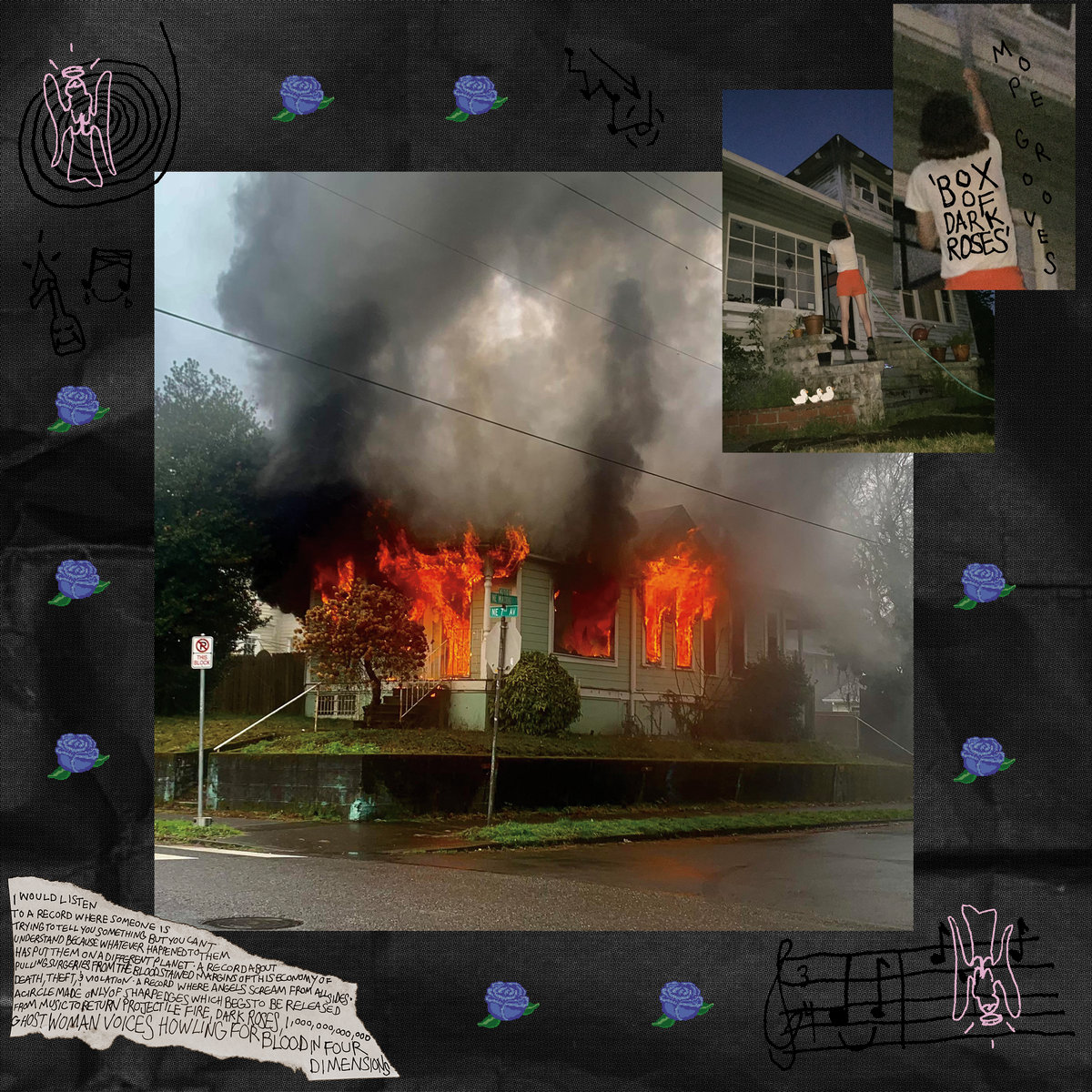
Release date: October 25th
Record label: 12XU/Night School
Genre: Lo-fi pop, art pop, post-punk, experimental punk, twee
Formats: Vinyl, digital
I don’t really want to talk about this record. There’s too much to say about it, and also nothing to say about it. Box of Dark Roses is the fifth and final album from Mope Grooves, a Portland, Oregon-based project led by Stevie Pohlman (or just stevie, “lowercase, no last name”, as she’s credited on this record) and realized with the help of a long list of collaborators and friends. The four albums that Mope Grooves released on stevie’s on label, See My Friends, from 2017 to 2019, garnered them a fair amount of attention with the project’s distinctly Pacific Northwestern mix of art-y post-punk and “indie pop”–the long-awaited Box of Dark Roses was put together over the first few years of the pandemic and is being co-released by 12XU and Night School posthumously, as stevie died earlier this year.
In her extensive liner notes for Box of Dark Roses (in which, among many other subjects, she discusses the physical toll that making enough money just to survive and finish this album took on her), stevie discusses the album as something that was created practically from its inception as a single unit–a twenty-seven-song, ninety-minute double LP conceived at once and built with this vision in mind. It’s ramshackle pop music, drawn from clanging keyboards and buzzing beats and vocals that regularly surprise. Stevie (who shares lead vocal duties with several others on this album) is a captivating writer–she’s a poet, yes, that’s part of it, but Box of Dark Roses is so easy to follow despite everything about it because its leader is unfailingly consistent in her worldview, and doesn’t shy away from following these core tenets to wherever they take her.
And Box of Dark Roses, it bears emphasizing, is right. Sure, there are some specifics we can hash out in some imaginary world where it matters, but every “slogan” and excerpt and point on this record is hard-earned, drawn from the reality of the life of a transgender woman and radical activist from the Pacific Northwest who isn’t naive or self-centered enough to believe she’s the first to be in her position. It’s a “difficult” piece of queer art, not because its message or themes are hard to tease out, but because they’re horrifically easy to. Box of Dark Roses is…I’m not sure if it’s right to call it an “angry” album, but it’s, at the very least, an album about anger. The revenge and militarism and intersectional class warfare that populate the album are bound to be alarming to anyone unfamiliar with or intentionally tuned-out to the structural violence that is perhaps even more baked into the creation of Box of Dark Roses (and, as stevie seeks to point out, one’s “queer identity” is not inherently a magic bullet that illuminates all these struggles). “They’ll tell you you’re a criminal for paying them back in kind / But in the dark, in the wild, in the heart of the night, it is right to fight,” is a key lyric in “Aileen”–those lines are about Aileen Wuornos, but I thought of something else when I heard them, and perhaps you will, too. In elucidating one of those all-important “themes”, Mope Grooves stare down the cognitive dissonance and open contradictions one is required to accept in order to be a “respectable” member of society, and rejects them.
So, there’s some rough stuff on Box of Dark Roses. Sometimes it’s softened by the music, like in “Isn’t It” (“Now that you know this is the game / Isn’t it hard to play? Isn’t it?”), but there’s also “Dora”, which, again, coldly dispatches with any of the false comforts the empire provides to us that we might be tempted to cling to rather than do the harder and more correct thing. But do not mistake any of this as a lack of beauty, because that’s what Box of Dark Roses has above anything else. There are so many incredible, inventive pop and “art rock” songs on this album that I’m grateful exist, and they’re all pretty distinct from each other, too–the shrill, droning “Forever Is a Long Time”, the folk-crumpled “Here Comes the Moon”, the meandering “Cap Hits the Button”, the violin-aided lullaby “Tired All the Time”, any of these could be the one to suck you into Box of Dark Roses’ world, inviting you to readjust yourself to keep meeting Mope Grooves’ ever-changing definition of pop music where it’s at.
So, there’s a lot more I could say about Box of Dark Roses. About the album itself, about the circumstances leading up to its creation and release, about how correct it is. I hope other writers eventually help me out on covering all that (really, I can’t imagine listening to this record and not wanting to find some way to do it justice). I do kind of fear that I’ve just ended up talking around the album, though, focusing on my own personal mini-soapboxes and hyper-specific interests because I can’t explain and interpret Box of Dark Roses better than it does of itself. These are the kinds of things I think about when I think about Box of Dark Roses. Maybe you’ll think about them, too. Maybe you’ll be angry, like I also am when I listen to this record sometimes. It is, as Mope Grooves emphasize, a decentralized, collective anger, not about one’s self except in the sense that one is a part of a whole–I hear, in stevie’s art, a real fury and fervor with regards to the unjust precariousness of the people around her, collaborators, friends, and comrades. It is, for many reasons, contagious. (Bandcamp link)


No, you didn’t talk around the album, although maybe not a lot about the music itself. But it’s amazing, complex music that is difficult to describe other than pointing in a general direction. Your take on what Stevie was trying to do with it seems very much what I’m hearing, and what I know of her. Thank you.
LikeLike