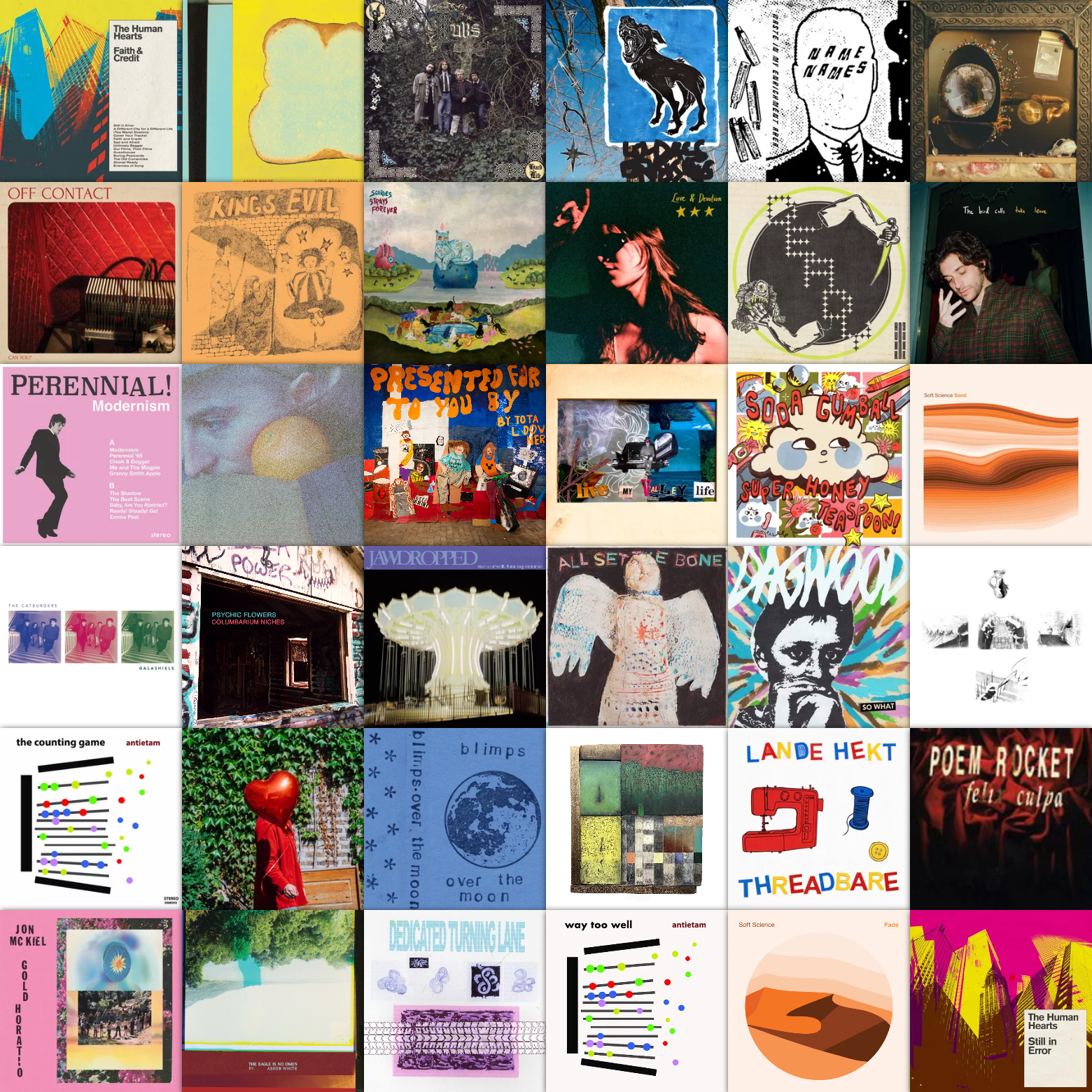
Hey there, everyone! Check out the September playlist below. We’ve got two hours’ worth of mostly new music for you to enjoy.
Artists with multiple songs on this playlist: Scarves (3), Perennial (2), My Pet Fossil (2), Name Names (2), The Tubs (2), Asher White (2), Deady (2).
Here is where you can listen to the playlist on various streaming services: Spotify (missing three songs), Tidal (missing two). Be sure to check out previous playlist posts if you’ve enjoyed this one, or visit the site directory. If you’d like to support Rosy Overdrive, you can share this (or another) post, or donate here.
“Still in Error”, The Human Hearts
From Faith & Credit (2026, Dromedary)
It’s been a fourteen-year wait for the third album from The Human Hearts, the current band of 90s indie rock/pop lifer Franklin Bruno (Nothing Painted Blue, The Extra Glenns). Sure, the singles/EP compilation Viable bridged the gap in 2023, but it’s still very exciting to hear the brisk rhythm section and jangly guitars that kick off “Still in Error”, the opening track and lead single for Faith & Credit. Bruno picks up right where he left off, just like riding a bicycle–an activity that he only just recently learned how to do, as amusingly chronicled in the song’s music video.
“The Eagle Is No Omen”, Asher White
From Love Aggregates (2026, Joyful Noise)
On Love Aggregates, Asher White is still the same weirdo musician who made 2025’s wild 8 Tips for Full Catastrophe Living, but her eccentricities are focused relatively cleanly on making 70s-inspired baroque/chamber pop this time around. One fun wrinkle to Love Aggregates is that many of its “wildest” moments are also its catchiest ones, like the synthetic, bass-led minimal banger “The Eagle Is No Omen”, which might be my favorite song on the LP. Read more about Love Aggregates here.
“Stoop to Me”, The Tubs
From Hard Life (2026, Merge)
Oh, Jesus Christ. About a year and a half after their last album, the superb Cotton Crown, British jangle pop institution The Tubs have already returned with their third album and Merge Records debut Hard Life. It contains “Stoop to Me”, which is possibly the best song ever (every Tubs album–scratch that, every album from an Owen Williams band–has at least one song that makes me feel like this). So many of the Tubs’ hallmarks–the folk-influenced Big Music opening, the jangly guitars, the Husker Du edge to the instrumental breaks–are present in “Stoop to Me”, and that’s not even going into how weird and funny it is to hear Williams contort his voice in an almost mocking tone to try to wrap himself around this too-good pop chorus he’s had the misfortune of writing. Because baby, you know, he’s a patient guy.
“New Year’s Eve”, Hey I’m Outside
From Loud Ass Barking Dogs (2026, Archival Workshop)
Hey, Hey I’m Outside are back with a new album. Despite being from Massachusetts, the Medford duo (now trio)’s 2024 self-titled album proved them to be one of the best new alt-country bands capable of incorporating actual twang into their music. Their winning streak has extended into Loud Ass Barking Dogs, surprise-released last month. So far, my favorite song on Loud Ass Barking Dogs is the first one–on “New Year’s Eve”, guitarist/vocalist Patrick McPherson, drummer Noah Wisch, and bassist Hannah Fletcher waste no time jumping right back into their rootsy No Depression-style folk/country rock sweet spot.
“A Million Bugs”, Name Names
From Waste in My Enrichment Area (2026)
One of the great indie pop bands of the 2010s was Bent Shapes, a Boston-originating “jangle punk” group led by the inimitable Ben Moy until they broke up in 2017. Moy’s new band, Name Names, doesn’t exactly sound like Bent Shapes, but they can get pretty damn close. The five-song, eight-minute Waste in My Enrichment Area is way too short, but it packs a punch for every second. Opener “A Million Bugs” is seventy-two seconds of fizzy power-garage-pop-punk (“You make me feel like a million bugs! / Crawling all over me, I can’t get enough!” bellows Moy at the onset) featuring great intertwined sibling vocals (shout out to Moy’s sister, Kate Virginia). Read more about Waste in My Enrichment Area here.
“All the Rage”, Wishy
From Nature’s Pill (2026, Winspear)
After seemingly getting a more laid-back detour out of their system last year with the Planet Popstar EP, Nature’s Pill is every bit the gigantic-sounding pop album that 2024’s Triple Seven was, cementing Wishy’s status as one of the best at making this kind of 90s alternative-influenced guitar pop. “All the Rage” opens with the Indianapolis group’s second album with nothing less than a lost, timeless indie pop classic–this breezy, jangly fuzz-pop banger is perhaps not the most entirely representative “Wishy song” on the LP, but it’s hard not to open your record with something like this if you have the option to do so. Read more about Nature’s Pill here.
“Anew”, Off Contact
From Can You? (2026)
Hailing from Sioux Falls, South Dakota, Off Contact are an art-punk quartet who marry jagged post-punk foundations with psychedelia, off-beat guitar pop, and shoegaze distortion. Unsurprisingly, their latest album Can You? is thus kind of unclassifiable, other than being “very good”. Largely due to Qarl Koyzer’s somewhat petulant yelp of a led vocal, I can’t help but being reminded of Game Theory listening to this album, even as the differences between the two acts are nonetheless myriad. Opening track “Anew” is seething, streamlined, and incredibly catchy. Read more about Can You? here.
“Sneezed”, King’s Evil
From King’s Evil (2026, Worry Bead)
King’s Evil are a duo co-founded in 2020 by two very good Boston indie musicians in their own right: Sami Martasian of the bedroom pop act Puppy Problems and JM Dussault of chiptune-slacker-rockers (T-T)b. Their self-titled debut EP’s one entry into the modern alt-country sweepstakes, “Sneezed”, is a perfect toe-dipping; the “Range Life” guitar riff and the Silver Jews reference situate it right at the center of a hyper-specific movement, but one doesn’t need to have an opinion on Berman versus Malkmus to appreciate what’s ultimately a flawless pop song. Read more about King’s Evil here.
“We Should Get a Dog”, Scarves
From Strays Forever (2026, Tender Loving Empire)
I wrote about the Seattle group Scarves back in 2022, when the Niko Stathakopoulos-led act put out their fourth album, Delicate Creatures. That aptly-titled record won me over with its mixture of tender, almost-twee indie pop with 90s-style meandering and occasionally distorted indie rock, all led by a frontperson whose earnest and, yes, gentle vocals and lyrics take cues from John K. Samson of The Weakerthans and Ben Gibbard of Death Cab for Cutie. Their fifth LP, Strays Forever, was produced by Chris Walla, a natural choice to record a Scarves album. A second-half highlight, “We Should Get a Dog” is a swirling, anthemic kicking against ennui that all leads up to the title line. Read more about Strays Forever here.
“Down on Love”, Sam and Louise Sullivan
From Love & Devotion (2026, Historic New Jersey)
Sam and Louise Sullivan are a sibling duo inspired by 60s and 70s folk and pop rock who’ve put out three albums since 2023. Unlike a lot of modern bands who try to recreate this kind of laid-back, “studio-based” 1970s music, Sam and Louise Sullivan keep the recordings on Love & Devotion crisp and clear, the arrangements simple, and the pop hooks front and center. There’s nothing “psychedelic” whatsoever about the fist-pumping retro-pop success of opening track “Down on Love”. Read more about Love & Devotion here.
“The Weight”, Deady
From Hunka Junk (2026, Romanus)
Hunka Junk is the long-awaited debut album from Kentucky post-hardcore/noise rock group Deady. Over twenty-seven minutes and thirteen tracks, the quintet offer up plenty of the self-aggrandizing, absurdist fury of their first EP and fully veer away from their signature sound on multiple occasions, too. A late-record highlight, the relatively mid-tempo “The Weight” demonstrates that Deady can evolve their sound a bit while still remaining pretty heavy (in multiple senses). Read more about Hunka Junk here.
“Means More Now”, The Bird Calls
From Take Leave (2026, Ruination)
This year’s Bird Calls album, Take Leave, continues Sam Sodomsky’s collaboration with producer Ryan Weiner that began with last year’s Melody Trail, but the two take a step back from some of that album’s more synthetic touches on this LP. That doesn’t mean, however, that Take Leave is a complete return to the straight-up one-man acoustic band sound of early Bird Calls; effectively, Sodomsky and Weiner embrace a warm, simple but robust folk rock sound throughout the album. Take Leave’s second song, “Means More Now”, is on the animated, electric, and (relatively) fist-pumping side of The Bird Calls’ sound. Read more about Take Leave here.
“Modernism”, Perennial
From Modernism (2026, Ernest Jenning/Safe Suburban Home)
On their fourth album, Modernism, New England art-punk trio Perennial are extremely “Perennial”–like I said when I wrote about 2024’s Art History, they’ve a near-AC/DC level of knowing exactly what they’re about and performing it perfectly. It’s easy to take this for granted after four LPs’ worth of it, but whenever the faucet stops and the group decide to hang it up–that’s it. This is the Perennial Sound, and they’re the only band that does it. Modernism gives us the hits yet again, rolling through blaring, deafening songs that are equally indebted to 60s garage rock and turn-of-the-century noise rock–and the opening title track sets the bar high. Read more about Modernism here.
“Life of Accidents”, Joan Kelsey
From A Dog Called Memory (2026, Dear Life)
Joan Kelsey’s 2022 album Standing Out on the Grass is a sleeper contender for one of my favorite “folk” LPs I’ve written about on this blog; the Dear Life Records mainstay penned some of the most rewarding music in that vein for that record. A Dog Called Memory is Kelsey’s first new record in nearly four years, and comes after the singer-songwriter relocated to New York City from Seattle. “Life of Accidents” is the standout of this five-song EP and already one of my favorite Kelsey songs; it’s a little more ragged than most of Standing Out on the Grass, but there’s still a refined, string-aided side to it.
“Pretend”, Total Downer
From Presented for to You by (2026, Just Because)
Cleveland pop punk/power pop group Total Downer followed up their very good 2023 album Caretaker last month with a surprise-release LP called Presented for to You by (got it?). Caretaker was a “big feelings” album, tackling heavy subject matter head-on via frontperson Andy Schumann’s performance. If you enjoyed that, you’ll love “Pretend”, the immediate standout on their latest LP. Even if Schumann didn’t leave us with a messy oversharing tangle of sexual and gender identity to sift through, the triumphant refrain would be enough to get me to come back to “Pretend” (“In the dark, you can be anything”).
“Dedicated Turning Lane”, My Pet Fossil
From Live My Valley Life (2026, Cherub Dream)
Live My Valley Life is effectively a concept album about the “American West” as an ideal–sometimes it’s a violent exorcism of its demonic influence, other times it’s a more curious exploration, but the subject is certainly dark enough to give My Pet Fossil enough fuel for a thirty-minute record. “Dedicated Turning Lane” is an exciting, skeevy rock song that imagines a world where Wipers and Thin White Rope crossed paths at the peak of their powers. Read more about Live My Valley Life here.
“Malt Shop Gizmo”, Soda Gumball
From Super Honey Teaspoon! (2026, Den Tapes)
Soda Gumball is the project of Benjamin Rea, a Seattle music instructor who has been making chaotic freak-punk on his own as Jealous Yellow since the pandemic and who also plays in the post-hardcore group Laminate. Soda Gumball in particular stems from Rea’s time as an instructor, and some of these comparatively simple pop songs even originated from collaborations with the musician’s students. Super Honey Teaspoon!, the first Soda Gumball album, displays a laid-back comfort with K Records-style indie pop; Rea’s low-key vocals, while more outwardly sorted for the kind of greyscale, noisy post-punk of his other projects, lend a slacker, almost Elephant 6 psychedelic vibe to these compositions. The chirping synth-twee-pop of “Malt Shop Gizmo” is about as animated as Soda Gumball gets. Read more about Super Honey Teaspoon! here.
“Fade”, Soft Science
From Sand (2026, Shelflife/Spinout Nuggets)
On 2023’s Lines, Sacramento’s Soft Science established themselves as a heavier, distorted indie pop group with a sound containing bits of dream pop, synthpop, jangle pop, and shoegaze. The quintet’s fifth LP, Sand, is even larger-feeling than their previous LP; it’s a full-on “dream-rock” album, with vocalist Katie Haley’s vocals gliding over full-bodied, shoegaze-influenced, fuzzed-out pop music. Sand is very nearly a tour through several types of “big music”, such as in the starry-eyed highlight “Fade”, which shoots for power pop and new wave. Read more about Sand here.
“I’ve Got a Friend”, The Catburgers
From Galashiels (2026, Slumberland)
The Catburgers formed in 1985 in Edinburgh, Scotland, right in time to be part of a golden age of indie pop, post-punk, and combinations thereof in the United Kingdom. They broke up in 1990 without ever formally releasing anything, including nine songs that they recorded in 1989 which then sat on a shelf for thirty years before seeing the light of day this year via Slumberland Records. Listening to Galashiels is to suddenly be swept back to the key time and place from which The Catburgers emerged–an exciting era where bands made records with bubbly, jangly indie pop songs like “I’ve Got a Friend” right next to moodier post-punk. Read more about Galashiels here.
“Living Is Easy”, Psychic Flowers
From Columbarium Niches (2026, Living Lost)
Not only have David Settle’s blown-out, fuzzed-out garage-pop group Psychic Flowers returned, but their first album since 2021’s For the Undertow is an oversized, twenty-song, forty-plus-minute CD and cassette. Settle wrote a dozen new songs for Columbarium Niches, but then decided to augment the record with a handful of outtakes from previous Psychic Flowers albums and a few alternate versions of previously-released tracks. The overstuffed record tosses off highlights like the sparkly, Guided by Voices-esque guitar pop song “Living Is Easy” with ease. Read more about Columbarium Niches here.
“Chainsaw”, Scarves
From Strays Forever (2026, Tender Loving Empire)
Scarves frontperson Niko Stathakopoulos is most impactful when he seems to fully give in to his deeply-felt, eccentric writing, and the triumph of “Chainsaw” in the second half of Strays Forever reflect this. The dreamy track is a love song apparently inspired by The Texas Chainsaw Massacre and features Stathakopoulos proclaiming “I love you like a cat loves cardboard / I want to tear you to shreds / Out of pure joy” in the refrain. Read more about Strays Forever here.
“Split Lip”, Jawdropped
From Secret to Spare (2026, Transgressive)
The Los Angeles group Jawdropped has been getting a fair amount of buzz since they put out their debut EP, Just Fantasy, on Fire Talk last year. Signing to Transgressive Records (Greg Freeman, Alvvays, Black Country, New Road), playing shows with This Is Lorelei and Graham Hunt, and having Alex Farrar (Wednesday, Colin Miller) mix their debut album, Secret to Spare, all certainly helps with that. Regardless, I was fairly impressed with Secret to Spare, a strong guitar pop album with an appropriate amount of Teenage Fanclub and Lemonheads influence. You can hear it especially in highlight “Split Lip”.
“Cahokia”, Greg Freeman
From All Set the Bone (2026, Transgressive)
In an indie rock landscape dominated by Magnolia Electric Co.-influenced “alt-country” acts, Greg Freeman separates himself by singing like Jason Molina sang on his most beloved records. Freeman’s lightning-strike tenor voice is what stood out to me first on All Set the Bone, the Vermont singer-songwriter’s third album and best one yet. The magic of this sixty-six-minute double LP is that it merges Freeman’s windswept Molina-style vocals with tight pop songcraft. Read more about All Set the Bone here.
“Easier to Trust”, Dagwood
From So What (2026)
So What is Dagwood’s fourth full-length album and first in four years. The twelve-song proper LP also comes with six bonus tracks, christened the So What Else EP by the Connecticut group, making the entire package a behemoth eighteen-song collection of 90s-style fuzzed-out power pop, alt-rock, and garage rock revival that stands as Dagwood’s most impressive statement yet–in terms of sheer magnitude, if nothing else. The steadily-building opening track “Easier to Trust” is a more restrained version of Dagwood, but it’s one of the best pop songs on the album regardless. Read more about So What here.
“Prophets of Doom”, The Drin
From I Lost My Way for Centuries (2026, Feel It)
I Lost My Way for Centuries feels like a “double album” in a classic rock sense. The Drin take the meditative aspects of 2024’s Elude the Torch and allow them to stretch and sprawl to previously-unthinkable proportions. This album’s twenty-three songs give the Cincinnati group the chance to fully embrace the music that’s led them to this point: you’ll hear clear bits of progressive rock, psychedelia, folk, dub, and krautrock throughout I Lost My Way for Centuries. The thundering blues-rock of “Prophets of Doom” evokes Led Zeppelin through the Midwestern post-punk underground haze in which The Drin operate. Read more about I Lost My Way for Centuries here.
“Now and Then”, The Tubs
From Hard Life (2026, Merge)
I’ve said it before and I’ll say it again: Owen Williams and Lan McArdle singing together is one of the best sounds in “indie rock”. The band they co-led, Ex-Vöid, sadly but unsurprisingly disbanded last year, but it doesn’t seem like these two will ever stop showing up on each others’ records, and the chorus of “Now and Then” certainly benefits from McArdle dropping in to check up on Williams’ group The Tubs. I like plenty of the stuff Williams has led The Tubs into on his own, but he could do whatever he wanted and still get me to listen as long as he turns in refrains like this every now and then.
“Way Too Well”, Antietam
From The Counting Game (2026, Dromedary)
It’s been nearly a decade since the most recent original Antietam album, but bassist Tim Harris, guitarist/vocalist Tara Key, and drummer Joshua Madell still sound like themselves four decades into their career. The Counting Game is classic Antietam–it’ll appeal to real-deep-in-it “indie rock/alternative rock” fans in its evocation of the likes of the Paisley Underground, Crazy Horse, alt-country, and psychedelic pop rock. See the album’s Dream Syndicate-like opening track “Way Too Well” for a sterling example of multiple of these influences. Read more about The Counting Game here.
“Gender Dysphoria”, CalicoLoco
From I Love Myself (2024, Ur Mom)
CalicoLoco are a new-to-me band, but they’ve been putting out singles since 2020 and their first album, I Love Myself, came out back in 2024. They’re a Chicago-based emo-punk-pop-power et cetera group who were a duo (Dani Robles & Zeke Ramsey) when they recorded I Love Myself but who seem to have since expanded to a five-piece. The first track on I Love Myself is called “Gender Dysphoria”, and it’s a gigantic emo-punk pop song large enough to tackle the subject acknowledged in its title. It can (and should) be enjoyed by fans of Jeff Rosenstock and that one We Are the Union album–let’s say that it’s “not ska-punk, but fits nicely alongside ska-punk”.
“Over the Moon”, Blimps
From Over the Moon (2026, Terminal Releases)
Blimps is Rocky Mercer and Colin Musolf, a lo-fi power pop duo from Charleston, South Carolina who put out their debut record, a seven-song cassette called Over the Moon, back in May. As a prolific group of underground pop musicians from a C-class American city whose band is named after a Guided by Voices song, Blimps certainly have a Robert Pollard-esque side, but that doesn’t necessarily define all of Over the Moon. The crunchy opening title track, for one, is more indebted to Weezer and 90s fuzzed-out power pop (it’s very nearly a Rozwell Kid song). Read more about Over the Moon here.
“Is It Real?”, Mr. Husband
From Song for the Old World (2026, Good Soil)
As Mr. Husband, the Maryland panhandle’s Kenny Tompkins has straddled the line between Appalachian-inspired folky Americana and jangly indie pop (with plenty of excursions away from both as well), and Song for the Old World (dubbed the ninth Mr. Husband album by Tompkins, though I think it depends on how one counts) plays to the troubadour’s strengths. Tompkins and the same lineup from 2024’s Wildflower (drummer Chris Morris, lap steel guitarist Adam Laye, and bassist Curt Tompkins) thoughtfully move through timeless-sounding pop music with bits of folk and rock music history contained therein, rousing a bit more than normal to suit the rollicking folk-rocking “Is It Real”. Read more about Song for the Old World here.
“The Time Changes”, Lande Hekt
From Threadbare (2026, Tapete)
Back in January, Bristol musician Lande Hekt put out Lucky Now, her fourth album and first in four years–I called it “an earnest, emotional take on British guitar pop, C86 and jangle pop” at the time and compared it to Hekt’s labelmates Ex-Vöid. We didn’t have to wait nearly as long for new music from Hekt this time, though, as the four-song Threadbare EP showed up in September with some more excellent indie pop songwriting–especially on my favorite song on the EP, “The Time Changes”.
“My Day at the Casino”, Asher White
From Love Aggregates (2026, Joyful Noise)
Just about everything on Love Aggregates is ornate pop music–just listen to how Asher White turns the minimalist, R&B-influenced “My Day at the Casino” into a clever, single-worthy orchestral pop piece if you’re still a White skeptic. Read more about Love Aggregates here.
“Baby, Are You Abstract?”, Perennial
From Modernism (2026, Ernest Jenning/Safe Suburban Home)
Well, are you? Like many a track on Perennial’s latest LP, Modernism, “Baby, Are You Abstract?” has everything one could want in a Perennial song–Chelsey Hahn’s sharp electric organ stabs, Chad Jewett bellowing lyrics (and Hahn giving them right back), plenty of “yeah yeahs”, and a weirdly (ahem) abstract instrumental break as the song draws to a close. It’s over in two and a half minutes, too, so if you have somewhere to be after our date with abstraction, that’s nice. Read more about Modernism here.
“(No Subject) Empty Body”, Name Names
From Waste in My Enrichment Area (2026)
Name Names is a new quartet featuring former Bent Shapes leader Ben Moy on vocals, guitar, and keys, alongside Moy’s sister (and occasional Bent Shapes member) Kate Virginia on vocals and guitar and a rhythm section (drummer Ethan Cannon and bassist Dan Paul Mary) who used to play together in the band Courters. The polish of the final Bent Shapes album is entirely dispensed with on their debut EP, Waste in My Enrichment Area, and Name Names instead bash out five relatively snotty and gritty garage punk tracks recorded in a basement. Nonetheless, everything that made Bent Shapes great–the indie pop melodies, Moy’s lyrics, the overall shout-along-vibe–is still there upon a closer listen, especially in the clinking, biting garage rocker “(No Subject) Empty Body”. Read more about Waste in My Enrichment Area here.
“Eject”, Poem Rocket
From Felix Culpa (1995/2026, PCP/Silver Girl)
Originally released in 1995, Felix Culpa wasn’t a proper “album” from turn-of-the-century New York City noise rock group Poem Rocket but rather a CD compilation of the band’s earliest EP and singles. Now reissued on double vinyl to coincide with its 30th anniversary, Felix Culpa is a time capsule straight from the 1990s New York art rock scene. The screeching feedback, post-punk rhythms, and noise rock abrasion of Felix Culpa make names like Sonic Youth and Blonde Redhead obvious points of comparison for Poem Rocket, though the “art” side of their music doesn’t prevent Poem Rocket from pulling off straightforward noise rock rippers like “Eject”. Read more about Felix Culpa here.
“Berlin”, Scarves
From Strays Forever (2026, Tender Loving Empire)
The third Scarves song on this playlist, “Berlin” may not have the offbeat thematic hooks that “We Should Get a Dog” and “Chainsaw” do, but it’s still an exploration of everything Scarves do best on Strays Forever: an ambitious, busy, Chris Walla-guided instrumental, strong hooks, and maximum earnestness from frontperson Niko Stathakopoulos. Read more about Strays Forever here.
“My Heart Won’t Wait”, My Pet Fossil
From Live My Valley Life (2026, Cherub Dream)
The heart-on-sleeve jangly indie rock of “My Heart Won’t Wait” is a likely candidate for “song on a Rosy Overdrive playlist”, but it comes from an unlikely place: the B-side of an SST/Touch & Go Records-inspired noise rock band from central California. Nonetheless, Sacramento’s My Pet Fossil pull this off very well, and it helps cement Live My Valley Life as one of the sneakily more interesting rock records I’ve heard this year. Read more about Live My Valley Life here.
“Louisville”, Deady
From Hunka Junk (2026, Romanus)
The first curveball on the Kentucky noise-punk group Deady’s debut album is track number five, “Louisville”, nestled right in between the metallic “Spinning Rooms” and the furious rocker single “Bad As It Sounds”. It’s a straight-up acoustic folk song, believe it or not. The gorgeous guitar line has the work of Deady guitarist Sam Woodring (FKA Mister Goblin) written all over it with its hushed, resigned, but somewhat wonky beauty; lead vocalist Mandy Keathley adds a twang to it that I never knew I needed in a Sam Woodring ballad. Read more about Hunka Junk here.
“Pass Life”, Jon Mckiel
From Gold Horatio (2026, You’ve Changed)
New Brunswick-based singer-songwriter Jon Mckiel has subtly been one of the most consistent voices in psychedelic Canadian indie folk this decade (though I’m not sure if one can be a non-subtle Canadian psychedelic indie folk musician). Picking up where strong releases like 2020’s Bobby Joe Hope and 2024’s Hex left off, this year’s Gold Horatio is a nicely frayed and warbly collection of warped pop music. The simple groove and golden melodies of “Pass Life” make this song one of Mckiel’s most straightforwardly enjoyable moments yet, but it’s hardly the only one on Gold Horatio.

