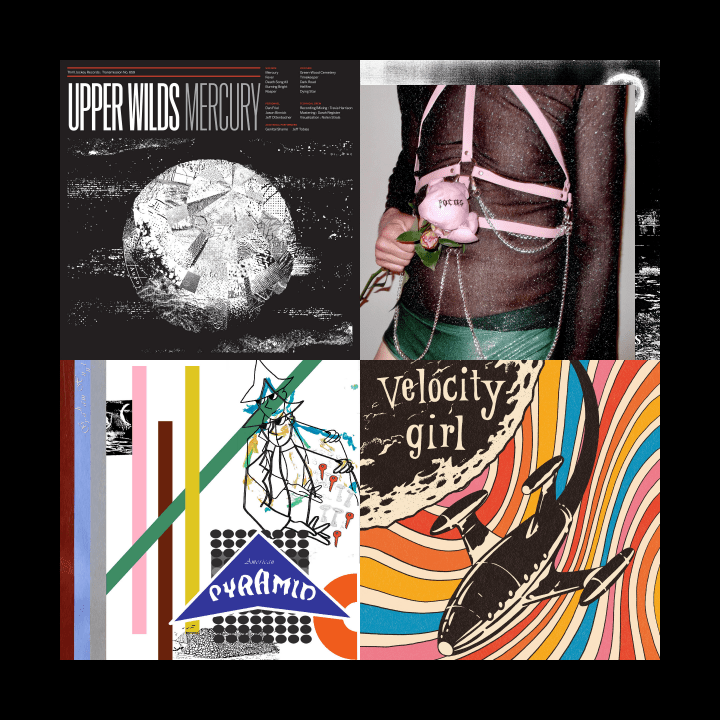
It’s an instant-classic Thursday Pressing Concerns! We have new albums from Upper Wilds, Graham Hunt, and John Vanderslice, plus an archival compilation from Velocity Girl. They’re all coming out tomorrow (August 28th)! Check them out below, and if you missed Monday’s blog post, check that out too.
If you’re looking for more new music, you can visit the site directory to see what else we’ve written about lately. If you’d like to support Rosy Overdrive, you can share this (or another) post, or donate here.
Upper Wilds – Mercury
Release date: August 28th
Record label: Thrill Jockey
Genre: Space rock, fuzz rock, noise pop, noise rock
Formats: Vinyl, CD, digital
Pull Track: Fever
Well, here we are. Four LPs and nearly a decade into Upper Wilds’ space-rock exploration of our solar system, we’ve reached Mercury, the inevitable “death album”. And by that, I mean both that it was inevitable that Upper Wilds would make a planet-based album about death, and that Mercury is about the inevitability of death. For a mortal, though, Dan Friel has been quite busy and alive lately–his 2000s Brooklyn noise rock group Parts & Labor reunited this year to release the incredible double album Set of All Sets, and for someone who’s been making music for over twenty years, it’s just as remarkable that his recent output (like Upper Wilds’ 2021 album Venus and 2023’s Jupiter) has been as great as anything else with which he’s been involved. With that in mind, there are few musicians I’d rather hear tackle an album inspired by “cancer, climate change, funerals, Henry Kissinger”, et cetera, and few musicians other than Upper Wilds’ rhythm section of bassist Jason Binnick and drummer Jeff Ottenbacher (not to mention multi-instrumentalist Jeff Tobias guesting and Guided by Voices engineer Travis Harrison behind the deck) that I’d prefer to hear back these songs up.
The signature Upper Wilds sound–maximum loudness, big riffs, just-as-big hooks–is on full display in Mercury’s opening title track, and the delirious power pop of “Fever” does that song one better (Friel writes that the song “kinda feels like it’s about everything”, which makes sense for a song inspired by capitalism bleeding our current planet of residence dry). Anyone expecting the grim reaper to slow down or modulate Upper Wilds’ sound (not that I would really guess that describes anyone) would be mistaken–“Burning Bright”, “Reaper”, and “Hellfire” hit as hard as anything off of Mars or Jupiter. There’s a slight hymn/standard-like undercurrent to “Timekeeper”, and the music of “Green-Wood Cemetery” is just a little more sidelined than normal, but these are still pretty intense songs. It’s not until closing track “Dying Star” that Upper Wilds truly let up on the power-trio assault, instead ending Mercury with a stark black hole of a song that’s one of the most jarring things the band have put to record yet. That’s the kind of gravity it takes to slow Upper Wilds down for even just five minutes–I look forward to hearing where the trio go next after death. (Bandcamp link)
Graham Hunt – American Pyramid
Release date: August 28th
Record label: Run for Cover
Genre: Indie pop, power pop, art pop, post-punk
Formats: Vinyl, CD, digital
Pull Track: Straight Line to Love
The past few years have seen Madison, Wisconsin musician Graham Hunt emerge from a Midwestern underground indie rock lifer to one of the best, most innovative, and most rightfully-celebrated guitar pop minds currently operating. A tinkering, “mad scientist” approach to pop music culminated last year in Timeless World Forever, Hunt’s best album yet and one that perfectly synthesized a bunch of his influences (power pop, late 90s alt-pop, “slacker” pop, Madchester, trip hop, psychedelia, electronica, etc.) into a career-defining LP. Coming a little over a year after Timeless World Forever, American Pyramid (Graham Hunt LP number six) stems from the musician resolving to do things differently, bringing skeletons of songs and an eight-piece band (synth player Neal Jochmann, pianist Emili Earhart, guitarists Shannon Connor and Isaac deBroux-Slone, drummer/percussionists Sheridan Connor and Stu Manley, and bassist Sam Reitman) to Minnesota’s Pachyderm Studio to record the album live with Logan Severson.
It’s both surprising and not at all surprising that American Pyramid ends up sounding a lot like the Graham Hunt albums that preceded it. “Straight Line to Love” is the sanded-down, slow-moving platonic pop rock song it feels like Hunt has been working towards for some time now, and busier stuff like “Waiting for You to Come Home” and “Riverboat Blues” contain the classic Hunt mixture of experimental touches, grooves, and hooks. On the more traditional pop side of things, “Getting Older” is perhaps Hunt’s breeziest jangly guitar pop moment yet, “Places That Are Gone” is a gorgeous piano ballad that justifies its sharing a name with the Tommy Keene power pop classic, and the sixty-second “Thank You Mother Squirrel” wrings the maximum amount of melody out of itself. No amount of studio chaos can obscure the rock and roll heart of closing track “You Always Have the Morning”, probably the most extreme example of Hunt using his band to sound as much like himself as ever before. American Pyramid is a new but familiar dispatch from somebody still at the top of their game. (Bandcamp link)
John Vanderslice – FOCUS
Release date: August 28th
Record label: Tiny Telephone
Genre: Indie folk, indie pop, electronica
Formats: Digital
Pull Track: From the Life of the Marionettes
John Vanderslice was one of the architects of the sound of 2000s “indie music” thanks to a slew of now-underappreciated solo albums and his production work, and his influence has been felt in the years beyond as bands continue to record at the studio he founded, Tiny Telephone (currently in Oakland, formerly in San Francisco as well). Despite all this, Vanderslice has abdicated this position since the beginning of this decade, abandoning his analog-recorded folk-y indie rock sound for highly digital, experimental, frequently wordless electronic music. Vanderslice’s path has occasionally crossed with “pop music” during this exploration (his project with James Riotto, Google Earth, had some good moments of it, for example), but it’s been fairly incidental, which makes his latest solo album, FOCUS, all the more surprising. Apparently the least interesting aspect of writing pop music for Vanderslice is lyrics (“I have nothing left to say,” he claims, somewhat dubiously), so his wife and sometimes musical partner Maria Vanderslice volunteered to write words for him to sing, and FOCUS was born.
I wasn’t sure if I would ever hear something like “From the Life of the Marionettes” from John Vanderslice ever again, but here he is again, singing conversationally and emotionally over tight acoustic guitars (and, of course, whirring synths) like a more synthetic version of earlier Vanderslice albums. It may not surprise you that FOCUS is a weird listen–Vanderslice still can’t commit to fully returning to folk-tinged indie pop, but “Aquamarine”, “Steep Land Surveyor”, and the first half of “Magnolia” ensure that a good portion of the album is made up of it. The halfway points are strong too, like how “Chasing My Blues” eventually congeals into something solid or how John returns to hushed piano ballad mode (in a way) in the one song whose lyrics he did write for the album, “Song for Maria”. I’ll probably always keep tabs on what John Vanderslice is doing regardless of how far out of my “wheelhouse” it is, and FOCUS is a welcome reminder of why. (Bandcamp link)
Velocity Girl – 1989 – 1992
Release date: August 28th
Record label: Slumberland
Genre: 90s indie rock, fuzz pop, indie pop
Formats: Vinyl, digital
Pull Track: Forgotten Favorite
Rosy Overdrive loves a good time-capsule release from a 1990s indie rock band, and the latest archival release from D.C.-area group Velocity Girl certainly fits the bill. The indie pop group’s first two albums have been given expanded reissues from Sub Pop over the past few years, and now they’ve partnered with Slumberland Records for 1989 – 1992, a compilation of Velocity Girl’s earliest material. These songs predate any of their proper albums, their Sub Pop signing, and, in some cases, lead singer Sarah Shannon–nearly half of these songs feature Unrest’s Bridget Cross, who departed the band in 1990, on vocals. Velocity Girl straddled the line between indie pop and noisy lo-fi rock with a love of fuzz that would probably get them tagged “shoegaze” if they came out today; not everything is intense as the blasted artifact of “Clock”, but there’s no doubt a razor-sharp edge to nonetheless undeniable pop songs like “I Don’t Care If You Go”, “I Know Exactly What You Mean”, and their cult-hit “Forgotten Favorite”. Do you want to hear a fuzzed-out cover of The Jam’s “That’s Entertainment”? Of course you do. What about a swooning, roaring version of Beat Happening’s “Tales of Brave Aphrodite”? That’s here, too. Even though Velocity Girl may not always fit into the box, 1989 – 1992 is as great a singles collection as any from this era of indie pop. (Bandcamp link)
Also notable:
- Dinosaur Jr. – There Near
- Ty Segall – Chrome / Love Fuzzz EP
- Bee Million – Lost on Me
- Leah Senior – Pt. Roadknight
- Frances Chang – Been Thinking Bout Confession
- The Mellons – The Mellons in Color
- Waltzerr – Tomorrow Will Be Better
- Swanderer – Ballet Arcane
- Crank – Crank
- Ernest Strawfield – Untitled
- Black Duck with Elena Setién – Black Duck with Elena Setién
- Visiting Hour – Visiting Hour
- S.W.A.R.M. – Infection EP
- Soft Top – Gathering Dust
- The Hanging Stars – Just a Day
- BBCC – King Michael II and the Trial of the Axe
- Adult Magic – Are You Even Happy Now?
- A Brief Memoir – A Brief Memoir EP
- Tuffie – Tuffie EP
- Girl with a Hawk – Regenesis
- Upset Boy and the Queens – Hissy Fit of Destruction EP
- Frank Rabeyrolles – Slow #2
- Jonny’s Day Out – JDO
- Julia Greenberg – Born Sentimental EP
- Pye Corner Audio – More Songs About the Sun
- Cento Threeo – Halfway to Mellowtown
- Matterform – Matterform
- Jeb Loy Nichols – You Know Where I Live
- Kit Major – Miss Ego EP
- Swamp Dogg – Swamp Dogg Contemplates the Afterlife

