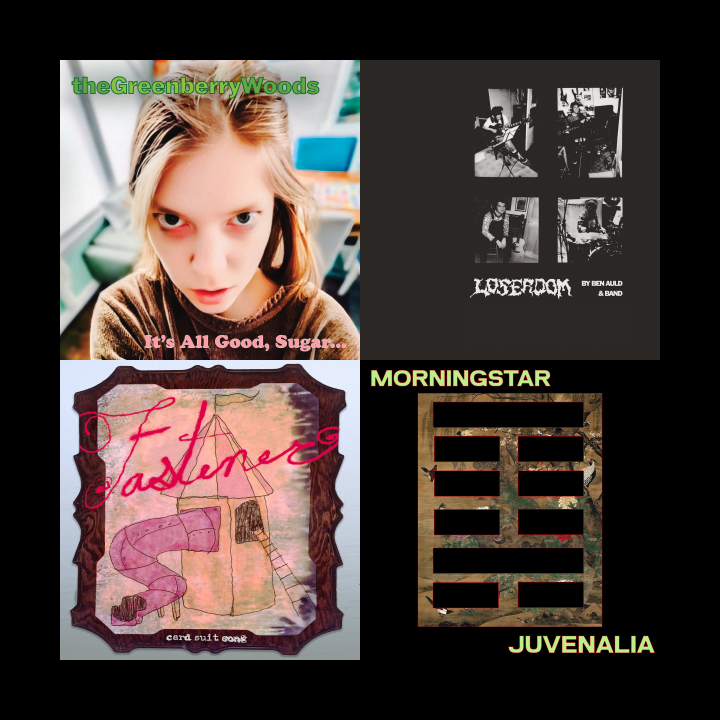
Hey there! In this Monday Pressing Concerns, we’ve got new (or new-ish) albums from The Greenberry Woods, Fastener, Ben Auld, and Morningstar. Check them out below!
If you’re looking for more new music, you can visit the site directory to see what else we’ve written about lately. If you’d like to support Rosy Overdrive, you can share this (or another) post, or donate here.
The Greenberry Woods – It’s All Good, Sugar…
Release date: May 29th
Record label: Big Stir
Genre: Power pop, jangle pop
Formats: Vinyl, CD, digital
Pull Track: Very Good Year
Who doesn’t love 1990s power pop? If you’re reading Rosy Overdrive, you probably at the very least enjoy some of it. The Greenberry Woods didn’t reach the commercial heights of, say, Matthew Sweet or Fountains of Wayne, but they had their moment in the limelight, releasing two albums on Sire Records in the mid-90s, opening for Debbie Harry and Squeeze, and playing on Late Night with Conan O’Brien before getting stuck in major label purgatory and disbanding in 1996. The University of Maryland-originating quartet (vocalist/guitarists Matt Huseman and Ira Katz, vocalist/bassist Brandt Huseman, and drummer Miles Rosen) were silent for a while after that, but the two Husemans and Katz continued on in the band Splitsville with multi-instrumentalist Paul Krysiak in the 2000s, and 2018 saw an archival Greenberry Woods release called House. A couple of years ago, though, The Greenberry Woods announced a reformed lineup featuring the Husemans, Katz, Krysiak, and new drummer Joe Parsons, and the five of them recorded the first Greenberry Woods album in over thirty years, It’s All Good, Sugar…, out via modern power pop purveyors Big Stir Records.
A 90s-originating power pop band with three main songwriters (the Husemans and Katz) with similar but discernible styles and a love of Beatlesesque harmonies–the Sloan comparisons practically write themselves. The only song on It’s All Good, Sugar… that I’d say very explicitly sounds like Sloan is “Very Good Year”, though (fans of losing the state of California and waking up covered in Coke fizz will enjoy that one). The Greenberry Woods don’t always embrace the “alt-rock”-indebted sound I associate with the power pop of their original scene, but the nice riff anchoring “The One That Makes You Happy” makes its foray into that arena count. The jangle-ish “Whenever You Want Me Too” and the desperate, Matthew Sweet-evoking “All I Want Is You” are both “electric”, to be sure, but The Greenberry Woods pull from a wider array of guitar pop history to make these effective, economical, hefty (“powerful”?) pop songs. I wouldn’t expect It’s All Good, Sugar… to reinvent the sound that put The Greenberry Woods on the map all those years ago, but it’s an album made by a group of people still excited and still exploring the different possibilities contained therein. (Bandcamp link)
Fastener – Card Suit Song
Release date: March 20th
Record label: Self-released
Genre: 90s indie rock, emo, post-hardcore
Formats: Digital
Pull Track: Beach I
There’ve been a slew of good bands out of Olympia, Washington over the past few years, not the least of which have been the excellent 90s indie rock revivalists Wavers and the self-described “country/punk maximalist” folk punk act Pigeon Pit. It should be big news in Rosy Overdrive world, then, that there’s also another Olympia act with ties to both of those bands. That would be Fastener, a quartet marrying vintage Pacific Northwest indie rock with 90s emo and featuring Jim Rhian (who plays in Pigeon Pit) and Josh Hoey (Pigeon Pit and Wavers). The four of them (Rhian sharing guitar/vocal/songwriting duties with Sam Costello, Hoey on bass, and Ian Francis on drums) put out their self-titled debut on Anything Bagel in late 2023, and they quietly released a follow-up called Card Suit Song earlier this year. Hoey appears to not have played on this one, but Wavers’ Rosie Shaw guests on vocals on a couple of tracks, so there’s still some kind of Wavers connection on this LP.
I called Fastener “messy, all-over-the-place emo-rock” back in 2023, and Anything Bagel name-dropped canonical second-wave emo acts Braid and The Promise Ring as influences on that one. That’s a decent starting place for Card Suit Song, a dozen-track, twenty-eight minute punk album that also brings the spunkier side of The Lonesome Crowded West-era Modest Mouse into the fray. Fastener bash out a couple of emo-punk tracks in “Club Soda” and “Fresh” to welcome us before getting a little bit more comfortable with the riff-based “Beach I” and K Records-indie pop-curious “Hearts”. Card Suit Song has plenty more loud ones (check out “Spades” and “Beach II”), but Fastener are a band for people who also can appreciate the slow-build of “t.m.t.n.t.” and “Surface Tension”. They’re a band that makes difficult and cathartic music for, as one of Card Suit Song’s tracks puts it, the “Love of the Game”. (Bandcamp link)
Ben Auld – Loserdom
Release date: April 1st
Record label: Repeating Cloud/Safe Suburban Home
Genre: Power pop, pop punk, indie pop, jangle pop
Formats: Vinyl, digital
Pull Track: Red Bandana
The Norwich, UK-originating singer-songwriter Ben Auld arrived on the scene in 2022 with an Earth Libraries-released debut album called Lemongrass, a humble solo outing of 1960s-influenced jangle pop, folk rock, and psychedelia that begged for the descriptors “Byrdsian” and “Beatlesque”. Auld released Lemongrass while living in Bristol, but soon after he returned to his hometown and recruited a few local musicians (bassist George Witty, drummer Duncan Baker, and guitarist Conor Etteridge) to be his backing band. His new collaborators seem to have given Auld the power to explore the more electric power pop side that only existed on Lemongrass as an undercurrent; classic early guitar-hero-era Tony Molina is the most obvious influence I hear on Loserdom, but there’s also plenty of Teenage Fanclub and even Weezer (it’s more 90s than 60s, if you hadn’t yet gathered).
Like Lemongrass, Loserdom is a brief twenty-four-minute listen, and it takes about a half of one of those minutes before the ascending Molina-style electric guitars to announce what Ben Auld is doing this time around. The first song (just barely) over two minutes is “Red Bandana”, a brilliant power pop track featuring power chords and distortion in the verses colliding with a vintage Teenage Fanclub chorus, which I would call the “most Gerard Love moment on the LP” if “From Now On” didn’t exist just two tracks later. Loserdom doesn’t “settle” into anything, but it’s easy enough to start expecting Auld to jump between squealing guitars to gorgeous melodies with lightning speed as he and his band rip through one song after another. It might’ve taken a move back home and a new band to get there, but Loserdom makes it sound like Ben Auld was always made for this kind of music. (Bandcamp link)
Morningstar – Juvenalia
Release date: February 23rd
Record label: Self-released
Genre: Alt-country, 90s indie rock, Crazy Horse stuff, folk rock, garage rock
Formats: Digital
Pull Track: Hair of the Dog
I can’t tell you that much about the band Morningstar. You can learn about other bands called Morningstar from a Google search, but seemingly not this one. They’re from Maine, I know that, and their debut album was recorded last February at Prism Analog by Joni Elfers, who described the sound of Juvenalia as “like [if] Neil Young ran a post punk band”. I don’t take any issue with that, although it doesn’t quite do justice for this massive eight-song, fifty-four minute rock journey. Morningstar have absolutely inherited a disregard for punctuality from Crazy Horse, both in terms of song length (every track is at least five minutes long, with a couple well beyond that) and in tempo (a leisurely stroll, more often than not). There are a few indie rock bands Juvenalia reminds me of from time to time–Silkworm, Lungfish, and, of course Magnolia Electric Co.–although Morningstar’s sprawling, messy, occasionally rootsy electric sound isn’t overly indebted to anyone in particular. I think what I’m trying to say is–we think of “post-punk”, “noise rock”, and “indie rock” as sounding a certain way, but sometimes bands come along that clearly hover around these worlds without making a recognizable version of it. Rosy Overdrive is nonetheless all about whatever it is you’d call what Morningstar is making, and hopefully they decide to come out of the shadows again with another record sooner or later. (Bandcamp link)
Also notable:
- Florence Dore – Hold the Spark
- The Chovies – Chovy Supernovy
- Jonny Tex – Mark of Cain EP
- The Maureens – Don’t Give Up
- Wormstew – Last Days of Loma
- St. Moon – St. Moon EP
- Yleiset Syyt – Saitte Mitä Halusitte
- Billiam – Open Comma Vault
- Salamirecorder – Inside the Cage
- Jesus Christ Taxi Driver – Taxi the Rich
- MARS – Live at the Village Gate 1977
- Bobby Dove – Fortune Teller
- Evolfo – Of Love
- Moon Pussy – At the Pace of Outrage
- Corb Lund – Dark Horses
- Big Long Sun – Love Songs and Spiritual Recollections
- MoeSOS DC / Tracy Shedd – This Water Is Life, Vol. V EP
- Mark Crozer – Homecoming
- Rosco P Coldchain & Nicholas Craven – Play With Something Safe
- Julia Cumming – Julia
- Russel the Leaf – Summer of ‘24
- Kurt Vile – Philadelphia’s Been Good to Me
- Various – Bomb Your Brain Vol.5 – Stupidity Contest Compilation
 Rosy Overdrive