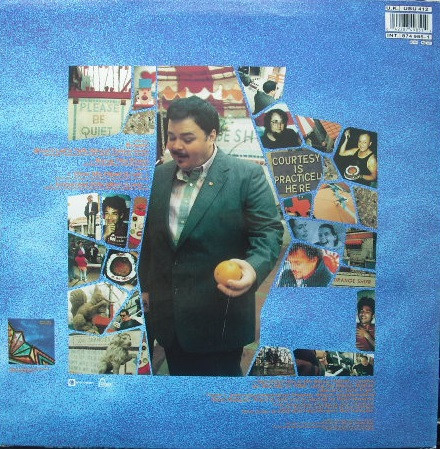
I’ve been wanting to acknowledge the passing of David Thomas on this blog ever since it happened on April 23rd of this year, and I suppose Memorial Day is as good a time as any to finally do it. I’m not in the business of writing “obituaries” or “tributes” or any such thing, but Thomas’ music was and is a huge one for me personally and for a lot of the music I write about on Rosy Overdrive. Only Steve Albini has had more of an impact among those who’ve departed from this world during this blog’s lifespan, but while Albini’s passing brought forth a truly amazing amount of tributes from his peers and influences, the reaction to Thomas’ death seemed much more muted; it got the requisite coverage, the “importance” of Pere Ubu acknowledged, and everyone moved on. Sure, Thomas’ death was less shocking–he’d effectively been publicly dying for the past half-decade or even more–but also, this means that everyone had plenty of time to do the (admittedly difficult) task of wrapping their heads around Pere Ubu and what they’ve meant since the 1970s before the moment finally came.
Everything you need to know about David Thomas the artist is in Pere Ubu. He was certainly a fascinating (and frequently frustrating) interview subject, and I’ve seen plenty of memorable quotes of his surface in the past month, but his work as the bellowing ringleader of the Pere Ubu experience gives us so much (he was the only constant member of Pere Ubu, but I believe he would bristle at being compared to other “difficult” one-man-bandleaders like Mark E. Smith, claiming to be on good terms with “almost” all of the band’s former members). It’s not hard to see why the critics who bothered to look past the band’s abrasive surface loved Pere Ubu, and so much of that has to do with Thomas’ mixture of the highbrow and the lowbrow–listening to him sing/speak/yell, you get cultural references on the level of the band’s name, a sincere but not naive love of America and all its strange, freakish wrinkles, crude humor, opaque fury, and, above all, a deeply intentional surrealism. This mixture applied to his very performance, too–was his voice a confrontational statement of his own, or one strange man from Cleveland just throwing all of himself into his work?
It was definitely “Breath” that first made an impression on me. It wasn’t the first Pere Ubu song I heard, and I was aware of their reputation as challenging art rock oddballs, but hearing “Breath” altered everything about Pere Ubu for me–at least at first. A band that can make music as abrasive as some of their most famous works and make pop music as committed and simple (on the surface, at least) as “Breath”? That’s a band to remember. I got into Pere Ubu’s initial albums (from 1978 to 1982) and their “middle years” (1995 to 2002) first, but I always loved “Breath”. It might be my favorite song. I’ve definitely referred to the recording of them playing it on Night Music as “my favorite video on the Internet” before.
The four albums that Pere Ubu released on Fontana after reforming from 1988 to 1993 are referred to as their “pop albums”. This is correct–they’re the band’s most commercial offerings, conscious attempts to make pop music in a way that others could understand. I’ve always liked that all four of them had distinct personalities, though. The first and the fourth of them are the “buffer zone”, where we can see the weirdness of earlier and later Pere Ubu trying to creep in–1988’s The Tenement Year is the busy, chaotic blast-off, effectively brilliant pop music with strange, often frustrating industrial and drilling synth sounds laid over top of it. The final one, 1993’s Story of My Life, is Pere Ubu’s simplest, most stripped-down album from a band lineup perspective, but there’s also a restlessness to it (strange choices, potent injections of oddness) that indicated their time as respectable alternative rock musicians was coming to a close. In between them are the two most pure “pop” albums Pere Ubu ever made, Cloudland and Worlds in Collision. The former is perhaps the band’s masterpiece (it’s certainly the masterpiece of this era of Pere Ubu, but of course it has competition elsewhere)–Cloudland is the sound of Thomas and his band approaching pop music frantically and intensely, obsessed with getting every little detail of it right. Worlds in Collision, conversely, is the closest thing to “comfortable” Pere Ubu ever sounded–they were fully immersed in the world of pop with this one, no longer weirdos pretending, and could focus on just delivering the music.
Still, if I had to pick one era of Pere Ubu to define that band (and, subsequently, David Thomas), it would be the one after their “pop music”, the one that their website calls “The Modern Era” and the one that was collected on a Fire Records box set called Drive, He Said 1994-2002. 1995’s Raygun Suitcase retained some of the accessible structure of the records that came before it, but it’s all wrong and messed up (it is, again, perhaps the band’s masterpiece); 1998’s Pennsylvania and 2002’s St. Arkansas are burned out, dilapidated, rusted-shut Americana records for those of use who don’t believe in the concept of time passing (and thus are constantly bewildered by the change happening around us).
Pere Ubu famously (infamously?) got increasingly difficult during their initial run together–1982’s Song of the Bailing Man is a little less challenging than 1980’s The Art of Walking, but it mostly follows a straight line–but the hardest Ubu albums for me to appreciate have always been the newest ones. When Fire Records did their Nuke the Whales 2006-2014 box set, I was skeptical that those albums deserved a retrospective revisit, but I came away from it fully convinced that three out of the four records included in it (sorry, Long Live Pere Ubu) were great works of art all along. 2006’s Why I LUV Women is a busted rock and roll album that probably would’ve made them garage rock superstars if Thomas hadn’t been so committed to what he saw as an obvious ironic wink in the album’s original title, 2013’s The Lady from Shanghai is a dark electronic cloud that befuddles to fascinating ends, and 2014’s Carnival of Souls is effectively the best of the both of them.
Pere Ubu released three albums after Carnival of Souls, and they (with the exception of 2017’s 20 Years in a Montana Missile Silo, which is one last rocking ride at the art punk rodeo) still leave me cold and confused to this day. That’s what I’ve come to expect from Pere Ubu, though–The Long Goodbye and Trouble on Big Beat Street don’t really make sense to me right now, but that’s fine, and I won’t be surprised if they lock into place for me a few years down the line. When Pere Ubu announced that Thomas had passed away, they dutifully updated us on what he’d been working on as he stared down his own mortality–a new album, an autobiography, archival Pere Ubu recordings. I took note of all of this, aware that I’ll be exploring all of it some day in the future, and proceeded to do the thing that I always proceed to do when I think about David Thomas. I listened to his music.
 Rosy Overdrive
Beautifully put, Rosy! Cloudland is a record that has meant the world to me for different times at different points in my life. “Bus of Happiness” was for me what “Breath” meant for you. Total mind rearranger.
For my $$$, World’s In Collisions’ “I Hear They Smoke the BBQ” is peak pop for the band (and a fave of mine).
As for the muted response to his passing, I wonder if part of that has to do with the idea that his–and the band’s–most fervent fans might not be terminally online they way Albini fans might be? I will say that the posts I’ve seen have been longform, earnest posts as opposed to the ones I saw about Albini, which were shorter takes and more IG ready. Not an indictment of either, just an observation. Either way, the world is just a bit shittier without them in it.
LikeLiked by 2 people