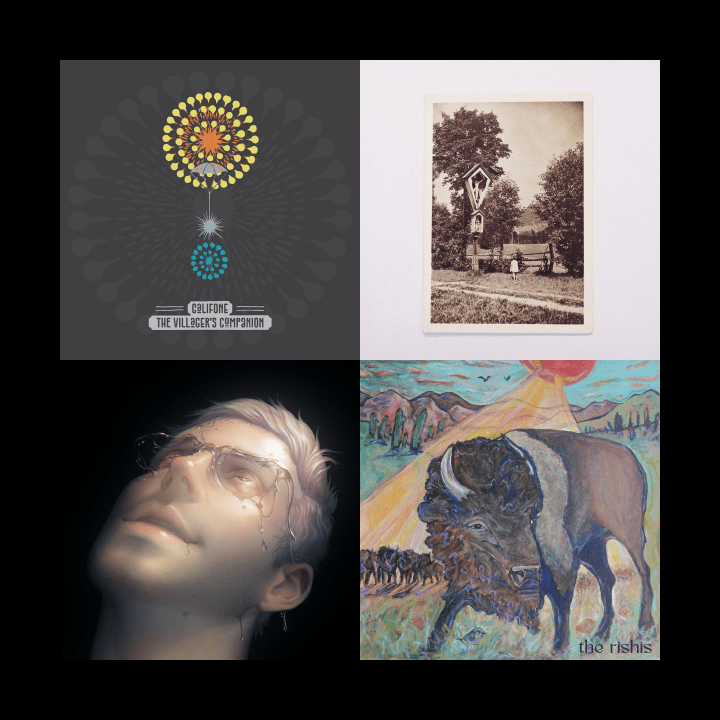
It’s the Thursday Pressing Concerns! It’s an avalanche of new music that comes out tomorrow, February 21st! It’s new albums from Califone, Baths, Rapt, and The Rishis! Oh, and also be sure to check out Monday’s Pressing Concerns (featuring Minorcan, Outro, Above Me, and Nobody’s Dad) or Tuesday’s (featuring Patches, …or Does It Explode?, Future Living, and Hour) if you haven’t yet. And–of course–you want to read 1,700 words on Silkworm’s reissued 1997 masterpiece Developer, which went up yesterday.
If you’re looking for more new music, you can visit the site directory to see what else we’ve written about lately. If you’d like to support Rosy Overdrive, you can share this (or another) post, or donate here.
Califone – The Villager’s Companion
Release date: February 21st
Record label: Jealous Butcher
Genre: Folk rock, post-rock, art rock, blues rock, 90s indie rock
Formats: Vinyl, CD, digital
Pull Track: The Bullet B4 the Sound
One of my favorite lesser-remembered 90s indie rock bands is Chicago blues-influenced group Red Red Meat, who were on Sub Pop and released four increasingly experimental LPs before disintegrating at the end of the decade. Frontperson Tim Rutili has went on to have an impressive second act as the leader of Califone, which I haven’t kept up with as much as I should but who more or less have continued to make music in the vein of Red Red Meat for over twenty years. Califone came back from something of a hiatus at the beginning of this decade by partnering with Jealous Butcher Records and starting to put out regular records again (2020’s Echo Mine, 2023’s The Villagers), and it’s apparent that the band (featuring contributions from a couple other Red Red Meat alumni in producer Brian Deck and percussionist Ben Massarella, as well as ex-Decemberists drummer Rachel Blumberg and guitarist Michael Krassner, a journeyman who’s played with everyone from Simon Joyner to The Moles) are fully active again, as they’re back just two years after their most recent album with another LP.
As the name implies, The Villager’s Companion is linked to the record before it, recorded around the same time and augmented by a couple of covers that have been previously released over the past few years. Rutili referred to these songs as “misfit toys” when the album was announced, but The Villager’s Companion is just further confirmation that Califone thrives in a less formal environment. It gives Rutili and company a chance to both spin some simple blues-folk numbers and to journey beyond them right next to each other, to interpret other people’s songs and incorporate them into the Califone songbook like they’ve always belonged there. After spending more time with them, Califone feel to me like old Chicago-blues version of what Lambchop do with bygone Nashville country-pop–both bands have a distinct but shifting style that can’t be summed up by a pair of “canonical” albums, and they’ve both clearly got a way with a cover song.
The Califone originals are too strong to be dinged with “castoff” status, even as they’re all disparate and probably tricky to slot into a “normal” LP–we’ve got “Gas Station Roller Doggs” and “Jaco Pastorius”, songs that the band were correct to let marinate in their skeletal folky forms, then there’s opening track “Every Amnesia Movie”, which thrives with a spacious Windy City post-rock reading, and “Burn the Sheets, Bleach the Books”, which becomes the full-throated Yo La Tengo-esque noisy indie rocker it was born to be. My favorite of these songs is “The Bullet B4 the Sound”, which is a bit of everything–Califone float purposefully but languidly in the ether on the verses, but come together all of a sudden to pull off a beautifully damaged chorus that’s on the level of career highs like Red Red Meat’s “Gauze”. The covers are the final two songs, and while that might feel like a relegation in some context, they’re an extension of Califone and The Villager’s Companion in attitude, too. “Family Swan” is a later-record song from Mecca Normal (a nineties indie rock band probably even less-remembered than Red Red Meat) and “Crazy As a Loon” comes from a 21st-century John Prine album I’ve never heard. There’s room for these “misfits” on The Villager’s Companion, too, enough so that the term ceases to apply. (Bandcamp link)
Baths – Gut
Release date: February 21st
Record label: Basement’s Basement
Genre: Art pop, post-punk, art punk, psych pop, synthpop
Formats: Vinyl, digital
Pull Track: Eyewall
I came to the music of Will Wiesenfeld in a fairly roundabout way–after missing the boat on his most well-known project, Baths, I found myself being surprisingly drawn to the instrumental ambient/folk of The Anchorite, the most recent record from his more experimental and disparate alias Geotic. This year, Wiesenfeld has brought back Baths for its first proper album since 2017 (not counting B-side compilations and soundtrack work), a double LP called Gut. Accompanied by quotes from Wiesenfeld about seeking to incorporate noise rock and post-punk (Gilla Band and Protomartyr are some of the names being thrown around) into Baths’ electronic indie pop sound, my interest was certainly piqued. Gut is a lot to take in, unsurprisingly–featuring live drums on six of its eleven tracks (from Casey Dietz and Sam KS), there are a few genuinely gripping moments of real live indie rock and noise rock/post-hardcore catharsis in Wiesenfeld’s vocals, while the fifty-two minute album still has plenty of room for atmospheric electronica and even a few moments of synthetic dance-friendly electronic pop music as well. Wiesenfeld sought to hold “no regard to personal embarrassment or relatability” in his writing on Gut, exploring “men, and sex” (an “actual honest effort” to elucidate what’s on his mind on a regular basis) with all the freedom the instrumental side of Baths allows.
Gut starts off like an honest-to-God arty indie rock record in its opening trio of songs. “Eyewall” sets the stage for the album with an interesting mix of a post-punk bass undergirding and a vocal performance from Wiesenfeld that goes from “urgent pop music” to “spoken word” to a lacerating post-hardcore yell. “Sea of Men” couches its psychedelic indie pop in a mid-tempo indie rock sheen, Wiesenfeld singing about “fucking all the men in droves” against a vibrant, propulsive background; “Peacocking” isn’t as upbeat, but the electric guitar gets a prominent spot in the ever-so-slightly-darker art rocker. Gut’s strongest electro-pop moments come after this–there’s a bright euphoria to the bubbling “Eden”, while “American Mythos” is a synthpop wringer that leaves everything all out in the open and the of Montreal-like tinker-dance-pop of “Chaos” is wild in more ways than one. As much of a whirlwind as Gut is, Wiesenfeld does indeed bare much of himself in between the grooves–stuff like the psych-wobbling gut-check of “Homosexuals” finally comes to a head in “Governed”, a pretty unflinching self-assessment that stops the dizzying party right in its tracks. “Governed” isn’t the end of Gut, however–that would be “The Sound of a Blooming Flower”, a seven-minute epic that begins in delicate, almost ambient piano realms and finishes as a careening, explosive, noisy indie rock barnburner. The lyrical honesty of Gut might be the most obvious throughline, but “The Sound of a Blooming Flower” is the right final statement because it captures a larger one–the musical growth and exploration of Baths to the point where it can, yes, comfortably hold these musings of its frontperson. (Bandcamp link)
Rapt – Until the Light Takes Us
Release date: February 21st
Record label: Start-track
Genre: Folk, chamber folk, singer-songwriter, slowcore
Formats: Cassette, digital
Pull Track: Making Maps
Jacob Ware is a folk musician from London, although he (and by extension, his solo project Rapt) isn’t just a folk musician. He started out playing bass in the “brutal death metal” band Enslavement, and, while his musical career as Rapt hasn’t encompassed that, he’s been dabbling in ambient, post-rock, and even techno over the course of four LPs since 2019. Until the Light Takes Us, the fifth Rapt album, is definitely, inarguably “folk music”, though: it’s just Ware and his gently-plucked guitar for the most part, with intermittent percussion, bass, strings, and pianos fading into and out of frame and, all the while, Ware singing about death and dreams and love (and the disintegration thereof) in a winding pastoral, British conversational cadence. Until the Light Takes Us places Ware in a storied lineage of “heavy” musicians (or at least those associated with heaviness) abandoning the musical intensity of their past for something more stark but nonetheless imbuing their acoustic pursuits with a kind of darkness and a different kind of intensity–names like 40 Watt Sun’s Patrick Walker (whose sprawling, ornate slowcore feels like what Rapt would be in a less stripped-down environment), Clockcleaner’s John Sharkey III, and Phil Elverum come to mind.
A lot of “slowcore”-associated music is centered around minimalism–think Alan Sparhawk and Mimi Parker wringing worlds out of just a couple of sentences and just as many chords–but Until the Light Takes Us takes a different path, choosing to build itself around Ware’s lengthy, always-centered diatribes and purposefully-meandering trains of high thought. “Tolkienesque prose”, his bio calls it, an unavoidable reminder that, by going from black metal to folk music, Ware has merely traded in one fantasy-nerd music genre for another. Ware doesn’t hide his vocals under any studio trickery; there’s a buttoned-up, formal quality to Until the Light Takes Us that underlines his writing instead. The guitar is plucked in a perfunctory manner, intricate little swirls of melodies, and when the strings appear, they’re always tastefully draped around the core of the track. It’s the same kind of craftsmanship that turned 2000s “indie folkers” like Sufjan Stevens and Andrew Bird into unlikely stars, but Ware resists the pop touches or heart-clutching relatability that could’ve ever put him in on such a trajectory. This isn’t to say Until the Light Takes Us is impenetrable or even unwelcoming–I’ve loved the most upbeat song on the record, “Making Maps”, from the moment I heard it, and “Attar of Roses” and “Fields of Juniper” both tap into the combination of instrumentation and imagery that reminds us why and how “folk music” endures and reverberates. After intently listening to Until the Light Takes Us, I couldn’t imagine not getting anything out of, say, the life-encompassing dream sequence of the title track–but “intent” is what it takes to get there, from both Rapt and us. (Bandcamp link)
The Rishis – The Rishis
Release date: February 21st
Record label: Cloud Recordings/Primordial Void
Genre: Psychedelic pop, folk rock, chamber pop
Formats: Vinyl, digital
Pull Track: Criminal Activities
Athens, Georgia band The Rishis debuted in 2022 with the full-length record August Moon, introducing us to the 60s pop-tinged folk rock of core duo Ranjan Avasthi and Sofie Lute and their many collaborators, including notable Elephant 6 Collective members John Kiran Fernandes, Scott Spillane, and Andrew Rieger, among others (Elephant 6 co-released August Moon on vinyl the following year, along with Fernandes’ Cloud Recordings). A second Rishis album, self-titled this time around, arrives a few years later, co-released by Cloud and another Athens stalwart label, Primordial Void (Real Companion, Banned 37, Limbo District), and Avasthi and Lute retain the relatively streamlined charms of August Moon once again. Despite a credits section again filled with indie rock royalty (Robert Schneider of The Apples in Stereo! Mac McCaughan from Superchunk!), The Rishis resist the urge to turn their sophomore album into an overstuffed affair and continue to lock their gaze on creating perfect pop tunes in their chosen folky, slightly psychedelic realms. The Rishis is perhaps more electric than their debut, but (with a couple of exceptions) it’s not exactly a “rock and roll” record; it’s just a means to keep their sound rolling forward.
The Rishis opens with a pair of reassurances in the toe-tapping pop rock of “Coloring” and the note-perfect indie balladry of “Miles”, both of which are as good as anything on their debut LP. The folk side of The Rishis takes a minute to fully resurface, but the banjo-marked “Buffalo” and the pedal steel that opens the horn-laden “Ride” make sure that this part of the band is represented here, as well. For the most part, the Rishis’ guests are integrated seamlessly, but when McCaughan steps in on guitar on “Criminal Activities”, The Rishis are all of a sudden riding Superchunk-like electricity for a two-minute surprising album highlight. The slacker pop-tinged “Robot Factory” is less openly a departure, but the spirited mid-tempo bummer pop of that song is, upon closer inspection, exciting new territory for the band as well. August Moon contained at least one track (“Uttar Pradesh”) that openly nodded to Avasthi’s Indian ancestry; here, we get “Dharamsala” (a psychedelic pop song about the Dalai Lama fleeing Tibet for the titular Indian city) and closing instrumental “Rishikesh”. These two tracks are separated by a “normal” indie-psych-folk-pop song called “Stratosphere”, which ties the tracks surrounding it to the rest of The Rishis, much like the album as a whole pulls in disparate movements, faces, and histories together to make a neatly-tied singular sound. (Bandcamp link)
Also notable:
- Patterson Hood – Exploding Trees & Airplane Screams
- The Stayres – Duplex
- Horsegirl – Phonetics On and On
- JJ Sweetheart – Big Things EP
- Snörkler – Sleven Songs
- With Child – Undressing in the Wind
- Last Days of Heaven – Out of Body EP
- Public Toys – Public Toys EP
- Amiright? – Husk of a Body
- Sicky – Troubled Delight
- Dino Pitoski – The Morning Cigarette
- Irkya – Mind Fog
- Whait – Close Quarters
- Frank Rabeyrolles – In Conversations
- Orchid Mantis – Close to You EP / Rain Tape
- Agaaze – Cherry Town
- 72 Rats – Nothing Left to Lose EP
- Marshall Allen – New Dawn
- John Howard – For Those That Wander By
- Rapid Dye – Rapid Dye
- I Am Robot and Proud – Bird at Sunrise
- Spiders – Sharp Objects
- Cryogeyser – Cryogeyser
- Anna Arboles – Pure Fanfiction
- Manic Street Preachers – Critical Thinking
 Rosy Overdrive
New Califone is fantastic! Wild to think these are the tracks that didn’t make the last record. I’ve got a brief Q & A and write up coming out tomorrow.
LikeLike
New Califone is fantastic! Wild to think these are the tracks that didn’t make the last record. I’ve got a brief Q & A and write up coming out tomorrow.
LikeLike