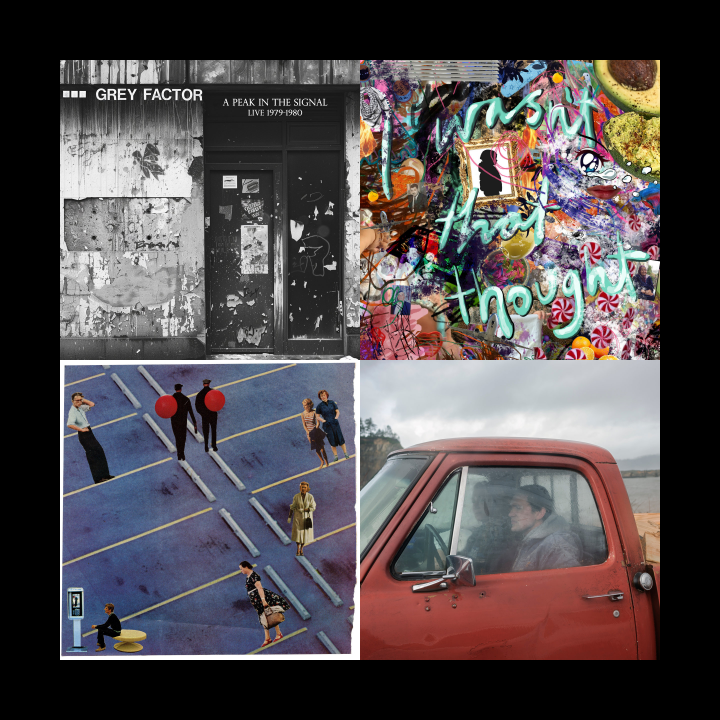
A good, old-fashioned Tuesday Pressing Concerns! It’s here! It features an archival live album from Grey Factor, a new EP from Red Pants, and brand new full-lengths from DUNUMS and Bondo. It’s a good one, and it pairs well with yesterday’s post (featuring Casual Technicians, Sexores, Dogwood Gap, and Morpho), which you should check out if you missed.
If you’re looking for more new music, you can visit the site directory to see what else we’ve written about lately. If you’d like to support Rosy Overdrive, you can share this (or another) post, or donate here.
Grey Factor – A Peak in the Signal: Live 1979-1980
Release date: October 23rd
Record label: Tiny Global Productions/Damaged Disco
Genre: Synthpunk, experimental, synthpop, post-punk
Formats: Vinyl, digital
Pull Track: Everything
At the beginning of last year, I wrote about 1979-1980 A.D., an archival release from Los Angeles synthpop/post-punk group Grey Factor that collected the band’s entire recorded output, put together by Dave Trumfio (Pulsars, Mekons) and his new label Damaged Disco. By definition, all of Grey Factor’s studio recordings have been reissued already, but the band were able to find enough live recordings from their initial two-year run to make A Peak in the Signal: Live 1979-1980, an entire new full-length. Drawn from across the “around twenty live shows” that Grey Factor played in their initial incarnation, A Peak in the Signal features six tracks that I don’t believe ended up recorded on 1979-1980 A.D (if they were, they were significantly reworked). Their studio compilation hinted at the band’s range, but A Peak in the Signal blows it wide open–there are a couple of “pop songs” on here, but the majority of the LP’s thirty-seven minutes is significantly more experimental and out-there than almost everything that the band formally recorded. A Peak in the Signal almost sounds like it’s degrading and disintegrating in real time, as the more recognizable post-punk and synthpop moments of the first couple of tracks give way to pure electronic dadaism and lengthy ambient moments.
The most accessible moment on A Peak in the Signal belongs to “Everything”, a chirping, relatively crystal-clear synthpop track found in the third track slot. “No Time”, the five-minute synth-led post-punk song that precedes it, is the clear runner-up, as it’s the only other song on the LP I can imagine being enjoyed by people whose musical adventurousness doesn’t go far beyond, say, the Talking Heads. A Peak in the Signal’s opening track is a cutting darkwave song called “Why Me”–there’s a muddled darkness to it that obscures the pop song that’s struggling somewhere underneath, hinting at the chaos that’s to come later on in the album. Grey Factor really lean into it with the six-minute industrial electronic noise-pop collage of “Won’t Have to See You”; there’s a song barely contained within it, although Grey Factor aren’t overly committed to seeing it through (there’s a memorable moment where the synth just starts playing “Twinkle Twinkle Little Star” for a bit as the rest of the instrumentation continues stumbling around). “Every Five Minutes”, the final song on the LP, returns to this head-spinning well; between the two of them, it reminds me of the more confrontational moments of Pere Ubu and Wire (and their side projects), drilling and piercing sounds obscuring everything else about the music. Ironically enough, the most peaceful moment of A Peak in the Signal is also probably the most “difficult” track on the record–the thirteen-minute ambient hard-stop of “Inja”. For most bands, I can’t imagine needing more than their entire recorded studio output, but A Peak in the Signal makes a strong case that there’s more to Grey Factor than what we’d previously heard. (Bandcamp link)
Red Pants – Pale Shadows
Release date: October 25th
Record label: Painted Blonde
Genre: Lo-fi indie rock, fuzz rock, lo-fi pop, 90s indie rock
Formats: Digital
Pull Track: To the Deep End
As long as the band Red Pants keeps putting out quality new music, I’ll keep writing about them on this blog. This is the fourth record from the Madison, Wisconsin duo of Jason Lambeth and Elsa Nekola that I’ve written about ever since I first heard of them in early 2022–for the two LPs they’ve put out in that timespan (2022’s When We Were Dancing and 2023’s Not Quite There Yet), they linked up with established indie labels Paisley Shirt and Meritorio, while both Red Pants EPs (2022’s Gentle Centuries and now the brand-new Pale Shadows) have come out via Lambeth’s own Painted Blonde imprint. Regardless of who’s putting out their music, Red Pants have retained their charmingly distinct brand of lo-fi Midwestern basement indie rock, which incorporates bits of Yo La Tengo-esque fuzzy noise pop, Sonic Youth-style drone-y rock, and even a touch of Stereolab-like dusty indie pop. Pale Shadows is no exception; comprised of five songs from the Not Quite There Yet sessions that were believed to be lost on “dead 2009 MacBook” only to be rediscovered and finished a few months ago, these tracks are good enough to stand up against any of their previous work. Unlike Gentle Centuries, which felt like a consistent, singular listen, Pale Shadows is more varied, but that’s hardly a complaint, as we get a brief but complete sampling of Red Pants in these five songs.
We join Red Pants in the middle of a four-minute instrumental basement jam called “Into the Deep End”, in which Nekola steadily marches along to Lambeth’s increasingly bold guitar playing–both of them are mostly restrained for the majority of the track, almost hypnotic-sounding, with Lambeth only kicking up some real fuzz-rock in the final few seconds. The sub-ninety-second “Proto Punk” doesn’t quite sound like the MC5, but it’s the most spirited and electric moment on the record, and the refrain does muster a bit of the garage-punk one might imagine based on the song’s title. Hopefully you’re ready for droning synthesizers after that one, because that’s what “Underneath the Sun” brings–the vocals are barely above a whisper, and a drum machine is the only other accompaniment to the track’s ghostly synthetic pop. The final two songs on the EP are, if anything, even more subtle than what came before them, but I also view “One More Ghost” and “Sunset Hill” as a culmination of sorts–the former track starts off as a wobbly lo-fi indie rock/slowcore tune that eventually adds louder guitars and synths as the track takes off, and the Nekola-sung latter is the dreamy organ-led benediction. It all adds up to a welcome dispatch from the world of Red Pants, and it leads one to wonder just what other gems they’ve got hidden away on old hard drives. (Bandcamp link)
DUNUMS – I Wasn’t That Thought
Release date: October 4th
Record label: Sleepy Cat
Genre: Psychedelia, noise pop, art folk, shoegaze
Formats: Vinyl, CD, digital
Pull Track: Mouthful of Pears
Sijal Nasralla most notably plays in Durham, North Carolina punk group The Muslims (they use aliases but I believe he’s Ba7Ba7, the drummer), but the Palestinian-American’s solo-ish project DUNUMS actually predates that band’s founding, with records dating back all the way to 2011. The music of DUNUMS (which they helpfully describe as “arty, noisey, post-rock, bedroom fake-jazz”) has been driven by the settler colonialism that has ravaged Nasralla’s home country for much longer than the year and change that many of his white indie rock music peers have been paying attention–the project’s name is Arabic for an “arbitrary unit of land measurement, approximately 1 Hectare, used differently to quantify space among villages throughout Palestine”–and it’s marked DUNUMS’ music through their 2015 self-titled album, 2022’s Where’s My Eidi?, and a few EPs and splits. It’s no surprise, then, that the third DUNUMS album, I Wasn’t That Thought, is shaded by Israel’s ongoing genocide in Gaza, but do not expect this album to sound like the kinetic punk music of Nasralla’s other band. I Wasn’t That Thought is also inspired by the birth of Nasralla’s daughter, Tasneem, and Nasralla has written much of this album as though through her eyes–“Palestine-centric Toddler-core anthems”, is what he calls them.
I Wasn’t That Thought reminds me a bit of the band OMBIIGIZI–that group’s co-leaders also make 90s indie rock, folk rock, and noise pop/shoegaze with a different perspective than the majority of groups in those genres (for them, it’s an Anishnaabe-Canadian vantagepoint). There is a spoken word “story” from Tasneem and there are jazz-rock flare-ups in the record’s title track and “The Portal”, but I Wasn’t That Thought’s primary mode is adventurous, multi-layered, melodic indie rock. DUNUMS sound thoughtful and measured throughout songs like “Mouthful of Pears” (featuring vocals from Catherine Edgerton), they make noise sound regal on “Honeycomb Art on a Billion Twins”, there’s interesting dream pop, folk, and experimental touches across the middle of the album in “Butt Parade”, “When We Ate the World and Its Wars”, and “Holding the Cake Up to the Sky”. These moments are all strong, but I Wasn’t That Thought might be the most effective as it comes to a close and invents new ways to deliver its messages; Nasralla’s final lyrical statement is the quiet hope of “There Are Dreamlands”, which DUNUMS immediately follow with two jazz-flecked instrumentals (“USA Ain’t Shit” and “The Portal”), and the last thing we hear on the album is a lullaby sung by Nasralla’s “co-parent”, Rakhee Devasthali. I Wasn’t That Thought is a pointed album, even when (perhaps especially when) Nasralla expresses himself in a way that might make more sense to a child than us adults. (Bandcamp link)
Bondo – Harmonica
Release date: October 18th
Record label: Day End
Genre: Post-rock, 90s indie rock, slowcore, noise rock
Formats: Vinyl, digital
Pull Track: Enter Sand
Bondo are a quartet from Los Angeles who first came to my attention via their debut album, Print Selections, which came out last year on Quindi Records (Monde UFO, Dead Bandit, American Cream Band). The quartet (Cook Lee-Chobanian, Andrew “Gerry” Dykes, Brian Bartus, and Nikolas Escudero) played an intriguing, band-centric version of post-rock on that album, with a mostly-instrumental, downbeat sound that captured both the low-key and experimental sides of 90s “Numero Group-core” indie rock groups like Slint, Duster, and Unwound. The second Bondo full-length arrives a year and a half later via Day End Records–with the band in a self-proclaimed “creative stride”, they went ahead and recorded Harmonica live to tape even with Lee-Chobanian (the band’s drummer) nursing a torn ACL (“from playing basketball at LA Fitness”). Harmonica can feel like a more polished and even accessible version of Bondo, but only sometimes–there are more songs with vocals this time around, and we can recognize somewhat jagged but still structured “indie rock” compositions throughout the album, yes, but the careening punk-informed musicianship, the probing post-rock guitars, and the experimental track-jumping of their previous LP are all still characteristic of Harmonica, too.
The first two songs on Harmonica are wordless indie rockers, picking up the instrumental thread of Print Selections and shaving it down to mid-tempo, melodic Duster-esque slowgaze (“Enter Sand”) and a contained burst of post-punk circle-chasing (“Bibbendum”). It’s something of a feint; not that Bondo switch things up in any extreme way in terms of the music, but the plodding lo-fi indie rock “Sink” introduces vocals into the mix–mumbled and downcast-sounding, but still quite audible–and it’s far from the last time we hear them on Harmonica. After getting some more noisier instrumentals out of their system, Bondo start to hit a subdued stride between the title track, “Blinko”, and “Headcleaner”, which slow and tone the music down enough for the vocals to once again feel like a key part of the compositions. By the latter of those three songs, Bondo have found something of a second wind, with spindly post-rock guitars marking the song–the group finally strole a balance and let the six-strings and the singing share the limelight. Not that Bondo have ever been a particularly loud band, but the back half of Harmonica is really no-man’s land, with only “Porchetarian” really showing off Bondo’s tougher instincts. As they mumble and drift their way through “Paul Gross” and “Triple Double”, Bondo’s attitude on Harmonica crystallizes–exploratory, but cautiously and with one foot on solid ground. (Bandcamp link)
Also notable:
- Nothing Natural – Cold Star
- Mt. Misery – Love in Mind
- Picture That – Strum EP
- The Successful Failures – Enemy Sublime
- The Asteroid No. 4 – Several Shapes of Solar Flares
- Sam Blasucci – Real Life Thing
- Ty Walker and the Humanoids – Home on the Strange
- W.H. Lung – Every Inch of Earth Pulsates
- Texture Freq – What Make Come EP
- Verböten – Verböten
- JW Francis – Sunshine
- Chris Acker – Famous Lunch
- Electric Hero – Another Time
- Evil – Obedience EP
- Danny & The Champions of the World – You Are Not a Stranger Here
- Public Service Broadcasting – The Last Flight
- Shemekia Copeland – Blame It on Eve
- The Silence Industry – The Lamest Cyberpunk Dystopia You Could Imagine
- Mark Templeton – Two Verses
- Damien Jurado – Live at St. Mark’s Cathedral, Seattle, WA, August 7th 2024
- Neon Nightmare – Faded Dream
- SML – Small Medium Large
- EXUM – Hole
- Why the Eye – Inspirex
- Concrete Cedars – Gold Code
 Rosy Overdrive
Pale Shadows is a fantastic EP! I hope a lot of people see it here and check it out.
LikeLiked by 1 person