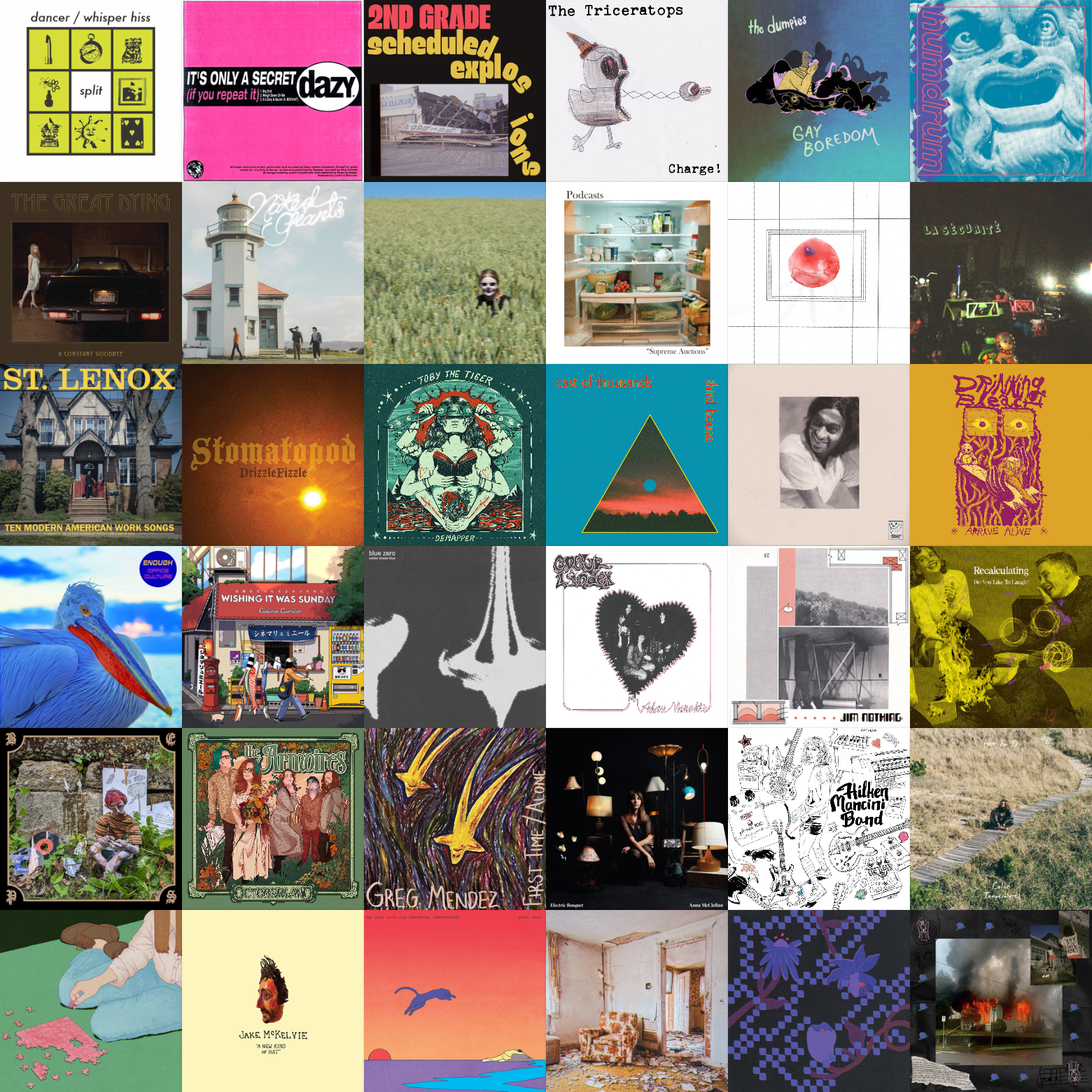
Come with us as we wrap up October! This monthly playlist has a bunch of great new music on it, featuring a bunch of bands that I’m probably going to be thinking about as I try to put together my favorite albums of 2024 in list form in the coming month. Plenty of good choices below, that’s for sure.
2nd Grade, Toby the Tiger, and Humdrum have multiple songs on this playlist (two apiece).
Here is where you can listen to the playlist on various streaming services: Spotify, Tidal, BNDCMPR (missing two songs). Be sure to check out previous playlist posts if you’ve enjoyed this one, or visit the site directory. If you’d like to support Rosy Overdrive, you can share this (or another) post, or donate here.
“Limbo Land”, Dancer
From Split (2024, HHBTM)
Dancer and Whisper Hiss are both post-punk bands that know their way around a pop hook, but they’re fairly distinct to me–the former are the irreverent, offbeat Brits who mix new wave-y art punk with fluffy indie pop, and the latter are the heavier, more serious Americans who certainly have listened to their fair share of Dischord and Kill Rock Stars records. Both bands bring their A-game to their recent split LP on HHBTM Records, but it’s the Glasgowians (whose entire discography I’ve written about on this blog at this point) who win the day for me with “Limbo Land”. “Limbo Land” closes Dancer’s half of the album with some tightrope-walking power chords and eventually builds to a fuzzed-out power pop conclusion–it’s a bit heavier and blunter, almost like they’re trying to meet Whisper Hiss halfway. Read more about Split here.
“Big End”, Dazy
From IT’S ONLY A SECRET (If You Repeat It) (2024, Lame-O)
Opening track “Big End” is the most obvious “hit” to me on IT’S ONLY A SECRET (If You Repeat It), the latest three-song EP from James Goodson’s one-man power pop project Dazy. It’s the one “vintage Dazy” classic song on the EP–it’s got a bit of alt-dance energy to it, but it’s primarily a power pop guitar assault that just happens to have a beat. Goodson’s unflagging, almost robotic high energy is so strong here that his performance alone is ample reassurance that Dazy’s still “got it”–“it” being the ability to write a scorching anthem for staring directly at the sun and sounding incredibly cool while doing it. Dazy’s release rate has slowed down over the past year or so, but Goodson’s been clear that he’s still working (and reworking) on new music all the time. Open the vault, James. It’s time. Read more about IT’S ONLY A SECRET (If You Repeat It) here.
“Out of the Hive”, 2nd Grade
From Scheduled Explosions (2024, Double Double Whammy)
Like any power pop band with a penchant for shorter songs, 2nd Grade have been blessed or cursed with Guided by Voices comparisons pretty much since their inception as a Peter Gill solo project, but Scheduled Explosions is the first 2nd Grade album that actually sounds like Guided by Voices does to my ears. A lot of this record was recorded by Gill alone, stitched together with full band recordings to create an exciting patchwork. Even on the homespun recordings, though, 2nd Grade don’t abandon the “power” side of power pop–take early highlight “Out of the Hive”, for example, a blustering piece of GBV-esque revved-up, fuzzed-out guitar pop. Gill–on everything here–stumbles through the track, speeding up and slowing down as he does everything in his power to get this winner out of his mind and onto tape as soon as possible. Read more about Scheduled Explosions here.
“We Will Shatter”, The Triceratops
From Charge! (2024, Learning Curve)
Brooklyn’s The Triceratops deliberately and intentionally walk the line between “pop” and “heavy” rock music on their debut album Charge!’s fifteen songs. It reminds me of, more than any other band, the Archers of Loaf–huge and catchy without being dogmatically “punk” or “noise rock”. Charge! is an urgent-sounding album–it does feel like the work of a couple of people who haven’t gotten to make a full-length statement of an LP in a while and maybe don’t know when or if they’re going to get to again, so they’ve put as much as they can into it. It’s no wonder that the most rousing moments on Charge! are the most destructive–single “We Will Shatter” is maybe the catchiest song I’ve heard this year, jumping from the slick verses to an exorcism of a refrain (that’s just the title line). Read more about Charge! here.
“Ballad of Two Stubborn Men”, The Dumpies
From Gay Boredom (2024, Dirt Cult)
There’s this great song called “The Ballad of Two Stubborn Men” by the underrated Bay Area garage/punk group The Younger Lovers (Brontez Purnell’s band since the early 2000s, haven’t released much lately but hopefully still active). Like a lot of Purnell’s greatest songs, it could be described as “queer slacker guitar pop”, and it’s probably my personal favorite Younger Lovers track. There’s also this really fun band from Oregon called The Dumpies–seen earlier this year releasing a split 7” with Night Court and more recently putting out an entire album called Gay Boredom. Nineteen songs in nineteen minutes, Gay Boredom hops from lo-fi garage pop to hardcore punk, and their seventy-eight second version of “Ballad of Two Stubborn Men” is my favorite thing on it. The Dumpies speed the track up, finding a hair-pulling, foaming pop punk anthem in the original version somehow. It rules! It sounds like Green Day!
“Come and Get Me”, Humdrum
From Every Heaven (2024, Slumberland)
Chicago’s Loren Vanderbilt has a keen grasp on a very specific time and place in the history of indie rock as Humdrum, carefully and devotedly pulling together jangle pop, new wave, college rock, and dream pop from the 1980s and early 90s to make Every Heaven’s warmly familiar sound. Although it does feature some guitar contributions from Vanderbilt’s former Star Tropics bandmate Scott Hibbitts, Every Heaven is largely the work of a singular pop-minded visionary, with everything from its prominent, pounding mechanical drumbeats to its New Order-y synth washes to sprinkled guitar arpeggios all working in tandem to service the melodies and hooks, all unfailingly upbeat but also unafraid to turn up the “wistful” dial. On late highlight “Come and Get Me”, the emotional cracks and visible wear and tear only enhance the great New Romantic performance given by Vanderbilt and guest vocalist Melissa Buckley. The titular plea sounds desperate and time-sensitive–but still hopeful!–in the hands of these two. Read more about Every Heaven here.
“New Years Day Blues”, The Great Dying
From A Constant Goodbye (2024, Dial Back Sound)
Loosely speaking, A Constant Goodbye is a “country-punk” album, although The Great Dying frontperson and songwriter Will Griffith stamps his writing with a pronounced dour streak compared to peers like Drive-By Truckers (with whom they share a sometimes-member in Matt Patton) and Lee Bains III & The Glory Fires. The songs on A Constant Goodbye generally hew towards the darker end of the spectrum, but it’s a pleasingly varied-sounding album nonetheless, with outliers like “New Years Day Blues” almost being the norm rather than exceptions. “New Years Day Blues” closes A Constant Goodbye with a perfect starry-eyed ballad, a lost college rock anthem unlike anything else on the record. Except in the sense that it’s incredibly lonely-sounding–in that way, it’s right at home. Read more about A Constant Goodbye here.
“Apartment 3”, Naked Giants
From Shine Away (2024, DevilDuck)
Naked Giants decide to start their third album, Shine Away, in media res: “As I was saying, it was 1964 / They put a color television on the second floor / Didn’t that change everything?” It’s an offbeat but welcoming introduction to the band’s familiar-sounding, well-worn, lived-in mixture of the poppier side of 90s indie rock a la Pavement/Archers of Loaf, garage rock, and power pop. There’s a bit of whiplash throughout Shine Away as Naked Giants dart from different ideas, but “Apartment 3”–a piece of slacker-pop ear candy that features the line “Put me in that television like I’m Tom Verlaine” immediately followed by a Marquee Moon guitar lick–is the band at their easiest to grasp and appreciate. Read more about Shine Away here.
“Brand New TV”, Porcine
From Something’s Dawning (2024, ART TNEET)
Barnsley trio Porcine released a really solid self-titled record of indie pop earlier this year via Safe Suburban Home, and last month they quietly followed it up with a five-song EP called Something’s Dawning (the only reason I even know about is because Jim Quinn of Safe Suburban Home sent it to me, wanting to make sure I heard it even though he didn’t have space on his label to release it). Something’s Dawning is some more excellent jangly/dreamy guitar pop from the group, and “Brand New TV” (a song about buying a brand new TV) might be my favorite Porcine song yet. Giannis Kipreos’ vocals, the cheerily-strummed acoustic, the laser-precise lead guitar melodies–they’re all in the right place on this one.
“Never Been a Problem”, Podcasts
From Supreme Auctions (2024, Omegn Plateproduksjon)
The latest release from Oslo indie pop quartet Podcasts is a “3.5 song” EP called Supreme Auctions. The “0.5” is the brief “Intro (For Supreme Auctions)”, which blends seamlessly into “Never Been a Problem”, not allowing us to take much of a breath before Supreme Auctions is already halfway over. “Never Been a Problem” is a polished, sugary piece of power pop that grinds to a complete halt halfway through, only to jam the keys back in the ignition and soar yet again (and then pull a slightly smaller version of the same trick one more time before the song ends)–there’s a bit of the tricky guitar pop that was found all over Podcasts’ 2023 self-titled debut album, but “Never Been a Problem” keeps the hooks even closer to the forefront than the band have ever done before. Read more about Supreme Auctions here.
“It Wasn’t Me”, Russel the Leaf
From Thought to an End (2024, Records from Russ)
Thought to an End, the first Russel the Leaf album of 2024, is Evan Marré’s return to pop music after spending last year dabbling in the realms of experimental, jazz, and improvisational, and it’s a triumphant one. Spanning twenty-one songs and seventy-five minutes, we’re quite possibly dealing with Russel the Leaf’s magnum opus here; it has the feel of a classic double LP, with everything from streamlined, breezy pop rock to layered orchestral and psychedelic passages to heady art rock to, indeed, the experimental/jazz moments of the last couple of Russel the Leaf records featuring on the album. Coming about a third of the way through Thought to an End, the joyous-sounding tinker-pop of “It Wasn’t Me” might be the single greatest triumphant on the album, with Marré sounding locked in with a stop-start instrumental–but thankfully, there’s a lot of competition on this album. Read more about Thought to an End here.
“Detour”, La Sécurité
(2024, Bella Union/Mothland)
Things are looking bright for Montreal art punk/post-punk group La Sécurité. They put out their debut album, Stay Safe!, last year on local label Mothland, and they’ve been picked up by Bella Union for their next album (as of yet unannounced). The first new music from the five-piece (six if you count Emmanuel Éthier, credited for “hand claps”) is the one-off “Detour” single, and it’s as good as La Sécurité have sounded yet. They keep hewing towards the “danceable” side of post-punk music, with everything from the rhythm section’s prominent groove to the blaring synths to the skipping and flashing guitars all working towards the beat. Not that I’d forgotten about La Sécurité, but “Detour” will keep the band squarely on my radar.
“Your Local Neighborhood Bar”, St. Lenox
From Ten Modern American Work Songs (2024, Don Giovanni/Anyway)
Penultimate track “Your Local Neighborhood Bar” is one of the most upbeat, jubilant songs on St. Lenox’s Ten Modern American Work Songs, finding singer-songwriter Andrew Choi stepping back into the world of Joe Peppercorn’s open mic nights at Andyman’s Treehouse in Columbus, Ohio, where he lived before moving to New York for work (“Last week, down at your neighborhood bar / I heard that it was some kind of legendary / … / I gotta go there and sing you a song”). As the modern-day Choi sits on the subway and reminisces, however, he goes beyond the rose-tinted, Cheers-evoking glasses with which he begins (“Seven years ago stuck on the ivories / It reveals explicit themes / Seven years yeah, stuck in the brain”). All the while, Choi’s huge voice–the one that first got him noticed at by Anyway Records at those open mics a decade ago–is just as incredible as ever. Read more about Ten Modern American Work Songs here.
“Someone Else’s Enemies”, Stomatopod
From DrizzleFizzle (2024, Pirate Alley)
Streamlined but expansive, unmistakably Midwestern, punk-y and garage-y, dark but “pop music”–this is rock and roll according to Chicago trio Stomatopod. DrizzleFizzle is their fourth album, and it’s a doozy, nearly twice as long as their last one and made up of ten enormous songs–the snapshot of brilliance that was their last album, Competing with Hindsight, is blown up onto the big screen here, and Stomatopod are ready for primetime. “Someone Else’s Enemies” was instantly my favorite song on the record; it’s a big, angry Andy Cohen-type beast that benefits from its players’ experience (Stomatopod know they’re onto something here, and they’ve got the clarity to embrace it seriously and without any self-consciousness). “You should never go to war with someone else’s enemies,” frontperson John Huston ominously thunders–a piece of obvious advice that nonetheless ends up unheeded all around us. Read more about DrizzleFizzle here.
“Bones”, Toby the Tiger
From Demapper (2024, Peligroso es Mi Nombre Medio)
Brock Ross and his solo project, Toby the Tiger, are squarely in the realm of “emo-adjacent” indie rock; the Boise-based musician is adept at writing delicate pop melodies, but there’s an electric side to Demapper as well. The first Toby the Tiger album takes great pains to reveal itself in the sturdiest, most arresting fashion possible; “Bones” is one of the best album openers I’ve heard this year, starting off simple with just electric guitar and Ross’s vocals. However, given the literal Biblical torrent of emotion and violence he eventually gets around to depicting, it can hardly be described as a low-key or “soft” launch. Read more about Demapper here.
“If I Could Take It Back”, Cast of Thousands
From Third House (2024)
On their first full-length, Austin’s Cast of Thousands pick up the thread they started with First Six Songs, although Third House continues to add dimensions to the group’s sound–in particular, new member Ali Ditto’s organ-toned keys add a The Clean-esque indie pop element to the band’s college rock, power pop, and jangle pop (delivered with just the right amount of Lone Star garage rock energy). Max Vandever remains a sneakily stellar rock and roll frontperson in his ability to sound believably conversational even when I have no idea what he’s talking about; “If I could, I’d buy you every star in the sky / Well, what are the stars worth / And what do they even do,” he rambles in the excellent “If I Could Take It Back”, which opens the LP. “If I Could Take It Back” is so catchy and enthusiastic it makes me want to grab the nearest tambourine and keep time myself. Read more about Third House here.
“Your Purse or Your Life”, Tony Vaz
From Pretty Side of the Ugly Life (2024, Jubilee Gang)
The first Tony Vaz LP is a constantly surprising pop album–self-recorded in Vaz’s home studio, Pretty Side of the Ugly Life is rooted in mid-2010s “bedroom pop” and “lo-fi indie rock”, with regular detours into everything from orchestral pop to folk and alt-country to electronic music. Pretty Side of the Ugly Life starts in indie rock territory and gets more adventurous as it progresses, but there are inspired, intriguing choices right up front on the album, too. “Your Purse or Your Life” opens the record with some strong country-rock guitar-play merged with a greyscale 90s indie rock foundation, soaring violin from Camellia Hartman, and Alena Spanger’s backing vocals–it’s a somewhat confusing combination, but it works, and it opens up a bunch of possibilities that the rest of Pretty Side of the Ugly Life continues to probe. Read more about Pretty Side of the Ugly Life here.
“Got U (Reprise)”, Drinking.Bleach
From Arrive Alive (2024, Pill Mill)
Drinking.Bleach are a “slacker-folk” trio from Portland, Oregon who’ve been kicking around since the mid-2010s, and the latest release from the group (guitarist/vocalist James VonUrchin, upright bassist Ross Fish, and percussionist Pepper Smithereenz) is a five-song EP called Arrive Alive. The trio mention being inspired by Beat Happening–the Violent Femmes are another obvious point of comparison, and I’d even list the lo-fi folk side of Beck, too. My favorite song on Arrive Alive is pretty easily “Got U (Reprise)”, a weird but incredibly catchy piece of hypnotic alt-folk. The upright bass and the “found” percussion (“things like sheet metal, crates and chains”) create a strong rhythm, and VonUrchin’s strong, droning vocals are striking in their own right.
“We Used to Build Things”, Office Culture
From Enough (2024, Ruination)
For the fourth Office Culture album, Winston Cook-Wilson decided to try something different–he decided to make a CD. The seventy-three minute, sixteen-song Enough was deliberately inspired by “the CD era”, when artists blew their work up to previously-unmatched proportions without any heed as to how they were going to pare it down to some forty-odd minutes. Enough sees just how many directions Office Culture can stretch Cook-Wilson’s distinct sophisti-pop songwriting at once, with the help of twenty-something collaborators and a buffet of pop, jazz, and electronic ideas. The five-minute jazz-funk-groove of “We Used to Build Things” is much more showy than anything on Office Culture’s last record, the soft rock/jazz-pop Big Time Things, and it might just be the most satisfying thing on the entire album. Read more about Enough here.
“Sunday”, Cinéma Lumière
From Wishing It Was Sunday (2024, Subjangle/Catshelf)
I haven’t gotten to write about it as much as I’d like, but there’s a burgeoning guitar pop scene going on in East Asia, and a lot of it is headquartered in none other than Manila, the capital of the Philippines. The five-piece dream/jangle pop group Cinéma Lumière put out their debut EP in 2020, and their first album, Wishing It Was Sunday, arrived earlier this year (initially given a digital release via Catshelf in August and picked up by international guitar pop label Subjangle for an “extended” CD release two months later). Cinéma Lumière’s two co-lead vocalists, Jon and Mary, duet on my personal favorite track on the record, “Sunday”, which is a classic twee-pop celebration of having no obligations other than lazing around and enjoying the world on the titular day.
“Foot in the Grave”, Blue Zero
From Colder Shade Blue (2024, Lower Grand Tapes)
Oakland, California indie rock busybody Chris Natividad fronts two bands already–so why does he need Blue Zero, his latest quasi-solo project? Well, I’m not sure exactly, but Blue Zero’s debut LP Colder Shade Blue is pretty distinct from his other groups–while Public Interest and Marbled Eye both trade in the worlds of sharp, tough, and rhythmic post-punk and garage rock, Blue Zero is more at home in the world of shoegaze-adjacent, fuzzed-out pop. The album is somewhat torn between jangly guitar pop and basement-evoking noisy indie rock, and “Foot in the Grave” is the clearest example of the former on the record. Natividad’s opening guitar line packs enough “jangle” for the entirety of Colder Shade Blue, and while the following song has plenty of psychedelia and dreaminess baked into it, it never lets go of the sharp pop writing that’s apparent from the get-go. Read more about Colder Shade Blue here.
“Rattrapez-moi”, Coeur à l’Index
From Adieu Minette (2024, La Vida Es un Mus)
Coeur à l’Index put out their first demo at the beginning of last year, and renowned European punk label La Vida Es Un Mus (Straw Man Army, The Chisel, Home Front) have scooped the Brussels/Marseille-based band up for Adieu Minette, their debut album. Adieu Minette is a lot more pop-friendly than a lot of La Vida Es Un Mus’ output–guitarist/vocalist Julia Stravato, bassist Charlotte Lobert, and drummer Pogy clearly have listened to their share of classic C86, power pop, and, as their bio says “French Chanson from the 60’s onwards”. Coeur à l’Index’s confident, high-flying energy helps them fit in with their louder, more aggressive peers, though–for example, take “Rattrapez-moi”, a bouncy, brilliant power pop anthem that opens Adieu Minette with a whirlwind of hooks.
“The Shimmering”, Jim Nothing
From Grey Eyes, Grey Lynn (2024, Meritorio/Melted Ice Cream)
Grey Eyes, Grey Lynn continues to mine the rich veins of classic Flying Nun-inspired jangle pop, psychedelic pop, and noise pop that Jim Nothing so effectively explored on 2022’s In the Marigolds, but this one feels like a more wide-ranging take on this kind of music. Sometimes, the Jim Nothing of Grey Eyes, Grey Lynn feels like a sturdier, louder rock band than ever before, other times like the home-recorded solo project of bandleader Jim Sullivan. Sullivan’s songwriting is still sublime, though, and more than capable of weathering a more involved journey. “The Shimmering” is a classic late-album hidden gem–it’s absolutely brimming with melody in every aspect of the recording, the one track that truly rivals album opener “Hourglass” for the album’s immortal heavenly pop hit throne. It feels much greater than its relatively brief two-minute lifespan. Read more about Grey Eyes, Grey Lynn here.
“Based on the Comedy of Ray Romano”, Recalculating
From Do You Like to Laugh? (2024, Band Dinner)
Recalculating make skittering, talk-singing punk rock and garage rock that can go from minimal to noisy at the drop of a hat in the vein of classic alt-rock groups like the Minutemen, Mission of Burma, and Nomeansno, and their songs will appeal to the contingent of post-punk revivalists that don’t take themselves too seriously. Do You Like to Laugh? opens with one hell of a mission statement in “Based on the Comedy of Ray Romano”, an absolutely wild punk rock exploration of comedy and fiction and the performance of life (“Ladies and gentlemen, be gentle with comedians / For while they are blessed with prodigious download metrics / They endure life defenseless / Unarmed with guitars!” roars whichever one of them is on the mic as the song comes to a head–it’s hard not to imagine the album’s engineer, Steve Albini, enjoying that part). Read more about Do You Like to Laugh? here.
“Bent”, Black Ends
From Psychotic Spew (2024, Youth Riot)
Black Ends are a new trio from Seattle who refer to the music they make as “gunk pop”, and the core of their debut album Psychotic Spew’s sound is the stripped-down, heavy-duty punk rock that Black Ends hone across the record’s ten tracks. Bits of grunge, psych-rock, and even blues rock shade Psychotic Spew, as Black Ends grab onto any and every corner of rock and roll they can get their hands on to further their self-proclaimed gunk-pop mission. Sitting in the album’s second slot, “Bent” takes the spark that opening track “She Speaks of Love” provides and creates a garage-punk wildfire with it. Black Ends only need two minutes and change to charge through “Bent”, whose choppy, showy guitar playing never feels too distracting from the lockstep feeling that vocalist/guitarist Nicolle Swims, bassist Ben Swanson, and drummer Billie Jessica Paine evoke together. Read more about Psychotic Spew here.
“Ridley and Me After the Apocalypse”, The Armoires
From Octoberland (2024, Big Stir)
Burbank, California’s The Armoires are the flagship act of Big Stir Records, and their fourth album, Octoberland, showcases the quintet’s penchant for vintage college rock, jangle pop and power pop–while Larysa Bulbenko’s string playing adds some psychedelia and perhaps even a bit of Eastern European folk traditionalism to the mix. Octoberland is an incredibly rich collection of music both from a lyrical and instrumental perspective, all of which is on display in my favorite song on the album, “Ridley and Me After the Apocalypse”. Musically, it’s a truly infectious piece of jangly power pop–The Armoires can basically do whatever they want after that opening guitar line and it’d still sound great. Band co-leaders Christina Bulbenko and Rex Broome choose a sprawling, high-concept post-apocalyptic story to sketch, imagining themselves as artists providing “Copium for trying times / Just to mitigate the rancid vibes” in this dystopian setting. Read more about Octoberland here.
“Alone”, Greg Mendez
From First Time / Alone (2024, Dead Oceans)
Sometimes the world is just. Greg Mendez broke out in a major way with last year’s self-titled album, and now he’s a household name and playing stadiums (I think). Unlike most people that this kind of thing happens to, Mendez’s last album was very good, and his first widely-released new music since then is a very strong follow-up, too. Mendez quietly moves through four folk-pop ideas in seven minutes on First Time / Alone–the organ-led “First Time” is great, but I had to go with Mendez’s strongest six-string moment here with “Alone”. It sounds just about how one would expect a just-acoustic-guitar Greg Mendez song called “Alone” to sound, although it’s one of the singer-songwriter’s more spirited (speaking very relatively here!) moments. “I’m a lonely winter away from punishment,” he sings amidst the cold–he sounds alive enough to know something isn’t right.
“Co-Stars”, Anna McClellan
From Electric Bouquet (2024, Father/Daughter)
For nearly a decade now, Anna McClellan has been a key part of the Omaha, Nebraska indie rock, folk, and alt-country scenes, both in her solo output and via her contributions to fellow Nebraskans’ records–most notably, the work of Ryan McKeever of Staffers and Workers Comp. McKeever, in turn, contributes heavily to McClellan’s latest album, Electric Bouquet, and even duets with her on “Co-Stars”, my favorite track on the record. “Co-Stars” is a bit more jaunty and (dare I say) twee than the rest of Electric Bouquet’s more standard folk rock, but it’s a lovely change of pace, with the organ (also provided by McKeever) turning the song into a lo-fi, off-the-cuff version of what feels like a timeless pop song (McClellan even sticks a “shoo bop shoo wah” in towards the end of the song, and it totally fits).
“Set My Sights”, Hilken Mancini Band
From Hilken Mancini Band (2024, Girlsville)
In the mid-90s, Hilken Mancini co-led the Boston alt-rock/pop group Fuzzy, who toured with Buffalo Tom and Velocity Girl and released two albums for Atlantic before fizzling out before landing a “proper” radio hit at the end of the decade. I admittedly haven’t kept up with all of Mancini’s output since the dissolution of her most well-known band, but the self-titled debut album from the Hilken Mancini Band arrives with a bang, embracing sugary, hooky, fuzzy guitar pop music like 1994 never fully left us. The ten songs of Hilken Mancini Band practically helicopter in with their loud, unmistakable catchiness front and center. Album opener “Set My Sights” would already be a classic just based on the strength of the verses and instrumental alone, but Mancini somehow finds a classic 90s alt-pop-rock chorus that nobody’d thought to use yet to really push the song over the top. Read more about Hilken Mancini Band here.
“Airplane”, Color Temperature
From Here for It (2024, Developer)
Based on who I’d seen extolling the virtues of Color Temperature and its mastermind, Brooklyn’s Ross Page, I’d assumed that the project fell somewhere on the “emo-punk” spectrum. Nothing wrong with that, but I was pleasantly surprised to listen to Here for It and hear something else entirely–it’s a low-key, vaguely dark mix of psychedelic pop and folk music, with some classic indie rock thrown in, too. My favorite song is called “Airplane”, which I would consider a “banger”–it’s an inspired concoction from Page, who merges a mid-period of Montreal-esque vocal with a vintage Spoon rhythm section/beat. Like a lot of Here for It, it manages to be toe-tapping and propulsive without sounding too “upbeat”–there’s something shady going on here, somehow, but that only enhances the experience.
“Bureau of Autumn Sorrows”, 2nd Grade
From Scheduled Explosions (2024, Double Double Whammy)
Scheduled Explosions is such a good album that I didn’t even find the time to talk about one of my favorite songs on the record when I wrote about it. That would be “Bureau of Autumn Sorrows”, a weird electric-guitar-and-vocals-only composition buried in the middle of the second half of the record. Unlike “Out of the Hive”, it wasn’t recorded by Gill alone–it’s a studio track also featuring Jon Samuels (Gill’s bandmate in Friendship, and recently a part of MJ Lenderman & The Wind) on guitar, too. Gill delicately weaves his way through a tender guitar pop song, with Samuels interjecting some strange, arresting moments of guitar noise at the end of each refrain. I couldn’t really tell you what “Bureau of Autumn Sorrows” is about between its incredibly Robert Pollard-esque title and Gill’s simple and opaque lyrics (“All my friends are on the moon now / The news nearly killed me / But then I put on my ten-gallon hat / And I I got over it”). Great stuff, though. Read more about Scheduled Explosions here.
“Demande spéciale”, Bon Enfant
From Demande spéciale (2024, Duprince)
Montreal’s Bon Enfant apparently simply refer to their sound as “Québécois rock”, which is a good a term as any to describe what I hear on their third album, Demande spéciale. It’s an incredibly fun-sounding rock album, with bits of psychedelic pop, power pop, post-punk, dream pop, and plenty more influences sparkling around the record’s dozen tracks. The group are pretty much always putting something hooky to tape, but Bon Enfant aren’t afraid to take different routes to get there–sometimes they’re groovy, suave, and rhythmic, other times they go all-in with the “big” guitars and vocals. Mélissa Fortin’s synths get their moment in the sun with the album’s new wave-y title track, but the guitars remain huge, too–this is probably what “French-Canadian power pop” is, and it’s an excellent argument in favor of Montreal getting a little more into Shoes (or at least Blondie). Read more about Demande spéciale here.
“Pump Fake”, Jake McKelvie
From A New Kind of Hat (2024)
Ah, there’s some great folk rock songwriting on A New Kind of Hat, the latest album from longtime troubadour Jake McKelvie. Wish I had the space to do the full record, but I’ll settle for highlighting “Pump Fake”, my favorite track on the album. A New Kind of Hat is McKelvie’s first record in eight years, and the songs all sound impeccable, like they’ve been honed over the long gap between releases, and “Pump Fake” is no exception. McKelvie’s writing is more classic country than his music would suggest, a collection of quips and one-liners that add up to greater than the sum of its parts (“When there’s a fire that burns in your belly / It’s not like others can gather around it and feel the warmth” … “And if you’re learning the world’s smallest fiddle / You’ve gotta practice it in your spare time” … and so forth).
“T.B.W.T.P.N.”, The Boys With the Perpetual Nervousness
From Dead Calm (2019, Pretty Olivia/Bobo Integral)
One simply must respect a band with a theme song. That’s what the first song on the debut album from Spanish/Scottish duo The Boys With the Perpetual Nervousness is–the initials of “T.B.W.T.P.N.” spell out the band’s admittedly wordy moniker, and song itself immediately gets to work in displaying Andrew Taylor and Gonzalo Marcos’s incredibly strong knack for achieving the platonic ideal of jangle pop. Dead Calm came out in 2019 on Pretty Olivia Records, and we have their current home of Bobo Integral to thank for reissuing it in “deluxe” format (featuring a bonus track and a bunch of demos). The Boys With the Perpetual Nervousness have a reputation as one of the most consistently great modern jangle pop bands, and a revisitation of Dead Calm does little to dispute this–especially when Taylor and Marcos need only the first few seconds of “T.B.W.T.P.N.” to deliver a killer hook.
“Colonial Lanes”, American Motors
From Content (2024, Expert Work/The Ghost Is Clear)
Lancaster, Philadelphia noise rock group American Motors understand that the monster you can’t see is even scarier, and their debut album Content utilizes a huge amount of empty space to hover around the edges of its songs. Engineer J. Robbins helped the trio zero in on a Rust Belt-inspired post-punk/noise rock/post-rock sound, keenly sharpened and hammered out much more finely than a lot of bands in their shoes would dare to even attempt. Content’s opening track, “Colonial Lanes”, is a shapeless, formless post-noise rock soundscape, the narration getting overtaken by moments of atmospheric instrumentals and a few genuine “rock” sections. Read more about Content here.
“Wave Goodbye”, Humdrum
From Every Heaven (2024, Slumberland)
I view Loren Vanderbilt’s Humdrum project as somewhere between a more melancholic version of bands like Chime School and Ducks Ltd. and a more peppy Lost Film or Old Moon–but Vanderbilt’s writing is fresh and features a unique feeling of yearning, so it doesn’t feel like a retread of other jangle pop hitmakers. Every Heaven is a steady stream of rock-solid, fully-teased-out jangly/dreamy guitar pop anthems, although some moments stand out as being especially immediate and sugary. “Wave Goodbye” is a modern jangle pop classic, with legitimate rushes of melodies and propulsion with hooks in every crevice. Read more about Every Heaven here.
“In a Dream”, Trace Mountains
From Into the Burning Blue (2024, Lame-O)
There are days where I lament that Dave Benton left LVL UP, arguably the best band of the 2010s, to make Steve Hyden-core heartland indie rock as Trace Mountains. But god damn, Trace Mountains is very good Hyden-core heartland rock at its best. Who else but Benton could pull off something like “In a Dream”, the opening track from the latest Trace Mountains album Into the Burning Blue? The seven-minute mutant heartland-pop-folk-electronic-rock creation merges just a bit of the Americana/alt-country of the past couple of Trace Mountains records with the synthpop-curious nature of early Trace Mountains, and it doesn’t really sound like anything else going on right now. Into the Burning Blue isn’t my favorite Dave Benton record, but I’ll probably think it’s brilliant in a year or two. I still have plenty of faith in Trace Mountains. And at the very least, “In a Dream” is an instant classic.
“Letter to Screwtape”, Toby the Tiger
From Demapper (2024, Peligroso es Mi Nombre Medio)
Brock Ross enlists his brother Mitch to play trumpet on “Letter to Screwtape”, and the orchestral-folk touches help make the acoustic guitar-led track a highlight of Demapper, Toby the Tiger’s debut album. “Letter to Screwtape” sits right in the middle of Toby the Tiger’s “emo/pop/folk” Venn diagram, sure to please fans of the likes of Death Cab for Cutie, Bright Eyes, and/or Pedro the Lion. It’s Biblical from the song’s C.S. Lewis-referencing title on down–between that, the song’s enthusiastic acoustic guitar flourishes, the horns, and Ross’ thoughtfully petulant delivery, it’s got just about everything one could want in this kind of music. Read more about Demapper here.
“Tired All the Time”, Mope Grooves
From Box of Dark Roses (2024, 12XU/Night School)
I wrote a lot about Box of Dark Roses, the final album from Portland lo-fi pop project Mope Grooves, and I’m not going to try to rehash everything about it here. Suffice it to say there’s a lot of heaviness surrounding and permeating the 90-minute double LP–but there’s also a lot of beauty on Box of Dark Roses, probably more than anything else. Sometimes, the darkness of Box of Dark Roses is softened by the music; that’s the case with “Tired All the Time”, the record’s penultimate track. A couple of Mope Grooves contributors–Cap and Lee–sing lead vocals aided by Ray Aggs on violin and plenty of instrumental touches provided by the band’s ringleader stevie. The violins make the song seem like a folk lullaby, the duo singing “I’m tired all the time and I don’t know why / Someone take this memory from my mind,” coming at the end of a taxing album that answers this question for them. Read more about Box of Dark Roses here.
 Rosy Overdrive