Release date: October 25th
Record label: Anyway/Don Giovanni
Genre: Indie pop, singer-songwriter, synthpop
Formats: Vinyl, digital
I believe that Andrew Choi’s previous album as St. Lenox, 2021’s Ten Songs of Worship and Praise for Our Tumultuous Times, still holds the record for “most words I’ve written about a single album for this blog” to this day. St. Lenox’s music brings that out of me (and, anecdotally, plenty of other writers)–Choi’s writing, ambitious, autobiographical, stream-of-consciousness-feeling but always circling its way back to whichever theme he’s zeroed in on for a given record, is particularly welcoming to dissection, discussion, and other “dis-” words. The first decade of Choi’s music career followed him from central Ohio to New York City and brought four rich records in this vein–2016’s Ten Hymns from My American Gothic, a meditation on Choi’s upbringing as a first-generation Korean-American in Missouri and Iowa, might be his “best” album, although following Choi’s writing across several subjects in records up to last year’s religion-inspired LP is a reward in itself. The fifth St. Lenox album, Ten Modern American Work Songs, looks at a key aspect of Choi’s life that has undoubtedly shaped the trajectory of St. Lenox even as it’s mostly been on the periphery of his writing thus far. Somewhat jokingly dedicated in honor of the “10-year Reunion of the NYU Law Class of 2014” (in lieu of the “financial gift” the university had suggested to mark the occasion instead), Ten Modern American Work Songs traces Choi’s journey from a graduate student and aspiring philosophy professor at Ohio State University to a JD program in Manhattan to his current status as a lawyer.
Listen, I’m no big-shot corporate lawyer in New York City (or whatever Andrew Choi is these days), and I’m guessing you aren’t either, but–and maybe you’re aware of this–it’s a pretty long road for anyone to get to that point, and there’s probably something that Choi experiences along the way that doesn’t quite seem as foreign to you. Maybe it’s the grinding in grueling, low-paying jobs with a distant goal on the horizon, maybe it’s the crushing student debt he takes on because received wisdom says it’s a good idea, maybe it’s the white collar job workaholic cultural death spiral, maybe it’s a career/life goal change that requires him to leave a place that truly felt like “home”. These are some of the clearest mile markers on Ten Modern American Work Songs, delivered in a way that will be eminently familiar to anyone who’s experienced St. Lenox’s previous work. Musically, Choi’s distinct style of indie pop is as bright as ever, corralling piano pop, synthpop, and occasional folk and violin touches into something that never threatens to distract from the lyrics but sharp enough to compliment them. Choi’s huge voice–the one that got him noticed at Joe Peppercorn’s open mic in Columbus over a decade ago, leading to a long partnership with Anyway Records–is just as incredible, and his pointed ramblings remain pointed and rambling (I mentioned John Darnielle, Craig Finn, and Michael Stipe last time–as well as comparing Choi to an “over-excited professor”, which I wrote before I even knew that was his original ambition).
Even for St. Lenox, Ten Songs of Worship and Praise for Our Tumultuous Times was sprawling and overflowing–graded on Andrew Choi’s curve, Ten Modern American Work Songs is a bit more “pop”, the songs a bit more upbeat and the instrumental hooks a little more prevalent. Combined with some moments where Choi’s voice sounds higher and even younger than he has of late in “Kalahari” and “Your Local Neighborhood Bar”, it feels like he’s tapping into the energy that colored his relatively “rough draft” first album, 2015’s Ten Songs About Memory and Hope–which indeed coincided with a lot of the events depicted in this record. “Courtesan”, the first proper song on the album, combines the giddy (the instrumentation, the “Victory! After seven years of agony!” declaration) with the sarcastic self-congratulation of the song’s title. “Lust for Life”, the musically-minimal follow-up track that feels more in line with Choi’s more recent work, is a more clear-eyed look at this moment, with its refusal to romanticize the previous track’s dizzying experience and pull up the ladder (“I hear the people are starting a union, Jesse / I hope if we work together, we can make this school a better place”) complimenting it satisfyingly.
Like “Courtesan”, the most triumphant-sounding, pop-forward moments on Ten Modern American Work Songs combine genuine elation with a three-dimensional attitude that deepens the foundation of the tracks, if not outright contradicting them. The most fun-sounding song on the record is arguably “Quasi-Nichomachean Ethics (Drunk Uncle Advice)”, the parenthetical qualifying the full-throated stream-of-consciousness pointers Choi gives to a nephew on his twenty-first birthday (“Don’t check your emails after 7pm, dear God / ‘cause ignorance is the the better part of valor,” Choi sings early in the song, and later says the subtext out loud with “That’s why I am telling you to learn from my mistakes in this life”). The penultimate song “Your Local Neighborhood Bar” rivals “Quasi-Nichomachean Ethics” in terms of pure jubilation, as Choi steps back into the world of Peppercorn’s open mic nights at Andyman’s Treehouse in Columbus (“Last week, down at your neighborhood bar / I heard that it was some kind of legendary / … / I gotta go there and sing you a song”). As modern-day Choi sits on the subway and reminisces, however, he goes beyond the rose-tinted, Cheers-evoking glasses with which he begins (“Seven years ago stuck on the ivories / It reveals explicit themes / Seven years yeah, stuck in the brain”).
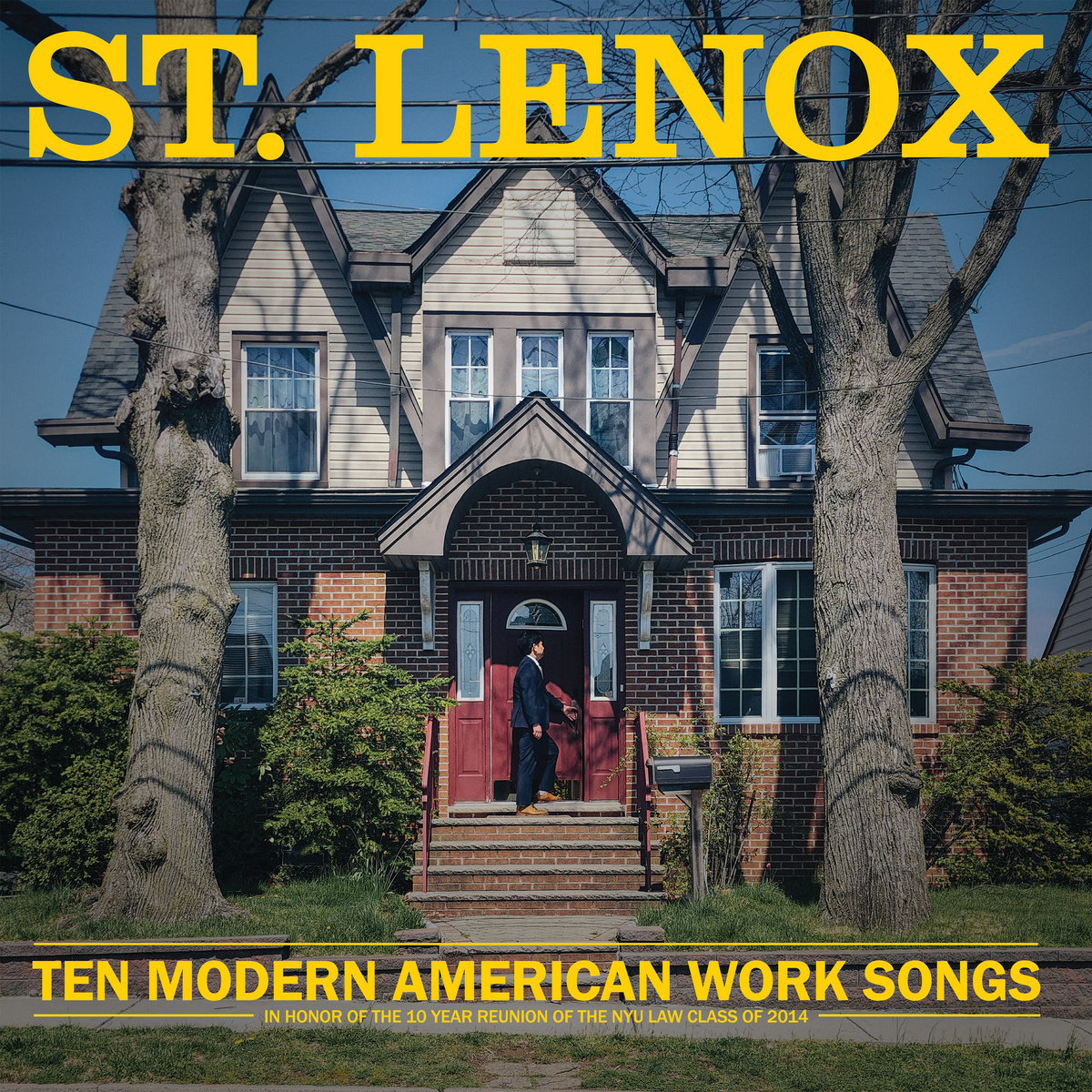
The flip side of this is that Ten Modern American Work Songs’ subtler, less outwardly triumphant moments contain a hint of that “victory” in them, even as one might need to lean on greater context to see them. Choi’s letter to the titular character of “Rudy” might feel like a backhanded compliment (“Did you know that I’ve been inspired by you / To give up on my dreams and be a family man”), but both the rest of the song (“Sad sack institution salaryman / Overtime stuck on the dashboard”) and the album as a whole reveal the sincerity of the remark. Meanwhile, “The House I Left for Work in New York” is shot through with a very real sense of loss, the feeling like Choi is giving up the tangible manifestation of the American dream for something much less certain in the future–but the entire song sounds different after reading that the cover of Ten Modern American Work Songs depicts Choi’s current home, which he put a down payment on last year at the age of 43. And then there’s the final song on the record, “On Fulfillment”. Taking the form of a conversation at a wedding, Choi finishes the record by saying “Did you know ive been up at night, screaming curse words in the dark? / As if the whole of my career has been a big mistake”–that’s a hard note to end on no matter how you slice it. Salvation from this creeping feeling can only be won by taking a wider view of both Ten Modern American Work Songs and St. Lenox’s oeuvre as a whole, which makes the case that, even in this worst-case scenario, one’s work “career” is (or, at least, can be) just one piece of something larger. (Bandcamp link)
 Rosy Overdrive