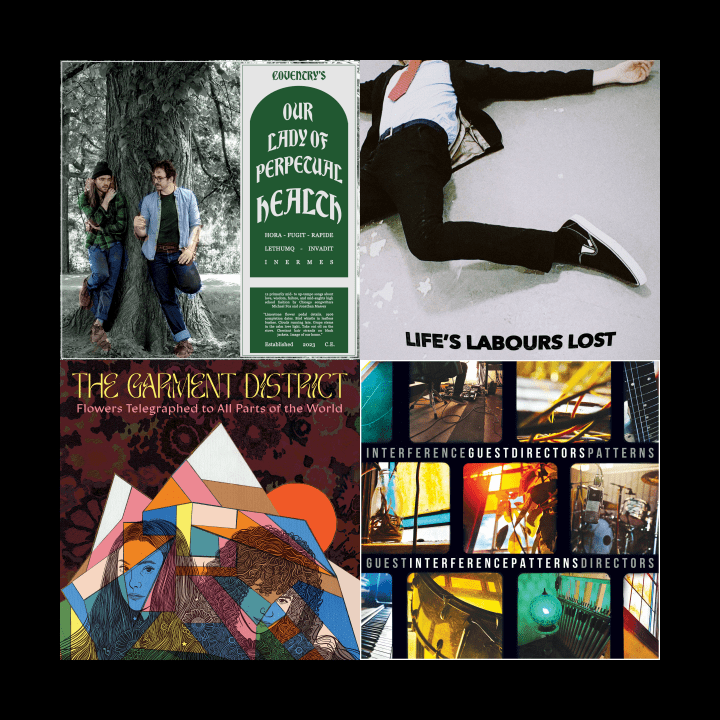
This is a good blog post! Okay, we’ve gotten that out of the way–now that you’re fully on board, we can start discussing new albums from Coventry, The Garment District, Soft Screams, and Guest Directors. Although only one of these acts (Soft Screams) has appeared in Pressing Concerns before, you’ll find plenty of friendly faces throughout this post.
If you’re looking for more new music, you can visit the site directory to see what else we’ve written about lately. If you’d like to support Rosy Overdrive, you can share this (or another) post, or donate here.
Coventry – Our Lady of Perpetual Health
Release date: September 19th
Record label: Septic Jukebox
Genre: Folk rock
Formats: CD, digital
Pull Track: Chain Wallet
Chicago’s Coventry is a brand new collaboration between two singer-songwriters who’ve bounced around several Windy City bands: Jon Massey (who I knew from Silo’s Choice and has also played in Animal Mother and Upstairs) and Mike Fox (from Arthhur and Flesh of the Stars). The duo’s other bands range from art punk to doom metal, but with Coventry, they seem to have landed on something closest to a more ornery version of Silo’s Choice’s folk rock. Their debut CD, Our Lady of Perpetual Health, is an accessible but decidedly offbeat collection of excellently-penned pop songs. Massey and Fox certainly have spent plenty of time with classic folk rock and “studio pop” from the 1960s and 70s, but it’s also a very Chicago record, channeling the spirit of both Drag City iconoclastic troubadours and Thrill Jockey jazz-fusion scientists.
The duo (who play everything on the record themselves) sound inspired and energetic for the entirety of Our Lady of Perpetual Health–Coventry seem to feel the pull of mellow soft rock, but Massey and Fox are too busy building their songs up to piano belters, soaring indie rock, or synth-populated jungles to completely heed it. One aspect of Our Lady of Perpetual Health I find myself appreciating is how often Massey and Fox sing on the same song. They have fairly distinct voices from one another, so when Massey’s Dan Bejar-ish lounge-voice switches to Fox’s deeper, startled-Bill-Callahan tones, it’s just another exciting turn in the music. Take something like “Chain Wallet”, the most immediate standout pop song on the album. Bright, mid-tempo acoustic pop rock marks the majority of the song (“Had a bitter fight over Shugo Tokumaru / You lost your temper and took the aux cord from me” receives a shockingly beautiful delivery from Fox), and then Massey takes the bridges and they both launch into guitar heroics overdrive for a huge showy finish.
The sub-two-minute, zippy “Coach House” is a piece of lo-fi fuzzy pop that gives that final part of “Chain Wallet” a run for its money, while plenty of the record’s mid-tempo moments (the relaxed strumming of “Seneca”, the pensive piano pop of “Large Portable Shrine”) acquit themselves just as sharply. Other parts of Our Lady of Perpetual Health take center stage on repeat listens, from the sleepy opening track “Middlebrow” to the majority of the record’s back end–on this particular listen, it’s the final track, “Sprouts”, which begins with some nice Charlie Gillingham organ-keys and an all-timer from Fox: “If I was a dog, then you were a fish / Because you’re cold and slipped through my fingers”. That song’s friendly neighborhood jazz-pop feels like an appropriate send-off for Our Lady of Perpetual Health, with the eager-to-please music thriving alongside both of Coventry’s members offering up quality-over-quantity lyrics. (Bandcamp link)
The Garment District – Flowers Telegraphed to All Parts of the World
Release date: September 22nd
Record label: HHBTM
Genre: Psychedelic pop, psychedelic rock, synthpop
Formats: Vinyl, digital
Pull Track: Left on Coast
Jennifer Baron was a founding member of The Ladybug Transistor, the Brooklyn indie pop group associated with the Elephant 6 collective–joining as a bassist in the mid-90s, she eventually became a songwriting force within the group. Since 2011, however, Baron has led another outlet for her music–The Garment District, in which she gathers up a host of collaborators and contributors to make her busy brand of pop music. The Garment District put out three full-length albums between 2011 and 2016, although the project had been quiet as of late. However, their fourth album (and second, after 2016’s If You Take Your Magic Slow, to be released on vinyl) is certainly a fully-formed return–Flowers Telegraphed to All Parts of the World is a stuffed, expertly-crafted pop album with all kinds of fascinating twists, details, and musical decisions.
On Flowers Telegraphed to All Parts of the World, Baron once again hands off the bulk of lead vocal duties to her cousin, Lucy Blehar, although guitarist Dan Koshute also sings a couple of songs and Alex Korshin sings one (and in the case of “Seldom Seen Arch” and “Cooling Station”, Baron is content to leave them purely instrumental). The majority of the songs on the album are over five minutes long, and The Garment District make every effort to develop each one of them into its own little odd, self-contained world. The first half of the album kicks off with the organ-sweet “Left on Coast”, a busy retro-pop tune that’s perhaps the most “Elephant 6” song here–although it’s the analog synth touches that set the tone for the bizarre dance-rock of “A Street Called Finland” immediately after.
Koshute’s vocals on “The Starfish Song” remind me of Joseph D’Agostino from Cymbals Eat Guitars, and the music takes a hard left turn towards big-picture guitar-forward indie rock to the point I had to make sure I was still listening to the same band (if I’d just waited until the band veer into weird organ-pop in the song’s second half, I would’ve known). The second half of Flowers Telegraphed to All Parts of the World is just as compelling–it contains the weirdest moment on the record with the dub-influenced “Cooling Station”, a beautiful conventional pastoral guitar pop conclusion in “The Instrument That Plays Itself”, and “Moon Pale and Moon Gold”, which balances the two ends of The Garment District quite nicely. As Flowers Telegraphed to All Parts of the World hits the 45 minute mark and floats off into a psychedelic outro, one is left sitting, impressed, at the other end of the large amount of ground the group has traversed. (Bandcamp link)
Soft Screams – Life’s Labours Lost
Release date: September 22nd
Record label: Corrupted TV
Genre: Lo-fi power pop
Formats: Digital
Pull Track: Carry on Young Cadavers
Perhaps more than anything else, I’ve been impressed with the ambition of Connor Mac. I’ve observed them putting copious amounts of worldbuilding into the realms of both their band Galactic Static and their solo project Soft Screams, and I’ve also heard plenty of music (Friendly Universe from the former, Diet Daydream from the latter) good enough to back up this sprawling presentation. Mac is a lo-fi power pop devotee in the vein of plenty of Rosy Overdrive mainstays, although they’ve developed a distinct style of it–too conflicted to embrace the sugaryness of Matt Addison’s Mythical Motors, not quite noisy enough to match the darkness of Ben Spizuco’s Hello Whirled, but containing shades of both–particularly on the newest Soft Screams album, Life’s Labours Lost. From its Shakesphere-inspired title to the musings on capitalism and work culture contained therein, it’s perhaps Mac’s most thematically heavy record yet–although, thankfully, it’s also one of their best as a pop songwriter.
“Anything I Want” kicks off the album with a Soft Screams pop anthem, and Mac’s love of chunky riffs helps build “Carry On, Young Cadavers” into one of the best pop moments on the album–the chorus of “Carry on, you young cadavers / Got caught up in a dead man’s game” is one of the record’s best-sounding rebukes. More than a bit of Life’s Labours Lost matches Mac’s thoughts with musical shifts, like the cloudy, worried-sounding “Hell in My Hands”, or the pissed-off drum-machine-punk of “AGITATOR”. Life’s Labours Lost reaches something of a climax in its second half, as Mac offers up two songs that pretty clearly grapple with the capitalist rot at heart of the album; “Sad @ the System” finds Mac “just worn out, sad at the system, spirit’s torn out,” unable to muster up energy for anger, but in the next one, “Fucked Up Forever”, Mac starkly stares down the fear that they’ve wasted their entire life laboring under capital, and emerges from the other side defiant and revolutionary. Mac sounds downright cheery at the end of “Fucked Up Forever”, but the record closes with “The Great Decimator”, a Hulk-smash piece of fuzz rock aggression that lets out a laborer’s life’s worth of tension in three minutes, and rightfully (and righteously) so. (Bandcamp link)
Guest Directors – Interference Patterns
Release date: September 22nd
Record label: Topsy/Snappy Little Numbers
Genre: Shoegaze
Formats: Vinyl, CD, digital
Pull Track: Nico
This may be Guest Directors’ first album, but that hardly means that the Seattle quartet is new to indie rock. For one, the band have already put out five EPs dating from 2016 up to last year, and for another, the band’s two singer/guitarists have a musical history dating even further back–Julie D. played guitar in the San Diego 90s math rock band Chinchilla, and Gary Thorstensen is none other than the founding guitarist of TAD. This helps explain the noise that the quartet (also featuring bassist Charlie Russo and drummer Rian Turner) are able to whip up on Interference Patterns, their debut full-length. Rather than trading in punk or math rock, the first Guest Directors album leans hard into stately, dense, shoegaze-influenced indie rock–it doesn’t quite let the noise overtake the vocals enough to be “pure” shoegaze, instead letting Julie D. and Thorstensen confidently ride alongside the distortion (it reminds me kind of the Phosphene album from last week, but with more emphasis placed on guitars vis à vis synths).
The thundering “From This Distance” opens Interference Patterns with a big, fuzzed-out shoegaze anthem, and while the dramatic, swirling “Perfect Picture” continues the distorted rock, the song’s nimbleness and less blunt nature indicates that Guest Directors aren’t going to just keep repeating themselves. The band go a step further by offering up a dream-y power ballad in “Raise a Glass”, and the mid-tempo “Blackout Dream Blues” has a probing, meandering sound. The electricity-charged “Skinless’ kicks off Interference Patterns’ flipside with a heavy shoegaze energy that matches the other half’s opener, but the B-side also contains “Nico”, which feels like the most openly “pop” moment on the record. The album closes things out with a pair of songs in “Stare It Down” and “You’ll Never Know” that still contain plenty of guitar heroics and walls of sound, but they both build their way slowly and deliberately towards these conclusions. Although Interference Patterns is certainly made by a rock band, it’s also the work of one that can pull back just enough when the music calls for it. (Bandcamp link)
Also notable:
- Al Menne – Freak Accident
- Another Michael – Wishes to Fulfill
- Buzz Zeemer – Lost and Found
- Leopardo – Solo Recordings 2019-2022
- Jeffrey Alexander + The Heavy Lidders – New Earth Seed
- Billiam – Corner Tactics
- Consensus Madness – Consensus Madness EP
- Mount Vernon Arts Lab – Deltic Vespers
- Emma Bowers – Losing Game EP
- The Lottery – Principles of Mountain Warfare
- Teenage Fanclub – Nothing Lasts Forever
- KEN Mode – Void
- Wet Fruit – Dandelions at the Gate
- Good Looking Friends – Wasted Now
- The Mommyheads – Coney Island Kid
- Field School – A Familiar Fate EP
- Outwest – 2023 Demo EP
- Teenage Sequence – Teenage Sequence
- School Disco – Denton Rock
- POSTDATA – Run Wild
- Samantha Urbani – Showing Up
- Orson Wilds – This Burning House (We All Fell Asleep In) EP
- Arny Margret – Dinner Alone EP
- STMNTS – Tendencies EP
- Buddy & Julie Miller – In the Throes
 Rosy Overdrive
5 thoughts on “Pressing Concerns: Coventry, The Garment District, Soft Screams, Guest Directors”