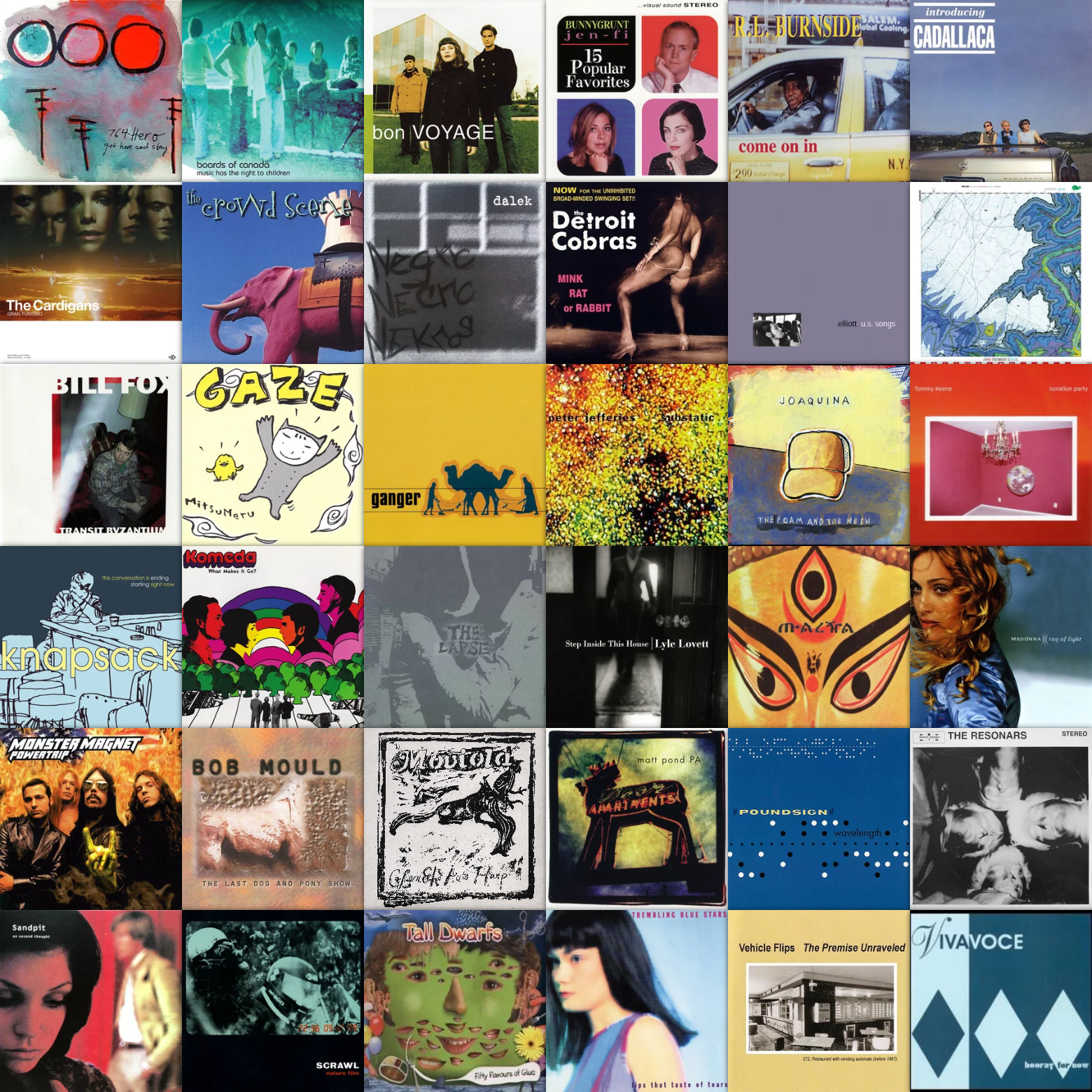
It’s time for another listening log post! If this is the first one of these you’ve encountered, here’s the deal: during this January, I listened to one new-to-me album from 1998 every day (this continued sporadically into February), wrote down a little bit of what I thought about it, and posted said thoughts in the Rosy Overdrive Discord (which you’re encouraged to join if you haven’t). This post collects my work: 36 albums’ worth. This is the fifth one in a series also featuring 1981, 1993, 1994, and 1997 (if you enjoyed this post, maybe head to those next!).
Note that these are only albums I’d never listened to in full before, so if you’re wondering why something well-known/up Rosy Overdrive’s alley from 1998 isn’t here, it’s probably because I’ve heard it already. Those are the rules!
Bandcamp embeds are included when available.
1/1: The Resonars – s/t (Star Time)
An early record from Matt Rendon’s Arizona psychedelic power pop project. This album is definitely, aggressively 60s pastiche, but I don’t even think “psychedelia” is all that applicable here—most of The Resonars is straight-up bubblegum pop in barebones 90s indie rock dressing. Early GBV is again an obvious analogue, or a more slapdash, looser Sharp Pins, to keep things current. It’s a little “punk” but not in a Ramones way. It’s more like early 60s Beatles played with a mid-period Who energy. I dunno if we’re talking about an album full of perfect pop songs or anything like that, but the simplicity/enthusiasm is a breath of fresh air compared to where most bands go when they’re trying to evoke this era. Great drums, too.
1/2: Moviola – Glen Echo Autoharp (Spirit of Orr)
A selection from the large discography of the long-running Columbus alt-country band. I’m not even sure if this is 1998; their own Bandcamp says ‘97, but Discogs said ‘98 and that’s the basis on which I chose it. At this point there’s a hissing lo-fi 90s indie rock element to their sound; it doesn’t sound like Guided by Voices but it does feel of the same time and place. But there’s legitimate twang under the tape hissing—violins are all over the place, and “Spin the Car” for instance is basically a Sebadoh song but built off of a rockabilly riff. Starts off strong, sags a little in the middle, but gets really good again with “Pigeon Shot” onward. Recommended if it sounds like your thing.
1/3: Matt Pond PA – Deer Apartments (Lancaster)
This was the debut, before Matt Pond and company became a solidly reliable B-class indie rock group of the 2000s. This is definitely one of those “haven’t figured out what they want to be yet” first albums; there’s a post-grunge greyness, more rustic folk rock, and orchestral/symphonic touches all trying to work with each other here. At its best, it rules—“Fortune Flashlight” is an awesome pop song, and if you want an anthem, “Stars and Scars” works just fine. In a lot of their more hit-and-miss moments, they remind me of The Tragically Hip; I like the Hip, though it’s hard for a band from Pennsylvania to consistently pull off (“For Sale” is pretty good though). My least favorite moments on the LP lean too hard into melodrama; these just don’t really work at all. Still, the rough-around-the-edges quality is part of what makes it an interesting if inconsistent listen.
1/4: Tall Dwarfs – Fifty Flavours of Glue (Flying Nun)
Fifty shades of Tall Dwarfs. I’ve heard bits and pieces of this one (mainly whatever was on that Merge Records retrospective from 2022) but never listened to it front to back. It doesn’t seem to be one of the more well-regarded Tall Dwarfs album, but it’s a Tall Dwarfs album, and that’s a precious commodity. It’s the full Tall Dwarfs experience—stuff that sounds like Satanic children’s TV show music, freak folk, kazoos, nightmare fuel, gross/skewed humor, great pop music. Not every song here is essential but like an off-the-beaten-path Bob Pollard album, that’s not really the point. No other band would be capable of putting “Gluey, Gluey”, “The Future See”, “The Fatal Flaw of the New”, and “Just Do It!” on the same album and have it all make sense. And, honestly, just about every song from track 9 onwards rules; this is almost comically backloaded (including with “Round These Walls”, possibly the greatest song of all time).
1/5: The Crowd Scene – Turn Left at Greenland (EggBert/Harvey)
The Crowd Scene make a very specific kind of guitar pop music that comes from power pop and “college rock”; largely mid-tempo, acoustic and slightly folky, 60s-inspired but not in a recreation way. Less “cool” alternative history figures come to mind: Robyn Hitchcock, World Party, John Wesley Harding, 10,000 Maniacs. One of the two lead vocalists is named Grahame, which seems right. Truthfully I think the other singer, Ann Rodgers, has the best moments on this album— “Backtracking”, “Stupid People”, “Crush Me”, and “Permanent One” are all rock-solid pop songs. Grahame has his moments, too; if anything, this album’s also kind of backloaded, as that’s where most of the strongest material lies. Although this seems like it’ll take a couple of listens, so that might have something to do with it too.
1/6: The Vehicle Flips – The Premise Unraveled (Magic Marker)
I’ve written a fair amount about Frank Boscoe’s current band The Ekphrastics on this blog, and I’ve also touched on his early 90s group Wimp Factor 14 in these. The Vehicle Flips spanned from the late 90s to early 00s, bridging the gap between the two aforementioned acts, and, sensibly, the first album of theirs that I’ve heard combines the lo-fi, twee-ish 90s indie rock style of the latter with the folk rockier Mountains Goats-ish storytelling of the former. A vaguer/more opaque version of Boscoe’s recognizable narrative voice is here; I can easily hear it in “Requiem for a Canceled Program”, “Florence Scene Report”, and “Honeywell Round Thermostat”. Thanks in large part to “Song of the Slag Pile”, this is the most “Pittsburgh” Boscoe record I’ve heard yet. Oh, and “Self-Pity 6.0.1” is probably the best song ever about ClipArt.
1/7: Poundsign – Wavelength (Fantastic)
A Santa Cruz indie pop quartet with connections to The Aislers Set, Kids on a Crime Spree, and Dressy Bessy, among others. This was their first album of two; you might guess from the album artwork and title that this is one of those turn of the century “indie pop goes electronic-curious” albums, and you’d be in the ballpark. For Poundsign, though, this mostly just means prominent but recognizably melodic synths washing over their music, which works very well for their very melancholic style that’s bits of chamber pop and soft rock but still more or less “twee-pop”. Really beautiful album overall. Definitely a CD-era runtime but not much in terms of obvious filler (in the past, this likely would’ve been broken up into an LP and EP/single, probably the ideal format for this kind of music, but I can get into this).
1/8: Boards of Canada – Music Has the Right to Children (Warp/Skam/Matador)
Every one of these provides me with opportunities to get out of my comfort zone…and we’re way out of it now. This is electronic music! Not electro pop, or folktronica, or synthpunk, or whatever. I know this is a really important one, downtempo and IDM and Warp Records and whatnot. I did Autechre in a previous one of these, and it’s funny…this is pretty clearly more “normal”/accessible-sounding than Autechre was, but I think I liked listening to Autechre more. I’m not sure what I “want” out of electronic music, but I don’t think it’s this. It’s “sort of” many things; sort of ambient, sort of psychedelic, sort of pop…but not exceptional at any of them. Just not much for me to grab onto. I mean, it’s not like there aren’t interesting moments; the thing’s 70 minutes long, it’d be impressive if there weren’t. Out of respect for my peers who are into this more than I am, I’ll refrain from saying “more like Bored-s of Canada”.
1/9: Gaze – Mitsumeru (K)
Oh, here’s a notable K Records/twee album I haven’t heard! Gaze were only active for a couple years but they still released two LPs before breaking up; this is the first one. I’ve mentioned them in passing as one of the many bands Rose Melberg played in (she was the drummer), but they were actually co-led by Miko Hoffman and Megan Mallet, neither of whom have been in any other bands that I know of. Unsurprisingly, this is very good; vocal-wise, it is (ahem) soft like The Softies, but the instrumentals are louder and tougher, more on the power pop/punk-ish side of twee (Melberg’s drumming helps punch these songs up). There is of course a lot of great indie pop still being made, but, still…they don’t really make songs like “Peeking Shows His Ignorance” anymore. It wouldn’t hit the same way in 2026, anyway.
1/10: Peter Jefferies – Substatic (Emperor Jones)
A legend in New Zealand indie rock between his earlier bands and later solo work, both of which straddled lines between lo-fi experimental post-punk and pop. This one is entirely within the former category—it’s an instrumental post-rock album, five tracks in forty minutes, without any recognizable trace of “Kiwi pop”. Rhythms are important; they form the foundation of “Index”, “Signal”, and “Kitty Loop” (the drone-y “Damage” is the exception). Jefferies’ distinctive piano playing is also all over this album, occasionally as reprieve from the busyness, but even more frequently he’ll just be plonking along with the noise. If you’ve absorbed all that, you’re ready for the seventeen-minute closing track called “Three Movements”.
1/11: Bill Fox – Transit Byzantium (SpinArt)
Believe it or not, I’ve never really listened to much Bill Fox. The Cleveland guitar pop cult favorite is linked to a bunch of music I like between his 80s group The Mice and his solo material, and ‘98 saw the release of the second of his two 90s solo albums. Seems a little less popular than his first one, but I still quite enjoyed this one. I definitely hear the influence he had on Tony Molina; this is the midpoint between acoustic folk rock troubadour and 60s ornate jangle pop bliss. Much like Elliott Smith, I can imagine a legion of bedroom pop musicians hearing this and thinking “oh, I can do this”. Unlike Smith’s deceptively intricate pop music, though, Fox’s recordings really are that simple—you just have to write songs as good as “I’ll Give It Away” and “My Baby Crying” to get there. Good luck with that!
1/12: Tommy Keene – Isolation Party (Matador)
As much as I love his 1980s albums and his Keene Brothers project with Bob Pollard, Tommy Keene’s two 90s albums are blind spots for me. Like many cult power pop acts, he returned to the indie world after a “failed” major-label stint (though Matador in ‘98 is not a bad consolation prize, I’d think), but Isolation Party hardly carries itself that way. The 90s alt-rock-scape was littered with bands emulating the half-mast pop brilliance of Paul Westerberg, but Keene stood alone in shooting for the full-fledged early power pop from which Westerberg himself drew inspiration. The 80s-hit-bait largesse of Keene’s early work is scarcely turned down here, nor should it be; these songs should sound huge. He covers Mission of Burma. Jay Bennett plays on a couple of tracks. It’s high praise for me, but as of now I see no reason why this shouldn’t be on the level of Songs from the Film and Blues and Boogie Shoes. Peak Keene.
1/13: Bon Voyage – s/t (BEC)
There was a Starflyer 59 album this year, but there was also this, the first album from Starflyer bandleader Jason Martin’s other project, Bon Voyage (a duo with his wife Julie on lead vocals). This is more blatantly “pop music” than anything by Starflyer I’ve heard; it’s full-on fuzzy indie-power-pop verging on “twee”. It’s very nineties, yes—the Martins bravely conduct a series of experiments marrying Belly/Breeders noise to the tenderness of The Sundays and that Sixpence None the Richer song (and sometimes Rentals-like synth hooks are there, too). “Kiss My Lips” even does the noir-pop thing that was super en vogue at the end of last century. Of course, it also sounds like it could’ve come out this decade, because there are still so many bands trying to recreate this kind of music. Unsurprisingly I quite like this. It’s immediate, which helps for these “initial impressions” things, but I also really felt like there was a very high percentage of “hits” here.
1/14 Cadallaca – Introducing… (K)
I’m not sure how I’d never heard of this one before (at least I think I hadn’t); this was the only album from a trio led by Corin Tucker and featuring the underrated Sarah Dougher on Farfisa organ and backing vox. With the stripped-down setup (the third member is the drummer) and the heavy Farfisa usage, this should land squarely in Nuggets/60s garage rock territory, but you also have Corin Tucker sounding exactly like Corin Tucker, so it’s also like an alternate-universe Sleater-Kinney album. This rules! It should probably be more well-known! It’s easy to forget how great Corin Tucker was around this time (unless you’ve listened to Dig Me Out or The Hot Rock recently, I mean), but this is a welcome reminder that should be more than a footnote.
1/15: Joaquina – The Foam and the Mesh (Future Farmer)
I believe this was the only album from these irreverent California alt-country/folk rockers. They were more successful as labelheads, as Future Farmer, apparently run by 2/3 of the band, eventually put out albums from recognizable names like M. Ward, The Minders, and David Dondero. As for The Foam and the Mesh…it’s set-up like an acoustic version of mid-90s landfill slacker rock, but the album’s preoccupations (dead-end jobs, getting out of one’s hometown, alcohol) are indeed classic country. From the state that brought us Steinbeck, the Laurel Canyon, and the Bakersfield Sound, we get a tongue-in-cheek ode to moving to Fresno and multiple songs about throwing up. The highlights, “Fresno” and “Child Star”, are really good roots-pop-rock songs, and while I can’t fault any of the individual brief throwaway folk-indie-country rock songs, it could’ve used a couple more heavy hitters (especially because “The Day the Dogs Took Over” shows they can develop those kinds of songs a bit). Maybe an uneven listen, sure, but the kind of thing worth digging up for the best parts of it. Stick around for one last joke song where they pretend to be The Beatles.
1/16: Sandpit – On Second Thought (Fellaheen)
We’re once again doing “sole album by an obscure 90s indie rock band” here, but this time we hop over to Australia to hear the first and only LP by Melbourne trio Sandpit. This is a more stone-faced and gray version of “90s-slacker-indie”; it’s a noisy, fuzzy, post-Sonic Youth kind of sound. It didn’t stick with me on the first listen, but I’m on a second, more active, one now, and it sounds a lot stronger; there’s a really nice diamond-in-the-rough melodic quality to these songs that feels more like Eric’s Trip or even mid-period Sebadoh. They have some fun influences, but there’s nothing truly “out there” on this album (arguably “D.I. Eclipse”, I guess); it’s an indie pop album at its core, and it seems to work quite well at it.
1/17: Trembling Blue Stars – Lips That Taste of Tears (Shinkansen/Elefant/Clover/Noise Asia)
The Field Mice and Trembling Blue Stars (which vocalist/guitarist Robert Wratten founded after the former broke up) remain a huge indie pop blind spot for me. Is the 70-minute sophomore Trembling Blue Stars album the place to start? I’m guessing most fans would say no, but this is what came out in 1998, so we’re going headfirst into this thing. And, drumroll please: I really like this! As you may be able to guess from the album title, this is a heady, messy, too-romantic breakup album; TBS get to eat their cake and have it too musically, with room for jangly, guitar-led indie pop and 80s synthy/sophisti-art-pop twisters. It was the back-to-back experience of “Made for Each Other” and “Letter Never Sent” (not an R.E.M. cover) that sold me on this; both are perfect pop songs, but only the latter starts out making this known. There’s a lot more in here I’m still figuring out (the 7-10 minute tracks, for example…). My blog is named after a Scott Miller song—I love when simple pop emotions get given the complex, deconstructed (still) pop treatment like this.
1/18: Monster Magnet – Powertrip (A&M)
1998 was a special time. For example, it was apparently exactly the right moment for a stoner-groove metal/hard rock/space rock band from central New Jersey to get their big break. I can hear why “Space Lord” became a flukey rock radio hit; it’s just the right concoction of post-grunge acoustic guitars and real-deal Soundgarden riffs (right at the time “alternative rock” had started drifting away from things of that sort). It’s alright, but there are better moments on Powertrip than that. It’s a fun, heavy, and goofy listen; to demonstrate how unfamiliar I am with this kind of music, I found myself thinking “this sounds like Electric Six” at points here. It’s better than the Electric Six album I know, I think. Referencing MODOK in ‘98 (as they do in “Baby Götterdämerung”) is wild work, as is letting the harpsichord-organ(?) go crazy on “See You in Hell”, their ode to infanticide(??).
1/19: Komeda – What Makes It Go? (Minty Fresh/North of No South)
I don’t know a ton about this band, but they were a psychedelic pop group from Sweden active from 1991 to around 2003; this album was successful enough to get them an opening tour slot for Beck, apparently. Stereolab comparisons are begged here, although this record is a lot less high-concept; for the most part, this is a flowery, groovy, Scooby-Doo 60s pop rock album (with strings, occasional horns—the works) and then sometimes the synths will make wet and/or whooshing sounds. This is perhaps not the most essential or life-changing version of this kind of music that I’ve ever heard, but there’s good stuff on here, and worth listening to if it sounds up your alley. Plus the last song genuinely rocks.
1/20: Elliott – U.S. Songs (Revelation)
Elliott are a name I see come up fairly regularly discussing 90s emo (loosely speaking, I mean; their second and seemingly most popular album came out in 2000) but I’ve never heard more than a song here and there. This was the Louisville group’s first LP, and while their hometown was known (to me, at least) for a post-rock/experimental bent to their underground music, that’s not really what we get with U.S. Songs. Their emo is light on its feet, with a punk rock/proto-orgcore sound in line with California groups like Jawbreaker, Samiam, and Knapsack. There’s no math rock here (although, like a lot of math-y emo albums, the drums are great), and the heaviest they get is scattered chunky power chord riffs and vocals. “The Watermark High” and “Suitcase and Atoms” were the songs that stood out to me the most, but on the whole I was pretty impressed with this one. Super solid.
1/21: Bob Mould – The Last Dog and Pony Show (Rykodisc/Creation)
For whatever reason, Bob Mould’s mid-career records are largely dismissed by most, enough so where his 2010s records got the “return to form” treatment. This is the first Mould album from that 18-year gap between the end of Sugar and 2012’s Silver Age that I’ve heard in full, I think; it turns out that it’s a pretty good 90s power pop album! It’s a really bright, upbeat listen; a bunch of these songs are every bit the anthemic, electric alt-rock experiences with which Mould is well-associated (pretty much all the first half, especially “Moving Trucks”). You could maybe criticize it for being “Sugar-lite” if you wanted, or for moving a bit too much into that mid-tempo 12-string acoustic territory in its second half, but not every album can sound like Copper Blue (and if you can’t see the charm in stuff like “Vaporub”, idk what to tell you). “Megamanic” sucks, sure, but nobody ever says New Day Rising is a bad album because of “How to Skin a Cat”, so…
1/22: R.L. Burnside – Come On In (Fat Possum)
One of the undercurrents of 90s indie music that I don’t see discussed much these days is the resurgence of a handful of O.G. Delta blues musicians, almost single-handedly spearheaded by Fat Possum Records but certainly aided by garage rock bands conscious of their lineage like Jon Spencer Blues Explosion and The Gories. I intended to choose a “normal” one of these albums to listen to, but it turns out the album I chose is basically a collaboration between the late Burnside (who would’ve been in his early 70s at this time) and producer Tom Rothrock (whose credits at the time included Beck, the Foo Fighters, and…Elliott Smith). Basically, Rothrock took a bunch of Burnside recordings and added electronic/dance elements to them—Wikipedia even calls it a remix album. This is just what people did in 1998. I would characterize this experiment as “hit and miss”. Rothrock has good material to work with, of course, and I can believe that the person who remixed “Let My Baby Ride” and “Rollin’ Tumblin’” understands how the blues is supposed to sound and feel. On the other hand, though…I like Beck, and I even like that one Primitive Radio Gods song just fine, but it seems like one ought to aim a little higher than that when working with a living, breathing blues legend. It’s really easy to be romantic about the blues and how it still sounds really powerful and timeless a century later—and with that in mind, there’s something truly profane about taking that and layering the chintziest, cheapest late 90s production signifiers all over it (“Don’t Stop Honey” maybe the clearest example, but far from the only). But…shouldn’t the blues be profane, anyway? Maybe, I guess…but maybe not really like this.
1/23: The Detroit Cobras – Mink, Rabbit or Rat (Sympathy for the Record Industry)
The first album from the crate-digging Motor City garage rock group. This is one of those albums that cemented Detroit as the garage rock capital of the world—or, at least, helped carry that reputation into the 21st century. The group take an early R&B/rock-n-roll-forged sledgehammer to a bunch of selections from 60s girl groups, early soul, Motown, and at least one of their contemporaries (the Oblivians). The songs are all very well-chosen, the late Rachel Nagy is everything one could want in a powerhouse vocalist, and it’s a tight 31 minutes. Trying to list highlights invariably results in naming half the record—there’s the rock and roll party of “Putty (In Your Hands)” (probably my favorite), the garage-punk side in “The Summer the Slum” and “Bad Girl”, “Hittin’ on Nothing” (from which the album title comes), “Midnite Blues”…
1/24: Dälek – Negro Necro Nekros (Gern Blandsten)
This is the first album from the cult experimental rap group from New Jersey; MC dälek has been the project’s only constant member, and for this one it looks like it’s him, producer Oktopus, and multi-instrumentalist Joshua Booth. I got a little nervous after selecting this album when I found out that the whole thing is just five tracks, but I went along for the ride nonetheless. They get there with a bunch of wild, lengthy instrumental segments in between (and, typically, after) MC dälek’s verses; honestly, this is probably an easier sell for me then seven/eight minute tracks of nonstop rapping. It’s not “trip hop”, but the effect is trippy, psychedelic, hallucinogenic, more or less. It’s not like I’ve actively disliked any of the more mainstream rap albums I’ve done in previous exercises, but this feels closer to something I’d choose to listen to outside of them.
1/25: Madonna – Ray of Light (Maverick)
Today’s forgotten indie rock band is a New York group most notable for an earlier association with Sonic Youth and—haha, I’m just kidding. It’s Madonna! We’re doing Madonna today. All I knew going into this one more or less is that it’s the “acclaimed”/critics’ favorite Madonna album (and it comes years after all her biggest albums, which is interesting in and of itself). This is a 66-minute-long “turn of the century” electro-pop album, with stoic beats, new agey sound effects, measured vocals; it’s the “ethereal” going mainstream, basically. Not that I know much about what Madonna albums sound like, but I don’t imagine it’s much like this. I see why people chose this as the respectable Madonna album! If that sounds backhanded: I do think I enjoyed listening to this. Tasteful can be good, sometimes (like it is here, yes). It’s not like “indie” pop wasn’t (in a scaled-down way, of course) exploring similar ideals around the time, and I like a good deal of that. Of course it’s too long, but what are you going to do about that? Tell Madonna to cut songs from her Seminal Album(TM)?
1/26: Ganger – Hammock Style (Domino)
It’s been a couple days since I’ve done an indie rock album! We need to get back on track, and that’s what today is for. Sort of. We’re going to Glasgow now and listening to the sole LP from the Scottish post-rock group Ganger. This might’ve been the band’s only “real” album, but they put out several singles and EPs, and they’d already experienced some major lineup shifts by the time Hammock Style rolled around. “Scottish post-rock” is probably defined by Mogwai (with whom Ganger apparently toured) more than anyone, but Ganger’s minimal, guitar-based, sometimes instrumental, slightly jazz/math-influenced take on it feels more American—specifically what was going on in Chicago around this time. Or (and maybe this is just because I only know a few Scottish bands) the parts with vocals are kind of like “post-rock Life Without Buildings”. This actually sounds very fresh now; I’m surprised I hadn’t heard of this before. It’s not like Domino is some obscure, forgotten record label or something.
1/27: Knapsack – This Conversation Is Ending Starting Right Now (Alias)
I referenced Knapsack in an earlier one of these, so I better listen to one of their albums to make sure I know what I’m talking about. I’ve always thought of them as one of the quintessential “emo/punk” groups of the 90s even though I’d only heard a handful of their songs; this is their third and final album (the three LPs all seem to be well-regarded). It turns out that they sound pretty much like how I thought they sounded! Very emotional punk rock music we’ve got here, frayed and ragged and always finding away to make some kind of shout-along chorus out of the mess. Maybe it’s a side effect of hearing a fair amount of this kind of music recently, but this didn’t really blow me away. Nothing wrong with it, and some of these songs are quite good, but I’m not sure this makes it to the upper echelons of the sub-genre.
1/28: Flin Flon – A-OK (Teenbeat)
For as much as I love those late-period Unrest albums, I’ve never really explored co-founder (and Teenbeat labelhead) Mark Robinson’s music beyond those. This was Robinson’s second post-Unrest band after the short-lived Air Miami; this is the first album of what seems to be a few. Compared to Unrest, this is more…direct? The spacier, post-rock kind of side of that band is absent here, replaced by a fairly smooth rhythmic post-punk sound over which Robinson is free to do his golden indie pop thing. That being said, when Unrest went “pop” they had a tendency to go all-out, and A-OK is more laid-back for the most part. That being said, though, the best versions of this (“Odessa”, “Ukraina”, “Colgate”) are, in their own way, as good at being pop music as Unrest’s best. Also, if you want to hear Robinson list off a bunch of food, check out “Yellowknife” (which is actually a pretty good song). Also also, all the songs on this album seem to be named after cities and towns in northern Canada, which as far as I can tell doesn’t have anything to do with the actual music. Cool!
1/29: The Lapse – Betrayal! (Gern Blandsten)
One of a countless number of short-lived late 90s bands whose members also played in more well-known acts, The Lapse was formed by Chris “brother of Ted” Leo (The Van Pelt) and Toko Yasuda (Enon, also The Van Pelt for a bit) and lasted for two albums; this is the first one. I’ve always thought of The Van Pelt and Enon as “emo” and “art punk”, respectively (vaguely, I mean; maybe I need to put them in future ones of these), and this album is somewhere in between the two. It’s emo-ish at parts, but there’s also a lot of post-Sonic Youth art rock kind of construction and decision-making and even a bit of Dischord-like post-hardcore in here. To be perfectly honest, I’m not sure that this album works as a whole for me; much of it feels like the kind of thing done better by other bands and lacking in standout qualities. There are some interesting moments here, between “The Threat” and “Consent” (the latter of which is sort of my impressions of how Enon sound), though I wish there were more of those. This is probably most notable today for “The A, B, C, and D’s of Fascism”, which…I’m not sure I’d call it a 100% successful anti-fascist anthem, but they gave it a shot, bless ‘em.
1/30: Viva Voce – Hooray for Now (Cadence)
Something about this band’s history intrigued me. They’re from Alabama, moved to Portland (Oregon) in the early 2000s, and made music there until the couple at the center of the band broke up in the early 2010s. Their bio notes that they opened for Sunny Day Real Estate towards the beginning of their career and Silversun Pickups towards the end of it, meaning they effectively played the undercard through multiple eras of “alternative rock”. Hooray for Now feels very of its time, but this ironically makes it sounds very current—there are no shortage of “grunge-gaze”, “bubblegrunge”, “dreamgaze” etc bands out there right now making a similar kind of music mixing post-Smashing Pumpkins alt-rock with more explicit dream pop and shoegaze influences. I found it to be a fun listen! You might too if you like this kind of thing.
1/31: 764-Hero – Get Here and Stay (Up)
764-Hero are one of the names that come up when you’re talking about 90s indie rock from the Pacific Northwest; they weren’t as successful as Modest Mouse or Built to Spill, and they don’t have the present-day cult following of Unwound or even Lync, but their connections to those acts are numerous and they seen well-regarded by those in the know today. There isn’t an “easy hook” that would give this album a shortcut to intergenerational appreciation—there’s no post-hardcore angst whatsoever, none or the guitar heroics of mid-to-late BTS, and not even much of the post-twee-pop hooks of early MM/BTS. You kind of have to be on board with the whole indie rock thing to get into this. But if you are, this is really good at that. It’s an incredibly well-flowing and naturally-feeling album; the band (the founding duo and Lync’s James Bertram on bass) sound like they’re linked together telepathically or something. It’s the kind of album where the band can segue into “dub reggae and vibraslap” (“Typo”) and it barely even registers as a shift.
2/1: Bunnygrunt – Jen-Fi (No Life)
Bunnygrunt reissued the album before this one last year and I enjoyed it, so why not queue up the follow-up? Action Pants demonstrated a twee-pop/“cuddlecore” act who nonetheless wanted to tour everything from garage rock to krautrock; Jen-Fi has a lot of the same elements, though it has a different feel to me. It’s overall a more straight-laced album, sticking to bursts of two-minute garagey indie pop for much of its 30 minutes. It’s a pretty solid exhibition of the “twee band with a 60s rock streak” archetype, though I also like when they slow it down a bit with stuff like “Downbeat for Danger”. I’d recommend Action Pants for the better overall experience, but this is a worthy sequel.
2/2: Macha – s/t (Jetset)
The first album from the Athens, Georgia Numero Group-core band (surprisingly, it wasn’t until last year that the archival label formally partnered with them). Their claim to fame seems to be described as “post-rock, but with gamelan and other East Asian instrumentation”, which is an…incomplete assessment of what I heard on Macha. That’s a good enough description for the instrumental opening track, sure, but “Cat Wants to Be Do is wonky psychedelic pop music, and “The Buddha Nature” is scuzzy, noise indie rock in the same universe as The Grifters or even Archers of Loaf. I think the gamelan (which is, indeed, given prominent placement throughout the album) may have obscured how just-as-important post-punk and pop are to their sound. Like, other than “exotic” instrumentation I don’t think they’re really that comparable to Tortoise. Even when things get pretty spacey in the back half—8-minute trip “Visiting the Ruins” is closer to The Jesus Lizard than anything I’d call “jazz”, and the sharp guitar riff of “Capital City” is as important as anything else on that track.
2/6: The Cardigans – Gran Turismo (Stockholm)
I’ve never listened to a full Cardigans album before. This is the one after the one that had their fluke retro-pop hit “Lovefool”, and there’s nothing as outwardly sugary as that one here. To be clear, it’s still very much a pop album, but it’s of a more laid-back, languid trip hop-influenced dream pop variety. It leans heavily on electronic beats and strong but sensitive lead vocals; “rock band mode” is used sparingly but is welcome when it does show up (like in “Hanging Around” and “My Favourite Game”). It’s very “of its time”, but that’s hardly a bad thing; it was a good time for “alternative” pop music (however you define that)! Maybe I’m not rushing to check out any of their other albums but I wouldn’t mind hearing more of them at some point.
2/11: Lyle Lovett – Step Inside This House (MCA)
Who doesn’t love Texas? The music of it, I mean. What a beautifully unique place it is culturally, despite the best efforts of some. Lyle Lovett knows about this, and he made an eighty-minute folk-country album where he covers a bunch of Texas songwriters to prove it. A few of these names—Robert Earl Keen, Guy Clark, of course Townes Van Zandt—are familiar to me; many more aren’t. Paradoxically, it doesn’t feel like a covers album because I don’t know most of these songs (aside from “Flyin’ Shoes” and “If I Needed You”, both classics) and Lovett makes them sound similar enough, but it’s too sprawling to feel like a “normal” album either. My indie rock brain thinks of it like a scene-report compilation, a bunch of similarly-minded acts grouped together as a survey. Perhaps not something I’d return to, but it’s a nice one to tour, and it does make me want to look into some of these songwriters more.
2/12: Scrawl – Nature Film (Elektra)
We’re closing this out with the final album from the cult Columbus, Ohio power trio (well, final for now at least; they’re still active, apparently). My impression is that this one isn’t as well-regarded as some of their earlier albums, but it hardly sounds like a band on its last legs to me. Starts off with a couple great, taut, post-punk-y rockers, and, like the other Scrawl albums I’ve heard, delivers both more of those and some more nebulous material. Best example is right in the middle of the album where they go from a rollicking cover of “Public Image” by PIL (really!) to a listless, meandering New Year’s observance called “11:59 (It’s January)”. The dour, bass-heavy title track is another instantly memorable one.
 Rosy Overdrive