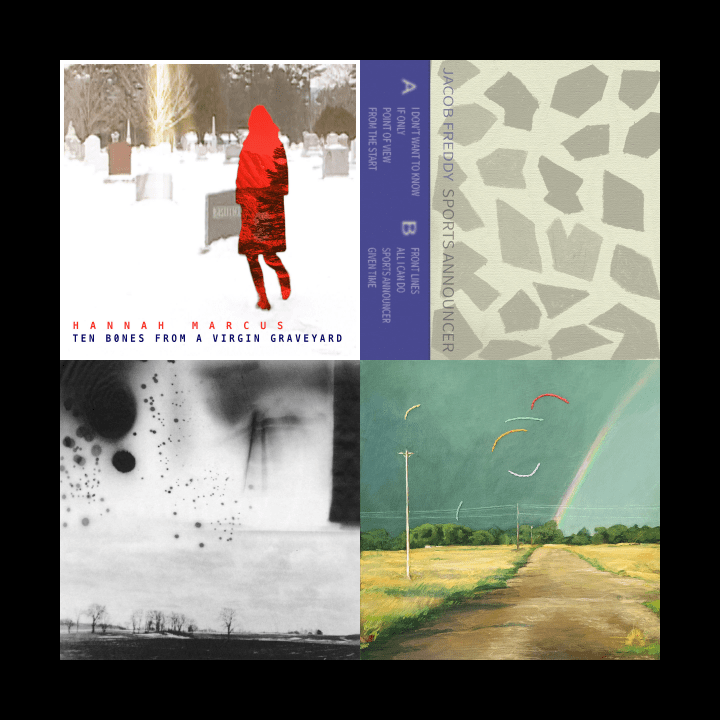
The Monday Pressing Concerns is a nice big one, featuring new albums from Hannah Marcus, Abel, Jacob Freddy, and The Pond. Three out of four of these acts have appeared in Pressing Concerns before (and the one that hasn’t features at least one person who has with a different project), so it’s nice to take the week after a (U.S.) holiday to catch up with some familiar faces.
If you’re looking for more new music, you can visit the site directory to see what else we’ve written about lately. If you’d like to support Rosy Overdrive, you can share this (or another) post, or donate here.
Hannah Marcus – Ten Bones from a Virgin Graveyard
Release date: June 6th
Record label: Bar None
Genre: Singer-songwriter, folk, slowcore, sadcore
Formats: Digital
Pull Track: Eric
I wrote a fair amount about the New York/San Francisco singer-songwriter Hannah Marcus last year–that was thanks to her longtime record label, Bar None Records, who released a career-spanning compilation pulled from Marcus’ six solo records called The Hannah Marcus Years: 1993-2004. The Hannah Marcus Years chronicled an impressive and undersung music career, one in which the titular musician collaborated with members of American Music Club, Godspeed You! Black Emperor, and Red House Painters (among others) to pursue her heady, drawn-out version of folk-ish slowcore songwriting. 2004’s Desert Farmers proved to be her final solo album for twenty years–it seemed like Marcus had moved on to other pursuits, playing in experimental groups like The Wingdale Community Singers and Wintersea Playboy and being an “olfactory artist”. However, Marcus had actually been working on another solo album in the years after Desert Farmers–Ten Bones from a Virgin Graveyard was recorded over a period of six years (2004-2010) in Montreal with Godspeed You! Black Emperor members Thierry Amar and Efrim Menuck. I don’t know why Ten Bones from a Virgin Graveyard took another decade and a half after its completion to see the right of day, but in 2025 it sounds like a worthy companion to The Hannah Marcus Years, continuing the singer-songwriter’s mission to stretch out and slow down the folk music upon which she bases her songs.
Ten Bones from a Virgin Graveyard reaches towards orchestral and chamber music more boldly than Marcus’ earlier work did, although it’s a fairly natural-sounding progression (I’m sure it helped that the album features many of the same musicians from her earlier albums, including Amar and Menuck). The two opening tracks on Ten Bones from a Virgin Graveyard–the leisurely instrumental “Ten Bones and a Screwdriver” and the whirlwind art-chamber pop of “Affirmative Infinity”–hint at a total departure for Marcus, but the folk storyteller of previous records comes into the frame soon enough with songs like “Bury Me Under the Elbow Room” and “A Virgin Graveyard” (the minimal epic crawl of the latter in particular feels like the “full Hannah Marcus experience”). From “Hey, Mister Goldminer” to sparse closing track “From English Planes”, there are plenty of more subtle, folk-inspired moments on Ten Bones from a Virgin Graveyard, but you never know when Marcus and her collaborators are going to sweep us all off our collective feet with something like the boisterous, horn-heavy piano ballad/sing-along “Eric”. Supposedly Marcus has been working on a new new album that’s slated to be released by the end of this year–perhaps the most chaotic decision involved in Ten Bones from a Virgin Graveyard by Marcus is to make something this immersive, hold onto it for twenty years, and then barely give us any time after it’s finally released before moving onto the next thing. (Bandcamp link)
Abel – How to Get Away with Nothing
Release date: May 28th
Record label: Julia’s War/Candlepin/Pleasure Tapes
Genre: Lo-fi indie rock, shoegaze, experimental rock
Formats: Cassette, digital
Pull Track: Grass
Last year, the band Abel first appeared on my radar thanks to Candlepin and Julia’s War Record’s co-release of an album called Dizzy Spell. It was far from the first release from the Columbus act–the band’s frontperson, Isaac Kauffman, has been releasing music under the name since the late 2010s–but Dizzy Spell appeared to be the first Abel album recorded by a proper full band. The shoegaze-inspired basement rockers have returned less than a calendar year later with another new album called How to Get Away with Nothing, once again released by Julia’s War and Candlepin (with Pleasure Tapes getting in on the fun this time, too)–the three-guitar quintet lineup from the previous LP has been pared down to a quartet, but Kauffman, guitarist John Martino, drummer Ethan Donaldson, and bassist Noah Fisher are still rolling full steam ahead. At least, as “full steam” as this kind of music can be–inspired by slowcore, noisy indie rock, and 90s emo, How to Get Away with Nothing is frequently loud but even more consistently insular and introverted. The album’s dozen tracks and forty-five minutes are an overwhelming, greyscale listen, more adventurous and sprawling than Dizzy Spell yet with that record’s scattered moments of beauty still intact.
Abel make the bold choice to start How to Get Away with Nothing with what’s easily the catchiest and most accessible song in “Grass”–and it’s also a red herring, as the slightly twangy (reminiscent of fellow Columbus act and previous collaborator Villagerrr) country rock of the opener doesn’t really come up again for the rest of the album. The next song on How to Get Away with Nothing is called “Daunting”, and that’s a good way to describe the five-minute track, which meanders its way from a light-touch, simple-guitar instrumental to a full-force wall-of-sound fuzz rock song that burns bright for the rest of its length. The broken ballad “Lung” and the acoustic/drum-machine lo-fi experiment “Loathe” provide a bit of a respite, relaxing in the margins of How to Get Away with Nothing’s sound and finding a little peace. The second half of How to Get Away with Nothing is even spacier–even the “rock” songs on the B-side (like “Parasympathetic”, “Scarecrow”, and “Six”) feel distant and lost, to say nothing of oddities like “Dusk” and “Talk”. Abel have continued making music in the way that makes sense to them with How to Get Away with Nothing, leading to an album that isn’t always legible to us but clearly always pushing towards something. (Bandcamp link)
Jacob Freddy – Sports Announcer
Release date: May 9th
Record label: Self-released
Genre: Lo-fi pop, bedroom pop, jangle pop, power pop, folk-pop
Formats: Cassette, digital
Pull Track: If Only
Last year, I introduced Rosy Overdrive to Jacob Frericks, a promising new guitar pop singer-songwriter originally from Orange County, California. Upon moving across the country to Brooklyn to attend school, he began a solo project called Jacob Freddy, and his debut album under the name, Songs from a Quiet Aliso Viejo Wasteland, was a “pleasingly lively and pop-forward” version of bedroom indie rock (as I called it at the time) that wore its Teenage Fanclub, Big Star, and Elliott Smith influences on its sleeve. It took Frericks a little over one year to return with a second Jacob Freddy album, this time a self-released cassette called Sports Announcer. Like Songs from a Quiet Aliso Viejo Wasteland, it’s a brief listen (eight songs, twenty minutes), and it continues Frericks’ pursuit of wistful, diamond-in-the-rough guitar pop music. The main difference this time around is that Frericks has put together a quieter, more subdued, and more melancholic collection of songs compared to the more upbeat Songs from a Quiet Aliso Viejo Wasteland. It’s not as immediate as Jacob Freddy’s debut, but there’s no sophomore slump here, either–I’ve started to view Sports Announcer as a more insular, thoughtful companion to the project’s initial burst of energy of a first LP.
Not that the first song on Songs from a Quiet Aliso Viejo Wasteland, “All Along”, was a punk track exactly, but its power pop is a lot more surging and upbeat than the rainy day indie pop of “I Don’t Want to Know”, the song Frericks tasks with opening Sports Announcer. If you’re looking for more straightforward jangle pop “hits”, there are still a few of them here–Jacob Freddy’s first attempt at it here is via the wobbly, daydreaming “If Only”, and “From the Start” and “All I Can Do” are electric numbers that more or less qualify as well. Otherwise, Frericks is in a more foggy, obscured mood on his latest album, as exemplified by the percussionless, dreamy folk-slowcore-pop track “Point of View” (which is effectively a Tony Jay song), the cavernous, echoing acoustic balladry of the title track (which could also be a Tony Jay song, I suppose), the confusing, almost psychedelic snippet song “Front Lines”, and the dream-folk closing track “Given Time”. All of these tracks have some kind of hook baked into their cores, because that’s how Frericks writes songs, but Sports Announcer, as brief and (relatively) barebones as it is, is an album with aims beyond merely delivering said hooks without anything extra attached. (Bandcamp link)
The Pond – A Year As a Cloud
Release date: May 9th
Record label: Anything Bagel/Hidden Bay/Wood of Heart
Genre: Folk rock, slowcore, lo-fi indie rock, 2000s indie rock
Formats: Vinyl, cassette, digital
Pull Track: Burnt Plant
I’ve written about a handful of releases that have come out via the Butte, Montana DIY label Anything Bagel over the years, but this time around, the person who’s (co-)responsible for releasing all those albums is the one who’s stepping up to the mic. Anything Bagel co-leader Jon Cardiello previously made music under the name Bombshell Nightlight; for his latest album, A Year As a Cloud, he’s rechristened himself The Pond and put together a firm quartet rounded out by Sanders Smith on bass, Kale Huseby on drums, and Noelle Huser (of Bluest) on vocals. Montana may be a landlocked state, but The Pond are able to recall the rainy indie rock of the Pacific Northwest throughout their somewhat fuzzy, somewhat folky, somewhat slowcore debut album (I’m thinking specifically of The Microphones and Mount Eerie), but mixed together with a certain kind of East Coast lo-fi indie rock reminiscent of the spacier sides of LVL UP (and associated projects), Greg Mendez, and Friendship. There’s a tension between Cardiello’s downtrodden, low vocals and the expansive indie rock the four of them make to accompany it, and it helps A Year As a Cloud feel a lot more gripping than your average greyscale indie rock record.
The Pond’s Year As a Cloud begins more or less in media res with “Cup of Lilacs”, a mid-tempo slowcore-informed song that starts off as a low hum and steadily builds to something larger (or at least to a hint of something larger). The Pond’s version of fuzz rock is rumbling and electric–“Burnt Plant” is rousing, and while “Translucent” and “When a Song Dies” as a whole don’t reach this energy level, they certainly have their overwhelming moments. Although A Year As a Cloud is a relatively quick thirty-four minutes long, it feels larger than it is thanks to mood-setting interludes like “(The Stream)”, “(The Clouds)”, and “(The Lake)”, more than providing the space for stuff like the synth-folk psychedelic odyssey of “More Time” and mid-record slow-burn centerpiece “All the Dogs” to tower ever higher. Huser’s vocals drop in and out throughout the album, trading the lead with Cardiello or simply backing him up–while this alone doesn’t make The Pond feel like a “band”, it certainly leads to A Year As a Cloud sounding like something much more than a solo project. And that’s a good thing, because A Year As a Cloud wouldn’t be the same if it wasn’t a group effort. (Bandcamp link)
Also notable:
- Throwing Muses – Live in Providence
- Castlebeat – Revival
- 95 Bulls – Canadian Nightclub
- Radiant Heart – Weep for Me
- Slick – The Perfect Pop Song EP
- Greg Brady and the Anchors – I’d Rather Walk
- Comet Gain – Letters to Ordinary Outsiders
- Voicemail – Roof on Fire
- Balance Lost – Which Has Since Been Deleted
- Activity – A Thousand Years in Another Way
- Snarewaves – HUFF EP
- Stephen Vitiello with Brendan Canty and Hahn Rowe – Second
- Guy Capecelatro III & Mike Effenberger – Devils
- DeBörds – Pay for the Bürds
- Maripili – Maripili EP
- Psychic Armour – Pressure EP
- Nape Neck – Live at Sonic Protest Festival
- Didion’s Bible – Yours Truly, DB
- Monda – Quadruple Cheeseburger (Covers Vol. I) EP
- Slow Country – Swiss Movement EP
- Friendly Rich – Sings the Nihilist Spasm Band
- Disketnyc – Demos EP
- Chwaer Fawr – Diwedd
- Dominic Sambucco + Demetrio Cecchitelli – Fuga & Discesa EP
- Gnäw – Gnäw II
 Rosy Overdrive
One thought on “Pressing Concerns: Hannah Marcus, Abel, Jacob Freddy, The Pond”