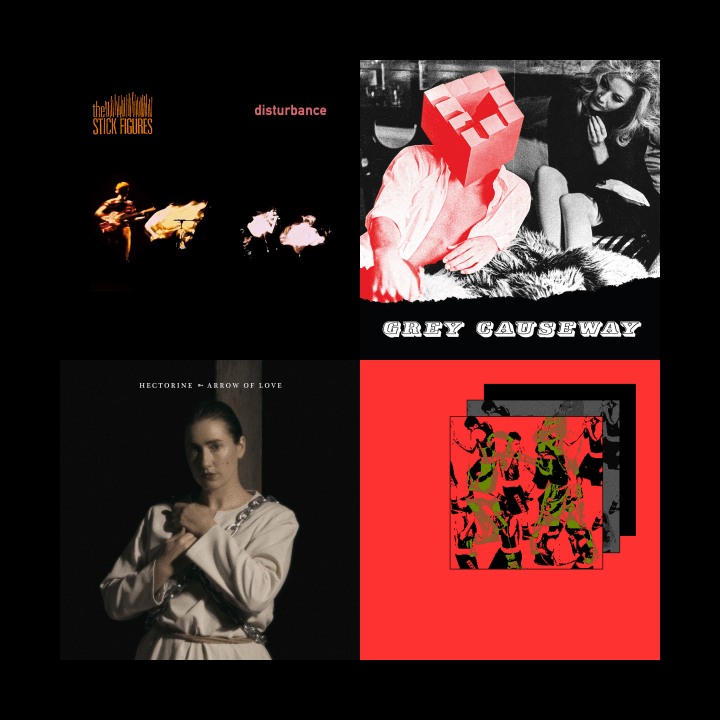
Round two, on a Tuesday! Today’s Pressing Concerns brings us an archival album from The Stick Figures, a new EP from Docents, and new albums from Hectorine and Grey Causeway. If you missed yesterday’s blog post (featuring Six Flags Guy, Dave J. Andrae, Nac/Hut Report, and Peaceful Faces), be sure to check that one out, too.
If you’re looking for more new music, you can visit the site directory to see what else we’ve written about lately. If you’d like to support Rosy Overdrive, you can share this (or another) post, or donate here.
The Stick Figures – Disturbance
Release date: June 1st
Record label: Self-released
Genre: Post-punk, dance punk, art punk, college rock
Formats: CD, digital
Pull Track: The Other Myth
I wrote about The Stick Figures back in the early days of this blog on the occasion of the release of 2021’s Archeology, and I was happy to do so. An early-adopter post-punk band from the underheralded music scene of late-70s Tampa, Florida, the five-piece “collective” (David and Rachel Bowman, Bill Carey, Sid and Robert Dansby, all of whom were attending the University of South Florida at the time) only ever released one EP (a 1981 self-titled one) before Floating Mill Records released an expanded version of it featuring a full album’s worth of unreleased recordings forty years later. At the time, the band stated that they had a second album’s worth of entirely unreleased material that they hoped to release soon after Archeology, and while their initial targets of 2022 and 2023 didn’t come to fruition (which may have had something to do with unspecified issues with their erstwhile record label), Disturbance is finally here in 2025, and it was worth the wait. Work on these songs apparently began in Tampa and continued after the band moved to New York, leading to the eleven tracks finally unleashed here on one LP. Why The Stick Figures disintegrated and these songs sat unreleased for so long isn’t really given a satisfying answer by the liner notes (Carey admits to only having “patchy recollections” of their break-up, Robert Dansby mentions Sid and David Bowman leaving New York City at some point), it’s clear that the music was important for all five of them when the project was active, and Disturbance reflects a band hell-bent on pushing forward (in multiple senses) no matter what.
Recorded in places like Davis Island’s PMS and Noise New York in Manhattan between 1980 and 1982, Disturbance is not “high-fidelity” as we know it (there’s a swampy murkiness to these songs that harkens back to their southeastern origins), but it does bear the mark of songs labored over and teased out carefully. Sometimes, this is more obvious than other times (I’m thinking of the deconstructed post-punk of “14 Days”, the floating, polished art rock of “Zone”, and the muddy jangle-funk of “Loudspeaker”), but The Stick Figures know what to keep “immediate” and when. “The Other Myth” is a great lost college rock/post-punk/dream pop anthem, easily hitting the best parts of all of those genres with the skill of a band not confined by such labels, “Worried” and its absurd spoken-word ranting is the most “Athens, Georgia” moment on the album, stuff like “After Me”, “Dusseldorf – Gleis 9”, and “Notes from Now On” incorporate empty space, surf-synth-punk, and dub into their sound without going to overboard, and the violin in the Mekons-y “Oil Painting” is a welcome modest excess. Disturbance is probably the closest thing we’ll get to a Stick Figures “album”–we had to wait forty-five years, but now we can finally hear the band at their most focused and locked-in. (Bandcamp link)
Hectorine – Arrow of Love
Release date: May 23rd
Record label: Take a Turn
Genre: Folk rock, soft rock, indie pop, singer-songwriter
Formats: Vinyl, digital
Pull Track: Heart of Stone
Hectorine–aka Sarah Gagnon–is an Oakland-based musician with some ties to the Bay Area indie pop scene–stalwart lo-fi pop label Paisley Shirt put out her 2021 album Tears (as well as a live cassette), Arrow of Love is being released by Take a Turn, the label co-run by Ray Seraphin and Luke Robbins (Ryli, Yea-Ming and the Rumours), and Matthew Ferrara of The Umbrellas and Magic Fig has mastered at least one of her albums. Assumed mutual admiration aside, Gagnon does something different from the majority of her peers with Hectorine, pursuing a sound drawn from classic folk rock and soft rock; names like Christine McVie, Leonard Cohen, Yoko Ono, and Bridget St. John (among others) have been thrown around in an attempt to describe her project. Arrow of Love is Gagnon’s third album as Hectorine and her first in four years, but she and her collaborators (returning contributors Betsy Gran and Max Shanley, new faces Geoff Saba, Jon Wujcik, Joel Robinow, and Lizzy Dutton) continue mining in Hectorine’s chosen corner of popular music history as if no time has been lost between Tears and now.
Arrow of Love is incredibly full-sounding throughout its ten songs and forty-one minutes–sometimes Hectorine tilts towards maximalism in its “easy-listening” (in theory) pop music, sometimes it attempts a more streamlined presentation, but everything on here sounds like Gagnon and Saba (who co-produced the album) really used the studio to sharpen and hone the songs down (or up) to their truest versions. I can hear the 80s influences in the synth-touched regal pop of “Is Love an Illusion?”, and this attitude bleeds into the more traditional piano-folk-pop balladry of “Everybody Says”. The organ-based polish of “No Hallelujah” and the cheerful indie pop of “Heart of Stone” (perhaps the most “Bay Area pop” moment on the LP by default) are some of Hectorine’s simplest pop moments, although the swooning studio pop of “Roses & Thorns” shows that Gagnon can still deliver strong pop hooks through the gauze of a little more studio glitz and tinkering. On the other hand, the title track sprawls to six minutes and “Throw Caution to the Wind” is content to wander around in its vintage folk-rock/soft-rock dressings without trying too hard to overly impress; Arrow of Love is equally at home catching a vibe and marinating thoughtfully in it. Saba adds a notable amount of harpsichord to Arrow of Love, which certainly helps the album feel lost in time, although she does her best to let it take its place alongside more “normal”-sounding synths and keys. Picking out individual elements of Arrow of Love can be fun and interesting to examine, but it’s the full-on blend that makes this album work as it does. (Bandcamp link)
Grey Causeway – Grey Causeway
Release date: May 27th
Record label: Dandy Boy
Genre: Post-punk, college rock, garage rock
Formats: Vinyl, digital
Pull Track: No Condition
Grey Causeway are a new band made up of four veterans of the San Francisco Bay Area indie rock, garage rock, punk, and post-punk scenes. Vocalist/guitarist Andy Asp and guitarist/keyboardist Omen Starr are both ringers who’ve most recently been spotted in the dark early-punk/garage rock revivalists Smokers, bassist Frankie Koeller was a longtime member in dreamy indie pop group Papercuts, and Chris Appelgren played in countless Bay Area punk groups and co-owned Lookout Records until it folded. Grey Causeway arrived last year with two digital EPs released on Mouth Magazine Records, and these songs make up about half of their self-titled debut album (co-released by local scene chronicler Dandy Boy Records and Mouth Magazine). The Oakland band certainly are drawing from early punk and post-punk music on Grey Causeway, but there’s a delicate and hook-filled side to their songs that fits in well with the Bay Area’s bustling world of indie pop (in fact, it’s significantly more indebted to classic guitar pop music than the most recent Smokers record). Displaying their experience, Grey Causeway lock into their various roles easily–Asp’s punk rasp softens just a bit to fit the more college rock/jangle pop-evoking material, the guitars and keys neatly arrange themselves as needed, and Koeller’s bass playing displays all the skill one wants in a post-punk bassist.
Perhaps the most “punk” thing about Grey Causeway is its devotion to brief, perfunctory bursts of catchy but somewhat dark rock music–none of its thirteen songs are all that short, but the group only push things past the three-minute mark when it’s really necessary. Opening track “I-580” is not one of those moments (it’s a clean two-and-thirty), but it is one of the most complete-sounding songs on the album and a perfect introduction to Grey Causeway–slightly dark, slightly rough, slightly smooth, quite “pop”. “Lost Squadron” is arguably even more impressive, combining lost, wallflower-y British indie pop with a somewhat dangerous post-punk edge, and “Unsettled Weather” has the whole “melancholic” and “rhythm section-forward” thing down very well. Grey Causeway have arrived at their debut LP with a songbook full of tricks, and the record is full of striking moment after striking moment–the awash-with-synths crawl of “Narcolepsy”, the jangly cheeriness of “No Condition”, the creepy “Girlfriend’s Boyfriend” (it’s just so much more unsettling than that Killers song, somehow), the punk firecracker of “The Raft”. Grey Causeway is evidence of a band of musicians who know both how to make strong music together and how to harness that into a strong first statement. (Bandcamp link)
Docents – Shadowboxing
Release date: May 16th
Record label: Ten Tremors
Genre: Noise rock, no wave, post-punk
Formats: CD, digital
Pull Track: Garden
Alright, we’ve got some New York noise rock for you today! Specifically, we have the latest release from a quartet called Docents, a CD EP called Shadowboxing. These four (vocalist/guitarists Will Scott and Noah Sider, bassist Kabir Kumar-Hardy, and drummer Matthew Heaton) debuted back in 2021 with a self-titled cassette EP, returned in 2023 with a full-length called Figure Study, and released a pair of two-song singles last year. Like everything else that Docents have released, Shadowboxing is out via the New York “collective” label Ten Tremors, and it’s more than enough to get a solid handle on the kind of music in which Docents specialize. At a clean five songs in ten minutes, Shadowboxing is short and sweet (okay, maybe not “sweet”), delivering quick blasts of noisy rock music with bits of post-punk, no wave, and industrial clang in the mix. I hear the New York unflappability of SAVAK, the explosiveness of Open Head, and the dead-seriousness art-rock sensibilities of FACS in these songs; Shadowboxing may be over in the blink of an eye, but the quartet still have an ear for the dynamics here, as well as inflicting as much damage as they reasonably could in a limited amount of space.
Comparably speaking, Shadowboxing’s opening track, “Garden”, shows a bit of restraint–the instrumental is all frantically-paced garage-y post-punk, yes, but the vocals rest at a monotone, dryly observing the ensuing chaos. Things get just a little more dire in the title track, which tries to walk a similarly understated tightrope, but the vocal hollering wins out in the end and Docents whip up an instrumental storm to match it. “Double Fantasy” is where Shadowboxing truly goes off the deep end, a horrifying wasteland of industrial, static-y noise and blind-shooting, and the ninety-second in-the-red hammering of “Shouldn’t We” certainly doesn’t do anything to clean up the ever-increasing inferno. “Workout” ends Shadowboxing with one minute of pummeling noise-punk–the EP offered a few different pathways for Docents to traverse down, but by this point, the group have set fire to everything and charged into their wildest impulses head-on. The brevity of Shadowboxing starts to feel more and more like a feature rather than a bug upon repeated listening–if it was depicted in some kind of graphical analysis, it’s a steadily-increasing line that all of a sudden bolts off the charts, and we only have our imaginations to figure out where Docents have ended up after these recordings abruptly stop. (Bandcamp link)
Also notable:
- Dummy – Bubbelibrium DLC
- Samuel Aaron – Rambler
- MK Naomi – Dream Hiss EP
- Theatre Royal – A Change of Weather
- Budos Band – Budos VII
- Hudson Freeman – Is a Folk Artist
- Creepy Crawly – Like a Real Thing
- RIBS – Junk Dynasty Leaderboard
- Christo Graham – Clown Riot
- Egg Girl Girl – Roomers
- New Candys – The Uncanny Extravaganza
- Caroline – Caroline 2
- CIVIC – Chrome Dipped
- Zuckerbecker – Retortenstadt
- Robots in Love – Activate!
- Bloodhorse – A Malign Star
- The Airport 77s – Don’t Let Go
- Bibion – Paprikatraumbrötchen
- Jess Joy – Won’t Be Kicked Out the Garden
- Lavinia Blackwell – The Making
- John Swanke – Horizon Lines
- Eye Ball – Gull Songs
- FRND CRCL – JRSY FRSH
- Shura – I Got Too Sad for My Friends
- Matt Berninger – Get Sunk
 Rosy Overdrive