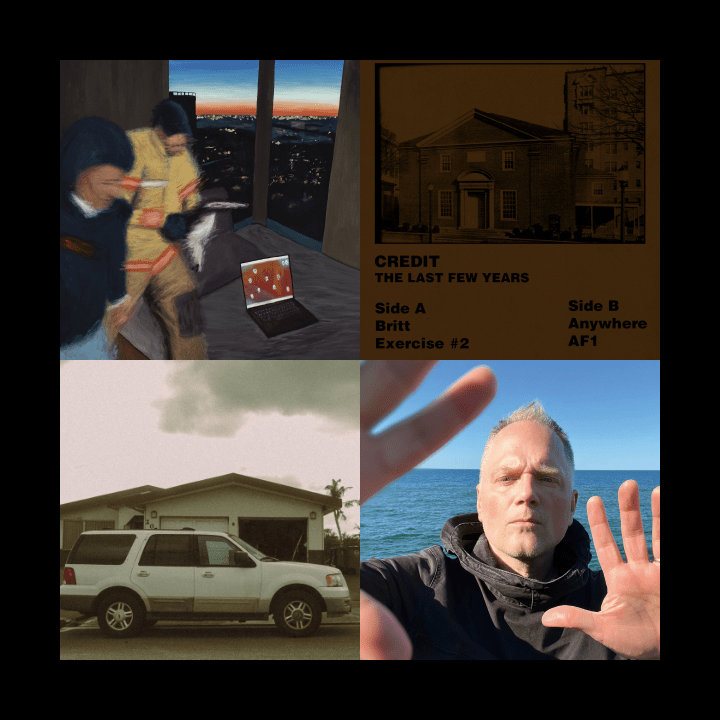
The first Pressing Concerns of the week is on a Tuesday, and it’s a great one, featuring new albums from Friendship and Jonathan Rundman plus new EPs from COR1 and Credit. Check these out! There wasn’t a Pressing Concerns yesterday, but I did take the holiday to pay tribute to David Thomas of Pere Ubu in light of his recent passing.
If you’re looking for more new music, you can visit the site directory to see what else we’ve written about lately. If you’d like to support Rosy Overdrive, you can share this (or another) post, or donate here.
Friendship – Caveman Wakes Up
Release date: May 16th
Record label: Merge
Genre: Alt-country, ambient country
Formats: LP, CD, digital
Pull Track: Resident Evil
It seems that my mental health always disintegrates in the spring (it craters over the winter, which is a different thing). I was white-knuckling it over a rough couple-day stretch around the time that the latest Friendship album came out without realizing it, but Caveman Wakes Up set me straight. It was like Dan Wriggins and company sat me down and told me things weren’t right. Of course, it takes one to know one, and Caveman Wakes Up is a real “game recognize game” moment in that regard. I’ve believed in Friendship the alt-country heroes since I first heard “Skip to the Good Part” in 2017, and their last album, 2022’s Love the Stranger, felt like vindication. They’d successfully transformed into a tight four-piece indie rock band, linked up with the legendary Merge Records, gained a respectable following, and its members had all found success with endeavors outside of the band as well (some of which you can read about on this very blog). Caveman Wakes Up is the sound of what comes after that.
The more anthemic, immediately-gripping songs of their last album are gone here, replaced with ambient, vibes-based music, and the skills of Peter Gill, Jon Samuels, and Michael Cormier-O’Leary are put to a different kind of use. I compared Love the Stranger to Lambchop, without properly appreciating the kind of range that “Lambchop-esque” would end up giving them. Perhaps the die was cast for how this album would be perceived when they released a song called “Free Association” as the lead single. If Wriggins’ lyrics occasionally do sound like “free association”, though, it might be on you for not listening to closely. The one-of-a-kind frontperson, who recently released his first book of poetry, is certainly more “poetic” on Caveman Wakes Up than he’s been in the past, but Wriggins is also quite direct in his own way. I didn’t need the press pack to infer that a breakup was involved in the composition of these songs, for instance.
“I got married on a cloudy day / And I figured the clouds would magically roll away,” Wriggins sings in the centerpiece of the album, “Hollow Skulls”, and a few lines before that “Radiator shuts off, it’s a whole new level / Of silence”. These are the twin pillars of “Hollow Skulls” and subsequently Caveman Wakes Up to me–the after and the before, the former realized before the latter and prompting the association (not a particularly “free” one, though). “Hollow Skulls” also defines Caveman Wakes Up sonically–delicate but insanely charged, on the brink of collapsing in some way much like Wriggins is himself. I’m not sure if Friendship ever quite “get it together” on Caveman Wakes Up, but there’s some livelier moments that do a little more damage on first glance–“Tree of Heaven” is one of those, relying on a pained, worried guitar riff and clipped lyrics from Wriggins, daring to look backwards for seconds at a time before coming up for air (“You know you changed me, babe” sums it all up). “Resident Evil” also took my breath away at first–it’s a raw one, and “Who’s that shithead in my living room / Playing Resident Evil?” is brilliant in three or four different ways. The last one I want to mention is “Love Vape”, the only real pop song on Caveman Wakes Up. “Too late to turn back now / If you don’t know how to end it, you can just fade out,” Wriggins quips in that one in a nod to the “Motown and ’70s ballads” that inspired some of the playing on this record. Friendship, of course, decline to take the easy out that Wriggins offers up as “Love Vape” draws to a surprisingly perfunctory close. (Bandcamp link)
COR1 – Take What You Need
Release date: March 7th
Record label: Antithesis of Everything
Genre: Pop punk, emo-punk
Formats: Digital
Pull Track: Country Browns
There seems to be some interesting things going on on the Pacific Island of Guam. I’d written about music from a few expats of the tiny U.S. overseas territory before (Star 99, Rosa Bordallo), but earlier this year I learned that Guam actually has an active power pop/pop punk/indie rock scene being chronicled by Pure Chance Records thanks to their most recent single (“Out Comes Crazy” by a band called In Bedrooms). And, just like that, I’ve heard even more music out of Guam–COR1 aren’t a Pure Chance band, and I’m not sure if they’re associated with them or In Bedrooms in any way (it’s a small place; I’d assume that they know each other), but their debut EP Take What You Need fits in with the other music I’ve heard coming out of the island so far. I don’t know much of anything about the band’s members (one of them is named Sam), but the credits on their Bandcamp page paint an interesting and mysterious picture of their hometown music scene–these five songs were recorded by Jeremy Muñoz and RJ Aguon II in places called “100dB Studios” and “Marca Museca” (at least one of those places is located in the village of Harmon).
Regardless of where Take What You Need originated, the emotional vocals and guitar riffs contained herein are geographical barrier-breakers. While In Bedrooms have a bit of a slacker power pop streak to them, COR1 reveal themselves to be more emotional, sloppy, and heavier emo and pop punk devotees on their first record. Most of the EP’s eighteen minutes is spent with the band fully pressing the gas pedal, from the math-y leads and power chords of exciting opening track “New Fursona (alt)”, the melodic punk firebomb of “Lost”, and the post-hardcore-tinged punk anthem-waving of “Blame” (there are at least two lead vocalists in COR1, and they’ve both giving it their all whenever they can). Post-hardcore screams, emo melancholy, and fiery guitars all collide in the EP’s climax (and the one that gives it its title) “Incognito”, and then the whole thing ends with the biggest outlier on the record, the four-minute comedown of “Country Browns”. Upon further reflection, “Country Browns” is my favorite song on Take What You Need–it incorporates a bit of acoustic power balladry, although the shout-along chorus is as strong as anything else on the record, and the “Take Me Home, Country Roads” nod is unexpected but works quite well (as a native West Virginian, I give Guam full permission to co-opt that song all they want). Now I’m eager to hear what other good punk rock is coming out of the northern Pacific. (Bandcamp link)
Credit – The Last Few Years
Release date: May 23rd
Record label: Self-released
Genre: Art rock, art punk, post-punk, noise rock, post-rock
Formats: Cassette, digital
Pull Track: Britt
An interesting email alone isn’t going to get your band on Rosy Overdrive, but I do always appreciate it. Recently, a Baltimore-based “experimental rock/punk collective” called Credit showed up on my radar claiming The Four Tops, Nico, and Madlib as influences and Nation of Ulysses, The Pillows, and “Minutemen (With Keys)” as “for fans of”. This type of thing seems par for the course for Credit, upon further research–they’re led by somebody who only refers to themself as “The Keyboard Player”, who co-founded the band with someone only referred to as “The Original Writing Partner” in the 2010s. I don’t think this initial incarnation of Credit released anything; The Keyboard Player resurrected this dormant material with guitarists Luke Mayhew and Sandy Wilbur, bassist Alex Dicken, and drummer Gabe Fricks-Starrat a few years ago. Some combination of those musicians recorded Notes on Naturalism in Performance and Tone: 4 More Songs Live, an EP that came out in 2023, and all five of them appear on the most recent Credit recording, another four-song EP called The Last Few Years. I’m pleased to say that The Last Few Years lives up to Credit’s own bizarre and somewhat nonsensical hype, featuring four compelling live recordings that range from “brief, noisy punk rock band” to “experimental, jammy post-rock-and-roll music”.
No two songs on The Last Few Years sound alike, but each of these four tracks presents a lively and exciting version of the band Credit. By some metrics, “Britt” is the most “easy listening” song on The Last Few Years, but by others it’s the strangest thing on the EP–the opening track (which, per the EP’s Bandcamp page, was initially written in 2009) is a hazy recollection of a classic rock band heard from a couple of rooms over, beginning with a clean electric guitar drone for around two minutes before the amorphous country rock blob initially settles into place. “Exercise #2” is perhaps more like what one would expect from Credit based on their self-comparison to the Minutemen (and Beefheart, and Cap’n Jazz)–a deranged, noisy jazz-punk torrent. The six-minute “Anywhere” is the longest track on The Last Few Years, and there’s a disciplined post-punk/no wave track hidden in here somewhere–it’s strong enough to keep marching forward while the Credit players chip away and whir around the song in a frantic buzz. The Last Few Years closes with a hardcore song, of course–or, at least, Credit’s version of hardcore punk. It’s ninety seconds of ragged punk vocals, furious instrumental speed, and that classic Credit noisiness. Maybe there is something tying these disparate recordings together after all. (Bandcamp link)
Jonathan Rundman – Waves
Release date: April 11th
Record label: Self-released
Genre: Roots rock, alt-country, college rock, folk rock
Formats: Vinyl, CD, digital
Pull Track: Living on the Lakeside
If you think that Jonathan Rundman’s first new album of original material in ten years, Waves, sounds like The Silos–well, there’s a good reason for that. For the past decade, Rundman has been a touring member of the aforementioned legendary alt-country band, and many of the other musicians who play on Waves have performed the same role backing Walter Salas-Humara as he keeps his long-running band alive. It should be noted, though, that Rundman has had a long and productive music career outside of The Silos–one that, spanning over three decades, is nearly as long as The Silos’ journey. Rundman was born in the Upper Peninsula of Michigan, and while he’s been based in Minneapolis for twenty years, the title of Waves nods to the continued importance of the Great Lakes (and specifically Lake Superior, the sounds of which can be heard on this album) in his life. All of this adds up to a solid and inviting roots rock album where Rundman and his collaborators–including Ron Gomez, Eric Kassel, and Gerald Dowd, among others–paint plain-spoken character sketches and Midwestern slices of life with the help of twelve-string guitars, accordions, mandolins, and a host of other tools eagerly.
As character-driven as Rundman’s writing is, the first subject we meet on Waves appears to be the man himself–“Living on the Lakeside” feels as autobiographical as anything on the album, a mandolin-and-accordion tribute to Rundman’s obscure peninsula of origin that’s sure to please fans of Los Lobos and Peter Buck. Organs and locked-in bass grooves move us into the character-study section of the album–“Veronika Ann” and “Elizabeth, Don’t Waste Your Breath” are written from the outside looking in at the titular characters, sympathetic but hardly tearjerkers in their power pop-indebted beds. The latter of those two tracks was co-written by Salas-Humara, and The Silos’ bandleader also has fingerprints on “Diner by the Train”, the obvious centerpiece of Waves. If you’re looking for waterworks, “Diner by the Train” has ‘em, a piece of Americana that certainly gained some sharpness with the help of an all-timer in the field. It’s strong, but it doesn’t overshadow the rest of Waves, and I find myself actually enjoying the more laid-back touch that Rundman brings to second-half highlights like “Evidence” (just as affecting as “Diner by the Train” in its own way) and “Let’s Put on an Opera” more upon repeated listens. I’ve heard music from the shores of Lake Superior before, but I’m not sure that I’ve heard anything so tied to its banks as Waves. (Bandcamp link)
Also notable:
- Cash Langdon – Dogs
- Ben McElroy – Elkwort
- Les Lullies – Une Nuit à Leipzig
- Saline x Collective Fear – Saline X Collective Fear EP
- Loose Lips – Smoocher EP
- Bill Can – T-Ball
- Waylon Thornton – Sunshine Vampire
- Answering Machines / Act – Tour 24 Archive EP
- Bugg Music – Wartmann Demo Sessions EP
- Gubba Hori – gubb að vori
- Kram-A-Xam – Maxi and Marky
- Skymender – Skymender
- Glitterfast – Glitterfast EP
- Dennis Davison – Sirens and Hellbenders
- Pipi – Eins, eins, eins, eins!
- Rival Waves – New Fear EP
- House of Warmth / Herr God – Dawn Summers Is Dead EP
- Los Sex Sex Sex – Control EP
- Fleas of Mercy – The 8th of May
- Welpe – Demonen
- Jah Hell – Dead in the Water EP
- Les Rencards – Angles Morts
- Mild Horses – Grime’s Graves EP
- Ugly Sounds – Never Say I’m Doomed
- Chumhuffer – Slaughterhouse Five EP
 Rosy Overdrive
4 thoughts on “Pressing Concerns: Friendship, COR1, Credit, Jonathan Rundman”