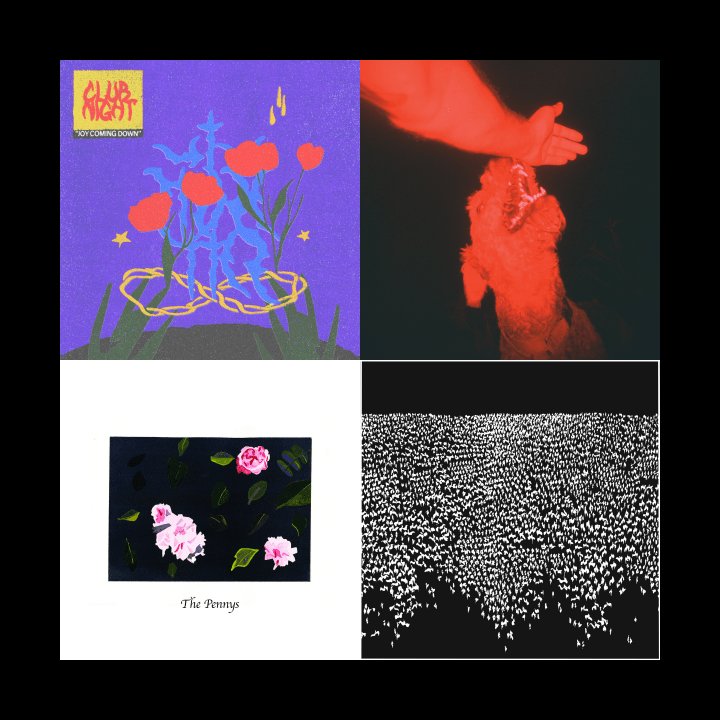
We’ve got a nice and weird Thursday Pressing Concerns up at bat, featuring three albums coming out tomorrow, May 2nd: new LPs from Club Night, Eli Winter, and Milkweed. Plus, we get an EP from The Pennys (a new band featuring some familiar faces) which is out today! We also had posts go up Monday (featuring Mike Frazier, JPW & Dad Weed, Chris Brokaw, and Blue Cactus) and Tuesday (featuring Erik Woods, Percy Higgins, Emma Munger, and Lily Seabird); check those out too!
If you’re looking for more new music, you can visit the site directory to see what else we’ve written about lately. If you’d like to support Rosy Overdrive, you can share this (or another) post, or donate here.
Club Night – Joy Coming Down
Release date: May 2nd
Record label: Tiny Engines
Genre: Art rock, math rock, emo
Formats: Vinyl, digital
Pull Track: Lake
I’m not sure why I like Wolf Parade so much more than all of those other big-tent 2000s indie rock bands. Maybe I just heard them at the right time and I could just as easily have fallen similarly into Arcade Fire or Broken Social Scene, but I’d like to think that there’s just a certain fire in those records, a post-punk chaotic anthem-writing ability that’s just not there in their peers. I find myself thinking about Wolf Parade and this question while listening to Joy Coming Down, the long-awaited sophomore album from the Oakland band Club Night. There were plenty of groups in the late 2010s making music that could be described as some combination of “math rock”, “indie rock”, and “emo”, but the way that Club Night do it–an overall hugeness, jittery art-punk instrumentation, strange but welcome synth-centric additions–just works better than the others. It was enough to keep the band regularly on my mind in the six-year gap between their first album, What Life, and this one–a gap that was enough time for their label, Tiny Engines, to shutter and relaunch, not to mention countless bands sharing space with them both geographically in the Bay Area and sonically. Joy Coming Down (which is named after a Fred Thomas lyric) picks up right where Club Night left off–not that a band like this can ever really be predictable, but their second album packs as much of what makes this group special as it can in its forty-two minutes.
Guitarist/vocalist Josh Bertram, bassist Devin Trainer, guitarist Ian Tatum, and drummer/synth player Nicholas Cowman alternate between sounding like a real, rumbling live rock band and a bunch of artists frantically sculpting something in a gigantic studio throughout the album. Like a good math rock record, a lot of these change-ups in Joy Coming Down happen in the same song–this is the case right from opening track “Expo”, which takes a minute before coming into focus and then really steps on the gas pedal. Club Night sound like they’re trying to traverse over hot coals in “Lake”, an emo-rock song with an inability to stay in any one place for more than a moment. If you can ignore the AutoTuned intro and occasional harmonics, “Palace” almost sounds like a normal post-punk song, but there aren’t any “normal” bands that have the ability to put stuff like “Dream” and “Judah” (the latter of which features guest vocals from somebody named Brijit Spencer) to tape. Everything on Joy Coming Down is a mountain, but if there’s a single summit, to me it’s “Station”–it’s probably the song that initially made me bring up Wolf Parade, but the six-minute journey sounds like a lot more than just that one band. Maybe it’s a more caffeinated Vulture Feather, or an emo band that knows how to show just a little fucking bit of restraint. I’ve enjoyed plenty of music that can be called “difficult” over the years, but nobody else can make it sound as exciting, feverish, and (yes) joyful as Club Night. (Bandcamp link)
The Pennys – The Pennys
Release date: May 1st
Record label: Mt.St.Mtn.
Genre: Jangle pop, indie pop
Formats: Vinyl, digital
Pull Track: No More Tears
The Pennys are the indie pop team-up that we didn’t know we needed. The band came together as a creative partnership between two San Francisco Bay Area titans in Michael Ramos and Ray Seraphin, later adding Yea-Ming Chen (Yea-Ming and the Rumors) on vocals, keyboards, and organ, Owen Adair Kelley (Sleepy Sun, R.E. Seraphin) on slide guitar, and Luke Robbins (R.E. Seraphin, Ryli, Yea-Ming and the Rumors) on vocals. Ramos and Seraphin have perhaps two of the most distinct styles of all the Bay Area pop revivalists–via his solo project Tony Jay (and to a lesser degree, his work as one half of Flowertown), Ramos embraces a slow-moving, unmoored, dreamy indie pop sound, while Seraphin’s quasi-solo project R.E. Seraphin embraces more full and grounded power pop/college rock (albeit tempered by his relatively gentle vocals). They’re clearly removed from one another, but compatible enough that it doesn’t surprise me that they blend well together on The Pennys, their new project’s debut 12-inch EP. Busier than Tony Jay but more subdued than R.E. Seraphin, The Pennys hit the jangle pop sweet spot for six songs and sixteen minutes on their first record (out via Mt.St.Mtn., which would be an indication of quality even if the co-bandleaders didn’t have plenty of work that speaks for itself).
Apparently The Pennys began with Seraphin asking Ramos to record an upcoming solo album of his, but their debut EP opens with a track that has Ramos’ creative input all over it in “Say Something”. It’s relatively lively for Ramos, yes, but that dream pop, Velvets-y ramshackleness and slowed-down pop charm all feel very Tony Jay-adjacent. “One Million Things” might as well be The Pennys’ “hit” (as if they’re not all hits); it’s very upfront with its jangly hooks and never falters from its strong start. The Pennys delve a little more into desert rootsiness with “Trilobytes” and 60s jangle-psych with “My World” while holding onto their direct pop instincts, while “Long in the Teeth”–an electric power pop tune destabilized and distorted by the recording and production–could be the most successful synthesis of the two bandleaders’ various styles on the EP. “No More Tears”, the song that closes The Pennys, might have something to say about that, though–the chorus (“Every time I tell myself ‘no more tears’ / The clouds above begin to unleash all my fears”, accompanied by sparkling guitars) is probably the single most gorgeous moment on the entire EP, its perfect guitar pop containing both shades of Seraphin’s lost-in-time power pop and Ramos’ “prehistorical pop music slowed down and reverb-ed all up”. They can’t keep getting away with this. (Bandcamp link)
Eli Winter – A Trick of the Light
Release date: May 2nd
Record label: Three Lobed
Genre: Jazz-rock, post-rock, experimental folk
Formats: Vinyl, digital
Pull Track: For a Fallen Rocket
The Houston-originating, Chicago-based guitarist Eli Winter has certainly accomplished quite a bit since the beginning of the decade. His 2020 debut solo album Unbecoming kicked off a productive period that’s included collaborative LPs with Jordan Reyes and Cameron Knowler, a steadily-growing collection of live records, and an acclaimed 2022 self-titled album that featured everyone from Yasmin Williams to jaimie branch to Ryley Walker. Winter’s latest album, once again released on Three Lobed Recordings (who put out Eli Winter), is an exciting six-song collection that weaves together rock, jazz, and folk music in an active and interconnected manner. Like Winter’s last “proper” album, A Trick of the Light features a variety of notable experimental and indie rock musicians–Mike Watt, David Grubbs (Gastr del Sol), and Kiran Leonard are some of the names appearing in the credits on this one. Some of these contributions were recorded remotely, added to the core of the album that was engineered by Cooper Crain at Electrical Audio, and Winter (as a songwriter, as a guitarist, as an arranger) does a satisfying job of making these instrumentals sound of a piece.
It’s a precarious setup for a record: six songs, two of which are covers, and the album opener (which is one of those covers) is sixteen minutes long. Eli Winter knows what he’s doing, though, and that includes the incredibly bold maneuver of beginning A Trick of the Light with a take on Don Cherry and Ed Blackwell’s “Arabian Nightingale”. It starts with some fearless electric guitar playing from Winter, but it’s Gerrit Hatcher’s tenor saxophone and Andrew Scott Young’s upright bass that turn the track (which takes up almost the entire first side of the record) into the most overtly “jazz” recording on A Trick of the Light. The comedown is the only other song on Side A of the album, “For a Fallen Rocket”, which explores a bit of the fabled “cosmic country” sound between Winter’s acoustic picking, Sam Wagster’s pedal steel, and Eli Schmitt’s harmonium. The second half of A Trick of the Light kicks off with what’s probably the most compact jazz-infused rocker on the album, “Cracking the Jaw”, and “Ida Lupino” (a Carla Bley cover) and the title track both lead Winter and his band into stranger, emptier, and more restrained climes before all hands return on deck for the swirling seven-minute post-rock, post-country finale of “Black Iris on a Burning Quilt”. Winter lets some explosive, squealing guitar solos fly in the second half of the closing track, but it all ends with two minutes of near-silence. It’s an expertly wild trip. (Bandcamp link)
Milkweed – Remscéla
Release date: May 2nd
Record label: Broadside Hacks
Genre: Experimental folk, traditional folk, sound collage, electronic, post-rock
Formats: Vinyl, cassette, digital
Pull Track: Exile of the Sons of Uisliu
London’s Milkweed are an experimental folk/“slacker trad” duo who’ve been doing their own thing since earlier this decade. The band (whose members seem to remain anonymous) put out their debut album, Myths and Legends of Wales, on Devil Town Tapes in 2022, and every year since then they’ve made an LP of crackling, warped, chopped-up folk and electronic music. The lyrics of every Milkweed album are drawn from historical source texts–their debut album comes from the 1984 book of the same name, last year’s Folklore 1979 comes from the ninetieth edition of The Folklore Society’s journal, and so on–and Remscéla is no different. Milkweed initially wanted to adapt the entirety of the 400-page Irish epic Táin Bó Cúailnge, but they were able to make an entire album just out of the “Remscéla”, a collection of backstories typically included alongside the epic’s main narrative but considered separate from it. Remscéla sounds like nothing else I’ve heard recently–the base of the record is traditional-sounding folk music, which Milkweed sometimes leave intact, sometimes distort slightly, and sometimes revamp entirely with industrial electronic and nearly trip-hop sounds. Banjos, beats, and dreamy vocals all float in Remscéla’s bizarre, intriguing atmosphere.
No part of Remscéla is all that “friendly”, but the beginning is particularly strange and difficult to grasp–“How the Táin Bó Cuailnge Was Found Again” is a spoken word intro obscured and shrunken, while “How Conchobor Was Begotten” (which is, I guess, the first “proper” song) adds a cavernous dread to the already-pretty-cavernous-and-dreadful base folk song (structurally, it’s largely left intact). Remscéla is a pretty brief listen–most of these tracks are fairly short, but all of the sub-two-minute songs feels pretty complete nonetheless. The trip-hop Irish folk of “Téte Brec, the Twinkling Hoard”, the eerie creep of “Drinking in the House of Fedlimid”, and the noisy folk cloud of “Imbas Forasnai, the Light of Foresight” are as potent as anything else on Remscéla–in fact, it’s the longer songs where Milkweed truly let the ambient and collage tendencies to take over, between “Noisiu’s Voice a Wave Roar, a Sweet Sound to Hear Forever” and (parts of) “The Pangs of Ulster”. “Exile of the Sons of Uisliu” is probably the closest thing to a “hit” on Remscéla–it’s almost like a lo-fi Portishead by way of “I Am Stretched on Your Grave”-era Sinead O’Connor, but also with a part that sounds like a multi-banjo pile-up. Irish folklore never sounded so good. (Bandcamp link)
Also notable:
- Simple Son – The Other Side EP
- Say Sue Me – Time Is Not Yours EP
- Lowmoon – Cathedrals
- PUP – Who Will Look After the Dogs?
- Mei Semones – Animaru
- Paco Cathcart – Down on Them
- Slags – Lick It
- Nova Robotics Initiative – Patchwork
- Propagandhi – At Peace
- Car Seat Headrest – The Scholars
- Bill Orcutt Guitar Quartet – HausLive 4
- Teens in Trouble/Bat Boy – Split EP
- Meres – Worried Sick
- Bart and the Brats – Missed Hits
- William Tyler – Time Indefinite
- Beach Bunny – Tunnel Vision
- Eddie Marcon – Carpet of Fallen Leaves
- Violets – Violets
- Spread Joy – Live at l’international
- BIG|BRAVE – OST
- Computer – Computer
- Um Jennifer – Um Comma Jennifer Question Mark
- The Black Lagoons – These Hills We Ride
- I’m Being Good – Shapeshitter
- Eliza Waters – Eliza Waters
 Rosy Overdrive
2 thoughts on “Pressing Concerns: Club Night, The Pennys, Eli Winter, Milkweed”