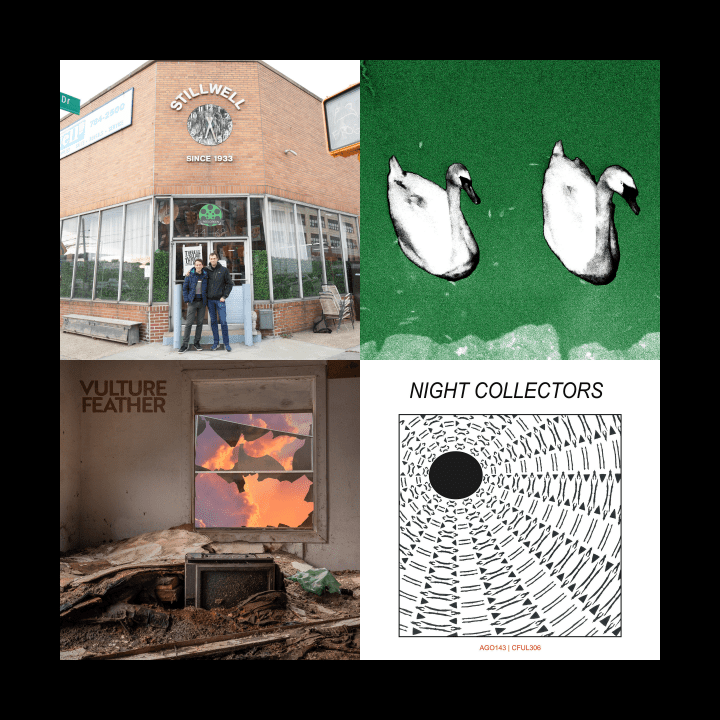
Happy Valentine’s Day’s Eve! Tomorrow (February 14th) is shaping up to be a pretty big day for new music, and Rosy Overdrive is looking at a few of these upcoming records today: new albums from Frog, Vulture Feather, Cathedrale, and Night Collectors. Be sure to check out the previous posts from this week (Monday’s Pressing Concerns featured The Pains of Being Pure at Heart, Iffin, Brown Dog, and Paul Bergmann, while Tuesday’s featured Hello Whirled, The Winter Journey, Jac Aranda, and Grant Pavol) if you didn’t catch them the first time, too.
If you’re looking for more new music, you can visit the site directory to see what else we’ve written about lately. If you’d like to support Rosy Overdrive, you can share this (or another) post, or donate here.
Frog – 1000 Variations on the Same Song
Release date: February 14th
Record label: Tapewormies/Audio Antihero
Genre: Indie pop, folk rock, psychedelic pop, piano pop, alt-country, Frog
Formats: Vinyl, digital
Pull Track: DOOMSCROLLING VAR. II
The cult New York act Frog returned after a four-year hiatus in 2023 with an album called Grog, a perfect reintroduction (or, for me at least, a formal introduction) to an exciting world of folk rock/country-influenced indie pop music dreamed up by Daniel Bateman with assistance from his brother, Steve, on drums. I called Grog an “alternate-universe oldies station” and mentioned Mercury Rev, The Flaming Lips, and Grandaddy, among others, as artists evoking a similar feeling to that record. 1000 Variations on the Same Song, the sixth Frog album, is a departure from the more technicolored, eager-to-please pop sensibilities of their previous LP, even though it still sounds like a Frog record. As the title implies, 1000 Variations on the Same Song arose from Bateman realizing he was working on “a bunch of stuff that all sounds alike” and deciding to embrace the similarities rather than try to vary things up some more; on this record, Frog sound more subdued and thoughtful, making their way through simple yet disorienting piano-led instrumentals at a leisurely pace. Bateman’s singular-sounding high-pitched vocals prevent 1000 Variations on the Same Song from truly being “laid-back”; I was helpfully given a lyrics sheet for this record, but it almost feels like cheating to pull too much from it in this review, as I think the proper way to take it in is to catch snatches of phrases in moments of clarity between Bateman jumping between soul-influenced croons and Isaac Brock-like yelps.
I like that Frog (who’ve recently welcomed back founding drummer Thomas White into the live band on bass) followed up an immediately-satisfying comeback record with something that took me a few listens to really get a handle on. It’s good world-building! After spending a good deal of time in 1000 Variations on the Same Song, it’s now hard to imagine it sounding any other way–Bateman sounds almost divinely inspired in the most memorable parts of the record, giving a chant or even hymn-like quality to the refrains of “DOOMSCROLLING VAR. II” (yes, he is saying “Damn, baby, what is you talking ‘bout” there), “HOUSEBROKEN VAR. IV” (“It sounded clever to regale her ‘front of all her friends,” no idea why this sounds so profound), and “MIXTAPE LINER NOTES VAR. VII” (which rhymes “broken Casios” with “The National”). The other Bateman makes a stronger impression on the drums than I would’ve expected on first listen, but Steve’s contributions are really sticking out to me now–Daniel leaned pretty heavily on non-rock influences for this record, and it’s his brother that keeps things grounded with stuff like the sharp marching beat to “DOOMSCROLLING”, the melancholic shuffle of “WHERE DO I SIGN VAR. III”, and the slow plodding to “HOUSEBROKEN VAR. IV”. In fact, it becomes pretty noticeable when the percussion is sidelined in the final two tracks, the ringing piano carol “DID SANTA COME VAR. IX” (Bateman mentions listening to “a lot of Mozart” while making this record, by the way) and the campfire folk closing track “ARTHUR MCBRIDE VAR. X”. Not to belabor the point, but by making a album with its own wrinkles and bumps that still sits nicely with the rest of their records, Bateman and company have created a welcome variation on the same Frog. (Bandcamp link)
Vulture Feather – It Will Be Like Now
Release date: February 14th
Record label: Felte
Genre: Post-punk, art rock, art punk
Formats: Vinyl, digital
Pull Track: Let It Through
When I wrote about Liminal Fields, the 2023 debut album from northern California trio Vulture Feather, I didn’t expect to be writing about two more Vulture Feather records in less than two years. It’s not that Liminal Fields wasn’t a great debut, it’s just that when artists return to making music after a long time away, they don’t typically start putting out records prolifically. But vocalist/guitarist Colin McCann and bassist Brian Gossman have apparently found a fertile third act after playing together in Florida emo group Don Martin Three in the 1990s and Baltimore art rock group Wilderness in the 2000s. Now based in Hayfork, California (about sixty miles west of Redding), the duo have linked up with new drummer Eric Fiscus and have gotten to work hammering out slow, deliberate, Lungfish-esque guitar-heavy post-punk (as I called Liminal Fields at the time). We got a three-song EP called Merge Now in Friendship last year, and 2025 has brought the second Vulture Feather LP, It Will Be Like Now, recorded after a year of touring by ex-Nation of Ulysses guitarist Tim Green (another former mid-Atlantic resident who’s since relocated to northern California; he plays baritone guitar on one track on the record, too) at his Louder Studios in Grass Valley.
Vulture Feather have such a distinct sound–McCann’s otherworldly yowling vocals and chiming guitar, the steady, glacial movement, a rapturous devotion to minimalism and repetition–that they really only sound like themselves at this point. Like Merge Now in Friendship and Liminal Fields before it, It Will Be Like Now is a powerful-sounding record, but I didn’t come away from it thinking “Vulture Feather just made the same album again”. The fact that they recorded the album after a bunch of touring might explain the subtle difference I hear–“looser” isn’t exactly the right descriptor…maybe “more alive”? Liminal Fields sounded like it just came into being one day, but I can actually imagine Vulture Feather playing the songs of It Will Be Like Now live, in person, in-studio. This is their punk album, maybe. It’s hard to single out specific Vulture Feather songs because everything they ever do feels like one big single movement, but It Will Be Like Now has some notable mile markers–for one, “Let It Through” (the one with Green on baritone guitar) is really indescribable, just four minutes of one three-chord guitar progression and McCann giving it everything in the vocals. “Into Space” starts off with some excellent guitarplay that underscores how close McCann’s playing is to “jangle pop” when you listen to it intently, and “Like Now” makes up for being mostly instrumental by letting the guitar show off in a way they hadn’t really before. As always, though, Vulture Feather is even more so about the moments in between these ones, about the eternal balancing act that they make feel frighteningly vital and easy at the same time. (Bandcamp link)
Cathedrale – Poison
Release date: February 14th
Record label: Howlin’ Banana/Regarts
Genre: Garage rock, punk rock, post-punk
Formats: Vinyl, CD, digital
Pull Track: Cravings
I’ve written a fair amount about France’s surprisingly robust garage rock scene in recent years between TH Da Freak, Opinion, and SIZ, but Toulouse’s Cathedrale seem to be an institution of their own. Starting in 2017, the quartet have put out four albums of energetic, power pop-informed garage rock, all the while honing their skills touring across Europe (apparently with Osees at one point, too). Perhaps their time on the road has hardened and darkened Cathedrale’s sound–there were hints of this on their most recent album, 2023’s Words/Silence, and their fifth LP, Poison, continues down this path. Recorded live by Almost Lovers’ Mathieu Versini in Brussels at Chez Nini, Poison is a fiery punk album, with the darker and noisier edges of post-punk and garage rock poking through these thirteen tracks. The former genre is present in a sort of greyscale stoicism in both the music and singer/guitarist Jules Maison’s vocals, while Cathedrale remind us again and again of their garage rock roots by launching into one torrent of guitars after another before Poison is all said and done. I shouldn’t overstate how inaccessible Cathedrale sound here; there’s still plenty of catchy songwriting going on in Poison, the band just sound a bit more…pissed off about it.
“Monuments & Bricks” functions excellently as a table setter for Poison–it’s a four-minute chugging opener, never fully releasing the tension it builds up and filling in empty spaces with whirring, Pere Ubu-like synths. It feels a lot like underground American garage punk, like Devo but with any bright colors intentionally leached out of it. The cruising “South Life” brings more rock and roll to said table, and it’s served with a helping of white-hot anger (I love hearing Maison’s French-accented voice shouting “You fucking loser!” in the refrain). There are a few more stabs at genuinely freewheeling garage rock on Poison, like in single “The Setting Sun”, the almost bouncy “Cravings”, and the dark but quick-moving “Enchantress”. Poison corrodes in real-time, though, starting around the one-two punch of “Radium” (a disintegrating-sounding piece of art punk) and “Polonium” (which is more or less a sound collage). Cathedrale come out the other side of this collapse damaged but still intact, resulting in spirited late-record numbers like the synthpunk-tinged “Wave Goodbye” and the anticipatory “Horsemen”–not to mention “New Light”, in which Cathedrale sign off with an uncharacteristic hymn-like snippet of a final track. You can listen to an unhealthy amount of albums with similar origin stories as Poison (as I have), but as long as you don’t lose the ability to appreciate these little defining moments and what must’ve gone into them, I don’t see how you could ever reach capacity. (Bandcamp link)
Night Collectors – Heat and Fury
Release date: February 14th
Record label: Aagoo/Cardinal Fuzz
Genre: Psychedelic rock, fuzz rock, acid rock, garage rock
Formats: Vinyl, digital
Pull Track: Transmission
Night Collectors are a quartet made up of a bunch of San Francisco indie rock, psychedelic, and experimental music veterans–guitarist/vocalists John Krausbauer and Blaine Todd, drummer Kaori Suzuki, and bassist Brian Wakefield (who’s since been replaced with Kevin Guzman) started playing shows together and rehearsing before the pandemic, eventually recording two songs at Tiny Telephone in Oakland before COVID interrupted work on a planned full-length record. Those songs, “One Thousand Years” and “Transmissions”, came out on a 7” single for Debacle Records in 2022, and around that time Night Collectors reconvened to finish their first LP, Heat and Fury. The first Night Collectors album is a brief but incredibly potent blast of psychedelic rock from beginning to end–neither in line with the garage-punk of the late 2000s-2010s Bay Area nor the dreamy guitar pop of the current scene, Heat and Fury instead opts for a challenging, droning, but very much rocking take on the genre. Only five songs and twenty-five minutes long, Heat and Fury makes every overloaded second count, making sure to cover everything up with a blanket of ringing, roaring guitar fuzz whether Night Collectors are surging alongside it or staggering within its mist.
The two previously-released Night Collectors tracks open and close Heat and Fury, and they’re two of the most intense moments on the album. “One Thousand Years” is tasked with introducing us to the band, and it indeed sounds like the awakening of something ancient–Krausbauer and Todd draw up a full-on assault of distorted guitars, while Suzuki’s simple, steady percussion marches the song forward, obscured but not dampened by the noise surrounding it. “Transmission” is the slow burn, sounding almost lazy in its meandering psych rock at first but soon launching into another drone-psych-fuzz piece that only gets larger and larger as everything draws to a heady conclusion. In between these twin towers is one song that meets the extremes of the record’s bookends (the title track, another pounder that’s probably the closest thing to “garage-y rock and roll” on the LP), and two songs where Night Collectors dig deeper into the trenches of their psychedelic sound. “Take Me Higher” and “What Would I Do” are still pretty distinct from each other–the former sounds like a slowed-down and warped version of the louder tracks on Heat and Fury, the latter like Night Collectors have fully set this record adrift into murky waters–but both songs (which feature contributions from a mysterious “T. Gevondyan”) help the band’s first album feel like a complete journey. It’s not always a smooth one, but that’s the point with Night Collectors. (Bandcamp link)
Also notable:
- Tobin Sprout & Bevil Web – 4 Song EP
- Prison – Downstate
- Ginnels – The Picturesque
- Jake Nicoll – On Hold EP
- Bartees Strange – Horror
- Closure Is a Waiting Room – Pirouettes into the Ceiling EP
- Taleen Kali – Covered EP
- Bikini Beach – Cursed
- Dr. Mocker – Constant Current Stimulus
- The Blasts – The Blasts
- Horsebath – Another Farewell
- Sam Moss – Swimming
- Russel the Leaf – This One’s for Simon J-E-F-F-E-S EP
- Richard Brisbois – Between the Light and Me
- Les Passagers – Tu n’es pas seul
- The Yets – Pinup Girl
- Nadia Reid – Enter Now Brightness
- Raya – Un despertar EP
- Christian Winther – Sculptures from Under the City Ice
- Matt Pond PA – The Ballad of the Natural Lines
- Haunted Horses/Facet – Split
- L.S. Dunes – Violet
- Joe Ely – Love and Freedom
- Various – If I Could Only Fly: A Comp for LA Wildfire Relief
- Various – Now That’s What I Call Heartbreak Volume 7: Songs from the Movies
 Rosy Overdrive
5 thoughts on “Pressing Concerns: Frog, Vulture Feather, Cathedrale, Night Collectors”