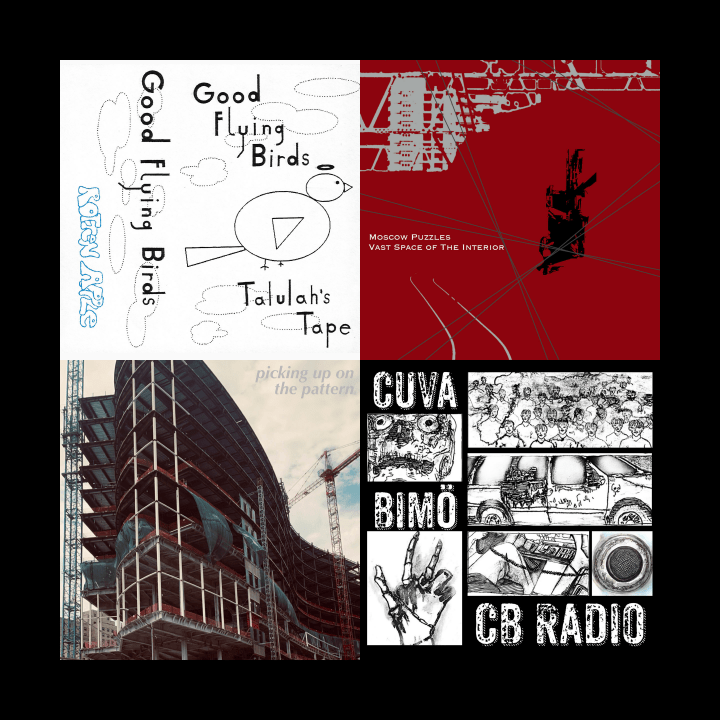
We’ve already reached the third week (and second full week) of January; 2025 is really starting to come into focus, at least in terms of music. This Monday Pressing Concerns brings us four records that have already come out this year: a compilation cassette from Good Flying Birds, new albums from Moscow Puzzles and CuVa Bimö, and a new EP from All My Friends Are Cats. Look for a normal Thursday Pressing Concerns later this week, as well as…something…on Tuesday, as the blog ramps back up to a “normal” schedule.
If you’re looking for more new music, you can visit the site directory to see what else we’ve written about lately. If you’d like to support Rosy Overdrive, you can share this (or another) post, or donate here.
Good Flying Birds – Talulah’s Tape
Release date: January 2nd
Record label: Rotten Apple
Genre: Lo-fi pop, jangle pop, psychedelic pop
Formats: Cassette, digital
Pull Track: I Care for You
A bunch of friends of this blog have rung in 2025 by writing or talking about Indianapolis lo-fi indie-jangle-punk pop group Good Flying Birds, and I’m happy to join the committee in sharing Talulah’s Tape with you all. Is there something going on in Indianapolis that I need to know about? As of late, Wishy has started to really take off, the very underappreciated psychedelic guitar pop group Living Dream just announced a new EP, and now there’s the Good Flying Birds. As best as I can tell, all of this started with a YouTube channel called Talulah God uploading a few Good Flying Birds songs (there’s also an impressive Neocities page dedicated to the group) and attracting the attention of Martin Meyer (Rotten Apple and Inscrutable Records), who started the year by releasing two Good Flying Birds-related releases: Talulah’s Tape, which collects “16 tracks recorded at home between 2021-2024”, and Star Charms, a compilation featuring three new Good Flying Birds songs as well as new material from Soup Activists and Answering Machines. They’re both good (shout out Answering Machines’ “Rocks Hit My Window”, probably my favorite song of the year so far), but I’m going to put the spotlight on Talulah’s Tape as it’s just an undeniable collection of excitable, exuberant, weird pop music.
Loosely speaking, Good Flying Birds fit into a new jangle pop movement somewhere alongside acts like the psychedelic freakbeat of The Smashing Times, the lo-fi mod revival of Sharp Pins, and their dreamy, hazier now-labelmates Living Dream. However, Talulah’s Tape is more…frantic than any of those bands. Perhaps appropriately for a band whose name evokes a Guided by Voices song (intentionally or otherwise), there’s a slapdash basement feel to these tracks. The most obvious pop hits on the record (“Down on Me”, “ I Care for You”) sound like the band recorded them as quickly as possible before the jangly inspiration faded, while the more full-on rockers (“Wallace”, “Fall Away”) demonstrate their ability to step on the gas pedal (while still making pure “pop music”) when they want to. Even as there’s a staggeringly high “hit” rate here, Talulah’s Tape is an offbeat and chaotic listen nonetheless; there’s a goofiness that for the most part is kept to brief interlude tracks and between-song transitions (there’s some drum machine false starts and red herrings, some odd dialogue, Mario and Spongebob make appearances, et cetera), but there are a few moments (like the drum machine-heavy flat-psych of “Every Day Is Another”) where Good Flying Birds display an aptitude for incorporating it into their “songs”, too.
I don’t want to overstate any “difficulty”; excellent pop songs are never out of reach throughout Talulah’s Tape, whether it’s those opening jangle pop smashes, the back-of-one’s-hand automatic excellence that is “Eric’s Eyes”, or “Art Rock (Gidget)”, some sneaky brilliance hidden towards the end of the tape. “Art Rock” is one of three songs with the “(Gidget)” tag; I’m not sure who or what Gidget is, but these are definitely some of the strongest moments on the tape. This applies to Talulah’s Tape as a whole, but there’s particularly a freewheeling, carefree approach to guitar pop music that reminds me of early of Montreal (but, like, more jangly and electric) in the “Gidget” part of the cassette. The bright, shiny jangle-psych-pop of “Art Rock” touches Good Flying Birds’ spaceship down with remarkable ease, and the central line of the song (“We can make a video / Or song / And call it art”) lands because of everything else about this band and cassette. (Bandcamp link)
All My Friends Are Cats – Picking Up on the Pattern
Release date: January 7th
Record label: Grey Cat Studios
Genre: Power pop, pop punk, slacker rock
Formats: Digital
Pull Track: Every Summer
I wrote a little bit about All My Friends Are Cats back in 2023 with the advent of their debut album, The Way I Used to; I called them “vaguely feline-themed pop punk/power pop/slacker rock” and highlighted “Voices”, a song I still like very much. They were a trio at that point, but as of late it seems like bandleader Dave Maupin is going it alone, including on the latest All My Friends Are Cats release, a five-song EP called Picking Up on the Pattern. Even without Maupin’s old backing band, All My Friends Are Cats still sounds familiar–by which I mean that they still sound like they did on The Way I Used to, yes, but also that their sound has a comforting, well-worn feeling to it that reminds me of a more casual, mostly bygone era of slacker-y pop punk/power pop. The more “chill” side of laid-back Midwestern hook-churners like Brat Sounds, Total Downer, Jacky Boy, and Telethon come to mind, and there’s a bit of early Fountains of Wayne in these songs, too. All of it goes together to shade the strongest songwriting I’ve heard from Maupin yet–like the construction on the EP’s cover, Picking Up on the Pattern feels like a transitional work, its songs looking back at bad habits and bad situations, its narrator recognizing that they’re in the past but still lingering on them before moving on.
“I’m picking up on the pattern / That I’d rather be somewhere else at all times,” Maupin sings to open the record on “Somewhere Else”, the closest thing to an upbeat pop punk anthem on the EP. As catchy as “Somewhere Else” is, the mid-tempo pop rock targeted strike of “Every Summer” bests it–the chorus is an excellent loaded gun, but it’s the shit-eating-grin-delivered verses (“This place is just a ghost town, but the views they aren’t as vast / The buildings are much bigger and the tumbleweeds are trash”) that really make the track transcend. Picking Up on the Pattern only gets more insular as it goes on–“Wasted Space” is the emo-tinged track that’s explicitly about moving (“I’ve got these boxes full of shit that would be better off replaced / If they were gone it would hardly affect me”), and the parallels aren’t hard to draw (“Is it a bad thing that every couple years I think / That this is it, this is the new me?”), while “Not Normal” is a sugary, lo-fi guitar pop cry for help (“It’s not normal / To act this way at this age”; well, at least you’re aware, I guess). By the time Maupin proclaims “Oh well, it was just my scenic hell,” in “Double Down”, one hopes that Picking Up on the Pattern helped get something out of the singer-songwriter’s system once and for all. I mean that for Maupin’s own sake–from a listener standpoint, Picking Up on the Pattern is an incredibly rewarding place to be. (Bandcamp link)
Moscow Puzzles – Vast Space of the Interior
Release date: January 10th
Record label: Placeholder
Genre: Post-rock, math rock, 90s indie rock, post-hardcore, experimental rock
Formats: CD, cassette, digital
Pull Track: Highway Apathy
Cicadas Are Sensitive to Parallel Lines, the debut album from Iowa City post-rock duo Moscow Puzzles, was a sleeper hit of 2023 for me. That record was made up of five lengthy instrumental jams built from a barebones foundation (everything on it is played by drummer Tony Andrys and guitarist Tobin Hoover) that recalls basement-friendly post-rock and math rock that flowed from labels like Quarterstick, Touch & Go, and Thrill Jockey at the end of the 20th century. Almost exactly two years later, Andrys and Hoover are back with a brand-new Moscow Puzzles full-length, once again recorded by Luke Tweedy (American Cream Band, Wowza in Kalamazoo, Hayes Noble) at Flat Black Studios in Lone Tree, Iowa and self-released on CD and cassette by the band. In some ways, Vast Space of the Interior picks up right where Cicadas Are Sensitive to Parallel Lines left off, but it distinguishes itself enough to not feel like a full-on retread. Although both records lean entirely on the same guitar-and-drums ingredients, Vast Space of the Interior lives up to its name by sounding a little more ambitious and, indeed, vast. Moscow Puzzles sound ready to expand beyond Midwestern basements, even if they’re not entirely sure where that will lead them.
There’s nothing on Vast Space of the Interior that sounds as accessible (relatively speaking) as Cicadas Are Sensitive to Parallel Lines’ spiky, distorted Unwound tribute “Radix”, but there are moments that are…more succinct than others here. The first two songs on the album are probably the “hits”–the six-minute chug of opening track “Highway Apathy” is Moscow Puzzles at their most purposeful, marching intently and intensely down said freeway, and “Unknown Fixed Object” once again finds the band leaning on heavy, mathy guitar riffs and tough percussion to make a fiery post-rock statement. The rest of Vast Space of the Interior is for the real post-rock heads–about half of it is made up of the three-part “Monumentation”, which builds patiently for seven minutes (Part “I”) before demolishing itself in the two-minute crescendo of Part “II” and the four-minute coda of “III”. And if “Monumentation” is still too commercial for you, I’ve got good news about the final track, the fourteen-minute “Every Tongue Will Confess”. Andrys and Hoover probe and dig around in the noise for most of the track, steadily examining the walls of their sound, and while they do get louder, the song stubbornly veers into ambient nothingness to close the record out. Having done their best to tame it for thirty-some minutes, Moscow Puzzles leave us alone with the Vast Space of the Interior. (Bandcamp link)
CuVa Bimö – CB Radio
Release date: January 3rd
Record label: Cuva Groove
Genre: Garage rock, punk rock, noise rock, art punk, post-punk
Formats: Digital
Pull Track: Post/Wall
CuVa Bimö are a new “Oakland grunge rock” band who kicked off the new year by releasing their debut album, CB Radio. The quartet (started by guitarist/vocalist Pete Vadelnieks and drummer Ricky Cunliffe, quickly rounded out by guitarist/vocalist Sebastian Moeller and bassist Jake Bilich) recorded CB Radio with Kevin O’Connell (of The Strange Ones and Strange Sound), and they sound like a furious force on their first record together. Gruffer and rougher than the majority of bands I write about from the San Francisco area, CuVa Bimö are one part classic Bay Area garage punk, one part dark and distorted post-punk, and one part trashy noise rock (one of the vocalists, I’m not sure which one but I think it’s Vadelnieks, has a nice, deep AmRep/Touch & Go-style of talk-singing which helps a lot in this department). CuVa Bimö manage to pull off both “sloppy” and “tough” on CB Radio, making a strong and substantial first impression as a “punk band” even if their music doesn’t always fit neatly into that box.
The first proper track on CB Radio is “Wasting Time”, a crunchy and swirling alt-rocker that works quite well, even though it doesn’t fully hint at everything else CuVa Bimö have in store for us with the album. “Bad Jacket” one song later is our first taste of CuVa Bimö as a snotty, sneering garage punk group, and is a nice assurance that, even though the band can sound dead serious at times, not everything on CB Radio is so dire, as the band spend most of the song denigrating the titular article of clothing (“I know a few things that are true / That new jacket makes you look like a tool / … / If I’m wearing that, please kick my ass”). “Post/Wall” is yet another side of CuVa Bimö, a more limber, nervous-sounding post-punk version of their sound that also characterizes a lot of the other highlights of the record from the requisite raging at the state of the Bay Area in “Doom Loop” to the melodic punk-influenced “Workhorse”. Moeller is apparently a big Sonic Youth devotee, and the guitar work on CB Radio reflects this, but CuVa Bimö is interesting because it doesn’t feel like they’re trying to sound like Daydream Nation. In fact, there’s a kind of tension coming from the other genres towards which the rest of the members of CuVa Bimö seem to try to be dragging the music (like the aforementioned garage punk) and the guitar squalls. The four of them manage to keep the peace in a nice and explosive way. (Bandcamp link)
Also notable:
- Gnome – I Like It EP
- Liquids – Tennesee Rose
- Denude – A Murmuration of Capitalist Bees
- Clean Lines – Nuisance EP
- Bike Notes – Bike Notes
- Eliot Eidelman – Silhouette
- Shobijin – Self-Titled EP
- Heet Death – Bad Reading
- Nonsense – Office Pop EP
- Dean Blunt – Lucre EP
- Franz Ferdinand – The Human Fear
- Glass Tides – The First EP
- Zeta – Was It Medicine to You?
- Bridget Hayden and the Apparitions – Cold Blows the Rain
- Inside Voices – If It Matters
- Part-Time Legend – You’re a Ghost
- Will Mason Quartet – Hemlocks, Peacocks
- Small Portions – Demonstrate EP
- Brown Spirits – Cosmic Seeds
- Various – Rajneeshpuram Reveries: The Birthday Sessions (1982)
- Sondre Lerche – Sea of Sighs EP
- Eugene – Sydereal EP
- Ethel Cain – Perverts
- Morlocks – Amor, Monstra Et Horrore Profundi EP
- Starflyer 59 – Dejame Dormir
 Rosy Overdrive
3 thoughts on “Pressing Concerns: Good Flying Birds, All My Friends Are Cats, Moscow Puzzles, CuVa Bimö”