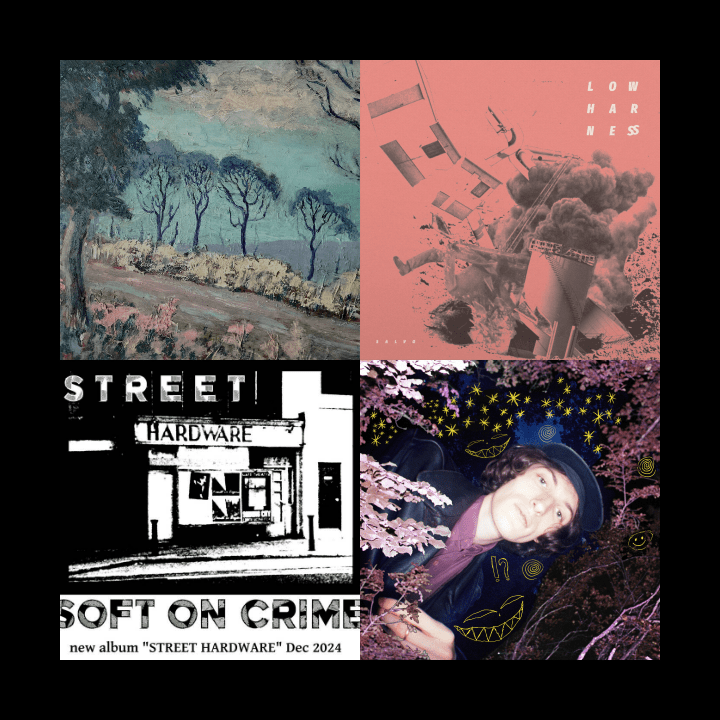
Hello, all! The first week of December has been a great one on Rosy Overdrive, and we’re wrapping it up with a Thursday Pressing Concerns featuring four albums coming out tomorrow, December 6th: new LPs from Advance Base, Soft on Crime, Low Harness, and Opinion. If you missed the Monday Pressing Concerns (featuring Mother of Earl, Big’n, Radio Free ABQ, and Miners) or the November 2024 playlist/round-up (which went up on Tuesday), check those out, too.
If you’re looking for more new music, you can visit the site directory to see what else we’ve written about lately. If you’d like to support Rosy Overdrive, you can share this (or another) post, or donate here. And last but not least: don’t forget to vote in the 2024 Rosy Overdrive Reader’s Poll!
Advance Base – Horrible Occurrences
Release date: December 6th
Record label: Run for Cover/Orindal
Genre: Singer-songwriter, synthpop, folk
Formats: Vinyl, CD, cassette, digital
Pull Track: The Year I Lived in Richmond
It’s hard to believe that I’m only passingly familiar with the music of Owen Ashworth, given how many people whose taste I respect love it (musicians, writers, all around solid people). Of course, I’m a big fan of the releases he’s curated as the head of Orindal Records (Dear Nora, Tara Jane O’Neil, Young Moon), and was aware that Ashworth’s cult solo projects Casiotone for the Painfully Alone and Advance Base–lo-fi, low-key minimal electronic pop soundtracking the artist’s deep talk-singing vocals–are in the same realm of many of those records. Horrible Occurrences, the fifth Advance Base album of original material and the project’s first in six years, is subsequently my entry point into the world of Ashworth–and “world” is a more than appropriate descriptor for what the singer-songwriter creates in these eleven songs. On Horrible Occurrences, Ashworth builds a set of characters and their stories, largely taking place in a fictional town called Richmond (I picture it as somewhere in the Midwest, in part due to references to Wisconsin, Lake Michigan, and Columbus, but I don’t believe it’s specified). As the title of the record hints at, Horrible Occurrences is dark more often than not–murder, grievous injury, abandonment, and the supernatural are among these “occurrences”. In the world of deep-voiced, occasionally synth-curious indie pop storytellers, though, Ashworth is more David Bazan than Stephin Merritt; these are vivid, delicate figures and tales, real-feeling people too complex to simply feel doomed.
Ashworth recorded all of Horrible Occurrences on his own in his Oak Park, Illinois basement, accompanied by “pianos, synthesizers, samplers, and drum machines”. Most of these songs are only built out of Ashworth’s voice and a simple piano or synth part–both ingredients are slow-moving but follow pop progressions and vocal melodies, acknowledging an important part of the power of “folk music”. “The Year I Lived in Richmond” and “Big Chris Electric” both come early on in the album, and subject matter-wise they’re two of Horrible Occurrences’ most dramatic moments, but Ashworth keeps things hushed and quiet in a way that reflects the stark, endlessly-reverberating qualities of major events in a small town. It’s not until the second half of Horrible Occurrences that Ashworth dials up an instrumental with a bit of flair–it’s still in slow motion, but the prominent drum machine beat of “Brian’s Golden Hour” helps paint the picture of the song’s teenage character falling off his roof, shattering his spine and leaving him paralyzed and “lucky to be alive”. Ashworth uses the beats for a decidedly different end in “Little Sable Point Lighthouse”–in it, a character disappears forever as the synths simulate a haze and the drum machines the distant clang of buoys and small craft. The way that the story of “Little Sable Point Lighthouse” spills into “Andrew & Meagan” is chilling, but I suppose that it shouldn’t be so jarring–throughout Horrible Occurrences, it’s apparent time after time that Ashworth’s narrators and subjects are eternally connected to the town at the center of the album, regardless of where they find themselves geographically. It’s not a curse, it’s just life. (Bandcamp link)
Soft on Crime – Street Hardware
Release date: December 6th
Record label: Eats It
Genre: Power pop, jangle pop, lo-fi pop
Formats: Cassette, digital
Pull Track: Villain
One of my favorite albums of last year was New Suite, the debut LP from Dublin trio Soft on Crime. New Suite was a guitar pop cornucopia, stuffed with hooks delivered to the tune of giddy college rock, jangle pop, power pop, psychedelic pop, and new wave. Not only did Dylan Philips, Padraig O’Reilly, and Lee Casey unleash New Suite on us last year, but they also took a rewarding victory lap with an entire second CD/cassette called Rarities Vol. 1 a few months later. Although songs on that compilation dated all the way back to 2018, there were some (very good) brand-new recordings on it, too, and Soft on Crime continue their hot streak into 2024 by getting their sophomore album out right under the wire here in December. New Suite was already on the shorter side, and Street Hardware does it one better in terms of brevity, zipping through eight songs in a mere twenty-two minutes. Soft on Crime also sound looser and more streamlined on their newest album–aside from brass played by J Sousa on “No Story”, the core trio is all you’ll hear on Street Hardware. It all amounts to a relatively low-key follow-up, but the reduction in bells and whistles hasn’t weakened the power of Soft on Crime; in fact, with some of the group’s more offbeat tendencies largely sidelined, this might be the trio’s smoothest ride yet.
Do you want to hear a garage band hammering out lost power pop classics, seeming aloof with regards to the gold upon which their sitting? Well, Street Hardware has plenty of that in its brief runtime, not the least of which is the bouncy opening track “Way Facing”. “Tonight” surely belongs in this category as well, as does “Crackdown”. “No Story” is the one time on the album where Soft on Crime allow themselves any kind of excess, and they use it well–there’s the aforementioned brass accents, as well as flamboyant usage of what sounds like a harpsichord and some sky-high melodic power pop guitar leads straight out of New Suite, too. With a limited palette, everything Soft on Crime does to give extra power to these songs is subtle brilliance–the stopping and starting in the mid-tempo pop of “Villain”, and jovially strummed acoustic guitar underneath “Bread & Roses”, and so on. I did mention that the “offbeat” side of the band is a bit reduced on Street Hardware; it’s largely concentrated in two tracks, the weirdo psychedelic rumble of “Repo Man” in the second slot and “Favourite Band”, the strange lo-fi rock opera that closes the album. Soft on Crime had already proven that they can dip into these detours without losing any pop appeal, and both of these songs feel like the trio reminding us (and themselves) of a key part of their music that’s a bit less prevalent on Street Hardware. I don’t know what aspects of their sound Soft on Crime will emphasize on their next record, but they’ve earned my trust in whatever they choose to do. (Bandcamp link)
Low Harness – Salvo
Release date: December 6th
Record label: Krautpop!
Genre: Post-punk, art punk, 90s indie rock
Formats: Vinyl, digital
Pull Track: Redux
It’s a tale as old as time–a couple of British musicians bond over a shared love of arty European post-punk and underground American 90s indie rock/noise rock, polish up their influences together, and make a buzzy and inspired record together. In the case of Low Harness, it’s the story of four musicians from Falmouth who came together last year but have been playing locally in various bands for a while now, specifically vocalist/guitarist Hannah Gledhill (ex-H. Grimace), guitarist Martin Pease (ex-Hanterhir), drummer Ed Shellard (ex-Witching Waves), and bassist Alex Harmer. Frankly, the members of Low Harness have been at all of this for far too long to bother with demo cassettes and debut EPs–their first release together is a nice, full eleven-song long-player. Salvo is certainly an album made by a band who cut their teeth on Sonic Youth and Wire records, but it’s not that simple to get a handle on what this record sounds like. Aside from a couple of memorable moments, Low Harness eschew the more outwardly abrasive sides of their influences and pursue enlightenment through hypnotic, droning rhythmic rock music, non-intuitive pop songwriting, and a way of carrying themselves that does sound kind of “punk” from a certain viewpoint.
The opening salvo of Salvo, “Ready from the Start”, is a noisy indie rock masterpiece–sharp, pounding distortion and anthemic pop hooks sit side by side, delivered with equal weight. It’s a great introduction to Low Harness, even as it’s something of a red herring–the next few songs, from the sprawling “Exit Plan” to the foot-on-gas rocker “Too Long Together”, move between the extremes of the band’s sound much more subtly. A lot of Salvo’s strength comes from Low Harness continually setting up rock music in which it feels like anything can happen, even if it’s rarely outwardly shocking; they can sound like they’re willing to get their hair a little mussed up (on the title track), they’ll pull a stunningly beautiful pop melody out of absolutely nowhere (“Redux”), they can sound like they’re on edge for the entire track without falling off the tightrope (“Blood Play”). It’s a post-punk album that doesn’t scream “post-punk” in our faces, being content to reinvent this combination of fractured guitars, robust rhythms, and inspired atmospherics from scratch in their own way. I think this lends a hard-to-get-a-handle-on feeling to Salvo that drew me to it more than a lot of records that are similar to it on the surface–although the fact that it’s still a pretty powerful rock record certainly helped keep me around. (Bandcamp link)
Opinion – Troisième Opinion
Release date: December 6th
Record label: Howlin’ Banana/Flippin’ Freaks/Les Disques Du Paradis/Nothing Is Mine
Genre: Fuzz pop, lo-fi indie rock, bedroom pop, shoegaze
Formats: Vinyl, digital
Pull Track: Microrange
Congratulations to Bordeaux, France’s Opinion for joining the “two LPs in Pressing Concerns in one year” club (the Casual Technicians, Alexei Shishkin, and Mythical Motors also did it this year, and Tony Jay and Dancer both had one and a half). Hugo Carmouze, who writes, plays, and records everything on Opinion’s records on his own, is a prolific practitioner of what I’d call “lo-fi indie rock” or “fuzz rock”; the latest Opinion record, Troisième Opinion, is the twelfth album under the project name. The previous Opinion LP, February’s Horrible, caught my attention with its confrontational take on bedroom rock–it was recorded over a single evening and sounds like Carmouze intentionally pushing the limits of noise and distortion in the presentation of his shoegaze/garage rock-inspired songwriting. Troisième Opinion, conversely, was recorded by Carmouze over several years, and while there’s certainly still plenty of abrasive and noisy moments on the album, it’s much less all-consuming than on the previous Opinion album; with the songs given a little more room to breathe, Troisième Opinion is more recognizable to us as a vintage lo-fi pop, bedroom pop, and even power pop-inspired record.
The forty-five minute Troisième Opinion LP has plenty of pop music on it, but Carmouze clearly enjoys burying these hooks so that we have to work a little bit to land on them. Sometimes that entails the multi-layered walls of sound that marked Horrible, but Carmouze goes about this in other ways, too–like, for example, starting off this album with the six-minute lo-fi rock odyssey of “Neige Florale” and the strange psychedelia-tinged “Un Petit Chat Dans Mes Bras” before we get to the first single, the triumphant gaze-pop of “19”. When Opinion let the clouds part, Carmouze is more than capable of pulling off the increased visibility–there’s a delicate bedroom pop appeal to stuff like “Microrange” and “For Real”, both of which start off relatively low-key before roaring to fuzzed-out conclusions. That being said, it’s still a surprise when the band sneaks a genuine power pop song into the record’s second half–that’s “Cimetière”, which uses fuzz in a much more “Teenage Fanclub” than “Loveless” way. The surging, dreamy noise-pop of “Smile” makes a little more sense, but it’s still an impressive left turn, especially after a couple of late-record confrontational numbers in “Waking Up” and “Gemini”. Carmouze may be prolific, but he’s certainly not spread thin–right up until the Elliott Smith-baiting acoustic closing track “Pour La Nuit, Par La Fenêtre.”, Troisième Opinion sounds like the work of a musician giving it their all. (Bandcamp link)
Also notable:
- Carry Ripple – Raw & Acoustic
- Gold Connections – Fortune
- Dogwood Tales – Sending EP
- What Gives – Got Lost
- Sunturns – Christmas III
- Alexei Shishkin – Greenwich Mean EP
- The Hard Quartet – The Hard Quartet
- Grey Gardens – Holding On EP
- Bright Islands – Currents EP
- Cold Summer – Altlasten EP
- S.C.A.B. – Rose Colored Glasses EP
- White Denim – 12
- Peter Perrett – The Cleansing
- Tiny Moon – I’m Sure It’s Fine
- Pipe-eye – Pipe-defy
- Slags – The Marshmallow Man EP / The Melted Marshmallow Machine EP
- Iji – Automatically
- We Are Winter’s Blue and Radiant Children – No More Apocalypse Father
- Liv Greene – Deep Feeler
- Barry Archie Johnson – Fortune’s Mirror
- Primal Scream – Come Ahead
- Sun Ra & His Arkestra – Kingdom of Discipline
- Stephen Becker – Middle Child Syndrome
- Swim School – Duality & Seeing It Now
- Jopy – Planet Zombie EP
 Rosy Overdrive
One thought on “Pressing Concerns: Advance Base, Soft on Crime, Low Harness, Opinion”