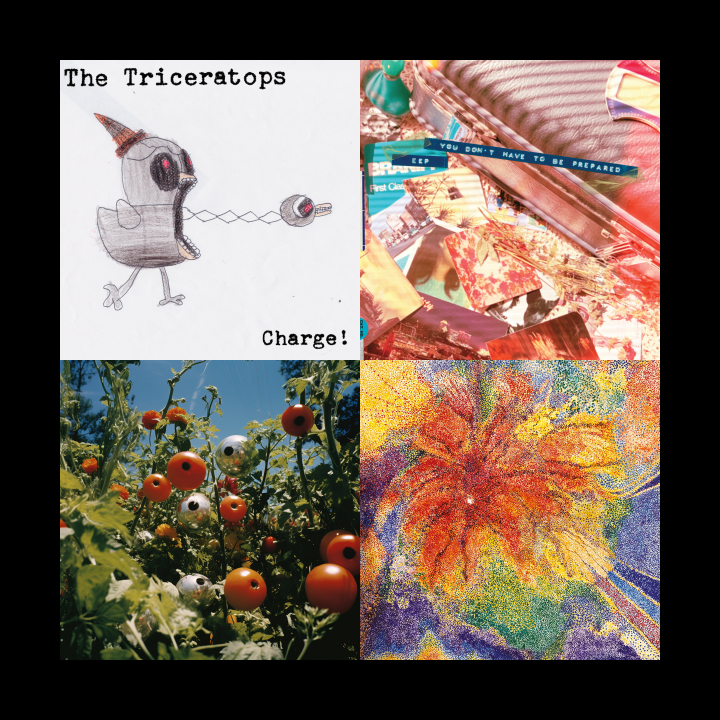
It’s November already, which is hard to believe. In fact, three of the albums in this Monday Pressing Concerns came out last Friday, the 1st of the month: new LPs from The Triceratops, wilder Thing, and EEP (plus an album from Tess Parks from late October). This is a nice and weird one!
If you’re looking for more new music, you can visit the site directory to see what else we’ve written about lately. If you’d like to support Rosy Overdrive, you can share this (or another) post, or donate here.
The Triceratops – Charge!
Release date: November 1st
Record label: Learning Curve
Genre: Punk rock, noise rock, power pop, alt-rock, fuzz rock, grunge
Formats: Vinyl, digital
Pull Track: We Will Shatter
The Triceratops are a new Brooklyn-based duo formed by two indie rockers who go way back together–vocalist/guitarist John Van Atta and drummer/vocalist Melvin Monroe met as stagehands working at CBGB in the 1990s, and after falling out of touch for a few years, reconnected at a recent Future of the Left show and decided to make music together. The first record called The Triceratops is called Charge!, and it feels like a special one to me. The Triceratops deliberately and intentionally walk the line between “pop” and “heavy” rock music on Charge!’s fifteen songs–it was recorded by a producer (Andrew Schneider) who’s worked with noise rock bands like Unsane and KEN Mode and was made by a band who has recently played noise/punk rock festival Caterwaul, but Van Atta also has history playing in a Beatles cover band and Charge! is a strong argument for more hooks in this confrontational indie rock subgenre. It reminds me of, more than any other band, the Archers of Loaf–this kind of music, which is huge and catchy without being dogmatically “punk” or “noise rock”, is kind of a lost art, largely the domain of Electrical Audio-core lifers like The Rutabega and These Estates, but the potency that The Triceratops are able to get out of it suggests that there’s a lot to dig into for those that find their way to it.
Charge! is an urgent-sounding album–it does feel like the work of a couple of people who haven’t gotten to make a full-length statement of an LP in a while and maybe don’t know when or if they’re going to get to again, so they’ve put as much as they can into it. Van Atta and Monroe sound gritty as they fly through these songs, which are intended to reflect “the struggles and joys of working-class life in 21st-century America”. The highs on Charge! are euphoric, led by the trio of lethally-catchy alt-rock songs that lead off the record between the pumped-up introduction of “Can’t Take You”, the mid-tempo ripper “The Saddest Story in Science”, and the soaring “I’ll Go If You Go”. “Efficiency Expert” introduces some New York City post-hardcore into the mix, fiery and heavy but still with a “rock and roll” sheen–it’s the acoustic “Neoliberal Bedtime Routine” (which is given an electric reprise later in the album) that really blows the record open, though. The one-minute gut check ends with “Sorry kid / I know how much you hate / That your family leaves you,” a brief but cutting reminder of the never-ending toll of what The Triceratops rage against. It’s no wonder that the most rousing moments on Charge! are the most destructive–single “We Will Shatter” is maybe the catchiest song I’ve heard this year, jumping from the slick verses to an exorcism of a refrain (that’s just the title line). And then there’s penultimate track “Something Done Right”, a primordial mess of caveman noise rock, mythology, evolution, and revolution. “So–monkeys ready on three, throw your wrench in the gears,” yells Van Atta at the song’s climax. A cornered creature will strike, especially if it’s got something like Charge! to hype it up for that moment. (Bandcamp link)
wilder Thing – I Have My Mother’s Eyes and I’m Not Giving Them Back
Release date: November 1st
Record label: Repeating Cloud
Genre: Lo-fi pop, experimental folk, psychedelic pop
Formats: Cassette, digital
Pull Track: I’m Done Falling Over You
Who likes when a punk musician has a weird lo-fi psychedelic side project? I sure do, and I suspect that Repeating Cloud Records does, as well. That’s who’s putting out I Have My Mother’s Eyes and I’m Not Giving Them Back, the latest from wilder Thing, aka Wes Sterrs. Sterrs is the drummer for Portland, Maine post-punk trio FonFon Ru, but before that band even formed, he self-released four records as wilder Thing from 2013 to 2015. I Have My Mother’s Eyes and I’m Not Giving Them Back is the first wilder Thing release in nearly a decade, and it’s also the most substantial one yet, spanning seventeen songs and forty minutes of fractured but melodic bedroom psychedelic pop. There’s folk music, hooks, dreaminess, and pure psych throughout I Have My Mother’s Eyes and I’m Not Giving Them Back, reminding me a bit of labelmates Log Across the Washer or a more ramshackle version of The Olivia Tremor Control and other song-forward Elephant 6 groups (Repeating Cloud’s Galen Richmond mentioned Chad VanGaalen in his email about this record, which I’m tacking on here because I think it’s pretty accurate, too). We’re left with something that balances intimacy with adventurousness, an album that invites you in to watch it go to work.
The catch is that you’ll have to do a bit of work yourself–for instance, are you willing to navigate the swirling, layered soundscapes of opening track “He Used to Be Beautiful” to get to its moments of eerie but potent beauty? Are you able to accept that Sterrs takes some of the best melodies on the entire record and sticks them in brief transitional songs like “Sorry I Missed You, Happy Birthday” and “It’s Too Cold for the Roof”? Are you down with a singing-saw-heavy instrumental track (skip “Luno” if not)? If you’ve made it this far, I’d imagine that the answer to all of these questions (whether you know it or not) is “yes”, and I Have My Mother’s Eyes and I’m Not Giving Them Back has plenty of gems for you to peruse. The gorgeous minimalist psych pop of “The Gardener” and “The Flower” break open the infinite possibility machine early on in the record, and if you decide to embark on the journey after that, you’re rewarded with a nearly-perfect fuzzy lo-fi pop song called “I’m Done Falling Over You”. wilder Thing invites you to handle them at their trippiest (“Technicolor Psychoscapes”) and noisiest (“Big Twitch”) as I Have My Mother’s Eyes and I’m Not Giving Them Back advances, but the pop never stops, both hidden in songs like those and slightly more out-in-the-open with tracks like (the still pretty psychedelic) “Horn of the Moon”. The presentation of I Have My Mother’s Eyes and I’m Not Giving Them Back might feel like it caps how many people it can reach, but it’s also a key part of its charm, I think; after all, I’m sure In the Aeroplane Over the Sea felt destined to be bound for obscurity at some point too. (Bandcamp link)
EEP – You Don’t Have to Be Prepared
Release date: November 1st
Record label: Hogar
Genre: Dream pop, art pop, synthpop, psych pop
Formats: Vinyl, CD, digital
Pull Track: Ghost
The beginning of this decade was a very fertile time for the El Paso, Texas group EEP and its members–they put out two full-lengths (2020’s Death of a Very Good Machine and 2021’s Winter Skin), while members Rosie Varela and Ross Ingram also released solo albums. The EEP albums used the band’s robust quintet lineup to create distorted, layered, shoegaze-influenced indie rock, while Ingram and Varela experimented with electronica, art pop, and psychedelic pop on their own records, although there was an understandable amount of overlap between the various projects. Things have been relatively quiet on the EEP front for the past couple of years–as it turns out, two-fifths of the band departed after Winter Skin, and Varela, Ingram, and Sebastian Estrada had to retool themselves as a trio. You Don’t Have to Be Prepared, the third EEP album, is a concept record–by chance, the band found a voicemail from about forty years ago taped via a “dictaphone, reel-to-reel tape recorder” in an organ at the band’s home studio, and the story of a woman moving across the country for a romantic partner hinted at by the recording served as the inspiration for the album. Intentionally or otherwise, this record themed around departure and major life changes is soundtracked by a band that’s reinvented themselves musically, debuting a new sound on their latest collection of music.
The differences are apparent with even just a cursory listen to You Don’t Have to Be Prepared–instead of being almost entirely led by Varela, she and Ingram are now effectively co-lead vocalists on these songs, and there’s almost none of the shoegaze influence that permeated EEP’s last album. It’s been replaced by a much more open, subtler, more electronic-tinged dream pop sound–creep from Ingram and Varela’s solo music, perhaps, but more like a band that’s playing to different strengths with a different lineup. The band no longer has a permanent drummer, and You Don’t Have to Be Prepared is given a certain freedom by this fact–sometimes, one of the trio will step behind the kit for the more “rock”-based songs that need a proper drumbeat (the lilting opening pop of “Ghost”, the jazz-influenced art rock of “Here’s What I Want You to Forget”), but songs like “14 Days” and “Clay Center” are free to explore new terrain for the band via floating, drum machine-paced synthpop tunes. “On Tenterhooks” is a post-rock/jazz-rock instrumental song that might be my favorite recording on the entire album, pushing the band into Thrill Jockey/Quarterstick territory effortlessly–it’s up there with “Always”, a driving piece of dreamy indie rock that’s maybe the closest thing to “classic-sounding” EEP on You Don’t Have to Be Prepared. Still, the song has a sparkly 80s synthpop/new wave sheen to it that’s not exactly in the same ballpark as Winter Skin–like the album’s main source of inspiration, it uses parts of the past as a way to focus on what’s as of yet unwritten. (Bandcamp link)
Tess Parks – Pomegranate
Release date: October 25th
Record label: Fuzz Club/Hand Drawn Dracula
Genre: Psychedelic pop, dream pop, psych rock, psych folk
Formats: Vinyl, CD, digital
Pull Track: Surround
Toronto psychedelic pop singer Tess Parks has had an interesting career. Her debut solo album, Blood Hot, came out back in 2013, but she became more well-known in the following years after releasing two collaborative albums with The Brian Jonestown Massacre’s Anton Newcombe in 2015 and 2018. Parks never stopped working on a proper follow-up to Blood Hot, although health problems and eventually a pandemic slowed progress before And Those Who Were Seen Dancing came out in 2022 on Fuzz Club (The Men, DAIISTAR, The Jesus and Mary Chain) and Hand Drawn Dracula. Thankfully, we didn’t have to wait another nine years for the third Tess Parks album, as Pomegranate follows just two years removed from her last one. Although it’s a “solo” LP in name, Pomegranate wouldn’t be what it is without Parks’ longtime collaborator Ruari Meehan, who produced the album and co-wrote every song. The psychedelic music that Parks and Meehan create on Pomegranate (with assistance from organist/bassist Francesco Perini, drummer Marco Ninni, and flutist Kira Krempova, among others) is subdued but adventurous, sounding like the work of collaborators who know how to get the most out of each other without abandoning the album’s singular groove.
Ninni’s hypnotic, almost trip-hop drumbeat, the grooving bass, and Krempova’s flute all ensure that “Bagpipe Blues” opens Pomegranate with a low-key but wild psychedelic experience, and Parks doesn’t slow things down as “California’s Dreaming” embraces more straightforward 60s pop and “Koalas” goes down the road of psychedelic folk. There’s some Paisley Underground psychedelia a la Mazzy Star–or even offbeat lo-fi folk musicians like Lisa Germano–in stuff like “Lemon Poppy” and “Sunnyside”, which gives Pomegranate a nice extra layer to go along with the more traditional psychedelic pop. At the album’s most exploratory, we get the six-minute “Charlie Potato” and “Running Home to Sing”, both of which aren’t afraid to try everything from spoken word passages to electronic touches. Pomegranate only have nine songs, so every one of them has to bring something substantial to the table for the album to work, and indeed the LP is a consistent listen; even as it stretches from one side of Parks’ sound to the other, everything’s working together to get the record across the finish line. The closing track is called “Surround”, and it almost feels like a victory lap–there’s a sunny groove to it that isn’t too prevalent elsewhere in the album, perhaps hinting at Newcombe’s influence. It sounds like Tess Parks, though, the same as the rest of Pomegranate. (Bandcamp link)
Also notable:
- Sui Moto – Splat EP
- Gina Gory – Died Laughing
- Spiral XP – I Wish I Was a Rat
- Fierce Shook – Something Sophisticated EP
- Hemlock – 444
- The Reds, Pinks & Purples – Restless When You Sleep EP
- The Lentils – Where UFOs Fear to Tread
- Dave Vettraino – A Bird Shaped Shadow
- The Lipschitz – Plinth
- Steve Robinson – Window Seat
- Karl D’Silva – Love Is a Flame in the Dark
- Some Gifts – Misguided
- Matt Caskitt and the Breaks – California Dream Hearse
- The Split Bell Chime – My Kinda Love EP
- The Shivas – Can’t Stop Coming Around
- Executioner’s Mask – …Almost There
- Barry Archie Johnson – Fortune’s Mirror
- Josh Kaufman – What Do the People in Your Head Say to Each Other?
- Abstract Crimewave – The Longest Night
- Porcine – Something’s Dawning EP
- Steve Kilbey – Bespoke Wheels & Winged Heels
- Advocatus Dei – Eiszeit
- Various – Red Scare Industries: 20 Years of Dreaming and Scheming
- James Taylor Quartet – Hung Up on You
- Cadmium Rock Band – Train the Model EP
 Rosy Overdrive