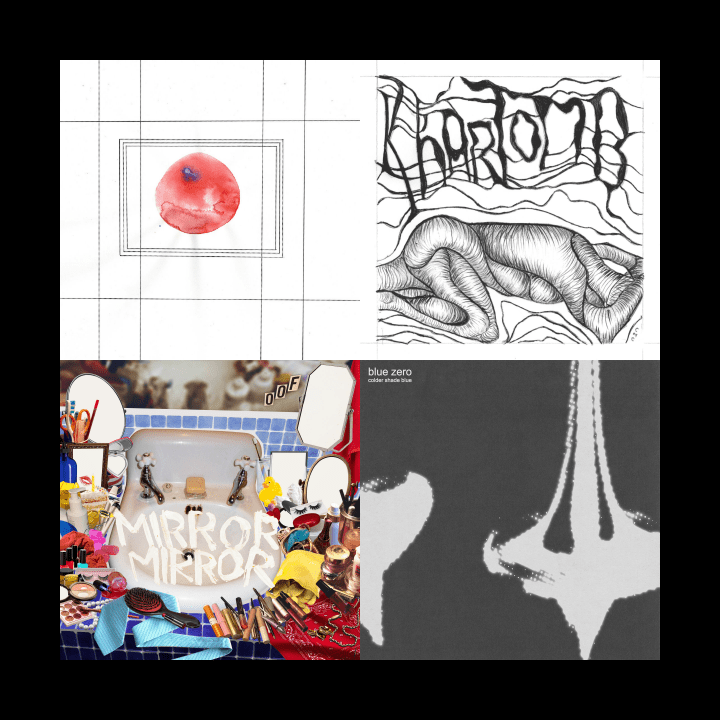
Humming along swimmingly, we’re back on a Tuesday with our second blog post in as many days. This time, we’ve got new albums from Russel the Leaf, OOF, and Blue Zero to look at, as well as a reissue of an EP from Khartomb. And if you missed yesterday’s blog post, featuring Cast of Thousands, The Armoires, Black Ends, and Plastic Factory, check that one out here.
If you’re looking for more new music, you can visit the site directory to see what else we’ve written about lately. If you’d like to support Rosy Overdrive, you can share this (or another) post, or donate here.
Russel the Leaf – Thought to an End
Release date: September 1st
Record label: Records from Russ
Genre: Art pop, indie pop, experimental pop, psychedelic pop
Formats: CD, digital
Pull Track: It Wasn’t Me
I’ve written a fair deal about Troy, New York-based producer and musician Evan M. Marré and his Russel the Leaf project on this blog before. 2021’s Then You’re Gunna Wanna hooked me with its 60s-style Brian Wilson-indebted studio pop sound, and Marré’s twin LPs as Russel the Leaf the following year (My Street and You Blocked the Light for Me) cemented him as one of the best pop singer-songwriters currently operating. It’s been a bit since I’ve written about Russel the Leaf in Pressing Concerns, but they haven’t gone anywhere–last year, Marré released Midnight Studio and Expressionate, both of which took his project into the realms of experimental, jazz, and improvisational music. Thought to an End, the first Russel the Leaf album of 2024, is Marré’s return to pop music, and it’s a triumphant one–spanning twenty-one songs and seventy-five minutes, we’re quite possibly dealing with Marré’s magnum opus here. Even though Marré is putting it out on CD (through his own Records from Russ imprint), Thought to an End has the feel of a classic double LP–it’s got room for everything, from streamlined, breezy pop rock to layered orchestral and psychedelic passages to heady art rock to, indeed, the experimental/jazz moments of the last couple of Russel the Leaf records.
One indulgence Thought to an End sports that I appreciate is that it doesn’t just put the “hits” up front, instead layering them throughout the journey. Sure, opening track “I’m Calling the Artist” is one of the catchiest songs on the album (if you’ve got patience for six-minute progressive pop songs, which you should), but “Oh, the Plan” and “You Win Again” are Russel the Leaf at their most insular and “arty”, getting to the point but only when they’re satisfied with everything else about the song. “My Condition Is This!” is another early pop highlight, but it’s not until about a third of the way into Thought to an End that Russel the Leaf consistently sound like a pure pop band (not that “Accident Going Southbound”, “It’ Wasn’t Me”, and “Straight With Your Head” don’t have their quirks, too, but the pop cores of these tracks are so strong that they’d be undeniable even if Marré and his collaborators didn’t take steps to emphasize them). I’ve kind of been dragging my feet about writing this record up because I know I’m not going to do it justice–such is the nature of an incredibly long and rewarding record like Thought to an End. As I’m listening to it now, late-record low-key pop highlights “Sing Like You Talk” and “Is It Wrong to Be So Matter of Fact?” definitely seem worth pointing out, but I’d wager that if I was writing this on a different day, there’d be other tracks sticking out to me on a re-listen. Thought to an End is a record worth investing serious time into–if it seems insurmountable, throw on some of the songs that I’ve mentioned as the more pop-forward selections (oh, put closing track “Go!” in there too) and investigate further from there. (Bandcamp link)
OOF – Mirror Mirror
Release date: August 30th
Record label: 20/20
Genre: No wave, art punk, art rock, post-punk, noise rock
Formats: Cassette, digital
Pull Track: Even My Therapist Wants to Be an Artist
OOF are a New York-based “skronky post-punk no-wave” trio who have been inflicting their gruff, saxophone-based sound on the masses since the late 2010s. Founding members Anna Hochhalter (vocals/baritone saxophone) and Peter Joseph (vocals/guitar) were joined by drummer Linda Casey sometime earlier this decade–this is the lineup responsible for Mirror Mirror, the fifth album to bear the OOF name. Within a few seconds of the record’s opening track, “Even My Therapist Wants to Be an Artist”, one will already have a firm answer as to whether Mirror Mirror is “for them” or not–Casey’s drumset pounds, Hochhalter’s saxophone squeals, and Joseph begins rattling off a straightforward train-of-thought lyric about whether or not the creative aspirations of his psychiatrist should bother him with the gruff, growling attitude of a Michael Gerald with somewhat more pep. This more or less describes the bulk of Mirror Mirror–Hochhalter and Joseph do swap vocals sometimes, the former occasionally serving as a more polished counter to the latter and other times sounding just as wild in her own way, and Joseph even deigns to play some notes on his guitar every now and then, but the album’s bread and butter is abrasive but compelling storytelling delivered with the aid of brass and steady rhythms.
All of this sounds very “New York no wave”, yes, but the reason I tend to think of OOF as more in the realms of the weirder sides of early SST and Touch & Go Records is their sense of humor with regards to their art. And I do say art intentionally, because there’s plenty of purpose and sharp points to be found on Mirror Mirror–for all of its wandering detours into George W. Bush and Koko the Gorilla and “a sale on brushes at Blick”, “Even My Therapist Wants to Be an Artist” is ultimately a piece of self-reflection. One of their most compelling moments is “Fat Gold”, a classic noise rock/post-punk instrumental that’s smart and incisive, sounding more industrial than a lot of actual “industrial music”. Hochhalter’s voice is arguably Mirror Mirror’s secret weapon–while Joseph sounds like he’s winking very obviously more often than not, Hochhalter’s lead vocals go a long way towards turning songs like “I Caught a Mouse”, “Add to Cart”, and “My Mind Is Revolting” into the sound of pure, uncut anxiety. Like a good noise rock band, rot and failure are also undercurrents of Mirror Mirror, from the smug denial of “Running Out the Clock” to the dreams deferred of “Let the Dream Die” (“Never gonna murder a Midwestern family / And get away with it”) to the self-explanatory “Money Pit”. These subjects are all “real shit”–the things you (yes, you) will see in the mirror more often than you’d like to. OOF probably have the right idea to package it up all volatile-like. (Bandcamp link)
Khartomb – Swahili Lullaby/Teekon Warriors/Daisy High
Release date: July 20th
Record label: Before I Die
Genre: Post-punk, dub, experimental punk
Formats: Vinyl, digital
Pull Track: Swahili Lullaby
Sometime in the early 1980s, a group of young London musicians recorded a couple of songs that would come out on Television Personalities’ Whaam! Records in 1983 and constitute an interesting part of early post-punk history. Vocalist/lyricist/bassist Caroline Cakebread, vocalist Paula Crolla, guitarist Ian Christie, and drummer Ali Barnes were active as Khartomb from 1981 to 1986, recorded a Peel Session, were written about favorably by Melody Maker, and played shows with the Television Personalities and The Jesus and Mary Chain, among others. Despite this, Khartomb only released the one 7” single during their initial run–proud of their work, however, Christie and Cakebread kept the original Khartomb recordings available digitally via Bandcamp and even recorded some new material together in the 2010s. It was through this caretaking endeavor that Manchester’s Before I Die Records stumbled upon the original Swahili Lullaby/Teekon Warriors single, and set about reissuing it on vinyl for the first time in forty years alongside a previously unreleased song called “Daisy High” and two brand-new remixes on a single 12” record. As the reissue notes, Khartomb were contemporaries with The Slits and The Raincoats, and their incorporation of reggae and dub into their version of post-punk is key to the sound of this single.
“Swahili Lullaby” and “Teekon Warriors” sound incredibly fresh in 2024, standing as two shining examples of the fruits of one of the most exciting eras of rock music that many bands are still trying to recapture to this day. Both tracks are relatively minimal post-punk songs built on heavy rhythmic emphasis, with the in-control bass and flourishing drums in the former bouncing nicely off of Cakebread’s psychedelic pop vocals (which do most of the song’s “pop” work). “Teekon Warriors” is even more out-there in its hypnotic, marching drumbeat and sparingly-used but always expertly-deployed stabs of electric guitar (and flute!). The newly-unearthed “Daisy High” is a wild departure from the two previous songs, but still incredibly present-sounding–it effectively becomes proto-dream pop by mixing in minimal, fluttering dub-pop and post-punk in a much more laid-back way than “Swahili Lullaby” or “Teekon Warriors” does. If the three 1980s recordings didn’t make the case cleanly enough on their own, the two modern remixes of “Swahili Lullaby” underscore just how timeless Khartomb sound here–Synkro’s version is the total reinvention, turning it into an ambient electronic dub-informed construction, while Talking Drums keeps the original recording mostly intact and instead expands it, which the rhythms allow quite easily. As is the case with most now-canonized rock and roll movements, it’s always interesting and even important to hear less-remembered but vital takes on it, lest we simplify and reduce a vibrant scene down to its two or three most famous acts. (Bandcamp link)
Blue Zero – Colder Shade Blue
Release date: October 11th
Record label: Lower Grand Tapes
Genre: Alt-rock, shoegaze, noise pop, fuzz rock, psychedelia
Formats: Vinyl, digital
Pull Track: Foot in the Grave
Although I haven’t yet written about Oakland distortion-pop group Blue Zero yet on this blog, the project is linked to several bands from the Bay Area that have graced the digital pages of Pressing Concerns before. It began as the solo project of key local fixture Chris Natividad, who also leads the bands Marbled Eye and Public Interest and drums in Aluminum, and the project’s debut LP was recorded by Andrew Oswald (also of Public Interest and formerly of Marbled Eye) and features guest vocals from Lauren Melton (of Sucker). Natividad plays all the instruments on Colder Shade Blue, the first Blue Zero record, but the project already has a solid live trio lineup featuring Melton and Rick Altieri (who plays in Blue Ocean and on the most recent Ryann Gonsalves album). Natividad has already done the “solo project that turns into a full band” thing with Public Interest, so why does he need another one? Well, I’m not sure exactly, but Colder Shade Blue is pretty distinct from the other bands Nativdad helms–while Public Interest and Marbled Eye both trade in the worlds of sharp, tough, and rhythmic post-punk and garage rock, Blue Zero is more at home in the world of shoegaze-adjacent fuzzed-out guitar pop. They’re more in line with bands like Sucker, Nothing Natural, or a more subdued version of Aluminum.
Colder Shade Blue seems to be torn between wanting to tilt its sound towards jangly guitar pop and firmly staying in the basement and recalling many an insular, Sonic Youth-informed 90s indie rock group. Natividad has always been a fairly subtle vocalist–on Colder Shade Blue, he lets his guitar handle its fair share of the melodies, with soaring six-string forming the hooks in the sweeping opening track “Broken by a Glance” and (at least partially in) the more Aluminum-y drone-pop of “Lemon Year”. The fuzzed-out slacker pop of “Clownin’” is a grower, and Blue Zero actually reveal a more confident embrace of pop music as their debut LP goes on between mid-to-late-record highlights “Scar” (which starts off as Pavement-esque fractured indie pop/rock and congeals into something more solid), “Foot in the Grave” (which is where Blue Zero keep the bulk of their “jangle” sound), and “Gone Again” (which is “just” mid-tempo indie rock at its all-around smartest and most well-executed). There are shades of Natividad’s other bands in Colder Shade Blue, and there are shades of other Bay Area bands in Colder Shade Blue, but Blue Zero sounds fresh and distinct on their first album–it’s a good argument for letting its architect start up as many new quasi-solo projects as he wants. (Bandcamp link)
Also notable:
- Tombstone Poetry – How Could I Be So in Debt?
- The Reds, Pinks & Purples – The World Doesn’t Need Another Band
- Ulna – Gazebo
- Kurt Pacing – Fear of Missing Out
- Midwife – No Depression in Heaven
- The Meringues – Pavlova’s Dog
- Another Dancer – I Try to Be Another Dancer
- Fisher Thing – Patterns in the Sky
- Silver Scrolls – Mind Lines
- Knitting – Some Kind of Heaven
- Steve Wynn – Make It Right
- GIFT – Illuminator
- The Mystery Lights – Purgatory
- La Culpa – Clavos en el tiempo
- The Last Gang – Obscene Daydreams
- Shampoo Tears – Tidal Wave EP
- SHEIVA – Heech EP
- Emmett Kai – Whale Milk
- Stoke Signals – Make Dying Fun
- George Alley – George Alley
- Kilonova – Dial Tone EP
- Brookelen – Time to Go EP
- Rob Mazurek – The Exploding Star Orchestra – Live at the Adler Planetarium
- Semi-Famous – Destroy Ourselves
- The Damned – AD 2022 – Live in Manchester
 Rosy Overdrive
One thought on “Pressing Concerns: Russel the Leaf, OOF, Khartomb, Blue Zero”