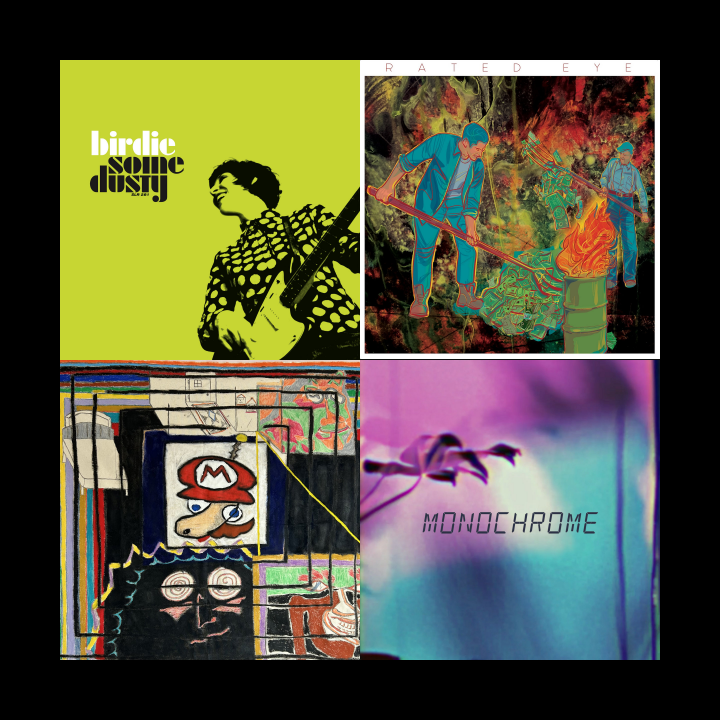
In a classically eclectic Tuesday Pressing Concerns, we’ve got two new albums (from Rated Eye and Lowmoon), a new “mixtape” from Miserable chillers, and a reissue of a 90s indie pop classic from Birdie below. There’s definitely something here for you, the reader! If you missed yesterday’s post, featuring Nightshift, Sylvia Sawyer James, Goodbye Wudaokou, and Manners Manners, check that one out here.
If you’re looking for more new music, you can visit the site directory to see what else we’ve written about lately. If you’d like to support Rosy Overdrive, you can share this (or another) post, or donate here.
Birdie – Some Dusty (Reissue)
Release date: July 26th
Record label: Slumberland
Genre: Indie pop, twee, baroque pop, chamber pop
Formats: Vinyl, digital
Pull Track: One Two Five
The most recent reissues from longtime indie pop label Slumberland have included the sole full-length from Rose Melberg’s 90s San Francisco supergroup Go Sailor and a compilation from pre-Velvet Crush band The Springfields–two records qualifying as “legendary guitar pop” and setting the bar incredibly high for the imprint’s continuing crate-digging activities. At the very least, British band Birdie has the pedigree to match these high expectations–they were formed in the mid-nineties by Debsey Wykes (of essential indie pop/post-punk group Dolly Mixture) and Paul Kelly (of the underappreciated East Village, who also received a Slumberland reissue a few years ago) while they were both playing in Saint Etienne’s live band. Some Dusty, the first of the band’s two albums, came out in 1999 and featured string arrangements from The High Llamas’ Sean O’Hagan. The record’s sound really does place it at the end of the twentieth century, although that certainly doesn’t mean that its ten songs don’t sound just as fresh now, a quarter-century later.
As “indie pop” and “twee” moved away from its relatively slapdash beginnings and into a more ornate, baroque period in the mid-to-late 90s, Wykes and Kelly’s backgrounds had more than prepared them to rise to the occasion. It’s not hard to see Birdie in the context of bands like O’Hagan’s High Llamas, but while other indie pop veterans (Everything But the Girl, Ivy, Stereolab) were embracing electronics to gesture towards a “post-genre” utopia, Birdie explored a more subtle and cautious version of this movement on Some Dusty. Wykes and Kelly zero in on the precision and studiousness of their beloved 1960s pop, and Some Dusty makes the most sense as an attempt to update and interpret it using the streamlining found in “indie” guitar pop and the lushness afforded to the group via (then-) modern technology.
The word that comes to mind over and over listening to Some Dusty is “impressive”. Not in a “technically proficient but boring” kind of way–Birdie get around that trap by embracing some of the most warm and welcoming moments in pop music history–but in how the record’s accents and choices all take Some Dusty down the freshest possible paths. Wykes’ vocals can’t go unremarked upon–almost always somehow summoning up the approachability of twee pop, even when she’s matching the most professional moments of the music, while the instrumental choices (pianos set to “jaunty” on “Laugh”, horns laid-back on “Dusty Morning” and just a little on-edge when they surface in “Let Her Go”) are just as confoundingly natural. It’s tempting to call some of the more outwardly distinct moments on Some Dusty (“One Two Five”, whose rhythms accomplish the same thing as a lot of the more electronic-curious indie pop bands of the time without the bells and whistles, and the effortless college rock/C86 studies of “Port Sunlight” and “Folk Singer”) “boasts”, but that’s not really in the nature of Birdie. Even when Some Dusty was brand new, I have to imagine those listening to it recognized that Wykes and Kelly were making something built to last for the long haul. (Bandcamp link)
Miserable chillers – Great American Turn Off
Release date: June 21st
Record label: Self-released
Genre: Art pop, pop rock, soft rock
Formats: Digital
Pull Track: Done Dancing
Who are Miserable chillers? Well, it’s a project let by one person–Miguel Gallego, a New Jersey-originating, Brooklyn-based musician who’s been making music under the name for at least a decade. The Miserable chillers discography seems to be rather sprawling and varied–there are “proper” albums released on a “real” label, self-released Bandcamp-only records, music made alone and with collaborators. The latest Miserable chillers release has been given the “mixtape” designation by Gallego, and while it’s “new” to us, some of the material here has been gestating for up to six years. Great American Turn Off is an exercise of sorts–Gallego gave himself the task of completing a bunch of long-unfinished songs, and the fourteen-song mixtape (initially released only on YouTube and via Gallego’s website, both as a tribute to Cindy Lee and as a way of distinguishing it from more cohesive, “official” Miserable chillers records) is what he ended up with as a result. Unsurprisingly, Great American Turn Off is an eclectic listen, but Gallego is more or less operating in the world of vintage “studio pop” here, pulling together soft rock, sophisti-pop, psych pop, and yacht rock of yore to make rich-sounding pop compositions.
If you’re thinking, “well, that kind of sounds like the 80s-influenced art pop revival currently being spearheaded by folks like Sun Kin’s Kabir Kumar”, you wouldn’t be far off–the two have collaborated together, and Kumar is one of the many featured vocalists on Great American Turn Off (Kumar sings “After the Show”, and Silent Light’s Alex Robertson, Spirit Night’s Dylan Balliet, and Kate Ehrenberg are among the others who contribute vocals to the mixtape). Of course, Gallego is the sole writer of thirteen of these fourteen songs, and Great American Turn Off is able to make something quite strong out of its stable of stars due to his guiding hand. Miserable chillers flit between dutifully-engineered polished pop throwbacks and more offbeat fare that pushes against these boundaries, with both styles being rich avenues of exploration for Gallego and his collaborators. The roots-tinged “The Shaft” and Ehrenberg’s simple guitar pop-led “Journeying with Julian” set up the house of cards only for alien funk rock and Robertson’s manipulated vocals to knock them down in “Pastime”. Great American Turn Off skips through tons of ideas in forty minutes, but it’s worth taking it in actively to key in on some later highlights, like the low-key, slightly-dangerous-sounding “Get the World Off My Ass”, the Beach Boys-y slow burn of “Done Dancing”, and the easy-listening soft-country of closing track “Go West Boys”. Great American Turn Off doesn’t have to be an “album”; it’s got more than enough going on on its own. (Bandcamp link)
Rated Eye – Rated Eye
Release date: May 10th
Record label: Wax Donut
Genre: Noise rock, art punk, no wave, punk blues
Formats: Vinyl, digital
Pull Track: Pig’s Eye
Here’s something that I know will interest a small subset of blog readers–a new obscure, avant-garden noise rock band from an American Rust Belt city. Rated Eye are a Pittsburgh-based quartet featuring musicians who’ve played in several other local bands (Microwaves, Night Vapor, Brown Angel, The 1985), but their self-titled debut album (released on vinyl via upstart Wax Donut Records) is their first release together. Vocalist Albert C. Hall, guitarist Anthony Ambroso, bassist Dan Tomko, and drummer John Roman make a distinctly American blend of ugly underground rock music, drawing from both “highbrow” (no wave, jazz) and “vulgar” (hard rock, sludge) influences to create a virtuosic assault that would’ve been right at home between the Butthole Surfers and Killdozer during their shared time on Touch & Go Records. Like many great noise rock records, the eight-song, twenty-seven-minute Rated Eye is marked by four disparate musicians forming some kind of twisted harmony on equal footing–Ambroso’s showy, fiery classic rock guitar soloing, Tomko’s caveman-level low-end, Roman’s reliable time-keeping, and Hall’s just-as-primal delivery, liable to jump from a mutter to a howl to a growl at any given moment.
“Burn Barrel” is Rated Eye’s version of an “atmospheric” opener, an eerie utilization of empty space and light math rock touches before it eventually smolders in its second half. “Mia Demon II” is the moment where Rated Eye really starts to eat away at itself, with the guitar flaring up like a skin condition and the rhythm section locking into something hypnotic and dangerous-sounding, and then all hell breaks loose in “Pig’s Eye”, a piece of punchy-but-sludgy Americana punk-blues. In that song, we hear Ambroso running towards AOR guitarplay while Hall starts sounding more and more like a hardcore frontperson, creating a massive cord of tension between them. The second half of Rated Eye (obviously) offers no relief–the drums and the guitars seem to be trying to outdo each other throughout “The Crying Man”, “Economy Boro” lurches through a particularly robust rhythm section workout while Hall rumbles about “a deer running full speed into the plate glass of a bank”. There is nothing particularly “accessible” on Rated Eye, but “Miss Bliss” is a neat sub-three-minute summation of the band’s sound, ticking off guitar heroics, ironclad rhythms, and a relatively dynamic vocal performance from Hall before it bows out. Still, one probably will have a sense of whether Rated Eye is “for them” by the midpoint of “Burn Barrel”, where the post-rock guitars give way to Hall grunting about self-immolation amongst garbage and cultural detritus. This album is for those who arrive there and say, “well, let’s hear them out”. (Bandcamp link)
Lowmoon – Monochrome
Release date: June 28th
Record label: Safe Suburban Home
Genre: Lo-fi pop, post-punk, dream pop
Formats: Cassette, digital
Pull Track: Closer
Mikey Wilson is a British musician who put out a record on Safe Suburban Home back in 2022 as one-half of York duo Kimber. His latest project, Lowmoon, is an entirely DIY affair–Wilson wrote, performed, produced, mixed, and mastered Monochrome, his debut under the name, all on his own. As Lowmoon, Wilson gravitates toward a recognizable sub-genre of lo-fi guitar pop music–a reverb-y, melancholic version that pulls heavily from the “indie” and “alternative” music of the 1980s. Monochrome chews up and spits out post-punk, jangle pop, and dream pop, leaning on a distinct combination of melodic New Order-esque chorused basslines, reverb-drenched guitar lines, utilitarian drum machines, and breathy vocals. Wilson is hardly the only person out there making such music in 2024–I’ve written about bands like The Death of Pop, Old Moon, and Lost Film that also run in these circles, and you can find plenty of playlists out there full of modern bands reared on The Cleaners from Venus and the best of the Captured Tracks catalog. Do we really need another eight-song, twenty-minute cassette of this kind of music? Well, no, in the same way we don’t “need” electricity or reliable internet access–but I’d rather live in a world with it.
Monochrome doesn’t waste any time establishing just what Mikey Wilson has in store for us with the debut Lowmoon record–the sparkling guitars are present from the get-go of opening track “Closer”, within fifteen seconds the Roland TR-505 is rolling along and Wilson’s already doing Peter Hook heroics, and the vocals (clearly not Wilson’s focal point, but not quite “afterthought” either) finally show up at about thirty seconds. From that moment forward, the core sound of Monochrome is effectively set–don’t expect any major detours. Nevertheless, Wilson tinkers with the “post-punk” and “new romantic” dials and knobs throughout “Photograph” and “Decay”, and the title track lets the shining guitars take the center stage even more so than normal. “1997” and “Monday Night” might be a little more low-key, “Summers Gone” a little more peppy, but the second half of Monochrome mirrors the first half nicely, even to the point where the final track on the tape (“Book Club”) is just an effective distillation of Lowmoon’s sound as “Closer” is. There’ll be more bedroom pop singer-songwriters with chorus pedals coming down the line, I’m sure (some of them might even name their solo project a phrase that uses the word “moon”), but the light from Monochrome is illuminating on its own for the moment. (Bandcamp link)
Also notable:
- Love Fiend – Handle with Care
- Sinai Vessel – I SING
- Bats & Mice – PS: Seriously.
- Jean Paul Jean Paul – It Comes Back
- Userband – Looking for a Band
- Scree – Live at the Owl Vol. 2
- Casey Neill & The Norway Rats – Time Zero Land
- Nicolette & the Nobodies – The Long Way
- Kairos Creature Club – Kairos Creature Club
- Josaleigh Pollett – In the Garden, by the Remixes
- RINSE – STARFISH* EP
- Real Rejects – Not Allowed
- Los Campesinos! – All Hell
- Oreglo – Not Real People EP
- Brandon Royer – Good Times
- Kiely Connell – My Own Company
- The Galaxy Electric & Droog Mulholland – Muzak From The Korova Milkbar
- Patrick Higgins – Versus
- AJ Lee & Blue Summit – City of Glass
- Clothing – From Memory
- Pat Metheny – MoonDial
- NiCKY – by EP
- Assistert Sjølmord – Assistert Sjølmord
- Ginger Sparks – Porcelain / Oniria
- Oval Angle – Figures of Speech
 Rosy Overdrive