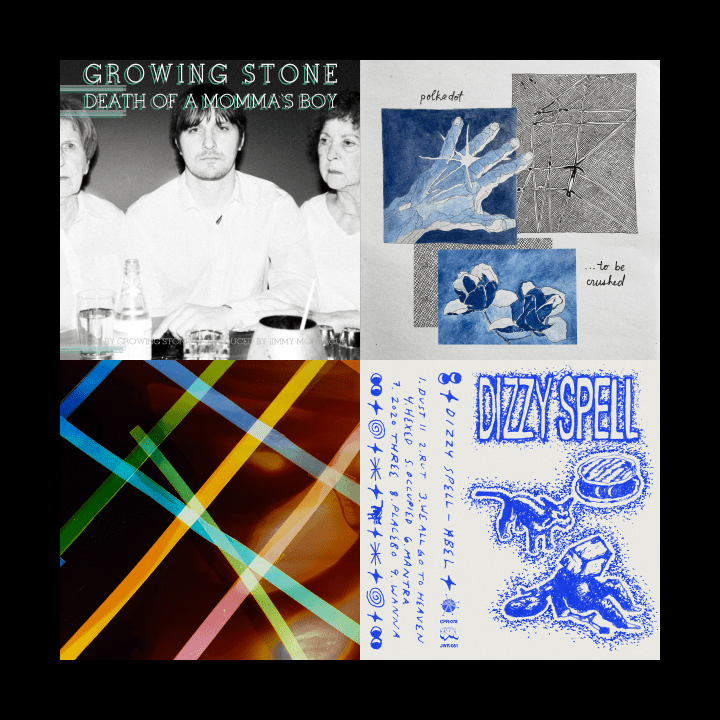
Hello, and welcome to July! The first Pressing Concerns of the week and the month pulls together three solid albums that came out last week (from Growing Stone, Lame Drivers, and Abel) as well as an LP from Polkadot that came out a month ago. Some nice variety here!
If you’re looking for more new music, you can visit the site directory to see what else we’ve written about lately. If you’d like to support Rosy Overdrive, you can share this (or another) post, or donate here.
Growing Stone – Death of a Mama’s Boy
Release date: June 28th
Record label: Near Mint
Genre: Indie folk, alt-country, orchestral folk, singer-songwriter, gothic folk
Formats: Vinyl, digital
Pull Track: Country Song
One of my favorite albums of last year was Dial M for Meds by Taking Meds, a 90s indie rock/punk revivalist record that shot for massive and polished hooks and choruses with a straightforwardness rarely seen in that kind of music. When I heard that Taking Meds frontperson Skylar Sarkis had a side project called Growing Stone which had a new album coming out, I thought “Oh boy, I hope it sounds like Taking Meds!” It does not sound like Taking Meds. Death of a Mama’s Boy is the second Growing Stone album, and it showcases a different side of Sarkis entirely–acoustic guitar-based, transparent, conversational lyricism, and darkly ornate in its arrangements. Death of a Momma’s Boy was recorded by emo-musician-turned-orchestral popper Jimmy Montague, and instrumental duties are largely shared between Sarkis and Montague with a couple of guest appearances (Chet Wasted’s Jacob McCabe on trumpet, former Taking Meds drummer Matt Battle on “Spring in New York”). Sometimes Sarkis sounds like a punk vocalist singing more delicate music (like a bit of Greg Barnett of even Craig Finn’s solo work), other times like somebody who’s a natural gothic folk troubadour.
Growing Stone try on a few different versions of their core sound on Death of a Mama’s Boy–for one, there’s Skylar Sarkis the introspective folk-tronica-pop singer, displayed on the first two songs on the record, the gliding “Apple Church Rd” and the sleepy drum machine-led “The Keep”. Then there’s Sarkis the balladeer, appearing on two of the best songs on the record, “Country Song” (a slow-moving meditation that’s evocative enough that I’ll allow the title) and “No Substitute” (in which Sarkis gets away with singing “You’d be worth rebuilding Germany”), as well as a vaguely haunted version of Warren Zevon’s “Play It All Night Long”. And then there are the act’s rambling tendencies, most clearly visible in “The Gym”, a treadmill-spurred intense train-of-thought monologue from Sarkis (if you’re still unclear on the difference between Taking Meds and Growing Stone, he actually explains it in a lyrical aside here). “Spring in New York” has a bit of this to it as well, even as its dark undertones eventually overtake it to where it becomes the most “rock” song on the record. Death of a Momma’s Boy bridges the gaps between these aforementioned tentpoles frequently–the poppiest song on the album, “The Keep”, opens with some frank lyrics about sobriety, while the sparseness and rawness of “The Ballad of Growing Stone” is aided by a simple but potent melody. At no point does Death of a Momma’s Boy sound like Taking Meds, no–Growing Stone wins us over via entirely different tools. (Bandcamp link)
Lame Drivers – Become an Island
Release date: June 28th
Record label: Jigsaw/Bleeding Gold
Genre: Power pop, psych pop, college rock
Formats: Vinyl, CD, digital
Pull Track: Professional Volunteer
What’s that, you say? There’s a new album from a college rock/power pop revival band that’s been toiling in relative obscurity for over a decade now? And it was recorded by Guided by Voices producer/“sixth member” Travis Harrison? Well, now I’m interested. (Re)introducing New York’s Lame Drivers, a trio made up of guitarist Jason Sigal (who also played in Home Blitz), bassist Joe Posner, and drummer Jeff Wood, who released a fair amount of music in the late 2000s and early 2010s before going radio silent after 2015’s Chosen Era. Become an Island is their triumphant return, a great big “power trio” indie rock album that does indeed contain plenty of the aforementioned college rock and power pop, but doesn’t just stop there–I also hear a fair bit of rubbery post-punk, hazy psychedelia, and earnest, maximalist 2000s-style indie rock (albeit delivered with an economical lineup) throughout the record’s ten (on the LP) to fourteen (on the CD) tracks. The pop hooks are all there, although they’re often delivered surprisingly or unsuspectingly, suddenly locking together after the trio have snaked through several decades’ worth of indie rock history to get there.
The opening title track is one of the best examples of Lame Drivers as patience-rewarding pop stars–the song is great from the get-go, but the refrain hits harder after the band hold back on it for the first half of the four-minute tune. “Professional Volunteer” and “Change Agent” are the songs on Become an Island that make the most open use of Lame Drivers’ power pop knowledge–they both find time to meander a bit, sure, and neither of their choruses are particularly intuitive, but they all flow seamlessly as part of a greater whole (particularly the early punk-recalling proclamation of the latter track). The murky, dark punk of “My Problem”, the dreamy psych pop of “Temple”, and the post-punk-garage-rock “Sealed” all find Lame Drivers pushing the edges of their foundation, and why bring a latter-day Guided by Voices collaborator on board if you aren’t going to attempt something like that band’s multi-part, arena-prog-pop (check out “Runnin’ Scared”)? For an album that zigs and zags a fair bit, it’s strange to say that the CD-exclusive tracks don’t quite fit in with the “record” proper, but they work as an interesting postscript, with two of them (“Winners Game”, a quick-look retro power pop song in which Lame Drivers give into some of the urges they’d resisted previously, and big-finish closing track “Fade”) ending up highlights of the whole thing. Quite literally overflowing with great ideas, there’s no dust to be shaken off with Become an Island. (Bandcamp link)
Polkadot – …to Be Crushed
Release date: May 29th
Record label: Count Your Lucky Stars
Genre: Emo-y indie rock, indie pop, alt-rock
Formats: Cassette, digital
Pull Track: If There’s Nothing Left to Say
Daney Espiritu is a Bay Area-based singer-songwriter who put out a cassette on Lavasocks Records as Polkadot back in 2020, with help from Anton Benedicto on drums and Jordan Jones on bass. As of late, Polkadot has congealed into a quartet, with Matthew Estolano joining on guitar to round out the band, who’ve signed on with Count Your Lucky Stars to put out their latest album, …to Be Crushed. I’m not sure exactly what I would’ve expected a Bay Area indie rock group signed to a legendary emo imprint to sound like, but …to Be Crushed is a pretty good approximation of the midpoint between the indie pop scene around Polkadot and the emo-tinged 90s indie rock side of their label. …to Be Crushed suggests that the distance between twee and emo (or between lo-fi bedroom pop and blown-out, noisy alt-rock) isn’t as great as it might seem, as the band bang out ten songs that have heft both in their full-band instrumentation and in Espiritu’s performance as a frontperson. Instead of turning insular like labelmates Be Safe or breaking out post-hardcore bombast like En Garde, though, Polkadot make these songs go down easy like a good Bay Area indie pop record should.
Opening track “Left Behind” feels a little bit indebted to 60s pop (or, at least, 60s pop as interpreted by 90s twee and power pop groups) with its harmonies and simple melody, with the “emo” coming in via Espiritu’s upfront, confessional-sounding lyrics and vocal performance. The mid-tempo alt-pop-rock of “New Friends” really blows …to Be Crushed open and reminds me a bit of Katie and Allison Crutchfield’s various projects (not that they’ve ever really been called “emo”, but they’ve both long been great at emotional songwriting with shades of both lo-fi pop and punk-y indie rock). There’s a healthy amount of quick, zippy punk-pop tunes on …to Be Crushed between “Pulling Threads”, “Baby Buzzkill”, and “Still Around”, although unlike a lot of these kinds of records, the “stopgaps” in between them might actually be my favorite moments. I like when Polkadot attempt to make their slower songs just as loud as the faster ones in “Unstuck” and “P.S.”, and the best song on the album is “If There’s Nothing Left to Say”, one of the band’s clearest embraces of indie pop. “I don’t wanna be stuck in this place anymore / Or maybe I do, I guess, now I’m not so sure,” Espiritu sings in that song’s chorus–other Bay Area bands might use a dream pop haze to portray confusion, but for Polkadot, it’s presented crystal clear. (Bandcamp link)
Abel – Dizzy Spell
Release date: June 27th
Record label: Candlepin/Julia’s War
Genre: Shoegaze, experimental rock, fuzz rock
Formats: Cassette, digital
Pull Track: Rut
2024 has been one of the best years for music out of Columbus, Ohio that I can recall–there have been good folk, country punk, and pop punk records to come out of the city this year so far, but the majority of the albums that have caught my attention have been lo-fi, distorted indie rock. This has historically been a strong suit of Buckeye State music, but between Villagerrr, Winston Hightower, and Big Fat Head, it’s as obvious as ever that the epicenter of new, exciting Ohio bands is in the state’s capital. Two of the finest modern purveyors of this kind of music, Candlepin and Julia’s War Records, have taken note, as they’ve come together to jointly release Dizzy Spell, the latest album from nü-shoegaze quintet Abel. Abel actually made their Candlepin debut last year with the Leave You Hanging EP, and while some of their records (like last year’s Rat Race ∞) are the solo work of vocalist/guitarist Isaac Kauffman, Dizzy Spell features a full-band, three-guitar sound, aided by John Martino and Brynna Hilman on the six-strings and Noah Fisher (bass) and Ethan Donaldon (drums) rounding out the group.
Dizzy Spell is definitely a record worthy of a Julia’s War release–Mark Scott of Villagerrr guests on “Placebo”, but there are few traces of that band’s bedroom folk tendencies here. Opening track “Dust II” announces the arrival of Abel with loud and overwhelming guitars, rolling everything into a sucker punch of noisy rock music. If you’re not into that, chances are Dizzy Spell isn’t the album for you, but Abel also aren’t just interested in erecting walls of sound. “Rut” features vocals shouted out over the guitar squall, creating a massive pop tune, and the initial fuzz-jolt of “We All Go to Heaven” gives way to a restrained, laid-back indie pop core. Later in the record, the 90-second Martino-penned “Placebo” is the one song that relents and turns in acoustic indie folk–not wasting an opportunity to use Scott’s guitar playing and vocals. Still, Abel’s bread and butter are in-the-red shoegaze songs with pop music intermittently visible within them, and songs like “Hexed”, “Occupied”, and “Mantra” (which has a healthy amount of noise punk attitude to it) all excel in the band’s home turf. All roads lead to closing track “Wanna”, which starts off as a distant-sounding, windswept lo-fi rock tune before climbing a mountain of guitars to its pummeling finish. You’re probably not all that afraid of heights if you’ve gotten this far. (Bandcamp link)
Also notable:
- The Folk Implosion – Walk Thru Me
- K9 – In Blistering Stereo EP
- Bad History Month – bh1
- Model Child – Get There!
- Demo Division – Sunken Skin EP
- FAITH/VOID – Weird Chills
- Boulder Fields – With All the Other Ghosts
- The Color Study – Canyons Pt. 1 EP
- The Arturtos – Mondo Arturo
- Cardinals – Cardinals EP
- Tidiane Thiam – Africa Yontii
- The Sheaves – A Salve for Institution
- Raised on TV – Make Time to Make Time
- Sooks – Moral Decay
- Found Space – Closer EP
- Crypt Sermon – The Stygian Rose
- Joe Ghatt – Caper
- Niamh Regan – Come As You Are
- Ginger Winn – Stop-Motion
- Ani DiFranco – Unprecedented Sh!t
- ShrapKnel & Controller 7 – Nobody Planning to Leave
- Neighbourly – Alla Discoteca
- Neil Young & Crazy Horse – Early Daze
- Jason Hawk Harris – Breakup Songs Are Love Songs Too Vol. 1 EP
- Crowded House – Gravity Stairs
 Rosy Overdrive